Introduction
The postwar years 1945 to 1949 were a critical period for the Netherlands and Indonesia, during which the centuries-long relationship between the two countries was disrupted and, only two decades later (in the late 1960s), restarted completely anew.Footnote 1 For the Netherlands the years 1945 to 1949—known as the “preparation” (Bersiap) period—marked a total rupture of their past administrative and economic dominance in the Indonesian archipelago.Footnote 2 For Indonesia those years—the period of Revolusi—were decisive because they formed a legacy for the birth of the independent state of Indonesia.Footnote 3
A number of Dutch historians, who perceive 1945–1949 as the endpoint of the four-century-long Dutch business empire in Asia, have examined the different dimensions of the period by following the Bersiap historiography. They began to reexamine the nominal involvement of the Dutch armed forces in the insurgency. For example, Harmanny and Linn examine the use of heavy arms by the Dutch military during those war years against the Indonesians.Footnote 4 Luttikhuis and Moses explore the mass murders committed by the Dutch military and call them a “violent end” to the Dutch presence in this archipelagic region.Footnote 5 Others examine the extreme scale of violence by comparing Asian and African histories.Footnote 6 The shift to violence in the focus of studies about the period, according to Remco Raben, shows a growing concern about the scale and intensity of victimhood that resulted from the process of decolonisation. In this line of argument the decolonisation process cannot be understood unless the acts of violence and mass murder by both Dutch and Indonesian sides during the period are deliberately revealed.Footnote 7
Meanwhile, Indonesian historians have generally perceived the 1945–1949 period as a historical episode with a fixed storyline: a moment of tumultuous yet victorious struggle against colonialism. This storyline is solidified by military themes,Footnote 8 pointing to the Dutch attacks in 1947 and 1948 as an intrusion of an external force into the Indonesian territories.Footnote 9 In addition, there is aggrandisation of historical narratives, which emphasise the participation of all Indonesians in the seizing and defence of the country's independence.Footnote 10 Although some historians have begun to reexamine wider aspects of social history, such as crimes and banditry,Footnote 11 a state-prescribed narrative has usually become a “standard” account of Indonesian historiography about the period.Footnote 12
Overall, the way in which the disruption of the relationship has been depicted by Dutch and Indonesian historians alike suggests a hard concept of decolonisation. The depiction represents an immediate rupture of colonial relations, where political and military strategies projected the losses and gains of the two sides.Footnote 13 It highlights the acts of violence and the fragile agreements signed by the Netherlands and Indonesia,Footnote 14 and puts them at the centre of historical analyses. By focusing largely on the deconstruction and reconstruction of the institutional states, many studies have tended to refrain from representing people as key agents during the tumultuous stage of the breakup.Footnote 15 The lively encounters among people, as richly illustrated by Cas Oorthuys,Footnote 16 for example, or inspirationally fictionalised by Yusuf Bilyarta Mangunwijaya,Footnote 17 have been missing or only partially taken into account in understanding decolonisation. A hard concept of decolonisation thus focuses on a neat institutional divide between “before” and “after.” It often neglects the overall process of challenges and responses that shaped the people's “hopes, fears and traumas unleashed in the course of struggle.”Footnote 18 While decolonising societies have to deal with the social problems of governance, the unfulfilled hopes and complexities of identities related to citizenship and belonging,Footnote 19 the way these issues have been studied is generally overshadowed by large events at the national level moulded in a chronology.Footnote 20
The present paper argues that what happened in Indonesia during the 1945–1949 period was also a “soft decolonisation.” Soft decolonisation refers to the process of un-sharing, that is when both the Dutch and the Indonesians departed, or broke away, from a shared imagination of colonial society and moved back to their respective cultural roots. It deals as much with the institutional restructuring of the states as with the practicality, opportunity, and hardship of daily life at the individual or personal level. The latter was imposed by soft decolonisation through the dissolution of the cultural relations between Indonesia and the Netherlands.
In particular, this paper focuses on the figures and fates of several Dutch and Indonesian schoolteachers who had received education during the colonial time, survived the Japanese occupation in Indonesia, and came into the 1945–1949 period confused by the chaotic disruption of the social mobility they had formerly enjoyed. Although many of these teachers wished to rejoin the social and economic establishment as before, in the fast changing circumstances of the 1940s they had to choose a new trajectory of citizenship that directly hampered their individual well-being. The collapse of the colonial state and the emergence of the new states in the aftermath of the Second World War cost them the path of career and status their colonial schooling had previously promised.
Looking back at the process of social transformation in the early twentieth century, Dutch and Indonesian schoolteachers had played a key role in bridging and integrating the cultural gap in the Netherlands Indies society. They represented a cultural bridge not only between the European and the indigenous communities, but also between the colonial state and its subjects. Their role was to connect different social and political layers and to undermine the so-called “cultural citizenship” which produced Eastern and Western idiosyncrasies.Footnote 21 Together with other middle-class professionals like medical doctors and administrative officials, schoolteachers functioned as a cultural glue through a process of becoming.Footnote 22
However, the wars during the 1940s tremendously disrupted the developmentalist colonial state which the schoolteachers had served and become part of. Especially during the 1945–1949 war years, Dutch teachers in Indonesia attempted to “negotiate the past” in order to resume their position in the colonial civilising project, which had come to an end. On the other hand, the Indonesian teachers also struggled to redefine their position in the process of transnational modernity. They realised that “the gateway to the Western world,”Footnote 23 which had contributed to the contour of their identities since the end of the nineteenth century, would soon be lost. For Dutch and Indonesian teachers alike, the drastic changes during this period explained how the “cultural citizenship” of “the middle classes who inhabited the very centre of the late colonial state” transformed into “full citizenship” in which “law, equality, the rights and duties of the individual” was recognised by the state.Footnote 24 The disappearance of the bridging role of the teachers disengaged their ties as a designated group of cultural agency of the then colonial society. Soft decolonisation thus represented the loss of the teachers’ strategic role in the intangible process of the colonial state formation.
The changing position of schoolteachers during the 1945–1949 period is hardly visible in the Dutch and Indonesian historiography, which has largely focused on the narratives of state restructuring, atrocities, and violent acts. It has remained “unknown by means of more conventional historical strategies.”Footnote 25 Any attempt to lift the teachers’ stories is often overshadowed by “the grand narratives of grand historical approaches.”Footnote 26 Therefore, taken together, this paper argues that the case of Dutch and Indonesian schoolteachers during the frantic years 1945 to 1949 represents a micro history in the bigger picture of decolonisation, an instrument to reflect on the grand historical narratives, among others the claim that the cultural citizens of the colonial society became “all of a sudden part of the new upper middle class of the Indonesian nation.”Footnote 27 This paper shows that the decolonisation of the Dutch–Indonesian relationship took place in a gradual manner by the process of un-sharing of the social trajectory and imagination of the colonial past. The case of schoolteachers portrays the dynamics at the individual level of people who had to struggle for their socioeconomic well-being amidst tumultuous changes of political regime.
This paper relies on the Algemeene Secretarie archives of the postwar Netherlands Indies government stored at the Indonesian National Archives (ANRI) in Jakarta as its main source. Following the Introduction section, this article discusses the existence of cultural agents in the late colonial society of the Netherlands Indies. Then it explores the teachers’ situation and the educational situation in the aftermath of the Second World War. The next section discusses the personal condition of Dutch and Indonesian schoolteachers as a reflection on the state educational policy during the prolonged war.
Cultural Agents of a Colonial Society
The existence in history of “the social actors who mediate between two cultures in the sense of geographically separate entities,” created cultural hybridity in which encountering cultures affected each other.Footnote 28 This intermediary group was generally known as the “cultural broker” or “cultural agent” which, in the case of the Netherlands Indies, was made up of the middle class. Historians have an imprecise definition of who the middle class cum cultural brokers in colonial Indonesia were. John Legge referred to government officials, journalists, schoolteachers, and law officers.Footnote 29 Robert van Reference NielNiel pointed to “administrators and civil servants in all branches of development service,” such as professional men, certain entrepreneurs, religious teachers, and persons of social prominence.Footnote 30 Henk Schulte Nordholt argues that cultural brokers included lower civil servants, teachers, medical personnel, railway employees, clerks of European companies, and journalists,Footnote 31 whereas Heather Sutherland refers to government administrators and bureaucrats.Footnote 32
A master's thesis defended by Ardela Iga Pratiwi has interestingly asserted that indigenous assistants in the European households (called baboes and jongos) also played the role of cultural broker in early twentieth-century Java. Being assigned by their European lady-lords to the provision of daily household services, the Javanese baboes and jongos intensively introduced the European children they fostered to the Javanese cultural realms by singing them Javanese songs and rhymes, telling them Javanese ghost stories and kings’ histories, and communicating with them in Javanese, thus teaching them the language.Footnote 33 Unfortunately, the position of indigenous household assistants has been much overshadowed by larger narratives of race, gender, and social class.Footnote 34
Like the other cultural brokers, schoolteachers in colonial Indonesia functioned as intermediaries in the integration of colonial society.Footnote 35 They underwent a shift “from reluctance to enthusiasm” in their social orientation towards a Western type of modernisation and progress.Footnote 36 Most of them paved their way to serve the colonial state, and in so doing to embrace modernity, by way of outward appearance, daily consumption mode, and standards of hygiene.Footnote 37 However, unlike the middle class in Europe, the schoolteachers in colonial Indonesia were “late comers” to that process of modernisation. Their impact on social change only began to reach the wider public when the expansion of rubber, coffee, and sugar industries had strongly influenced colonial society. Thus, in the process of cultural modernisation, schoolteachers connected the colonial society to industrially driven state formationFootnote 38 and were closely attached to the economic sectors which had become the foundation of the process.Footnote 39 Their position was a product of an “informal interface between the State and the society.”Footnote 40 As such, they existed in the border of the interface, at “the fringe” of social economic encounters,Footnote 41 but they also functioned to anchor the state to society.Footnote 42 They were not initially concerned with political movements because that would risk their social mobility,Footnote 43 but rather with a modern lifestyle.Footnote 44
As in colonial Latin America, the recruitment of indigenous teachers by the Netherlands Indies government was motivated by their ability to serve as intermediaries between Europeans and the local people.Footnote 45 Overall, the teachers—Dutch and Indonesian alike—were assigned to work on the development of the colonial state by (among other things) combating illiteracy among the peopleFootnote 46 and by connecting the “different elements of the Indies cultural society.”Footnote 47 However, their positions were segregated by colonial policy. Although the European teachers differed in their professional ranks, they enjoyed privileges of salary and career paths which their Indonesian counterparts did not.Footnote 48 The Indonesian teachers, meanwhile, possessed various degrees of qualification given the large variety of training designated for them. Only a very small number of the Indonesian teachers were graduates of the Dutch teachers’ school.Footnote 49 So, while sharing the same mission duty and following the same trajectory of colonial modernity, the teachers followed different paths of social mobility because of the colonial segregation policy.
During the Second World War, many Dutch teachers in Indonesia were sent to Japanese prison camps, whereas Indonesian teachers were sent to the military training centres.Footnote 50 Although some schools started again in 1943, for example the Malay-language teachers’ schools,Footnote 51 the overall institutional system of colonial education, which by then had disseminated a sense of integration among the Dutch and Indonesian teachers, was already destroyed. The role of the schoolteachers as cultural brokers was gone along with the collapse of the colonial state and the restructuring of the world's political orders afterwards.Footnote 52 Notwithstanding this, the dispersal of the schoolteacher community would take a longer time than anybody could have expected. Many of the teachers who had survived the war and who were able to return to schools faced a serious problem of social and political belonging. In the aftermath, the teachers had to deal with a changing self-image along with their expanded political consciousness.
As in the Western countries, teachers’ political consciousness in Indonesia developed through organisational and cultural activities. However, the process was much more complicated for the teachers in Indonesia because of the shifting paradigm of governance.Footnote 53 In the Netherlands, schoolteachers formed a “new perspective” by getting actively involved in sociocultural organisations such as music ensembles and band groups, youth movements, pop dance, and public speaking and writing associations.Footnote 54 In Germany, schoolteachers initially experienced so-called Nazification, which made them embrace the Nazi ideology. Soon after the Second World War ended, “denazification” programmes dragged many of them into Communism.Footnote 55 In the U.S., the influx of Second World War veterans had changed teachers’ colleges into multipurpose colleges and made American educational policy more politically driven.Footnote 56
Meanwhile, under the umbrella of decolonisation, schoolteachers in Indonesia had to invent the trajectory of the “new” political belonging they would later assume. Although many had begun to develop political consciousness during the 1930s,Footnote 57 most teachers were not prepared for the dramatic shift in the administrative governments of the 1940s, especially when the shift had a fundamental impact on their economic situation and cultural identity.Footnote 58 For some years following the fall of the colonial state, most teachers were still inclined towards the platform of colonial modernity, for example by attempting to resume their prewar teaching positions. Nevertheless, the image of the teachers’ colonial citizenship, which had been transnational and culturally invasive,Footnote 59 had begun to disappear. Hence, along with the collapse of the colonial state, schoolteachers gradually lost their function as cultural intermediaries.
For much of the period following the surrender of the Japanese in 1945, the enthusiasm for colonial citizenship that some teachers retained was twisted by the Indonesian declaration of independence and by the Dutch military insurgence against it.Footnote 60 The people's participation in public life was growing tremendously. However, for the Indonesians this change meant moving towards a dreadful trajectory of nation-state building,Footnote 61 whereas for the Dutch, it meant the time to move on from the wrecks and the wounds of the nostalgic tempo doeloe of the colonial past.Footnote 62 In the four years after the Japanese surrender, a drastic divide between Dutch and Indonesian teachers took place, which highlighted the different trajectories of their political and cultural orientation and belonging, in contrast to the previous decades, when they shared an intermediary role in the development of colonial society.
The Prolonged War and the Absence of Educational Directives
By the time of the Japanese surrender to the Allied Forces in August 1945, many school buildings in Indonesia had been used as military and police headquarters. According to a Netherlands government report, “most of the school buildings were in a dreadful condition owing to their being used as barracks.”Footnote 63 The photographs documented by Cas Oorthuys show learning activities taking place in open air buildings against the background of a bamboo-made residency house, most likely in Central Java.Footnote 64
The condition of the teaching personnel—both Dutch and Indonesian—was also bad. According to a report by the Director of Education and Public Worship of the Netherlands Indies Government in April 1946, many secondary schoolteachers were either lost or dead, and those who had survived were in a very poor condition.Footnote 65 Another report released in April 1948 points out that some schoolteachers were in such “a deplorable state of health that they were unable to resume their task immediately.” A considerable number of the teaching personnel “even appeared to be unfit for their life” whereas “more than 30% of the European teachers had died in the various internment and concentration camps.”Footnote 66
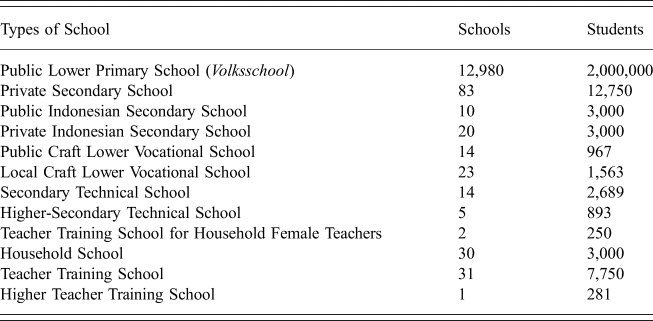
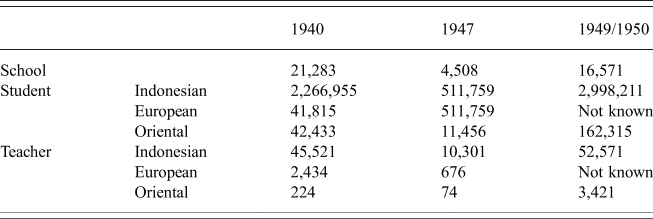
Thanks to the messy situation left by the Japanese occupation, it is not easy to provide a picture of the education situation in the aftermath of the war in much detail. The situation then becomes even more complicated because the end of the Japanese occupation in Indonesia was soon followed by another dreadful period of war between the Dutch and Indonesian armies, effectively from 1946 to 1949. Nevertheless, an illustration of the overall condition of schooling is important to help start this discussion, even if it is only very rough and debatable in terms of accuracy, such as that presented in Tables 1 and 2.
Number of Schools and Students by School Types in Java and Madura, December 1946.

Source: Reference OverdijkinkOverdijkink, Het Indonesische Probleem, 153–4.
Number of Schools, Pupils, and Teachers in Primary Education in 1940, 1947, and 1949/1950.

Sources: Reference WalWal, Some Information on Education in Indonesia, 14–6; Departement van Economische Zaken, Statistik Pengadjaran Rendah di Indonesia, 1–2, 9–10, 49–50; Kementerian Pendidikan, Beberapa Angka, 5–8, 11–2.
Table 1, an excerpt of a Dutch report published in 1948, shows the number of schools and students by school types. What matters most in Table 1 is the information about the many different types of colonial schooling that could be identified as resuming operation as soon as 1946. This shows the variety of educational quality at the primary and secondary levels and implies the requirement for teachers. Unfortunately, the cited source does not provide any information about the teachers.
Table 2 presents the number of schools, students, and teachers in three different years between 1940 and 1949. The figures count total numbers but omit the quality of each component. For example, the table shows an increase in the number of Indonesian teachers, but it disregards the levels of the teachers’ qualifications. In addition, the table also provides no clue on the teachers’ individual identity except their racial group. The statistics alone do not explain who those teachers were. But a rapid review of the teachers’ training system in colonial times provides us with some information about their professional identity.
The education system for the teachers of primary school in colonial Indonesia was highly segregated, with training for the European teachers (Europeesche kweekschool) being the best and the training for the village school teachers (Opleiding voor Volksschool onderwijzers, OVO) the lowest in quality. In between the two were about seven types of teachers’ schools of various quality levels.Footnote 67 The teachers shown in Table 2 thus may represent an assortment of formal training acquired before the war. By a colonial rule, the European teachers in Table 2 were most likely holders of a European kweekschool certificate, or higher had they received training in Europe. They were differentiated from the indigenous teachers in terms of training, salary scale, and career track. But the European and the Indonesian teachers had shared the same mission: to act as a cultural intermediary in the integration of colonial society.
The two states that emerged in the months following the Japanese surrender—the Republic of Indonesia in August 1945 and the Netherlands Indies Civil Administration (NICA) in NovemberFootnote 68—made any attempt to reintegrate the educational mission impossible. Although the Netherlands’ plan for postwar education in Indonesia had been drafted in 1945 and 1946,Footnote 69 the Dutch consolidation of education did not begin until 1947, following the transfer of power from the British Representative of the Allied Forces to the Dutch authority.Footnote 70
Under Lieutenant Governor-General H. J. van Mook, the Netherlands’ administration was dragged away from the idea of integration. Van Mook was completely occupied by his ambition to install a federative Indonesian state in the effort to overrun the Indonesian Republic, for which purpose he held a series of conferences between 1946 and 1947.Footnote 71 In a lecture at Chatham House in London in July 1949, van Mook said that a federative Netherland Indies would let local security problems be effectively identified and localised.Footnote 72 Van Mook completely overlooked the impact of a federative policy on education and teachers. With van Mook holding sway, education policy in the Dutch-controlled territory was not in the centralised hand of Batavia, but was transferred to the local state authorities. The East Indonesian state established its own department of education on 1 April 1947 and began to take over from Batavia the educational affairs in its area.Footnote 73 In the NICA-controlled territory, meanwhile, schooling was aimed at combating illiteracy while developing students’ practical skills on the basis of Western knowledge.Footnote 74 But, generally, Batavia remained remote from problems at the local level.
By the time the Dutch consolidation of education was taking place, the general situation in Indonesia was chaotic. The idea of Indonesian independence had influenced a wide array of the Indonesian people by way of the propaganda of nationalist leaders such as Soekarno, Mohammad Hatta, Sutan Sjahrir, and Sjarifoeddin.Footnote 75 The slogan kedaulatan rakyat (people's sovereignty) had become the core idea of Revolusi, which “represented urgency, action, exhilaration, and impatience with diplomatic fussiness.”Footnote 76 In this context, although the Indonesian Republican government clearly emphasised that schoolteachers should strengthen “the unity of the people” and develop their sense of citizenship,Footnote 77 the schooling in the Republican-controlled territories was frequently interrupted by war mobilisation.Footnote 78 So, amidst the chaotic situation with the NICA and the Indonesian Republican governments fighting each other, the Dutch and Indonesian teachers struggled to overcome their personal difficulties, among others in resuming their teaching positions. Some cases of the teachers’ struggles as presented in the following section show that the teachers were no longer concerned about becoming an intermediary of state integration as they had been in colonial times. Most of them aimed first to rebuild their individual lives. While the teachers’ focus was understandable, their detachment from the state-building programme would lead to the dissolution of Dutch and Indonesian relations in the longer run.
A Twisted Trajectory of Teachers’ Services
During the Revolusi/Bersiap period, the Dutch teachers wished to resume their former jobs, whereas the Indonesian teachers viewed the social stratification of their profession with stronger suspicion than their Dutch counterparts. The overall situation was confusing for Dutch and Indonesian teachers alike, and the teachers in general were deeply concerned with their own personal cases. The individual stories explored in this section indicate how teachers’ personal struggles forced a disengagement between Dutch and the Indonesian teachers, and in the overall teacher community.
The trajectories of Dutch teachers in the post–Second World War Netherlands Indies followed three different paths. First were those who asked for an early retirement from the teaching service. For some of the Dutch teachers, life in the Indies was destroyed and lost with the outbreak of the Second World War. The “resurrection” of the Netherlands Indies state was irrelevant to their expectation of personal recovery. E. H. de Haan, J. van Goudoever, and Harriet Elisabeth Dürst Britt were among the Dutch teachers who requested an honourable discharge (eervol ontslag) from their service as civil servants at the Department of Education of the Netherlands Indies. The reasons for the requests varied.
De Haan wanted to retire because the Association of Christian Schools in Batavia, to which he had been affiliated as a permanent teacher, no longer existed. He had been interned by the Japanese, was only evacuated by the Allied Forces on 10 December 1945, and was sent back to the Netherlands afterwards. Writing in July 1946 from Zeist, De Haan said he had lost his teaching employment documents. He said he began teaching at a subsidised school in the Netherlands on 1 February 1914 before being assigned to the teaching service in the Netherlands Indies.Footnote 79
Van Goudoever asked for discharge because, although he was “medically fit to return for a service in the Netherlands Indies,”Footnote 80 he said he was too tired to return to service.Footnote 81 Dürst Britt applied for discharge in March 1947 because she was going to get married. Before the Second World War, Britt had worked as a two-thirds teacher (twee-derde leraar, a teacher who worked only two-thirds of the full-time working hours) at a primary school of the Bandung School Association. When the war was over, she could not find a teaching position in public schools and kept working part-time at a private school.Footnote 82
The second group includes the Dutch teachers who sought to revive their careers by asking the government for rank adjustments and furloughs, referring back to the services they had performed for the prewar Netherlands Indies government. The Dutch teachers in this category considered the postwar state of the Netherlands Indies to be a continuation of the prewar state. Unlike De Haan, Van Goudoever, and Dürst Britt, who showed no more interest in state service, Cornelis Henri Noordhoorn, L. Greeven, and M. Veldkamp expressed their willingness to continue their service. They still trusted the postwar government in the Netherlands Indies, but their trust was conditioned on the fulfilment of their demands that their rank and salary be raised.
Noordhoorn asked if his salary could be adjusted from fl 325 to fl 415 per month as reimbursement for the teaching years he had missed when he joined the Royal Netherlands Navy on 30 August 1939. Before the Second World War, Noordhoorn was a permanent teacher at Europese Lagere School II in Batavia. After mobilisation he was assigned a post in the coast guard division of the naval base in Surabaya. He was captured by the Japanese and was detained as a prisoner-of-war (krijgsgevangenschap) in Siam until August 1945. After returning to Batavia, Noordhoorn resumed his teaching position as of 1 August 1946. According to his meticulous calculation, his salary should have been fl 415 instead of the fl 325 he received.Footnote 83 The head of the First Division of the Navy Department, P. C. Wouters, confirmed that a schoolteacher with a European head-teacher certificate did deserve a salary of fl 415 as of 1 September 1948 instead of 1 September 1947. However, his office could not verify “the non-military related information” Noordhoorn described in his claim for a salary increase.Footnote 84
In May 1947 Greeven asked for furlough. “It has already been ten years since I went on leave,” wrote Greeven in his letter. “I am convinced that I want to remain working in the teaching profession, but I think I would desire to spend sometimes in the Netherlands.” Greeven was captured by the Japanese on 17 July 1942 and was sent to an internment camp. On 4 February 1943, he was released and was ordered by the Japanese to teach at an emergency Hogere Burger School (nood-HBS) in Cimahi, West Java. After the Japanese surrender, the Recovered Allied Prisoners of War and Internees (RAPWI) asked Greeven to return to Bandung. As soon as May 1946, he assumed the position of director of the Bandung public kweekschool. Thus, he said, “I have continuously worked without interruption and now I would need to take a rest.”Footnote 85
The case of Veldkamp perhaps represents the most complicated effort to assure the well-being of the Dutch teachers. In November 1946, Veldkamp requested an increase of rank as a director of a junior high school (Meer Uitgebreid Lager Onderwijs, MULO). He had returned to his teaching position on 26 June 1946. However, he felt disappointed because the starting date of his new position as MULO director was 1 August 1945, not 1 August 1941 as he had been “promised” by an educational official in 1941. Veldkamp said he lost four years of service, which would reduce his pension. “I feel very much offended that I am not in the top of the list for a timely promotion,” he said.Footnote 86 In reply, the Director of Education said that Veldkamp's qualification did not match the position available at the MULO.Footnote 87
The third group consisted of those who were able to resume state service either as schoolteachers or as educational officials. P. J. Velsen, J. A. Manusama, F. W. A. Don, A. H. Luikens, C. Leertouwer, A. Neijenhuis, and H. Kroeskamp were in this category. They all held a high rank and had performed “special capabilities and loyalty to their services” since the prewar time, thus wrote the Director of Education.Footnote 88 Most of these personnel were assigned as headmasters. Velsen assumed the directorship of a public high school in Batavia in April 1946. He was promoted because “now more than ever, the school leadership should be in the hand of a competent and experienced teacher.” Because of “the current circumstances, a large section of the educational personnel . . . does not in any sense have the experience in the province of secondary education.”Footnote 89
Manusama was transferred from Makassar to Ambon in May 1947 to become an acting director of a secondary school,Footnote 90 whereas Don assumed the position of acting director of the restored HBS in Cideng, near Batavia.Footnote 91 In August 1947, Luikens—holder of a diploma in Geography for Secondary School—settled her position as director of the Kweekschool of the Ursuline nuns at Postweg 2, Batavia.Footnote 92 Leertouwer became the director of the Kweekschool which was just reopened in Tomohon, North Sulawesi, in September 1947. The Director of Education said Leertouwer had a “long and multifaceted educational experience carried out satisfactorily.”Footnote 93
In the meantime, Neijenhuis’ appointment in March 1946 as the acting Inspector General of Primary-, Upper Primary-, and Teacher-Education of the Department of Education created a high expectation about the progress of postwar education in Indonesia.Footnote 94 Neijenhuis was assisted by B. de Kruyff, a deputy-inspector starting 2 December 1946,Footnote 95 and by E. A. Kayadoe, a general inspector. Notwithstanding this, Neijenhuis faced a serious budget shortage.Footnote 96 The overall situation also made it impossible for him to expand educational reform due to military insurgences.
Kroeskamp assumed the position of chief official of the Department of Education in November 1946. He was promoted because of his twenty years of experience as a teacher and researcher in the prewar period.Footnote 97 Like Neijenhuis and many others, Kroeskamp depended on the larger political circumstance in order to carry out his educational reform programmes. While the aim of his and his colleagues’ appointment was “to re-organize and redesign the curricula for the education of the geographically scattered territories of the Indies in the new political and cultural relationship,”Footnote 98 their contributions would be overshadowed by political dynamics.
A Confused Trajectory of Belonging
As confounded as their Dutch counterparts, the Indonesian teachers were seeking personal recovery after surviving the Second World War. However, the issue was more complicated for them because the Indonesian Republican government was still too weak to function as a state.Footnote 99 While the Dutch teachers sought to resume their jobs by querying the postwar Netherlands Indies government, the effort of the Indonesian teachers to do the same was confronted by a question of political loyalty. In reinstating the teachers in their teaching positions, the postwar Netherlands Indies government was alert to whether or not these teachers were Indonesian revolutionists. Meanwhile, those who were reinstalled in their teaching positions had to face hostility from their fellow Indonesian citizens due to allegations of being pro-Dutch. The following cases best illustrate how confusing the trajectory of belonging was for the Indonesian teachers at the time.
M. Hukom, an assistant teacher in the Lease District, Ambon Residency, sent a request to the lieutenant governor-general to withdraw his transfer from Saparua to Ambon in February 1946. He refused to be transferred because most affordable houses in Ambon had been destroyed during the Second World War. With a wife, eleven children, and a salary of fl 48.50, he would find it much harder to afford his family in Ambon than on Saparua. Meanwhile, six of his children went to a Dutch school on Saparua which had better facilities than those in Ambon. Hukom said:
I worked in that school before the war and continued to work there during the Japanese occupation, at which time I experienced various difficulties including physical torture simply because I remained loyal to the Kingdom of the Netherlands.Footnote 100
Hukom had reported his problem to the Education Controller of Saparua, A. Stoelenga. But he had received no reply. He wrote:
Now is the time that common people can speak up to the government about anything they think inappropriate. But the Education Controller in Saparua was not comfortable with this and forced ordinary people like myself to keep silent.Footnote 101
The Director of Education said that the transfer of Hukom to Ambon had nothing to do with his outspoken behaviour. The reason of the transfer was that Ambon needed a handicrafts teacher (handarbeidsleraar). Nevertheless, the director agreed that the living cost in urban Ambon would hamper Hukom's family. In the end, Hukom was transferred not to Ambon, but to another school near Saparua.Footnote 102
Meanwhile, for a tragic reason Th. Maridjan Koop, a school principal in Ungaran, near Semarang, Central Java, requested a sabbatical leave to the Netherlands on 1 June 1946. “Some extremist elements in Semarang created real dangers to the lives of their fellow citizens, who entertained dissident [political] perspectives,” he wrote in a letter.Footnote 103 Maridjan Koop was one of the three Javanese sent by the Jesuits to study in the Netherlands in 1928.Footnote 104 From January to May 1946, Mardijan Koop initiated “with diligent enthusiasm” a school in Randoesari and headed a Dutch-language primary school. He was described in a documentFootnote 105 as being “strongly pro-Dutch (sterk pro-Nederlands).” The political situation in Semarang put him under threat as Central Java was mostly under the control of the Republican fighters. The assistant-resident of Semarang advised him not to stay in town.Footnote 106 The Director of Education supported his proposal.Footnote 107 He endorsed Maridjan Koop for a reduced salary (wachtgeld) during his leave and guaranteed him an automatic re-instatement to his post on his return.Footnote 108
The case of M. Anwar had the opposite outcome. Anwar, an assistant teacher at the continuation school (vervolgschool) in Jeneponto of the Takalar Subdistrict in the Makassar Regency asked for an “honourable discharge.” He found his salary of fl 40 inadequate, complaining that the price of one litre of rice was already fl 0.80. In his resignation letter dated on 30 August 1946, Anwar wrote:
The Dutch government still applies a discriminating policy. It only fulfils the primary necessities of the employees it needs to sustain the colonisation of Indonesia. For example, the military forces, police officers, and high-ranking civil servants. During the occupation by the NICA troops I never received any clothes. [The NICA] only distributed clothes to those who adored being colonized. Those who loved their tanah air [mother land] remained oppressed and squeezed. Schoolteachers indeed needed clothes. It is on their [the schoolteachers’] shoulders that the Indonesia Merdeka will rely, if the Dutch were truly to give Indonesia independence.Footnote 109
On 2 September 1946 Abdoelwahab, school principal where Anwar worked, made a report to local inspector Boediman, saying that Anwar had not come to school since August 1946 without giving prior notice.Footnote 110 Boediman passed Anwar's case to his superior, Baso, school inspector of Takalar,Footnote 111 who in turn passed it up to the school commission of Jeneponto.Footnote 112 The case of Anwar soon became a serious issue. On 22 October, the assistant-resident of Makassar, N. C. Beudeker, reported the case to Inspector of Indonesian Education J. J. van Dijk in Makassar, with carbon copies forwarded to the deputy police chief and to the head of the country division of the NEFIS. The assistant-resident said that Anwar had joined the “Pemoeda jang Fanatiek” (the militant youth) group from February to May 1946. The report also said that Anwar “possibly joined the Pemoeda Polombangkeng,” another youth group.Footnote 113
The case of Anwar eventually reached Batavia through a report from van Dijk on 16 December 1946. Van Dijk asserted that Anwar “did not show the right mental attitude (geestes-gesteldheid)” to get discharged honourably because he had left his post without prior notice.Footnote 114 The Director of Education agreed to discharge Anwar dishonourably,Footnote 115 while comparing the case with that of R. Arismoenandar, a tax and education official in Batavia who “voluntarily resigned his post so as to join the service at the Republic.” Arismoenandar however was granted an honourable discharge.Footnote 116
The cases of Hukom, Anwar, Arismoenandar, and Maridjan Koop invited different decisions of the government. Despite careful examinations prior to the decisions, there was an overall impression that the Dutch government had been inconsistent in dealing with the affairs of Indonesian teachers. This policy only added fire to the Indonesian nationalism movement.
Apart from individual cases of teachers, there were queries from Indonesian teachers’ organisations seeking improvements in living conditions. The Saparua Branch of the Association of Teachers of the People's Schools (Volksonderwijzersbond) demanded financial improvement for its members.Footnote 117 The Jakarta Branch of the Association of Indonesian Teachers also insisted on a salary raise because “the teachers’ salary is too low to buy non-consumption goods” and “many teachers cannot afford to rent a house.”Footnote 118 The Director of Education in Batavia realised that “in this time of political agitation, social issues like this require appropriate solutions.” But he also realised that it was difficult to satisfy the associations’ queries.Footnote 119 In the end, he said local governments should handle the matter.Footnote 120
Conclusion
Consecutive changes of political order during the 1940s—the fall of the colonial state, the Second World War, and the birth of new states amidst a continued war—had forced Dutch and Indonesian teachers to dramatically shift their social roles. The Dutch teachers made use of all kinds of administrative channels available to recommence their careers and lives. The Indonesian teachers paved their own way through the tangle of chaotic political developments in order to find where they belonged. Both the Dutch and the Indonesian teachers sought to resume a normal life. Whereas the government once included schoolteachers in the new agenda of state building (both the NICA and the Indonesian Republic), the teachers focused now on economic resettlement at the personal level. They were dragged by the dreadful postwar conditions and adjusted to the changing situation surrounding them. But this consciousness was mainly triggered by their personal concern about economic resettlement rather than by the grand issues of state building. None of the existing governments of the time was concerned with the problems of the schoolteachers. Particularly General Van Mook—born and raised in the Netherlands Indies himselfFootnote 121—failed to identify the teachers’ problem as one of “the problems of the ground” he talked about in London, although he was aware that the teachers could have become unreserved supporters of his policy.Footnote 122
Soft decolonisation during the 1945–1949 period saw the breakup of the schoolteacher community and the colonial dream they had shared. The process took place on two levels. First, through the dynamic of state reinstitutionalisation during the period, the Dutch and the Indonesian teachers diverged from the shared social trajectory they followed in colonial times. In the 1940s, their social and political paths no longer crossed because the colonial state institutions they served had fallen apart. This centrifugal trajectory made the conflicting potentials of cultural divergence between the European and the indigenous communities, which were previously pruned by so-called cultural citizenship and colonial modernity, more visible and distinct. The breakup of the schoolteacher community thus reflected the process of un-sharing between the Dutch and the Indonesian communities in general. It barred them from reimagining a society where they could have lived together.
Second, in ensuring their personal well-being, both the Dutch and the Indonesian teachers experienced a detachment from the colonial state as a model of social mobility. The teachers, Dutch and Indonesian alike, attempted to find a new place in the rapidly changing circumstances of the 1940s. They referred to their professional status in the prewar period (such as length of service and salary scale) but by that time their actual circumstances had changed. So there was a discrepancy between the teachers’ reference point in the colonial past and their contemporary existence, a distance between the imagined and the material. The discrepancy highlights a subtle switch in the teachers’ mind-set, from the colonial realm to a new polity of reference, be it the NICA or the Indonesian Republic. By this gradual process the teachers softly de-colonised themselves, moving away from an imagination of the then colonial state in order to create a new social orientation.
The cases of the schoolteachers presented in this paper show that what happened during the 1945–1949 period was not only a hard process of decolonisation characterised by atrocities and violent acts. Amidst the diplomacies and agreements to settle war disputes, another type of “negotiation” was going on between schoolteachers and the state that focused on such daily matters as individual well-being. The latter shows how softly the process of decolonisation could have taken place. While hard decolonisation was a process much related to the divorce of the Netherlands and Indonesia at the state level, soft decolonisation did the same at the level of the people. Soft decolonisation thus represents a sociocultural dimension of state building.
Acknowledgements
The author would like to thank the two anonymous reviewers for their critical comments.