Introduction
For high-risk breast cancer patients, post-mastectomy radiation therapy (PMRT) has been shown to significantly reduce the probability of recurrence and improve overall survival when compared with surgery alone. Reference Jones, Read, Shoushtari, Khandelwal and Sheng1,Reference Remick and Amin2 The target volume normally includes the chest wall and regional lymph nodes which is close to the lung, heart and contralateral breast. Reference Remick and Amin2,Reference Nichols, Fontenot, Gibbons and Sanders3
Helical tomotherapy (HT) is a recent treatment trend for PMRT with complex targets, especially with regional nodal irradiation (RNI), because HT demonstrated improvement of dose conformality to the target while sparing the organ at risk (OARs). Reference Chitapanarux, Nobnop and Tippanya4,Reference Nobnop, Phakoetsuk, Chitapanarux, Tippanya and Khamchompoo5 On the other hand, HT increases low-dose area and mean dose of OARs, high normal tissue complication probability for the lungs and heart, and high secondary cancer complication probability for the lungs and contralateral breast. Reference Tang, Liang, Guan and Yang6 HT used without block structure has a potentially higher risk of radiation pneumonitis, cardiac disease and secondary cancer. Reference Tang, Liang, Guan and Yang6 On the other hand, HT with a block structure increases the number of monitor units and treatment time (TT). Reference Tang, Liang, Guan and Yang6–Reference Shiau, Hsieh and Tien8 The trade-off between the TT and the plan quality should be balanced. Reference Tang, Liang, Guan and Yang6 The reduction in TT may lead to improved treatment accuracy because the influence of intrafraction motion was reduced. Reference Davidson, Blake, Batchelar, Cheung and Mah9 Moreover, less TT could provide the opportunity for more patients to be treated earlier and improve the treatment efficiency.
The modulation factor (MF) influences plan efficiency, freedom of the optimiser to vary beamlet intensities and TT. Using a high MF results in an increased TT. Nevertheless, reducing the MF may decrease the plan quality. Reference Reynders, Tournel and De Coninck10,Reference Kraus, Kampfer, Wilkens, Schüttrumpf and Combs11
Therefore, this study aimed to improve treatment plan efficiency for left-sided PMRT with RNI by using three different virtual structures with directional block techniques to limit the entrance beam to this structure. As a result, the difference in dosimetric parameters, plan quality, TT and the integral dose was evaluated.
Methods and Materials
Patient selection
In this study, a total of 50 treatment plans were generated from ten breast cancer patients who were treated left-sided PMRT with RNI between January 2020 and December 2020 by HT and were enrolled in this study. The patient characteristics and treatment targets are demonstrated in Table 1. All patients had performed CT simulation in head-first supine position with both arms up on the wing board (CIVCO, USA).
Patient characteristics and treatment targets

Abbreviations: Lt. CW, left-sided chest wall; SPC, supraclavicular nodes; IMN, internal mammary nodes; AX, axillary nodes.
Target and OARs delineation
The CT image dataset with 5 mm slice thickness was transferred to Oncentra MasterPlan 3·2 for the target and organ delineation. The clinical target volume (CTV) included the left chest wall, supraclavicular nodes, axillary nodes and internal mammary nodes. The CTV was expanded isotropically by 5 mm to create the planning target volume (PTV). The PTV was cropped 3 mm beneath the external surface. Besides, the heart, both lungs and contralateral breast were contoured as organs at risk (OARs).
Dose prescription and dose constraint
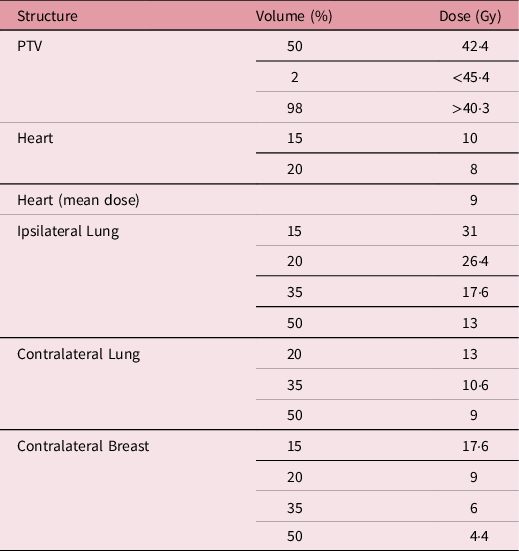
The prescription dose was 42·4 Gy in 16 fractions to 50% of the PTV (D50%). All plans met the criteria for cold and hot spot areas by 98% of PTV volume received more than 95% of the prescribed dose and 2% of PTV volume received less than 107% of the prescribed dose. In addition, the dose constraints for OARs are illustrated in Table 2.
Dose constraints to PTV and OARs

HT treatment planning
The CT images dataset and structure were transferred to the tomotherapy treatment planning system version 5.1.1.6 (Accuray Incorp., Sunnyvale, CA, USA) to generate the treatment plans. HT planning parameters for all plans were 5 cm (FW), 0·287 (PF), and MF starting with 2·0.
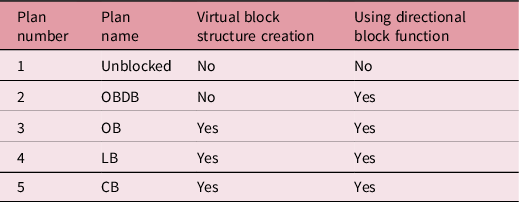
Regarding the planning techniques, a total of ten cases, five treatment plans were generated for each case with the planning details as shown in Table 3. A total of 50 treatment plans were evaluated in terms of plan quality and treatment efficiency.
Five treatment planning techniques

Abbreviations: OBDB, organ-based directional block technique; OB, organ-based virtual block technique; LB, L-shaped virtual block technique; CB, C-shaped virtual block technique.
Without virtual block structures
The two treatment plans in each case were generated without additional creating virtual block structures to be the reference HT plans as follows: (1) the unblocked technique (Unblocked); no directional block was used in this technique; and (2) the organ-based directional block technique (OBDB); directional block was used to limit the primary entrance beam through the heart, both lungs and contralateral breast. Reference Yeh, Huang and Wang12
With virtual block structures
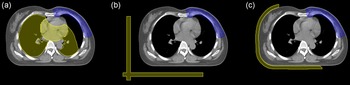
The three treatment plans in each case were created in different types of virtual block structures with a directional block to limit the entrance dose to OARs (Figure 1) as follows: (1) The OB virtual block technique was created by grouping the heart and both lungs to be the virtual block structure and was subtracted from PTV with 3 cm margin expansion; (2) The L-shaped virtual block technique (LB) was created by two rectangle structures perpendicular to each other similar to ‘L-’ shaped on the right side out of the body contour along the length of PTV. The heart shape in the axial plane was used to define the length of the L-shaped virtual block structure; and (3) The C-shaped virtual block technique (CB) was generated by using 1 cm margin expansion from the patient’s body contour and was subtracted from PTV with 9 cm margin expansion.
The planning target volume (blue) and virtual block structure (yellow) for (a) organ-based; OB, (b) L-shaped; LB and (c) C-shaped; CB on the transverse view of computed tomography (CT) images.

Plan evaluation parameters
The dose-volume histograms were calculated to evaluate the PTV and OARs. The plan evaluation was compared by following parameters 13–Reference Ślosarek, Osewski and Grządziel15 :
-
1. Homogeneity index for PTV was defined as follows:
where D2%, D50% and D98% are the dose received by 2%, 50% and 98% of PTV, respectively. The HI value of 0 was represented as ideal homogeneity. $${\rm{HI}} = {{{{\rm{D}}_{2{\rm{\% }}}} - {{\rm{D}}_{98{\rm{\% }}}}} \over {{{\rm{D}}_{50{\rm{\% }}}}}}$$
-
2. Conformation number for PTV was defined as follows:
where TV is the target volume, TVRI95% is the target volume covered by the reference isodose (95%), and VRI95% is the volume of reference isodose (95%). The CN value of 1 was represented as ideal conformity.
$${\rm{CN}} = {{{\rm{T}}{{\rm{V}}_{{\rm{RI}}95{\rm{\% }}}}} \over {{\rm{TV}}}}{\rm{\;}} \times {{{\rm{T}}{{\rm{V}}_{{\rm{RI}}95{\rm{\% }}}}} \over {{{\rm{V}}_{{\rm{RI}}95{\rm{\% }}}}}}$$
-
3. Integral dose of radiation delivered to the whole patient’s body was defined as follows:
where D mean is the mean dose delivered to the whole patient’s body, and V is the whole patient’s body volume.
$${\rm{ID\;}}\left[ {{\rm{Gy}} \cdot {\rm{L}}} \right] = {{\rm{D}}_{{\rm{mean\;}}}}\left[ {{\rm{Gy}}} \right] \times {\rm{V\;}}\left[ {\rm{L}} \right]$$
-
4. TT was defined as a beam on time that was associated with total monitor units of each technique; and
-
5. Block structure contouring workload was defined as time-consuming for delineating the additional virtual structures in the contouring process of each technique.


Statistical methods
All statistical analyses were performed by using the SPSS statistics 26. The normal distributions were investigated by Shapiro-Wilk test. Regarding the dosimetric analysis, ANOVA was used for comparison of normal distributions, while the Friedman test was used in case if the distributions were not normal. The paired sample t-test and the Wilcoxon signed-rank test were used to compare score parameters between two groups. A p-value < 0·05 was considered statistically significant.
The performance score was used to explore the suitable plan by summation of the score of each parameter in each technique which was defined as ‘0’, ‘1’ and ‘2’ when the p-value was > 0·05, < 0·05 and < 0·001, respectively, and then comparing the sums with the highest one. Reference Yeh, Huang and Wang12
This retrospective study recruited the CT images of the patient in the period from January 2020 to December 2020. The ethical clearance was approved by the Institutional Review Board of the Faculty of Medicine ChiangMai University (Study code: RAD-2564-08094/Research ID: 8094).
Results
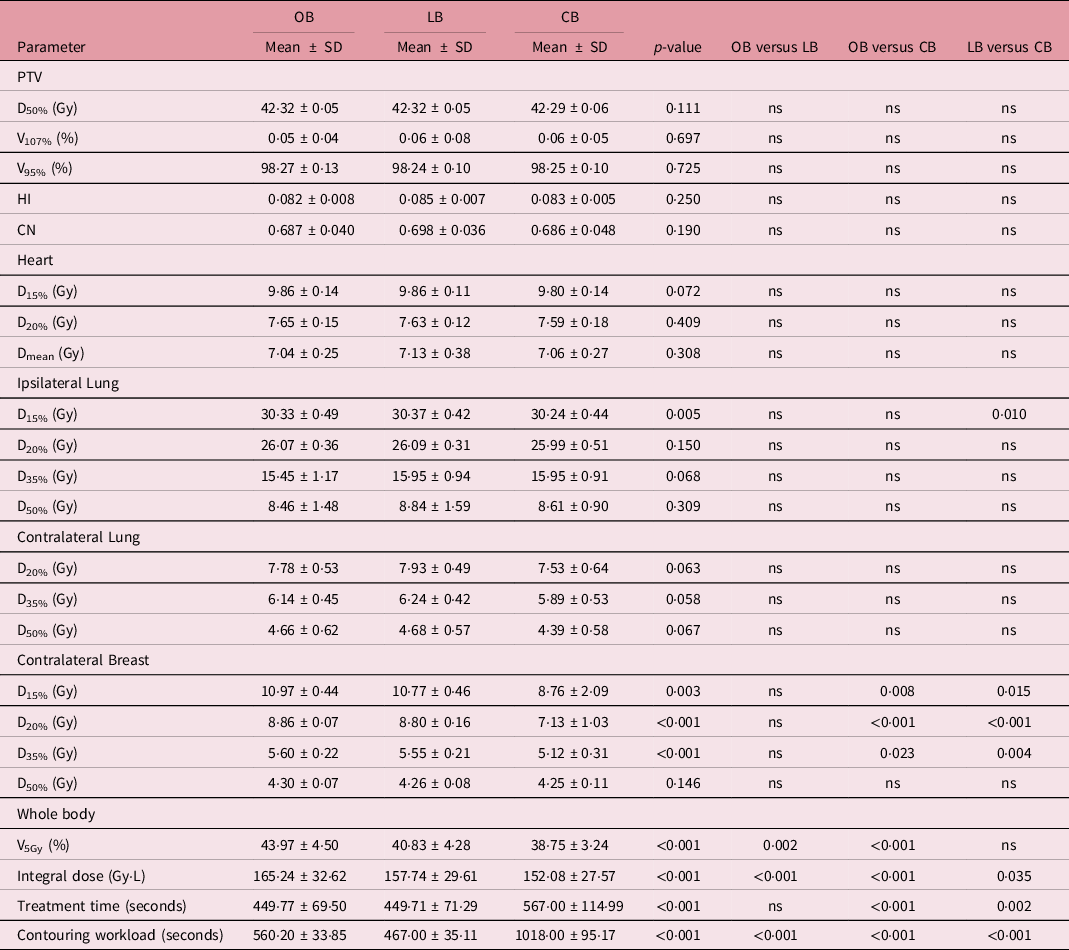
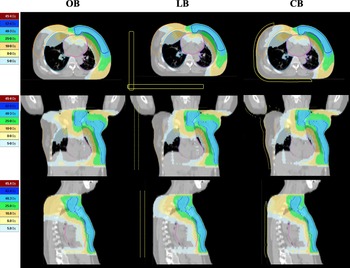
Dosimetric comparisons of the PTV, OARs, V5Gy and integral dose of whole body, TT and block structure contouring workload for three virtual block planning techniques are shown in Table 4. There were no statistically significant differences in dosimetric parameters of PTV, heart, both lungs except D15% of ipsilateral lung and D50% of the contralateral breast. All three virtual block planning techniques reached the acceptable dosimetric criteria for target and OARs. However, there were statistically significant differences with the highest V5Gy (43·97 ± 4·5%) and integral dose (165·24 ± 32·62 Gy·L) in the OB plans as the highest low-dose spread is displayed in Figure 2.
Dosimetric comparisons, treatment time and contouring workload between three planning techniques

Abbreviations: OB, organ-based virtual block technique; LB, L-shaped virtual block technique; CB, C-shaped virtual block technique; HI, homogeneity index; CN, conformation number; ns, no statistically significant difference (p > 0.05).
The dose distribution of axial, coronal and sagittal plane for three virtual block planning techniques: (a) organ-based; OB, (b) L-shaped; LB and (c) C-shaped; CB.

Another statistically significant difference was found that the LB plans provided the shortest block structure contouring workload (467 ± 35·11 seconds). Additionally, the CB plans provided the lowest D15% (8·76 ± 2·09 Gy), D20% (7·13 ± 1·03 Gy) and D35% (5·12 ± 0·31 Gy) of the contralateral breast and integral dose (152·08 ± 27·57 Gy·L) and the longest TT (567 ± 114·99 seconds) and block structure contouring workload (1018 ± 95·17 seconds).
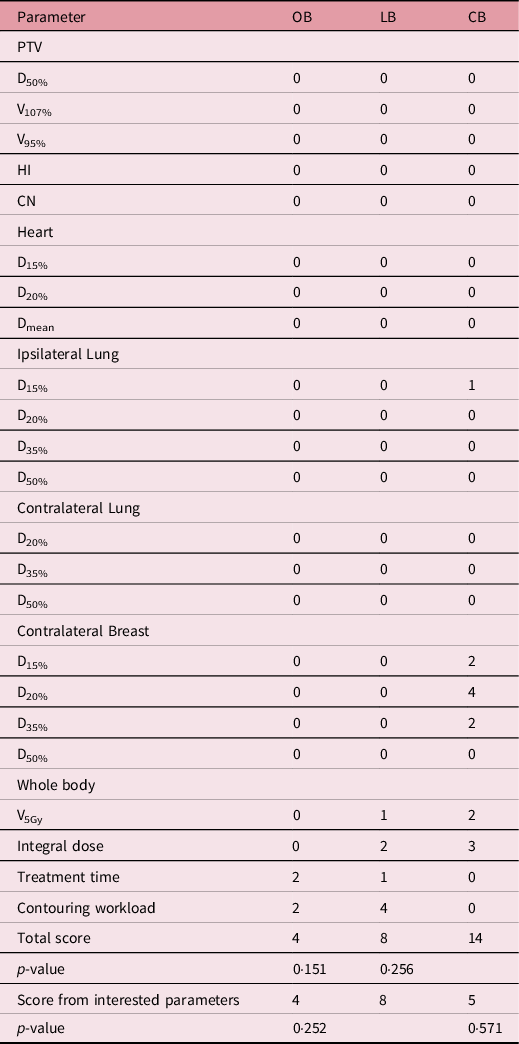
The comparisons of the performance score for three virtual block planning techniques are summarised in Table 5. The summation of the scores from all parameters in OB, LB and CB plans was 4, 8 and 14 points, respectively. Therefore, the results with the highest score demonstrated the superiority of the CB plan to spare contralateral breast and also reduce V5Gy and integral dose. For clinical practice, other important factors, such as TT, should be considered. The consideration issue for HT involves balancing issues relating to a low-dose bath and TT. The LB technique was optimal because it provided acceptable dosimetric parameters, reasonable low-dose spread and a satisfactory TT. According to the summed scores, the LB plans (8 points) demonstrated the highest score when compared with OB (4 points) and CB (5 points) for TT, block structure workload and low-dose spreading as V5Gy and integral dose parameters. Therefore, the results with the highest score demonstrated the superiority of the LB plan in all clinical practice parameters. However, no significant differences were found.
Planned score table of three planning techniques

Abbreviations: OB, organ-based virtual block technique; LB, L-shaped virtual block technique; CB, C-shaped virtual block technique.
Discussion
The dosimetric parameters of three virtual block treatment planning techniques were evaluated using multivariate analysis to determine the optimal planning technique. The unblocked and OBDB techniques were created as the reference plans. The unblocked plans showed the advantage of TT and block structure contouring workload despite providing a very high V5Gy, integral dose and dose to contralateral organs. Compared with the unblocked plans, the OBDB plans showed the advantage of contralateral lung and contralateral breast-sparing, V5Gy and integral dose while providing a very long TT. Similar results have been reported by Tang et al. Reference Tang, Liang, Guan and Yang6 for PMRT with SIB by HT. They revealed that the complete block function significantly reduced the dose to the lungs and heart but provided a significantly higher amount of MU and longer TT.
The mean V5Gy were 43·97 ± 4·5% (OB), 40·83 ± 4·28% (LB), and 38·75 ± 3·24% (CB). Moreover, the integral dose were 165·24 ± 32·62 Gy·L, 157·74 ± 29·61 Gy·L, and 152·08 ± 27·57 Gy·L for the OB, LB and CB plans, respectively.
Another consideration point for HT with block structure is the TT, which was 7·5 ± 1·2 minutes (range 6·3–10·4 minutes), 7·5 ± 1·2 minutes (range 6·1–10·3 minutes) and 9·5 ± 1·9 minutes (range 7·5–13·7 minutes) in OB, LB and CB plans, respectively. The LB and OB plans were significantly superior to the CB plans. For the mean block structure contouring workload comparison, the LB plans (7·8 ± 0·6 minutes) were significantly better than the OB (9·3 ± 0·6 minutes) and CB plans (17·0 ± 1·6 minutes).
Regarding the plan quality score, the highest total score was shown in the CB plans (14 points) which provided the superiority of V5Gy, integral dose and contralateral breast-sparing. On the other hand, the OB plans (4 points) provided the superiority of TT and block structure contouring workload. The OB and CB plans showed a trade-off between TT and normal tissue sparing. However, when focusing on the clinical practice issue in the low-dose spreading and TT, the LB plans (8 points) showed the balancing of plan efficiency by improving V5Gy, integral dose, TT and block structure contouring workload with the highest score from all clinical practice concerning parameters.
Additionally, LB plans provided superior V5Gy and equal integral dose compared with the OBDB, whereas TT and block structure contouring workload were slightly higher than the unblocked technique.
Even though some reports in modifying the HT treatment plan for limiting the low-dose volume spreading were published, but this study is the pioneer which concerned about the TT for implementation in clinical practice. Moreover, this study attempts to create a virtual block structure to reduce the volumes of normal tissue receiving low doses and minimise TT to reduce the impact of intrafraction motion and whole-body integral dose. Reference Sharma, Gupta, Jalali, Master, Phurailatpam and Sarin16 However, this study has limitation in small sample size. A study with larger sample size is the next plan to develop block structure technique which tailor to individual patient anatomy.
Conclusion
Regarding the plan quality score, the highest total score was shown in the CB plans which consumed the longest TT and block structure contouring workload. On the other hand, the OB plans provided the superiority of TT and block structure contouring workload but showed the inferiority of low-dose volume spreading. Therefore, the LB technique is considered to be the suitable technique for left-sided PMRT with RNI because of the balancing of plan efficiency by improving V5Gy, integral dose, TT and block structure contouring workload with the highest score while maintaining the plan quality within the acceptable criteria as well.
Acknowledgements
The authors wish to thank staffs of the Division of Radiation Oncology, Faculty of Medicine, Chiang Mai University for supporting the data of this study.
Conflicts of Interest
No conflicts of interest.