1. Introduction.
In Modern English pronunciation, the interdental fricatives at the beginnings of function words (including the, this, and that) are voiced, although comparative evidence shows that these words originally began with the voiceless interdental fricative, with which content words (such as thin, thick, and so on) now begin. It is clear that this sound change happened by the fourteenth century, because Chaucer rhymes sothe … to the (Benson 1987.271:662–663) and hy the … swythe (Benson 1987.279: 1294–1295). The generally accepted view is that it happened no earlier than this time, but little evidence has been presented to support this; the sound change could have happened much earlier. Dating it is difficult because of the way fricatives, especially interdental fricatives, have been represented in English orthography. From Old English to late Middle English, scribes had multiple characters (<þ>, <ð>, <th>) with which to represent interdental fricatives, but they did not assign different phonetic values to these symbols, instead distributing them by a variety of methods.
However, one particular text, Vices and Virtues (preserved in London, British Library, Stowe MS 34), shows a distribution of graphs that suggests phonetic conditioning. In this paper, I analyze the distribution statistically and show that its most plausible interpretation is that <ð> and <þ> were used to encode stress-conditioned differences in voicing. Therefore, it appears that the sound change occurred much earlier than is generally accepted.
2. Voiceless Interdental Fricatives in Germanic.
The voiceless interdental fricatives in Germanic arose from Indo-European +t, as in the Greek neuter definite articles tó, tá, and so on (Bornemann & Risch 1978:28). Grimm's law led to Gothic forms such as þata, þu, and þatei (Braune & Ebbinghaus 1981:99–102). In early and middle Old High German, the demonstrative pronoun occurs as thē, dē, thie, thiu, and diu, with forms in <th> alongside those in <d>. The <th>-forms must have been pronounced voicelessly, because Germanic /ð/ became /d/ in pre-Old High German and then /t/ in Old High German. The change from /θ/ to /d/ is a part of the High German Consonant Shift, and by Notker's time, only the forms in <d> remain (Sonderegger 1987:155, 203).
The voicing of word-initial interdental fricatives in English function words was part of a wider development in which the fricatives /f/, /s/, and /θ/ gained voiced, positionally distributed allophones that later became phonemic and could appear in any position within a word. Pre-Old English had the fricatives /f/, /s/, /θ/, /x/, and /ɣ/, only the last of which is voiced (Hogg 1992b:101). By the time of Old English, voiced allophones of the first three of these fricatives occurred medially, as in Modern English wolf, wolves, a development traced by Hogg (1992b:109–110). Since the sound represented by a letter could be predicted by the position within a word, different letters for the new voiced allophones [v], [z], and [ð] were not needed.
Lass (1992:58–59) divides the change from the Old English distribution to the modern distribution (fricatives are always short, but may be voiced or voiceless in any position) into four steps. The first step, the appearance of voiced fricatives in initial position, is of interest here. Three factors may have made Middle English, unlike Old English, receptive to voiced initial fricatives: the shift in contrast from length to voicing, southern Old English dialects with voiced initial fricatives, and the large number of words borrowed from French (Lass 1992:58). The first of these, described by Kurath (1956), probably did not contribute to the specific problem discussed in this paper, because Vices and Virtues was written circa 1200 in Essex (Laing & Lass 2007), that is, before the change reached that area. The other two factors cited by Lass seem more likely to have contributed. In southern Old English, Germanic initial [f, s, θ] changed to [v, z, ð] before voiced sounds, perhaps due to contact with Old Low Franconian, a possibility which Bennett (1955:353) suggests “would mean that the conventional formula for determining the initial allophones of West Saxon and Kentish Old English /f s þ/ would have to be revised.”
Brink (1992) points to Scandinavian influence as a possible catalyst for word-initial fricative voicing in function words in the Ormulum, a contemporary of Vices and Virtues with a northern provenance (East Midlands). This contrasts with the last two of Lass's (1992:58–59) three factors. It is possible that Old Norse took the place of the southern dialects and French loan words in making Old English receptive to this change in the north. For Vices and Virtues, the relevant languages are those cited by Lass (1992).
The mechanism of the change from voiceless to voiced pronunciation of word-initial interdental fricatives in function words is unclear. Kurath (1956:146) attributes it to “a native development” that may have been stress-related, while Jespersen (1909:291) connects the voiced pronunciation of these sounds to medial voicing:
The voiceless initial consonant in the pronominal words the, they, them, their, thou, thee, thy, thine, that, those, this, these, then, than, there, thither, thence, thus had probably begun to become [ð] before the voicing of consonants in other words on account of the frequent position between vowels. … Note that in this [ð] is due to such positions as to this, while [s] was kept voiceless after the stressed vowel. In though the voiced [ð] began in although and after a vowel, and was later generalized.
It seems likely that stress conditioning played a role in this sound change because function words tend to lack syntactic stress. In The Hymn to the Virgin, a text written slightly before 1500 by a Welshman who wrote English phonetically using Welsh spelling conventions, function words start with <dd> (/ð/), except when stressed; then they start with <th> (/θ/). Compare tw thank tw thi (line 77) with ddi tw mei sicht! (line 84): the stressed form thi must begin with /θ/ to alliterate, while the unstressed form ddi begins with /ð/ (Dobson, 1954:96–97).
Hackauf (1902:xxxii) observes that <th> is used for /θ/ and <þ> for /ð/ in Göttingen, Universitatsbibliothek, MS Theol. 107 of Cursor mundi.Footnote 1 In an examination of this manuscript, Jordan (1974:185–186) writes, “occasionally differentiation of voiceless <th> from the voiced fricative <þ> is attempted, as in MS. Göttingen Theol. 107 of CM. … The <þ> sign remains particularly in little words like þe, þat, þis, þey, þer,” and points out that these “little words” were often abbreviated by barred <þ>, which was also used to abbreviate longer words with medial <þ>. Following through on Hackauf's (1902) observation, von Appel (1936–1937:26) examines several late Middle English manuscripts of the Cursor mundi, as well as The Gast of Guy and Barbour's Legenden-sammlung, with the conclusion that “einzelne mittelenglische Schreiber [bemühten] sich um eine phonetische Wiedergabe der stimmhaften und stimmlosen Interdentalspirans” [individual Middle English scribes tried to differentiate between voiced and voiceless fricatives phonetically]. In these texts, the distribution of <þ> and <th>, apart from a few exceptions or scribal errors, follows modern English pronunciation, with <þ> representing the voiced sound, and <th> the voiceless.
The idea that the distribution of graphs in the group of manuscripts examined by von Appel (1936–1937) is due to phonological differences has been disputed. Jespersen (1909:44) thinks that function words were usually written with <þ> instead of <th> due to orthographic conservatism, rather than the scribes having two different sounds to represent:
Some ME manuscripts use both <th> and <þ>, though they do not, as is sometimes said, distinguish them systematically, using <th> for the unvoiced and <þ> for the voiced consonant. So far as I have been able to see, they do what we should much rather expect from mediaeval scribes, namely use <þ> in the small constantly recurring (pronominal) words, in which orthographical conservatism is quite natural, and <th> in nearly all other cases, whether the sound was unvoiced as in thing or voiced as in brother. The spelling thus shows nothing with regard to the pronunciation, and þ u, etc. may at that time still have had the unvoiced sound.
Jespersen (1909) and Jordan (1974) agree that the words pronounced with a voiced initial fricative in Modern English began with <þ>, while other words began with <th>; they disagree on the reason behind this, with one opting for orthographic conservatism and the other for a differentiation between sounds. This argument for orthographic conservatism is plausible because <th> was a new way of writing interdental fricatives. <þ> was an inherited graph which was often used in abbreviations, and since function words were frequently abbreviated, <þ> may have been retained as a conventionalized writing for function words in Middle English.
The argument for orthographic conservatism does not apply to Vices and Virtues, which uses <ð> and <þ>, but not <th>, because it is based on the idea of a new way of writing interdental fricatives. In earlier times, there was no conventional discrimination between <ð> and <þ>, and other early Middle English manuscripts do not have a consistent distribution of <ð> and <þ>. The scribes were able to choose how to distribute these letters and could have used phonological criteria to do so.
It seems clear from the rhymes in Chaucer and the distribution of graphs in The Hymn to the Virgin and the manuscripts examined by von Appel (1936–1937) that this sound change had happened by the fourteenth century. The received opinion is that the sound change did not occur earlier than these fourteenth-century examples, but little evidence has been presented to support this opinion, and some scholars have suggested that the sound change could in fact have occurred much earlier. The idea that these sounds became voiced in the fourteenth century has been cited by Jordan (1974:187), Lass (1992:59), and Pinsker (1963:89).
An early date for the voicing word-initial fricatives in unstressed function words was proposed by Sievers (1918:100): “Germ. þ bleibt im Anlaut stimmlos außer in den Formen pronominaler Herkunft, die auch im Ne. stimmhaftes th zeigen. Eine Ausnahme macht das starkbetonte þ  dœ ʒ e Ine 7,1.”Footnote 2 This statement is the result of the “schallanalytische” methods described by Sievers (1924) applied to various texts (Sievers 1918, 1925, 1929). Wright & Wright (1923:105) also suggest an unspecified early date:
There is no indication either in ME. or NE. to show when the <þ-> became voiced in such words, but the dialects of Sus., Ken., and s. Pem. show that it must have taken place fairly early, because in these dialects the <þ-> has become <d->, although the forms with <d-> are now obsolescent in the two latter counties. … These forms with <d-> show that the voicing of the <þ-> in the pronominal and adverbial forms was older than the voicing of it in the other OE. words beginning with <þ>.
The difficulty in determining when word-initial fricatives in function words became voiced is due to orthographic uncertainty. Since whether a sound was voiced could be predicted by its position within a word, there was no need to use different letters for the two sounds. This allowed <ð> and <þ> to be used interchangeably and be distributed as decided by the scribe: capriciously, with a preference for one of the two, or according to some pattern (Hockett 1959:113; Jordan 1974:185).
One example of a pattern is shown in manuscripts written in the AB dialect of early Middle English, which use <ð> medially and finally, and <þ> initially (Jordan 1974:185).Footnote 3 This dialect is unique in that its spelling is remarkably consistent across authors and scribes. Linguistically, the language is close to West Saxon, with the addition of some Mercian features. This consistency in both language and orthography suggests the possibility of a strong and lasting literary tradition in the West Midlands (Scragg 1974:28). If scribes were taught to write <þ> initially, where it was pronounced voicelessly, and <ð> medially, where it was often voiced, they may have come to associate these different sounds with different letters. Stockwell & Barritt (1961:137) point out that
if we assume that <þ> had some notion of voicelessness attributed to it originally and <ð> some notion of voice, we might then infer that this notion is further borne out by [the] distribution in initial and medial positions.
This notion could be related to the original meaning of the graphs, or it could have been developed after this AB dialect's orthographic practice became common. However, an <ð> in final position could not have been voiced because Old English had final devoicing of fricatives (Mitchell & Robinson 1992:15); therefore, this convention must have been based only on position.
In Vices and Virtues, <ð> and <þ> are distributed in a way that suggests that word-initial fricatives in unstressed function words were voiced. The different ways in which Scribes A and B distributed these letters suggest that the scribes were using their own systems rather than copying the manuscript slavishly.Footnote 4 Scribe A copied the text from the beginning to page 74 (Holthausen 1888:119.19), then returned for another page (Holthausen 1888:119.25–121.6) after a brief interlude by Scribe B, who wrote 78 words on page 74 (Holthausen 1888:119.19–25) and the final section of the text (Holthausen 1888:121.6–end).
Vices and Virtues is of particular interest in the development of voiced word-initial fricatives in function words because of its southern dialect and the fact that southern dialects showed voiced fricatives early on. Laing & Lass (2007) place Vices and Virtues in southwestern Essex, and Luick (1964:43), Schmidt (1899:10, 66–69), and Morsbach (1896: 10–11) point to some Kentish features, especially in Scribe B's section. The differentiation between voiced and voiceless sounds in the Cursor mundi manuscript cited previously may also be related to its language's southern provenance because the scribe claims to have translated its original southern dialect into northern English (Hackauf 1902:v). Heuser (1904:256) writes that the copy of Assumptio Mariae preserved in this manuscript shows “kentische färbung” [Kentish coloring] and suggests that the scribe lived in Kent while he copied the manuscript.
In contrast to this, Brink (1992) attributes the possible voicing of word-initial fricatives in function words in the Cursor mundi manuscript to Scandinavian influences. He states that the manuscripts used by von Appel (1936–1937) “constitute compelling evidence that not long after Orm, voicing had indeed established itself in his area” (Brink 1992:29). This analysis, combined with the evidence for voicing in Southern England presented here, suggests that voicing of word-initial fricatives in function words may have existed across England by circa 1200. If this is the case, it must either have arisen independently in several places or have occurred earlier and spread.
3. A Statistical Analysis of the Distribution of <ð> and <þ>.
A statistical analysis of the distribution of <ð> and <þ> in Vices and Virtues reveals a pattern to the use of <ð> and <þ> which may have phonological significance.Footnote 5 In general, the scribes follow the practice of beginning content words with <þ>, while using <ð> medially, finally, and at the beginning of function words. The most notable pattern that emerges from this analysis is the possibility that these two letters did indeed represent voiced (<ð>) and voiceless (<þ>) sounds, and that function words started with a voiced sound at the time of this manuscript's production, circa 1200, nearly two centuries earlier than the generally accepted date. The methods used in this analysis are unlike any methods previously applied to the question of word-initial fricative voicing, and the results undermine the ideas that have been generally accepted for the last century.
A program written in Python counted the occurrences of <ð> and <þ> in each scribe's section, without differentiating between capital and lower case letters.Footnote 6 The program considered any word tagged as a pronoun, pronominal relative, conjunction, preposition, definite article, indefinite article, determiner, indefinite pronoun, or adverb to be a function word, in keeping with modern English pronunciation.Footnote 7 In determining compound words, the program followed Laing & Lass 2007, so that, for example, þrie-&-þrihti is counted as having one initial and one medial <þ>.
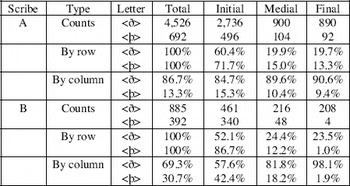
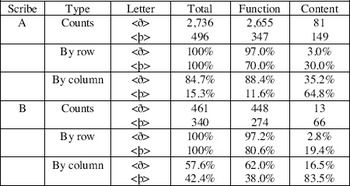
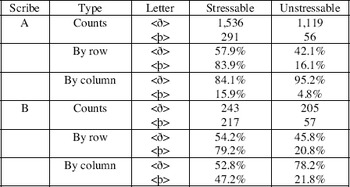
The results are shown in tables 1–3. Table 1 shows how <ð> and <þ> are distributed by position within a word, giving the total number of times each letter occurs in each position. Table 2 splits the initial column of table 1 into function and content words. The overall ratio of function words to content words is 9962:10234 (49% function words) for Scribe A and 2342:2507 (48% function words) for Scribe B. These ratios are somewhat different from the ratios shown in the tables, a result attributable to the openness of the class of content words. If only content words starting with <ð> or <þ> are included, the ratios are 3002:230 (92.9%) for Scribe A and 722:79 (90.1%) for Scribe B. The first two tables show that both scribes used <þ> more frequently at the beginning of content words and <ð> medially, finally, and at the beginning of function words. The medial <þ>s often start elements of compounds or follow a prefix, making their use consistent with use in initial position. In table 3, the function words are broken down by their ability to bear stress. Percentages are given by row (the number in the first row in the “Initial” column represents the percentage of <ð>s in initial position) and by column (the number in the first row in the “Initial” column represents the percentage of initial graphs that are <ð>s) Some round-off errors prevent all rows from adding to 100%.
Counts of <ð> and <þ> in each position.

The distribution of initial <ð> and <þ> across word type.

The distribution of initial <ð> and <þ> across function word type.

Although the two scribes followed the same general pattern, their distributions are not identical. Only 15.3% of Scribe A's initial <ð>s and <þ>s are <þ>s, but 71.7% of the <þ>s are initial, a percentage which is much higher than might be expected given the overall percentage of <þ>s. Of the 4,526 <ð>s in Scribe A's section, 2,736 (60.4%) are word-initial and 2,655 (97.0% of the initial <ð>s) start function words. Scribe A used <ð> initially in 88.4% of the function words and only 35.2% of the content words.
Scribe B was stricter about writing <þ> only in initial position than Scribe A, with 86.7% of his <þ>s occurring initially, and only 1.0% finally. His overall distribution of <ð> and <þ> in initial position is much more even than Scribe A's. Scribe B wrote <ð> rather than <þ> initially only 57.6% of the time overall. This may be attributable to the differences in the overall distribution, since Scribe B's <ð> to <þ> ratio is lower than Scribe A's. Like Scribe A, Scribe B preferred to start function words with <ð> and content words with <þ>: 97.2% of the <ð>s in initial position start function words and 62.0% of the function words and 16.5% of the content words start with <ð>.Footnote 8
4. Discussion.
These numbers show that both scribes had a strong preference for starting function words with <ð> and content words with <þ>. One possible explanation for this preference is an orthographic convention. This is unlikely because there is no record of such differentiation in the Old English period. In fact, barred <þ> was used to abbreviate function words, making it seem more likely that a scribe would begin them with <þ> rather than <ð>, as in the manuscripts examined by von Appel (1936–1937).
Since there is no record of such an orthographic convention in Old English, the closest such convention being that of the AB dialect, it is unclear why the scribes would have chosen to follow this system unless they had a phonological reason. One possible explanation for this is that the scribes used <ð> in function words to show that they were pronounced differently than the <þ>-initial content words. Old English medial voicing and the custom of writing <ð> instead of <þ> in the middle of words could easily have led the scribes to associate <ð> with a voiced sound, in accordance with the theory of Jespersen (1909:201) concerning the mechanism of the sound change. This spelling of function words suggests that the initial consonant of these words was voiced.
Neither scribe was entirely consistent with respect to the first letter of function words. If the scribes did assign phonological significance to the letters at the beginning of function words, and if the sound change had been completed by their time, the percentage of word-initial <ð>s in function words would be even higher. It is possible that the sound change had not yet been completed, and that at this stage of the language, stress conditioning played a role in determining what sound function words started with. By writing þat instead of ðat, the scribes could be pointing out that, when stressed, the initial sound of þat was pronounced voicelessly, as it was in The Hymn to the Virgin. The data in table 3 follow this line of reasoning and suggest that both scribes may indeed have used stress conditioning to decide which letter to write.
Analyzing stress in prose is very difficult because there is no reliable method of identifying stressed words. It is now necessary to make two assumptions: First, the metrical stress shown in poetry reflects the general stress hierarchy of the spoken language. Second, the ability of a word to bear metrical stress did not change between Old and early Middle English. Minkova (1996) suggests that the first is a reasonable assumption for early Middle English, as Godden (1992:493) does for Old English. As for the second, it seems unlikely that the stress hierarchy would have changed significantly between the Old English period and Vices and Virtues because the stressability rules are a part of the underlying West Germanic grammar (Sievers 1893:§29). The description of the metrical transition from Old to early Middle English given in Fulk 1992:251–268 suggests that these underlying rules did not change significantly: The tendency is toward more unstressed syllables, fewer compound words, and fewer verse types. Fulk (1992) does not mention any changes in which word-types may be stressed.
In Old English verse, the function words that could bear stress were adverbs, pronouns, demonstratives, prepositions, and conjunctions (including relatives).Footnote 9 These are included in the “Stressable” column of table 3. The unstressable function words are articles and pronominal relatives. If stress was taken into account by the scribes and a stressed word was written with <þ>, then stressable function words should show a higher proportion of initial <þ>s than word types that cannot be stressed, as is the case here.
The two scribes show the same general trend in spelling the two types of function words. Overall, 60.9% of Scribe A's and 63.7% of Scribe B's function words are stressable. In both cases, about 55% of the function words that start with <ð> and 80% of those that start with <þ> are stressable. If the proposed correspondence is true, stressed words would begin with <þ> and unstressed words—some of the stressable and all of the unstressable words—would not. Allowing some space for variation, this is the case for Scribe A: 15.9% of his stressable function words begin with <þ>, compared to only 4.8% of the unstressable function words. For Scribe B, the results are along the same general lines, but the conclusion is not as clear: 47.2% of Scribe B's stressable and 21.8% of his unstressable function words begin with <þ>. Here the incidence of <þ> in unstressable words is higher than might be anticipated. Both of these percentages are much higher than Scribe A's, suggesting that another criterion may underlie his distribution.
Overall, the statistical evidence supports the idea that the scribes preferred to use <þ> to begin stressed function words and content words, and <ð> to begin unstressed function words. This could have been an orthographic convention or have phonological significance, but it is unclear where such an orthographic convention could have come from. Scribes were trained to use different symbols to encode different sounds, not stress, making the interpretation of this distribution as phonetic differentiation more plausible than simple stress marking.
Despite the difficulty of determining the stress in prose, I offer a few examples of this in action. The first two are from Scribe A, and the third from Scribe B.Footnote 10
- (1)
a. nu ðu wilt mine name swa ʒiernliche witen soð ic ðe wile seggen.
(Holthausen, 1888:23.8–9)
‘Now as thou wilt so eagerly know my name, I will tell thee forsooth’ (Holthausen 1888:22.8–9).
b. þat is se-ilke ðe santus Paulus us takð on his pisteles & þus seið.
(Holthausen, 1888:31.2–4)
‘That is the same that St. Paul teaches us in his epistles, who says thus’ (Holthausen 1888:30.2–3).
c. ga into þine bedde. þat is in-to þine hierte. ðar ah to bene þine reste. & scete ðe dure swa-ðat þu ne lat none oðre þouhtes into þe bute of gode & of þine niede.
(Holthausen, 1888:143.5–7)
‘Go into thy bed-room, that is, into thy heart—there ought to be thy rest—and shut the door, so that thou lettest no other thoughts into thee but of God and of thy need’ (Holthausen 1888:142.5–8).
In 1a, the “scribe first began to write thorn or wynn” for the first letter of ðu (Laing & Lass 2007). This scribal error and a few others where an <ð> replaced an unidentifiable letter show that the scribe was indeed thinking about whether to write <ð> or <þ>. In 1b, the subject, þat, is at the beginning of the sentence, where it would naturally bear some stress. The relative ðe is unstressed and what St. Paul said is important and therefore likely to be stressed. The frequent appearance of the second person pronoun in the passage in 1c suggests that it was important, and it could have been stressed. If so, its first letter, <þ>, is consistent with the ideas presented here. The article ðe starts with <ð> and could have not have been stressed.
5. Conclusion.
In conclusion, the scribes of Vices and Virtues had systems behind their uses of <ð> and <þ>. The scribes generally preferred to begin content words with <þ> and function words with <ð>, and to write <ð> in medial and final position. The medial and final spellings are reminiscent of the AB dialect pattern. The most plausible explanation for the scribes' initial letter choice is that the scribes associated initial <ð> with a voiced sound, implying that function words had become voiced by the time the manuscript was written. Within the function words, there may be stress conditioning. In The Hymn to the Virgin, function words are written with <th>, representing a voiceless initial fricative, when stressed, and with <dd>, representing a voiced fricative, when unstressed. The scribes of Vices and Virtues may have followed a similar pattern. Scribe A was fairly consistent about following this pattern, but Scribe B was less so, and he may have had other reasons for his choices. This suggests that unstressed function words in English were voiced by circa 1200, much earlier than the generally accepted date.