Mountain pine beetles, Dendroctonus ponderosae Hopkins (Coleoptera: Curculionidae: Scolytinae), a major forest pest in western North America, tend to have female-biased sex ratios (Safranyik and Carroll Reference Safranyik and Carroll2006). In insects, a common mechanism of sex-ratio distortion is the endosymbiont Wolbachia Hertig (Rickettsiales: Rickettsiaceae), estimated to infect 66% of arthropod species (Hilgenboecker et al. Reference Hilgenboecker, Hammerstein, Schlattmann, Telschow and Werren2008). Wolbachia can cause infected insects to produce strongly female-biased broods by killing male offspring early in development (Fialho and Stevens Reference Fialho and Stevens2000; Stouthamer et al. Reference Stouthamer, Hurst and Breeuwer2002). The presence or absence of infection in populations can produce geographic variation in population sex ratios (Charlat et al. Reference Charlat, Hornett, Dyson, Ho, Loc and Schilthuizen2005). The prevalence in infected populations, which tends to be either >90% or below 10% (Hilgenboecker et al. Reference Hilgenboecker, Hammerstein, Schlattmann, Telschow and Werren2008), will affect the extent to which the population sex ratio is biased. However, infected populations may evolve the ability to suppress infection, returning sex ratios to equality (Hornett et al. Reference Hornett, Charlat, Duplouy, Davies, Roderick and Wedell2006) while naïve populations, without resistance, will display strongly female-biased sex ratios if male-killing Wolbachia is introduced (Veneti et al. Reference Veneti, Toda and Hurst2004). Recent dispersal events or isolated populations may affect the sex-ratio patterns observed due to different levels of infection (Charlat et al. Reference Charlat, Hornett, Dyson, Ho, Loc and Schilthuizen2005).
Wolbachia has been detected in a number of beetle species causing female-biased sex ratios through male killing (Hurst et al. Reference Hurst, Jiggins, von der Schulenburg, Bertrand, West and Goriacheva1999; Fialho and Stevens Reference Fialho and Stevens2000) or infertility through cytoplasmic incompatibility between individuals carrying different strains (Kondo et al. Reference Kondo, Ijichi, Shimada and Fukatsu2002; Keller et al. Reference Keller, Windsor, Saucedo and Werren2004). The possibility of male-killing cytoplasmic factors has been suggested as a cause of sex-ratio bias in bark beetles (Coleoptera: Curculionidae: Scolytinae), namely Orthotomicus latidens (LeConte) (Lanier and Oliver, Reference Lanier and Oliver1966) and Dendroctonus jeffreyi Hopkins (Lanier and Wood Reference Lanier and Wood1968). Wolbachia has since been detected in the following scolytines: Hypothenemus hampei (Ferrari) (Vega et al. Reference Vega, Benavides, Stuart and O’Neill2002), Xylosandrus germanus (Blandford) (Peer and Taborsky Reference Peer and Taborsky2005), Coccotrypes dactyliperda (Fabricius) (Zchori‐Fein et al. Reference Zchori-Fein, Borad and Harari2006), and Pityogenes chalcographus (Linnaeus) (Arthofer et al. Reference Arthofer, Riegler, Avtzis and Stauffer2009). In mountain pine beetles, Wolbachia has been investigated in relation to cytoplasmic incompatibility, but no evidence of this mechanism was found (Bracewell et al. Reference Bracewell, Pfrender, Mock and Bentz2010) although Wolbachia was detected in two individuals (Bracewell Reference Bracewell2009). To the best of our knowledge, Wolbachia has not been investigated in mountain pine beetles with respect to sex-ratio distortion through male killing.
Wolbachia has been studied for potential use in biological control of insect pests (reviewed in Floate et al. Reference Floate, Kyei-Poku and Coghlin2006). If Wolbachia acts as a male killer early in development, this could greatly reduce the effective population size (Engelstadter Reference Engelstadter2010). However, given that female mountain pine beetles are the pioneering sex and mass attack by females is required to overcome healthy host trees, Wolbachia-induced biases in sex ratios could have important implications for both attack success and population growth, particularly when populations of this pest species are low.
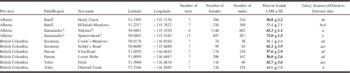
We screened 10 populations of mountain pine beetle to test for Wolbachia infection as a proximate mechanism of female-biased sex ratios. We expected female-biased sex ratios to vary depending on prevalence of infection in populations. Mountain pine beetles were collected from naturally attacked lodgepole pine trees, Pinus contorta var. latifolia Engelmann (Pinaceae), in southeast British Columbia and southwest Alberta, Canada (Table 1). Five regions were studied, with beetles collected at two sites per region. Historically, mountain pine beetle populations have been larger and more evenly distributed in southeast British Columbia, and smaller and more isolated in southwest Alberta. Although these populations are likely genetically indistinct (Samarasekera et al. Reference Samarasekera, Bartell, Lindgren, Cooke, Davis and James2012; Janes et al. Reference Janes, Li, Keeling, Yuen, Boone and Cooke2014), they may differ in population sex ratio or in the prevalence of infection.
Locations of beetle populations, the number of beetles that emerged of each sex, and the sex ratio.

Bold font indicates sex ratios significantly different from 1:1 (χ2, ∝<0.05).
* The greater number of beetles that emerged from Kananaskis sites is due to differences in the amount of tree surface area from which beetles were collected. Logs cut from naturally attacked trees were moved to the laboratory in the spring and enclosed. Beetles completed development in the laboratory and were collected as they emerged. For all other sites beetles were collected using traps placed directly on standing trees in summer 2008.
≅ Collected spring 2008.
⊥ Collected spring 2009.
Sex was determined according to the presence of a stridulation organ on the enlarged seventh tergite of male beetles (Lyon Reference Lyon1958). The sex ratio was calculated for each tree at each site (n=75). We used a generalised linear model (GLM) (SAS 9.2; SAS Institute Inc., Cary, North Carolina, United States of America) with a binomial error distribution to analyse sex ratio as a function of province, region nested within province, and site nested within province and region. Sex ratios differed at each level: (Province: χ2 1,65=9.65, P=0.0019; Region: χ2 3,65=47.16, P<0.0001; Site: χ2 5,65=38.01, P<0.0001, Table 1). Populations tended to be female biased, with sites in Alberta more female biased than sites in British Columbia (% female: 61.7±0.9 and 56.4±1.4, respectively). The Kananaskis region in Alberta was significantly more female biased than the other four regions, according to a Tukey–Kramer post hoc test.
To screen populations for Wolbachia infection, we randomly selected one female from each tree at each site and one male from each site (females n=75, males n=10). Beetles were stored individually at −18 °C until screened. Beetles were cleared of any external mites and DNA was extracted using a DNeasy Blood and Tissue Kit (Qiagen, Germantown, Maryland, United States of America). Trichomalopsis sarcophagae (Gahan) (Hymenoptera: Pteromalidae) wasps infected with Wolbachia pipientis Hertig were used as positive controls and uninfected wasps were used as negative controls. Controls were obtained from K.D. Floate at the Agriculture and Agri-Food Canada research centre in Lethbridge, Alberta, Canada.
Primers for the Wolbachia surface protein, wsp 81F and wsp 691R, were used to test for infection (Zhou et al. Reference Zhou, Rousset and O’Neill1998). These wsp primers are general and can amplify multiple strains within 10 of 12 supergroups of Wolbachia, with expected fragment sizes of 590–632 base pairs, depending on the strain amplified (Zhou et al. Reference Zhou, Rousset and O’Neill1998; Simões et al. Reference Simões, Mialdea, Reiss, Sagot and Charlat2011). As well, primers wsp 81F and wsp 691R have been used to detect Wolbachia in other bark beetle species (Vega et al. Reference Vega, Benavides, Stuart and O’Neill2002; Zchori‐Fein et al. Reference Zchori-Fein, Borad and Harari2006; Arthofer et al. Reference Arthofer, Riegler, Avtzis and Stauffer2009). To confirm DNA extraction Wolbachia-specific primers were used in combination with arthropod-specific primers (CO1: LCO1490 and HCO2198) with an expected fragment size of 710 base pairs (Folmer et al. Reference Folmer, Black, Hoeh, Lutz and Vrijenhoek1994). Amplification was done separately for the Wolbachia and the CO1 assay in 25 μL reactions containing the two primers for each, a polymerase chain reaction (PCR) ready bead (Illustra Pure Taq Ready-to-go from GE Healthcare Life Sciences, Baie d’Urfé, Québec, Canada) and 2 μL of extracted DNA at 94 °C for two minutes, 30 cycles of 94 °C for 30 seconds, 55 °C for 45 seconds, 72 °C for one minute, with a final extension at 72 °C for 10 minutes. Banding patterns were visualised on a 2% agarose gel containing SybrSafe fluorescent DNA stain.
DNA extraction was successful as bands were observed for the arthropod-specific primers at the same height as negative controls, uninfected T. sarcophagae. Positive controls, infected T. sarcophagae showed bands for both the arthropod specific primers and Wolbachia-specific primers.
Wolbachia was not detected in any of the mountain pine beetles from any of the 10 sites in Alberta and British Columbia. Previously, the only reported detection of Wolbachia in this species was in a single mountain pine beetle from each of two populations in La Grande, Oregon, and Klamath, Oregon, United States of America (Bracewell Reference Bracewell2009).
Although we did not detect Wolbachia in these populations, this does not preclude the possibility that it or another cytoplasmic factor plays a role in this system. Although wsp 81F and 691R are general and have been shown to have high detectability, detection of some strains were exclusive to certain primers (Simões et al. Reference Simões, Mialdea, Reiss, Sagot and Charlat2011). Detectability of Wolbachia can be imperfect, especially if there is low prevalence within a population (Hilgenboecker et al. Reference Hilgenboecker, Hammerstein, Schlattmann, Telschow and Werren2008; Simões et al. Reference Simões, Mialdea, Reiss, Sagot and Charlat2011) or low titres within individuals (Arthofer et al. Reference Arthofer, Riegler, Avtzis and Stauffer2009). In Brugia malayi (Brug) (Spirurida: Onchocercidae), a filarial nematode, Wolbachia density was shown to vary between life stages of its host (Fischer et al. Reference Fischer, Beatty, Jiang, Weil and Fischer2011). In vector stage larvae, only a few cells contained Wolbachia, while in reproductive females, Wolbachia was localised in the lateral chords, ovaries and embryos at much greater densities. We used pre-dispersal beetles, which have much of their energy invested in flight muscles, whereas in post-dispersal females the reproductive system doubles in size as they invest in gonadal tissue (Reid Reference Reid1958). Thus the probability of detecting Wolbachia is expected to be greater in adult female beetles in the egg-laying stage as Wolbachia population density increases to invade reproductive tissues. We suggest future screens use post-dispersal reproductive females that have been mated.
In the populations studied here, observed sex ratios were consistently slightly biased, which is inconsistent with the extreme sex ratios seen in other species infected with Wolbachia (e.g., Veneti et al. Reference Veneti, Toda and Hurst2004; Charlat et al. Reference Charlat, Hornett, Dyson, Ho, Loc and Schilthuizen2005). While some of the mountain pine beetle population sex ratios did not differ from equality, the most extreme sex ratio observed was 72.0% female. Assuming that uninfected mothers produced twice as many offspring as an infected mother due to complete mortality of the latter’s sons, we can calculate that the prevalence of male-killing Wolbachia would have to be 61% to produce a population sex ratio of 72%. This prevalence is also inconsistent with expectations of a <10% or >90% prevalence typical of populations affected by Wolbachia (Hilgenboecker et al. Reference Hilgenboecker, Hammerstein, Schlattmann, Telschow and Werren2008; Arthofer et al. Reference Arthofer, Riegler, Avtzis and Stauffer2009).
Thus, while our study cannot definitively exclude Wolbachia, it strongly suggests that future investigation should focus on alternate mechanisms that could produce biased sex ratios in mountain pine beetles. Male-biased mortality during overwintering increases the sex-ratio bias in mountain pine beetles, but a female bias was still detected in emerging adults in the absence of overwintering conditions (Lachowsky and Reid Reference Lachowsky and Reid2014). The cause of the female bias in emerging adult mountain pine beetles that is widely observed, in this and most other studies, remains an enigma despite its importance to the population dynamics of this important pest species.
Acknowledgements
The authors thank two anonymous reviewers for their comments on this manuscript. For logistical support and access to study sites, they thank P. Frasca (Canfor Corp., formerly Tembec Inc.), G. Roke (Parks Canada), B. Jones, S. Lebrun, B. McAnally (all Alberta Environment and Sustainable Resource Development), R. Gow, and D. Milhousen (both Alberta Tourism, Parks, Recreation). They also thank L. Adderly, K. Baker, V.A. Kowal, N. Lloyd, G. Meldrum, T. Mousseau, and M. Russum for assistance in the field; G. Meldrum, C. Michael, and S. Parlee for assistance in the laboratory; and R. Garner for assistance with the Wolbachia screen. K.D. Floate (Agriculture and Agri-Food Canada, Lethbridge Research Centre) kindly provided the positive and negative Wolbachia controls. This research was funded by a Natural Science and Engineering Research Council (NSERC) (Canada) Discovery Grant (M.L.R.) and NSERC and Alberta Innovates scholarships (L.E.L.).