




No CrossRef data available.
Article contents
Health-related quality of life of coronary artery bypass grafting and percutaneous transluminal coronary artery angioplasty patients: 1-year follow-up
Published online by Cambridge University Press: 26 April 2005
Abstract
Objectives: The aim of the study was to compare the health-related quality of life (HRQoL) of patients undergoing coronary artery bypass grafting (CABG) or percutaneous transluminal coronary angioplasty (PTCA) before the interventions and 6 and 12 months afterward, and to compare their HRQoL also with that of the general population.
Methods: The sample (n = 615) consisted of consecutive coronary artery disease patients treated with elective CABG (n = 432) or PTCA (n = 183). The baseline data before the treatments were collected by structured interview, the follow-up data mainly by mailed self-administered questionnaires. HRQoL was measured by the 15D. For comparisons, the groups were standardized for differences in socioeconomic and clinical characteristics with a regression analysis.
Results: At baseline, the average 15D scores of the patient groups were 0.752 (95 percent confidence interval [CI], 0.743–0.761) in CABG and 0.730 (95 percent CI, 0.716–0.744) in PTCA. After standardization, the difference between the groups was statistically significant but not clinically important. These scores were significantly worse (statistically and clinically) than the score of 0.883 (95 percent CI, 0.871–0.879) in the general population sample matched with the gender and age distribution of the patients. By 6 months, the CABG and PTCA patients had experienced a statistically significant and clinically important improvement to 0.858 (95 percent CI, 0.844–0.872) and 0.824 (95 percent CI, 0.806–0.842), respectively. No significant change took place in either group from 6 to 12 months.
Conclusions: Both CABG and PTCA produces an approximately similar, clinically important improvement in HRQoL in 1-year follow-up.
Information
- Type
- GENERAL ESSAYS
- Information
- International Journal of Technology Assessment in Health Care , Volume 21 , Issue 2 , April 2005 , pp. 172 - 179
- Copyright
- © 2005 Cambridge University Press
In Finland, coronary artery disease (CAD) is a common cause of death, accounting for approximately 6,500 annual deaths in a population of 5 million. The mortality of men has decreased but that of women has increased in the recent years (33). CAD also constitutes a considerable financial burden on the society (9;17).
Coronary artery bypass grafting (CABG) and percutaneous transluminal coronary angioplasty (PTCA) are standard treatments of symptomatic CAD. In Finland, the number of CABGs has decreased and that of PTCAs has increased in the 1990s. In 2001, approximately 4,500 PTCAs and 3,500 CABGs were performed (8).
In addition to the effect on mortality, the interest in measuring health-related quality of life (HRQoL) has grown considerably in recent years (31). Over the past 20 years, it has become almost mandatory to describe health outcomes also in terms of HRQoL. Measures of HRQoL are now in common use in clinical studies (12;15).
This trend applies also to the treatment of CAD. The patient's subjective assessment of the treatment has become an important aspect after CAD interventions (20;36). The quality of life of CABG patients has been studied from different viewpoints, and angina and pain relief have been important aspects together with return to work and improvement of functional and psychosocial status (4–6;34).
The HRQoL is a multifactorial construct, whose components remain consistent but whose individual significance within the overall model may vary over time (26). In most of the studies of CABG or PTCA patients, basically profile-type instruments such as the Nottingham Health Profile (NHP; 3;7;10;21), the Sickness Impact Profile (SIP; 2;16;19;22), and the SF-36 (11;14;24;27) have been used to measure quality of life. Profile instruments can show where problems with health status exist and where the possible changes take place. However, if changes in the different domains/dimensions of health go to different directions, it is impossible to say whether there has been an improvement or deterioration in the overall HRQoL and the quantity of it. Similarly, in a cross-sectional situation, it may be difficult to say how the pre- and postoperational HRQoL of the patients compare with that of the general population, if the patients are worse off on some dimensions and better off on others. Consequently, using a single index score alone might result erroneously “no difference” in these situations. Instruments possessing both the profile and single index number properties can provide a clear answer on both occasions. The aim of this study was to evaluate and compare the HRQoL of CAD patients undergoing CABG or PTCA before the interventions and 6 and 12 months afterward and to compare their HRQoL also with that of the general population with the same age and gender distribution.
MATERIALS AND METHODS
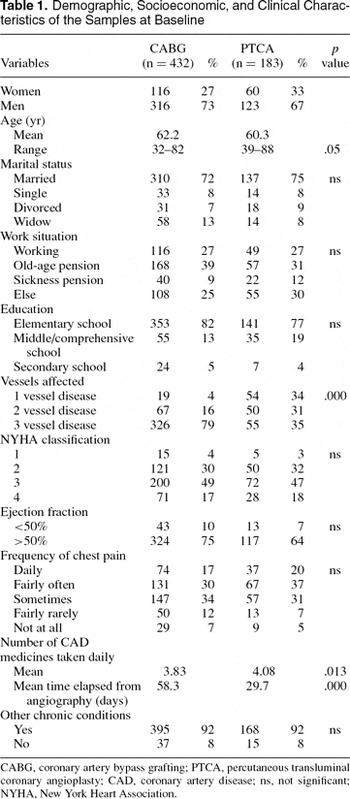
Between April 19, 1999, and September 30, 2000, from all consecutive CAD patients who were admitted to the Kuopio University Hospital to be treated with elective CABG (n = 1,037) or PTCA (n = 498), 463 consecutive CABG and 201 PTCA patients were invited to this study. A total of 31 CABG patients (7 percent) and 18 PTCA patients (9 percent) refused to participate due to tiredness, tension, or unwillingness to participate in any kind of study. The overall refusal rate was 7.4 percent. Thus, 615 patients, 432 (42 percent) CABG patients, and 183 (37 percent) PTCA patients, gave written consent to the study (Table 1). The patients in the original CABG group were a year older than in the research group (63.1 years in the original group, 62.2 in the research group). The proportion of women was similar in both groups (26 percent in the original group, 27 percent in the research group). Similar statistics are not available from the PTCA patient group. The treatment was authorized 1 to 3 months earlier on the basis of clinical data and angiography. The Ethical Committee of the hospital granted permission for the study. The patients were informed about the nature of the study and the follow-up data collection. Participation was completely voluntary in every phase of the study. The ethical principles for medical research involving human subjects were followed (35).

The patients were interviewed with a structured questionnaire a day before the procedure. These baseline interviews lasted from 40 minutes to 1.5 hours. In addition to HRQoL, the patients were asked about their demographic and socioeconomic characteristics, CAD-related symptoms, and comorbidities. The current CAD-related medication, left ventricular ejection fraction, the number of vessels affected by CAD, and New York Heart Association (NYHA) classification were obtained from the medical records. The follow-up questionnaires were mailed 6 months and 12 months after the treatment. The follow-up data were collected by phone interviews from 51 (12 percent) CABG patients and 18 (10 percent) PTCA patients, owing to their request. The same person (E.K.) carried out all phone interviews in a standardized manner with questionnaires, which were exactly similar to the mailed ones. The data collection came to an end on September 30, 2001.
HRQoL was measured by the 15D. It is a generic, multidimensional, standardized, self-administered instrument, which has both a profile and single index score property. Conceptually, the 15D subscribes to the definition of health by World Health Organization (WHO) as being composed of physical, mental, and social well-being. The dimensions of the 15D are (in parentheses are the abbreviations found in Figure 1): mobility (move), seeing (see), hearing (hear), breathing (breath), sleeping (sleep), eating (eat), speech (speech), elimination (elim), usual activities (uact), vitality (vital), mental function (mental), discomfort and symptoms (disco), depression (depr), distress (distr), and sexual activity (sex). Each dimension is divided into five levels, by which more or less of the attribute is distinguished (31).

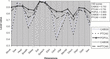
The mean 15D scores and profiles (mean scores on the dimensions) of the coronary artery bypass grafting (CABG) and percutaneous transluminal coronary angioplasty (PTCA) patients at baseline (CABG0 and PTCA0) and at 6 months after treatment (CABG6 and PTCA6), and of general population matched with the age and gender distribution of the patients (POPUL).
The valuation system of the 15D is based on an application of the multiattribute utility theory. A set of preference weights, elicited from the representative samples of general population through a three-stage valuation procedure with a combined rating scale and magnitude estimation method, is used in an additive aggregation formula to generate the 15D score (single index number) over all the dimensions. The maximum score is 1 (no problems on any dimension) and the minimum score is 0 (being dead; 31). A change of approximately ±0.03 in the score is clinically important (28). No clear guidance can be given on the clinically important change in dimension scores (level values). A natural unit would be a change from one level to another, but the distances between levels vary both within and across dimensions.
HRQoL of patients at baseline was compared with that of the general population measured by the 15D in the Finnish National Health Survey in 1995–96 (n = 2,943 in the age range of patients; 1). To allow comparison, the population sample was matched with the patients by weights reflecting the age and gender distribution of the patients.
When comparing the patient groups and the population sample cross-sectionally, independent samples t-test or 95 percent confidence interval (CI) was used for continuous variables, and Chi squared test for categorical variables. In addition to this strategy, stepwise linear regression analysis was used to explore whether there is a difference in the 15D score between the groups at baseline. When possible, differences in their socioeconomic and clinical characteristics were standardized. When comparing patients, who self-administered the follow-up questionnaire and who were interviewed by phone, Mann–Whitney U-test was used. Marginal homogeneity test was used to analyze whether the samples at 6 and 12 months after dropouts were similar to the original final samples. When comparing the HRQoL of the patient groups over time, paired samples t-test was used. Stepwise linear regression analysis was used to explore whether there is a difference in the 15D score between the groups at 6 and 12 months. When possible, differences in their socioeconomic and clinical characteristics and 15D scores at baseline were standardized. The follow-up results are presented with and without the patients, who died during the follow-up. When included, their 15D score is 0. A p value [les ].05 was regarded as statistically significant.
RESULTS
Table 1 shows the characteristics of the patients in both treatment groups at baseline. Apart from the average age (CABG 62.2 years, PTCA 60.3 years; p = .05), there was no statistically significant difference between the groups in the demographic and socioeconomic characteristics. The patients were mainly men (67–73 percent), married (72–75 percent), pensioners (43–48 percent), and with a low level of education (77–82 percent elementary school or less).
In terms of clinical characteristics, there was a statistically significant difference between the groups in the average number of vessels affected by CAD (CABG 2.75, PTCA 2.01; p < .0005), number of CAD medicines taken (CABG 3.83, PTCA 4.08; p = .013), and time elapsed from angiography (CABG 58.3 days, PTCA 29.7 days; p < .0005). There was no significant difference in the distribution of NYHA classification, frequency of chest pain, circumstances of its occurrence, use of nitro, the average cardiac ejection fraction, and whether or not the patients reported other chronic illnesses. In the CABG patients' group (PTCA patients), the most common comorbidities were high blood cholesterol 68 percent (68 percent), hypertension 45 percent (53 percent), diabetes mellitus 20 percent (24 percent), back pain 12 percent (20 percent), and ache in the joints 19 percent (12 percent).
At 6 months, 393 CABG patients (response rate 95 percent) participated in the study. The reasons for dropout were five had died (1.16 percent), six had moved (address unknown), twenty did not respond, and eight were rejected due to inadequate data. At 12 months, 343 CABG patients responded (response rate 89 percent). The reasons for further dropout were another three had died, forty did not respond, and seven were rejected. Thus, the total dropout rate was 20.6 percent. According to the marginal homogeneity test, the groups at 6 and 12 months did not differ from the original CABG group in the socioeconomic or clinical characteristics.
At 6 months, 153 PTCA patients participated in the study (response rate 92 percent). The reasons for dropout were one had died (0.55 percent), five had moved, two were not treated with PTCA (medical treatment), seven were treated with CABG, thirteen did not respond, and two were rejected. At 12 months, 141 PTCA patients responded (response rate 93 percent). The reasons for further dropout were another ten did not respond and two were rejected. The total dropout rate, thus, was 23 percent. According to the marginal homogeneity test, the groups at 6 and 12 months did not differ from the original PTCA group in the socioeconomic or clinical characteristics.
There was no difference in the 12-month mortality between the CABG and PTCA patients (two-sided Fischer's Exact Chi-squared test, p = .293). At 6 months, the CABG patients interviewed by phone were older than those who self-administered the questionnaire (66.8 versus 62.3 years; p = .004). The PTCA patients interviewed by phone had less occupational training than those who self-administered the questionnaire (67 percent; n = 12 with no occupational training versus 33 percent; n = 44; p = .035). There were no other differences between the phone interview patients and self-administered patients.
At baseline before the procedures, the average single index 15D score among the CABG and PTCA patients was 0.752 (95 percent CI, 0.743–0.761) and 0.730 (95 percent CI, 0.716–0.744), respectively. A comparison of the 15D profiles (mean scores on the dimensions) showed that there was a statistically significant difference between the groups only on the dimension of vitality, the PTCA patients being worse off. The average 15D scores of the patient groups were significantly (both statistically and clinically) worse than the average score of the general population sample (0.883, 95 percent CI, 0.879–0.887) matched with the gender and age distribution of the patient groups. A comparison of their 15D profiles showed that both CABG and the PTCA patients were at a statistically significantly lower level on all dimensions (except eating and hearing) than the general population, but both patient groups were better off on the dimensions of seeing and speech (Figure 1).
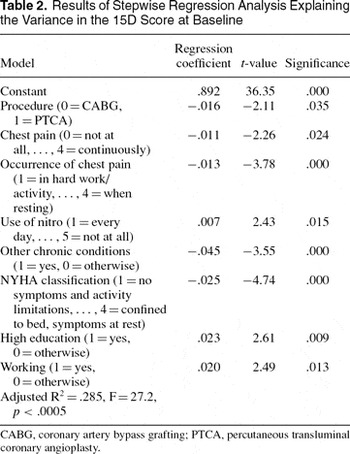
After controlling for the most relevant socioeconomic and clinical characteristics of the patients with a linear stepwise regression model, the difference in the 15D score between the groups (procedure) at baseline was statistically significant but not clinically important (Table 2). The group variable was not forced into the model. In addition to the variables in the model, the full pool of independent variables included age, gender, income, time from angiography, number of CAD-related medicines, number of vessels affected by CAD and experience of myocardial infarction.

The model suggests that, other things being equal, the more frequently and in lighter activity chest pain occurs, the lower the 15D score. Also more frequent use of nitro, comorbidities, and higher NYHA scores are associated with a lower 15D score. However, patients who are working and have higher education tend to have a higher 15D score, other things being equal.
At 6 months after the treatment, the CABG patients had experienced a statistically significant and clinically important improvement in the average 15D score to 0.858 (95 percent CI, 0.844–0.872). Approximately 82 percent of the patients experienced a clinically important improvement, and 6 percent a corresponding deterioration. When excluding the five patients who died before 6 months, the average 15D score was 0.869 (95 percent CI, 0.859–0.878). Regardless of whether the deceased patients were considered or not, there was a statistically significant improvement at 6 months on the dimensions of mobility, breathing, sleeping, usual activities, discomfort and symptoms, vitality, and sexual activity (Figure 1, the profiles at 6 months include the deceased patients). No significant change took place in the average 15D score or in the profile from 6 to 12 months (the average 15D score at 12 months was 0.853; 95 percent CI, 0.836–0.870). However, 26 percent of the CABG patients experienced a clinically important improvement in HRQoL, whereas another 26 percent a corresponding deterioration. When excluding the 8 deceased patients before 12 months, the mean 15D score was 0.873 (95 percent CI, 0.863–0.883).
At 6 months after the treatment, the PTCA patients had experienced a statistically significant and clinically important improvement in the average 15D score to 0.824 (95 percent CI, 0.806–0.842). A total of 78 percent of the patients experienced a clinically important improvement, and 7 percent a corresponding deterioration. When excluding the patient who died before 6 months, the average 15D score was 0.830 (95 percent CI, 0.815–0.844). Regardless of whether the deceased patient was included or not, there was a statistically significant improvement at 6 months on the dimensions of mobility, breathing, sleeping, usual activities, mental function, discomfort and symptoms, vitality, and sexual activity (Figure 1, the profiles at 6 months include the deceased patients). No significant change took place in the average 15D score or in the profile from 6 to 12 months (the average 15D score at 12 months was 0.822; 95 percent CI, 0.801–0.844). However, 36 percent of patients experienced a clinically important improvement in HRQoL (in comparison to the CABG patients, this is statistically significantly higher), and 29 percent a corresponding deterioration. When excluding the patient who died before 12 months, the mean 15D score was 0.828 (95 percent CI, 0.810–0.846). There was no statistically significant difference between the CABG and PTCA patients, whose HRQoL improved or deteriorated to the extent that was clinically important.
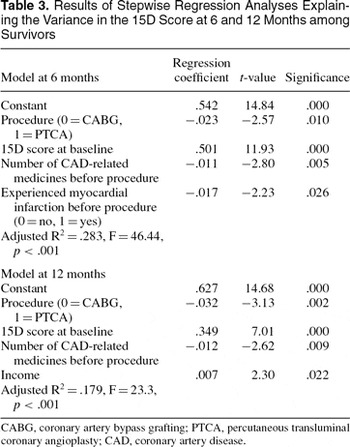
Table 3 shows the results of stepwise regression analyses explaining the variance in the 15D score at 6 and 12 months among survivors. The full pool of independent variables was the same as in the baseline regression and the group variable (procedure) was not forced into the models. After controlling the baseline 15D score and the most relevant socioeconomic and clinical characteristics of the patients, PTCA seems to bring about a smaller change in the 15D score at 6 and 12 month than CABG. At both points of time, the difference is statistically significant, and at 12 months also clinically important. The 15D score at baseline seems to be the single most powerful predictor of the score at 6 and 12 months. A difference of 0.1 in the baseline score is associated with a difference of 0.0501 and 0.0349 at 6 and 12 months, respectively. The increasing number of CAD-related medicines before the procedure seems to predict a successively worse HRQoL at both points of follow-up. The experience of myocardial infarction before the procedure seems to predict a worse HRQoL at 6 months but not to the extent that is clinically important (Table 3).

DISCUSSION
A compelling feature of our study is the longitudinal data, because the majority of publications on the measurement properties of HRQoL instruments have been based on cross-sectional studies. The baseline data were collected mainly by personal face-to-face interviews, partly from medical records. The follow-up HRQoL data were collected by mailed self-administered questionnaires, but a small minority was interviewed by phone due to personal request. This minority did not differ from the rest in any essential respect. The same person carried out all interviews, so there is no interinterviewer variability.
HRQoL was measured by the 15D because of its capability of being used as a profile and single index measure. Another reason was the possibility to compare the HRQoL of the patient groups with that of the general population measured also by the 15D in the Finnish National Health Survey.
The instrument is easy to use in self-administered surveys, the response rates have been high, and missing value rates low, and these findings proved to be the case also in this study. In terms of discriminatory power and responsiveness to change, the 15D has been shown to be superior to other generic HRQoL instruments available in Finnish (29;30). The comparisons between the patient groups and the general population, the follow-up of patients over time indicated that these properties were evident also in this study. A comparison in this respect with a disease-specific instrument such as, for example, Seattle Angina Questionnaire (SAQ; 32) would have been interesting, but the SAQ was not available in Finnish when designing this study.
In this study, the treatment modality, CABG or PTCA, was not chosen at random, but the decision on the treatment was made on the basis of clinical findings in angiography. There was a statistically significant difference between the groups at baseline in age and in some clinical characteristics such as average number of vessels affected, number of CAD medicines taken, and time elapsed from angiography. However, these variables did not turn out to be significant explanatory factors for the variance in HRQoL at baseline measured by the 15D. After adjusting for socioeconomic and clinical characteristics of the patients, there was a statistically significant but not clinically important difference between the groups in the baseline 15D score. In the 15D profile, there was a significant difference only on the dimension of vitality (cf. 36).
The CABG and PTCA patients were at baseline considerably worse off in HRQoL than the general population sample matched with the gender and age distribution of the patient groups (the average 15D scores 0.752, 0.730, and 0.912, respectively). A comparison of the 15D profiles showed that both CABG and PTCA patients were at a statistically significantly lower level on all dimensions (except eating and hearing) than the general population, but both patient groups were better off on the dimensions of seeing and speech. It is hard to find any other logical explanation why the patient groups were better off on these dimensions, other that by a statistical chance, unless the patients overestimate their status on the dimensions, which are not at least directly connected with their CAD-related health problems.
In the 12-month follow-up, the dropout rate was 20.6 percent and 23 percent in the CABG and PTCA groups, respectively. However, marginal homogeneity tests indicated that the groups at 6 and 12 months did not differ from the original CABG group in the socioeconomic or clinical characteristics. Thus, the missing data are sufficiently at random, and the analyses based on observations available at 6 and 12 months are not biased due to dropout.
On average, a statistically significant and clinically important improvement in HRQoL took place in both patient groups from baseline to 6 months. Even after controlling the baseline 15D score and the most relevant socioeconomic and clinical characteristics of the patients, there was no clinically important difference in the improvement between the groups, the change for better being approximately 0.1. To reflect this change on the 0–1 scale of the 15D in perspective, newly diagnosed asthma patients experienced an average improvement of 0.04 in a 1-year follow-up (13), hip and knee replacement patients an improvement of 0.055–0.07 in a 6-month follow-up (23), and gastrointestinal surgery patients an improvement of 0.02 in a 1-year follow-up (25).
In both treatment groups, the improvement took place on the dimensions of mobility, breathing, sleeping, usual activities, discomfort and symptoms, vitality, and sexual activity, and in the PTCA group, also in mental function. In the CABRI trials, the improvement concerning family life and social and sexual life was not significant in either group (CABG or PTCA; 36).
Observing the groups separately, no further significant change took place in the average 15D score by 12 months, but yet 26–36 percent of the patients experienced either a clinically important improvement or deterioration. In the CABRI trials, the deterioration figures were 3–12 percent measured by the NHP Part 2 (36). However, after controlling the baseline 15D score and the most relevant socioeconomic and clinical characteristics of the patients, the results suggest that, in the PTCA group, the improvement from baseline to 12 months is smaller than the extent that is clinically important. Papadantonaki et al. (20) found a significantly greater improvement in quality of life among PTCA patients, but the study samples were small (44 CABG and 32 PTCA patients) and the follow-up time of 3 weeks is not comparable to this study.
The findings of this study confirm the results of previous studies that both interventions improve HRQoL in a 1-year follow-up, and in this respect, there are no great differences between the interventions (18;21;36), at least in the short run. There was no statistically significant difference between the patient groups in 1-year mortality. The findings of CABRI trials were similar (36). No conclusions can be drawn on the basis of this study on the longer-term relative benefits of these treatments in terms of HRQoL or mortality—a longer follow-up is required.
CONCLUSIONS
There was no clinically important difference in the HRQoL between CABG and PTCA patients before the procedures, but the patients were considerably worse off than the age- and gender-matched general population. By 6 months after the procedure, both patient groups experienced on average a similar, clinically important improvement of approximately 0.1, but no further significant change took place from 6 to 12 months.
Policy Implications
The present findings suggest that, in terms of HRQoL, it remains for the doctors and patients to choose which mode of revascularization will be adopted. Furthermore, the long-term HRQoL results of the both types of procedures will be seen within 6 months, which facilitates a prompt decision making on ability to work and on the need for rehabilitation.
CONTACT INFORMATION
Eija Kattainen, RN, PhD (eija.kattainen@dnainternet.net), Researcher, Department of Nursing Science, University of Kuopio, P.O. Box 1627, FIN-70211 Kuopio, Finland
Harri Sintonen, PhD (harri.sintonen@helsinki.fi), Department of Public Health, University of Helsinki, Mannerheimintie 172, 00300 Helsinki, Finland; Research Professor, FinOHTA, STAKES, Lintulahdenkuja 4, 00530 Helsinki, Finland
Raimo Kettunen, MD, PhD (raimo.kettunen@phks.fi), Docent (Associate Professor), Department of Cardiology, Kuopio University Hospital, P.O. Box 1627, FIN-70211 Kuopio, Finland; Chief Physician, Department of Internal Medicine, Päijät-Häme Central Hospital, Keskussairaalankatu 7, FIN-15850 Lahti, Finland
Pirkko Meriläinen, RN, PhD (pirkko.merilainen@uku.fi), Professor (emerita), Deparmtnet of Nursing Science, University of Kuopio, P.O. Box 1627, FIN-70211 Kuopio, Finland
This study was supported by the University of Kuopio, Finnish Postgraduate School in Nursing Science, the Finnish Heart Foundation, the University Hospital of Kuopio with EVO–financier, Finnish Konkordia Association, the Cultural Foundation of North Savo, Foundation for Nursing Education, and the Finnish Association of Caring Sciences. The authors thank MSc, Statistician Veikko Jokela for statistical advice.
References
Arinen S,
Häkkinen U,
Klaukka T, et al.
1998:
Suomalaisten terveys ja terveyspalvelujen käyttö [Health and use of health care services of Finnish people].
Terveys.
5.
Artinian NT,
Duggan CH.
1995
Sex differences in patient recovery patterns after coronary artery bypass surgery.
Heart Lung.
24:
483–
494.Google Scholar
BARI Investigators.
1997
Five-year clinical and functional outcome comparing bypass surgery and angioplasty in patients with multivessel coronary disease. A multicenter randomized trial.
JAMA.
9:
715–
721.
Brorsson B,
Bernstein SJ,
Brook RH,
Werko L.
2002
Quality of life of patients with chronic stable angina before and four years after coronary revascularisation compared with normal population.
Heart.
87:
140–
145.Google Scholar
Dimopoulou I,
Anthi A,
Michalis A,
Tzelepis GE.
2001
Functional status and quality of life in long-term survivors of cardiac arrest after cardiac surgery.
Crit Care Med.
29:
1408–
1411.Google Scholar
Edell-Gustafsson U.
1999
Sleep, psychological symptoms and quality of life in patients undergoing coronary artery bypass grafting.
Linköping University Medical Dissertations No 584.
10–
11.
Engblom E,
Korpilahti K,
Hämäläinen H,
Ronnemaa T,
Puukka P.
1997
Quality of life and return to work 5 years after coronary artery bypass surgery: Long term results of cardiac rehabilitation.
J Cardiopulm Rehabil.
17:
29–
36.Google Scholar
Finnish Heart Association.
2001
Sydänleikkausrekisteri.
[Finnish Heart Surgery Register 2001].
Heikkilä J.
1992
Sepelvaltimotaudin esiintyvyys, kehityssuunnat, vaaratekijät ja ehkäisyn mahdollisuudet. [Incidence, developmental trends, risk factors and possible prevention of coronary artery disease].
Suom Laakaril.
15:
1413–
1417.Google Scholar
Herlitz J,
Wiklund I,
Sjöland H, et al.
2000
Impact of age on improvement in health related quality of life 5 years after coronary artery bypass grafting.
Scand J Rehabil Med.
32:
41–
48.Google Scholar
Hunt JO,
Hendrata MV,
Myles PS.
2000
Quality of life 12 months after coronary artery bypass grafting surgery.
Heart Lung.
29:
401–
411.Google Scholar
Jennings PM,
Staggers N,
Brosch LR.
1999
A classification scheme for outcome indicators.
J Nurs Schol.
31:
381–
388.Google Scholar
Kauppinen R,
Sintonen H,
Tukiainen H.
1998
One-year economic evaluation of intensive vs. conventional patient education and supervision for self-management of new asthmatic patients.
Respir Med.
98:
300–
307.Google Scholar
Kiebzak GM,
Pierson LM,
Cambell MBS,
Cook JW.
2002
Use of the SF-36 general health status survey health-related quality of life in patients with coronary artery disease: Effect of disease and response to coronary artery bypass graft surgery.
Heart Lung.
31:
207–
213.Google Scholar
Kind P.
2001
Measuring quality of life in evaluating clinical interventions: An overview.
Ann Med.
33:
323–
327.Google Scholar
King KB,
Porter LA,
Rowe MA.
1994
Functional, social, and emotional outcomes in women and men in the first year following coronary artery bypass surgery.
J Womens Health.
3:
347–
354.Google Scholar
Lukkarinen H.
1998
Quality of life in coronary artery disease.
Nurs Res.
47:
337–
343.Google Scholar
Lukkarinen H,
Hentinen M.
1998
Assessment of quality of life with the Nottingham Health Profile among patients with coronary heart disease.
Heart Lung.
27:
189–
199.Google Scholar
Moore SM,
Dolansky MA.
2001
Randomized trial of home recovery intervention following coronary artery bypass surgery.
Res Nurs Health.
24:
93–
104.Google Scholar
Papadantonaki A,
Stotts NA,
Paul SM.
1994
Comparison of quality of life before and after coronary artery bypass surgery and percutaneous transluminal angioplasty.
Heart Lung.
23:
45–
52.Google Scholar
Pocock ST,
Henderson RA,
Seed P,
Treasure T,
Hampton JR.
1996
Quality of life, employment status, and anginal symptoms after coronary angioplasty or bypass surgery. 3-year follow-up in randomised intervention treatment of angina (RITA) trial.
Circulation.
94:
135–
142.Google Scholar
Redeker NS,
Mason DJ,
Wykpisz E,
Glica B.
1995
Women's patterns of activity over 6 months after coronary artery bypass surgery.
Heart Lung.
24:
502–
511.Google Scholar
Rissanen P,
Aro S,
Sintonen H,
Slätis P,
Paavolainen P.
1996
Quality of life and functional ability in hip and knee replacements. A prospective study.
Qual Life Res.
5:
56–
64.Google Scholar
Ross AC,
Ostrow L.
2001
Subjectively perceived quality of life after coronary artery bypass surgery.
Am J Crit Care.
10:
11–
16.Google Scholar
Räsänen JV,
Niskanen MM,
Miettinen P,
Sintonen H,
Alhava E.
2001
Health-related quality of life before and after gastrointestinal surgery.
Eur J Surg.
167:
419–
425.Google Scholar
Schipper H,
Clinch JJ,
Olweny CLM.
1996
Quality of life studies: Definitions and conceptual issues.
In: Spilker B, ed.
Quality of life and pharmacoeconomics in clinical trials.
2nd ed.
Philadelphia:
Lippincott-Raven Publishers
11–
23.
Seymour Route PA.
2001
Patients' expected and actual functional status after coronary artery bypass graft surgery.
University of Massachusetts Amherst.
Abstract.
Sintonen H.
1994
Outcome measurements in acid-related diseases.
Pharmacoeconomics.
5:
17–
26.Google Scholar
Sintonen H.
1994b
The 15D-measure of health-related quality of life. Reliability, validity and sensitivity of its health state descriptive system.
National Centre for Health Program Evaluation, Working paper.
Melbourne.
41.
Available at: http://chpe.buseco.monash.edu.au.
Sintonen H.
1995
The 15D-measure of health-related quality of life. II. Feasibility, reliability and validity of its valuation system.
National Centre for Health Program Evaluation, Working paper.
Melbourne.
42.
Available at: http://chpe.buseco.monash.edu.au.
Sintonen H.
2001
The 15D instrument of health-related quality of life: Properties and applications.
Ann Med.
33:
328–
335.Google Scholar
Spertus JA,
Winder JA,
Dewhurst TA, et al.
1995
Development and evaluation of the Seattle Angina Questionnaire, a new functional status measure for coronary artery disease.
J Am Coll Cardiol.
25:
333–
241.Google Scholar
Statistics Finland 2002. Available at: http://www.tilastokeskus.fi. Accessed: August 30, 2003.
Wenger NK,
Naughton MJ,
Furberg CD.
1996
Cardiovascular disorders.
In: Spilker B, ed.
Quality of life and pharmacoeconomics in clinical trials.
2nd ed.
Philadelphia:
Lippincott-Raven Publishers
883–
891.
World Medical Association Declaration of Helsinki.
2003
Ethical principles for medical research involving human subjects. 1964.
Available at: http://www.wma.net/e/policy/17-c_e.html. Accessed: January 15
Währborg P.
1999
Quality of life after coronary angioplasty or bypass surgery. One-year follow-up in the coronary angioplasty versus bypass revascularization investigation (CABRI) trial.
Eur Heart J.
20:
653–
658.Google Scholar
Demographic, Socioeconomic, and Clinical Characteristics of the Samples at Baseline
The mean 15D scores and profiles (mean scores on the dimensions) of the coronary artery bypass grafting (CABG) and percutaneous transluminal coronary angioplasty (PTCA) patients at baseline (CABG0 and PTCA0) and at 6 months after treatment (CABG6 and PTCA6), and of general population matched with the age and gender distribution of the patients (POPUL).
Results of Stepwise Regression Analysis Explaining the Variance in the 15D Score at Baseline
Results of Stepwise Regression Analyses Explaining the Variance in the 15D Score at 6 and 12 Months among Survivors
 You have
Access
- 28
- Cited by