At least partially in response to Donald Trump’s 2016 presidential election (Jordan and Balz Reference Jordan and Balz2018), 2018 witnessed a record number of women running for and winning legislative elections across the country. This candidacy surge affords a unique opportunity to evaluate why individuals choose to run for office. Extant literature identifies both individual- and institutional-level determinants of candidate entry, yet little attention has been given to a critical institutional feature that can encourage or discourage women to put their names forward: primary type. This article develops a model of candidate emergence positing that different primary systems—by virtue of including and excluding the participation of various subpopulations of a state’s electorate—will be more or less attractive to potential female candidates relative to potential male candidates. We uncover evidence consistent with our theory: women appear less interested in running in certain types of primaries (e.g., semi-closed) but find other systems more appealing (e.g., nonpartisan). The results also indicate that after considering primary type, women tend to outperform men in the subsequent general election across the board. This study provides encouraging evidence that closing the representation gap is an increasingly achievable goal but that the rules of the electoral game continue to determine who is playing.
The research is clear: when women run for office, they win as much as men do. In 2018, women did run—more than 4,000 women filed paperwork to run for Congress and the state legislatures (Center for American Women and Politics 2018), resulting in the highest ever number of female victors. Therefore, 2018 represents a unique opportunity to assess the effect of electoral institutions on women’s choices to run. We know that many women who ran stated that they did so because of anger with Trump’s 2016 victory (Jordan and Balz Reference Jordan and Balz2018). In this environment, did the specific reasons that these particular women chose to run at that time “trump” institutional factors such as primary-election type?
Critically, we know little of how institutional differences across states condition the likelihood that women and men run for office; however, these dynamics likely contribute to the gender gap in representation that persists despite the success women now have when they do run. Using 2018 state legislative primary-election data, we develop an institutions-based model of candidate emergence, positing that different types of primary systems will be more or less likely to attract female versus male candidates, ultimately influencing their electoral success.
ELECTION RESULTS IN BRIEF
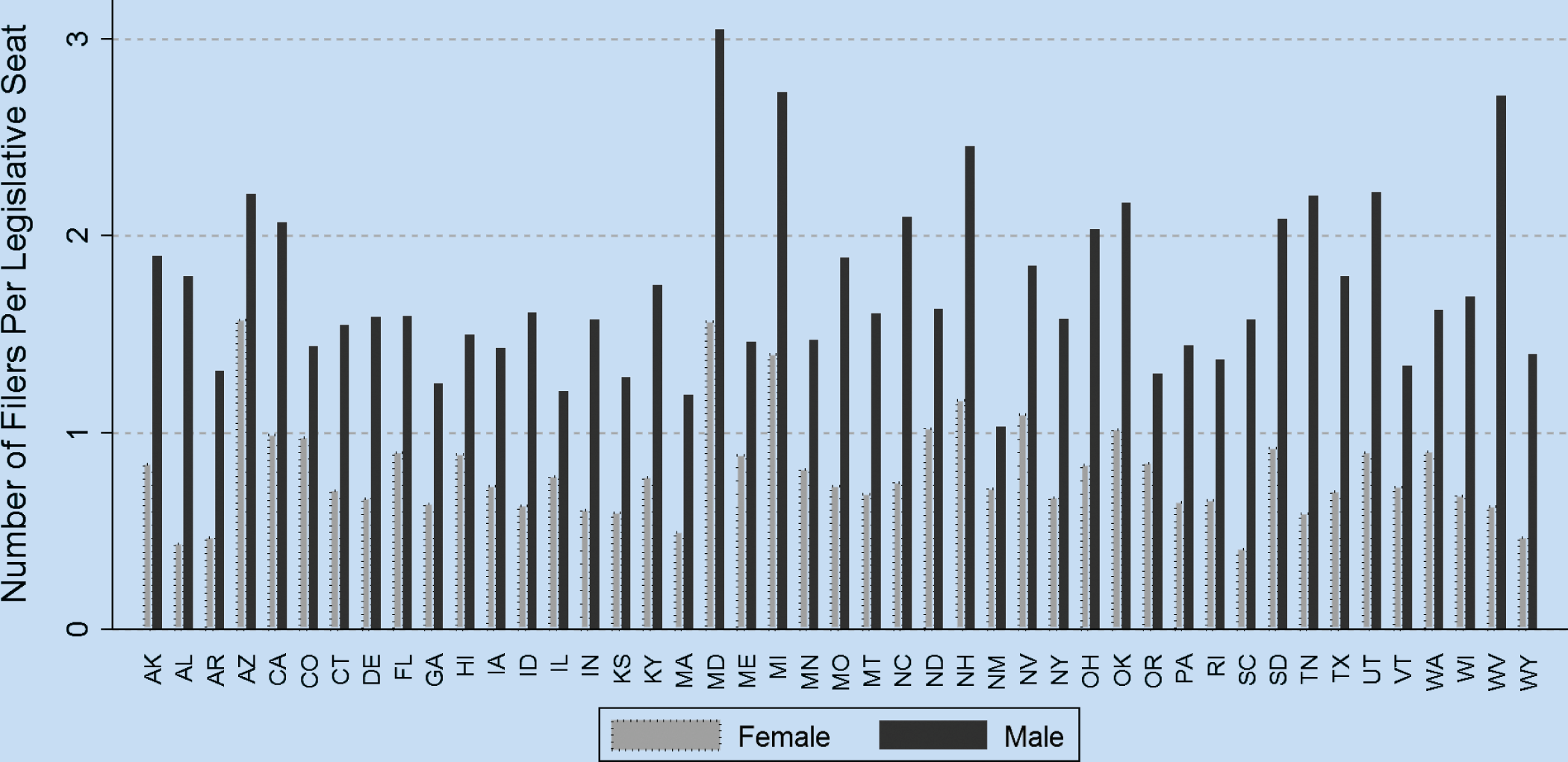
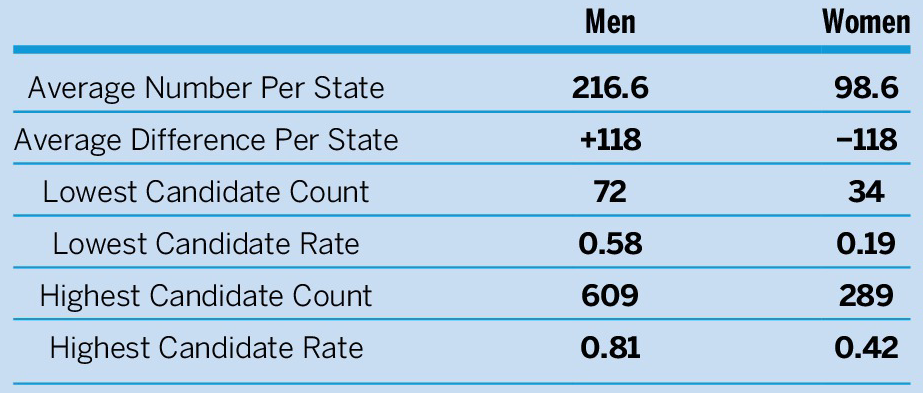
Coverage of the 2018 elections emphasized the historic numbers of women running for and winning office, including a first-ever women-majority legislature in Nevada. For all of the attention given to the number of female candidates, however, they still have not achieved electoral parity. Figure 1 and table 1 illustrate gender-based differences in candidates across the 45 states that held legislative elections in 2018. The candidate counts reflect the total number of individuals across all major parties who filed paperwork to run for a seat (upper or lower chamber) in the state legislature.Footnote Not surprisingly, the number of male candidates per legislative race was higher than the number of female candidates in every state. Indeed, on average, there were roughly twice as many male as female candidates across all seats. Thus, as encouraging as the 2018 election results were, candidate entry data tells a different story about the state of electoral opportunity for female candidates.
Number of Female and Male Candidates by State (Major Parties Only)

Gender-Based Differences in 2018 State Legislative Candidate Pools (Major Parties Only)

PRIMARY TYPES AND CANDIDATE EMERGENCE AND SUCCESS
Much ink has been spilled examining the disparity of representation between men and women in elective office. When considering whether to take on the cost and commitment required to run for an office, a rational individual is more likely to engage when the political and situational conditions are favorable. For instance, potential candidates consider factors such as whether the position is currently held by an incumbent, how highly professionalized the legislature is, how desirable the legislative service is, state term-limit requirements, partisan composition of the electorate, and party of the candidate compared to the incumbent (Black Reference Black1972; Diamond Reference Diamond1977; Kazee Reference Kazee and Kazee1994; Moncrief, Squire, and Jewell Reference Moncrief, Squire and Jewell2001; Rohde Reference Rohde1979; Schlesinger Reference Schlesinger1966; Stone and Maisel Reference Stone and Maisel2003). Yet, women must consider additional factors, such as questions concerning their qualifications for office, sexism, and gender stereotypes held by both the electorate and the political parties, as well as constraining institutional features inherent to the political system they seek to enter (Norris Reference Norris1997).
Explanations for the gender gap in legislatures can be organized in three categories. The first category includes candidate-centric variables: a priori, women tend to be less interested in running for office, often as a result of, among other things: (1) lower levels of interest in campaigning tasks such as fundraising (Jenkins Reference Jenkins2007); (2) perceptions that they are not qualified (Fox and Lawless Reference Fox and Lawless2003; Kanthak and Woon Reference Kanthak and Woon2015); (3) familial obligations (Fox and Lawless Reference Fox and Lawless2003); and (4) because no one asks them to (Carroll and Sanbonmatsu Reference Carroll and Sanbonmatsu2013; Lawless and Fox Reference Lawless and Fox2010). The second category of factors concerns a lack of external support by an historically biased electorate (Ambrosius and Welch Reference Ambrosius and Welch1984) and disinterested political parties that may ignore female candidates whom they believe would struggle to raise campaign funds (Hamm et al. Reference Hamm, Olson, Moncrief, Thompson, Moncrief and Thompson1992; Sanbonmatsu Reference Sanbonmatsu2002).
Powerful as these explanations are, it also is important to consider the third category: institutional factors that shape candidate fields. For instance, potential female candidates are limited by the incumbency advantage that, by definition, favors individuals who have already earned a seat in elected office—usually men (Carroll Reference Carroll1994; Herrick Reference Herrick1996). Indeed, female candidates tend to have more success running in open-seat or multimember district (MMD) elections (Pritchard Reference Pritchard1992; Welch et al. Reference Welch, Ambrosius, Clark and Darcy1985). Similarly, restrictive ballot-access rules such as high filing fees (Mitchell Reference Mitchell2014) naturally favor those politicians—usually men—who have an easier time curating competitive campaigns. The scholarly consensus is that potential women candidates are constrained by a social and electoral environment that historically has not been supportive of their candidacies, as well as institutional forces that tend to benefit the existing political class dominated by men.
We posit that strategic considerations by potential candidates concerning seat accessibility also are shaped by the type of primary election in which candidates must compete.We posit that strategic considerations by potential candidates concerning seat accessibility also are shaped by the type of primary election in which candidates must compete.
Different primary systems produce different electorates to which candidates must appeal. For instance, a closed primary restricts participation to voters formally affiliated with a particular party; other individuals are not permitted to vote. Conversely, an open primary permits all registered voters from all parties to participate in an election. Imagine a candidate trying to hone a message and campaign strategy in a closed-primary versus an open-primary state. A closed-primary state may compel that candidate to cater purely to partisan interests—and perhaps even pitch a more ideologically extreme policy agenda (Brady, Han, and Pope Reference Brady, Han and Pope2007). Conversely, if that same candidate were competing in an open primary, she may conclude that a less partisan, more moderate appeal is prudent for attracting casual partisans or voters who are entirely unaffiliated.
Such strategic considerations are relevant to all candidates; however, we argue that women face a unique situation punctuated by two questions for which male candidates usually do not need to be concerned. First, female candidates often are perceived as being the “ultimate political outsiders” (Sanbonmatsu Reference Sanbonmatsu2002) because they are not prototypical candidates in the historically male-dominated institutions for which they are running. As such, they must ask themselves: Can I appeal to outsiders as an outsider myself? In other words, can they appeal to a segment of the electorate that does not consist of party regulars and for which an outsider candidate may be an attractive option?
If the size and composition of the eligible electorate vary by primary type, women may perceive certain electoral contexts to be more conducive to an outsider winning.Footnote 2 In a purely open primary, the process of convincing outsider-type individuals to vote is significantly easier because these voters face few barriers to participation. Conversely, a fully closed primary is much less friendly to outsider voters, limiting the potential for outsider candidates to benefit from that shared status with like-minded voters. Primaries that lie somewhere between these two types facilitate the participation of various outsider groups: that is, semi-open primaries allow partisans to cross over but do not allow undeclared voters to participate; semi-closed systems allow the opposite. In short, the potential for building a coalition of “outsiders” depends heavily on whether and which outsiders are eligible to participate in a primary election.
Although district composition matters considerably, there is a second relevant question that female candidates must ask: How many potential voters must I ask? In other words, how far does a woman need to extend herself to contact and communicate with potential voters whom she needs to vote for her? Women are less likely than men to ask for things due largely to early-age socialization and cultural penalties for doing so (Babcock and Laschever Reference Babcock and Laschever2003; Reference Babcock and Laschever2007). Each primary system varies in the level of “asking” required to campaign. For instance, in semi-open primaries, candidates must ask voters to engage in multiple actions: first, voters must be asked to participate in a particular party’s primary; and, second, they must be asked to vote for a particular primary candidate. In open elections, in which voters of all political affiliations are eligible to vote, there are considerably more people to ask than in a closed system that excludes large swaths of the electorate from voting at all. Because “asking” may not come as naturally to female candidates, primary systems that produce high numbers of eligible voters and/or require multiple rounds of asking may be less appealing to women considering a run for office.
If women (1) tend to be considered outsiders, and (2) are less likely to ask, then which primary types are most conducive to female candidate emergence? We posit that semi-closed primaries represent the most fertile electoral ground for them because these contests provide an ideal scenario for women vis-à-vis the two questions posed previously: that is, semi-closed systems simultaneously facilitate participation from unaffiliated (outsider) voters and also limit the amount of asking required by barring the participation of partisans from the other party.
In this way, female candidates may enjoy the best of both worlds: they may be able to capitalize on their outsider status by targeting independent voters while also not enduring heavy amounts of asking that would be required in more open-primary systems.
In this way, female candidates may enjoy the best of both worlds: they may be able to capitalize on their outsider status by targeting independent voters while also not enduring heavy amounts of asking that would be required in more open-primary systems. Formally, we expect to observe the following:
Hypothesis 1: Ceteris paribus, women are more likely to run for office in semi-closed primary systems relative to other types of primary systems.
If some primary systems are better for women, then others—by definition—are better for men. We posit that the semi-open primary system may be the most attractive system for male candidates because it excludes undeclared outsider voters but invites partisans from other parties to participate—if the candidates are willing to ask. Both of these rules—excluding outsider voters and a high burden of asking—should be less appealing to women. Thus, we expect the following:
Hypothesis 2: Ceteris paribus, women are less likely to run for office in semi-open primary systems relative to other types of primary systems.
Whereas increasing the number of women running for office is a crucial first step, female candidates also must win to narrow the representation gap in state legislatures. To make it through the primary process, women must be willing to endure greater challenges relative to their male counterparts (Lawless and Pearson Reference Lawless and Pearson2008). As such, women who win their primary-election battles are more likely than men to have electoral experience and an aptitude for fundraising (Pearson and McGhee Reference Pearson and McGhee2004); in short, they have to be “better” to fare equally (Lawless and Pearson Reference Lawless and Pearson2008). Furthermore, when a candidate wins a party nomination, many institutionalized benefits automatically become available, making gender less of a factor in general elections than in primary elections. As such, the primary type in which they emerged as a candidate should differentially influence the degree of electoral success women experience in general elections. In other words, if the women who ran in 2018 ran only when entering a primary was relatively easy, the ultimate effect of their record number on women’s actual representation would be minimal.
Hypothesis 3: Ceteris paribus, female candidates will garner a higher vote share in semi-closed–primary systems than male candidates.
Hypothesis 4: Ceteris paribus, male candidates will garner a higher vote share in semi-open–primary systems than female candidates.
DATA AND METHODS
To examine the effects of primary type on the decision to run for office, we considered the emergence of all candidates who sought major party nominations via the primary process in 87 state legislative chambers holding elections in 2018.Footnote 3 Because we are interested in better understanding the larger number of candidates—particularly women—emerging in 2018, we counted the number of candidates who emerged under various institutional structures. Therefore, our key dependent variable was the number of women and men (i.e., # of female/male candidates) who ran under various primary systems. Our key independent variables of interest were the various types of primaries—semi-closed, semi-open, and closed (with purely open primaries as the omitted category). We also included nonpartisan and open-to-unaffiliated primaries for comparison. Finally, we included an array of ancillary control variables.Footnote 4
RESULTS
Results from analysis examining the emergence of candidates under differing primary types, as well as the success of these candidates in their respective primaries, are discussed in this section.
Candidate Emergence
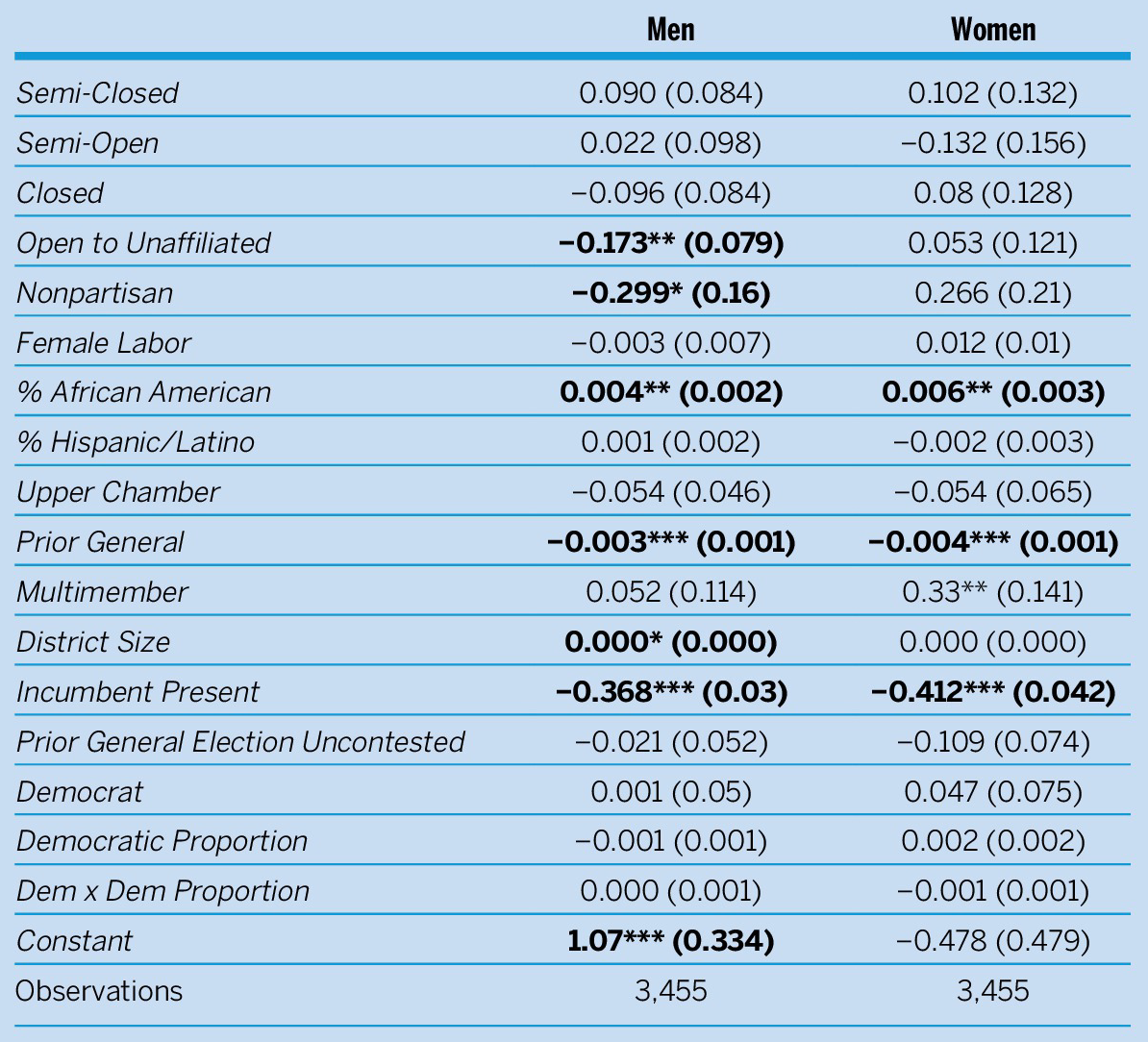
Table 2 lists the results of two Poisson models, with the count of female and male candidates estimated separately.Footnote 5 All coefficients are relative to the baseline category (i.e., open primaries). Directionally, the effects for women are consistent with our hypothesis: women are less likely to emerge in semi-open primaries, although the coefficient is not quite significant. Critically, however, a similar decrease for men in semi-open primaries does not occur, which is consistent with our expectation that this system is particularly suited to individuals more comfortable with asking voters for support. Similarly, the coefficient is positive for semi-closed systems, in line with our expectations but, again, not achieving significance.
Candidate Success and State Primary Type

Notes: Estimates for Poisson models for the number of female and male candidates (estimated separately). Standard errors, clustered by state, are in parentheses. ***p<0.01, **p<0.05, *p<0.1.
Several other results emerge as well.Footnote 6 Most notably, nonpartisan primaries in 2018 appeared to demobilize male candidates but not female candidates. Given the relative paucity of nonpartisan primary elections—only the Democratic strongholds of California and Washington used them in 2018—such results must be interpreted cautiously. However, given the evidence that parties historically have neglected female candidates, the data are consistent with the possibility that male candidates are less keen on running for office in states where party infrastructure may not be as easily accessible. Women, meanwhile, may not be so deterred in nonpartisan primaries because these contests represent the ultimate opportunity for political outsiders, albeit with considerable “asking” required.
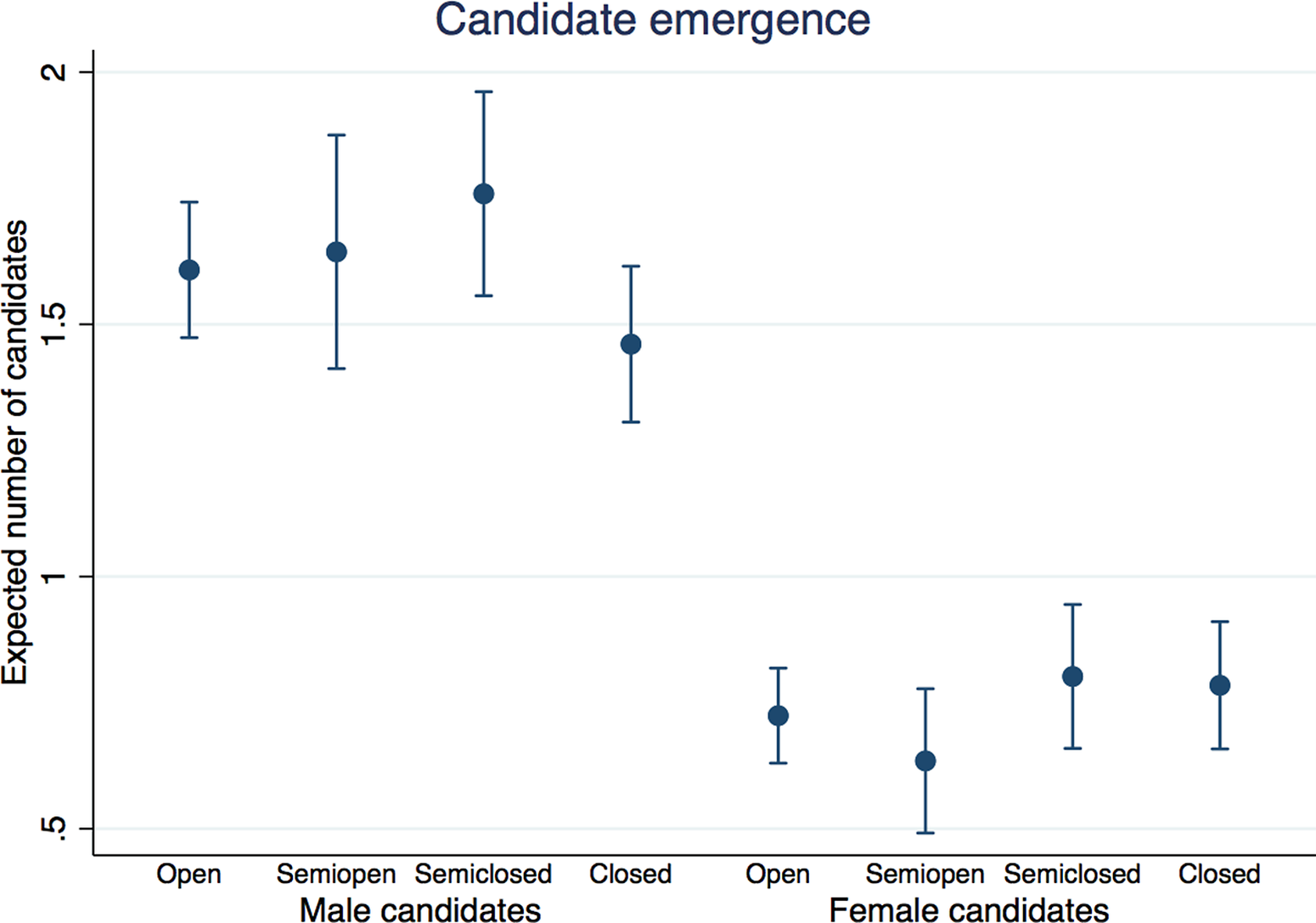
Figure 2 translates these statistical effects into predicted probabilities. Across all primaries, the number of male candidates is—not surprisingly—significantly higher than the number of female candidates for each primary type. Substantively, the results also provide support for our theory: that is, directionally but not statistically consistent with hypothesis 1, semi-closed primaries yield the greatest number of female candidates. Similarly, consistent with hypothesis 2 directionally but not quite statistically significantly, semi-open primaries yield the fewest women candidates.
Predicted Probabilities of Candidate Emergence

Several key factors must be recognized concerning the absence of statistical significance for female candidates. First, the scope of this study is limited to one election cycle. Consequently, our results are (1) limited in the number of cases available, and (2) subject to idiosyncratic forces at work in 2018. Both considerations increase the likelihood that we falsely accept a null hypothesis (i.e., Type II error). To clarify this point, we calculated the statistical power of our sample to assess its potential to accurately detect meaningful effects if they exist. Given our effect size and our standard deviation, we would require more than 78,000 observations to achieve the desired power of 0.8 (following common convention). Because the scope of this study was limited to 2018, it is possible that some of our null findings may be attributable not to the absence of an effect but rather a finite ability to detect it. We anticipate that expanding the dataset to evaluate additional election cycles may yield additional useful results in the future.
Second, the findings also may reflect a genuinely modest effect. However, even small effects at the individual-district level—when aggregated with other districts and states—may have a substantive effect on representation overall. For example, Nevada’s 63-seat legislature is 50.8% female—one or two individuals made the difference in achieving this first-ever female majority. Our data indicate that moving from a closed primary to a semi-closed primary would yield an expected increase of 0.01 female candidates in a district. Although this is a small effect in one district, suppose we implemented semi-closed primaries nationally: with more than 7,000 state legislative districts, we would expect a result of approximately 70 new female candidates running for office.
Candidate Success
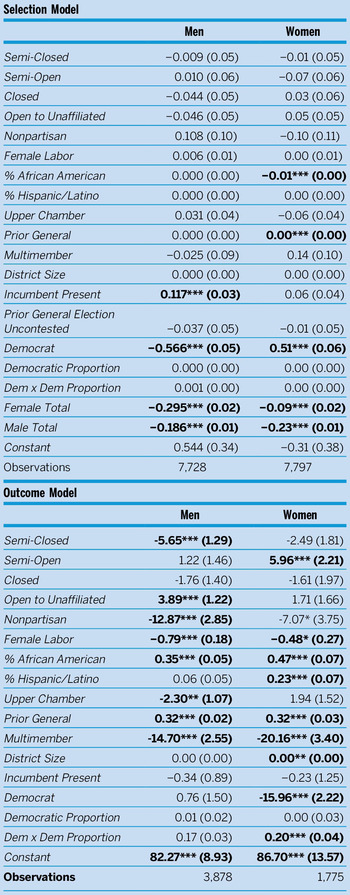
We also are interested in determining the effects of primary type on electoral support for male and female candidates. However, we cannot simply compare the success of women in the election with the success of their male counterparts because of the selection bias inherent in the previous results: women are less likely to run. Selection bias occurs when a phenomenon that is relevant to the model we are trying to estimate affects whether a particular observation is observed in the first place. In our case, candidates in the general election literally are selected in the primary election, and primary-election outcomes are determined by some of the same factors that determine general-election outcomes. In other words, we never observe the general-election performance of some potential candidates because they were selected out in the primary—in all likelihood, many of those candidates would have performed poorly in the general election. Ignoring this selection mechanism, therefore, would bias our estimates of the effects of these factors on general-election results. Therefore, we used a Heckman two-stage selection specification in which the dependent variable in the first stage is whether the candidate won their primary election contest and in the second stage is the vote share garnered by the candidate. The results are shown in table 3.Footnote 7
Candidate Success and State Primary Type

Notes: The selection stage of the Heckman model considers whether candidates won their primary-election contest, whereas the outcome stage considers the share of the general-election vote they garnered. Standard errors are in parentheses. ***p<0.01, **p<0.05, *p<0.1.
The outcome models allow us to assess how primary type affects the general-election vote share for male and female candidates. It is notable that the coefficient for primary type in the outcome model, in all cases, is higher for women than for men, although the difference is not always statistically significant. The results are consistent with the conclusion that, after accounting for the selection process, women tend to perform better than men following any type of primary. The results suggest a simple but powerful conclusion: as far as candidate quality is concerned, women should run more and men should run less. If women perform better in elections once we account for selection, then more women—even women who are not likely to perform as well as the current female entrants—could enter without making their average performance decrease. At the same time, the data indicate that more poorly performing men run than women, after we account for the selection process. Because election outcomes are stochastic, some of the poorly performing men sometimes may win. This phenomenon may explain why there are fewer women than men in most legislatures worldwide: perhaps men run too much.
The results suggest a simple but powerful conclusion: as far as candidate quality is concerned, women should run more and men should run less.
A final observation about these data concerns the electoral context: whereas many female candidates who ran for office were motivated in part by concerns about the Trump presidency, the results of this study imply that these were not impulsive or gratuitous campaigns: the women who ran performed well. They outperformed men in general elections across every primary type. They were attractive to voters because inherently well-qualified women were those who felt encouraged to run; because voters were more interested in female candidates in 2018; or because of some combination of the two. This, in turn, produced a record-breaking number of women serving in state legislatures nationwide.
CONCLUSION
Assigning relative weights to the myriad factors that influence men and women to run for office is a difficult task: many variables interact with one another to produce effects that are often modest at the district level. Rejecting a null hypothesis at typical levels when studying one election cycle is exceedingly difficult and produces a reasonable likelihood of a Type II error. Yet, this study reveals important conclusions about a critical phenomenon thus far not addressed in the literature, setting the stage for further analysis of candidate emergence in American elections. We uncovered evidence that women and men alike are motivated to participate in certain types of primaries rather than others. Furthermore, whereas efforts to encourage more women to run for office are certainly part of the solution to increase the number of women candidates on the ballot, our data also suggest that institutional choices matter. They dictate the eligible electorate that potential primary candidates consider when pondering a run for office. This study suggests, among other conclusions, that policy changes such as replacing semi-closed primaries with semi-open or nonpartisan contests may be critical factors motivating potential female candidates to throw their hat in the electoral ring. If the representation gap in state legislatures is not the result of sexist voters but rather a dearth of female candidates on ballots, then solutions must start long before people go to the polls in November.
Supplementary Materials
To view supplementary material for this article, please visit http://dx.doi.org/10.1017/S1049096520000244.