INTRODUCTION
The neogastropod genus Olivancillaria d'Orbigny, 1840 includes soft bottom species with oval–oblong and smooth shells. The spire is variable but usually low with the aperture narrow and always without operculum. The fasciolar band and columellar callus are both well defined. Radulae have an invariable tricuspidated rachidian tooth and two laterals. These species inhabit shallow waters to about 50 m depth at the Argentine Malacological Province, from Rio de Janeiro, Brazil, to Golfo Nuevo, Argentina (Pastorino, Reference Pastorino1995; Scarabino et al., Reference Scarabino, Zaffaroni, Carranza, Clavijo, Nin, Menafra, Rodríguez-Gallego, Scarabino and Conde2006; Rios, Reference Rios2009). Little is known about the predatory–prey interactions of these species. Marcus & Marcus (Reference Marcus, Marcus and Boletim da Faculdade de Filosofia1959) and Rocha-Barreira (Reference Rocha-Barreira de Almeida2002) mentioned the crustacean Emerita brasiliensis Schmitt, 1935 and the bivalves Donax hanleyanus Philippi, 1847 and Mesodesma mactroides Reeve, 1854 as main alimentary items of Olivancillaria vesica vesica (Gmelin, 1791) (as Lintricula auricularia) and O. vesica auricularia (Lamarck, 1811) from the coast of São Paulo and Cassino Beach (Brazil). In addition, Penchaszadeh et al. (Reference Penchaszadeh, Arrighetti, Cledón, Livore, Botto and Iribarne2006) reported that Olivancillaria deshayesiana (Ducros de Saint Germain, 1857) and O. urceus (Röding, 1798) consumed Amiantis purpurata (Lamarck, 1818) and Solen tehuelchus (Hanley, 1842) in the subtidal community of Mar del Plata (Argentina) between 10 to 18 m depth.
The traditional south-western Atlantic malacological catalogues (i.e. Castellanos, Reference Castellanos1970; Rios, Reference Rios2009) recorded seven species belonging to the genus Olivancillaria: O. carcellesi Klappenbach, Reference Klappenbach1965, O. contortuplicata (Reeve, 1850), O. deshayesiana, O. teaguei Klappenbach, Reference Klappenbach1964, O. uretai Klappenbach, Reference Klappenbach1965, O. urceus, O. vesica vesica and O. vesica auricularia. The last two are commonly cited as subspecies by authors, although their real status remains obscure.
Olivancillaria species are based on conventional shell features i.e. protoconch, aperture and columella folds (Klappenbach, Reference Klappenbach1964, Reference Klappenbach1965; Borzone, Reference Borzone1995), probably because radulae and other anatomical features (such as penes) are remarkably similar and therefore not taxonomically informative. Olivancillaria carcellesi is the only species living along the entire range of the genus (Pastorino, Reference Pastorino1995; Rios, Reference Rios2009). This form shows considerable shell variation which has introduced taxonomic inconvenience. The nominal species O. buckuporum Thomé, 1966 was described as a new form from Brazilian waters. However, several authors considered this name a local variant of O. carcellesi (e.g. Rios, Reference Rios1970; Thomé et al., Reference Thomé, Bergonci and Gil2004).
Recently Carranza & Norbis (Reference Carranza and Norbis2005) documented the variation among the morphology of the shells of O. urceus from several south-western Atlantic localities using traditional morphometry. Chiu et al. (Reference Chiu, Chen, Lee and Chen2002) and Carvajal-Rodríguez et al. (Reference Carvajal-Rodríguez, Conde- Padín and Rolán-Alvarez2005) worked with geometric morphometric methodology to report the phenotypic variation in shell morphology of several species of gastropods. Different environmental parameters like wave exposure (particularly on intertidal species), depth, or grain size, have been proposed to explain this variation (e.g. Olabarría & Thurston Reference Olabarría and Thurston2004; Conde-Padín et al., Reference Conde-Padín, Grahame and Rolán-Alvarez2007; Roopnarine et al., Reference Roopnarine, Signorelli and Laumer2008). Within this context the morphological shell variation of O. carcellesi observed along their distribution represents an interesting opportunity to study and quantify the specific constraints of this form. The size and shape variation of the shell of O. carcellesi from four representative localities was studied using geometric morphometric techniques. The possible ecological implications of the observed pattern are discussed.
MATERIALS AND METHODS
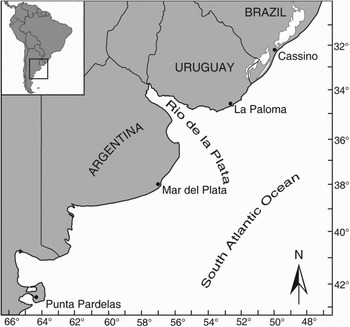
Specimens of Olivancillaria carcellesi were collected by bottom trawling from shallow subtidal zones off Mar del Plata (MdP) (38°02′S 57°37′W), Buenos Aires (Argentina) and, by SCUBA diving, around Punta Pardelas (PP) (42°37'S 64°15'W), Chubut (Argentina) (Figure 1). In addition, specimens from La Paloma (LP) (34°40'S 54°09′W), Rocha (Uruguay) and Cassino (C) (32°13'S 52°11'W), Rio Grande do Sul (Brazil) were analysed.
Map showing the sampled localities.

All specimens were collected alive and fixed in 70% ethanol. Specimens housed at Museo Nacional de Historia Natural, Montevideo, Uruguay (MNHNM); Museu Oceanográfico ‘Profesor Eliézer de Carvalho Rios’ Rio Grande, Brazil (MORG) and Museo Argentino de Ciencias Naturales ‘Bernardino Rivadavia’, Buenos Aires, Argentina (MACN) were also studied in order to compare an even number of specimens from each locality and species. For a more robust study the type specimens of O. carcellesi and O. buckuporum were also included in the analysis (Table 1).
Localities and museum specimens of Olivancillaria used for the analysis. Punta Pardelas (PP), La Paloma (LP), Cassino (C) and Mar del Plata (MdP).

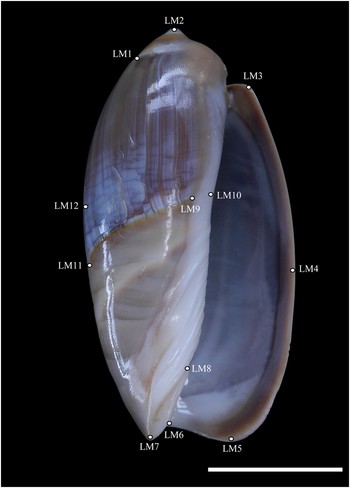
Twenty specimens of each species were randomly selected and photographed with a Nikon D100 digital camera. Twelve landmarks (LM) representative of the shell (sensu Rohlf, Reference Rohlf, Marcus, Corti, Loy, Naylor and Slice1996; Roopnarine & Vermeij, Reference Roopnarine and Vermeij2000) were chosen on apertural view (Figure 2). The location of the LM defines the category to which they belong. Bookstein (Reference Bookstein1991) classified the LM in three types (1, 2 and 3) where the type 1 is the optimal and defined in terms of specific local features (e.g. LM2). The type 2 lacks information from surrounding features in at least one direction (e.g. LM1). Finally the type 3 LM is defined as extremes of curvature or points along some structure (e.g. LM4, LM12) (Zelditch et al., Reference Zelditch, Swiderski, Sheets and Fink2004). In this work landmarks are defined as follows: LM1 is located on the exact intersection of the sutural canal and the left border of the shell; LM2 is on the apex of the shell; LM3 is on the posterior edge of the outer lip; LM4 is on the widest point of the lip; LM5 is on the anterior edge of the outer lip; LM6 is on the concave centre of the siphonal canal; LM7 is on the anterior tip of the columella pillar; LM8 is on the posterior extreme of the basal fold; LM9 is the intersection of the fasciolar band and the columellar callus; LM10 is on the most internal part of the posterior fasciolar band; LM11 is on the most external part of the posterior fasciolar band; and LM12 is the widest point of the shell side. The landmark data were used to calculate the specimen size and to describe the shape variation between species. Size was calculated as the square root of the summed squared distances of a specimen's landmarks to their geometric centroid: CS = [Σ (di)2]1/2, where CS is centroid size and di is the distance of landmarks to their centroid. Particularly, the centroid size is the only size variable uncorrelated with shape in the absence of allometry (Bookstein, Reference Bookstein1991). This absence of correlation is an advantage over other size measures used in morphometric analyses. Centroid size is the dimension measure used to scale a configuration of landmarks so they can be plotted as a point in Kendall's shape space. The denominator of the formula for the Procrustes distance between two sets of landmark configurations is the product of their centroid sizes. The description of shape was carried out using a relative warp analysis (Bookstein, Reference Bookstein1991) performed with the tpsRelw (Rohlf, Reference Rohlf2002). This method is comparable with the principal component analysis, which summarizes a specimen shape as a deformation from a common reference. The relative warps were computed with the scaling option α = 0 which weights all landmarks equally, for studying differences in shell shape among samples (Rohlf et al., Reference Rohlf, Loy and Corti1996).
Apertural view of Olivancillaria carcellesi (MACN-In 37505) showing the homologous landmarks. Scale bar = 1 cm.

In addition, the intraspecific variations found in O. carcellesi were tested with a multivariate analysis of variance (MANOVA) of partial warp scores. The following categorization was revealed by canonical variates analysis (CVA). Allometric variation was tested with a multiple regression model with the relationships between RWs and CS. Differences in centroid size distributions among groups were tested with the one-way analysis of variance (ANOVA) test and post-hoc Tukey HSD test (Sokal & Rohlf, Reference Sokal and Rohlf1995). Statistical analysis was carried out with the software Statistic v. 6.0. When homogeneity of variances could not be achieved by transformation, data were analysed nonetheless, since analysis of variance is robust for departure from this assumption when sizes of samples are equal (Underwood, Reference Underwood1997). Results were, however, interpreted with caution by judging significance more conservatively (α = 0.01).
RESULTS
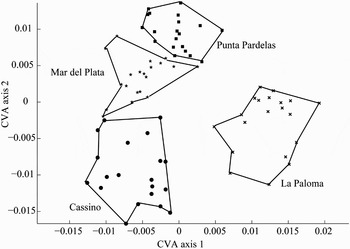
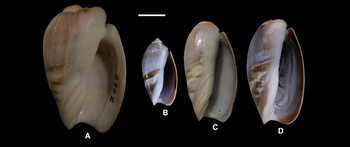
The intraspecific analysis of O. carcellesi performed with the MANOVA and subsequent CVA showed significant differences among groups in the first three axes of the analysis (Axis 1: Wilks' λ = 0.0122, χ2 = 295.0285, P < 2.22045 exp-16; Axis 2: Wilks' λ = 0.0731, χ2 = 175.2362, P < 2.22045 exp-16; Axis 3: Wilks' λ = 0.3428, χ2 = 71.7313, P = 2.29703 exp-8) (Figure 3). The study revealed four morphotypes (Figure 4). We found that 97.5% of the original cases were cross-validated correctly into their species groups based on the Mahalanobis distance in the space defined by the significant CVA axes (100% O. carcellesi MdP, 100% O. carcellesi C, 100% O. carcellesi LP and 90% O. carcellesi PP). All forms showed significant differences in centroid size distribution (ANOVA, F = 55.2 P < 0.01) except O. carcellesi from LP compared with those from MdP (Tukey tests P > 0.05). The smaller group was O. carcellesi from PP and the larger group was O. carcellesi from C (Table 2).
Results of canonical variates analysis of Olivancillaria carcellesi from four localities.

Different morphs of Olivancillaria carcellesi (Klappenbach, Reference Klappenbach1965) analysed morphometrically. (A) Cassino (MORG 7949) (paratype of O. buckuporum Thomé, 1966); (B) Punta Pardelas (MACN-In 37506); (C) La Paloma (MNHNM 4520); (D) Mar del Plata (MACN-In 37505). Scale bar =1 cm.

Tukey test and centroid sizes (average ± SD) of each morphotype of Olivancillaria carcellesi. Numbers in bold are cases that were significant at P < 0.01.

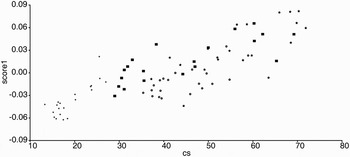
The RWA of all groups demonstrates that 70.5% (α = 0) of total variations are expressed by the first three axes (RW1 = 32.3%, RW2 = 21.1% and RW3 = 17.1%). The scores obtained after this analysis revealed significant regression between shape and centroid size (P < 0.0001). Two groups discriminated by the CVA, exhibited significant allometry between RW1 and CS (linear regression: O. carcellesi LP r2 = 0.53, P < 0.0001; O. carcellesi PP r2 = 0.83, P < 0.0001) (Figure 5). The two allometric relationships differed significantly (ANCOVA, F = 37.05, P < 0.0001). Allometry does not account for shape differences between O. carcellesi C and O. carcellesi MdP. Allometry in O. carcellesi PP is responsible for the relatively higher spires. The main differences among specimens of O. carcellesi from C, LP and MdP lay in width and length of the shells; and thickness of the columellar callus. This is observed in Figure 4.
Multivariate regression between shape and centroid size of Olivancillaria carcellesi from four localities showing allometry. Punta Pardelas, filled grey circle; La Paloma, black square; Mar del Plata, empty black circle; Cassino, black star.

DISCUSSION
The geometric morphometric method analyses the data obtained from digitized landmarks that would be later used for the calculation of size, as a centroid size, and reveals the shape of the specimens. It allows identifying groups and/or individual differences, or variation between samples and other results based on the original shape of the studied species (Zelditch et al., Reference Zelditch, Swiderski, Sheets and Fink2004). Bookstein (Reference Bookstein1991) described the shape using the relative warp analysis. This method summarizes the specimen's shape as a transformation to a common reference form. The specimen coordinates (partial warp scores) from axes of major shape dimensions in a Kendall shape space, can be used as ordinary variables in parametric statistical analyses.
Phenotypic variation on shell size and shape of O. carcellesi from different localities was here detected using geometric morphometric methods. Previously, Carranza & Norbis (Reference Carranza and Norbis2005), using traditional morphometric, reported shell variation of O. urceus among specimens from several localities from the south-western Atlantic coast. Chiu et al. (Reference Chiu, Chen, Lee and Chen2002), Conde-Padín et al. (Reference Conde-Padín, Grahame and Rolán-Alvarez2007) and Olabarría & Thurston (Reference Olabarría and Thurston2004) among others, showed external factors such as environmental conditions to induce variations on shell shape. Trussell & Etter (Reference Trussell and Etter2001) suggested that latitudinal differences in water temperature contribute to biogeographical variation in gastropod shell form. In the area studied, the range of surface seawater temperatures vary among localities, with the higher values at Cassino beach (C), 14°C to 26°C (Das Neves et al., Reference Das Neves, Da Silva and Bemvenuti2008) and the lower at Punta Pardelas (PP), 10.5°C to 17°C (Rivas & Ripa, Reference Rivas and Ripa1989). In agreement with the latter conditions, specimens of O. carcellesi from PP are significantly smaller than the others, whereas those from C are the largest.
It is a fact that natural variation of CaCO3 saturation in seawater decreases from the Tropics to the Poles (mostly as a function of the effect of temperature on the CO2 solubility) (Marubini et al., Reference Marubini, Ferrier-Pages and Cuif2003). This could be an explanation of the smaller sizes from PP and the larger sizes from C. A similar pattern was observed in the thickness of the callus at low temperatures in Cypraea annulus Linnaeus, 1758 from the Indian and West Pacific Oceans (Irie, Reference Irie2006), and in the shell thickness of Littorina obtusata (Linnaeus, 1758) from northern and southern areas of the Gulf of Maine, USA (Trussell & Etter, Reference Trussell and Etter2001). No differences in CS were found among populations of LP and MdP, which could be due to the similarity of environmental factors between those localities (Martos & Piccolo Reference Martos and Piccolo1988; Guerrero et al., Reference Guerrero, Acha, Framiñan and Lasta1997).
Crothers (Reference Crothers1998) and Plejdrup et al. (Reference Plejdrup, Simonsen, Pertoldi, Schoyen and Bayley2006) among others reported that exposure to tributyltin (TBT) could cause changes in shell size and shape. Recently, Teso & Penchaszadeh (Reference Teso and Penchaszadeh2009) described shell size variation produced by TBT in two populations of O. deshayesiana from Argentina. However, this was not tested here as Mar del Plata is the only locality that qualifies for TBT contamination.
Roopnarine et al. (Reference Roopnarine, Signorelli and Laumer2008) found phenotypic variation in the bivalve Anomalocardia squamosa (Linnaeus, 1758) from Thailand and attributed this variation to differences in sediment type and water energy. However, in our study the samples were obtained in very homogeneous sediment (medium sand). Carranza & Norbis (Reference Carranza and Norbis2005) reported that wider specimens of O. urceus with shorter spires are found in high-energy habitats and elongated forms occur in protected localities. We did not find those differences in the analysed shells, despite that sandy beaches of C, LP and MdP are exposed and have a strong wave action in contrast with those of PP. The main shell differences of O. carcellesi specimens from C, LP and MdP, found by means of the morphometric analysis, are width, length and thickness of the columellar callus. Specimens from PP showed allometry between size and shape and this is apparently responsible for their relatively higher spires.
As a general proposition, higher rates of metabolism should make possible higher potential rates of growth, or expansion. Available evidence indicates that shell form is greatly affected by food availability and other factors that influence growth (Vermeij, Reference Vermeij2002). Kemp & Bertness (Reference Kemp and Bertness1984) found that in dense populations of Littorina littorea (Linnaeus, 1758) individuals have relatively elongate shells in comparison to individuals in sparse populations, which have rounder, globose shells. They demonstrated that shell variation is a function of snail growth rate which depends on food supply; with rapidly growing snails developing thin, globose shells and slower growing snails with elongate, cone-shaped shells. However, no data are available on densities and food availability of O. carcellesi to corroborate this hypothesis.
In accordance with our results O. buckuporum is a local variation of O. carcellesi as was previously suggested by many authors (e.g. Rios, Reference Rios1970; Thomé et al., Reference Thomé, Bergonci and Gil2004). When compared to the whole dataset of O. carcellesi, a correlation between size and shape is detected. This suggests that the phenotypic variation is due to allometric differences with a progressive relative shortening of the spire and increasing expansion of the inner lip. However, a genetic study on the population structure of this species would be necessary to confirm this hypothesis.
ACKNOWLEDGEMENTS
Special thanks to the fisherman, the late José Luis Ungarelli who helped to get most of the samples; James Crampton (Institute of Geological and Nuclear Sciences, New Zealand) and two anonymous referees who made very useful comments that improved an early version of the manuscript. We are grateful to F. Scarabino (MNHNM, Montevideo), P. Spotorno (MORG, Rio Grande do Sul) and A. Tablado (MACN, Buenos Aires) for access to collections under their care. Thanks to F. Márquez (CENPAT, Puerto Madryn) for his useful comments. This work was partially supported by the PADI foundation in 2007 and a Lerner Gray Memorial fund in 2007 (AMNH) to V.T. and, by the projects UBACyT X171, from Buenos Aires University, PICT 942 from the National Agency for Scientific and Technical Promotion, Argentina, and PIP 2788 from the Consejo Nacional de Investigaciones Científicas y Técnicas (CONICET). We acknowledge funding by CONICET of Argentina, to which G.P. belongs as a member of the research carrier and, V.T. and J.H.S. are fellows.