This essay considers the construction of scientific identity in early American colleges. It begins with the premise that modern scientific identity involved a deeply rooted tension between those who, on the one hand, saw modern American scientists as inherently cosmopolitan (or international) and those who, on the other hand, viewed American scientists as citizens and servants of the national state. The question was: Could scientists be cosmopolitans and citizens at the same time?
This question, I suggest, is still with us today. Even as we think of scientists as serving the interests of a common, or universal, humanity, we also recognize the many ways in which science depends on the patronage of national states (though admittedly this patronage has been declining in both the United States and Europe in a context of globalized austerity and the growing commodification of knowledge, particularly scientific knowledge, as a private or for-profit good).
I define globalization as a phenomenon marked by expanding networks of commerce and communication as well as the apparent denationalization of knowledge and knowledge institutions. My aim in this essay is to examine the strategies that scientists in the early nineteenth century used to navigate an earlier process of globalization and, specifically, the ways in which they balanced the ideals of cosmopolitanism with an identity rooted in citizenship and service to a national state.
My story is built around three key questions. First, I ask how American scientists in the early nineteenth century actively pursued a process of “academic globalization.” Second, I ask how their conceptions of scientific identity—especially their understanding of the link between science and the state—changed during the first two decades of the nineteenth century. Third, I ask how a contest between scientific cosmopolitanism and citizenship set the stage for a new kind of institution: the American research university.
Today, we like to imagine scientists in American universities as serving “the public good,” or even the shared interests of all humankind, but it might be more accurate to say that scientists in universities serve two “publics”: one global, the other national (or even local). While some applaud the idea that globalization has effectively internationalized the university, others note that universities worldwide still rely heavily on state funds, even if these funds are dwindling in many places.
In this context, I ask how scientists in early American colleges served both global and national publics at the same time. Whereas today many scientists claim a cosmopolitan identity, even as they decry the decline of state funds, two centuries ago, I argue, they did just the opposite: to win public aid, they quietly subsumed the ideals of cosmopolitanism within a commitment to national service, all while deftly cultivating a new professional image rooted in a rhetoric of scientific internationalism.
One key outcome of this consciously orchestrated effort, I contend, was the creation of the modern American research university—particularly the public research university—which claimed to reconcile the competing ideals of scientific cosmopolitanism and citizenship. My aim in this essay is to shed light on this crucial and often-unappreciated precondition of the making of the American university: the construction of a new American scientific identity.
The basic outline of my story is that by the start of the nineteenth century US global trade already supported a broad network of international scientific exchange, but Americans found their reliance on this network increasingly jeopardized by the Napoleonic Wars. Forced by economic and geostrategic circumstances to reconsider their approach to research, they slowly began to build new institutions of science that claimed to be more “self-sufficient.”
Later, shaped by the experience of Thomas Jefferson's Embargo Act of 1807 (and its aftereffects in the War of 1812), these new institutions of science gradually redirected American scientific identity away from cosmopolitanism and toward citizenship and national service. This shift, I argue, paved the way for a new alliance between science and the state and, ultimately, the emergence of the “modern” American university.
To reveal the ideological roots of this new institution, I've chosen to focus this essay on a particular group of scientists whose global reach in the early nineteenth century was significant. The individual protagonists in my story are William Baldwin, a botanist who graduated from the University of Pennsylvania in 1807, and his teacher, Benjamin Smith Barton, who studied at the same institution two decades earlier.
So, without further ado, let's join Baldwin … in Brazil … in 1818.
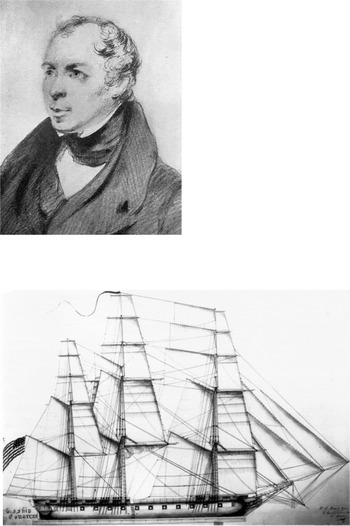
Pushing through palm fronds and papaya trees, William Baldwin pressed his way up the jungled slopes of the Pico do Papagaio, off the coast of Rio de Janeiro. It was hot and humid in February 1818 when Baldwin arrived in Rio as surgeon-naturalist with the South American Commission, the diplomatic mission that President James Monroe had dispatched two months earlier on a five-country tour of the subcontinent (see Figures 1 and 2).
Dr. William Baldwin, left, professor of the Theory and Practice of Medicine at the University of Pennsylvania, traveled on the USS Congress (built 1799), below, as part of scientific missions to South America. Illustration “Sail Plan of the USS Congress,” 1815, by Charles Ware (Courtesy of https://en.wikipedia.org/wiki/USS_Congress_(1799)#/media/File:USSCongress.png). Baldwin illustration in Perley Spaulding, “A Biographical History of Botany at St. Louis, Missouri,” Popular Science Monthly (Dec. 1908), 498 (Courtesy of http://en.wikipedia.org/wiki/William_Baldwin_(botanist)#/media/File:Dr_william_baldwin.jpg).

“Nothing so much strikes the stranger with wonder, as the luxuriant garb with which the earth is clothed in tropical climes,” wrote the commission's secretary, Henry Marie Brackenridge, after their first week in the forest. “He sees plants and trees entirely new to him, or the few that he has known rising here to a gigantic size; shrubs have become trees, and humble herbs enlarged to shrubs. … Among the most conspicuous are the [enormous] palms, … besides a number of aromatic plants shed[ding] the most delightful fragrance.”Footnote 1
The South American Commission had two aims: one strategic, the other scientific. Its first aim was to show US support for the political revolutions then sweeping across Brazil, Argentina, Bolivia, Paraguay, Chile, Peru, and elsewhere. Its second aim was to explore these countries’ natural resources—especially their plants and precious metals—to determine which could be exported to US markets as part of an increasingly globalized American trade.
Baldwin, who had spent his childhood in Pennsylvania but had since moved to Georgia, was eager to identify plants that could be cultivated in the American South—plants that, once naturalized, would help to make the United States more agriculturally productive, thus fulfilling Jefferson's vision of a commercially independent agrarian republic. Baldwin, himself a fervent Jeffersonian, sought to advance this goal at each stop on his South American tour.Footnote 2
He and his companions marveled at the agricultural prosperity of Buenos Aries. “In every … shelf of rock, the ground was cultivated,” wrote Brackenridge (who had gotten his own botanical start on a recent expedition up the Missouri River). “The chief culture near the city is grass, which is cut daily and carried to town for the supply of the immense number of domestic animals. … They cultivate besides … coffee, bananas, mangoes, oranges, and the king of fruits, the pine-apple.”Footnote 3
Which of these plants, Baldwin wondered, could be grown in the United States, produced not only for domestic consumption but also, some day, for distribution around the world? When he got home, he wrote a paper for the Transactions of the American Philosophical Society on four species of kyllingia, grasslike sedges that sprouted in profusion along the banks of the Rio de la Plata; all four, he claimed, were new to science and likely useful as forage crops.Footnote 4
This judgment was confirmed when Baldwin and Brackenridge visited the University of Buenos Aires to meet Aimé Bonpland, the French botanist who, a decade earlier, had accompanied Alexander von Humboldt on his legendary South American tour from the Amazon basin to Mexico's central highlands. Baldwin could hardly contain himself when Bonpland (trained at the renowned Museum of Natural History in Paris) showed him the university's huge botanical garden.
“He will form a valuable addition to my correspondents,” Baldwin scribbled in his travel journal. “He will be very happy to exchange South for North American plants and has already furnished me with some specimens.” Baldwin later sent a box of 138 plants to Bonpland and received in return the syena fluviatilis, a tiny flowering bristle named by French botanist Jean-Baptiste Aublet of what was then French Guiana (who, upon his death, had bequeathed his vast herbarium to Jean-Jacques Rousseau).Footnote 5
Baldwin's correspondence with Bonpland represented the sort of “enlightened” scientific cosmopolitanism that had been so assiduously cultivated in the eighteenth century. Here, in his mind, was the universal republic of letters that knit scholars together around the common pursuit of knowledge and, ultimately, a shared understanding of the natural world—a world that, for Baldwin, transcended nationality.
It was a striking image, this perfectly borderless community of explorers who recognized no distinctions of culture or creed, and it was an image that lay at the heart of “modern” scientific identity. Of course, in 1818, the word scientist had not yet been coined (that would take another few years), but the idea of a deep scientific internationalism at the heart of modern scientific identity was as old as the scientific revolution itself.
What made this idea notable in a case like Baldwin's was not the hemispheric scope of his scientific network—impressive as it was—but rather the geopolitical context that prompted his participation in this network. He was in Argentina, after all, because Monroe's administration wanted to show American support for that nation's republican coup against Spain's imperial regime. Baldwin, in a sense, was a scientific agent of the American state.
His voyage, as well as his botanical apparatus, was paid for by the American government, and he followed the commands of the American navy, which carried him and his fellow commissioners from port to port. Perhaps most importantly, he endorsed the political aims of the commission: he praised the recently victorious rebellion in Buenos Aires, and his letters repeatedly insisted that science itself was politically “republican.”
Baldwin considered himself a scientific cosmopolitan, but he was also, unquestionably, a servant of the state. In fact, it was his combination of cosmopolitanism and citizenship that made him so characteristic—so representative—of his era. Just like Humboldt and other contemporaries, he believed modern scientists could be equally cosmopolitans and citizens at the same time. But could they?
Bonpland, for his part, was in Argentina in 1818 because his earlier ties with Napoleon had made his situation in France precarious after the emperor's fall, and Humboldt, arguably the symbol of scientific cosmopolitanism in this era (with his self-funded expeditions, his residence in Paris, and his special grant of citizenship in Mexico), was nonetheless repeatedly obliged to do the diplomatic bidding of his native Prussia, even when its antirepublican politics clashed with his own.Footnote 6
And what of Baldwin: How did he balance the ideals of scientific cosmopolitanism with the expectations of scientific citizenship, or service to his national state? How did a botanist who did not come from an educated family make his way into the broader world of science in the early nineteenth century, and how did that world shape his sense of what Ralph Waldo Emerson would soon call “The American Scholar,” national yet universal at the same time?
In 1837, Emerson told a group of Phi Beta Kappans at Harvard that in the United States, “A nation of men will for the first time exist, because each believes himself inspired by the Divine Soul which also inspires all men.” It would be hard to find a more succinct expression of the dialectic of citizenship and cosmopolitanism in the identity of the American scholar, but how did Emerson come to see himself and his fellow Harvardians this way?Footnote 7
The question of American scholarly identity points to still larger questions about the institutionalization of American higher education, which, in the nineteenth century, gradually secured the patronage of the state in exchange for more direct national service. Well before the political and financial support represented by the Morrill Act, at least two generations of American scientists had already given up some aspects of cosmopolitanism in favor of an identity rooted in national service.
This shift was not without costs, of course, but looking back, it would be hard to deny that state aid to science, despite its many ups and downs, fostered not only the nation's rapid economic growth but also its rise to world power. This growing alliance between science and the state in the nineteenth century stands in sharp contrast with the apparent faltering of this alliance in the early twenty-first century: a period of widely reported disinvestment and even distrust.
The fraying of this alliance may have something to do with our failure to understand how the fragile relationship between science and the state was forged in the first place. The advancement of American science, and in turn the rise of the American university, hinged on the prior construction of a new “American” scientific identity—an identity that balanced the ideals of cosmopolitanism with the demands of citizenship and service to the state.
To appreciate how a figure like Baldwin came to see himself in relation to what Emerson called “The American Scholar”—national yet universal at the same time—we need to start at the beginning, that is, before the idea of the American university was even a twinkle in anyone's eye. Let's go back, then, to Baldwin's birth in 1779 in Chester County, Pennsylvania, just a few months after the British army ended its occupation of Philadelphia.
Baldwin grew up poor and sickly, and he suffered from tuberculosis all his life (he eventually died of the disease at the age of forty). Learning to read at home, he pursued a medical apprenticeship with a local doctor, who introduced him to scientific friends, including the botanist Humphry Marshall, an expert on American trees and the owner of a large house and botanical garden nearby.Footnote 8
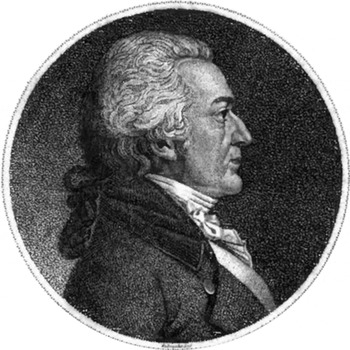
It was Marshall who introduced him to Professor Benjamin Smith Barton (see Figure 3) at the University of Pennsylvania, and it was Barton who drew him into a larger system of international science. It would have been hard for him to find a more well-connected mentor than Barton—a figure who personified the dual identity of “cosmopolitan” and “citizen” that was coming to define the modern American “man of science” in this period.Footnote 9
Dr. Benjamin Smith Barton encouraged Baldwin's botany interests. Illustration in William P. C. Barton, A Biographical Sketch … of their Late President, Professor Barton (Philadelphia: s.n., 1816), US National Library of Medicine, http://collections.nlm.nih.gov/catalog/nlm:nlmuid-2542060R-bk.

Barton, whose uncle David Rittenhouse had succeeded Benjamin Franklin as president of the American Philosophical Society, earned his medical degree at the University of Pennsylvania in 1785 and continued his training in Edinburgh and London, where he devoted special attention to pharmacology—and, thus, botany—an interest reflected in his Edinburgh thesis on the sedative effects of black henbane.Footnote 10
What set Barton apart from the many Americans who studied medicine abroad in this period was his determination to acquire dried plants—hundreds of dried plants—for his personal herbarium. While in London, he used his medical connections to obtain an unusually large collection from all over the British empire, and when he returned to Philadelphia to join the faculty at his alma mater in 1789, he used his collection to illustrate his lectures.Footnote 11
Barton's herbarium revealed the global scope of American science in this era. Among his specimens, for example, were several from Australia: gifts from James Edward Smith, owner of the famous Linnean herbarium, who had acquired them from the surgeon-naturalist on the first voyage to bring convict-settlers to Sydney. The first box of Australian plants reached London in 1788, and Barton, just before he left, obtained some of its best duplicates.
Barton's herbarium also included plants from South Asia and South Africa, the former supplied by William Roxburgh of the recently established Calcutta Botanical Gardens in India, the latter by the British explorer Francis Masson, who had sailed with Captain Cook to Cape Town in 1772 and was later joined by Swedish botanist Carl Thunberg, who had previously collected plants in Japan, Java, and Sri Lanka, many of which found their way to Barton.
Even after he started teaching, Barton continued to collect. For example, when the Danish botanist Julius von Röhr visited Philadelphia in 1791 after botanizing his way across Suriname and Brazil, he donated more than a hundred plants to Barton, including a species of cotton smuggled from Mexico that would soon prove useful in the American South. With his vast network of botanical correspondents, Barton was able to build an unmatched herbarium for instructional use.Footnote 12
Indeed, he often used his students to extend his international reach. William Baldwin enrolled in Barton's classes in 1802 and, in 1805, was chosen to be the surgeon-naturalist on a voyage to China, which he recounted in his Short Practical Narrative of the Diseases Which Prevailed Among the American Seamen at Wampoa, a project he submitted as his thesis for a medical degree in 1807.Footnote 13
In this work, Baldwin documented the botanical treatments he used on the sailors aboard his ship. In many cases, he challenged the prescriptions of British physician John Clark, whose Observations on the Diseases in Long Voyages to Hot Countries, and Particularly on Those Which Prevail in the East Indies (1773) had suggested heavy doses of Peruvian bark, along with copious bleeding, as the best defense against malaria.
Baldwin, convinced that his own combination of bark plus opium was superior to Clark's remedy, called for more physicians with botanical expertise aboard the vessels that had become so important to America's global trade. “It is to be regretted,” he wrote, “that the merchant ships are not more generally furnished with Physicians, especially when it is considered how extensive the trade has become, and how profitable East-India voyages are.”Footnote 14
Baldwin was hardly the only Barton student to advance this argument. His classmate Thomas Bryant was in China at the same time, and his best friend, William Darlington—who later served in Congress—got his start in science on a voyage to India, where he met regularly with William Roxburgh in Calcutta's botanical garden. Roxburgh gave Darlington seeds not only for Barton at the University of Pennsylvania but also for David Hosack at Columbia.Footnote 15
It would be hard to overstate the global reach of American college botanists in this era. Despite an image of early American colleges as parochial institutions focused narrowly on classical or denominational education, they had already become important nodes in a global scientific network, and if the students of Barton and Hosack were any indication, they consciously imbued their graduates with a spirit of scientific cosmopolitanism.
By the beginning of the nineteenth century, botany was taught in nearly every American college. Indeed, scientists at Harvard felt a need to expand their program just to keep up with their peers. In 1802, they asked the Massachusetts legislature, along with the Massachusetts Society for Promoting Agriculture, to endow a new professorship in natural history and establish a botanical garden at the college.Footnote 16
In a sign of strengthening ties between the college and the state, the legislature gave a land grant of twenty thousand acres in Maine to fund the project, while the agricultural society—itself funded by the state—persuaded Massachusetts governor Caleb Strong, the society's president, to give $500. Many of the state's wealthiest merchants also chipped in: Elias Derby of Salem gave $750 and John Lowell of Boston gave over $1,000.Footnote 17
These merchants certainly understood the importance of botanical study. After all, they owed a large part of their fortunes to East Indies spice plants. Just a decade earlier, Derby had been among the first Salemites to send a ship to Sumatra for pepper, a voyage that netted a jaw-dropping 700 percent profit, and by 1805 he was outfitting several vessels a year to barter in Bencoolen for his era's version of “black gold.”Footnote 18
Harvard could not have funded its new professorship in natural history without the profits from the East Indies trade—the very trade that prompted William Baldwin in 1805 to appeal for botanically informed physicians aboard commercial ships. Of course, as Baldwin well knew, by 1805, some of the biggest profits in the East Indies came not from the spice trade but rather from the drug trade, specifically the opium trade, and here too Harvard was a beneficiary.
The college received donations for its natural history professorship from members of the so-called Boston Concern, an opium syndicate operated by merchants connected with the Harvard corporation. With branch offices in London and Canton, the Boston Concern included the Cabots, the Forbeses, the Cushings, and the Perkinses, who together dominated the American opium trade and used part of its proceeds to support botanical study at Harvard.Footnote 19
Of course, opium was not the only botanical product of the China trade. Everything from bamboo to begonias was available for purchase in Canton's hongs, or sequestered coastal wharves. Americans who explored the narrow alleys behind the quays of Kowloon could venture up Fa-Tee Road, at the end of which sat the celebrated Fa-Tee flower markets. There, surrounded by plants from all over Asia, they could satisfy their most exotic botanical fantasies.Footnote 20
American merchant William Wightman Wood described the scene (which remains very much the same today): “Two miles above Canton, and on the opposite side, are situated the Chinese gardens, called Fa-tee, ‘the flower grounds’—the property, it is said, of the hong merchants.” He noted in particular the palace garden of merchant Houqua II, which boasted chrysanthemum pots “covered with flowers of … colours almost unknown to our horticulturists.”Footnote 21
Unknown as some Chinese plants may have been, American botanists in this period were in many ways more familiar with the plants of Asia than with the plants in their own backyard—particularly the plants of the American West. As Professor Eli Ives of Yale noted in 1802: “However degrading it may be to our national pride, it is a fact undeniable that we are dependent upon the Europeans for a knowledge of the plants of our own country.”Footnote 22
Ives pointed to French scientist André Michaux, who had botanized from the Gulf of Mexico to Hudson Bay, and Masson, who, after he left South Africa, had studied New York's trees. Noting that both men had received government support, Ives asked whether Americans would ever have such advantages. “Even in this State, which has been stiled [sic] the Athens of America, botany has been most neglected,” he told his students.Footnote 23
Without state aid, it took Ives more than a decade to build a botanical garden at Yale, and he was hardly alone. Barton too lacked a garden and, in 1803, his otherwise unparalleled herbarium had more species from India than it had from Indiana—let alone from west of the Mississippi River. Was it any wonder that Barton agreed in the spring of 1803 to prepare Lewis and Clark for their upcoming western expedition with a crash course in botany?Footnote 24 Or that Lewis brought a copy of Barton's new textbook, Elements of Botany, with him over the mountains?
In a previous work, Barton had urged University of Pennsylvania graduates to collect plants on the western frontier. “By your assistance,” he wrote, “the knowledge of the natural productions of our country may be greatly extended, and travelers shall then no longer upbraid us with an utter ignorance of the treasures which an all-benevolent Providence has so largely bestowed upon us.”Footnote 25
An increasing emphasis on western exploration played out among Barton's students as they wrote thesis after thesis on the agricultural, medical, and industrial benefits of native American plants. In 1803, for example, young John Mitchell wrote An Essay on the Arbutus Uva Ursi, and Pyrola Umbellata and Maculata of Linnaeus—an examination of two flowering wintergreens native to American forests that Mitchell considered substitutes for Peruvian bark.Footnote 26
This was no minor claim. Peruvian bark—the source of quinine to treat malaria—was a product of the cinchona tree, which grew only in the Andes mountains. Finding a substitute for the cinchona was the holy grail of early nineteenth-century botanical research. Given the rapid expansion of the southern cotton economy, as planters replaced tobacco with a new staple, the health of the region's growing slave population hinged on the search for a cinchona substitute.Footnote 27
Another student, John Walker of Virginia, also wrote a thesis in 1803 on the search for a bark replacement. “Too long has America paid tribute to foreign countries; too often have her physicians been baffled in their practice from the adulteration of the bark,” he observed. “Every attempt, therefore, to liberate us from importation … is praise worthy in itself; but how much more so must it be, when [a substitute] is directed to our own, too long neglected treasures?”Footnote 28
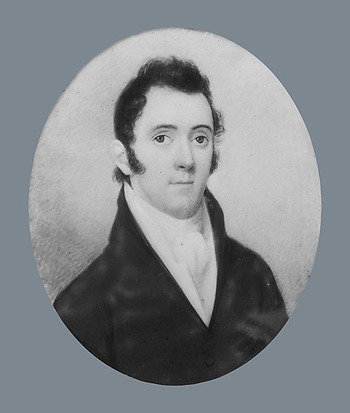
Few expressed this period's enthusiasm for native plants more energetically than Valentine Mott (see Figure 4), a student of David Hosack's at Columbia who earned his medical degree in 1806 with a thesis on statice limonium, a scrubby little plant found “in great abundance in the salt marshes” of New York Harbor. With more than a hundred subspecies, the statices were used to alleviate the symptoms of dysentery, diarrhea, and other gastrointestinal disorders.Footnote 29
Dr. Valentine Mott. Illustration by Anson Dickinson (1779–1852), ca. 1820, http://www.metmuseum.org/art/collection/search/10750 (Courtesy of https://en.wikipedia.org/wiki/Valentine_Mott).

Mott, inspired by the success of the Lewis and Clark expedition, urged his peers to look for any native plant that could replace a foreign import. “It is the duty of every enlightened citizen to examine into the natural productions of his own country,” he wrote patriotically. “Who knows but on the banks of the Mississippi, there may bloom a flower whose medicinal qualities may prove an antidote to the cancer or hydrophobia?”Footnote 30
The immediate context of Mott's statement was important. A few months earlier, a fifty-gun British warship, the Leander, had fired its cannons into New York Harbor, decapitating a young sailor, after which an enraged crowd paraded the boy's headless body through New York's streets, and President Jefferson issued a proclamation denouncing Britain's “unlawful interruptions and vexations on trading vessels coming to the United States.”Footnote 31
In this context, as the broader Napoleonic conflict made traditional avenues of transatlantic exchange more tenuous, Mott shifted his gaze from cosmopolitanism to citizenship in the conduct of American science. It was not that he turned his back on all forms of cross-national scientific collaboration; it was more that, in an era of war, he saw the future direction of scientific exchange flowing no longer from Europe to America but, rather, from America to the rest of the world.
Mott was not the only member of his generation to sense a turning of the scientific tide. Given the precariousness of maritime trade and mounting concerns about the effects of European naval campaigns, he and others began to look for ways to make American science more self-sufficient. In the process, American scientists began to cast themselves less as participants in a “universal” republic of letters and more as servants of their own national state.
Take, for example, the members of the new Linnean Society of Philadelphia that Professor Barton founded in this era. In the summer of 1807, Barton gathered his students (including William Baldwin) to hear A Discourse on Some of the Principal Desiderata in Natural History, and the Best Means of Promoting the Study of This Science in the United States, which announced the creation of a new society devoted to collecting American specimens.
Modeled (somewhat ironically) after its counterpart in London, the new society had a distinctly national—one might even say nationalist—orientation. Turning old assumptions upside down, Barton argued that Americans were better acquainted with American plants than Europeans could ever be. His new Linnean Society thus aimed to draw attention to “subjects in the investigation of which we, as Americans, are especially interested.”Footnote 32
He pointed in particular to native plants discovered by Lewis and Clark on their way across the continent. “In its higher latitudes,” he observed, “we may expect to find many of the vegetables of the north and east of Asia; … and in the lower latitudes we shall, in all probability, meet with many of the plants of China, and Japan, of Cochin-China, … and other regions of the old world.”Footnote 33
Barton told his students to look for useful plants wherever they went, both at home and overseas. “Some of you are soon to fix yourselves in the most opposite regions of North-America,” he anticipated, “while others of you are called by your profession, or urged by your intrepid zeal, into the distant countries of China, of Java, or of Hindustan. Remember, wherever you may be, the Philadelphia Linnean Society. Remember this seat of your intellectual happiness.”Footnote 34
Barton's oration was revealing on at least two fronts. First, instead of stressing a need to forge global networks of scientific correspondents, he now urged students to go out and find the world's plants for themselves. Second, instead of emphasizing his students’ place in a cooperative global community of scientists, he stressed their national identity as Americans. They might still be cosmopolitans, but first, they were citizens and servants of an expanding United States.
The reasons for this rhetorical shift were not hard to find. Not only had Lewis and Clark demonstrated a new capacity for scientific discovery on a continental scale, but in 1807, the outlook for international scientific exchange had dimmed owing to a series of attacks on American commerce that culminated in the Chesapeake-Leopard Affair, which occurred just twelve days after Barton's oration, killing four American sailors and wounding seventeen.
Six months after this event, Thomas Jefferson declared his infamous embargo, and the nation's maritime trade ground to a halt in an economic and diplomatic fiasco that lasted nearly two years. During the embargo, American scientists had to find alternate methods to conduct their work. Forced by circumstances to make the most of their domestic resources, they had to become more nationally self-reliant.Footnote 35
How, under these conditions, would they balance an older identification with scientific cosmopolitanism with newer expectations of scientific citizenship and service? Precisely this question arose in 1808, a year into the embargo, when Jefferson himself received a request for seeds from Napoleon's head gardener, André Thouïn, director of the Agricultural Society of Paris, who hoped to naturalize two species of cotton that had recently become popular in the American Southwest.
Jefferson—who over the years had gotten hundreds of seeds from Thouïn (not to mention a gift of a new steel plow from the Paris society)—was eager to grant his friend's request, but its timing was awkward. His own shipping agents balked at what they considered a clear violation of his embargo, and he quickly learned that his prohibitions against foreign trade made any form of international exchange—including scientific exchange—an object of political suspicion.
When a letter concerning Thouïn's request became public, Jefferson was pilloried in the press, and his shipment of seeds was stopped by members of his own party who took a holier-than-thou approach to enforcing his embargo. Jefferson was dismayed. Rather than acknowledging the principles of scientific cosmopolitanism, he told a friend, his critics’ “first object was to make a show of my letter as something very criminal.”Footnote 36
Jefferson believed science transcended nationality. He reminded his fellow Republicans that just before the embargo he had sent the Board of Agriculture in London three barrels of wheat in return for “the seed of the famous turnips of Sweden.” This exchange, he felt, illustrated “the nature of the correspondence which is carried on between societies instituted for the benevolent purpose of communicating to all parts of the world whatever useful is discovered in any one of them.”Footnote 37
It was a classic expression of scientific internationalism, but it failed to acknowledge the ways in which this ideal had been subsumed under national political interests. Even if science was “cosmopolitan” in the abstract, the individual scientist—and certainly one who also happened to be president—was expected to serve the national state. Scientific knowledge could not be international, or “public” in a global sense.
On the contrary, Jefferson's own embargo had made knowledge a form of intellectual property, and thus decidedly national. Indeed, when a figure like Jefferson appeared to favor cosmopolitanism over citizenship, or scientific internationalism over nationalism, he was accused of a “criminal” offense. And these links between science and citizenship only strengthened in the coming years.
Take, for example, Jefferson's successor, James Madison, who ended the embargo in 1809 and turned the nation's attention to war in 1812. As in all wars, science was drafted into service. In 1814, medical botanists in New York petitioned the state for wartime aid. “There may be glory in dying on the field of battle,” they acknowledged, “but surely there is none in falling by the hand of an ignorant practitioner” who could not tell a bark from a bandage.Footnote 38
And it was not just medical botanists. Links between science and citizenship also surfaced in a wartime dispute over the classification of American plants, specifically those discovered by Lewis and Clark on the frontier. Barton had recruited a German scientist named Frederick Pursh for this job, but when Barton failed to pay his assistant, Pursh left in a huff and took Lewis's plants—all considered top-secret—abroad, with plans to publish his classifications in London.Footnote 39
Pursh's much-anticipated work appeared in 1814, at the height of the war, and when it came out, American botanists exploded in anger. They charged Pursh not only with pilfering American plants but also, indirectly, with aiding the enemy. Columbia professor-turned-congressman Samuel Latham Mitchill wrote in his Medical Repository: “It is very remarkable with how much more avidity the history of our native vegetables is promoted by foreigners than by our own people.”Footnote 40
A few months later, when Pursh returned to America to resume his scientific explorations and was considered for a post at Yale's new botanical garden, a tutor at the college said he would not cooperate with a foreigner so reviled. He added that a new textbook he was publishing would “give no individual credit to any European” for the classification of American plants and certainly would “not be guided by the silly arrangement of Pursh.”Footnote 41
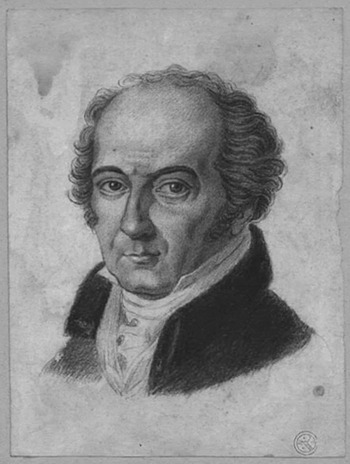
So much for the ideals of scientific cosmopolitanism—replaced during the war by a new scientific nativism. Harvard, for example, rejected a proposal in 1814 to hire Portuguese botanist José Francisco Correia da Serra (see Figure 5), preferring instead the native-born Jacob Bigelow, whose candidacy benefited from the fact that he never studied abroad. Indeed, shortly after his appointment, Bigelow founded the Linnean Society of New England, which conspicuously admitted no foreign members.Footnote 42
José Francisco Correia da Serra, ca. 1841, Biblioteca Nacional de Portugal Collection. Modified from original (color removed). (Courtesy of https://commons.wikimedia.org/wiki/Category:Jos%C3%A9_Correia_da_Serra#/media/File:Jos%C3%A9_Correia_da_Serra,_c._1841_-_Biblioteca_Nacional_de_Portugal.png).

At the society's inaugural celebration, President John Davis of the Harvard Corporation highlighted the wartime shift from cosmopolitanism to citizenship in American science. “The time indeed seems to have arrived,” he noted, “when the reputation of this country would appear to be somewhat interested in exhibiting, among ourselves [emphasis added], some further advances in a science [i.e., botany], which has long engaged the zealous attention of enlightened men in other parts of the world.”Footnote 43
This shift from cosmopolitanism to citizenship was on display in an exchange of letters between Correia da Serra and Thomas Jefferson following the war. In 1816, shortly after Correia was passed over by Harvard, he became Portugal's ambassador in Washington, a post that put him at odds with the US effort to support revolutionary movements in South America. In 1818, for example, when James Monroe sent the South American Commission to observe Brazilian rebels, Correia felt compelled to register a protest.
Correia—a man whom Commissioner Henry Marie Brackenridge had once called “a sage acknowledged in both Europe and America as one of the most enlightened of humankind”—wanted to believe in the possibility of a trans-American “republic of letters,” but he was deeply skeptical of Monroe's hemispheric motives. Indeed, he was shocked to see how quickly the president had rushed to support the republican independence fighters in Brazil.Footnote 44
In a letter to Jefferson, the ambassador lamented the fact that, shortly before the South American Commission sailed, American privateers had plundered fifty Portuguese ships full of supplies intended for Brazil's colonial government; shameful conduct, he said, for a supposed ally. He told Jefferson that he planned to leave Washington for Rio as soon as possible to escape the celebrations that seemed to erupt in the capital at every report of a Brazilian rebel victory.Footnote 45
Jefferson's reply was revealing. He did not apologize for America's role on the subcontinent; instead, he said it represented an extension of republican good will and urged Correia to support inter-American relations—especially scientific relations. “I hope you will … render precious service by promoting the science of your country,” he wrote, “for this motive … will be an incitement to promote that intimate harmony between our two nations which is so much the interest of both.”Footnote 46
Jefferson was sure that Correia shared his commitment to scientific internationalism—albeit now under American rather than European authority. “From many conversations with him,” Jefferson told a friend, “I hope he sees … the advantages of a cordial fraternization among the American nations and the importance of their coalescing in an American system of policy, totally independent of and unconnected with that of Europe.”Footnote 47
Jefferson, of course, considered what he called his “American system of policy” a plan for hemispheric republicanism, but Correia deemed it a policy of US imperialism. Jefferson cast American science as politically disinterested, but Correia thought it looked alarmingly self-interested. Jefferson claimed American science was fundamentally cosmopolitan, but Correia reminded the former president that actions spoke louder than words.
This correspondence in the summer of 1820 illustrated the dramatic change that had taken place in the construction of American science during the first two decades of the nineteenth century. What had begun with a pursuit of academic globalization had culminated in new forms of state-supported scientific reconnaissance. What had begun with assertions of scientific internationalism had given way to bold new claims of hemispheric domination.
William Baldwin and Henry Brackenridge embraced this change. “The United States will be the natural head of the New World,” wrote Brackenridge in a two-volume report on the South American Commission. Unlike the greedy “foxes and wolves” of Europe, he insisted, American scientists would lead the hemisphere toward a new era of transnational republican cooperation. “We wish them success,” he wrote of South American republicans, “because they are endeavoring to free themselves from Europe, because they are Americans, and because their success and happiness will afford additional security to our own.”Footnote 48
In the coming years, a new generation of American scientists would learn to master the rhetoric of republican scientific internationalism, even as they embarked on a breathtaking adventure of continental expansion, resource extraction, and geopolitical hegemony. Indeed, the rise of the modern American research university would hinge, in part, on its capacity to couch the pursuit of American empire in the language of enlightened cosmopolitanism.
In this regard, American scientists in the early nineteenth century shared much with scientists in the early twenty-first. Then, as now, science was a globalized project enmeshed in the diplomatic, strategic, and economic struggles of its day. Then, as now, scientists asked themselves whether, by serving their national state, they could also serve humanity at large. It was a difficult question, but most scientists in the emerging American research university assured themselves that, on balance, they could.