Introduction
Farming practices, extensive native vegetation loss coupled with growing awareness of the necessity of environmental conservation in Brazil led to increasing contact of natural and rural areas. Therefore, domestic animals from rural areas entering in wild sites can result in intensive association among wild reservoirs, vectors, domestic animals and humans (Shaw et al., Reference Shaw, Day, Birtles and Breitschwerdt2001). Domestic dogs, particularly, can act as carriers of vectors and pathogens (Queirogas et al., Reference Queirogas, Oliveira, Marques, Oliveira and Szabó2010) and habitually transit between natural and anthropized environments. On the other way round, wild canids frequently use rural areas, and are exposed to domestic animal parasites as well (Szabó et al., Reference Szabó, Cunha, Pinter and Vicentini2001; Labruna et al., Reference Labruna, Jorge, Sana, Jácomo, Kashivakura, Furtado, Ferro, Perez, Silveira, Santos, Marques, Morato, Nava, Adania, Teixeira, Gomes, Conforti, Azevedo, Prada, Silva, Batista, Marvulo, Morato, Alho, Pinter, Ferreira, Ferreira and Barros-Battesti2005a; Dantas-Torres, Reference Dantas-Torres2010). Wild canids are closely related to domestic dogs and share receptivity to numerous pathogenic agents (Woodroffe et al., Reference Woodroffe, Cleaveland, Courtenay, Laurenson and Artois2004). Nevertheless, due to their distinct co-evolutionary history, they can present different susceptibilities to each parasite, and spread highly pathogenic parasites to each other. In fact, several domestic dog vector-borne diseases have already been identified in wild canids (Aguirre, Reference Aguirre2009).
Environmental alterations and changes in host availability are particularly important for ticks and the epidemiology of tick-borne diseases. Most plastic and generalists tick species may be favoured at areas under anthropogenic influences. This is the case of Amblyomma sculptum, a tick species widely distributed in biomes such as the Cerrado and Pantanal (Pereira et al., Reference Pereira, Szabó, Bechara, Matushima, Duarte, Rechav, Fielden and Keirans2000; Szabó et al., Reference Szabó, Martins and Santos2007a, Reference Szabó, Castro, Ramos, Garcia, Castagnolli, Pinter, Veronez, Magalhães, Duarte and Labruna2007b; Cançado et al., Reference Cançado, Piranda, Mourão and Faccini2008; Veronez et al., Reference Veronez, Freitas, Olegário, Carvalho, Pascoli, Thorga, Garcia and Szabó2010; Martins et al., Reference Martins, Barbieri, Costa, Terassini, Camargo, Peterka, Pacheco, Dias, Nunes, Marcili, Scofield, Campos, Horta, Guilloux, Benatti, Ramirez, Barros-Battesti and Labruna2016; Ramos et al., Reference Ramos, Osava, Piovezan and Szabó2017) thrives in degraded areas as well. This tick species in anthropic environmental may present a potential risk to public health, once A. sculptum is the most important vector of Rickettsia rickettsii (Galvão et al., Reference Galvão, Silva, Nascimento, Calic, Sousa and Bacellar2005), the etiological agent of the Brazilian spotted fever, a highly lethal human disease (Angerami et al., Reference Angerami, Resende, Feltrin, Katz, Nascimento, Stucchi and Silva2006).
In Brazil, the hoary fox (Lycalopex vetulus), the crab-eating fox (Cerdocyon thous) and the maned wolf (Chrysocyon brachyurus) are wild canids commonly associated with the Cerrado biome. They occur in sympatry with other wild carnivores (i.e. felids, procyonids and mephitids) and may habit altered landscapes such as cattle raising and agricultural areas (Lemos et al., Reference Lemos, Facure, Azevedo, Rosalino, Gheler-Costa, Rosalino and Gheler-Costa2011). The hoary fox is an endemic species from this biome and one of the less studied canids of the world (Dalponte, Reference Dalponte2009; Lemos et al., Reference Lemos, de Azevedo, de Mello Beisiegel, Jorge, de Paula, Rodrigues and de Almeida Rodrigues2013). Among this assemblage, pumas (Puma concolor) play the role as top predator, interacting directly with various preys, competitors and habitats (Azevedo et al., Reference Azevedo, Lemos, Freitas-Junior, Rocha and Azevedo2018). Among others, A. sculptum and Amblyomma ovale, vectors of pathogenic rickettsias in Brazil, were recorded parasitizing these wild carnivores in South America (Labruna et al., Reference Labruna, Jorge, Sana, Jácomo, Kashivakura, Furtado, Ferro, Perez, Silveira, Santos, Marques, Morato, Nava, Adania, Teixeira, Gomes, Conforti, Azevedo, Prada, Silva, Batista, Marvulo, Morato, Alho, Pinter, Ferreira, Ferreira and Barros-Battesti2005a; Fiorello et al., Reference Fiorello, Robbins, Maffei and Wade2006; Curi et al., Reference Curi, Araújo, Campos, Lobato, Gennari, Marvulo, Silva and Talamoni2010). Despite this information, knowledge on interactions among ticks, wild carnivores and domestic dogs sharing areas in Brazil are still incipient and anecdotic. If wild fauna, domestic dogs and livestock share tick species, this is a situation that deserves attention, especially for vector species, such as A. sculptum. We herein present a survey of ticks on wild carnivores and domestic dogs from an extensive cattle ranch region (mixing agricultural and livestock activities with natural patches of vegetation), and from a natural reserve, both located in the Cerrado biome, Brazil.
Material and methods
Study area
This study was conducted in the Cerrado biome, a vegetation complex in central Brazil that covers ~22% of the country (Fig. 1). Samplings were performed in Goiás (GO) and Minas Gerais (MG) States, where agricultural and livestock practices coexist with natural patches of Cerrado vegetation (Areas 1 and 2), and in one natural reserve of the Cerrado biome (Area 3). Areas 1 (Cumari County, Limoeiro region) (18°15′S, 48°09′W) and 2 (Araguari County) (18°46′S, 48°14′W and 18°21′S, 48°38′W) encompass a typical extensive cattle ranch area (Bos indicus Nellore breed), filled by exotic pastures (Urochloa sp.), i.e. non-native grass. This vegetation corresponds to ~70% of the land use, and it is intermingled by small and medium-sized (until 500 ha) patches of natural vegetation (25.5 and 20% of the study areas of the land use, respectively) (Azevedo et al., Reference Azevedo, Lemos, Freitas-Junior, Rocha and Azevedo2018), annual crops (corn, sugarcane and soybean) and forestry (ruber tree Hevea brasiliensis). Remaining natural vegetation is restricted to scattered patches of savannah in the higher altitudes (trees and shrubs often 3–8 m tall, with more than 30% crown cover but still a fair amount of herbaceous vegetation), and mesophytic seasonal forest with the influence of Atlantic forest species (sensu Oliveira-Filho and Ratter, Reference Oliveira-Filho, Ratter, Marquis and Oliveira2002, Silva et al., Reference Silva, Terassini, Coragem, Camargo and Labruna2008), which are mainly concentrated along the margins of the Araguari and Paranaíba rivers and their tributaries. Due to the occurrence of Atlantic forest species in these areas, they represent ecotones between the Cerrado and Atlantic Forest biomes (Lopes et al., Reference Lopes, Schiavini, Oliveira and Vale2012). Area 1, where the most of collections were performed, as further described, includes ~50 farms supporting a herd of cattle with about 20 000–25 000 animals. Area 3 is a protected area (Serra de Caldas Novas State Park – PESCaN) in the Goiás State, and it is situated to 77 km distant from Area 1 (17° 46′S e 48° 39′W). This reserve holds 12 500 ha of preserved vegetation of Cerrado biome, mainly cerrado sensu stricto (Sano and Almeida, Reference Sano and Almeida1998) and other typical physiognomies of this biome (Oliveira-Filho and Ratter, Reference Oliveira-Filho, Ratter, Marquis and Oliveira2002; Ribeiro and Walter, Reference Ribeiro, Walter, Sano, Almeida and Ribeiro2008).
Study areas for the capture of wild carnivores, inspection of domestic dogs and collection of questing ticks from vegetation, between 2008 and 2015, in a cattle ranch area (Araguari and Cumari Counties), and in a natural reserve (Caldas Novas County), Cerrado biome, Brazil.

The climate in the studied region is classified as subtropical (Cwa) according to Köppen, and has two well-marked seasons, one hot and wet from October to April and another dry and cold from May to September (Alvares et al., Reference Alvares, Stape, Sentelhas, Moraes-Gonçalves and Sparovek2013). Mean annual temperature and precipitation vary between 22–25°C and 1600–1800 mm, respectively (data available by Centro de Previsão de Tempo e Estudos Climáticos – CPTEC/Instituto Nacional de Pesquisas Espaciais – INPE).
Capture of wild carnivores
Wild carnivores were captured in the ambit of the Cerrado Mammals Conservation Program (PCMC), long term study on the ecology of carnivores along anthropized landscapes. Traps were distributed non-systematically at the studied sites, encompassing all types of vegetation, and their location defined by sighting (during night spotlighting surveys), signs (faeces and tracks) or camera-trap records of focal species. Canids and other mid-sized carnivores were captured in Tomahawk cage-traps of two different sizes, both made with galvanized wire mesh (space between bars lesser than 2-cm). Medium-sized traps were 115-cm long, 60-cm high and 40-cm wide (Gabrisa™), and large-sized traps were 205-cm long, 105-cm height and 85-cm wide (custom-made by a local metalworker). Traps were baited with canned sardines and fried chicken and checked daily before 08:00 am; baits were replaced every 3 days or after a capture. Captured animals were immobilized with a handling intramuscular injection with 10 mg kg−1 of tiletamine-zolazepam (Zoletil®, 100 mg, Virbac, São Paulo, Brazil). Individuals were anaesthetized for clinical examination, biometry, collection of biological samples and identification (by numbered ear-tags and/or very high frequency or global position system radio-collars). All animals were released at a capture site after full recover from the anaesthesia. Non-target carnivore species accidentally captured in the traps were also inspected for ticks.
Pumas were captured using soft-hold foot snares and immobilized with a combination of tiletamine-zolazepam at 10 mg kg−1 (Zoletil®, 100 mg, Virbac, São Paulo, Brazil) and xylazine at 0.7 mg kg−1 (Xylazine, 10%, Syntec, São Paulo, Brazil) administered via projectile dart fired from a CO2 rifle. Once immobilized, animals were examined for body mass/condition, sex, age and reproductive status (when possible). Subsequently, adult animals were fitted with a global position system radio-collar and released at the same place of the capture, once totally recovered from immobilization.
Ticks collection on hosts
Ticks were collected by convenience (non-systematized collections) on wild carnivores and domestic dogs in both dry and wet seasons from 2008 to 2015, in the three areas, and data used for qualitative analyses. Systematized tick collections occurred on four target hosts (hoary-fox, crab-eating fox, maned-wolf and domestic dog) from Area 1, in 2013, 2014 and 2015, mostly in the dry season. To this end, wild canids were inspected for ticks for 1 min at each of three anatomical sites (head, dorsum-ventral region and perineum). Systematized samplings on domestic dogs from farms in this area were performed in June and July of 2014. Inspections of 10 min were done on all surface of each domestic dog. If ticks were still observed after 10 min of inspection, the collection was considered partial. Otherwise, when no more tick was observed after 10 min, the collection was considered as total. Dogs maintained exclusively in the interior of the house, or submitted to acaricidal treatment, were not included in the study. In the systematized collection, the owners informed if the dog had contact with areas of natural vegetation or pastures. This information was used for a better comprehension of the infestation pattern by ticks, but refined analysis on the behaviour of these dogs and parasitism will be presented in a posterior study. All samplings were conducted accordingly to the capture schedule of the PCMC.
Collection of questing ticks from vegetation
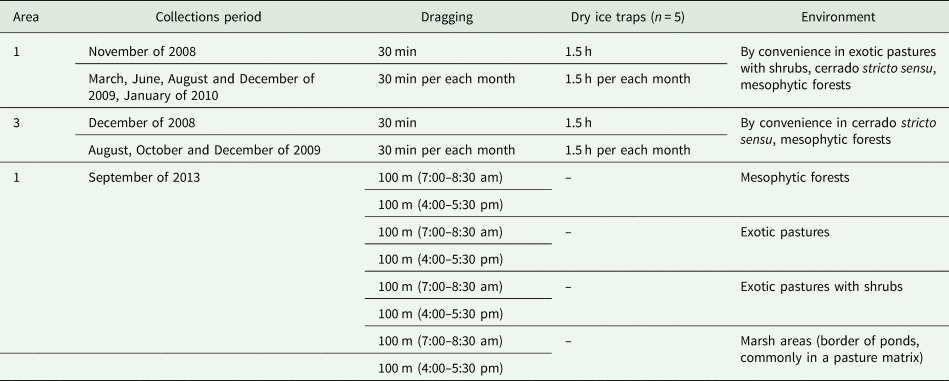
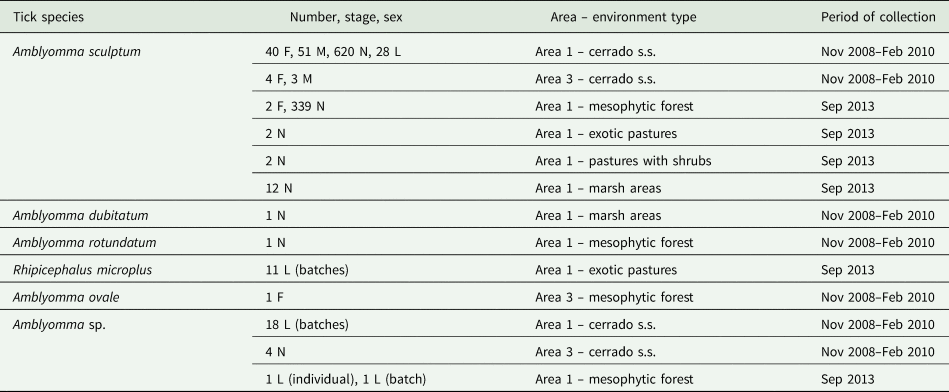
Questing ticks were collected from vegetation in two temporal and space settings. Initially, in 2008 and 2009–2010 at capture sites of wild canids in Areas 1 and 3, using the methods of dragging and CO2 traps (Oliveira et al., Reference Oliveira, Borges, Lopes and Leite2000; Arzua and Brescovit, Reference Arzua, Brescovit, Barros-Battesti, Arzua and Bechara2006). For cloth dragging, a 2 m long and 1 m wide cotton flannel was dragged over the vegetation. For CO2 traps, five traps with dry ice were positioned on the ground, at least 5 m distant from each other, for one and a half hour at each location. Later, in 2013, only cloth dragging was used in Area 1 at ranges of the hosts as determined by radio-collaring of captured animals. For this last, cloth dragging was conducted within 12 locations and adjusted to the time frames of wild canid activity peaks, twice a day (7:00–8:30 am) and (4:00–5:30 pm), as determined by previous host monitoring. Details of the sampling effort, habitat and period of collection are detailed in Table 1. Collections of questing ticks from vegetation were not conducted concomitant with the collections on hosts due to minimization of perturbation in the sites of capture and to logistic restrains.
Sampling effort for collection of questing ticks from vegetation in Area 1 (Cumari County, Goiás State) and Area 3 (Parque Estadual da Serra de Caldas Novas, Caldas Novas County, Goiás State)

Identification of ticks
Ticks were identified according to dichotomic keys (Onófrio et al., Reference Onofrio, Labruna, Pinter, Giacomin, Barros-Battesti, Barros-Battesti, Arzua and Bechara2006; Martins et al., Reference Martins, Onofrio, Barros-Battesti and Labruna2010; Nava et al., Reference Nava, Beati, Labruna, Cáceres, Mangold and Guglielmone2014), and compared with specimens from a reference collection (Laboratório de Ixodologia) in the Federal University of Uberlândia, Minas Gerais State. Amblyomma sp. larvae and damaged nymphs were identified at the genus level. Despite the existence of molecular methods for the identification of larvae, specimens were very small for individual tests, resulting in an insufficient quantity of DNA extracted. Tests in pools for larvae (resulting in more DNA) were not considered elucidative in this case, due to collections of the isolated individuals on the hosts.
Data analyses
Data of total study period (2008 to 2015) were mainly used for the description of richness (for hosts and environment) and prevalence (for hosts) of tick species. Abundance and prevalence, as described by Bush et al. (Reference Bush, Lafferty, Lotz and Shostak1997) were used to express infestation of hosts captured between 2013 and 2015. For wild hosts inspected with the systematized method, abundances of ticks were compared using the Kruskal–Wallis test and the Dunn's multiple comparison test (Zar, Reference Zar1999). Prevalence was compared among wild host species by the Fisher exact test (Rozsa et al., Reference Rozsa, Reiczigel and Majoros2000), performing one test for each method. Abundance and prevalence in domestic dogs (systematized method) were compared by the Mann–Whitney test (Zar, Reference Zar1999) and the χ 2 test (Rozsa et al., Reference Rozsa, Reiczigel and Majoros2000). For questing ticks collected from vegetation during 2013, we compared the densities (ticks per m2) among habitats (exotic pastures, pastures with shrubs, marsh areas and mesophytic forests) and between periods (morning and afternoon) using the Kruskal–Wallis test followed by the Dunn's test, and the Mann–Whitney test, respectively. Collections of free-living ticks on vegetation from 2008 to 2015 were not compared due to great differences in the sampling effort among different types of habitat, since they were carried out by convenience.
Results
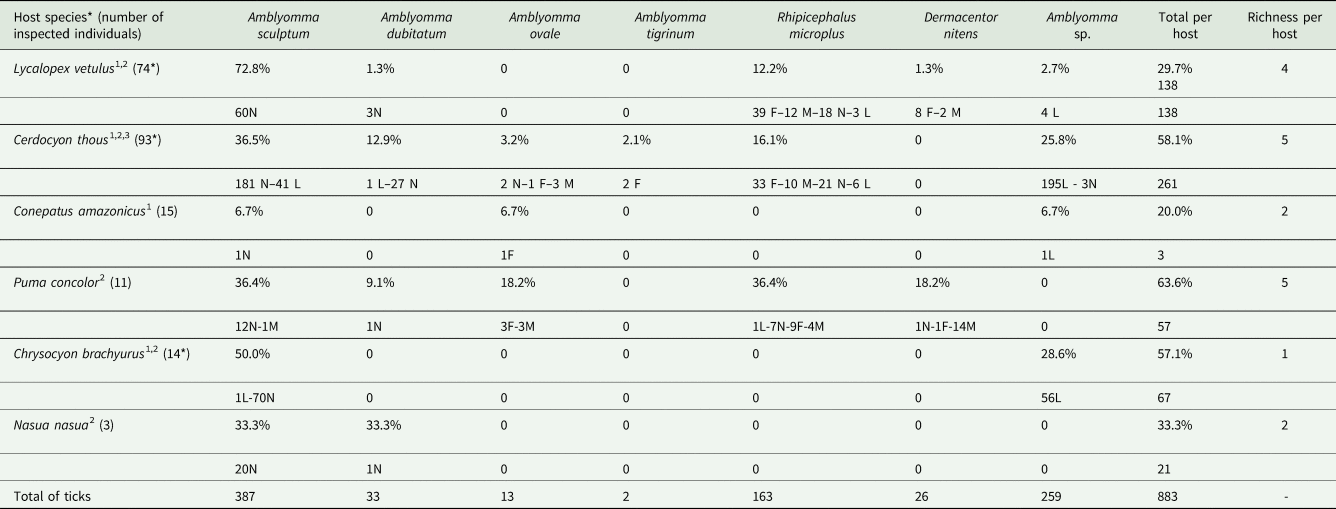
In general, we inspected 119 individuals from nine species of wild carnivores, from 2008 until 2015. Eira barbara (n = 2) was infested solely by A. sculptum (13 nymphs on the two hosts) and, Procyon cancrivorous (n = 1), by A. ovale (one female on one host). No tick was found on Leopardus pardalis (n = 2). The other captured host species and their ticks are described in Table 2. Overall six tick species were found, but A. sculptum was the most frequent and abundant tick on the wild carnivores, mainly in the nymph stage (98.6% of the total number of ticks). In the comparisons among the four host species with more than 10 individuals inspected exclusively in the non-systematized method, L. vetulus (prevalence = 88%), C. thous (50%) and P. concolor (63%) presented similar prevalence (Fisher exact test, P = 0.001), but higher than in C. amazonicus (20%).
Prevalence (infested/total of hosts) and abundance of larvae (L), nymphs (N) and adult ticks (M = males and F = females) collected on wild carnivores from 2008 to 2015, in two localities of a cattle ranch region (Areas 1 and 2) and in one natural reserve (Area 3), Cerrado biome, Brazil

The local of capture for each host species (Areas 1, 2 and 3) are indicated by a superscripted number (1, 2 and 3), and the asterisk indicates number of hosts correspondent to the pooled number of inspections using the both collection methods.
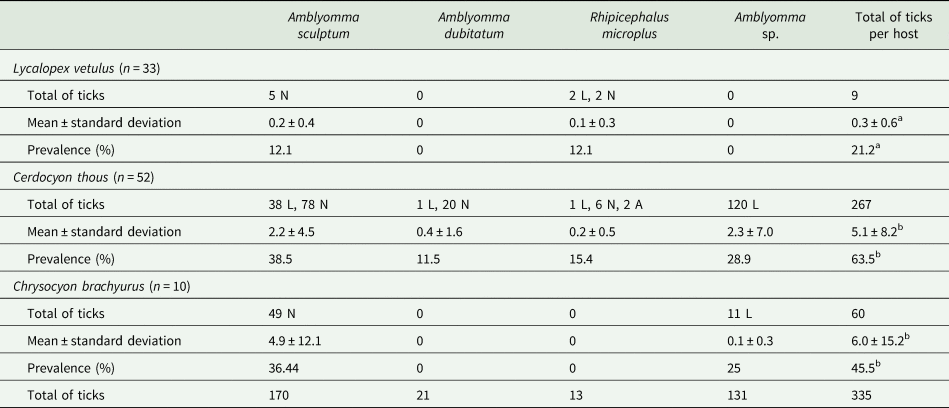
Systematized tick collections on C. thous, L. vetulus and C. brachyurus resulted solely in three tick species (richness = 3, 2 and 1, respectively) and, again, nymphs of A. sculptum dominated the infestations (Table 3). Using this method, L. vetulus presented the lowest abundance (H Kruskal−Wallis = 19.352; P = 0.017) and prevalence (Fisher exact test, P = 0.0000) among the three inspected canids.
Tick infestation on wild canids inspected in 2013, 2014 and 2015 (April, May and September), using the systematized collection method (3 min), in a cattle ranch region, Cerrado biome, Brazil

L, larvae; N, nymphs; M:L, larvae; N, nymphs; A, adult ticks.
*Different letters indicate a significant difference (P < 0.05) among infestation of the three hosts.
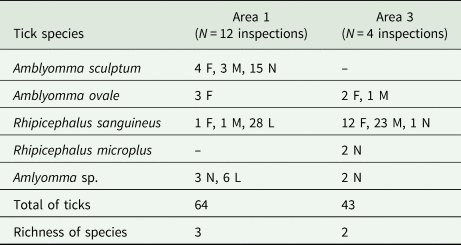
From 2009 to 2012, ten domestic dogs (corresponding to 16 inspections) were examined using the non-systematized method in Areas 1 and 3. Amblyomma sculptum was only observed in Area 01 and, R. microplus, in Area 3 (Table 4). In both areas, the dogs had access to natural vegetation and pastures, but they also had the farmhouse as the main resting place.
Number and species of ticks collected on domestic dogs using the non-systematized method (by convenience), in a cattle ranch region (Area 1) and in a natural reserve (Area 3), Cerrado biome, Brazil

In domestic dogs (n = 129) inspected using the systematized sampling, A. sculptum occurred in higher abundance (U Mann−Whitney = 10 646.0, P = 0.000) and prevalence (Chi-square test, χ 2 = 13.05, P = 0.0000) than the other abundant and frequent tick species, R. sanguineus. Tick infestation evaluated by systematized sampling, except for R. microplus (1.5%, n = 4 adult ticks), is detailed in Table 5.
Tick infestation parameters on domestic dogs (n = 129) inspected in farms of a cattle ranch area, Cerrado biome, Brazil, in June and July of 2014

L, larvae; N, nymphs; M, males; F, females.
*Different letters indicate a significant difference (P < 0.05) among infestation by R. sanguineus and A. sculptum.
For 59 domestic dogs, no tick was visualized after 10 min of inspection (total collection). On these, we found 74 R. sanguineus and 349 A. sculptum. For the other 70 dogs, it was not feasible to collect all the ticks in 10 min (partial collection). The collection from these dogs resulted in 214 R. sanguineus and 368 A. sculptum. We obtained behavioural information from 83 domestic dogs and, according to the owners, 46 did not have access to forest patches around the farmhouse, but still 26 of them (61%) had Amblyomma ticks.
Major relationships among hosts and ticks are shown in Fig. 2. Hosts with less than 10 individuals (E. barbara, N. nasua and P. cancrivorus), and ticks without the identification of species (Amblyomma sp.) were excluded from the figure.
Chord diagram representing the inter-relationships between tick species and domestic and wild carnivore host species with more than 10 captured animals in the Brazilian Cerrado. The border scale represents the number of host-parasite interactions for each species. The number of inspected hosts is indicated between parentheses. A.= Amblyomma; D.= Dermacentor; R.= Rhipicephalus; P. concolor = Puma concolor; C. amazonicus = Conepatus amazonicus; C. thous = Cerdocyon thous; L. vetulus = Lycalopex vetulus; C. brachyurus = Chrysocyon brachyurus; C. l. familiaris = Canis lupus familiaris.

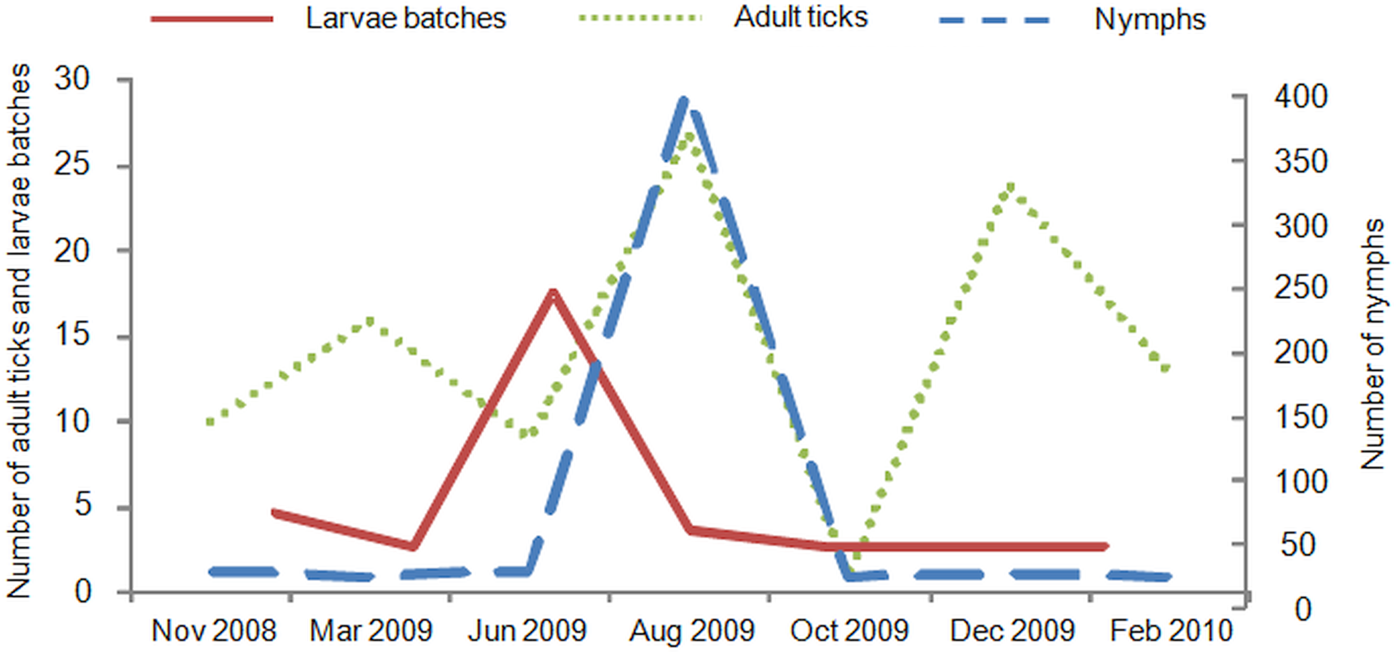
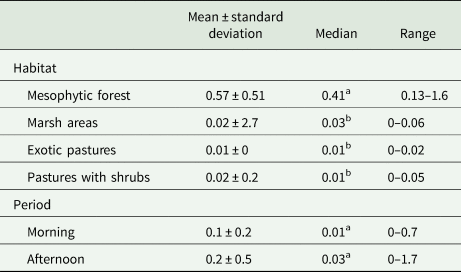
Samplings of questing ticks in the vegetation in Areas 1 and 3 are showed in Table 6. From November of 2008 to February of 2010, larvae and nymphs peaked (absolute numbers) in the dry season (respectively in June and August 2009) whereas adult tick numbers oscillated along the period (Fig. 3). In September of 2013, mesophytic forests were the main source of ticks (H Kruskal−Wallis = 14.172; P = 0.003), specially of A. sculptum nymphs. We did not detect differences among the other habitats (pastures with shrubs, exotic pastures and marsh areas) nor between the two periods of the day (U Mann−Whitney = 62; P = 0.559). Densities of ticks in each habitat and period are presented in Table 7.
Temporal variation of questing ticks (Amblyomma) collected from vegetation by dragging and dry ice traps in a cattle ranch area in the Brazilian Cerrado, between November 2008 and February 2010. Nymphs were represented in a distinct axis due the great differences in the range of collected specimens. Larvae batches were considered as individual unities, and were represented at the same axis of adult ticks.

Number of questing ticks collected from vegetation in areas used by wild carnivores in a cattle ranch region (Area 1) and in a natural reserve (Area 3), both located in the Cerrado biome, Brazil

Densities of ticks (ticks per m2) in different types of habitat and periods of the day, collected by dragging in cattle ranchareas in the Cerrado biome, Brazil, during 2013.

*Different letters indicate a significant difference (P < 0.05) among compared habitats and between periods of the day.
Discussion
Altogether six tick species were found on wild carnivores but infestations were quite dissimilar among the various host species. The most frequent and abundant tick on all host species, with exception of one (P. cancrivorous), was A. sculptum, reflecting the environmental infestation. Nymphs prevailed on the hosts and the adults were rare. Since adults of A. sculptum were sampled several times in the environment, and temporally coinciding with the capture of hosts (in the collections by convenience), it can be supposed that carnivores are not adequate hosts for adults of this tick species.
Amblyomma ovale, another frequent tick species on the wild hosts, is commonly associated with carnivores (Guglielmone et al., Reference Guglielmone, Estrada-Peña, Mangold, Barros-Battesti, Labruna, Martins, Venzal and Keirans2003; Labruna et al., Reference Labruna, Jorge, Sana, Jácomo, Kashivakura, Furtado, Ferro, Perez, Silveira, Santos, Marques, Morato, Nava, Adania, Teixeira, Gomes, Conforti, Azevedo, Prada, Silva, Batista, Marvulo, Morato, Alho, Pinter, Ferreira, Ferreira and Barros-Battesti2005a). This species is found more frequently in humid forests (Labruna et al., Reference Labruna, Camargo, Terrassini, Ferreira, Schumaker and Camargo2005b; Szabó et al., Reference Szabó, Labruna, Garcia, Pinter, Castagnolli, Pacheco, Castro, Veronez, Magalhães, Vogliotti and Duarte2009, Reference Szabó, Nieri-Bastos, Spolidorio, Martins, Barbieri and Labruna2013) and in lower numbers in the Cerrado (Szabó et al., Reference Szabó, Martins and Santos2007a). Such observation explains the lack of A. ovale on host species commonly associated with open habitats, as hoary foxes (Dalponte, Reference Dalponte2009).
Only a few specimens from other Amblyomma species were collected on carnivores. Amblyomma dubitatum is associated with humid environments such as areas prone to flooding and surroundings, and frequently parasitizes a rodent with semi-aquatic habits, the capybara, Hydrochoerus hydrochaeris (Aragão, Reference Aragão1936; Szabó et al., Reference Szabó, Castro, Ramos, Garcia, Castagnolli, Pinter, Veronez, Magalhães, Duarte and Labruna2007b; Nava et al., Reference Nava, Venzal, Labruna, Mastropaolo, González, Mangold and Guglielmone2010; Queirogas et al., Reference Queirogas, Del-Claro, Nascimento and Szabó2012; Debárbora et al., Reference Debárbora, Mangold, Eberhardt, Guglielmone and Nava2014). Therefore, carnivores must have been infested at such an environment.
In our study, capture effort in the most preserved area was lower, nevertheless, we found specimens of A. tigrinum on the only two inspected hosts (C. thous). It is known that adults of this tick species are common parasites of carnivores elsewhere in the Cerrado, especially on C. brachyurus (Labruna et al., Reference Labruna, Jorge, Sana, Jácomo, Kashivakura, Furtado, Ferro, Perez, Silveira, Santos, Marques, Morato, Nava, Adania, Teixeira, Gomes, Conforti, Azevedo, Prada, Silva, Batista, Marvulo, Morato, Alho, Pinter, Ferreira, Ferreira and Barros-Battesti2005a; Martins et al., Reference Martins, Arrais, Rocha, Santos, May and Azevedo2015). Our results from the preserved area, associated with the absence of A. tigrinum in the other areas submitted to a more intense sampling effort, indicate a higher environmental specificity of this tick in the region. It is important to observe that we did not identify the larvae at the species level, and some tick species could be underestimated, mainly the rarer ones.
Infestations of C. thous, L. vetulus and P. concolor with either R. microplus and/or Dermacentor nitens should be viewed as occasional, due to sharing of pastures with bovines and horses. Rhipicephalus microplus is the main cattle tick in Brazil whereas D. nitens is a horse tick (Borges and Leite, Reference Borges and Leite1993; Labruna et al., Reference Labruna, Kasai, Ferreira, Faccini and Gennari2002; Pereira et al., Reference Pereira, Labruna, Szabó and Klafke2008). Since both species are monoxenous (larvae, nymphs and adults feed on the same host), only larvae are host questing in pastures. Therefore, finding nymphs and adults on carnivores corroborates the capacity of these hosts to feed these tick species from larvae until the adult stage.
Specific habitat usage by the canid species may help to explain the infestation pattern. Different from L. vetulus, which are associated with open habitats, C. thous exploits different anthropized and natural environments throughout the landscape, as pastures, forests, humid areas among others (Jácomo et al., Reference Jácomo, Silveira and Diniz-Filho2004; Lemos et al., Reference Lemos, Facure, Azevedo, Rosalino, Gheler-Costa, Rosalino and Gheler-Costa2011). Cerdocyon thous is, therefore, exposed to a broader array of tick species. Undergoing research evaluating the effect of home ranges, habitat and tick infestations of each individual host, should add valuable information to these host-parasite relationships.
The tick species found on dogs were previously recorded in Cerrado (Szabó et al., Reference Szabó, Martins and Santos2007a; Queirogas et al., Reference Queirogas, Oliveira, Marques, Oliveira and Szabó2010) and reflect their access to natural, rural and domestic areas. Systematized sampling displayed infestations polarized between two tick species, A. sculptum and R. sanguineus sensu lato, nonetheless, with quite different characteristics. Whereas dogs are primary hosts for the latter in a domestic cycle, they are among many hosts for immatures of the Cerrado tick, A. sculptum. Nymphs were the main parasitic stage of A. sculptum, many of which engorging, and not a single adult was found on dogs. This infestation profile is undoubtedly linked to seasonality of this tick species (June and July are months with higher larvae and nymphs number) but since adults of A. sculptum are found all year round it shows a lesser dog-adult tick adequacy similarly to the observed for wild carnivores.
Lastly, the direct access to the forest patches is not the sole condition for infestation by Amblyomma. Infestations may occur with ticks left by wild animals circulating around human settlements, agonistic interactions and dog incursions to the neighbouring pastures. This could explain dogs restricted in the surrounding of the farmhouse presenting parasitism by Amblyomma ticks. A detailed study on the association between behaviour and characteristics of the dogs and infestation by ticks is in course, and it can be useful for a better comprehension of these initial observations.
Sampling of questing ticks from vegetation displayed high numbers of A. sculptum, overwhelmingly in shadowed locations (forests). This relationship of A. sculptum with shadow and forested phytophysiognomies has been observed before both in preserved Cerrado as well as in anthropized areas in Southeast Brazil (Labruna et al., Reference Labruna, Kerber, Ferreira, Faccini, De Waal and Gennari2001; Souza et al., Reference Souza, Souza, Rodrigues-Neto and Prado2006; Veronez et al., Reference Veronez, Freitas, Olegário, Carvalho, Pascoli, Thorga, Garcia and Szabó2010; Ramos et al., Reference Ramos, Piovezan, Franco, Rodrigues, Nava and Szabó2016). For R. microplus, a tick species with a one-host life cycle (Hoogstraal and Aeschlimann, Reference Hoogstraal and Aeschlimann1982), only larvae seek for hosts in the environment, and this fact explains the collections solely of larvae in the pastures. Other tick species were too few for considerations about environmental preferences in the studied areas, and some discussions were done previously on the host infestation. The seasonal distribution of A. sculptum grossly matched previous observations of a 1-year life cycle (Labruna et al., Reference Labruna, Kasai, Ferreira, Faccini and Gennari2002, Reference Labruna, Terassini and Camargo2009; Szabó et al., Reference Szabó, Martins and Santos2007a, Reference Szabó, Castro, Ramos, Garcia, Castagnolli, Pinter, Veronez, Magalhães, Duarte and Labruna2007b). Accordingly, larvae predominated in autumn, nymphs in winter and spring and adults prevailed in the hot and rainy season but were seen all along the year with fluctuating numbers.
In conclusion, tick species typically associated with domestic animals (cattle, horses and dogs) were observed infesting wild carnivores. Some of them could be vectors of pathogens to livestock (Pereira et al., Reference Pereira, Labruna, Szabó and Klafke2008), but their pathogenicity to wild fauna is uncertain. In the opposite way, domestic dogs became infested by ticks from the wild fauna (A. sculptum), and pathogens vectored by this tick could circulate between dogs, carnivores and humans. Finally, the dominance of A. sculptum and its broad host range, both under natural and anthropized conditions, deserves attention. This is an anthropophilic tick and is the main vector of the Brazilian spotted fever pathogen, which causes a lethal human disease in southeastern Brazil (Galvão et al., Reference Galvão, Silva, Nascimento, Calic, Sousa and Bacellar2005; Angerami et al., Reference Angerami, Resende, Feltrin, Katz, Nascimento, Stucchi and Silva2006). Its presence on dogs and wild carnivores, several times with other tick species on the same host provides means for pathogen flow from wildlife to anthropic areas and vice-versa. Although we did not observe a great number of tick species naturally associated with domestic animals infesting the carnivores, the sharing of A. sculptum among all evaluated hosts justifies the concern on the wild fauna. The close genetic proximity between canids, in particular, favours the transit of microorganisms vectored by this tick and enhances their establishment potential. In this sense, further studies focusing on monitoring spatial and temporal overlap of infected ticks and their vulnerable hosts and evaluating the risk of diseases in these areas (Zeimes et al., Reference Zeimes, Olsson, Hjertqvist and Vanwambeke2014) are essential, especially for these important predator species in the Cerrado biome.
Acknowledgements
We thank Centro Nacional para Pesquisa e Conservação de Mamíferos Carnívoros (CENAP)/ICMBio, Fundação Parque Zoológico de São Paulo, Fundação Oswaldo Cruz and Laboratório de Biodiversidade Molecular e Conservação/UFSCAR for logistical support. We also thank the Cerrado Mammals Conservation Program (PCMC) for the partnership and data acquisition carried by Mozart C. Freitas Junior, Fabiana L. Rocha, Eduardo Fragoso, Hugo C. M. Costa, Leandro Abade and Frederico Cigano Alves.
Financial support
This work was supported by Brazilian funding agencies Fundação de Amparo à Pesquisa de Minas Gerais (FAPEMIG), Conselho Nacional de Desenvolvimento Científico e Tecnológico (CNPq) and Coordenação de Aperfeiçoamento de Pessoal de Nível Superior (CAPES). This work was partially funded by Consórcio Capim Branco de Energia.
Conflict of interest
None.
Ethical standards
Procedures with handling of wild carnivores followed recommendations of the American Society of Mastozoology (Sikes and Gannon, 2011) were approved by the Brazilian government (Instituto Chico Mendes de Conservação da Biodiversidade – ICMBio (SISBIO license number 14576-2 and 18913)) and the Ethics Committees on Animals Using (CEUA) of the Universidade Federal de Goiás (UFG; process numbers 066/14 and 086/14) and Universidade Federal de Uberlândia (UFU; process number 089/14). Environmental tick collection was authorized by ICMBio (SISBIO – license number 10762-1).