Antibiotics are among the most commonly prescribed medications in the neonatal intensive care unit (NICU).Reference Clark, Bloom, Spitzer and Gerstmann 1 , Reference Fonseca, Ehrenkranz and Baltimore 2 Unlike in children and adults, neonates often exhibit nonspecific clinical and laboratory signs, making it difficult to distinguish infections from other disease processes.Reference Wirtschafter, Padilla, Suh, Wan, Trupp and Fayard 3 , Reference Cantey, Wozniak and Sanchez 4 While timely interventions for a true infection are critical, repeated and unnecessary exposures to broad-spectrum antibiotics can result in the development of antimicrobial resistance among certain organisms, as well as an increased risk of candidemia, necrotizing enterocolitis (NEC), hospital-acquired infections, and death in preterm infants.Reference Almuneef, Baltimore, Farrel, Reagan-Cirincione and Dembry 5 – Reference Kuppala, Meinzen-Derr, Morrow and Schibler 13
Organizations have published guidelines aimed at improving antibiotic prescription practices of healthcare providers and, based on these guidelines, some children’s hospitals have successfully implemented antimicrobial stewardship programs (ASPs). 14 – Reference Metjian, Prasad, Kogon, Coffin and Zaoutis 20 Information on the design and implementation of NICU-specific ASPs, however, remains extremely limited. In 2012, Patel and SaimanReference Patel and Saiman 21 modified aspects of the Get Smart for Healthcare campaign 17 and created a blueprint for such a program. Utilizing these guidelines, we designed and implemented an ASP in the Yale-New Haven Children’s Hospital (YNHCH) NICU. The primary objective of this investigation was to assess the impact of that ASP on antimicrobial prescription practices and utilization in our NICU.
METHODS
Study Setting and Population
The YNHCH NICU is a 54-bed, level 4 NICU within a non–free-standing children’s hospital in New Haven, Connecticut, with all pediatric medical and surgical subspecialties available on site. Approximately 9%–10% of our NICU population undergoes at least 1 major surgical procedure during their stay, and those necessitating any procedure other than major cardiothoracic surgery recover in the NICU. All neonates admitted to our NICU and prescribed antimicrobials from January 1, 2011, to June 30, 2016, were eligible for inclusion.
The Yale University Human Investigation Committee approved this investigation.
Program Design and Implementation
The design process for this ASP began in July 2012. At that time, the only component of an ASP that existed at our institution was formulary restriction for select antimicrobials. A multidisciplinary team was formed consisting of a neonatologist, a neonatal-perinatal medicine fellow (who led the initiative), a pediatric infectious diseases physician, a pediatric clinical pharmacist, a NICU registered nurse, and an infection control practitioner. Core members completed educational training modules on principles of antimicrobial stewardship. 22 Participation was voluntary, and no funding was directly applied to the design, implementation, or maintenance of the program.
A review of medical literature was undertaken to develop clinical guidelines for common neonatal infections to curtail provider-to-provider variability in prescription. Recommendations focused on evaluation and treatment and included standard durations of treatment for “clinical sepsis” (ie, culture-negative sepsis) and postoperative antibiotic prophylaxis. NICU-specific antibiograms were compiled and included. A draft of the guidelines was distributed to staff for feedback and, once finalized, published on our hospital-based intranet to facilitate access.
A unit-wide educational effort was launched in early 2013. Sessions were held that (1) outlined the principles and strategies of antibiotic stewardship, (2) introduced clinical guidelines, (3) reviewed baseline data, and (4) described outcome measures. The program was officially launched on May 1, 2013, as the first ASP at YNHCH.
To facilitate implementation and reinforce key concepts, a pediatric clinical pharmacist attended patient care rounds. A daily report from the electronic medical record was generated and distributed to ASP team members that included all prescribed antimicrobials and their rationales, and all cultures and their results. Reports were reviewed daily to allow for timely prescriber audit and feedback. Recommendations were then made to the clinical care team that included interpretation of positive cultures, opportunities to narrow broad-spectrum antimicrobial coverage, suggested duration of therapy, and discontinuation of antimicrobials in the setting of negative cultures and resolution of clinical signs of infection.
The ASP team met quarterly to review data, discuss feedback, address programmatic issues, and make modifications. A monthly summary was distributed to all staff detailing the number of evaluations for suspected infection, antibiotic utilization, positive cultures, and compliance with guidelines. An educational topic was selected based on any guideline deviations or consistent themes.
Study Design and Outcomes
We conducted a quasi-experimental study with interrupted time series aimed at determining the impact of an ASP on antimicrobial utilization in the YNHCH NICU. The preintervention period was defined as January 1, 2011, through June 30, 2012, and the stewardship period was July 1, 2012, through June 30, 2016. Our primary outcome measure was days of therapy (DOT) per 1,000 patient days (PD), compiled monthly. Data were collected from the Pediatric Health Information System, which includes comprehensive data from some of the largest children’s hospitals with the most demanding standards of pediatric service in North America. The aggregate sum of antimicrobial use in our NICU included any antibacterial or antifungal administered intravenously, intramuscularly, or orally and excluded antivirals, topical, ophthalmic, and nebulized antimicrobials. Data were collected separately for ampicillin, gentamicin/tobramycin, vancomycin, cefotaxime, and clindamycin, which constituted 92% of antimicrobials prescribed in our NICU. Notably, tobramycin was substituted for gentamicin from April through November 2011 due to a shortage. Gentamicin and tobramycin data were therefore combined. Standard empiric antibiotic regimens in our NICU include (1) ampicillin and gentamicin for suspected early-onset sepsis (EOS; laboratory confirmed blood or cerebrospinal fluid culture at ≤72 hours of life), (2) vancomycin and gentamicin for suspected late-onset sepsis (LOS; >72 hours of life), and (3) ampicillin and gentamicin (with clindamycin added for ≥ stage IIAReference Kliegman and Walsh 23 ) for NEC. Our standard practice is to discontinue empiric therapy after 48 hours in the setting of negative cultures and resolution of clinical signs of infection.
As a secondary outcome, we assessed the number of attending-specific LOS evaluation and antimicrobial prescription events per 100 days of NICU service (ie, the decision to obtain cultures and initiate antimicrobials for each neonatologist per time spent on-service in the NICU). Events were compared annually for 13 attending neonatologists who remained on faculty for at least 5 years of the study period. The decision to perform an LOS evaluation is made primarily by the neonatologist based on clinical assessment and judgment regarding the likelihood of infection. Alternatively, the decision to initiate evaluation and treatment for EOS has traditionally been based on application of management guidelines and algorithms created by national organizations and expert panels.Reference Polin 24 – Reference Brady and Polin 26 We surmised that educational efforts conducted as part of our ASP (ie, the emphasis on weighing the perceived risk of infection vs that of unnecessary antibiotic exposure) would more directly influence the decision-making scenario surrounding a LOS evaluation.
As balancing measures, each infection was reviewed in detail for timeliness of recognition. We also assessed whether infants with clinical or culture-proven infections had recurrence of infection within 7 days of discontinuation of their treatment course, and whether infants with a negative evaluation had antibiotics restarted within 72 hours of discontinuation of their initial course.
Statistical Analysis
Descriptive and outcome data from the entire NICU population admitted during the study period were compared between the preintervention and stewardship periods. Univariate comparisons were made via Pearson χ2 test for dichotomous data and Student t test for continuous data.
Interrupted time-series analysis was used to estimate change in antimicrobial use after ASP implementation, controlling for preintervention trends and other autocorrelations. SAS procedure PROC AUTOREG was used to examine change in level and/or trend of antimicrobial utilization following the intervention. A change in level is defined by an increase or decrease in the outcome after the intervention, which measures the abrupt intervention effect. A change in trend is defined by an increase or decrease in the slope of the period after the intervention as compared with the period preceding the intervention. This represents a gradual change in the value of the outcome postintervention. The trend of LOS evaluations per 100 days on service was evaluated using linear mixed-effects model, with time entered as fixed effects. A 2-sided P value<.05 was considered statistically significant. All analyses were performed with SAS software, version 9.4 (SAS Institute, Cary, NC).
RESULTS
No statistically significant difference in birth weight, gestational age, sex, the burden of laboratory-confirmed infection, or NEC was noted in the populations admitted to the NICU during the preimplementation and stewardship periods (Table 1).
Comparison of Infants Admitted to the Yale-New Haven Children’s Hospital Neonatal Intensive Care Unit in the Preimplementation and Stewardship Periods

NOTE. SD, standard deviation.
a Unless otherwise noted.
Antibiotic Utilization
Mean monthly antibiotic utilization rates were 270.4 DOT per 1,000 PD in the preintervention period and 258.8 in the stewardship period, representing a 4.3% decrease from baseline. By comparison, mean monthly antibiotic utilization rates from peer NICUs in the Pediatric Health Information System were 526.8 DOT per 1,000 PD over the pre-intervention period and 416.6 during the stewardship period.
Mean monthly ampicillin utilization in our NICU decreased during the stewardship phase by 12.8% from the preintervention rate (118.6 vs 103.4 DOT per 1,000 PD). Mean monthly vancomycin utilization decreased by 35.5% from the preintervention rate (32.1 vs 20.7 DOT per 1,000 PD), and mean monthly cefotaxime utilization decreased by 40.2% from the preintervention rate (19.4 v. 11.6 DOT per 1,000 PD). Mean monthly gentamicin/tobramycin usage increased by 19.4% from the preintervention period (68.7 vs 82.0 DOT per 1,000 PD), and mean monthly clindamycin utilization increased by 20.8% from the preintervention period (15.9 vs 19.2 DOT per 1,000 PD).
Interrupted Time Series Analysis
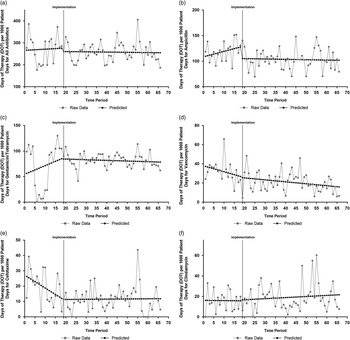
No significant month-to-month changes in overall DOT per 1,000 PD were observed before ASP implementation (P for baseline trend=.861). Following the start of stewardship period, overall DOT per 1,000 PD decreased by 14.7. This decrease was not statistically significant (P=.669). No significant month-to-month change in trend was noted during the stewardship period (P for trend change=.838) (Figure 1a).
Monthly antibiotic utilization in the Yale-New Haven Children’s Neonatal Intensive Care Unit for all antibiotics (Figure 1a), ampicillin (Figure 1b), gentamicin/tobramycin (Figure 1c), vancomycin (Figure 1d), cefotaxime (Figure 1e), and clindamycin (Figure 1f). Data are presented as total days of therapy per 1,000 patient days over the 66-month study period (January 1, 2011, through June 30, 2016). The gray circles depict raw data and the black dotted line predicted values. Each period represents 1 month.

Use of ampicillin decreased significantly by 22.5 DOT per 1,000 PD following initiation of our ASP (P=.037) (Figure 1b). No significant month-to-month change during the pre-intervention period (P for baseline trend=.235) or trend change during the stewardship period was observed (P for trend change=.217). Gentamicin/tobramycin use declined by 0.36 DOT per 1,000 PD with ASP implementation (P=.984) with no significant month-to-month changes noted pre-implementation (P for baseline trend=.314) or subsequently (P for trend change=.313) (Figure 1c).
Vancomycin utilization appeared to decline before the intervention, but the trend was not statistically significant (P for baseline trend=.189). At the start of the stewardship period, vancomycin use decreased by 1.1 DOT per 1,000 PD (P=.844), with no significant change in month-to-month trend noted after the intervention (P for trend change=.390) (Figure 1d). Cefotaxime use declined in the preintervention period (P for baseline trend=.061), and decreased by 0.79 days per 1,000 PD at the start of the stewardship phase (P=.889). We observed a marginally significant change in the month-to-month trend during the stewardship compared to the preintervention period (P for trend change=.065) (Figure 1e).
No significant month-to-month variability in clindamycin utilization was noted before the intervention period (P for baseline trend=.965) and overall utilization increased by 0.81 DOT per 1,000 PD following ASP implementation (P=.904). No significant month-to-month change in trend was noted during the stewardship period (P to trend change=.822) (Figure 1f).
Prescriber-Specific Events
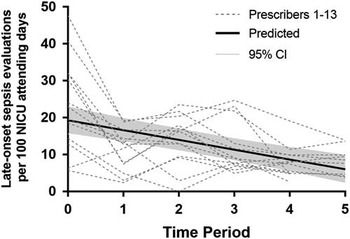
In 2011, an average of 21.2 LOS evaluations were performed per 100 NICU attending days, with substantial variability noted from physician to physician (range, 5.7–47.6 evaluations per 100 NICU attending days). During the stewardship period, a statistically significant reduction in evaluation and prescription events was observed (P<.0001), declining by an average of 2.65 evaluations per attending per year (Figure 2). In 2016, the number of evaluations reached 8.4 per 100 NICU attending days, with less variability (range, 3.8–13.9 evaluations per 100 NICU attending days).
Late-onset sepsis evaluation and prescription events per 100 NICU attending days for 13 neonatologists, from 2011 to 2016. The gray lines represent provider-specific evaluation and prescription rates and the single black line represents the mean number of evaluation and prescription events for the entire group. Each period represents 1 year.

Compliance
Compliance with clinical guidelines was noted in 1,738 of 1,760 (98.75%) treatment courses performed during the stewardship period. In 22 cases of noncompliance, most deviations were related to improper selection of initial empiric coverage (eg, vancomycin instead of ampicillin for suspected EOS).
Balancing Measures
During the stewardship period, no infants with culture-proven or clinical infection developed a recurrent infection within 7 days of discontinuation of their antibiotic course. However, 3 infants who had an initial negative EOS evaluation underwent subsequent evaluation and treatment within 72 hours of discontinuation of the initial antibiotic course, all of which were secondary to spontaneous intestinal perforation. In all 3 cases, the subsequent evaluation was negative, but prolonged courses of antibiotics were administered.
DISCUSSION
In 2015, antibiotic resistance was labeled a national public health crisis in the United States. 27 With the rise of antibiotic-resistant organisms outpacing development of new antimicrobials, drug shortages compromising availability of existing therapies, and more data emerging on the adverse effects of repeated and unnecessary antibiotic exposures,Reference Bizzarro and Gallagher 6 – Reference Kuppala, Meinzen-Derr, Morrow and Schibler 13 the practice of antibiotic stewardship has become one of necessity. Although development of antimicrobial resistance is multifactorial, inappropriate antibiotic prescription is a major contributing factor.Reference Bizzarro and Gallagher 6 The Centers for Disease Control and Prevention estimate that approximately 50% of antibiotic prescription is unnecessary or not optimally effective. 17 Cantey et alReference Cantey, Wozniak and Sanchez 4 observed that 72% of infants in a level III NICU received at least 1 antibiotic course, with only 5% of antibiotics prescribed for treatment of culture-proven infection. Schulman et alReference Schulman, Dimand, Lee, Duenas, Bennett and Gould 28 documented 40-fold variation in antibiotic use among 127 California NICUs, with utilization varying from 2.4% to 97.1% of PD. No significant correlations were observed between antibiotic use and the burden of proven infection or NEC, surgical volume, or mortality. Patel et alReference Patel, Oshodi and Prasad 29 assessed adherence to the Centers for Disease Control and Prevention’s 12-step campaign in 4 NICUs and determined that 24% of antibiotic days were inappropriate. A survey distributed to neonatologists revealed that some perceived antimicrobial resistance to be more of a national than local issue, and some lacked confidence in the accurate diagnosis and treatment of certain infections.Reference Patel, Rosen, Zaoutis, Prasad and Saiman 30
To breakdown some of these barriers, we created guidelines to assist with diagnosis and treatment, and we conducted an educational program that focused on the adverse consequences of repeated antibiotic exposures. We relied on timely data collection and distribution to allow for real-time feedback and to facilitate open dialogue. Prior to ASP implementation, there was little transparency regarding antibiotic prescription practices but, with time, clinicians began to approach ASP team members for advice. This culture change is exemplified in our high rate of guideline compliance and reduction in LOS evaluations, and our outcomes reflect 3 major programmatic accomplishments: (1) a more thoughtful approach to antimicrobial prescription, (2) less variability in practice and, (3) adherence to evidence-based practices.
We observed a significant decline in LOS evaluation and prescription events with ASP implementation that did not translate into a significant overall reduction in antimicrobial utilization. In our NICU, LOS evaluations encompass 20% of all prescription events, with EOS accounting for the majority. Our data highlight the need to focus additional efforts on the approach to EOS, which necessitates improvements in existing guidelines that drive practice.Reference Polin 24 – Reference Brady and Polin 26 In particular, more accurate identification of those who require antibiotic therapy is greatly needed. Kiser et alReference Kiser, Nawab, McKenna and Aghai 31 demonstrated that application of the Committee on Fetus and Newborn’s guidelines for evaluation and treatment of infants exposed to maternal chorioamnionitisReference Polin 24 resulted in many well-appearing infants with sterile blood cultures being treated with prolonged antibiotic courses, subjected to invasive procedures, and hospitalized for prolonged periods. The National Institute of Child Health and Human Development recently held a workshop to re-evaluate the management of newborns with a maternal diagnosis of chorioamnionitis. The recommended changes, if implemented, could substantially reduce unnecessary antimicrobial utilization in newborns.Reference Higgins, Saade and Polin 32 In addition, researchers at Kaiser Permanente have developed a multivariable risk prediction tool for early-onset infection.Reference Kuzniewicz, Puopolo and Fischer 33 Implementation of their model in several NICUs significantly reduced the proportion of newborns undergoing invasive evaluation and antibiotic treatment without any apparent adverse effects.Reference Kuzniewicz, Puopolo and Fischer 33 Continued efforts such as these are a key component in further reducing unnecessary antimicrobial prescription in the NICU.
Baseline antibiotic utilization in our NICU was low compared to peer NICUs, yet we still demonstrated a statistically significant reduction in ampicillin utilization (the most frequently prescribed antibiotic in our NICU) in the stewardship period. This finding is likely the result of implementation of several aspects of our clinical guidelines which incorporate ampicillin use, including limiting the duration of postoperative antibiotic prophylaxis, eliminating the need for antibiotic prophylaxis after a single, uncomplicated urinary tract infection, and setting limitations for duration of treatment for NEC and early-onset clinical sepsis. No statistically significant changes in utilization of other commonly prescribed antibiotics, however, were observed. A low rate of tobramycin use was observed in the preintervention period that correlated with a gentamicin shortage, but not with changes in demographics or the burden of infection or NEC. The shortage may therefore have led to more judicious prescription practices. Clindamycin utilization remained unchanged over the study period. In our NICU, clindamycin is utilized as treatment for NEC. No significant changes in NEC rates observed over the study period may partly explain this finding. Vancomycin and cefotaxime utilization appeared to decline prior to ASP implementation. We experienced a substantial reduction in NICU-acquired infections from 2008 to 2010 after implementing an initiative to improve central-line–associated bloodstream infections,Reference Bizzarro, Shabanova, Baltimore, Dembry, Ehrenkranz and Gallagher 34 which may partially explain this observation.
Our study has several limitations. DOT per 1,000 PD was used as our main outcome measure, but the optimal metric for antibiotic stewardship has not been defined.Reference Cantey, Wozniak and Sanchez 4 , Reference Cantey and Patel 35 Our primary focus was on improving antibiotic prescription, but we did not delve deeper into whether antimicrobial prescription practices are affected by specific conditions. We cannot prove that ASP implementation was directly responsible for any of the changes observed. Lastly, we were not powered to show differences in other outcome measures such as antimicrobial resistance between periods, so the impact of our program on this important metric remains undetermined.
In summary, we demonstrated the successful design and implementation of a multidisciplinary ASP in a level IV NICU, with improvements noted in antibiotic prescription practices. Our success is likely multifactorial, but we believe a key component was prospective audit and feedback to (and from) the prescriber. There has recently been a great deal of increased attention and resources allocated to the reduction of inappropriate antibiotic use on a national level, including international collaborative efforts among NICUs. 36 Our efforts, as well as the overall reduction in antimicrobial utilization observed among NICUs in the Pediatric Health Information System, may exemplify a growing awareness that ASPs have the potential to not only reduce antibiotic overuse and misuse but also to impact common neonatal morbidities and mortality faced by these extremely vulnerable infants.
ACKNOWLEDGMENTS
We would like to thank the NICU staff at YNHCH, and in the Division of Pediatric Surgery for their dedication, support, and diligence in improving antibiotic utilization.
Financial support: No financial support was provided relevant to this article.
Potential conflicts of interest: All authors report no conflicts of interest relevant to this article.