INTRODUCTION
With population growth and the rising prevalence of people living with acquired brain injury (ABI), there is an ever-increasing need for rehabilitation (World Health Organization, 2016). People living in rural and remote communities, in particular, face major barriers to accessing timely health services more broadly (Australian Bureau of Statistics, 2018). Telerehabilitation platforms are increasingly being used to provide rehabilitation remotely to people with ABI and their families (Chen etal., Reference Chen, Jin, Zhang, Xu, Liu and Ren2015; Rietdijk, Togher, & Power, Reference Rietdijk, Togher and Power2012).
Telerehabilitation can entail assessment, supervision, education, counselling, skills training, case management, and service coordination. Technologies include telephone, messaging and email, videoconferencing (VC), virtual therapists, and interactive web-based platforms (Theodoros, Russell, & Latifi, Reference Theodoros, Russell and Latifi2008). Telerehabilitation typically reduces the need for travel, enables flexible scheduling of appointments and extended follow-up, and can be cost-effective compared to clinic-based interventions (Lloréns, Noé, Colomer, & Alcańiz, Reference Lloréns, Noé, Colomer and Alcañiz2015).
Systematic reviews of the efficacy of telerehabilitation in stroke and other neurological populations identified comparable gains to in-person interventions (Chen et al., Reference Chen, Jin, Zhang, Xu, Liu and Ren2015; Tchero, Tabue-Teguo, Lannuzel, & Rusch, Reference Tchero, Tabue-Teguo, Lannuzel and Rusch2018). Despite a proliferation of online interventions for paediatric traumatic brain injury (TBI) (Wade, Carey, & Wolfe, Reference Wade, Carey and Wolfe2006; Wade et al., Reference Wade, Walz, Carey, Williams, Cass, Herren, Mark and Yeates2010), the telephone was found to be the most common telerehabilitation platform evaluated in adults with TBI (Ownsworth, Arnautovska, Beadle, Shum, & Moyle, Reference Ownsworth, Arnautovska, Beadle, Shum and Moyle2018). Survey research identified that people with brain injury expressed strong interest in accessing telerehabilitation services (Ricker et al., Reference Ricker, Rosenthal, Garay, DeLuca, Germain, Abreaham-Fuchs and Schmidt2002). Feasibility of VC for delivering in-home rehabilitation has been supported by several case studies (McGrath, Dowds, & Goldstein, Reference McGrath, Dowds and Goldstein2008; Rietdijk, Power, Brunner, & Togher, Reference Rietdijk, Power, Brunner and Togher2018; Sander, Clark, Atchison, & Rueda, Reference Sander, Clark, Atchison and Rueda2009). Potential barriers to in-home delivery relate to clients’ functional impairments, lack of comfort with technology, security concerns, and costs. Organisational barriers to VC implementation such as health professionals’ attitudes and skills have also been identified along with concerns about technology impacting on client centredness (Hines et al., Reference Hines, Brunner, Poon, Lam, Tran, Yu, Togher, Shaw and Power2017; Speyer et al., Reference Speyer, Denman, Wilkes-Gillan, Chen, Bogaardt, Kim, Heckathorn and Cordier2018). To enhance uptake in service delivery, research on user acceptance of telerehabilitation platforms is essential.
Technology Acceptance in Healthcare
Rapid developments in healthcare technology have given rise to poorly designed systems, limited user acceptance, and low implementation rates (Sugarhood, Wherton, Procter, Hinder, & Greenhalgh, Reference Sugarhood, Wherton, Procter, Hinder and Greenhalgh2014). Technology acceptance is defined as individuals’ willingness and intention to use technology for its intended purpose and way it was designed (Davis, Reference Davis1989). The Technology Acceptance Model (TAM; Davis Reference Davis1989) is a leading and well-supported theory of factors facilitating or constraining the adoption of a particular healthcare technology (Holden & Karsh, Reference Holden and Karsh2010). As shown in Figure 1, the TAM proposes that perceptions regarding the usefulness and ease of use of technology influence attitudes towards use and subsequent use (Davis, Reference Davis1989). Perceived usefulness refers to meaningful and tangible benefits associated with using the system, while perceived ease of use refers to efforts associated with system use. Both constructs are influenced by external factors (e.g., social norms and job relevance) which influence the likelihood of technology adoption (Lai, Reference Lai2017). A recent review on acceptance of rehabilitation technologies in adults with TBI identified very few studies that employed a user-centred approach (Vaezipour, Whelan, Wall, & Theodoros, Reference Vaezipour, Whelan, Wall and Theodoros2019). The authors advocated for theory-guided research on user acceptance to support effective planning for uptake of telerehabilitation platforms into service delivery.
Technology Acceptance Model framework.

Study Aims
Despite widespread use of VC as a communication platform, the acceptability and factors influencing uptake in ABI rehabilitation are largely unknown. This qualitative study aimed to explore the perspectives of rehabilitation coordinators, individuals with ABI, and family caregivers on the usability and acceptability of VC in community-based rehabilitation.
METHODS
Manuscript preparation was guided by the Consolidated Criteria for reporting qualitative research (Tong, Sainsbury, & Craig, Reference Tong, Sainsbury and Craig2007).
Research Setting
Established in 1997, the Acquired Brain Injury Outreach Service (ABIOS) is a statewide community ABI rehabilitation service in Queensland, Australia. Queensland has an area of 1,730,648 km2 and a population of approximately five million people (Australian Government, 2018). The ABIOS is based in a metropolitan centre (Brisbane), with rehabilitation coordinators providing in-person case management and rehabilitation services to clients within a 150 km radius and statewide support via telephone and email. Services include assessment, goal setting, service coordination, behaviour management, living skills training, prevocational and vocational support, family education and support, and advocacy. Coordinators work holistically with families and other informal supports to facilitate community reintegration and build sustainable support networks around clients. Interventions are delivered over an extended timeframe, and taper off as support networks are developed within the client’s own community. Education, training, and consultation are provided remotely to the wider state.
The ABIOS facilitates the Skills To Enable People and CommunitieS (STEPS), a 6-week group-based self-management program run statewide by local leaders (people with ABI, family members, and local professionals) who are trained, supported, and supervised by STEPS coordinators. The program focuses on the development of personal and social resources, with group projects (e.g., break-up activity) used to reinforce skills and foster collaboration.
Participants
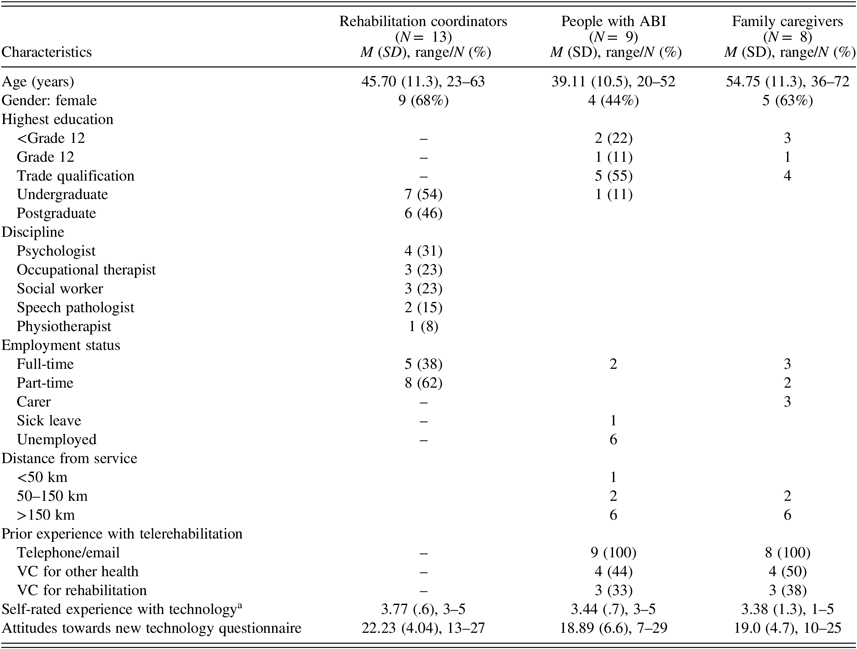
Participants included ABIOS rehabilitation coordinators and current clients with ABI and family caregivers. A sample of 25–30 participants was considered optimal to maximise the likelihood of data saturation. Following ethical clearance, all ABIOS rehabilitation coordinators (N = 13) were invited and all consented to participate in the study. As shown in Table 1, disciplines included psychology (31%), occupational therapy (23%), social work (23%), speech pathology (15%), and physiotherapy (8%). Occupational experience ranged from <6 months to 45 years (M = 20.24, SD = 13.9).
Participants’ demographic and technology characteristics

a Rating scale: 1 = unexperienced to 5 = experienced.
Purposive sampling was used to recruit individuals with ABI and family caregivers with diverse characteristics that were considered to potentially impact on perceptions of the usability and acceptability of VC. These characteristics included age (due to possible influence on familiarity with technology), distance from the service (with greater emphasis placed on recruiting people living >150 km), time since injury (possible impact on nature of service input), and nature of involvement in ABIOS (involved or not involved in STEPS). Following their own interviews, coordinators identified potential participants who differed according to these characteristics, as well as those they believed would be interested in taking part. They approached adults with ABI and family caregivers who had adequate cognitive capacity and English language skills to provide consent and participate in an interview. All clients approached consented and participated in the study. Of the nine participants with ABI (aged 20–52 years), six had caregivers who also participated. Two caregivers participated without the person with ABI being involved. Causes of ABI included traffic accidents (N = 4), stroke (N = 3), horse riding (N = 1), and substance overdose (N = 1). Time since injury ranged from 2 months to 30 years (M = 6.43, SD = 9.6). Caregivers were aged 36–72 years and included five spouses/partners and three parents. Two participants with ABI and one caregiver were STEPS peer leaders. There was variability in distance from the service (29%: <150 km and 71%: >150 km) and prior use of VC for health reasons (44–50%) and rehabilitation specifically (33–38%).
Data Collection
The data included in this manuscript were obtained in compliance with hospital and university ethics review committees. Coordinators were interviewed in a private work meeting room, whereas individuals with ABI and caregivers were interviewed over the telephone. The interviews were conducted by a postdoctoral researcher (LC), a speech pathologist for nearly 40 years with previous experience in conducting qualitative interviews. LC was external to ABIOS and while she had previously met some of the rehabilitation coordinators, she had no prior familiarity with the client participants. She initially spent time building rapport with participants and explained the background and purpose of the study. Participants completed a demographic survey and questions assessing their experience with technology (1 = unexperienced, 5 = experienced) and attitude towards new technology (Weyer, Fink, & Adelt, Reference Weyer, Fink and Adelt2015). For the latter, six items were rated on a five-point scale (1 = strongly disagree, 5 = strongly agree), with higher scores reflecting more positive attitudes towards new technology.
The semi-structured interview (see Supplementary material) explored participants’ experiences and perceptions of telerehabilitation and views on a specific VC platform (Queensland Health [QH] telehealth portal). Initial questions for coordinators focused on the nature of services provided and any service gaps. All participants were asked about their understanding of telerehabilitation prior to the interviewer providing a description. To ensure that participants understood what VC entails, they were shown a paper prototype (in person or posted prior to the interview) of the QH Telehealth Portal. This presented an overview of the portal with photographs depicting the computer screen from both users’ perspectives, weblink to attend an appointment, dial-in screen, webcam and microphone setup, and other features (e.g., screen sharing). Guided by the TAM, questions focused on perceived usefulness, ease of use or difficulties, ideas for improvement, and effects on service delivery. Attitudes towards and intentions to use the portal were explored in this context. Interview durations ranged from 9.29 to 32.25 min (M = 22.39, SD = 5.9).
Data Analysis
Interviews were digitally recorded and transcribed verbatim by a professional transcribing service. Although the interview was theoretically guided, an inductive approach to analysis was used to identify all relevant categories and themes underlying the data. Thematic analysis can provide a rich and detailed account of how individuals make meaning of their experiences and the ways in which the broader social context impacts on those meanings (Braun & Clarke, Reference Braun and Clarke2006, Reference Braun and Clarke2013). Braun and Clarke’s six-phase iterative analysis approach was used to identify patterns in participants’ perceptions regarding the usability and acceptability of VC in community-based rehabilitation. This entailed repeated reading of transcripts to gain familiarity, generation of initial codes, identifying categories and preliminary themes, reviewing and refining themes based on subsequent interviews and discussion with the research team, labelling and defining themes, and selecting illustrative quotes.
Three researchers met to discuss the first three transcripts and develop a preliminary coding framework. The remaining 27 transcripts were double coded by 2 researchers. In line with the approach of Nowell, Norris, White and Moules (Reference Nowell, Norris, White and Moules2017), this was done collaboratively for each transcript through biweekly meetings with the coding framework continually discussed and refined. For occasional inconsistencies in interpretation, feedback was sought from other authors for adjudication purposes. An electronic coding log organised ideas for categories and themes and recorded exemplar quotes throughout the coding process and also documented changes. Constant comparative analysis was used to identify patterns of meaning and contrasting perspectives and continued until no new codes were discovered in the data (Creswell, Reference Creswell2009).
Reflexivity and Rigor
Credibility and trustworthiness of the findings were enhanced through the use of field notes, a coding log and audit trail, and reflexive dialogue between the researchers throughout the analysis (Braun & Clarke, Reference Braun and Clarke2006). The major themes were developed through collaborative discussions among the research team, and they were presented to coordinators for feedback on whether these adequately reflected their experiences and those of their clients. Member checking was not completed with participants with ABI or family members due to practical issues relating to distance and technology.
RESULTS
Rehabilitation coordinators reported that the greatest percentage of client contact occurred through home visits (M = 32%, SD = 9.8), email (M = 27%, SD = 9.8), telephone (M = 27%, SD = 8.6), text messages (M = 7%, SD = 11.0), and letters (M = 6%, SD = 3.7). Modes of client communication were closely tied to locality, with those living within the 150 km catchment area receiving home visits. Clients outside the catchment primarily received support through telephone, emails, and internet resources (e.g., Fact sheets).
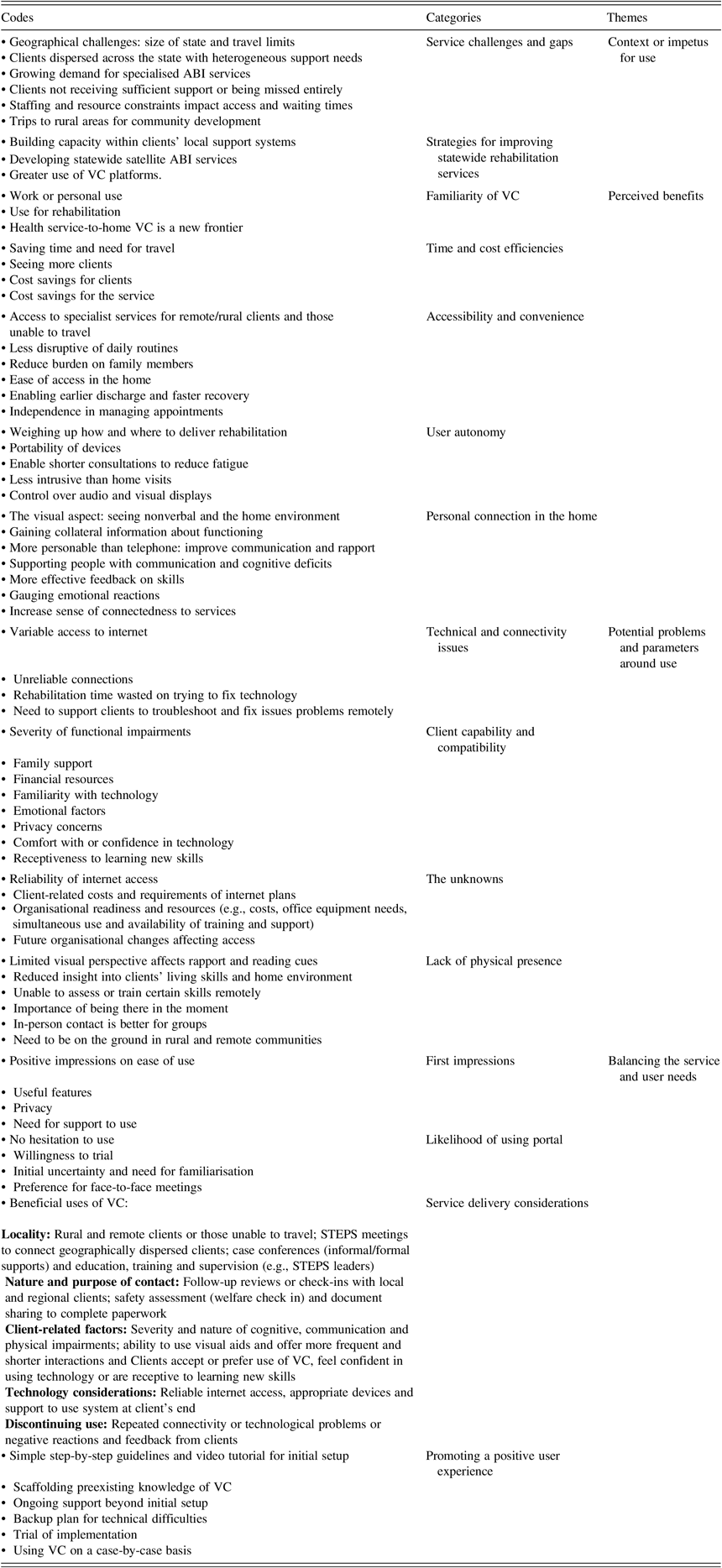
On average, VC was used for 2% (SD = 2.9) of all client contact, which was mainly for health service-to-health service contact whereby clients travelled to a hospital or medical clinic to access facilities. Coordinators had used VC for intake assessments, case conferences, and delivering training. A comparison of self-reported experience and attitudes across the three participant groups indicated coordinators reported slightly more experience and more positive attitudes towards technology than did people with ABI and family caregivers (Table 1). Four themes broadly characterize the factors influencing uptake of VC platforms into practice. These included the context and impetus for use, perceived benefits, potential problems and parameters, and balancing the service and user needs. Table 2 presents the relationships between codes, categories, and themes. Participant quotes are denoted as RC = rehabilitation coordinator, FC = family caregiver, and PwABI = person with ABI.
Relationships between codes, categories and themes depicting the factors influencing uptake of videoconferencing platforms in practice

Context and Impetus for Use
In describing the nature of service delivery, coordinators perceived various service challenges and gaps and also identified the need to improve statewide access to rehabilitation services. Foremost, was the geographical challenge and lack of ABI satellite services to enable comprehensive statewide service delivery. Due to the distance between clients and their varied support needs, it was difficult to link them to local services and the STEPS program. Coordinators felt the need to prioritise how and when to see clients, and they were concerned that some people were receiving insufficient or no support. This was particularly the case for individuals discharged from regional hospitals, clients from indigenous communities, and those with dual diagnoses.
The biggest gap is the people who don’t become clients….sometimes we get them years down the track when they’ve lost their job or families because of behavior. (RC10)
Coordinators perceived a growing need for specialist ABI services with more staff and resources (e.g., cars) to reduce delays for services. Frustration over delayed support was expressed by a family caregiver: The crux of the whole thing is being able to access someone straight away. It was very slow and not as urgent as we thought it should have been (FC05). The largest service gap was for clients in rural and remote areas. Coordinators felt limited in their ability to provide meaningful services and to build support networks due to their lack of presence in these communities. Recommended strategies for improving statewide service delivery included more frequent trips to rural areas for community development, building capacity within clients’ local support systems, developing statewide satellite ABI services, and greater use of VC platforms.
Perceived Benefits of VC
Telerehabilitation was broadly understood as working with rehabilitation professionals remotely, by going to a local health service, or using home-based technology. Health service-to-home VC was considered a new frontier in remote technologies. Most people with ABI and caregivers had prior experience of VC for personal or work use; yet, less than half had experience of using VC for health or rehabilitation reasons. One participant described regular use of FaceTime for rehabilitation purposes: I do that every Wednesday with my speech pathologist (PwABI08).
Perceived benefits of VC related to time and cost efficiencies, accessibility and convenience, user autonomy, and sense of connection in the home. The scope to save time and travel was perceived to enhance efficiency and access to support: If you’re spending an hour getting to a client, to only spend an hour with them and then an hour back, I think you could spend those two hours engaging with another client (RC12). Coordinators recognised the potential to use VC for follow-up appointments with local clients instead of home visits.
People with ABI and caregivers also recognised benefits for ABIOS, as well as personal time efficiency and convenience. So RC doesn’t have to come from Brisbane and travel back, just to see one person. He would save time and money for ABIOS, and see more people in one day (PwABI01). Receiving rehabilitation via VC was considered less disruptive of everyday routines, and to reduce burden on families: Would be able to do it at work, or in home without having to take time off work (PwABI02); it’s the getting there and parking … and then you’ve got kids and school on top of it (FC04).
Participants envisaged major benefits of VC for people living in rural and remote areas by enabling access to specialist in-home rehabilitation or connecting from local health centres. Some participants with ABI perceived that such access to rehabilitation would enable earlier discharge and hasten recovery. Caregivers recognised the potential for people with ABI to become more independent in managing appointments through electronic reminders. Conversely, one participant with ABI perceived that coordinators could provide constant prompts to support memory through VC.
The concept of user autonomy or options of how and where rehabilitation is delivered was emphasised. For coordinators, VC enabled greater flexibility in allocating time and resources when responding to clients’ needs: I could just – at my computer go it’s 11 o’clock, I’m talking to Joe … and if they were distressed I could say, “I’ll send you a link and we can talk face-to-face” (RC04). Clients’ ability to use portable devices such as mobile phones for VC was also seen to increase options. The scope for more frequent and shorter consultations would reduce fatigue associated with driving and lengthy home visits or telephone conversations. Compared to home visits, VC was perceived as less intrusive and giving clients more control, for example, positioning of devices and being able to mute audio and switch off the camera as needed.
In discussing the perceived benefits of VC, coordinators highlighted limitations of telephone and email contact which related to lack of nonverbal cues and insight into the home environment, delayed responses, and challenges in completing forms: They can tell you on the phone that everything is fine, but if you saw their house and it was chaotic, you’d know more (RC11). VC was perceived to provide collateral information regarding clients’ functioning from their appearance, family interaction, and the home environment. This was also evident from use of VC through a local hospital: we were able to see the interaction between the client and his wife - it allowed us to get a thorough overview of his current functioning (RC12). Furthermore, through screen sharing coordinators could assist clients to complete forms and provide visual aids when discussing rehabilitation plans. One coordinator noted that, similar to home visits, clients could take them on a home tour to help gauge their support needs: “open your fridge for me” … get a sense of their access (RC07).
The visual modality was seen as particularly helpful for clients with cognitive and communication deficits due to the ability to use gestures, facial expressions, and diagrams: When I’m trying to get a word out he can assist me if I’m making certain faces … if I’m confused he could slow down a bit (PwABI01). Others recognised potential to provide more effective feedback during therapy: It’s nice to reinforce those appropriate pragmatic skills, that online feedback of what they’re doing …. from a communication perspective, it’s more personable (RC03).
VC also afforded coordinators a better opportunity to assess clients’ emotional well-being than telephone. Moreover, face-to-face contact through VC was perceived to enhance the sense of connection and the quality of communication: That way, they can see expressions on my face and I can see theirs (PwABI03). Once we see each other face-to-face, there is that new level of connection that we didn’t have before (RC05). A caregiver noted that VC could be useful for a relative with anxiety who was unwilling to attend in-person consultations. For another caregiver, VC was perceived to increase the sense of connectedness to services: it’s like a sense of a safety net. You would know those services aren’t out of reach (FC04).
Potential Problems and Parameters
Potential problems or parameters around using VC related to technical and connectivity issues, client capability and compatibility, the “unknowns” and lack of physical presence. Access to, and reliability of internet connection was seen to vary considerably according to people’s locality, weather conditions, and technology. Variability in clients’ internet access had been illuminated by the VC trial for STEPS.
“We struggle to get mobile phone reception. Are you kidding me?” Then other people said, “We have satellite internet set up. It would work really well for us” (RC06).
Despite successful point-to-point trials with clients’ devices, there were connectivity issues when connecting multiple users. A STEPS leader explained how unsuccessful efforts to connect to group sessions led to frustration and disengagement: They’d honestly hang up or get angry. I think that we jumped in before we could pan out all the issues (FC06).
Consequently, it was perceived that poor internet connectivity would preclude access to health service-to-home VC. Furthermore, the reliability of connections, speed, and issues with “lagging” or “drop-out” raised concern that rehabilitation time would be wasted trying to establish or re-establish connection during sessions. Some coordinators were unsure of their capacity to support clients to troubleshoot and fix technological problems remotely.
Client capability and compatibility referred to their ability or receptiveness to use VC. Clients with severe functional impairments and those without support and limited financial resources were considered potentially disadvantaged: We’re dealing with clients with brain injuries …. how can they be expected to download an application or go onto a website, type in a password and then access us? (RC12). Lack of prior use of computers or experience with technology was also perceived as a barrier to learning new systems: For younger people brought up with it, an app is nothing … But, you see, I’ve struggled. People think that it’s just so easy, and sometimes, it’s not easy (FC06).
Emotional factors were also considered important, such that clients with anxiety or low frustration tolerance may find it stressful if they experienced technology problems: I wouldn’t like to put people with low frustration tolerance through the process of trying to connect (RC11); There are people who are terrified of computers and that often pre-dates their injury (RC04). Comfort or confidence with technology was also raised in relation to privacy, particularly sharing documents or those listening in a group call. Individuals’ receptiveness to learning new skills was seen to influence their willingness to use VC: Well, some people can, some people can’t; some people have got an attitude that they need to have their hands held and others take control (PwABI06).
Identification of these issues helped to define some parameters around the use of VC, or circumstances in which it may be problematic for clients. Less clear were issues representing the “unknowns”. Due to past experiences with the STEPS program, there was uncertainty about the reliability of internet connections: Have those connection issues improved? I wouldn’t want to do a trial again unless confident that we could mostly get through (RC08). Clients were also unsure of costs and requirements of their internet plan: It depends on the cost, or the connection to the Internet, or the data (PwABI05). Some coordinators were unaware of organisational resources and readiness in terms of the costs and office equipment, availability of training, and whether coordinators could use VC facilities simultaneously. One coordinator queried whether future organisational changes (e.g., licensing) may affect access.
Several participants emphasised that due to lack of physical presence and limited visual perspective, VC would never equal in-person contact: I’m not bagging it, but there’s no replacing physical presence (FC05). Meeting face-to-face in clients’ homes was viewed as important for developing rapport and gaining full insight into clients’ functioning, living skills, and home environment. Certain aspects of assessment and rehabilitation (e.g., mobility training) were not considered possible through VC. The value of being there in the moment with clients was stressed: There’s nothing like sitting in somebody’s house, because there’s so much more that you’re looking at than the person’s face (RC04). One coordinator felt that VC would not provide a meaningful connection to clients in rural and remote communities: You need to really work in those areas, have established local networks, be grounded in the community in which people live for the kind of work we do (RC13). Some previous STEPS participants felt that in-person contact was better for groups: there are certain things you’d still want to do face-to-face, like group meetings (FC01).
Balancing the Service and User Needs
After receiving a description of the QH telehealth portal, participants had differing first impressions and attitudes regarding the likelihood of use. VC was viewed as particularly beneficial for the service and for clients in certain circumstances. Various strategies were identified for promoting a positive user experience. These considerations ultimately highlight the importance of balancing the needs of the service with that of individual users.
Overall, most participants expressed willingness to use the QH telehealth portal. Initial impressions were positive regarding ease of scheduling and receiving VC calls. Features such as document sharing, ability to control the camera (angle and zoom), and audio functions were highlighted, and participants felt more reassured regarding privacy. However, one participant with ABI felt overwhelmed: My very first impression would be, oh gee, come and help me! (PwABI08).
When asked about their likelihood of using the portal, some participants showed no hesitation: Get it going now … I think it’s fantastic! (FC04); The sooner the better. I wouldn’t hesitate to use it (PwABI06). Others expressed willingness to trial use and recognised the likely learning curve: Yeah, definitely, and I’m acknowledging that putting anything new in place, there’s going to be teething problems, but I’m someone who would be wanting to try that (RC03). Others were more cautious: I must admit that it scares me a little bit. Maybe it’s fear of the unknown. But yeah, it’s a new thing to learn for me (RC10); I’m a bit timid of new stuff … the very first time I would definitely need somebody with me (FC02). One caregiver resolutely preferred in-person meetings: The only reason I’d instigate something like that is if I couldn’t access it (in-person). I don’t think it’s the best way (FC05).
As summarised in Table 2, the perceived beneficial uses of VC related to clients’ locality, the nature and purpose of contact, client-related factors, and technology considerations. VC was considered most useful for clients living in rural and remote locations and those with language impairments due to the audio-visual features of VC, and for conducting check-ins or follow-up with local and regional clients (<150 km). A caregiver in a remote location was keen to use VC for social connection: I’d like to talk to other people that are going through the same thing – that would be awesome (FC07). Reasons for discontinuing use (e.g., repeated connectivity problems) and how to manage the impact were considered: It does fail that stuff … we’ll have to reassure them and say whatever happens, we will get the job done (RC10).
Participants emphasised the importance of promoting a positive user experience of VC. Recommended strategies included simple step-by-step guidelines and a video tutorial for initial setup, ongoing support beyond setup (e.g., technical support), scaffolding preexisting knowledge of VC for personal or work use, having back-ups for appointments should technical difficulties persist, and conducting a trial of implementation. Coordinators could explain how communicating via VC differs to telephone and in-person, discuss optimal conditions for use (e.g., lighting) and practice brief VC calls to familiarise people with the steps and functions. The latter was considered particularly important for clients with memory problems: because of my brain injury, I won’t remember how to use it and I’d need to be prompted on different functions (PwABI08). Ultimately, participants felt that VC should be used on a case-by-case basis as one strategy for improving statewide access to rehabilitation: Thinking about each individual and what they need, versus giving them what’s easiest for us - that actually defines what technology you use or don’t (RC13).
DISCUSSION
This study on acceptability of telerehabilitation sought the perspectives of rehabilitation coordinators and clients on the usability of VC in community ABI rehabilitation. The findings indicated that uptake of VC is influenced by the context or impetus for use, perceived benefits, potential problems and parameters, and consideration of both the service and individual user needs. An understanding of the parameters and beneficial uses of VC and strategies for promoting a positive user experience can guide effective planning for uptake of VC into practice.
In line with the TAM (David, Reference Davis1989), external factors appeared to provide the impetus for using VC, with coordinators’ description of service gaps and challenges highlighting a growing demand for specialist rehabilitation services, particularly in rural and remote communities. Despite perceived advantages relative to telephone and email, and familiarity for work or personal use, VC was rarely used in practice. Hence, identified benefits such as time and cost efficiency, accessibility, convenience, and connection in the home appeared to be outweighed by technical, client-related and organisational barriers, and lack of physical presence. Similar issues have been found to influence uptake of e-Health technologies in TBI (Hines et al., Reference Hines, Brunner, Poon, Lam, Tran, Yu, Togher, Shaw and Power2017) and telerehabilitation services in disability and aged care, and contribute to lack of sustained use (Radhakrishnan, Xie, & Jacelon, Reference Radhakrishnan, Xie and Jacelon2015; Speyer et al., Reference Speyer, Denman, Wilkes-Gillan, Chen, Bogaardt, Kim, Heckathorn and Cordier2018; Sugarhood et al., Reference Sugarhood, Wherton, Procter, Hinder and Greenhalgh2014). The findings broadly support the main contention of the TAM that uptake of new technology depends on relative perceptions of how useful and easy the system is to use. Although there are few studies on VC specifically, research on internet use (e.g., email and Facebook) of people with ABI identified barriers related to cognitive linguistic and behavioural impairments, comfort with technology, internet access, technical support, and costs (Kilov, Togher, Power, & Turkstra, Reference Kilov, Togher, Power and Turkstra2010; Vaccaro, Hart, Whyte, & Buchhofer, Reference Vaccaro, Hart, Whyte and Buchhofer2007).
Barriers related to client capability and compatibility may be reduced by tailoring instructions for using VC to clients’ functional abilities and preferences, comprehensive training (e.g., skill demonstration and repeated practice), and ongoing support. Such approaches have been used to teach people to use smartphone applications (Vaezipour et al., Reference Vaezipour, Whelan, Wall and Theodoros2019). There is preliminary support for the efficacy of internet and assistive technology training for people with ABI (Kilov et al., 2010) and caregivers (Sander et al., Reference Sander, Clark, Atchison and Rueda2009).
The identified barriers related to organisational readiness and resources are consistent with broacher research on healthcare technology. Sugarhood et al. (Reference Sugarhood, Wherton, Procter, Hinder and Greenhalgh2014) found that novel technologies were more likely to be adopted by staff and organizations if systems were perceived as compatible with work needs and values, were able to be trialled and observed prior to adoption, had positive social influences (e.g., managerial support and technology leaders) and drivers for change (e.g., socio-political impetus), and linkages existed between technology users and those designing or governing the technology. The present findings similarly highlight the need for organisational strategies to facilitate VC adoption, such as staff education and training. Such training could address perceptions about ease of use (e.g., functionality) and quality of communication, and foster self-efficacy regarding VC. For example, several coordinators perceived that rapport building is more challenging through VC. Yet, client ratings of bond and presence are found to be equivalent between VC and in-person modalities (Simpson & Reid, Reference Simpson and Reid2014).
The present study also identified some parameters around use or circumstances in which VC is not possible (i.e., poor internet access) or may be contraindicated (i.e., clients with severe functional impairments without family support). As encapsulated in the final theme, these issues underscore the need to weigh up the potential benefits and disadvantages of VC for the service and individual users. Further research is needed to determine whether the parameters, beneficial uses, and strategies for enhancing user experience identified in this context are broadly applicable to community-based ABI services.
It is important to acknowledge that this study was conducted in a specific rehabilitation and socio-cultural setting. Coordinators’ selection of client participants and those who agreed to participate influences the relevance and applicability of the results to a larger ABI population. The perceptions of certain client groups (e.g., those with severe aphasia and those from culturally and linguistically diverse communities) may not be reflected in the findings. The detailed description of the setting and sample characteristics may help readers to gauge the relevance of findings to their own situation. As an additional limitation, participants were shown a paper prototype of the QH telehealth portal, rather than a live demonstration. In our future research, a trial of VC implementation is planned in which feedback will be sought after each consultation. Direct experience of the system and interaction through VC is likely to provide clearer insights into user perceptions of functionality, technical issues, and impact on service delivery. As a further limitation, member checking was not conducted with participants with ABI or family members. Therefore, the relevance of the themes and extent to which these accurately reflected the experiences of clients with ABI and their family members was not directly assessed. Finally, the likely influence of the researchers’ backgrounds (i.e., experience with technology and ABI) on interpretation of data is recognised and was taken into account through reflexivity.
CONCLUSIONS
This theory-guided study explored the usability and acceptability of VC in community-based ABI rehabilitation. The key findings were that uptake of VC is influenced by the context or impetus for use, perceived benefits, potential problems and parameters, and consideration of how to balance the needs of the service and users. Bearing the study limitations in mind, an understanding of the perceived benefits of and parameters around using VC and strategies for promoting a positive user experience can guide effective planning for uptake of VC into practice. Further research is needed to determine the applicability of these findings to other community rehabilitation settings.
ACKNOWLEDGEMENTS
The authors acknowledge funding from RECOVER (University of Queensland) and the Menzies Health Institute Queensland (Griffith University). We would also like to thank all participants of the study.
CONFLICT OF INTEREST
The authors have nothing to disclose.
SUPPLEMENTARY MATERIAL
To view supplementary material for this article, please visit https://doi.org/10.1017/S135561771900078X.