INTRODUCTION
Individual home range and territory sizes are crucial determinants for population ecology, because they can have a strong influence on population density (Carpenter Reference CARPENTER1987). Further, dispersal movements and excursions outside an individual's normal home range may be of paramount importance for population connectivity, gene flow and (meta-)population dynamics (Daniels & Walters Reference DANIELS and WALTERS2000, Walters Reference WALTERS2000). For forest passerines, detailed information on range use patterns is particularly interesting, especially in tropical rain forests, as some of these species can be useful indicators of fragmentation effects. Forest passerines may be physically capable of traversing open land between forest patches; yet, they may be reluctant to cross even relatively small gaps between forest patches (Awade & Metzger Reference AWADE and METZGER2008, Boscolo et al. in press, Desrochers & Hannon Reference DESROCHERS and HANNON1997, Develey & Stouffer Reference DEVELEY and STOUFFER2001, Laurance et al. Reference LAURANCE, STOUFFER and LAURANCE2004, Sieving et al. Reference SIEVING, WILLSON and DE SANTO1996). Little is known about range use patterns of rain-forest passerines, because of limited accessibility to their habitat. In larger birds radio-telemetry is often used (Cresswell & Alexander Reference CRESSWELL, ALEXANDER, Priede and Swift1992, Storch Reference STORCH1994, Walls & Kenward Reference WALLS and KENWARD1998), but in passerines those studies are still rare, due to short active life span of the small radio transmitters and their restricted detection distances.
Fragmentation of tropical rain forests affects patch occupancy dynamics (Ferraz et al. Reference FERRAZ, NICHOLS, HINES, STOUFFER, BIERREGAARD and LOVEJOY2007); however, rain-forest passerines have recently been reported to show different movement behaviour before and after fragmentation of their habitat (Van Houtan et al. Reference VAN HOUTAN, PIMM, HALLEY, BIERREGAARD and LOVEJOY2007). Thus, we hypothesized that our three studied bird species would show different range use patterns in a fragmented forest landscape when compared with an adjacent area of contiguous forest. We also expected that sex, age and season would influence home range sizes of the bird species. We supposed that the species would show different range use patterns, as they differed in feeding strategies and territoriality (Sick Reference SICK1997, Stotz et al. Reference STOTZ, FITZPATRICK, PARKER and MOSKOVITS1996, Willis Reference WILLIS1979). Accordingly, we analysed radio-tracking data of Chiroxiphia caudata (Shaw), Pyriglena leucoptera (Vieillot) and Sclerurus scansor (Ménétries) that we collected for 2 y in the Atlantic rain forest in south-eastern Brazil, one of the global biodiversity hotspots (Fonseca et al. Reference FONSECA1985, Myers Reference MYERS, MITTERMEIER, MITTERMEIER, DA FONSECA and KENT2000).
STUDY AREA
The study area was located on the Atlantic Plateau of Ibiúna in south-eastern Brazil, about 40 km west of the city of São Paulo (23°35–50′S; 46°45′–47°15′W) at an altitude of 800 to 1050 m asl. Birds were captured and tracked in two sites of a contiguous, large forest area (10 000 ha, Reserve of Morro Grande) and five sites in an adjacent fragmented landscape of approximately the same size. The forest in the reserve was of intermediate to old secondary growth and structurally connected to a large forest track (>760 000 ha) of the Paranapiacaba Serra (Metzger et al. Reference METZGER, ALVES, GOULART, TEIXEIRA, SIMÕES and CATHARINO2006). The same type of forest was scattered over the fragmented landscape as patches of <1 ha to 280 ha and comprised 31% of the landscape. Young secondary forest comprised 6%, and the surrounding matrix consisted of agricultural fields, Eucalyptus plantations, horticulture and urban settlements (Uezu et al. Reference UEZU, METZGER and VIELLIARD2005). The climate was warm and rainy (Köppen Reference KÖPPEN1948) with a mean annual rainfall of 1400 mm and a marked dry season from June to August (Metzger et al. Reference METZGER, ALVES, GOULART, TEIXEIRA, SIMÕES and CATHARINO2006). Mean maximum temperature was 27°C in the warmest month (February) and minimum 11°C in the coldest month (July). For a more detailed description of the study area see also Metzger et al. (Reference METZGER, ALVES, GOULART, TEIXEIRA, SIMÕES and CATHARINO2006) and Silva et al. (Reference SILVA, METZGER, SIMÕES and SIMONETTI2007).
BIRD SPECIES
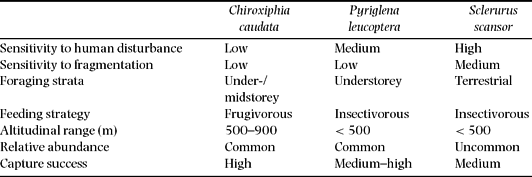
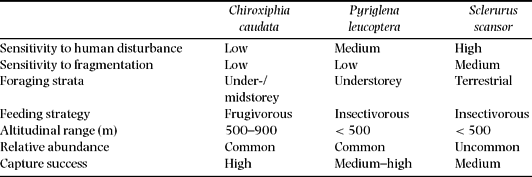
Our study species were Chiroxiphia caudata (blue manakin, Pipridae; beak-to-tail length = 15 cm, body mass = 25 g), Pyriglena leucoptera (white-shouldered fire-eye, Thamnophilidae; 18 cm, 30 g) and Sclerurus scansor (rufous-breasted leaftosser, Furnariidae; 18.5 cm, 39 g). All three species are endemic to the Atlantic rain forest (Ridgely & Tudor Reference RIDGELY and TUDOR1994, Sick Reference SICK1997, Stotz et al. Reference STOTZ, FITZPATRICK, PARKER and MOSKOVITS1996) but not threatened (least concern, Baillie et al. Reference BAILLIE, HILTON-TAYLOR and STUART2004). We selected them to consider different sensitivities to forest disturbances (Stotz et al. Reference STOTZ, FITZPATRICK, PARKER and MOSKOVITS1996) and fragmentation (Develey & Metzger Reference DEVELEY, METZGER, Laurance and Peres2006). These species were also relatively easy to capture (Develey & Martensen Reference DEVELEY and MARTENSEN2006) and represent different feeding strategies and territoriality (Sick Reference SICK1997, Stotz et al. Reference STOTZ, FITZPATRICK, PARKER and MOSKOVITS1996, Willis Reference WILLIS1979; Table 1). The sexes of C. caudata and P. leucoptera could be distinguished by plumage pattern. As S. scansor shows no apparent sexual dimorphism we collected one or two still-growing feathers from moulting birds for DNA based sexing.
Ecological attributes of the three study species in the south-eastern Brazilian Atlantic rain forest (after Stotz et al. Reference STOTZ, FITZPATRICK, PARKER and MOSKOVITS1996, modified). Sensitivity to fragmentation according to Develey & Metzger (Reference DEVELEY, METZGER, Laurance and Peres2006). Altitudinal range denotes the elevational zone (masl) in which the bird species is most common. Capture success according to Develey & Martensen (Reference DEVELEY and MARTENSEN2006).
METHODS
The birds were caught with mist-nets between February 2003 and February 2005. We fitted them with 0.43–0.64-g radio transmitters (< 2.9% of body mass; PIP2 and PIP3, Biotrack Ltd., Dorset, UK) and located them for 3–5 wk at least once a day by triangulation (Kenward Reference KENWARD2001). In case of signal loss, we stopped searching for that individual after 10–14 d. We tried to take bird's positions during all hours of daylight. For this study, because information on landscape cover type and total area that birds were capable to use was important to assess, we did not remove outlier positions. We used minimum convex polygons (MCP, Mohr Reference MOHR1947) including all locations for home range size estimations. Total observed (i.e. 10–47-d periods, depending on transmitter life) home range sizes strongly depended on the number of days recorded, and GLM analyses did not allow any inferences regarding the effects of fragmentation. We therefore used 10-d home ranges as standardized measures that allowed comparisons between landscapes, seasons, sexes and age. For each individual, we estimated a 10-d home range from the sequence of 10 consecutive d with the highest possible number of recorded locations (minimum 25 locations; for C. caudata Pearson rank correlation between N locations and home range size: r = 0.055; P = 0.752; for P. leucoptera Spearman rank correlation: r = 0.429, P = 0.397; for S. scansor Spearman rank correlation: r = −0.025; P = 0.949). For C. caudata (n = 35) we ran a General Linear Model (GLM) with log-transformed data to assess if the independent factor variables: landscape pattern (fragmented/contiguous), season (dry/wet), or sex, as well as the independent covariate number of locations would have an influence on the size of the 10-d home ranges. In a second GLM we only considered data of male C. caudata (n = 21) to test whether the independent factor variables age class (adult/subadult/juvenile), landscape pattern (fragmented/contiguous), or season (dry/wet), as well as the independent covariate number of locations would have an influence on the size of male's 10-d home ranges. The sample sizes (n = 14; n = 6) for the two other species were insufficient to perform a GLM, we conducted Mann–Whitney U-tests instead.
Data on total observed home ranges were obtained for 42 C. caudata, 10 P. leucoptera and 24 S. scansor. We considered ranges based on ≥ 25 locations and monitored for 10–47 d to assess their maximal observable home range extensions.
Non-parametric tests were performed with data of C. caudata to make comparisons between breeding and non-breeding females, and between recapture rates of males and females. Five recaptured males of C. caudata and four S. scansor were radio-tracked both in the dry and the wet season; we calculated the overlap of the seasonal home ranges. These data were analysed to assess site fidelity of birds.
RESULTS
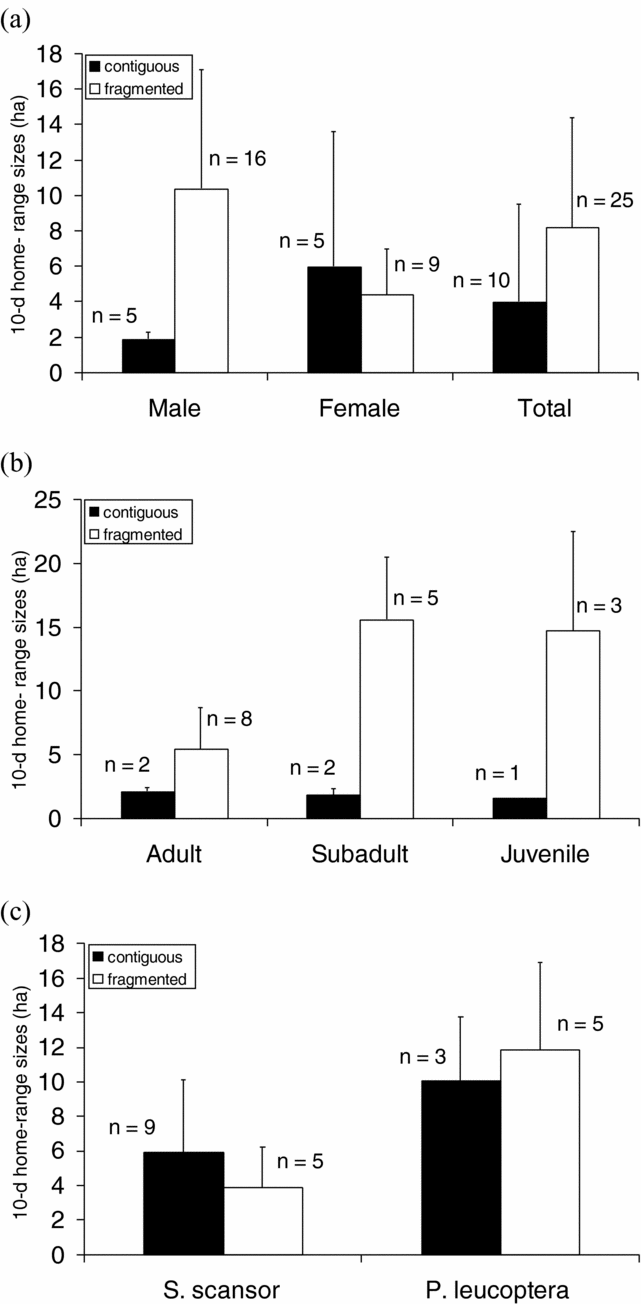
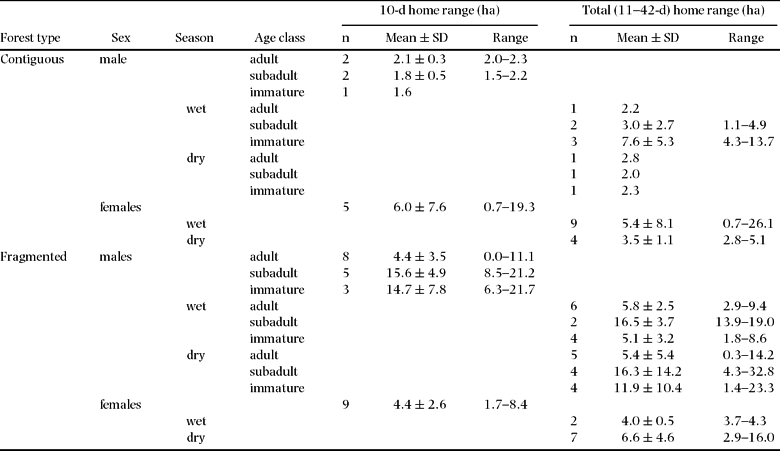
Our C. caudata data confirmed the assumption that some rain-forest understorey passerines may extend their home ranges in fragmented forests. Mean 10-d home range sizes of C. caudata varied between 1.6 and 15.6 ha, depending on sex in interaction with landscape pattern (GLM: n = 35, F = 3.30, r2 = 0.305, df = 4, P = 0.024; observed power: 0.774 (computed using α = 0.05); Figure 1a, Appendix 1). The analyses of only male C. caudata revealed significant differences between mean 10-d home ranges in fragmented and contiguous forest (GLM: n = 21, F = 6.140, r2 = 0.725, df = 6, P = 0.002; observed power: 0.973 (computed using α = 0.05); Figure 1b, Appendix 1). The number of points had no significant influence on the 10-d home range sizes (P = 0.997) and we removed it in earlier steps of the models.
Mean 10-d home range sizes of Chiroxiphia caudata (a), male C. caudata (b), Sclerurus scansor and Pyriglena leucoptera (c) in fragmented and unfragmented forest landscapes of the Atlantic rain forest in south-eastern Brazil. (a) Chiroxiphia caudata is pooled by sex. The interaction of sex with landscape pattern significantly affects 10-d home range sizes ((GLM: n = 35, F = 3.30, r2 = 0.305, df = 4, P = 0.024; observed power: 0.774 (computed using α = 0.05)). (b) Male C. caudata are divided into age classes. Home ranges of individuals in the fragmented landscape are significantly larger compared to contiguous forests (GLM: n = 21, F = 6.140, r2 = 0.725, df = 6, P = 0.002, observed power: 0.973 (computed using α = 0.05)). (c) Neither S. scansor nor P. leucoptera showed significant differences in range size between the two landscapes.

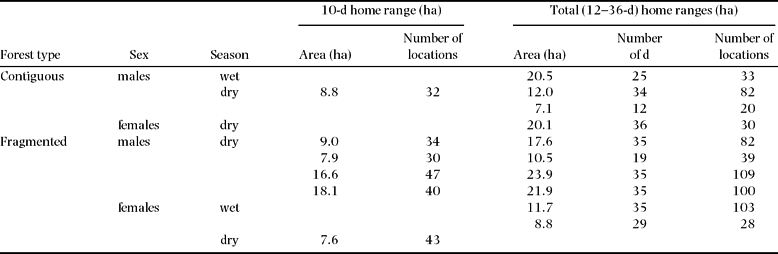
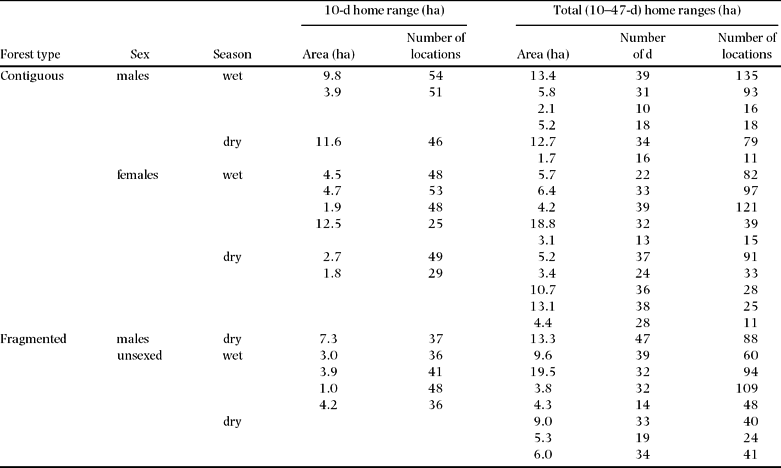
Ten-d home range sizes of S. scansor varied greatly between 1 ha and 12.5 ha, and those of P. leucoptera between 7.2 ha and 18.1 ha, but we found no significant evidence that this was linked to fragmentation, sex or season (Mann–Whitney U-test: P > 0.05 for all cases) (Appendices 2, 3).
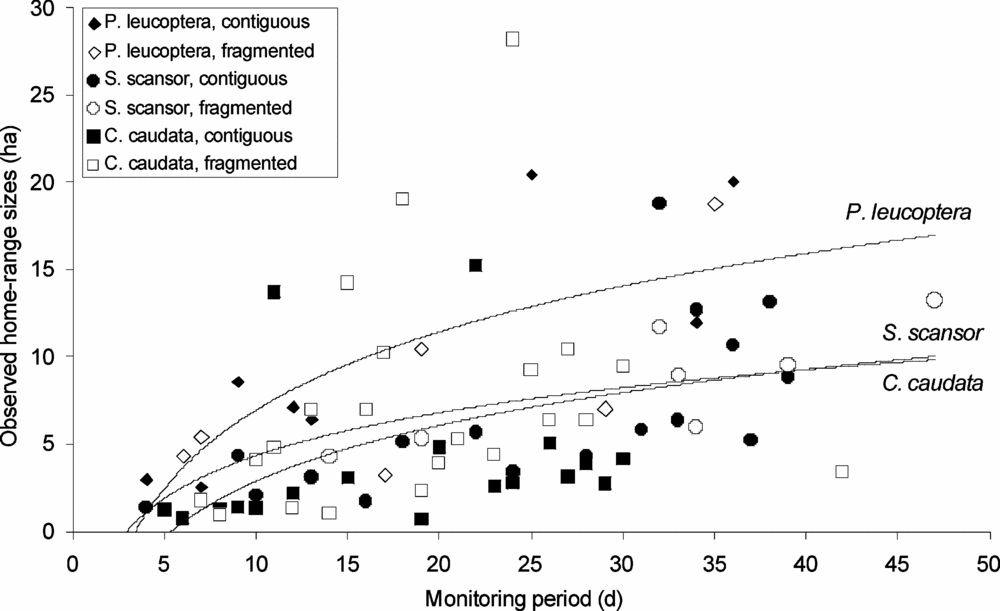
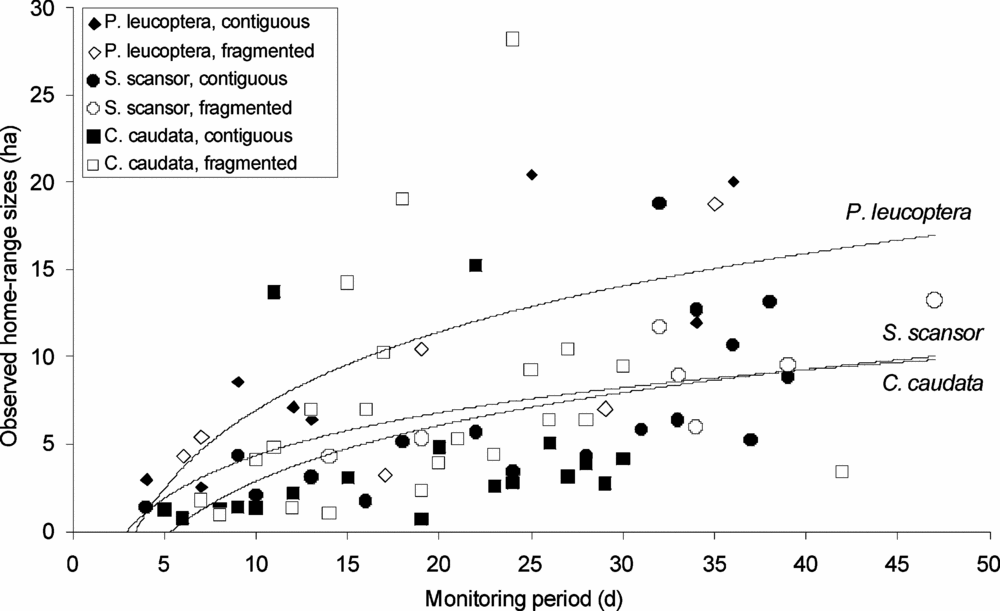
Observed total home range sizes differed among the three species (Figure 1, 2). Pyriglena leucoptera used larger ranges than the two other species (mean = 15.4 ha, SD = 6.1 ha, n = 10; range = 7.1–23.9 ha, both males in the dry season). The more days they were radio-tracked the larger their home ranges became (Figure 2).
Observed home range sizes (ha) of the three understorey bird species in relation to the monitoring period within a contiguous (black dots) and a fragmented (white dots) forest landscape of the Atlantic rain forest (south-eastern Brazil). Home range sizes were averaged if several individuals were monitored for the same number of days. Logarithmic regressions by species (landscapes pooled): Pyriglena leucoptera (n = 13, r2 = 0.554, F = 13.7, df = 11, P = 0.004), Sclerurus scansor (n = 20, r2 = 0.543, F = 21.4, df = 18, P < 0.001), Chiroxiphia caudata (n = 26, r2 = 0.105, F = 2.8, df = 24, P = 0.107).
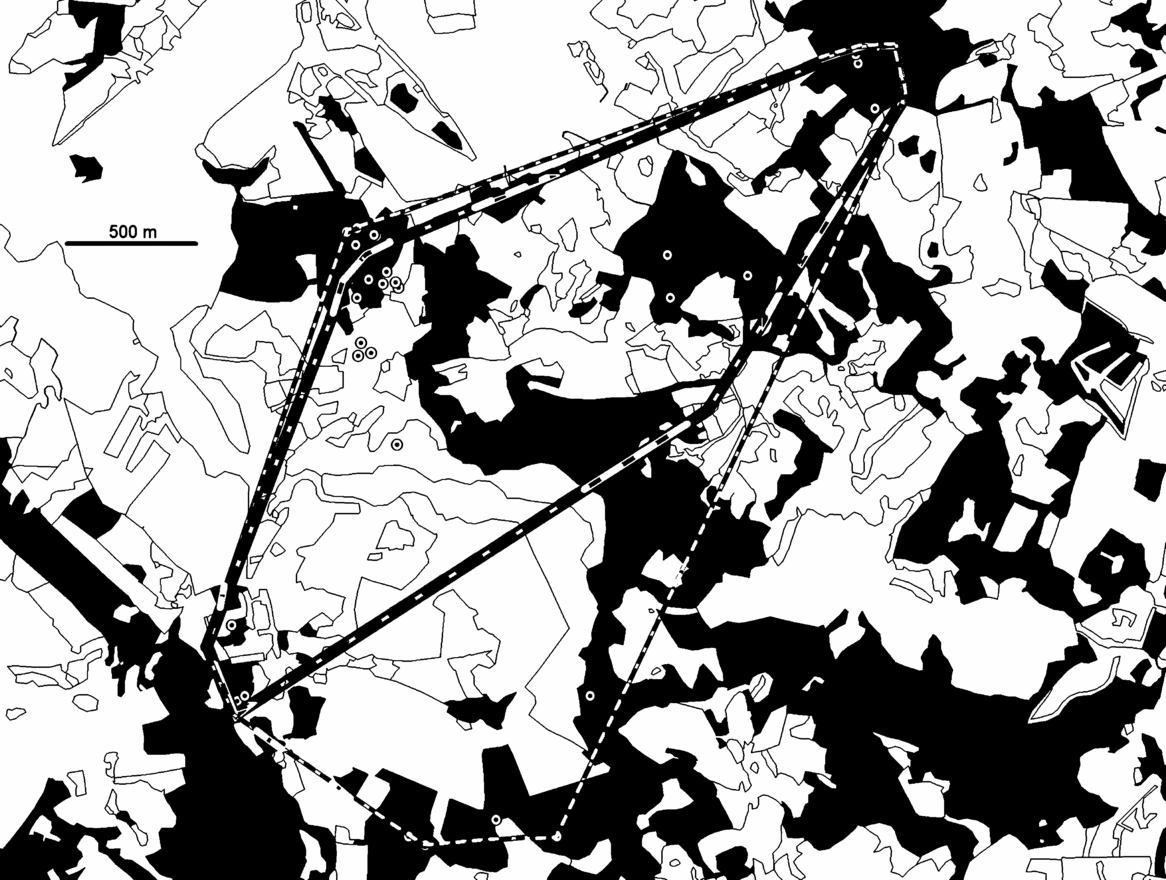
In S. scansor total observed home range sizes (mean = 7.8 ha, SD = 5.0 ha, n = 24) ranged between 1.8 ha (male, dry season) and 19.5 ha (unsexed, wet season). We also observed differences between home range sizes of C. caudata males (mean = 8.92 ha, SD = 7.97 ha, n = 27) and females (mean = 5.19 ha, SD = 5.76, n = 22). However, home range sizes of females that were breeding during the wet season (n = 5), of females that were not (yet) breeding (n = 3) and of females during the dry season (n = 10) differed significantly (Kruskal–Wallis: χ2-approximation = 9.61, P = 0.008), with breeding females using the smallest ranges (mean = 2.6 ha, SD = 1.4 ha). Some non-breeding females appeared to be exceptionally mobile as illustrated for one individual that used a total area of 460 ha (Figure 3). We speculate that her behaviour is not uncommon for C. caudata, because in total we lost signal of four female individuals (33%) in the fragments and of three (17%) in the contiguous forest. Of males, we lost signal of three individuals (14%) in the fragments and of one individual (14%) in the contiguous forest. This loss can be due to transmitter failure or to higher movement activities of these individuals. As we only could follow one such individual we did not include the data in our analysis, but gave a descriptive note.
Home range of an exceptionally mobile non-breeding female of Chiroxiphia caudata, monitored during the wet season in the fragmented study landscape in the Atlantic rain forest of south-eastern Brazil. Black indicates forest patches, and white is the surrounding matrix (agricultural areas). The thin line comprises a total minimum convex polygon (MCP) of 460 ha, after 27 d, including 39 locations. Thick line comprises 10-d MCP of 284 ha, including 23 locations.

Males of C. caudata were more likely to be recaptured than females: out of 28 males we recaptured eight (29%) and out of 30 females we recaptured one (3%; Fisher's Exact Test; P = 0.011). One of the recaptured males, a subadult, left his forest fragment a few times to explore neighbouring forest patches, but always returned to his core area. The five recaptured males that were radio-tracked several times in different seasons had smaller home ranges in the wet season. The wet-season ranges were overlapped by the dry-season ranges to 76.5% (± SD = 19.1%); vice versa the overlap was 40.8% (± SD = 9.5%). In S. scansor (n = 3) wet-season home ranges were overlapped 67.0% (± SD = 31.2%) by dry-season ranges; vice versa by 50.5% (± SD = 19.5%). One individual was tracked three times; the range during the second wet season was overlapped by the two earlier home ranges to 71.3%.
DISCUSSION
Neotropical forest birds often are adapted to highly dispersed resources and thus, many species occupy relatively large ranges to meet their requirements (Karr et al. Reference KARR, ROBINSON, BLAKE, BIERREGAARD and Gentry1990, Stouffer Reference STOUFFER2007, Stouffer & Bierregaard Reference STOUFFER and BIERREGAARD1995, Terborgh et al. Reference TERBORGH, ROBINSON, PARKER, MUNN and PIERPONT1990). Forest fragmentation may further reduce resource availability and quality (Andrén Reference ANDRÉN1994, Baillie et al. Reference BAILLIE, HILTON-TAYLOR and STUART2004, Fahrig & Merriam Reference FAHRIG and MERRIAM1994, Laurance Reference LAURANCE, Laurance and Bierregaard1997, Lovejoy et al. Reference LOVEJOY, BIERREGAARD, RYLANDS, MALCOLM, QUINTELA, HARPER, BROWN, POWELL, POWELL, SCHUBART, HAYS and Soulé1986, Terborgh Reference TERBORGH1992). Thus, one option for a forest bird to find sufficient food, shelter and nesting places in fragmented habitats is to enlarge its home range. At least one of our study species appeared to follow this strategy. As expected, 10-d home ranges of C. caudata were larger in the fragmented forest landscape than in the contiguous forest. Chiroxiphia caudata is capable of crossing different types of matrix (Hansbauer et al. Reference HANSBAUER, STORCH, LEU, NIETO-HOLGUIN, PIMENTEL, KNAUER and METZGER2008, Uezu et al. Reference UEZU, METZGER and VIELLIARD2005) and can reach other forest patches. Our results indicate that C. caudata might enlarge the foraging grounds, if resources in one forest patch are not sufficient. Subadult and immature males of C. caudata cover larger areas than adults, because they have not yet established their position in a lek (Foster Reference FOSTER1987); thus, they might switch lek sites (Théry Reference THÉRY1992) that can be distributed over several forest patches (pers. obs.). In contrast, S. scansor used similar sized ranges in contiguous and fragmented forest. They seemingly depended on a defined territory size, but refused to leave the forest habitat (Canaday Reference CANADAY1997, Develey & Metzger Reference DEVELEY, METZGER, Laurance and Peres2006, Laurance et al. Reference LAURANCE, STOUFFER and LAURANCE2004, Thiollay Reference THIOLLAY1992). Agreeing with Stouffer & Bierregaard (Reference STOUFFER and BIERREGAARD1995), we speculate that this species may only occur in forest patches large enough to sustain a territory.
Pyriglena leucoptera is not an obligatory army ant follower but individuals often move long distances while searching for ants (Willis & Oniki Reference WILLIS and ONIKI1978). Its range use seemed unaffected by habitat fragmentation as indicated by similar 10-d home range sizes in contiguous and fragmented forests. Pyriglena leucoptera is capable of using a variety of matrix types (Hansbauer Reference HANSBAUER2007, Hansbauer et al. Reference HANSBAUER, STORCH, LEU, NIETO-HOLGUIN, PIMENTEL, KNAUER and METZGER2008), and up to 20 individuals may gather at an army ant swarm (Willis Reference WILLIS1981, Willis & Oniki Reference WILLIS and ONIKI1982, pers. obs.). Thus, range use patterns of P. leucoptera appear to be more strongly affected by the highly dynamic distribution of their food resources than by forest fragmentation.
Our study revealed that while males of C. caudata maintained the size of their home range rather constant, females had two distinct phases during the wet (i.e. breeding) season. First, they covered large areas to maybe visit several male lekking-places (our study; Beehler & Foster Reference BEEHLER and FOSTER1988, but see Théry Reference THÉRY1992); this is why home ranges are difficult to define (Beehler & Foster Reference BEEHLER and FOSTER1988). Then they built a nest and while breeding and feeding the young they reduced their home range to a small area around the nest site. Similar behaviour has been observed in other manakin species (del Hoyo et al. Reference DEL HOYO, ELLIOTT and CHRISTIE2004). As also indicated by their significantly lower recapture rates, females of C. caudata were generally more mobile and therefore harder to track than males, that stay year-round at their lek sites (Théry Reference THÉRY1992, pers. obs.).
Sclerurus scansor showed high site fidelity as it is generally suggested for the family Furnariidae (del Hoyo et al. Reference DEL HOYO, ELLIOTT and CHRISTIE2003, but see Stouffer Reference STOUFFER2007). Our data show that it stayed in its range at least over two consecutive years. This could either be related to preferred habitat features or to traditional boundaries to neighbouring territories of conspecifics (Greenberg & Gradwohl Reference GREENBERG and GRADWOHL1986). The male that was recaptured and monitored three times, was first captured in March 2004, when he covered a large home range. During July/August 2004 and January 2005 he was foraging together with a female that was also recaptured and radio-tracked twice which conforms to findings of pair bonds in other members of the Furnariidae (Skutch Reference SKUTCH1996). Male home ranges were generally larger than those of females, but in January both home ranges were small. By comparing their behaviour to two other pairs of radio-tracked S. scansor for which we had found the nest sites, we assumed that the birds were breeding at that time.
Due to logistic constraints with telemetry of small passerines in tropical rain forests, our sample sizes remained limited. Yet, our study is one of the first documenting that rain-forest passerines may develop different strategies to cope with habitat fragmentation. Some enlarge their home ranges – incorporating parts of the matrix – as C. caudata does. Although data on longer-distance movements of females of C. caudata remained anecdotal, they suggest that this species might be able to reach habitat patches as distant as 3.5 km. Other species increase individual densities at sites rich in resources, like P. leucoptera when following army ants. Species, like S. scansor only remain in forest patches large enough to support a territory, thus being strongly susceptible to fragmentation.
ACKNOWLEDGEMENTS
This study was supported by the German BMBF (Federal Ministry of Education and Research) that financed the program BIOCAPSP within the framework of the Brazilian-German cooperation ‘Mata Atlântica’ (Förderkennzeichen 01LB0202 (Teilprojekt D3)). We especially thank our numerous volunteers who gave us invaluable support in collecting the data. Renato Caparroz, Erwin Tramontini Grau and Cristina Yumi Miyaki and her team of the Biology Department at the University in São Paulo helped with the molecular sexing of S. scansor. We further thank Rodnei Iartelli for arranging the trapping permits, Leandro Tambosi for digitizing the aerial photographs, and Zsolt Végvári for his valuable support on the statistical analyses. John Bissonette and two anonymous reviewers improved an earlier version of the manuscript.
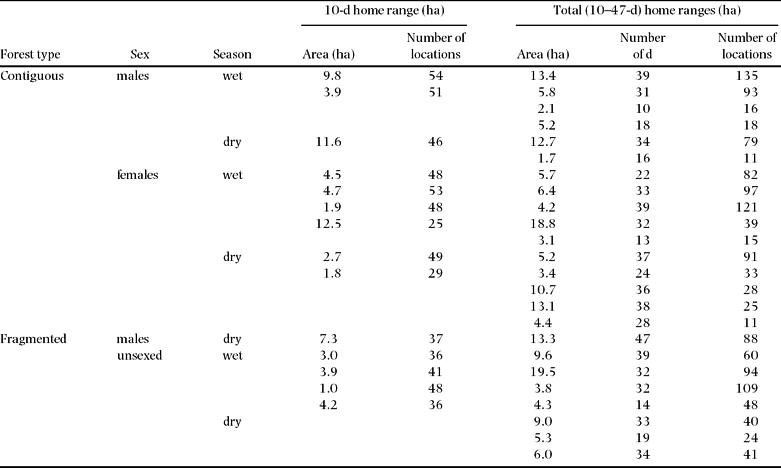
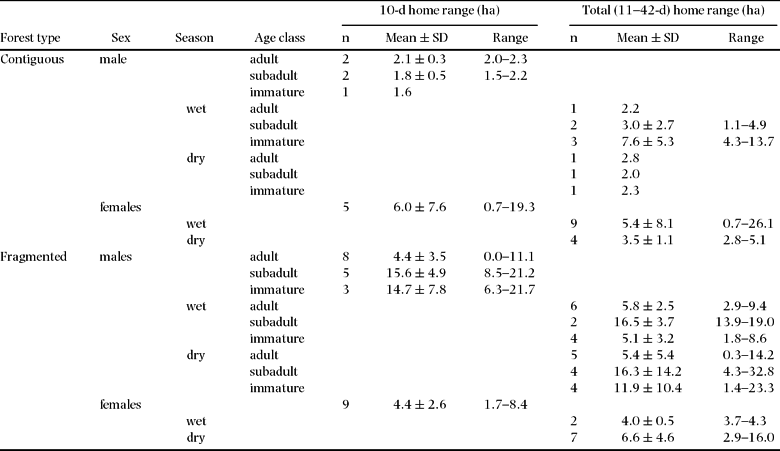
Range use of Chiroxiphia caudata: 10-d home range sizes (MCP in ha) with 26–54 telemetry locations. Home range sizes were not correlated with number of locations (r = 0.055; P = 0.752). Mean total observed home range sizes (MCP) monitored for 11 up to 42 d (32–109 telemetry locations). Mean, SD and range are listed by landscape pattern (contiguous/fragmented), sex, season, and age classes. n values differ, because not for every individual 10-d home ranges could be constructed
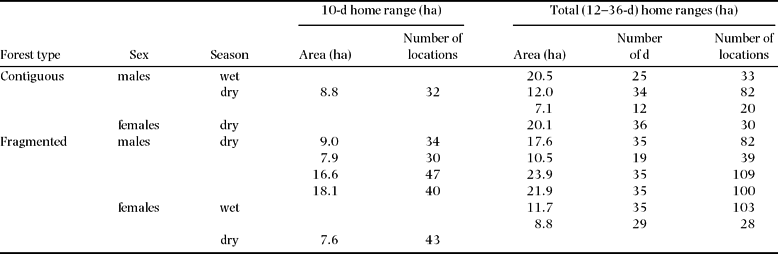
Range use of radio-tracked individuals of Pyriglena leucoptera by landscape pattern (contiguous/fragmented), sex, and season. 10-d home range sizes with 30–47 locations (home range sizes are not rank correlated with number of locations (r = 0.429; P = 0.397)) and total observed (12–36 d) home ranges. Each line represents one individual
Range use of radio-tracked individuals of Sclerurus scansor by landscape pattern (contiguous/fragmented), sex, and season: Given are 10-d home ranges with 25–54 locations (home range sizes are not rank correlated with number of locations (r = −0.025; P = 0.949)) and total observed (10–47 d) home ranges. Each line represents one individual