In 2014, cigarette producers in Indonesia began incorporating five government-mandated pictorial health warning labels into their product packaging. Three images of cancer-ravaged body parts—a pair of obscenely moist lips, a disfigured throat, and two autopsied lungs—inspired visceral horror. Two others featured people rather than diseased body parts and elicited more ambivalent sentiments. In one, a man exhales smoke that billows away from the baby he holds. It warns, “Smoking near children endangers them.” Another depicts a seemingly bare-chested man with a luxuriously full head of hair and mustache exhaling smoke and looking contemplative, while two skulls hover in the background. The label’s blunt warning, “smoking kills you,” is softened by its distant and abstract rendering of death, which comes for us all regardless of smoking status.Footnote 1
President Yudhoyono’s administration laid groundwork for the labels when he signed regulation 109 into law in 2012, followed by Health Ministry regulation 28 a year later.Footnote 2 The laws prohibited tobacco companies from distributing free cigarettes or showing cigarettes in advertising, but allowed television and radio advertising between 9:30 p.m. and 5:00 a.m. Local governments were empowered to craft smoke-free legislation, but at their discretion and without a deadline.Footnote 3 Companies were forbidden from creating new brands with “misleading descriptors” like “mild” or “light,” but existing brands could keep using these terms. Language on packs forbade their sale to pregnant women or children under the age of eighteen, but the prohibitions were not enforced. The new rules followed a trend of increasing albeit equivocating regulations, a tendency in evidence since the 1998 fall of authoritarian President Suharto. When the Ministry of Health released a “Tobacco Control Roadmap,” the Ministry of Industry issued a competing “Tobacco Industry Roadmap” promising to increase production, consumption, and revenues (Astuti and Freeman Reference Astuti and Freeman2017: 6).Footnote 4 Globally, Indonesia became the only country with pictorial warning labels that also allowed rampant cigarette advertising in conventional mass media, including television, radio, print media, and billboards (Anshari Reference Anshari2017: 28).
The five pictorial health warning labels required in Indonesia starting in mid-2014. Author’s photo.

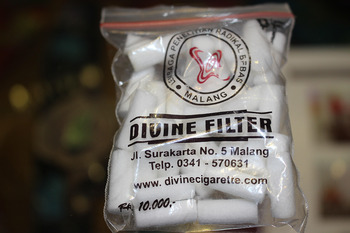
Divine filters, used by ordinary smokers and in cancer treatments. Author’s photo.

The Bentoel History Museum in Malang, East Java. British American Tobacco acquired Bentoel in 2009. Author’s photo.

A House of Sampoerna museum diorama of the kiosk run by the wife of Sampoerna’s founder evokes the modest origins of the company. Philip Morris International acquired Sampoerna in 2005. Author’s photo.

Veteran activist and Tobacco Control National Commission advisor Dr. Kartono Mohamad greeted the pictorial warning requirement as a step forward (satu kemajuan) in combatting Indonesia’s tobacco epidemic but lamented its half-heartedness (setengah hati). The labels were insufficiently grisly, partially obscured by excise tax labels, and too small, signaling yet another instance in which Indonesia fell short of other countries. Indonesia’s labels covered but 40 percent of the pack, he pointed out, whereas Singapore’s labels covered 50 percent, Malaysia’s 60 percent, and Brunei’s 75 percent. Mohamad felt they should aspire to the latter.
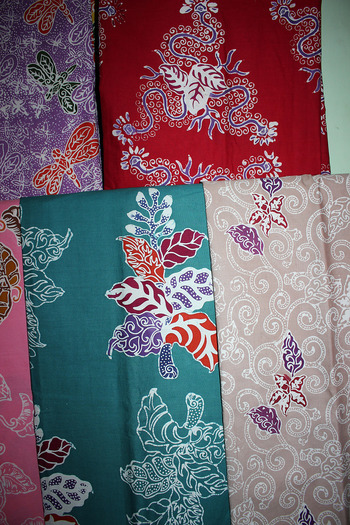
The Jember regency government encourages local batik makers to incorporate tobacco leaves into their designs. Author’s photo.

It is easy to draw such comparisons. Canada, the first country to deploy pictorial warnings back in 2001, releases reports reproducing lurid warnings and ordering and ranking countries based on whether, when, and how they use them. The Canadian Cancer Society lists Indonesia as the sixty-sixth country to implement pictorial warnings, and ranks it at 106 out of 205 countries for the size of its warning label (Canadian Cancer Society Reference Society2016: 3, 10).Footnote 5 The Framework Convention on Tobacco Control (FCTC), a global, evidence-based health treaty adopted by the World Health Organization in 2003 and ratified by over 180 countries—though Indonesia is not among them—endorsed pictorial warnings as a key demand reduction measure in Article 11 on packaging and labeling. The United Nations enshrined the flagship treaty in its 2030 Agenda for Sustainable Development, adopted by the General Assembly in 2015, as a “target” toward achieving goal three: “Ensure healthy lives and promote well-being for all at all ages.”
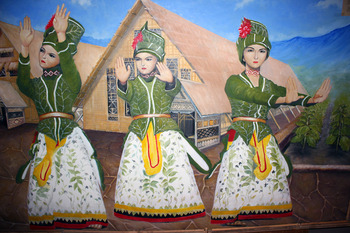
A tobacco dance painting (tari lahbako) in the government-run tobacco institute museum explains that tobacco is the pride (kebanggaan) of the Jember community. High quality cigar tobacco produced in the region is mostly exported, while lower quality cigarette tobacco is consumed domestically. Author’s photo.

An offering in Bali incorporating a kretek. Photo by Kristin D. Phillips.

Tobacco control discourse conventionally frames Indonesia as a “laggard” for not joining the FCTC fold, thereby failing to properly care for the health and wellbeing of its citizens.Footnote 6 I call such pressure to conform to a universalizing biomedical understanding of tobacco’s harms and implement tobacco control solutions (e.g., higher cigarette taxes; legal restraints on public smoking indoors, marketing, and sales to youth; public education) public health evolutionism. It is linked to broader forms of moral and legal evolutionism that take the valorization, promotion, and protection of certain forms of life, freedom, and alterity (e.g., environmental protections and human, indigenous, women’s, and queer rights) as signs of progress, and conceptualize religious, cultural, and economic opposition as barriers to advancement. Applied to tobacco control, this logic hierarchizes states, from the civilized and advanced to the primitive and backwards. It enables the mobilization of shame—actual or potential exposure to the disapproving gaze of more enlightened others—to compel state adherence to tobacco control orthodoxy (Keenan Reference Keenan2004).
Moral evolutionism is often vulnerable to contestation on the grounds that its purportedly universal goals and values are Euro-American in origin, and their propagation represents a Western neocolonial imposition that runs roughshod over local economic realities and religious and cultural differences (Brosius Reference Brosius1997; Chua Reference Chua2015; Hodžić Reference Hodžić2017; Merry Reference Merry2006). Such critiques allow for the assertion of cultural distinction rather than temporal backwardness, and pride rather than shame. In Indonesia, cigarette industry proponents counter the evolutionism and shaming of tobacco control discourse with commodity nationalism. Of Indonesian smokers, 95 percent consume clove-laced tobacco cigarettes onomatopoeically called kretek for the crackling sound they make when clove fragments ignite, whereas only 5 percent smoke non-clove “white cigarettes” (rokok putih).
Indonesian cigarettes combining tobacco and cloves emerged in the late nineteenth century but were the product of colonial processes set in motion four centuries earlier. In search of a western passage to the spice trade, Christopher Columbus landed in the Caribbean in 1492 and accepted a gift of tobacco from Taíno people whom he would later subjugate and enslave (Ortiz Reference Ortiz1995). The New World crop reached the Spice Islands and Java in the sixteenth century, though historians have disagreed over whether it was brought by Portuguese colonizers pursuing cloves, nutmeg, and mace, or by trade networks radiating out from the Philippines under Spanish colonialism (Courtwright Reference Courtwright2001; Reid Reference Reid1985). In the seventeenth and eighteenth centuries, the Dutch East India Company (Vereenigde Oost-Indische Compagnie or VOC) consolidated control over the spice trade, pursuing a “radical policy of exploitation” that aimed to concentrate clove production on Ambon and small adjacent islands and extirpate it elsewhere, disrupting ancient trade patterns and depopulating islands (Donkin Reference Donkin2003: 169; Andaya Reference Andaya1993; Bulbeck et al. Reference Bulbeck, Reid, Tan and Wu1998; Wright Reference Wright1958). As tobacco cultivation spread across the archipelago, people began smoking it in pipes or wrapped in dried banana leaf or cornhusk wrappers called klobot, but mostly they chewed it in betel quids. Tobacco joined the repertoire of additives such as cloves, cardamom, and gambier that garnished the quid’s core elements of areca nut, lime, and a betel leaf wrapper (Reid Reference Reid1985). In the nineteenth and twentieth centuries, with the introduction of the Manila cigar and cigarettes, and betel chewing and spitting increasingly regarded as unhygienic and uncivilized by colonial and postcolonial modernizers, tobacco smoking gradually supplanted betel chewing. As stimulants and relaxants, betel and tobacco produce similar physical effects. Both keep users awake but also calm and can serve as an appetite suppressant and food substitute. Tobacco has acquired many of betel’s social and ritual functions, facilitating quotidian social relations and reciprocity and playing a role in healing, funeral, and courtship rites. Whereas betel chewing was an accessible and affordable indulgence across gender and status differences, however, smoking is overwhelmingly reserved for men, and cigarette brand and price tiers serve as prominent wealth and status markers (ibid.: 542).
In the central Javanese town of Kudus, hand-operated rollers began producing klobot that combined tobacco, cloves, and a sweetening sauce (saus) in the 1880s (ibid.: 539). Some credit asthmatic Kudus resident Haji Djamhari with inventing kretek when, inspired by the practice of rubbing clove oil on his chest to ease his pain and shortness of breath, he added cloves to his klobot and proclaimed the resulting smoke had a medicinal effect (Hanusz Reference Hanusz2000: 30). Indonesians still smoke homemade and manufactured klobot, but kretek are wrapped in paper. As the kretek industry grew in the 1920s, Indonesia went from being a net clove exporter to an importer. (French and English traders broke the monopoly the Dutch had maintained over cloves since the 1650s by capturing clove seedlings in the 1770s. The plant was successfully cultivated in Zanzibar.)
Hand-rolled kretek, which constitute around 20 percent of the Indonesian cigarette market, are unfiltered, weigh 2 grams, and take about a half hour to smoke. Machine-rolled kretek, which claim 75 percent of the market, weigh 1 gram or less, take five to ten minutes to smoke, and exhibit conventional white cigarette features such as cellulose acetate filters. Kretek tips are dipped in saccharine, depositing a sweet taste on smoker’s lips. White cigarettes claim 5 percent of the market, take five minutes to smoke, and produce lighter smoke that disperses more swiftly. Indonesian smokers remark that white cigarettes disappear quickly; once lit, even if they are not actively smoked, the wind takes them (terbawa oleh angin). Smokers describe hand-rolled kretek as hot, warm, sweet, spicy, thick, and, above all, heavy (panas, hangat, manis, pedes, tebal, berat). White cigarettes, by contrast, are bland, tasteless, and light (rasa tawar, enteng).
Some Indonesian smokers are loyal to a single brand and claim they cannot tolerate any other. Others are brand-indiscriminate and liken themselves to ashtrays. Two-brand smokers are also not uncommon, and even something of an Indonesian marketing stereotype. Some two-brand smokers cite external scrutiny in explaining why they alternate. An undergraduate at Brawijaya University preferred “Inter” (machine-rolled kretek produced by Gudang Garam International) but bought less tasty white Marlboros when he could afford them to appear cool (keren) and wealthy. A sixty-year-old female rock star alternated between Esse, a budget, machine-rolled kretek brand marketed to women and adolescents with fruity flavors, and a hand-rolled, masculine-identified kretek brand (Sampoerna’s Dji Sam Soe) that she concealed in Esse packs. Other two-brand smokers shift between brands based on personal preferences. A telecommunications service provider smoked Marlboro Reds in hot weather, but preferred machine-rolled Surya kretek (Gudang Garam) when it was cold or rained since they lasted longer (lama habis) and warmed his body (menghangatkan tubuh). A residential security guard working two jobs smoked lighter Surya at the start of the day, then hand-rolled budget kretek Sampoerna Hijau come afternoon and nighttime.
Indonesian commodity nationalists who have defended kretek against the discourse of public health evolutionism—kretek nationalists—frame the cigarettes’ consumption as a patriotic activity, and tobacco control as a neocolonial effort to cripple a thriving, employment-generating indigenous industry and control Indonesian bodies and pleasures. The cigarette industry has deployed similar discourses in other times and places to marshal industry support, yoking wartime patriotism to tobacco production and cigarette provisioning in soldiers’ rations (Brandt Reference Brandt2007; Klein Reference Klein1993; Neuburger Reference Neuburger2013; Proctor Reference Proctor2011; Rudy Reference Rudy2005), for example, and in the United States evoking cultural pride and heritage while obscuring tobacco’s entanglement with slavery and racism (Benson Reference Benson2012; Griffith Reference Griffith2009; Kingsolver Reference Kingsolver2011; Swanson Reference Swanson2014). Kretek nationalists intensify run-of-the-mill commodity nationalism—the work of marketing and advertising agencies, which interpellate potential consumers with an appeal to achieving communion with unknown fellow patriotic consumer-citizens through consumption (Foster Reference Foster2002, building on Anderson Reference Anderson2006)—by infusing it with postcolonial affect and counterhegemonic appeal. Kretek nationalism is not only for the nation, but also against colonialism, conferring upon the kretek smoker a defiant and embattled identity.
Drawing on ethnographic research on Indonesia’s cigarette economy,Footnote 7 I examine how public health evolutionism and commodity nationalism work to induce shame and pride, and how these logics structure clashes over Indonesian tobacco regulations. The industry takes advantage of both discourses. It uses evolutionist marketing techniques to push products designed to appear safer to smokers alarmed by public health messaging and invests profits from conventional cigarette sales in Indonesia to create purportedly safer and more civilized products like e-cigarettes for consumers in the global North. At the same time, the industry promotes the kretek-as-national-heritage narrative and works to undermine Indonesia’s regulatory environment.
Commodity Violence
The stakes of Indonesia’s cigarette wars are high in a market distinguished by its unusual product composition, colossal size, and gender disparities. While Indonesia is the world’s fourth most populous country, its cigarette market is the second largest, with over 300 billion sticks consumed annually.Footnote 8 The Indonesian government collected over $11 billion in cigarette excise taxes in 2017, in addition to substantial corporate and individual income taxes from the industry and the employment it generates. Public health advocates claim that this revenue bonanza is offset by over $29 billion in smoking-associated direct health expenditures and indirect morbidity, disability, and premature mortality (World Bank 2018: 3). As debates continue over whether tobacco swells or depletes state coffers, the toxic consumer economy takes a vast sacrificial toll in human lives, with tobacco-related diseases killing over 225,000 Indonesians a year.Footnote 9
Tobacco’s violence has gendered, domestic, and intergenerational dimensions. Researchers estimate that 70 percent of Indonesian men smoke, compared to less than 5 percent of Indonesian women.Footnote 10 Boys experience social pressure to demonstrate their masculinity and adulthood by smoking, and 21 percent go on to die prematurely of tobacco-related diseases. Of the 7 percent of Indonesian women killed by tobacco-related diseases, many have never actively smoked a cigarette. In Indonesian households where the father smokes, tobacco accounts for 22 percent of average weekly per capita household expenditures, curbing spending on food, education, and health care; contributing to high rates of child malnutrition and stunting; and diminishing health and economic life chances (ibid.).
Exposure to cigarette smoke, which contains thousands of chemicals including carcinogens, poison gases, and toxic metals, unleashes a complex cascade of harms and is implicated in many cancers and vulnerability to chronic and infectious diseases. Indonesia’s five leading causes of death are tobacco-related: ischemic heart disease, cerebrovascular disease, tuberculosis, diabetes, and chronic respiratory diseases (ibid.: xi). By impeding the circulation of oxygen, carbon monoxide alone is implicated in Buerger’s disease and gangrene, erectile dysfunction, cardiovascular diseases, gum disease, and vision loss and blindness. Distributed over bodies and body parts, and dispersed over space and time, this suffering is primarily experienced as “ordinary, chronic, and cruddy rather than catastrophic, crisis-laden, and sublime”: non-eventful individual misfortunes of uncertain origin rather than a communal experience of impairment and early death that is a logical consequence of the flourishing of a single industry (Povinelli Reference Povinelli2011: 3). Tobacco control activists marshal an actuarial biopolitical imaginary, converting “cool facts of suffering” such as those recounted above into “hot weapons” to create a sense of crisis and urgency, and to classify ordinary capitalist harm as an extraordinary epidemic (Berlant Reference Berlant2007: 761; Ahmann Reference Ahmann2018).
Cigarette violence the world over exhibits various paradigmatic features of what Nixon (Reference Nixon2011) has described as environmental “slow violence.” On average, every million cigarettes consumed leads to one premature death over a latency period of twenty-five years (Proctor Reference Proctor2012). Incremental and accretive, tar attaches to lung tissue and stifles cilia. Attritional, cigarettes impede the circulation of oxygen and siphon off household funds. Their lethal effects unfold over a long timescale in a low-visibility, unspectacular fashion. And the long dying and mass infirmity they produce is unjustly distributed: concentrated in lower-income countries, and among the poor and socially disadvantaged in higher-income countries, where cigarette companies target people marginalized by class, race, sexuality, and mental health status (Apollonio and Malone Reference Apollonio and Malone2005). Unlike the cases Nixon excavates to develop his signature concept,Footnote 11 however, cigarettes do not necessarily give rise to ecocritique and heroic resistance by the suffering. Smokers’ implication in cigarette violence complicates crisp distinctions between community victims and corporate and state villains.
The suffering smokers incur and inflict on those close to them is intertwined with an array of experiences, values, temporalities, and affects, including belonging and identity-making, present-oriented gratifications and passing time, pleasure and numbness, as well as compulsion, fear, frustration, self-loathing, and shame (Klein Reference Klein1993). The latter sentiments are at once induced by public health discourse and diagnostic of addiction in discursive frameworks that tend to either blame and stigmatize smokers for their reprehensible squandering of cash, time, and health (Chapple, Ziebland, and McPherson Reference Chapple, Ziebland and McPherson2004), or to frame them as passive victims, “while the tobacco industry fills the role of active agent of disease and death” (Keane Reference Keane, Brodie and Redfield2002: 121).Footnote 12 Most smokers I interviewed blamed themselves for the health consequences of smoking, which they framed as their choice (“no one ordered us to smoke”), pointing to warnings that stood right there on the packages.Footnote 13 Most, though not all, also disagreed with my suggestion that cigarette companies or the government ought to bear greater blame, insisting that the industry provided vital employment and government revenues.
Deeply embattled Indonesian health officials, tobacco control researchers, and activists (McNeil Reference McNeil2018) turn to public health evolutionism as part of a progressive bid for membership in a global order of tobacco control that promises rights to knowledge, industry regulation, an environment free of smoke and cigarette advertising, and a healthier and more prosperous future for Indonesian citizens (Ferguson Reference Ferguson2002). But the same evolutionist logic also animates the stigmatizing Western media representations I turn to next.
Tobaccoland Tours and Time Travel Metaphors
For a Westerner like me, stepping off the plane in Indonesia is, in some ways, like stepping back in time…. The kind of marketing that has largely disappeared from the West now blankets Indonesia.
———“Sex, Lies and Cigarettes” (2011)
It is perfectly legal here for anybody of any age to buy cigarettes. They cost a dollar a pack, and there’s almost no tobacco regulation. It’s as if Indonesia is in an insane time warp, like America in the 1950s when cigarette ads were everywhere, even on the anchor desk on the network news.
———Dan Harris, ABC 20/20)Gleefully labeling Indonesia “the last outpost of pure unfiltered smoking freedom,”Footnote 14 HBO Vice correspondent Thomas Morton, like Dan Harris in the above epigraph, misleadingly implies that the country has no tobacco regulations whatsoever. Fareed Zakaria, who served as a consulting producer for the episode, more somberly observes, “They look so stupid, but that was us only thirty years ago.”Footnote 15 In tobacco control scholarship, too, time travel metaphors and temporal markers such as “still” and “not yet” position Indonesia as behind, caught in an expectant temporality (Strassler Reference Strassler2010: 20) and condemned to linger in the waiting room of tobacco control history (Chakrabarty Reference Chakrabarty2000). In an article in the Lancet titled “Tobacco Advertising Still Rife in Southeast Asia,” for example, the author remarks, “For those from other countries used to smoke-free public spaces, a trip to Indonesia is like a step back in time” (McCall Reference McCall2014, my emphases). Conventional media touchstones include child smokers, cigarette affordability, ubiquitous advertising and marketing, and the exotic cottage industry of kretek health cures.
Global media attention turned to the scandal of the Indonesian child smoker after Aldi Rizal, a chain-smoking toddler, became a viral sensation in 2010, tallying over twenty million views as his image circulated in YouTube clips, articles, documentaries, and late-night talk shows, including an episode of John Oliver’s popular Last Week Tonight episode on tobacco. While the Indonesian government sponsored a rehab program to cure this national embarrassment of his habit, journalists flocked to Indonesia to meet Rizal and document the broader phenomenon of underage smoking.Footnote 16 After Dan Harris of the ABC show 20/20 made the pilgrimage to Rizal’s “one-room hut” off a dirt road “deep” in the Indonesian countryside, he went on to discover “something horrifying”: an explosion of YouTube imitators. After inviting his audience to observe a baby “light up with the help of his own grandfather,” Harris remarks, “I can’t believe I’m breathing in a baby’s cigarette smoke” (ABC 2011). In fact, inhaling secondhand smoke from baby lungs is precisely what he went to Indonesia to accomplish. The sequence induces a queasy sense of voyeurism that is dispelled, or at least morally justified, in the following scenes when Harris points his finger at a familiar villain—Philip Morris International—which he accuses of contributing to a near doubling of youth smoking with its seductive ads, “squads of pretty girls,” and Eastern resurrection of the Marlboro Man. Child smokers, socially understood as beings with limited agentive capacity and knowledge (Stephens Reference Stephens1995; Zelizer Reference Zelizer1985), are ideal suffering subjects in such narratives because they lack the capacities imputed to purportedly sovereign consumers: independent adults equipped with the knowledge, free will, and agency to assume the risks associated with their consumption choices, even as companies work hard to influence these choices by creating new desires and exploiting insecurities.
Children appear not only smoking but also buying cigarettes from kiosk vendors, some of whom set up shop right outside of schools. “This is the entrance to a school, and”—Harris beckons—“come with me, just a few steps away from this entrance there is this kiosk that is sponsored by Marlboro Lights.” (Harris later intrepidly chases down and accosts PMI’s CEO Louis Camilleri following a shareholder meeting in New York City to quiz him about this exact kiosk.) This scene highlights the easy availability and affordability of cigarettes in Indonesia, where they are commonly sold as cartons, packs, and single sticks. Single-stick sales help initiate and perpetuate consumption by enabling consumers, including children using their pocket money, to buy cigarettes even if they are short on cash or reluctant to commit to buying an entire pack. Kiosk owners keep lighters tethered to strings for customers to borrow.
On HBO’s Vice, Morton accompanies nine-year-old Rifki on his way to school as the boy, dressed in school uniform, shouldering a backpack, and with his hair still damp and freshly combed, cashes in his pocket money for five cigarettes. As Rifki thanks the kiosk owner and departs clutching his cigarettes, she pats him on the back and giggles, probably at the presence of the camera. After Rifki gets out of school, Morton follows him and his pals to their smoking spot by a Chinese graveyard, remarking to the camera as they go, “Yeah, just take a right at the cigarette-sponsored badminton court.” His editorial aside underscores the ubiquitous embedding of cigarette marketing in the everyday environment. Indeed, when I counted how many cigarette ads my children passed during their ten-minute walk to school along narrow streets in the east Javanese city of Malang, the number was strikingly high: fifty-eight.Footnote 17 These advertisements included signs, banners, and stickers at various heights, mostly attached to small, independently owned retail infrastructure as opposed to the large billboards, conventional and electronic, that clamor for the attention of passersby along main roads and at busy intersections (Welker Reference Welker2018). Cigarette advertising is also broadcast on Indonesian television. After arriving at his hotel, the “Sex, Lies and Cigarettes” correspondent perches on his bed, remote in hand: “In my hotel room, I turned on the TV, and for the first time in my life, I saw a cigarette commercial. And then, I saw dozens more; ad after ad tying cigarettes to images of independence, adventure, and, most of all, youth.”Footnote 18
Representations of Indonesia’s tobacco epidemic conventionally also incorporate mildly salacious still and video images of attractive young women selling cigarettes. These women, typically attired in coordinating make-up, hairstyles, and flesh-revealing and form-fitting outfits, are an unremarkable sight outside of Indonesian government buildings in the mornings and inside popular restaurants and cafés in the afternoons and evenings. Newly labeled “brand promoters” but more widely known as Sales Promotion Girls, they are contracted by cigarette companies along with attractive young male “team leaders” who escort, monitor, and record their work on iPads. These “direct marketing teams” come out in force at special cigarette industry–sponsored events like concerts, shadow puppet and gamelan orchestra performances, motorbike shows, and mini-truck competitions. Event participants obtain brand-related swag as prizes for competing in games, or by paying a nominal premium on cigarette pack purchases. (I acquired or documented disposable, refillable, and USB-rechargeable lighters; coffee cups with ashtray attachments; insulated mugs; shirts; jackets; tote bags; backpacks; waist packs; backpack rain covers; rain ponchos; keychains; multi-outlet extension cords; and selfie sticks.) Cigarette companies also engage in newer forms of consumer outreach such as the recruitment of college clubs and brand ambassadors who are active on social media (Freeman Reference Freeman2012; Kaplan Reference Kaplan2018).
Examinations of the cigarette as health cure round out a portrait of Indonesia as not only temporally backwards on tobacco control but also disturbingly strange and exotic. “Indonesia,” the introductory voiceover on HBO’s Vice episode heralds, “where they think smoking doesn’t cause cancer, it cures it.” Displaying sardonic humor and journalistic grit, as well as an anthropological commitment to bodily immersion, Morton submits to a harsh curing procedure “to try to clear up my embarrassing late twenties acne.” Clinicians “baste” Morton’s skin with divine cigarette smoke as he lies underwear-clad and vulnerable on a bare table. They roughly massage him with a “scalding hot” mixture of water and urea, wrap him like a “baked potato” in aluminum foil, and blow smoke in his ears. Dr. Saraswati Soebagjo lights a cigarette, removes it from her mouth, and gently places it between his open lips as he lies with only his face peeking out of the foil wrapper. Morton responds, with perfect irony, “Thank you, doctor.” The perverse humor running through Morton’s treatment abruptly evaporates in the following scene, in which a fully dressed Morton interviews a foil-wrapped patient who halted chemotherapy treatments for Hodgkin’s lymphoma and began smoking “divine” kretek. As a child is subjected to similar treatments, his mother describes her desperate search for a cure for his seizures. Morton remarks that the “poor and gullible flock to these clinics,” which claim to have treated over thirty thousand patients since opening in 2007.
Dan Harris covers overlapping terrain, with images of a three-year-old undergoing treatment for ADHD and intermittently wailing piteously while lying naked atop his father who attempts to comfort the child. Harris turns to the camera, “You’ve got to ask yourself if this is child abuse.” Of the treatment’s promoter, Dr. Sutiman Sumitro, Harris remarks, “His answers made very little sense, as with almost everything having to do with cigarettes in this country.”Footnote 19 Where Harris channels exaggerated, almost pantomimed, astonishment and moral disapproval, Morton deadpans, ironizes, incessantly smokes, and irreverently accepts a light from a child. But the themes and the thrust of their stories are the same. Indonesia is a tobacco control anachronism, a country “that refuses to regulate its tobacco,” leaving smoking “to evolve on its own, completely unchecked.”Footnote 20 The kretek nationalists’ counter-narrative, to which I now turn, rejects the public health evolutionism that undergirds such media representations and insists that the trajectory of tobacco in Indonesia is distinct from, rather than temporally behind, those of other countries.
Kretek Nationalism
Among the various coalitions and organizations defending the Indonesian tobacco industry,Footnote 21 the most paradigmatic and prominent voice of kretek nationalism is Komunitas Kretek (Kretek Community). The group, commonly abbreviated as Komtek, describes itself as a “fun community that celebrates kretek as the cultural heritage of Indonesia … upholds national independence and opposes foreign threats towards a local commodity.”Footnote 22 Tobacco control is one foreign threat; another is Philip Morris International (PMI) and British American Tobacco (BAT), whose takeovers of two of Indonesia’s largest domestic kretek firms, Sampoerna and Bentoel, Komtek frames as a scheme to stealthily convert Indonesian consumers to white cigarettes by gradually eliminating cloves from kretek.Footnote 23 Komtek claims it accepts industry money exclusively from domestic-owned firms, and never directly promotes any company. Komtek refuses to disclose its sponsors’ identities or the size of their contributions, but Indonesia’s third largest cigarette company Djarum is rumored to be the group’s primary funder.
In their background and appearance, Komtek members channel the middle-class, college-educated urban activist who allies with, but is not quite of, “the people” (rakyat). Alongside Fatma and Shahnaz, who assisted me with my research, I met with several Komtek members at places and times of their choosing: the outdoor seating of a bustling Circle K convenience store in the large port city of Surabaya; in Yogyakarta, a college city and cultural center, at Komtek’s own café Hestek Kopi (Hashtag Coffee), and Asmara Art & Coffee Shop; in the capital of Jakarta at the Human Rights Commission, and at a café at the base of giant apartment blocks. All male, they sported the alternative/leftist/indie urban activist uniform: “protest T-shirt and jeans … fashionable and timeless in its spare ingredients” (Lee Reference Lee2016: 98; see also Luvaas Reference Luvaas2012).Footnote 24 Their particular line of activism, however, rendered their leftist status suspect in the eyes of other activists, who questioned Komtek’s promotion of kretek as benign and healthy or found their industry affiliation repellant. One Komtek member and lawyer complained that erstwhile activist friends now “bullied” him. Feeling embattled only hardened his resolve to defend the commodity.
Komtek represents itself as concerned with protecting subaltern subjects who depend on kretek. Komtek’s books and digital articles, videos, and photo galleries foreground images of tobacco and clove farmers; women workers making hand-rolled kretek in factories, or swarming outside their workplace, their large numbers made visible by their colorful uniforms; cigarette peddlers pounding the pavement; artists inscribing delicate and intricate swirling designs on cigarettes with toothpicks dipped in coffee grounds (cethe); and wizened men and grinning toothless women in bucolic settings enjoying a hand-rolled cigarette in their ripe old age. In a more urgent register, a Komtek poster of an oversized hand-rolled kretek screams, “CAUTION! ANTI-KRETEK HAZARDS!” and enumerates those purportedly endangered by tobacco control: six million tobacco farmers and laborers, 1.5 million clove farmers and laborers, six hundred thousand hand-rolling workers, 30.5 million workers with direct and indirect industry ties, and thousands of small vendors and people working in creative and print industries. In a striking reversal of public health discourse, the poster concludes “Save Kretek, Save Indonesia” (Selamatkan Kretek, Selamatkan Indonesia).
Komtek’s claim to be rescuing agrarian and working-class lives is part of its self-representation as a leftist organization inheriting the mantle of anticolonial nationalists. The revolutionary aesthetic and ethos with which the organization associates itself is evident in the dramatic images emblazoning the pro-kretek and pro-tobacco books that Komtek members readily gifted us (twenty volumes are also available for free download),Footnote 25 with motifs like thrashing serpents, fists crushing cigarettes, barbed-wire fencing and evil white businessmen, and a shadow puppet swallowing the Indonesian archipelago. While some emphasize the pleasure and sociality of smoking and its association with Javanese culture and literary figures, others bear alarming titles such as Murdering Indonesia: The Global Conspiracy to Destroy Kretek (Abhisam D. M., Ary, and Harlan Reference Abhisam, Ary and Harlan2011); Criminalize to Monopolize: The Indonesian Tobacco Industry Caught in the International Anti-Smoking Regulatory Vortex (Daeng Reference Daeng2011); White Coup d’État: The Reform Movement and the Institutionalization of Foreign Interests in the Indonesian Economy (Hadi Reference Hadi2012); and Global Capitalist Tactics: The Conspiracy between the Pharmaceutical Industry and the US Tobacco Industry (Pinanjaya Reference Pinanjaya2012). The name of the books’ primary publisher, Indonesia Berdikari, connotes the leftist nationalism of Indonesia’s first president, Sukarno. After the Japanese occupation and surrender in World War II, Sukarno declared Indonesia’s independence on 17 August 1945, marking the start of a bloody four-year struggle that ended in Dutch colonial defeat. In fiery speeches, Sukarno told the United States to go to hell with its aid and urged Indonesians to be self-sufficient and stand on their own two feet or berdikari (berdiri di atas kaki sendiri). At rallies, kretek defenders hoist posters of iconic national figures smoking: poet Chairil Anwar, face half-shadowed and cheekbones prominent as he inhales; novelist Pramoedya Ananta Toer with his typewriter and a kretek; Sukarno sharing a light with fellow postcolonial leaders.
An edited volume, Perempuan Berbicara Kretek (Women discussing kretek) (Handayani Reference Handayani2012), aims to remedy a glaring problem for kretek nationalists: their treasured commodity is predominantly consumed by only one gender. Espousing feminist consumerism, the volume urges Indonesian women to resist patriarchy through commodity consumption and deplores the tendency to scold and stigmatize female smokers as amoral sex workers or modern, urban, sexually promiscuous women who embrace Western ideals. Though Komtek is critical of the shaming of female smokers, the organization is silent on how peers often shame boys and men for not smoking and liken them to women or “queers.”
Komtek also produces false and misleading information on its website and incites its sharing through social media. “Research: Smoking Is Not Linked to Lung Cancer” reassures one article (Fuadi Reference Fuadi2015). To combat the COVID-19 epidemic, another urges, keep generating taxes by buying cigarettes.Footnote 26 Komtek’s motto, “The kretek is not a cigarette” (kretek bukan rokok),Footnote 27 decouples kretek from white cigarettes, implying that research on the latter does not apply to the former, although they share the same primary ingredient. In a nationalist idiom, Komtek continues a longstanding tobacco public relations project of manufacturing doubt and keeping controversy artificially alive in the face of an overwhelming scientific consensus about the harmful and addictive nature of cigarettes (Brandt Reference Brandt2007; Oreskes and Conway Reference Oreskes and Conway2011; Proctor Reference Proctor2011). Lies produce not only doubt but also affect and political community, inviting smokers to affiliate with one another and truth claims they wish were real (McGranahan Reference McGranahan2017). The spread of a popular epistemology around the health, economic, and cultural benefits of kretek, alongside the delegitimizing of conventional sources of authority (media, science, and government), is enabled by the stimulating, provocative, and novel quality of Komtek’s disinformation; its invitation to resist the status quo and convention; and its often memorable and impactful aesthetic packaging in memes, gifs, comics, uploaded videos, and URL links that invite audiences to share and produce content via Facebook, Twitter, Instagram, WhatsApp, and TikTok (Graan, Hodges, and Stalcup Reference Graan, Hodges and Stalcup2020). Indonesia’s social media landscape often rewards urban middle-class activists who espouse low-risk forms of activism such as commodity consumption and rely on simplistic, often nationalist narratives that do little justice to the complex problems facing the poor (Lim Reference Lim2013; Reference Lim2017).
Although Komtek depicts tobacco control and transnational tobacco firms as foreign threats, it strategically embraces foreign companies, sources of authority, and celebrities when they support its cause, such as BAT’s early reports on tobacco’s potential role in developing a COVID-19 vaccine.Footnote 28 One Komtek member told me he derived the epiphany that kretek were Indonesia’s cultural heritage from U.S. expatriate Mark Hanusz’s (Reference Hanusz2000) lavish coffee table book Kretek: The Culture and Heritage of Indonesia’s Clove Cigarettes. When I met Hanusz in an upscale Jakarta sports bar, he professed ignorance of Komtek, and happily identified as a former smoker, having turned to vaping to quit cigarettes and reduce his nicotine intake.Footnote 29 One of the downloadable books Komtek members gifted me was an Indonesian translation of Nicotine War, a book filled with dubious research and claims by U.S. author Wanda Hamilton (Reference Hamilton2010). Following Hamilton, Komtek members see the hand of Big Pharma and Michael Bloomberg with his investor (rather than philanthropic) interests behind the antismoking movement. From this perspective, pharmaceutical companies and Bloomberg—anti-Semitically depicted as a deceptive and “super-rich” Jew (Yahudi Superkaya)—stand to benefit from selling nicotine therapy products (Kurniawan Reference Kurniawan2012). In 2010, Muhammadiyah—Indonesia’s second largest Muslim organization with a reformist, modernist orientation and twenty-five million members—issued a fatwa (religious opinion) declaring cigarettes haram (prohibited). Without engaging the fatwa’s rationale—that smoking is a slow form of suicide and produces negative consequences for family members and bystanders (Muhammadiyah Tobacco Control Center 2014)—Komtek dismissed it as a “political” maneuver and performance for the Bloomberg Initiative, which awarded Muhammadiyah a $393,000 grant in 2009 (Emont Reference Emont2016).Footnote 30 Komtek endorses the traditionalist Muslim organization Nahdlatul Ulama’s (NU) softer stance on tobacco as at worst makruh (discouraged). NU, which boasts thirty to thirty-five million members, is more closely associated with tobacco industry patronage and smoking clerics.Footnote 31 In claiming kretek as Indonesian cultural heritage and smoking as a patriotic activity, then, kretek nationalists invoke foreign and religious sources of authority in a highly selective fashion and use various media to circulate (mis)information and potent leftist and anticolonial themes, imagery, and affects.
Kretek Capitalism in Global Perspective
By focusing on farmers and factory workers, Komtek obscures the extraordinary power, wealth, and profits of the four companies that dominate over 75 percent of the industry it defends: Sampoerna, Gudang Garam, Djarum, and Bentoel. PMI controls a third of the market through Sampoerna (acquired in 2005), and BAT controls 7 percent through Bentoel (acquired in 2009), for a combined foreign share of around 40 percent. Japan Tobacco followed in their footsteps, acquiring kretek company Karyadibya Mahardhika and its distributor, Surya Mustika Nusantara, for $677 million in 2017. Komtek also obscures how mechanization fueled the phenomenal growth of kretek capitalism. Hand-rolled kretek, the charismatic commodity of kretek nationalist discourse, absorb more labor and tobacco per stick, but have steadily lost market share to machine-rolled kretek since large companies started importing machines to manufacture them in the 1970s. The hand-rolling “home industry” Komtek claims to support is fast disappearing. Indonesia’s registered cigarette producers dropped from over four thousand in 2006 to around seven hundred a decade later, positioning Indonesia’s largest market players in an even more dominant role (World Bank 2017a: 31).
If a classic hallmark of nationalism is artificially projecting the nation back in time,Footnote 32 kretek nationalists do the same with the commodity, according kretek a more longstanding and central place in Indonesian life than it actually held historically. Until the 1970s, white cigarettes dominated the market (Reid Reference Reid1985: 541). President Sukarno himself smoked them.Footnote 33 Kretek took off only after the industry began importing cigarette-rolling machines from Germany and Italy, allowing companies to produce kretek that resembled white cigarettes. In 1968, Suharto’s administration granted four kretek manufacturers permission to purchase cigarette-rolling machines, but Bentoel was the first to do so in 1974. Its Biru International brand, launched in 1976 in a flip-top cardboard pack, proved a hit. Djarum mechanized the same year, and Gudang Garam followed suit three years later (Hanusz Reference Hanusz2000: 112, 131).
To protect the labor-intensive hand-rolled sector, in 1979 the Director General for Duty and Excise required that large manufacturers produce one hand-rolled for every two machine-rolled kretek, a ratio relaxed in 1986 to 1:4. When companies routinely violated these policies, the government turned to a tiered taxation system to keep hand-rolled kretek cheaper (ibid.: 112–15). Whereas in other industries, handmade commodities are often more expensive and prestigious than their mechanized counterparts, in Indonesia hand-rolled cigarettes are widely seen as old-fashioned and downscale, although the industry differentiates brands across product categories to distinguish between “premium” and “budget” machine-rolled and hand-rolled kretek. Indonesia’s excise tax structure is one of the world’s most complex, with different rates assigned based on the type of cigarette (hand- or machine-made, white or kretek), production scale, and retail price (World Bank 2017a: 27–28). Provisions meant to protect hand-rolled production and small producers created loopholes that allowed large firms to take advantage of lower tax rates by setting up small firms.
The hand-rolling industry has trended steeply downward over the last half-century. Between 1977 and 1987, the hand-made kretek market share shrank from 89 percent to 36 percent, the machine-made kretek market share grew from 9 percent to 63 percent, and klobot fell from 2 percent to 1 percent (Saptari Reference Saptari1995: 78–79). Because the overall market climbed dramatically, the hand-rolling industry continued to employ substantial numbers of workers, but growth in cigarette output and consumption far outstripped employment gains. More recently, hand-rolled kreteks rallied somewhat, before declining, despite government efforts to keep them affordable. In 2001, hand-rolled kretek claimed 40 percent of the overall cigarette market. This dropped to 35.5 percent in 2005, 30 percent in 2011, and hovered around 20 percent from 2015 to 2017 (World Bank 2017a: 28; 2018, 4).
Income growth has made machine-rolled cigarettes more affordable, while health fears have made them more appealing. The kretek industry adopted cellulose acetate filters and “Low-Tar, Low-Nicotine” (LTLN) engineering and marketing from the global tobacco industry’s playbook to placate health fears and encourage alarmed consumers to smoke purportedly safer cigarettes rather than quit. A tobacco farmer in Madura, for example, grumbled that he preferred hand-rolled kretek, but his wife insisted that he smoke machine-rolled kretek for health reasons. The industry engineered filters to turn brown when smoked, imparting the impression that filters effectively trap tar.Footnote 34 Kretek producers also adopted the global industry practice of manipulating nicotine levels and reducing the actual tobacco volume contained in each stick with innovations like “expanded” or “puffed” tobacco and “reconstituted” tobacco, made of dust and stems that were formerly waste (Brandt Reference Brandt2007; Kluger Reference Kluger1996; Proctor Reference Proctor2011). In recent years, LTLN brands have gained market share in Indonesia at the expense of “full flavor” hand- and machine-rolled brands.
Djarum first developed low-tar kretek in 1986 for the health-alarmed U.S. market (Hanusz Reference Hanusz2000: 143). Three years later, Sampoerna began heavily marketing A-Mild in Indonesia. Initially disparaged as a “queer” (banci)Footnote 35 cigarette (Kartajaya Reference Kartajaya2005: 433), A-Mild is today the most widely smoked brand in Indonesia. The tar and nicotine levels of LTLN kretek often equal or exceed those of “full flavor” Marlboro Reds. PMI subsidiary Sampoerna nevertheless cashes in on public health evolutionism by marketing A-Mild as the “progressive” product for “GoAhead People.” One brand extension, with the tagline “make the shift,” is even called AVolution. Smokers typically choose cigarettes marketed as “mild” and featuring pale and pastel color palettes because the industry has successfully misled them into thinking these are safer or, for female smokers, more gender appropriate. But listed tar and nicotine levels are deceptive: the machines that evaluate brands smoke all cigarettes in the same way, whereas actual smokers unconsciously cover venting holes with their fingers and inhale longer and deeper from “mild” cigarettes, thereby extracting more nicotine and increasing their risk of developing lung cancers that are harder to detect and treat (Benson Reference Benson2010; Brandt Reference Brandt2007; Proctor Reference Proctor2011).
Lifestyle changes have also made smoking hand-rolled kretek seem slow and boring (bosan) compared to the conveniently short machine-rolled cigarette break. Komtek members exemplified this shift, smoking machine-rolled brands that included references to a California city (e.g., Djarum’s LA Bold and LA Menthols). One smoked Gudang Garam brand Surya Pro Mild which, he felt moved to assert, signaled that Komtek members were not fully subservient to Djarum as popular rumor had it. He explained that people found it disruptive if you smoked a hand-rolled cigarette in enclosed, air-conditioned spaces like the café where we were sitting because the exhalation produces an enormous dense cloud of smoke.
For factory workers, the hand-rolled kretek market decline has meant dramatic job losses. Sampoerna alone, for example, closed two hand-rolling factories in 2014, and shed nearly thirty thousand directly employed and contracted workers between 2013 and 2019 according to its Annual Reports (from 90,000 to 60,700 workers, the majority of whom work in contract hand-rolling factories). Tobacco’s overall manufacturing employment contribution had already declined “from 28% in 1970 to less than 6% in 2008, largely due to mechanization” (Astuti and Freeman Reference Astuti and Freeman2017: 7). Whereas skilled hand-rollers can produce three hundred to six hundred cigarettes an hour, rolling machines in mechanized factories produce ten to twenty thousand cigarettes a minute. For farmers, the shift to machine-rolled kretek means that less tobacco and cloves are required per stick since a machine-rolled cigarette stick weighs half of its hand-rolled counterpart. But Komtek’s claim that six million farmers and workers rely on tobacco, and 1.5 million on cloves, is in the first place an astonishing exaggeration. According to government statistics, roughly five hundred thousand farmers produce tobacco in Indonesia, accounting for “1.6 percent of all farmers in Indonesia and about 0.7 percent of the total work force.” Tobacco comprises “approximately 0.3% of the agricultural sector and 0.03% of gross domestic product” (World Bank 2017b: 17). Both tobacco and clove farmers typically grow a variety of additional crops. Lowland farmers plant tobacco in the dry season after harvesting paddy. Upland farmers often plant clove trees alongside coffee, cacao, and banana trees. Due to the difficult and labor-intensive nature of tobacco agriculture, as well as its highly uncertain returns, many Indonesian farmers are opting not to plant tobacco, while those who do are often poor and food insecure (ibid.). Indonesia only produces 60–70 percent of the tobacco it consumes, suggesting that price or import controls would help farmers more than fighting tobacco regulations. Following global industry trends, tobacco companies in Indonesia have more recently turned to contract farming arrangements to stabilize their supply and exercise tighter control over Indonesian farmers. Tobacco and clove agriculture are not as central to the country’s economy as Komtek claims. Although the shift toward machine-rolled kretek has led to a loss of manufacturing employment, its effect on agriculture is less obvious, suggesting that tobacco control would not devastate the economy in the way that kretek nationalists maintain.
By adapting Western cigarette technologies for kretek (machine rolling, filters, puffed and reconstituted tobacco, flip-top cardboard packages, advertising campaigns and motifs), the kretek industry refashioned the commodity in ways that evoked a consumable Indonesian “alternative modernity” (Gaonkar Reference Gaonkar2001). The domestic industry’s mechanization of kretek production was extraordinarily successful in crowding out white cigarettes between the 1970s and the 1990s. This success, however, led foreign companies like PMI and BAT to indigenize by acquiring Indonesian kretek producers in the aughts. In doing so, these companies extended the global tobacco industry’s long history of exploiting uneven development and racialized populations.
Before making their acquisitions, BAT and Philip Morris researched the chemical composition and effects of kretek. Philip Morris found that tar from white cigarettes and kretek was equally toxic, but kretek deliver far more tar, nicotine, and carbon monoxide per stick than white cigarettes. BAT discovered that clove-derived eugenol was toxic when inhaled, and implicated in acute illness, pulmonary hemorrhage, and edema (Hurt et al. Reference Hurt, Ebbert, Achadi and Croghan2012: 307). Eugenol’s topical anesthetic properties decrease “the harshness of smoke inhalation by numbing oropharyngeal pain receptors,” allowing smokers “to deeply inhale smoke containing more tar and particulate matter” (ibid.). Mentholated cigarettes exhibit a similar anesthetic effect. In 2001, Philadelphia-based Reverend Jesse Brown filed a civil rights claim against Philip Morris (Brown v. Philip Morris, Inc.) on the grounds that the company targeted Black Americans with a product containing enhanced dangers, including higher nicotine and tar levels, and the menthol itself, which “encourages deeper and longer inhalation of tobacco smoke, increasing the addictive properties of the cigarette and decreasing the lung’s ability to rid itself of carcinogenic components of smoke” (Jain Reference Jain2003: 296). Although the lawsuit was ultimately unsuccessful, it called attention to how the cigarette industry’s racialized marketing tactics helped make tobacco the number one killer and disabler of African Americans (ibid.: 297). Knowing the enhanced dangers of kretek, PMI and BAT extended the racial capitalism (Robinson Reference Robinson1983; Virdee Reference Virdee2019) that has long animated tobacco production (Enstad Reference Enstad2018; Benson Reference Benson2012; Otañez, Mamudu, and Glantz Reference Otañez, Mamudu and Glantz2007) and marketing (Jain Reference Jain2003; Stebbins Reference Stebbins2001) by acquiring kretek companies in order to market to vulnerable populations products deemed too unsafe and uncivilized for populations better protected by state regulations and public health knowledge.Footnote 36
Hughes (Reference Hughes2014) uses Norbert Elias’s concept of “civilizing processes” to argue that the historical succession of tobacco consumption technologies corresponds to a centuries-old process of sanitizing, domesticating, and civilizing tobacco. He contrasts the intoxicating experience of premodern tobacco consumption, which served as a vehicle for escaping normalcy and communing with spirits, to the modern experience, in which machine-rolled, filtered cigarettes function as instruments of self-control and emotional regulation, affording smokers mild stimulant and sedative effects. In his typology, e-cigarettes represent the contemporary culmination of civilized technologies. Hughes’s illuminating account does not consider how companies distribute more and less “civilized” technologies across populations through marketing decisions motivated by racial capitalism. PMI CEO André Calantzopoulos informed a Wall Street Journal reporter that Indonesia lacked the “readiness” of Western markets for PMI’s new smoke-free products, which supposedly pose fewer health risks than ordinary cigarettes. The journalist observed that the company was relying on its traditional cigarette business in (immature) markets like Indonesia to fund its efforts to develop safer products for (mature) Western markets (Chaudhuri Reference Chaudhuri2017). In this fashion, kretek capitalism provides critical life support to the global tobacco industry.
Domestic and international cigarette producers have also worked to stave off tobacco control through “very high … interference in both parliament and government departments” (Astuti and Freeman Reference Astuti and Freeman2017: 6). The older language of dependency theorists could be extended here to argue that lax regulation of a foundationally harmful commodity does not reflect a natural and internal state of public health and legal backwardness, but rather the tobacco industry’s transnational and systematic efforts to “underdevelop”Footnote 37 tobacco control initiatives through court challenges and bribes to lawmakers and politicians.Footnote 38 In the late 1980s and early 1990s, the United States government produced tobacco control “backwardness” when it abetted the industry in prying open closed markets in Asia to U.S. cigarettes, and contested public health measures to protect citizens. This led to surging smoking rates—including among children and women—and encouraged state tobacco monopolies to behave more like the private industry and adopt its aggressive marketing tactics (Sesser Reference Sesser1993). Marshall (Reference Marshall2013) argues for understanding the bundle of tobacco-related illnesses; historical processes such as colonization, incorporation into the global economy, and slavery; and contemporary social and health inequities associated with poverty together as a tobacco syndemic.
If kretek producers in Indonesia exploit global supply chains and technologies, they also unabashedly draw on nationalist themes, from Gudang Garam’s invitation to join “Surya Nation” to the traditional themes of Sampoerna’s Dji Sam Soe brand’s lush advertisements. Museums across Java celebrate tobacco and its place in Indonesian history. A group of firms sponsored the Kretek Museum in central Java’s Kudus, the supposed birthplace of the kretek (Weix Reference Weix1997). The Bentoel Museum in the east Javanese city of Malang celebrates the company’s Chinese Indonesian founder, but the brand is now under BAT. The elaborate House of Sampoerna complex in Surabaya features free historical bus tours of the city and museum, a living factory exhibit, café, and art gallery housed in meticulously maintained colonial-era buildings. Visitors often ignore the uninteresting display detailing PMI’s acquisition of Sampoerna. Also in east Java, the Jember regency government runs a tobacco museum and library. The region produces high-end cigar tobacco for export, and the government positions tobacco as central to regional identity, with batik producers expected to incorporate tobacco motifs into their textiles and the leaf featured in the regional symbol and a tobacco dance. Domestic and foreign firms alike marshal culture as an expedient resource, producing and benefiting from the national cultural heritage discourse (Yúdice Reference Yúdice2003).Footnote 39
The notion that kretek are a quintessential part of Indonesia’s cultural heritage inspired a bid to confer legal protection on the commodity when an article was snuck into a culture bill that was up for debate in the House of Representatives in 2015. It listed kretek as cultural heritage (warisan budaya) and would have obliged the government to inventory, document, facilitate, and promote the industry, drawing on UNESCO definitions of intangible cultural property and heritage.Footnote 40 This news provoked the journal Tobacco Control to comment, in textbook evolutionist fashion, “Given the heavy burden smoking imposes on the Indonesian people, facilitated by poor knowledge of the dangers of smoking and advertising long banned in many other countries, kretek would be one aspect of Indonesia’s cultural heritage that would best be abandoned. To do otherwise is to risk international ridicule at a time when most nations are working to end the tobacco epidemic.”Footnote 41 Protections for kretek were struck from the law but attempts to weaken tobacco control legislation by having kretek declared a national heritage item continue (Astuti and Freeman Reference Astuti and Freeman2017).
Indonesian tobacco control activists published a book repudiating the claim that kretek merit national cultural heritage status (Chariansyah and Surya Reference Chariansyah and Surya2016), framing it as an effort to hoodwink the public and attractively package industry greed (ibid.: vi). In the book’s preface, the aforementioned Kartono Mohamad allows that kretek could be understood as a cultural product, but one that is negative and need not be passed on to future generations unless Indonesians wish to poison them. He proposes that kretek be consigned to the past in museums, encountered and condemned as a troubling curiosity rather than living history (ibid.: x). The book goes on to describe how tobacco was in the first place an imported crop, brought to the shores of the archipelago by colonizers who forced local people to cultivate the plant. Etymologically, Indonesian words for tobacco (tembakau, from Spanish and Portuguese tabaco) and smoking (rokok, from Dutch roken) testify to these colonial roots. The authors contrast kretek with more anodyne and acceptable forms of tangible and intangible cultural heritage, such as batik; musical instruments (e.g., angklung); traditional songs, dances, recipes, languages, and rituals; and Balinese offerings (which, it should be noted, not infrequently contain a kretek, the kind of offering that appeals to lower spirits with their appetites for food, coffee, liquor, cigarettes). This approach tends to rest on a definition of culture as that which is good, authentic, and autochthonous, delegitimizing cultural products that result from outside contact and obscuring power relations that surround various forms of cultural expression, documentation, and official recognition.Footnote 42
Viewed historically and globally, then, kretek capitalism’s growth over the past half-century is best understood as a product of colonial and postcolonial processes and a domestic and global industry that makes opportunistic use of both Western technologies and Indonesian cultural practices and nationalism.
Individualizing and Deflecting Public Health Shame
I opened this article with a discussion of Indonesia’s introduction of pictorial health warning labels in 2014, and Mohamad’s complaint about Indonesia’s half-hearted tobacco control commitment. If activists wield shame to influence state behavior (Hoesterey Reference Hoesterey2016; Keenan Reference Keenan2004), they also deploy this instrumental public affect to influence individuals. Embracing shame’s progressive potential, a public health scholar at Airlangga University in Surabaya declaimed:
Smoking in Indonesia must become an embarrassing cultural practice (budaya yang memalukan), one identified with the lower class (kelas bawah), the stupid people [in English] like in Singapore and other countries. It has to be seen as second class (kelas dua). We need to denormalize it (denormalisasinya), such that children won’t grow up seeing their fathers, older siblings, and uncles smoking as if it was just like drinking water. If you’re going to smoke, don’t do it in front of children. We should think of it like narcotics, heroin, psychotropics. Smokers should not be seen as ordinary people.
Critical public health scholars have raised concerns about how tobacco denormalization campaigns and pictorial health warning labels stigmatize smokers who are often already marginalized by race, class, and other identity markers. They caution that pictorial warnings render smokers subhuman, deviant, abject, and repugnant; sanction negativity, prejudice, ridicule, and exclusion; and often reinforce regressive gender stereotypes tying feminine and masculine self-worth to beauty and virility respectively (Haines-Saah, Bell, and Dennis Reference Haines-Saah, Bell and Dennis2015).Footnote 43 These incisive critiques are largely articulated by scholars in the global North, in countries where smoking rates have fallen below 20 percent, antismoking campaigns are extensive and relatively well resourced, and, in a testimony to the success of denormalization campaigns, cigarettes are no longer sublime (Keane Reference Keane2014).
By contrast, Indonesian public health scholar Dien Anshari (Reference Anshari2017: 1, 11, 13) argues for the particular importance of pictorial warnings in the global South, asserting that people have a fundamental right to information about the harms of tobacco use, and pictorial warnings afford a key mode of communication in low- and middle-income countries where 80 percent of tobacco-related deaths occur and where resources for effective mass media campaigns are lacking and rates of illiteracy and low literacy are often higher. In Indonesia, a linguistically and ethnically diverse country where over five hundred indigenous languages are spoken, images offer a vital supplement to national language textual warnings (ibid.: 59).
The tobacco control community at large has enthusiastically embraced pictorial warnings, regarding their instrumental scare aesthetics as an apt weapon to combat the affect work and false promises of cigarette marketing while forcing cigarette producers to pick up the tab for printing and distributing their own counterpropaganda. Researchers measuring their efficacity found that in Indonesia, as elsewhere, graphic and gory “vivid depictions of diseased or damaged body parts” outperformed suffering “personal portrayals” of tobacco’s health consequences, and symbolic or abstract representations (Anshari Reference Anshari2017: 15, 431; TCSC-IAKMI n.d.). I saw evidence of this in my own point-of-sale observations of smokers requesting packs with people warning labels rather than horrifying (mengerikan) body parts.Footnote 44
Kretek nationalists, by contrast, proffer freedom from shame (Berlant Reference Berlant2016). A Komtek article observed that pictorial warnings inspired terror and revulsion and disrupted smokers’ enjoyment, but also cracked jokes about the new horror genre, and asked why the government did not mandate similar warnings about road accidents for motor vehicles or diabetes for sugar.Footnote 45 The secretary-general of Komtek dismissed the revolting images because they came from Thailand. His objection suggests that lessons learned from Thai lungs cannot be applied to Indonesian lungs, either because Indonesian bodies are impervious to tobacco-related diseases or because kretek do not cause these diseases. Another Komtek representative illustrated that if he did not want to see the warnings he could slip his pack in his shirt pocket or position a lighter atop the pack when it sat on the table to cover the warning.Footnote 46 The latter strategy defied Mohamad’s hope that even if getting addicted smokers to quit was a lost cause, pictorial warnings at least made them ashamed of placing their packs out on tables, a practice that can signal brand identity and wealth status, and invite companions to help themselves to a cigarette.
Even as therapeutic or political projects of undoing shame or swapping it out for pride can have powerful effects, the affect often remains as a primary and permanent structuring fact of identity, perhaps too potent to purge (Sedgwick Reference Sedgwick2003: 62–65). At the opening of a pro-tobacco art exhibit at the Asmara Art & Coffee Shop in Yogyakarta, I witnessed a moment of shame interrupt an artist’s kretek-nationalist speech. The first time his small daughter erupted from the audience, the long-haired artist indulgently picked her up, kept talking, then returned her to the floor once she began to wriggle in his arms. He lit the cigarette he had been holding aloft before continuing to expound on the artwork, which included riffs on a smoking President Sukarno and the legendary beauty and cigarette roller Roro Mendut. His message grew discordant when his daughter returned and demanded to be picked up again. He parried her entreaties and began losing the thread of his speech. Even this commodity patriot seemed reluctant to stand in front of a public audience holding his daughter while smoke billowed about her face in a scene all too reminiscent of the pictorial warning to smokers that they are harming children.
Conclusion
Tobacco Control Activist: Isn’t smoking illegal in bars here?
Bartender: Not in Colorado.
Activist: Oh my god! What kind of backward hick state is this?
———South Park Footnote 47Indonesian tobacco control goals of curbing tobacco industry power and commodity violence and gaining more equitable access to global tobacco control knowledge and practices are laudable and deserving of support. The public health evolutionism that often runs through tobacco control discourse, however, is problematic and potentially counterproductive. As the South Park epigraph above illustrates, this evolutionism is hardly confined to Indonesia. It is also not limited to public health activism, animating voyeuristic Western media representations and cigarette companies’ ceaseless efforts to market purportedly more evolved products to more civilized and health-enlightened customers. Critiques of racial capitalism and colonialism provide firmer traction on the problem of tobacco in Indonesia than an evolutionary framework.
These critiques also highlight flaws in kretek nationalists’ anticolonial, leftist posturing around cultural distinctiveness and subaltern subjects. Kretek nationalists readily accept Big Tobacco’s science, technology, and marketing innovations for engineering kretek and manipulating Indonesian consumers, while rejecting vetted scientific research and global tobacco control practices. They foreground small farmers and factory workers while obscuring the companies that profit most, and the diminishing tobacco and labor needs of an increasingly mechanized industry. The industry kretek nationalists defend yields ever fewer Indonesian jobs relative to lives sacrificed, and profits increasingly repatriated to the United States, the United Kingdom, and Japan.