From the late fifteenth century, European overseas exploration led to a refocusing of trade in West Africa towards the Atlantic and away from former routes across the Sahara. At the same time, the opening up of the Americas and the dramatic decline in its native population following European contact created a growing demand for African slaves. Spain possessed no legal foothold on the African coast and was therefore forced to rely on foreign traders to supply her American colonies with slaves. The Portuguese dominated the trade in the fifteenth and sixteenth centuries and between 1580 and 1640, when the crowns of Spain and Portugal were united, they were given the asiento (monopoly contract) for the supply of slaves to Spanish America.Footnote 1 One of the main centres of the Portuguese slave trade at this time was the Upper Guinea Coast, a region that encompasses the present-day countries of Senegal, The Gambia, Guinea-Bissau, and Sierra Leone.Footnote 2
The slave trade in the sixteenth and early seventeenth centuries was relatively small. The Transatlantic Slave Trade Database suggests that the number of slaves exported from Africa between 1591 and 1640 accounted for only about 5 per cent of the total number exported during the duration of the slave trade.Footnote 3 For Senegambia, it suggests that during this period an average of only about 700 slaves were exported annually. However, this figure does not take account of contraband trade or the incompleteness of the data. Recent research based on Inquisition records has added to our knowledge so it is now estimated that between 2,000 to 3,000 slaves were exported annually.Footnote 4 Walter Rodney in his seminal history of the Upper Guinea Coast suggested a figure of 5,000 a year for the period between 1562 and 1640, a figure which is probably too high but not impossible.Footnote 5
How then did Portuguese slave traders on the Upper Guinea Coast acquire slaves in the late sixteenth and early seventeenth centuries? The general image of the organisation of the Atlantic slave trade derives largely from the eighteenth and early nineteenth centuries, when the slave trade was at its height and for which documentary evidence is more abundant. At that time, the trade was largely in the hands of private or state-controlled or -sponsored trading companies, whose representatives acquired slaves at coastal trading posts where they had been delivered by Africans. Few Europeans ventured into the interior.Footnote 6 However, this image belies the significant variations that existed in the organisation of the slave trade over time, across regions, and between nationalities, which reflected both local circumstances and wider economic and political considerations. In the early years of the slave trade, the Portuguese crown possessed a number of fortified trading stations in West Africa, while in Angola they acquired slaves in wars of conquest or as tribute.Footnote 7 The slave trade on the Upper Guinea Coast, on the other hand, was conducted by individual private traders and lançados. Lançados were traders born in Portugal or Cape Verde, who settled on the coast and, to varying degrees, became integrated into African communities.Footnote 8 While the broad outline of the activities of these private traders is known, this article demonstrates in detail how they operated and the critical role they played in the initial development of the Atlantic trade.Footnote 9
Scholars of the Atlantic slave trade have long debated the role played by Africans. In the 1960s, Walter Rodney argued that it was European demand for slaves that resulted in both the emergence of slavery in Africa and the development of the Atlantic slave trade.Footnote 10 Yet, others have maintained, both for this region and more generally, that Africans were active players in trading relations with Europeans, often determining the types and prices of goods exchanged, creating new markets for products, such as textiles and beeswax, and forcing Europeans to adapt to local trade networks.Footnote 11 Scholarship in this latter vein has contended that the Atlantic trade was built initially on pre-existing patterns of inter-regional trade, with a significant proportion of the goods exchanged being commodities already produced and traded by Africans.Footnote 12 Detailed evidence for the role of Africans and Luso-Africans (who included lançados and their descendants), in the Atlantic trade, however, is generally lacking, particularly for the period prior to 1650.
Since the term Luso-African has been employed rather differently by various scholars, usually in the context of discussions about their identity, it is essential to define how it will be used in this study.Footnote 13 The distinction between Africans and Luso-Africans is important because, as will be shown, their roles in the Atlantic trade and the commodities they traded differed. Prior to the seventeenth century, Portuguese settlement of the Upper Guinea Coast had been effected from Cabo Verde largely through the activities of lançados. These Portuguese became integrated into African society and often married, cohabited, or had sexual relations with African women. These relations resulted in people of mixed-race or descent, often referred to as filhos da terra. They formed the core of Luso-African communities. Over time, these communities came to embrace, not only those of mixed ancestry, but also Africans who, although they might continue to participate in local religious rituals, were distinguished by their Creole language, Christian religion, and generally greater involvement with European traders.Footnote 14 Among the Luso-Africans were individuals referred to as grumetes. Originally a Portuguese term for an apprentice ship- or cabin-boy, on the African coast, grumetes performed wider roles. They were often assigned to the Portuguese by African elites for employment or adoption so that they might gain commercial experience or skills in navigating European-style vessels.Footnote 15 Having a foot in both worlds, grumetes became indispensable to the riverine trade, acting as pilots, boat hands, interpreters, or trade intermediaries. Although they might be of African ancestry, because of their close association with outside traders they often resided in and around Luso-African trade settlements. The term Luso-African will thus be used to embrace the lançados, their mixed-race offspring and their descendents, as well as those referred to as grumetes.
One challenge facing scholars researching African and Luso-African involvement in the Atlantic slave trade, particularly for the period prior to about 1650, is the paucity of archival evidence. For the Senegambian region, scholars have perforce relied heavily on the published accounts of travellers or traders in the region. These include the Cabo Verdean-born traders André Álvares d'Almada and André Donelha, both of mixed European and African descent, and the English explorer-merchant, Richard Jobson.Footnote 16 These sources are essential for understanding the nature of trading relations in the late sixteenth and early seventeenth centuries, but they contain no quantifiable data by which it is possible to assess either the extent of African or Luso-African involvement in the Atlantic trade or the relative importance of the different commodities they traded. Neither do they describe the nature of transactions at the individual level.Footnote 17 Indeed, for the Gambia River region, Paul Hair has judged the pre-1650 sources to be ‘disappointing’.Footnote 18 In this context, the discovery of hitherto unknown account books of three Portuguese slave traders on the Upper Guinea Coast in the early seventeenth century in the Archivo General de la Nación in Lima, Peru is particularly noteworthy. These accounts were compiled by the New Christian slave trader, Manoel Batista Peres, and two of his business associates, namely his brother João Batista Peres and António Nunes da Costa.Footnote 19 Manoel Batista Peres dispatched 227 and 409 African slaves to the Americas in 1614 and 1618, respectively, which given the estimate of 2,000 to 3,000 slaves being shipped annually from the Upper Guinea Coast at this time, means he played a prominent role in the trade.Footnote 20 All three sets of accounts are especially valuable as they are private papers consisting of the traders’ personal records and, thus, compared to some other sources on the slave trade, are much less likely to contain falsified information.
Through the categorisation of the large number of names, titles, and, to a lesser extent, occupations of persons referred to in these accounts and a quantitative analysis of the relative importance of commodities that were bartered, this article reveals that different groups traded rather different products, but that slaves were acquired in very small numbers from persons from a wide range of social and ethnic backgrounds, including women. It also shows that there was no simple exchange of imported goods for slaves, but that traders operated within a complex system of exchange in which locally-produced goods and natural products, such as cloth and beeswax, figured prominently.
THE SOURCES
Many Portuguese slave traders were New Christians, descendants of Jews who under threat of expulsion from Spain in 1492 and Portugal in 1497, converted to Christianity. Over time, New Christian merchant families developed extensive and profitable trade networks that spanned the Iberia Peninsula, Asia, West Africa, and the Americas.Footnote 21 Working through kin and compatriots based at critical points in these global networks, they used goods imported from Asia and Europe to acquire slaves in Africa that were then sold on the other side of the Atlantic for American silver.Footnote 22
One such New Christian merchant family included the Peres brothers. Manoel Batista Peres was one of the most prominent slave traders in Peru in the 1620s and 1630s, when he was responsible for the shipment of about 300 to 400 slaves a year to Lima.Footnote 23 Before he became resident in Lima, in 1613 and 1616 he embarked on two journeys from Spain to Upper Guinea and subsequently to Peru, on each occasion spending between ten and eleven months on the African coast. His brother, João Batista Peres, and his business associate, António Nunes da Costa, were based in Cacheu and, after his brother's death in 1617, Manoel Batista Peres used António Nunes da Costa as his main contact in Upper Guinea.Footnote 24 As a New Christian, Manoel Batista Peres's loyalty to the Roman Catholic faith was always open to question and in 1635 he was accused of Judaizing by the Inquisition in Lima and put to death. During this process, his papers, which also include those of his business associates, were seized. They are now housed in the Santo Oficio (Inquisition) section of the Archivo General de la Nación in Lima, Peru.
The accounts kept by Manoel Batista Peres are the most extensive, running to some 750 pages. They include details of all the commodities he imported from the Iberian Peninsula to trade on the African coast, as well as those he acquired locally both for export and for trading during his residence there. The accounts of João Batista Peres consist of only 82 pages running for one year up until his death in early 1617. António Nunes da Costa, however, kept three sets of accounts between 1616 and 1620, totalling about 160 pages. His accounts are the least well-kept, but because he personally traded in the interior, they are, in many respects, the most interesting.Footnote 25
All three sets of accounts take the form of double entries for each client, with the first page recording the name of the individual at the top and listing the goods he or she received on credit and the second listing the commodities the trader received in return. The value of the items is generally indicated in locally-produced cloth known as panos. A pano was a piece of cloth measuring about one by two metres. Each pano was made up of six or eight strips of cloth that had each been woven on a narrow loom and then sewn together to form a single cloth.Footnote 26 Less commonly, where goods were expensive, their value is indicated in negros. In 1613–14, a negro was equivalent to 120 panos and, in 1616–18, to 150 panos. A negro reflected the average market value of a slave, but in reality individuals were valued differently according to their age and perceived quality. Only occasionally were commodities valued in iron bars with twenty bars equivalent to one negro. This unit of account was more commonly used in the late seventeenth century.Footnote 27
Since the aim of this article is to examine the involvement of Africans and Luso-Africans in the Atlantic trade, particular emphasis will be placed on the accounts of João Batista Peres and António Nunes da Costa, since they offer greater opportunities for distinguishing the ethnic and/or socioeconomic background of the clients from the names, titles, and occupations that appear in their accounts. Before discussing in detail the methodology used to categorise their clients, the following section will examine how and where the slave traders conducted their business since this affected the types of clients with whom they interacted and the commodities they exchanged.
IDENTIFYING THE CLIENTS
Manoel Batista Peres was not a permanent resident on the Upper Guinea Coast, though his visits there extended for ten to eleven months. During this time he seems to have remained in Cacheu, where he traded in local products as well as imported goods. Although he entered into contracts with six business partners to conduct slave trading expeditions to different parts of the coast, he does not appear to have participated in the expeditions himself. For example, he made a contract with a brother-in-law, Francisco de Narvaes, to share the profits from an expedition to Geba that generated 48 slaves.Footnote 28 Unfortunately, his accounts provide no information on where and from whom Narvaes acquired slaves.
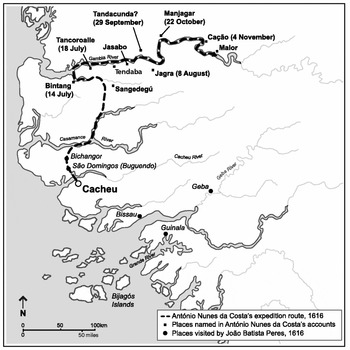
His brother, João Batista Peres, was a permanent resident on the Upper Guinea Coast, though it is not clear when he settled there. By the time he died in 1617, he had fathered four children by two different women, suggesting that he had lived there for some time.Footnote 29 Like his brother, João Batista Peres also seems to have been based in Cacheu, but his accounts indicate that at times he was personally in Buguendo, Guinala, and Bissau, and on the Grande River. He also sponsored expeditions to Serra Leoa, mainly to acquire kola, a natural product that was highly esteemed among Africans as a stimulant and to alleviate fatigue, hunger, and thirst.Footnote 30 António Nunes da Costa, on the other hand, was personally involved in trading expeditions on the Gambia River. From his accounts, it is possible to reconstruct the route he took between Bintang and Cação, and indicate the places at which he stopped to trade (Fig. 1). He traded from his boat and also sent Africans into the interior with small quantities of merchandise to trade, often for slaves.
Locations where António Nunes da Costa and João Batisa Peres traded in Upper Guinea.

Due to similarities in many Portuguese names, it is difficult to determine precisely the numbers who traded on the Upper Guinea Coast.Footnote 31 Was, for instance, Luis Lopes the same as Luis Lopes Marin? Nevertheless, the account books suggest that the number was substantial, though not all traders were directly involved in trading slaves. Together, they contain entries for about 345 clients or traders.Footnote 32 Those entries, in turn, include the names of about 280 other individuals, about one-fifth of whom were specified as being the clients' servants or slaves. The total number of persons named in the three sets of accounts is, thus, about 625. This figure alone suggests that direct and indirect involvement in the Atlantic trade was considerable, particularly given that it refers to only three Portuguese traders out of about seventy or eighty that were based in Cacheu at the time.Footnote 33 Also, these figures refer only to the Gambia River and the region immediately to the south, where these slave traders operated (Fig. 1), and not to the whole of the Upper Guinea Coast.
In order to analyse the varying roles played by Africans and Luso-Africans in the Atlantic trade, it is necessary to differentiate them from other traders and from one another. This is not an easy task given the highly cosmopolitan nature of society on the Upper Guinea Coast and the considerable degree of interethnic and intercultural mixing.Footnote 34 At this time, social groups were not distinguished on the basis of skin colour but culture. Hence, the traders being studied here only rarely referred to individuals as mulato (mixed African and white descent), preto (black), or branco (white), while European visitors to the coast very often commented on the propensity of Africans and people of mixed descent to refer to themselves as ‘Portuguese’.Footnote 35 The categorisation of clients here is based, therefore, on their names, titles, and, when possible, occupations. This is an imprecise exercise, particularly since traders, rather than clients, recorded the information. Also, as Peter Mark has observed, individuals might have multiple identities, moving backwards and forwards between categories according to context.Footnote 36
With these caveats in mind, a basic distinction can be made between those with African names and those with Christian names. Although one cannot rule out the possibility that an acculturated Portuguese might adopt an African name, it is probably safe to assume that those with African names were African by descent. It does not follow, however, that all those with Christian names were Portuguese. Using evidence of the roles of some clients as prominent officials, priests, or professionals, it is possible to identify a few individuals as having been born in Portugal. However, the social and ethnic background of the majority of those with Christian names is more difficult to ascertain.
Of particular significance is the fact that a large number of clients were referred to as senhor or senhora, titles suggestive of a superior social status. The majority of senhores were probably Luso-Africans, though it is known that at least some were lançados of Portuguese ancestry. Since the terms senhor/a are only recorded in the accounts of João Batista Peres and António Nunes da Costa, the analysis of the role played by different social groups will be based primarily on these sources.
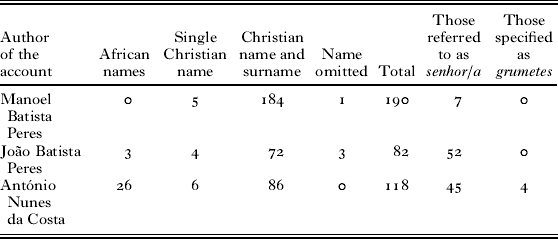
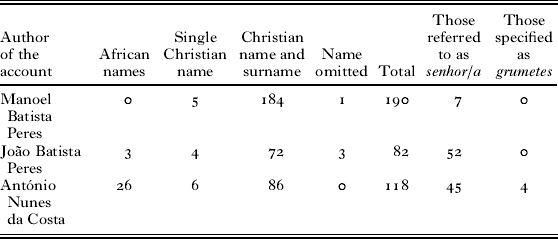
Relatively few individuals with African names appear in the account books. Since António Nunes da Costa traded in the interior, it is not surprising to find that such names figure more prominently in his accounts, where they comprise nearly a quarter of his clients (Table 1).
Number of clients of each slave trader by name and title
Source: AGNL SO CO 18–197, fols. 285–971v. Some individuals are named in more than one account.
About one-third of those with African names had titles such as falfa, farra, farão, or mansa. Two held the title of falfa – o falfa Crille and o falfa Liao Coile – which according to André Donelha meant alcaide (governor) or capitão (captain).Footnote 37 Other clients were o farra Jatta and farão Tamba, African and Portuguese titles respectively referring to Mandinka leaders generally considered to rank lower than a king.Footnote 38 Given that mansa means ‘king’ in Mandinka, Mansa Bare and Mansa Magam Cunda were presumably of higher status.Footnote 39 Another named individual was Mamude, described in the accounts as the brother of Tomane Francisco Domoire de Size of Bintang.Footnote 40 Most, if not all, of those with African names were men; in three cases where only surnames were recorded they could have been male or female.Footnote 41 To this relatively small number with African names, it is necessary to add other clients, who although they had Christian names, would probably have been African by descent and integral members of African communities.
Most of the traders' clients had Christian names and surnames, but the majority cannot be clearly identified as Portuguese, lançados, Luso-Africans, or Africans. It is therefore necessary to indicate how these different groups were distinguished for analysis. Within the accounts of João Batista Peres and António Nunes da Costa, it is difficult to identify those who were born in Portugal. It is slightly easier in the accounts of Manoel Batista Peres, since he noted the titles and occupations of his clients more frequently; some of them are also referred to in other sources. Among them were eight of the fourteen prominent Portuguese residents of Cacheu who were named in a legal case brought against the capitão mor (captain-major), António Proença, for misconduct in office in 1622; four of them were also clients of João Batista.Footnote 42 Among Manoel Batista Peres's clients were the current capitão mor, Baltazar Pereira Castelo Branco, and the scribe to the Fazenda Real, Manoel da Costa de Alvarenga.Footnote 43
While the number of clients who can definitely be identified as having been born in Portugal is very small, the proportion they represented of the total number of Portuguese-born residents on the coast is not clear. An account of the Christian needs of Guinea and Cabo Verde in 1621 estimated that there were between seventy and eighty Portuguese traders in Cacheu, and 15 in Bichangor.Footnote 44 Probably not all of those born in Portugal lived in these settlements. Rather as Richard Jobson observed, the Portuguese and ‘Molatoes’ were scattered ‘some two or three dwellers in a place’.Footnote 45 Moreover, Jobson doubted that most of them were actually Portuguese, writing that ‘they call themselves, Portingales, and some few of them seeme the same; others of them are Molatoes’. Equally, a navigational guide to the Upper Guinea Coast by Francisco Pires de Carvalho in 1635 noted that there were twenty Portuguese living on the Gambia River ‘mixed with Africans in their settlements’ (misturados com o gentio da terra nas suas povoações).Footnote 46 Over time, as fewer Portuguese arrived on the coast, the number of residents who had been born in Portugal declined. Thus, in the mid-seventeenth century, the Cabo-Verdean born trader Francisco de Lemos Coelho observed that settlements, such as Tancoroalle, which had always possessed white residents, by then had only people of mixed descent (filhos da terra), and went on to describe the locally-born white residents of Sangedegú as ‘brancos filhos da terra’.Footnote 47 Hence by the mid-seventeenth century, those referred to as white were most likely lançados or tangomaos. These terms were often used interchangeably, though the latter was often applied pejoratively to those who had become more fully integrated into African society and culture.Footnote 48 One client of the Peres brothers was the well-known New Christian lançado, Captain Sebastião Fernandes Cação, while João Batista Peres himself, being a permanent resident on the coast and the father of four children with African women, might also be regarded as such.Footnote 49
Among those with Christian names that can be identified as Luso-Africans were four of António Nunes da Costa's clients, referred to as grumetes. As noted above, they performed a wide array of roles as pilots, boat hands, interpreters, and trade intermediaries. Since many individuals named in the accounts acted in these capacities, the fact that only a few were referred to as grumetes suggests the title referred to a specific status, and possibly one of a contractual nature. Two of the four grumetes were referred to as ‘moços’ (youths) suggesting that they may well have been apprentices.
Apart from grumetes, clients who were referred to in the accounts of João Batista Peres and António Nunes da Costa as senhor or senhora were also likely Luso-Africans. 53 of João Batista Peres's 82 clients (65 per cent) were referred as senhores and 45 of 118 (38 per cent) of those who traded with António Nunes da Costa. Of the latter, one had an African name and another was a grumete. The title senhor/a appears to have been applied fairly consistently by the different traders suggesting that the status of individuals was socially recognised.
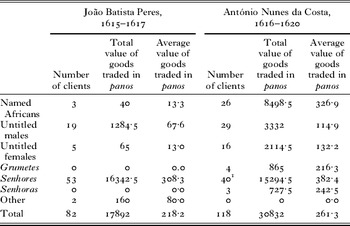
George Brooks has argued that the term ñhara, which was derived from the title senhora, was applied to Luso-African women. He explains that the Portuguese and lançados saw commercial and cultural advantages in having relations with Luso-African women, because of their wider trade connections, because they spoke Crioulo (Creole), and because they were generally more familiar with European culture.Footnote 50 These women, through employing their entrepreneurial skills and the resources they might inherit from deceased partners, could become highly respected and economically powerful within Senegambian society in their own right. João Batista Peres's own testament demonstrates how African women could inherit resources from deceased Portuguese partners.Footnote 51 In the accounts analysed here only three women were referred to as senhoras, all of them in António Nunes da Costa's accounts, whereas the title senhor was applied to 94 men. Nevertheless, distinctions among men were probably made on the same cultural basis. Many senhores were probably of mixed ancestry. Excluded by social custom from access to land and marriage partners from native communities, these individuals traded with the Portuguese, becoming familiar with their language and culture, and serving as essential commercial and cultural intermediaries.Footnote 52 That the title senhor/a might be used to distinguish Luso-Africans from Africans is supported by Table 2, which suggests that those with the title senhor/a were more prominent in trade than those who were not.Footnote 53 The analysis below will show not only that the senhores dealt in larger quantities of merchandise, but also rather different commodities from Africans.
Value of goods traded by the clients of João Batista Peres and António Nunes da Costa, 1615–1620

Source: AGNL SO CO 18–197, fols. 599–680v for João Batista Peres; and for António Nunes da Costa, AGNL SO CO 18–197, fols. 285–330v, 685v–742v, 917v–971v.
1 This number excludes one named African and one grumete who were referred to as senhores.
Returning to Africans, those with Christian names and surnames who were not accorded the title of senhor/a or who were not members of prominent Luso-African families identified in other sources were probably Africans. In some cases, their African identity is suggested by their occupations, notably as servants or boat hands. A small number of clients, only 15 in all three accounts together, had a Christian name only. These individuals were sometimes referred to as having a connection to another person, for example, Francisco de Maria Fernandes, implying they were either related or more likely were their slaves or servants. One Manoel was described as the calafate (caulker) of Sebastião Fernandes.Footnote 54
Others who are likely to have been Africans were boat hands. Even though they are not generally referred to as marinheiros (sailors), it is clear that some were being employed on trading expeditions, notably to Serra Leoa to acquire kola, and were being paid in imported or local cloth, clothes, and wine.Footnote 55 Most of those employed in such expeditions were probably Africans, since navigating the rivers was hazardous and required local knowledge, and locally-born intermediaries were often essential in making trading contacts.
ESTIMATING THE NUMERICAL IMPORTANCE OF SOCIAL GROUPS
On the assumption that those with African names and those with Christian names who were not referred to as senhor/a were Africans, they accounted for about 60 per cent of António Nunes da Costa's clients. Of the remaining 40 per cent, the four grumetes may be regarded as Luso-Africans, as can the three senhoras. This leaves 40 senhores whose status as Luso-Africans, lançados, or Portuguese is difficult to determine. The fact that António Nunes da Costa did not feel the need to differentiate between them may be significant in itself. Since his accounts refer almost exclusively to the Gambia River, any Portuguese he encountered there are likely to have been lançados. Distinguishing between lançados and Luso-Africans poses greater difficulties. As will be shown below, they cannot be differentiated on the basis of the quantity and types of goods they exchanged. For example, while European foods or kola might suggest a client was Portuguese or African, respectively, these are not reliable indicators of their ancestry because in the first instance European foods were also of interest to Africans, while in the second, lançados might acquire kola for onward trading or to smooth relations with Africans. In fact, lançados were especially active in the trade in kola.Footnote 56
It is also not possible from the accounts to distinguish individual clients as lançados, but it is worth trying to estimate their overall importance in the Atlantic trade if only for a single slave trader and for a limited region, the Gambia River. One approach is to consider how many lançados are likely to have been resident on the Gambia River at the time. António Nunes da Costa's accounts record six main settlements on the river and since, as noted above, other sources suggest that each might have two or three lançados, it can be estimated that 12 to 18 of the senhores might have been lançados. It is recognised that this is a highly speculative figure and, judging by the relatively small number of senhores who bought European food and clothing – products that lançados frequently used to demonstrate their European affiliations, it may well be too high.Footnote 57 Assuming that 15 of the forty senhores might have been lançados, the percentage of the 118 clients belonging to each of the three groups, may have been as follows: Luso-Africans, 40 per cent (of whom 3 per cent were grumetes and about 13 per cent might have been lançados), and Africans, 60 per cent.
It is not possible to apply this same reasoning to the accounts of João Batista Peres, since the number and location of settlements in which he traded are less apparent. What is clear, however, is that he had fewer clients with African names and without the title senhor/a. Africans figure even less in Manoel Batista Peres's accounts, though they are not totally absent. One Constantino, referred to as being a resident of Vila Quente, the African suburb of Cacheu, is likely to have been an African.Footnote 58
Overall the analysis suggests, as might be expected, that as one moves away from the coast, the proportion of Africans involved in the Atlantic trade increases. While some Africans sent their servants and slaves to Cacheu to trade on their behalf, Portuguese traders could not rely on slaves and other export commodities being delivered to them there. Rather, they frequently ventured up to one hundred miles into the interior to acquire them. Hence, although some slaves were acquired through intermediaries, there was also direct contact between Portuguese traders and Africans who lived in the interior.
What then were the commodities exchanged by Africans and Luso-Africans? The items traded by João Batista Peres were often referred to generically as ‘fato’ (goods), so the analysis below is confined to António Nunes da Costa's accounts. These accounts span a number of years and it is worth noting that the importance of different imports and locally-produced goods, varied from year to year, almost certainly reflecting their availability.
COMMODITIES ACQUIRED BY AFRICANS AND LUSO-AFRICANS
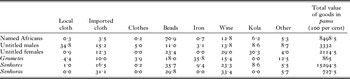
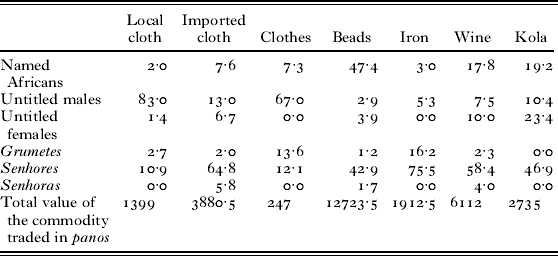
Early visitors to the Upper Guinea Coast often distinguished between the trade goods sought by European and African residents. Almada recorded that Portuguese wanted ready-made clothing, shirts, doublets, footwear, all other types of clothing, and foodstuffs, while the ‘blacks’ desired iron, cotton, cotton cloth, sail cloth, and wine.Footnote 59 Although Almada omitted beads from this list, elsewhere he noted that they were among the items valued most highly by Africans. Similarly, rather later in the seventeenth century, Coelho indicated that in the Gambia the ‘whites’ sought clothing, foodstuffs, and items for boats, whereas Africans wanted iron, aguardente (alcohol) – probably brandy, beads, red cloth, crystal, paper, and kola.Footnote 60 Kola was particularly highly esteemed in the Gambia River, where Richard Jobson deemed ten kolas to be ‘a present for a King’.Footnote 61 These observations are largely borne out by the evidence presented here. Table 3 indicates that, with the exception of grumetes, over 90 per cent of the goods acquired by all groups can be accounted for by seven commodities, among which beads, imported cloth, and wine were the most important. However, it also reveals a different emphasis among the groups, which is also apparent in the trade in specific commodities, such as types of clothing or foodstuffs.
Relative importance by value of goods acquired by different social groups

Source: AGNL SO CO 18–197, fols. 285–330v, 685v–742v, 917v–971v, António Nunes da Costa accounts, 1616–20.
Beads accounted for about 70 per cent of the goods acquired by Africans from António Nunes da Costa. This high figure derives in part from the inclusion of a very small amount of high value crystal worth 2,000 panos, but even if this were excluded, then the figure would still be 62 per cent. In fact, named Africans acquired nearly half of all the beads traded by António Nunes da Costa (Table 4), most of the rest being traded by senhores. Untitled clients generally acquired more local products: in the case of men, locally-produced cloth; in the case of women, kola. One exception was wine, which figured prominently among the goods traded by all groups. It was in particularly high demand among Africans who were said to be willing to ‘die for it’.Footnote 62 However, its importance also derived from its role in facilitating trade. The accounts reveal clearly how flasks of wine were regularly used to encourage people to come aboard to trade, including on different occasions a ‘king’ and his agents.Footnote 63
Percentage of each commodity by value acquired by different social groups
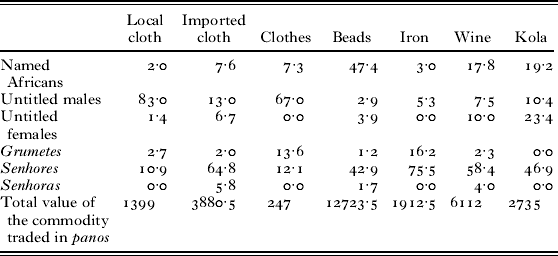
Source: AGNL SO CO 18–197, fols. 285–330v, 685v–742v, 917v–971v, António Nunes da Costa accounts, 1616–20.
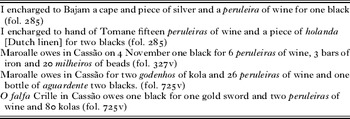
Judging by the quantities they were trading, named Africans, like other clients, seem to have comprised two groups: those who acquired goods in small quantities, probably for personal use, and those who obtained large quantities, most likely for onward trading. Those who purchased small quantities commonly acquired only a small number of beads, wine, or kola, together worth about 150 panos. Yet, two Africans who were referred to as o falfa also acquired goods for conspicuous consumption. O falfa Crille acquired a golden sword and o falfa Liao Coile, two silver bowls. Such acquisitions were commonplace among African leaders. Almada noted that the king of Bussis possessed many objects of worked silver, which he kept as a sign of his rank, while, according to Donelha, the Casamance king Masatamba enjoyed using a whole dinner service made of silver.Footnote 64
Other Africans were clearly receiving goods for onward trading. António Nunes da Costa distributed 400 panos of beads each to eight named Africans to ‘trade in the interior’ (para taguilar ao mato).Footnote 65 The most important trader with an African element to his name was António Vaz Tumba, who was referred to as a senhor.Footnote 66 He received 1,330 panos of merchandise consisting of lenço (imported cloth), large quantities of beads, crystal, and wine. Some of the wine was specified as being for his ‘youths’ and for use when he stopped at various trading points on the Gambia River, notably at Tancoroalle. He also made a payment to a caulker, which suggests he may have owned a boat or at least was in charge of it.Footnote 67
Compared to named Africans, grumetes received smaller quantities of goods worth less than 100 panos. These generally took the form of flasks of wine to be consumed on the journey, a bar of iron, or a piece of cloth. The total amount of iron being traded at this time appears limited, even though it was in high demand in the Gambia River.Footnote 68 Nevertheless, iron accounted for 36 per cent of the goods acquired by grumetes even though they numbered only 4 out of 118 clients. In fact, they acquired 16 per cent of all the iron registered in António Nunes da Costa's accounts (Table 4). The association of iron with grumetes suggests that they may have been acquiring it for boat building and repairs, rather than for agricultural tools or weapons, as was common among coastal groups, such as the Balanta.Footnote 69 On the other hand, one grumete, Pedro da Costa, was clearly playing a significant role as a trade intermediary since he received large quantities of beads and iron bars worth several hundred panos.Footnote 70 Unlike the other three grumetes, he was referred to as a senhor and most likely was using the iron bars as a barter commodity.
In general, the senhores acquired more imported goods, especially beads, European and Indian cloth, and wine, and very little locally-produced cloth and kola. That said, the proportion of kola handled by senhores was high, suggesting that some of them may have been lançados, who were particularly involved in that trade. Of the imported cloth, about one-fifth came from Asia, the rest coming from Europe in the form of ruao a (woollen cloth from Rouen in France), estamenha (serge), or lenço (linen). Since those dealing in imported goods would have needed to interact with European traders, this finding strengthens the argument above that those referred to as senhor/a were not simply the most prominent traders, but were Luso-Africans.
Certain goods acquired by clients might be used to reflect the status or identity of their purchasers. These included clothing and a number of miscellaneous items, such as swords or European foodstuffs. Such items accounted for only a small proportion of the total value of goods traded, but they are worth commenting upon briefly.
Visitors to the Upper Guinea Coast often remarked on the clothing worn by local residents. In 1685, a French visitor to the Gambia, Michel Jajolet de La Courbe, observed that those along the Gambia River who called themselves Portuguese, ‘normally wear a hat, shirt, and breeches like Europeans, and although blacks, they assert that they are whites’.Footnote 71 Africans, by contrast, rather than adopt European clothes, often preferred their own style of clothing. Hence, although the king of Bussis was said to own trunks and boxes full of clothing, including ‘elaborate smocks, doublets, and breeches’, Almada commented he seldom wore ‘clothing of the European kind’.Footnote 72 Instead, Africans asserted their status and identity through incorporating new, expensive fabrics often with unusual designs into their traditional form of dress.Footnote 73 Manoel Batista Peres's accounts record that shirts, shoes, hats, and stockings, mainly of silk, but also of wool and flax, as well as meias de cabrestilho (spats) and a small number of jubões (doublets) and bragas (breeches) were traded, mostly likely in Cacheu where he was based. However, there is little evidence for the purchase of European-style clothing or of exotic fabrics in the accounts of João Batista Peres or António Nunes da Costa. Outside Cacheu, most clothing traded was of local origin. The few shirts, breeches, and hats traded were generally acquired by those without a title and particularly by grumetes. One youth named Domingos Fernandes acquired a shirt, breeches, and a hat, perhaps to reinforce his Luso-African identity.Footnote 74 Neither is there much evidence for the purchase of expensive fabrics such as taffeta. The very small quantities that were traded were acquired almost exclusively by senhores/as, who were the main traders in imported textiles in general.
Other miscellaneous items, while often of low value, also reveal an interesting pattern of purchase. Grumetes and men not referred to as senhor were the most frequent purchasers of swords, mainly terçados (short swords), but occasionally decorative swords.Footnote 75 On the other hand, senhores were more prominent in trading European foods (oil, vinegar, cheese, marmalade, sugar, saffron, lentils, and olives), paper, and small items of silver. The consumption of European foods suggests that some of the senhores may have been lançados rather than Luso-Africans, though such comestibles were also favourites of local chiefs. Hence, in the 1630s, ships wishing to trade at Cacheu were required to give the king a cask of wine, a barrel of bread, four strings each of garlic and onions, two boxes of marmalade, and also some wine for his governor.Footnote 76
COMMODITIES DELIVERED BY AFRICANS AND LUSO-AFRICANS
The evidence available for the goods delivered to the traders in payment for those they had been supplied on credit is less complete, especially for António Nunes da Costa's third account book where over half of the repayments are missing. Nevertheless, it is possible to sketch the broad pattern of exchange.
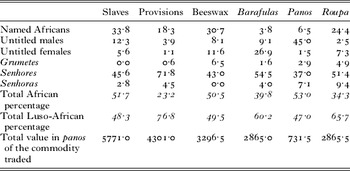
Slaves made up about 24 per cent of the value of goods delivered to António Nunes da Costa with provisions and beeswax following closely behind at 18 and 14 per cent respectively (Table 5).Footnote 77 Africans and Luso-Africans each supplied about half of the slaves and beeswax, but the latter dominated the trade in provisions (Table 6). It is worth noting that no gold or ivory was delivered.
Relative importance of the commodities by value delivered by different social groups

Source: AGNL SO CO 18–197, fols. 285–330v, 685v–742v, 917v–971v, António Nunes da Costa accounts, 1616–20.
Percentage of selected commodities by value delivered by different social groups

Source: AGNL SO CO Ca 18 doc 197, fols. 285–330v, 685v–742v, 917v–971v, António Nunes da Costa accounts, 1616–20.
The total number of slaves delivered to António Nunes da Costa was 39, of whom 21 were acquired from senhores, 13 from Africans, and of the remaining five, three were supplied by two untitled women, Esperança Vaz and Antonia Fernandes. The largest number provided by any one client was three and most were delivered as single individuals. As shown in Table 7, in some cases, mainly those involving Africans, the commodities for which individual slaves were exchanged were recorded.
Goods used to purchase slaves in the Gambia River, 1616–17

Source: AGNL SO CO 18–197, António Nunes da Costa's accounts, 1616–17.
Provisions, mainly millet, account for a surprisingly large proportion of the goods acquired by António Nunes da Costa, with most being supplied by only a few senhores, who probably acquired them through alliances with local leaders. Provisions would have been used to support the slaves while awaiting shipment on the coast and on the Middle Passage, but a proportion was probably sold in local markets and in Cabo Verde.Footnote 78
While grumetes were not heavily involved in trading provisions, they did participate in the trade in beeswax and, along with senhoras, also traded roupa, a type of locally-produced clothing. Female clients without titles more commonly traded barafulas rather than clothing.Footnote 79Barafulas were highly-prized deeply-dyed dark blue cloths, which were worth about five times an ordinary pano and were often used as a medium of exchange.Footnote 80 The importance of clothing and cloth (both panos and barafulas) is not surprising given the region's pre-eminence in textile production from pre-European times.Footnote 81 Following European contact, production was enhanced by the importation of raw cotton produced in Cabo Verde. The Peres brothers were involved in this trade and their accounts show that they distributed raw cotton to local weavers and tailors on the Upper Guinea Coast.Footnote 82
The importance of cloth and clothing indicates that commercial relations between Africans and Europeans in the early seventeenth century did not consist of a simple exchange of imported goods for slaves, but rather that both parties participated in an active trade in local products. It also demonstrates that far from being dependent on Europe for textiles and clothing, as has sometimes been argued for Africa in general, the demand for these commodities in Upper Guinea in the early seventeenth century, at least, was largely met by its vibrant local textile industry.Footnote 83
CONCLUSION
This study of the trading activities of three Portuguese slave traders on the Upper Guinea Coast in the early seventeenth century suggests that the number of people directly or indirectly involved in the Atlantic trade was considerable and included persons from diverse backgrounds and ranks. It shows how slave traders worked through networks of relatives, compatriots, and Luso-Africans, whose reach extended into African communities. Luso-Africans played a critical role in the development of the slave trade since, as residents on the coast, they were well placed to accumulate knowledge of markets, develop stable contacts, and could handle trade throughout the year, not only when slave traders arrived.Footnote 84 While the slave traders worked through such intermediaries, this article has also shown that they penetrated the interior personally and acquired slaves in small numbers directly from Africans.
In terms of the commodities that were traded, the evidence presented here generally supports but adds greater specificity to observations made by late sixteenth- and early seventeenth-century visitors to Upper Guinea Coast. All groups were interested in acquiring imported goods, especially beads, textiles, and wine. The trade in these items was largely in the hands of Luso-Africans, with beads predominating among the goods acquired by those with African names. Clients who were not referred to as senhores more commonly acquired locally-produced items, especially cloth and kola. Perhaps less expected, however, is that the goods returned to the traders comprised not only goods for export. In fact, slaves, beeswax, and provisions only accounted for about 55 per cent of the total value of commodities acquired by António Nunes da Costa. If provisions are excluded on the grounds that it is not clear to what purposes they were put – some may have been traded locally – then the figure falls to 37 per cent. A substantial portion of the other goods supplied by the clients comprised locally-produced textiles and clothing most of which would have been traded locally or more widely on the coast. Little difference exists between Africans and Luso-Africans with respect to the types of items they delivered to the slave traders, though the latter generally supplied larger quantities. Hence, the slave traders acquired half of the slaves directly from Africans and the other half, from Luso-Africans. Similarly, few, if any, differences exist in the commodities delivered by men and women, though women traded far less.
The Atlantic trade on the Upper Guinea Coast in the early seventeenth century was not, therefore, a simple exchange of European imports for slaves, but was embedded in and part of a more complex system of trade rooted in pre-European patterns of exchange in locally-produced commodities. In the sixteenth century, the trading activities of lançados had begun to develop an Atlantic dimension, but by the early seventeenth century, societies in Upper Guinea had not become dependent on imports from Europe. Rather, contrary to what Walter Rodney argued, they still participated in the Atlantic trade largely on their own terms.
While the sources examined here reveal much about the role of particular groups in the Atlantic trade and the commodities they traded on the Upper Guinea Coast, one must be cautious about extrapolating these findings to other regions of Africa. Even within the Upper Guinea Coast, the commodities traded around Cacheu varied from those exchanged along the Gambia River or in Petit Côte, reflecting among other things differences in the resource endowments of those regions, and local economies and sociopolitical structures.Footnote 85 Hence, the high percentage of locally-produced commodities found in these sources may partly reflect the existence of a highly productive textile industry in the central part of this region. At the same time, the particular character of Portuguese settlement on the Upper Guinea Coast, which involved the integration of lançados into indigenous communities, facilitated Portuguese insertion into local trading networks and patterns of exchange to a greater degree than elsewhere in Africa where Europeans acquired slaves in ways that did not bring them in to close contact with Africans. Thus, the relationship of the slave trade to pre-European patterns of trading described here may not have existed elsewhere.
More generally, this article demonstrates that the role of particular groups in the slave trade and the commodities they traded were a function of a large number of interrelated variables, including how different European slave traders conducted their business, the nature of local African economies and societies, and the resources of a region, to say nothing of the availability and prices of imports (not considered in detail in this study) as well as of local products and slaves, all of which did not remain constant over time. What this article highlights is that in the initial phase of the slave trade on the Upper Guinea Coast, Africans and Luso-Africans played active roles as traders and consumers, and that the Atlantic trade did not focus exclusively on the acquisition of slaves for export but developed in close relation with pre-European patterns of exchange. Given the complexity of factors that governed the operation and impact of the slave trade, it is unlikely that these findings for the Upper Guinea Coast will be replicated in detail elsewhere. However, this analysis suggests that in order to understand the development of the Atlantic slave trade in other regions, close attention needs to be paid to this early period, and to economic and social interactions of Europeans and Africans at the individual level. Unfortunately, sources of the quality and detail examined here are extremely rare.