Introduction
Persicaria chinensis (Polygonaceae) is a perennial herb native to tropical and subtropical eastern Asia. The plant can tolerate a wide range of environmental conditions, including shade, high temperatures, high salinity and drought and is abundant in wet valleys and on grassy slopes in China, from sea level to elevations of 3000 m (Galloway & Lepper, Reference Galloway and Lepper2010). In peninsular Malaysia, P. chinensis is frequently found growing wild in montane forests up to 1200 m and flowers year-round. It is also cultivated in the lowlands by the ethnic Chinese community who use the herb in traditional medicine to treat lung ailments. The cultivated plants rarely set fruit and are propagated through cuttings. P. chinensis has been categorized as a ‘high risk’ invasive species in the Pacific, based on a comprehensive risk assessment involving 41 criteria (PIER, 2010), and was recently discovered in New Zealand, with the traditional medicine trade implicated as a factor in this incursion (Galloway & Lepper, Reference Galloway and Lepper2010).
Besides ecological and economic importance as a rapid colonizer and a medicinal herb, P. chinensis is of evolutionary interest as a classic example of heterostyly (flower and pollen dimorphism) (Reddy et al., Reference Reddy, Bahadur and Kumar1977). Heterostyly, together with the production of showy inflorescences (fig. 1), nectar and a strong scent, suggests that the wild plant is extensively cross-pollinated by animal vectors. We have observed that open pollination resulted in three times more fruits than self-pollination (Wong, Reference Wong2012). However, the insects associated with P. chinensis pollination have received little attention. A survey of social bee and food plant associations in India identified Apis cerana as a visitor to P. chinensis flowers (Thomas et al., Reference Thomas, Rehal, Varghese, Davidar and Potts2009), while a study in Japan identified 15 morphospecies as potential pollinators of the congeneric, Persicaria japonica (Nishihiro & Washitani, Reference Nishihiro and Washitani1998).
Growing habit of Persicaria chinensis and a potential pollinator visiting an inflorescence at Ulu Kali, Pahang, Malaysia.

A ‘key question’ in pollination biology (Mayer et al., Reference Mayer, Adler, Armbruster, Dafni, Eardley, Huang, Kevan, Ollerton, Packer, Ssymank, Stout and Potts2011) concerns the factors determining the diversity of insect pollinators, but lack of taxonomic identification capacity is an impediment to research in this area (FAO, 2009). DNA barcoding, the use of a short standardized mtDNA sequence for species identification (Hebert et al., Reference Hebert, Cywinska, Ball and deWaard2003; Hebert & Gregory, Reference Hebert and Gregory2005; Floyd et al., Reference Floyd, Wilson, Hebert, Foottit and Adler2009), has been suggested as a solution for the taxonomic impediment to pollinator studies (FAO, 2009). In the present study we aimed to elucidate the insect pollinators of P. chinensis in peninsular Malaysia using DNA barcoding. Invasive plants generally lack specialized pollinator requirements (Bartomeus et al., Reference Bartomeus, Vilà and Santamaria2008). Therefore, as a widespread invasive plant we would expect P. chinensis to be associated with a diverse group of generalist insect pollinators.
Materials and methods
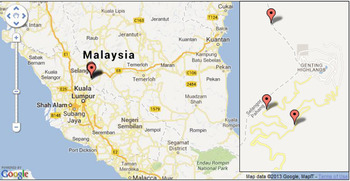
Wild P. chinensis is a scrambling herb found in isolated patches, termed ‘populations’, but which may be a single organism, covering an area of ground 4–10 m2 and growing up to 3 m vertically (fig. 1). We conducted observations on three populations of P. chinensis in the montane forest of Ulu Kali, Pahang, Malaysia (fig. 2), on alternate days between 16 May 2012 and 2 June 2012, from 0600 to 1400 each day. We divided our time equally between the three populations, which all were growing in direct sunlight along the roadside. Insects were observed to move between different inflorescences in the population. The frequency of visits to P. chinensis flowers by different insect morphospecies was assessed qualitatively with a morphospecies, for the purpose of this study, comprising individuals which were very difficult to tell apart during our field observations. Forty flower visitors, representing the range of morphological diversity observed, were captured in the proximity of inflorescences using a sweep net. The collected insects were observed under a dissecting microscope for the presence of pollen grains adhered to their bodies. Any pollen grains found were mounted on slides using glycerine jelly, counted and examined under a light microscope to determine if they were P. chinensis. A leg was removed from each insect specimen for DNA barcode generation using standard methods (Wilson, Reference Wilson, Kress and Erikson2012). In brief, DNA was extracted using glass-fibre plates and a fragment of COI mtDNA amplified using the ‘Lep’ primer combinations mentioned in Wilson (Reference Wilson, Kress and Erikson2012). Cycle sequencing was performed bi-directionally using the PCR primers. The DNA barcodes were uploaded to the Barcode of Life Datasystems (BOLD) (http://www.boldsystems.org; Ratnasingham & Hebert Reference Ratnasingham and Hebert2007).
The location of the three study populations at Ulu Kali, Pahang, Malaysia (03°25′55″N, 101°47′05″E; 03°24′55″N, 101°47′02″E; 03°24′45″N, 101°47′22″E).

Upon upload to BOLD the DNA barcodes (>500 bp) were automatically assigned Barcode Index Numbers (BINs; Ratnasingham & Hebert, Reference Ratnasingham and Hebert2013). BINs are Molecular Operational Taxonomic Units (MOTU) produced by Refined Single Linkage (RESL) analysis across the BOLD database and have been shown to correspond closely with traditional species limits characterized by morphology (Ratnasingham & Hebert, Reference Ratnasingham and Hebert2013; Hausmann et al., Reference Hausmann, Godfray, Huemer, Mutanen, Rougerie, van Nieukerken, Ratnasingham and Hebert2013). In addition to RESL, the DNA barcodes were arranged into MOTU using two other approaches commonly applied to DNA barcode data (Boykin et al., Reference Boykin, Armstrong, Kubatko and De Barro2012) that do not require a priori assignment of DNA barcodes to groups. The Automated Barcode Gap Discovery (ABGD; Puillandre et al., Reference Puillandre, Lambert, Brouillet and Achaz2012) web interface was accessed from http://wwwabi.snv.jussieu.fr/public/abgd/abgdweb.html. Previous studies have shown that there is typically a distinct pattern to intra- and interspecies DNA barcode divergences, a so-called ‘barcode gap’, but that this pattern can be unique to a dataset. ABGD uses an automatic recursive procedure to converge on the best pattern for the dataset and arranges DNA barcodes into species accordingly (Puillandre et al., Reference Puillandre, Lambert, Brouillet and Achaz2012). The method has been shown to perform well with sympatric datasets, is fast and user-friendly and does not have any special computational requirements (Paz & Crawford, Reference Paz and Crawford2012). A Bayesian implementation of the Poisson Tree Processes (bPTP; Zhang et al., Reference Zhang, Kapli, Pavlidis and Stamatakis2013) model was accessed through the web interface available at http://species.h-its.org/ptp/. bPTP can be used to delimit phylogenetic species in a similar way to the popular and widely used General Mixed Yule Coalescent (GMYC) approach (Pons et al., Reference Pons, Barraclough, Gomez-Zurita, Cardoso, Duran, Hazell, Kamoun, Sumlin and Vogler2006), but without the requirement for an ultrametric tree (Zhang et al., Reference Zhang, Kapli, Pavlidis and Stamatakis2013). The DNA barcode dataset was collapsed to unique haplotypes and a Maximum-Likelihood tree was generated in MEGA6 (Tamura et al., Reference Tamura, Stecher, Peterson, Filipski and Kumar2013) using the ‘best’ model (GTR + G + I), Subtree-Pruning–Regrafting – Extensive (SPR level 5) and otherwise default settings for input into bPTP.
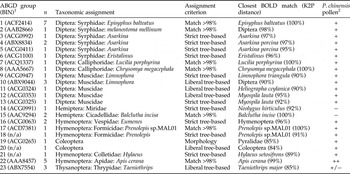
Representatives of each MOTU were submitted to the BOLD identification engine full database (‘Full DB’) to assign a taxonomic name to the MOTU. Species names were assigned using a >98% sequence similarity threshold. When there was no match >98%, the ‘Tree-Based Identification’ option was followed on BOLD and higher taxon names were assigned using tree-based criteria following Wilson et al. (Reference Wilson, Rougerie, Shonfeld, Janzen, Hallwachs, Kitching, Haxaire, Hajibabaei and Hebert2011; table 1).
Taxonomic assignment of 23 species visiting flowers of Persicaria chinensis at Ulu Kali, Pahang, Malaysia.

1 Some short DNA barcodes (<500 bp) were not assigned (n/a) a Barcode Index Number (BIN) on BOLD.
2 The pollen load was coded as: +, 20–100 grains observed per specimen; ++, >100 grains observed per specimen; +/−, 0–20 grains observed per specimen; −, no grains were observed.
Results
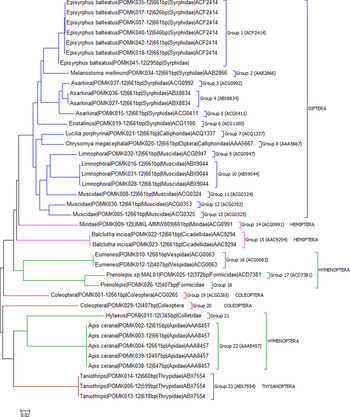
The DNA barcodes generated for this study, photographs and metadata of the specimens are available on BOLD in public dataset: DS-POCK (doi: dx.doi.org/10.5883/DS-POCK; GenBank Accessions KF200036-KF200075). RESL and ABGD converged on the same MOTU (fig. 3), indicating 23 species had been observed visiting P. chinensis flowers. bPTP indicated the sample comprised 20 species. Of the 23 putative taxa, six could be assigned a Linnaean species name, and one could be assigned a ‘dark taxa’ species name (Prenolepis sp. MAL01) (table 1). Dark taxa are previously recognized species, which have not been provided with a formal name, but which are nevertheless present on taxonomic databases such as BOLD (Maddison et al., Reference Maddison, Guralnick, Hill, Reysenbach and McDade2012; Wilson et al., Reference Wilson, Sing, Halim, Ramli, Hashim and Sofian-Azirun2014). Using tree-based criteria, nine of the remaining species could be assigned to genus, three to family, and three to order (table 1). One coleopteran species could not be assigned at any level using DNA barcoding and the closest matching sequence was a moth. We subsequently were able to note that insects from the genera, Apis, Askarina and Prenolepis, were the most frequent visitors to P. chinensis flowers. Under a dissecting microscope we observed that all of the insects, with the exception of the hemipterans, had P. chinensis pollen grains adhered to their bodies (table 1). Pollen grains from other plants were also observed on some specimens but the plant species were not identified.
BOLD Taxon ID tree (Kimura 2 parameter, neighbour-joining) showing the ABGD groups and BIN assignments. Taxon labels include taxonomic assignment, BOLD process ID, sequence length, family assignment and BIN.

Discussion
DNA barcoding implicated a diverse array of insects as potential pollinators of Chinese knotweed in peninsular Malaysia. Using RESL and ABGD, 17 morphospecies were assigned to 23 species representing at least ten families and four orders. Using the DNA barcode library (BOLD) 30% of the species could be assigned a species name, and 70% could be assigned a genus name. Failure of DNA barcodes to match to their closest relative in the library is analogous to ‘long-branch attraction’ in molecular systematics, and can be overcome through expanding taxonomic coverage in the library. Beetles, unlike bees and moths, have not yet been the focus of a global DNA barcoding campaign (but see Woodcock et al., Reference Woodcock, Boyle, Roughley, Keva, Labbee, Smith, Goulet, Steinke and Adamowicz2013; Pentinsaari et al., Reference Pentinsaari, Hebert and Mutanen2014 and Hendrich et al., Reference Hendrich, Morinière, Haszprunar, Hebert, Hausmann, Köhler and Balke2014 for recent work from Europe and North America), which could explain the case where a beetle matched most closely (although only sharing 85% similarity) to a moth DNA barcode and demonstrates why similarity alone cannot be used for taxonomic identification in the absence of species-level matches (Wilson et al., Reference Wilson, Rougerie, Shonfeld, Janzen, Hallwachs, Kitching, Haxaire, Hajibabaei and Hebert2011). Although overall the assignment rate may seem low, the species have the potential to be assigned more precisely in the future as the DNA barcode library continues to grow. Presently, cosmopolitan species are easily identified with DNA barcoding but a focus on regional libraries will be required to precisely assign most specimens a species name. However, standardized DNA barcoding (and the BIN) is potentially more useful at facilitating taxonomic connections between studies than morphospecies names such as ‘Unidentified Syrphidae sp. 1’.
Our results are broadly similar to those of Nishihiro & Washitani (Reference Nishihiro and Washitani1998) who recorded 15 morphospecies, from three orders (Hymenoptera, Diptera and Lepidoptera), visiting flowers of P. japonica. We did not observe any lepidopterans but did observe species from the orders Hemiptera, Coleoptera and Thysanoptera besides Hymenoptera and Diptera. Like Nishihiro & Washitani (Reference Nishihiro and Washitani1998) we also found the insect visitors comprised honey bees (Apis), droneflies (Eristalis), blowflies (Lucilia) and potter wasps (Eumedes). During our study, we observed that honey bees (Apis cerana) were the most common visitors to P. chinensis flowers, and among all the insects collected, had the largest number of the pollen grains adhered to their bodies. Given the high frequency of visits, and greatest pollen load, A. cerana is probably the most important pollinator of P. chinensis. Thrips, assigned to Taniothrips (Thripidae), were common visitors to P. chinensis and were abundant in inflorescences. Their foraging behaviour was similar to that seen at Antigonon leptopus (Polygonaceae) (Raju et al., Reference Raju, Kanaka Raju, Victor and Appala Naidu2001), mostly moving within one flower and occasionally moving to adjacent flowers of the same inflorescence. Thrips have been suggested as potential pollinators of many economically important plants, but besides playing this beneficial role, they are also known to cause extensive flower damage (Tillekaratne et al., Reference Tillekaratne, Edirisinghe, Gunatilleke and Karunaratne2011). Ants, assigned to Prenolepis (Formicidae), were also among the most frequent insect visitors to P. chinensis flowers. Typically, ants have been considered ineffective pollinators due to their small size preventing effective contact with anthers and stigmas, and a tendency to destroy ovaries during nectar foraging (Gomez & Zamora, Reference Gomez and Zamora1992). Ants have been suggested as pollinators of Polygonum cascadense (Polygonaceae) (Hickman, Reference Hickman1974) and we found that ants visiting P. chinensis were carrying P. chinensis pollen grains on their thorax, abdomen and legs. Further studies are needed to determine if these ants are effective pollinators or merely nectar thieves.
The results confirm our expectation that a taxonomically diverse group of insects are visiting the flowers of P. chinensis in peninsular Malaysia. Although we observed P. chinensis pollen grains adhered to the bodies of most of the captured insects, further surveillance programmes are required to confirm the level of pollination service provided by each of these species. In general, a lack of pollinators does not appear to be a factor limiting the spread of invasive plants (Richardson et al., Reference Richardson, Allsopp, D'Antonio, Milton and Rejmanek2000; Bartomeus et al., Reference Bartomeus, Vilà and Santamaria2008) and our study suggests this is the case for P. chinensis. How the presence of invasive P. chinensis plants would affect pollination of native plant species, which may rely on the services of the same group of generalist pollinators, is an area requiring further study. Such studies will undoubtedly benefit from new genomic approaches to resolving plant–pollinator interactions (Clare et al., Reference Clare, Schiestl, Leitch and Chittka2013). Uncovering the diversity, and identities, of flower visitors is a critical first step.
Acknowledgements
MMW was supported by a University of Malaya Postgraduate Fellowship. The research work was supported by the University of Malaya Research Grant RP003D-13SUS to JJW.