Several influential developmental theories of the last 25 years have emphasized the importance of studying individual adaption and maladaption from a holistic–interactionist perspective (e.g., Cairns, Reference Cairns1979; Cicchetti & Rogosch, Reference Cicchetti and Rogosch1996; Cicchetti & Schneider-Rosen, Reference Cicchetti, Schneider-Rosen, Rutter, Izard and Read1986; Kagan, Reference Kagan1994; Magnusson, Reference Magnusson1985; Rutter, Reference Rutter and Magnusson1996; Sameroff, Reference Sameroff and Collins1982; Sroufe & Rutter, Reference Sroufe and Rutter1984). This perspective asserts that an individual's prior behaviors, genetic makeup, and contextual risk or protective factors operate as an integrated whole; taken in isolation, they may lose their meaning and consequence for that individual's behavioral course. Yet the most commonly used longitudinal methods of the last quarter century for examining stability (e.g., panel and cross-lag models) and change (repeated measures analysis of variance, analysis of difference scores, analysis of residualized change) largely preclude this perspective. These highly restrictive variable-oriented methods (Block, Reference Block1971) assume that, given prior behavior scores, genetic markers, contextual risk and protective factors, and so forth, individuals are interchangeable units who, apart from random error, differ neither quantitatively nor qualitatively in behavioral course.
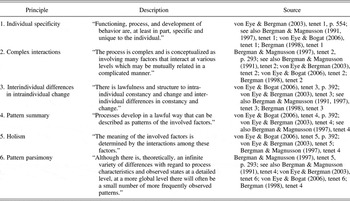
This disconcerting theory–method mismatch, together with the perception that the holistic–interactionistic perspective was “too loose and too general” (Magnusson & Torestad, Reference Magnusson and Torestad1993, p. 447), fueled an effort to distill this perspective into a concrete and unified set of core theoretical principles and to identify and explicate a set of concordant statistical methods (Bergman, Reference Bergman, Cairns, Bergman and Kagan1998, p. 84; Bergman & Magnusson, Reference Bergman, Magnusson, Magnusson, Bergman and Torestad1991, p. 324, 1997, p. 293; von Eye & Bergman, Reference von Eye and Bergman2003, p. 554; von Eye & Bogat, Reference von Eye and Bogat2006, p. 392.) These theoretical principles define person-oriented theory. Their concordant methods have been labeled person-oriented methods. The combination of both defines the person-oriented approach to developmental psychopathology research. Key principles defining person-oriented theory are given in Table 1. In brief, these principles state that development is partly individual specific (individual-specificity principle), involves complex interactions, such as Person × Person × Context × Time interactions (i.e., Colic × Gender × Depressed Mother × Time; complex-interactions principle), involves interindividual differences in intraindividual change (interindividual-differences/intraindividual-change principle), and can be summarized by patterns of variables (pattern-summary principle) that are not meaningfully reducible to their component variables (holism principle) and are few in number (pattern-parsimony principle). Methods that have been identified as person oriented include less-restrictive variable-oriented methods (e.g., latent growth curve modeling), classification methods (e.g., longitudinal cluster analysis, latent class growth modeling, latent transition modeling, latent Markov modeling, longitudinally linked configural frequency analysis), hybrid classification methods (e.g., latent growth mixture modeling, mixed latent Markov modeling), and single-subject methods (e.g., p-technique factor analysis, dynamic factor analysis; as in Bergman & Trost, Reference Bergman and Trost2006; Curran & Willoughby, Reference Curran and Willoughby2003; Curran & Wirth, Reference Curran and Wirth2004; Magnusson & Torestad, Reference Magnusson and Torestad1993; Molenaar, Reference Molenaar2004, Reference Molenaar2007; Muthén & Muthén, Reference Muthén and Muthén2000; von Eye & Bogat, Reference von Eye and Bogat2006).
Published person-oriented theoretical principles or tenets

The person-oriented approach has been gaining popularity in developmental psychopathological research (e.g., Cicchetti & Canon, Reference Cicchetti and Cannon1999; Emde & Spicer, Reference Emde and Spicer2000; Gottleib & Halpern, Reference Gottleib and Halpern2002; Sameroff & Mackenzie, Reference Sameroff and Mackenzie2003; Zahn-Waxler, Klimes-Dougan, & Slattery, Reference Zahn-Waxler, Klimes-Dougan and Slattery2000). This trend reflects the appeal of its underlying theory and methodology, and its potential for interrelating subdisciplines historically divided along variable-centric lines (e.g., neurological, social, emotional, and cognitive development). Nevertheless, the implementation of the person-oriented approach in developmental psychopathology research has been persistently hampered by two issues.
The first issue is an underappreciation of differences among person-oriented methods, which are of paramount importance when choosing an appropriate method. Methods labeled person-oriented differ with respect to which of the person-oriented theoretical principles they can empirically test and which they must assume true. In addition, no person-oriented method is compatible with all person-oriented principles. However, the similar labeling of many methods as “person-oriented” has been thought to obscure these important differences (e.g., Block, Reference Block, Bergman, Cairns, Nilsson and Nystedt2000), implicitly downplaying the informed compromises and trade-offs that must be made in selecting an appropriate method.
The second issue is a perceived blurring of the line between person-oriented theory and person-oriented methods. Certainly, the value of empirically assessing person-oriented principles, rather than taking them as de facto assumptions, has been recognized (Bergman & Trost, Reference Bergman and Trost2006, p. 604; Magnusson, Reference Magnusson, Cairns, Bergman and Kagan1998, pp. 51–52). However, person-oriented theorists have nearly exclusively promoted descriptive/heuristic person-oriented methods, which have limited ability for testing hypotheses about competing models (Bergman, Magnusson, & El Khouri, Reference Bergman, Magnusson and El-Khouri2003, p. 45), and this has served to broadly downplay the statistical testing of these principles. Consequently, there is a lack of clarity in practice regarding which person-oriented theoretical principles can be investigated, via which methods. This lack of clarity has in turn led to instances where a priori assumptions of person-oriented methods are posited as empirical hypotheses to be tested. In addition, investigators sometimes appear to confuse person-oriented theory and person-oriented methods. Bergman and Trost (Reference Bergman and Trost2006) even describe encountering the theory defined as the method: “one sometimes finds in the literature caricatures of definitions of the person-oriented approach such as ‘it is cluster analysis’ or ‘it is categorizing people.’ Statements of this kind ignore the theoretical aspects of this approach” (p. 624).
Our aim is to clarify the trade-offs and compromises that must be made by the developmental psychopathology researcher who is deciding among methods labeled person-oriented and who is seeking to test person-oriented theories. These trade-offs include (a) which and how many person-oriented principles can be empirically tested by the method, (b) what areas of model robustness are sacrificed to render these person-oriented principles testable, and (c) how the method balances risk of ecological fallacy (drawing false conclusions about individual behavior from population behavior) against risk of atomistic fallacy (drawing false conclusions about aggregate behavior from individual behavior). To do so, we consider a set of person-oriented methods. We highlight their statistical assumptions, strengths, limitations, and areas of interpretational confusion. We then review which person-oriented principles they can and cannot be used to evaluate. We use published empirical examples from developmental psychopathological research to provide concrete grounding for each method.
The set of person-oriented methods we consider minimally overlaps with prior reviews of person-oriented theory and methods geared toward developmental psychopathologists (e.g., Bergman & Magnusson, Reference Bergman and Magnusson1997; von Eye & Bergman, Reference von Eye and Bergman2003), as follows. First, prior theory/method reviews have almost exclusively covered one type of person-oriented method—classification methods—but we cast a wider net, including hybrid classification methods (newer and popular, but often misunderstood), single-subject methods (older and underused, but reemerging with more flexible software implementations), and less-restrictive variable-oriented methods (likely familiar, but not as a tool for person-oriented research). Second, prior theory/method reviews have almost exclusively considered heuristic, descriptive classification methods (e.g., K-means cluster analysis, hierarchical cluster analysis by Ward's method) rather than model-based alternatives (e.g., latent class and Markov models). Model-based methods have some unique and important strengths over descriptive/heuristic methods, such as the provision of standard errors for statistical hypothesis tests, the ability to contrast appropriateness of alternative models using overall model fit indices, and the allowance for uncertainty and measurement error that can otherwise bias statistical inference. For these reasons, model-based person-oriented methods are seeing increased interest and application in developmental psychopathology research (Bauer, Reference Bauer2007; Kaplan, Reference Kaplan2008; Muthén, Reference Muthén, Handcock and Samuelsen2007; Nagin, Reference Nagin2005; Nesselroade, Gerstorf, Hardy, & Ram, Reference Nesselroade, Gerstorf, Hardy and Ram2007). Still, it remains difficult for person-oriented theorists to adjudicate among model-based person-oriented methods because these methods have typically been presented in isolation. Even versions of these methods suitable for capturing continuous versus discontinuous change have been discussed in separate literatures (e.g., Collins & Wugatler, Reference Collins and Wugatler1992; Kaplan, Reference Kaplan2008; Muthén & Muthén, Reference Muthén and Muthén2000; Nagin, Reference Nagin2005). Hence, our review emphasizes interrelations among model-based person-oriented methods, where possible including descriptions of variants for capturing continuous and discontinuous (stage-sequential) change.
Our Keynote Article describes each method conceptually in the text with the aid of plots and diagrams. For the interested reader, accompanying model equations are presented in an online appendix (see http://www.unc.edu/~ssterba or contact the first author). Each method is identified as either being able to render a theoretical principle testable, conditionally testable, or untestable. When a principle is identified as testable or conditionally testable, the online appendix details one way in which such tests may be obtained.
Case I. Less-Restrictive Variable-Oriented Methods
Latent growth curve model (LGM)
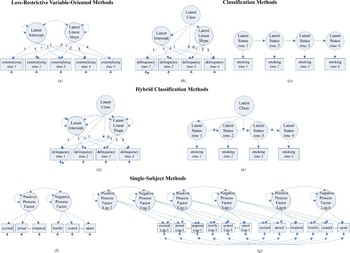
The less-restrictive variable-oriented method considered here is the LGM (Bollen & Curran, Reference Bollen and Curran2006; Meredith & Tisak, Reference Meredith and Tisak1990). It is identical to the hierarchical linear model growth curve (Willet & Sayer, Reference Willett and Sayer1994). The LGM is used to model quantitative individual differences in continuous developmental change for a population of persons. For instance, consider Gilliom and Shaw's (Reference Gilliom and Shaw2004) linear LGM for externalizing symptoms; it posited straight line growth for all children, but quantitative differences in the levels and slopes of individuals' behavioral trajectories. Figure 1a provides a path diagram of Gilliom and Shaw's (Reference Gilliom and Shaw2004) LGM of externalizing behavior at five time points (ages 2–6). Squares denote repeated measures of an observed variable (here, externalizing scale scores), which serve as indicators of one or more latent growth factors (denoted by circles). These latent growth factors represent aspects of change. The meaning of the growth factors is determined by the factor loadings (denoted by arrows connecting squares and circles), which often are not estimated, but rather fixed to specific values to determine the functional form, or “curve” of the latent trajectory. In Figure 1a, the loadings on the first latent growth factor (1, 1, 1, 1, 1) are shown to define it as the latent initial externalizing status (latent intercept), and the loadings on the second (0, 1, 2, 3, 4) are shown to define it as the latent rate of linear change in externalizing over time (latent slope).
Path diagrams of alternative model-based person-oriented methods. (b, d, e) Latent classification or chain variables can influence other model parameters (thus allowing them to be class/chain varying); only a few examples are given here. (a) Latent growth model, (b) latent class growth model, (c) latent Markov model, (d) latent growth mixture model, (e) mixed latent Markov model, (f) p-technique factor model, and (g) dynamic factor model. [A color version of this figure can be viewed online at journals.cambridge.org/dpp]

One “nonrestrictive” feature of the LGM is the fact that it allows each person to have his or her own scores on the latent intercept and latent slope factors. These individual-specific scores are not estimated directly. Instead, the mean of each factor is estimated, along with the variance of the individual-specific scores about the mean (denoted by the curved double-headed arrow attached to each circle). This feature of the LGM allows persons to vary quantitatively in their latent initial status and latent rate of change. For example, Gilliom and Shaw (Reference Gilliom and Shaw2004) found that children had an average of 1.7 externalizing symptoms at age 2 and a decreasing linear slope of −0.07. However, any individual's latent intercept score could quantitatively vary (higher/lower) around 1.7 and any individual's latent linear slope score could quantitatively vary (steeper/shallower) around −0.07. In contrast, a “restrictive” feature of the LGM is that it typically has factor loadings fixed to the same values for all persons (but see Mehta & West, Reference Mehta and West2000) and the same number of growth factors specified for all persons. This feature prevents different children from following different trajectory functions (e.g., linear vs. nonlinear).
Principles untestable with LGM
Like other variable-oriented methods, the LGM does not accord well with the pattern-summary principle and pattern-parsimony principle, as persons are allowed to vary only quantitatively, not qualitatively, in their latent initial status and latent rate of change, aside from groups defined by observed variables. Hence, these two principles are both untestable as well as inconsistent with LGM.
Principles conditionally testable using LGM
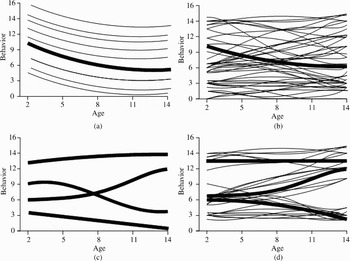
The LGM allows researchers to empirically assess the individual-specificity, complex interactions, and interindividual-differences/intraindividual-change principles to some extent. However, the interpretability of these results will be conditional on the legitimacy of disregarding the pattern-summary and pattern-parsimony principles. With respect to the individual-specificity and interindividual-differences/intraindividual-change principles, because each person has their own intercept and slope scores, the LGM can capture intraindividual change specific to each person, which is conditional on the constraint that all individuals follow the same general function of change (same factor loading pattern and same number of growth factors). In addition, because the LGM estimates the overall mean and variance of the individual-specific scores on the latent intercept and slope factors, LGM captures interindividual differences among the intraindividual trajectories. Finally, because the magnitude of these interindividual differences can be explicitly evaluated (e.g., by comparing a model that allows only interindividual differences in intercepts in Figure 2a with a model that also allows interindividual differences in slopes in Figure 2b), the LGM can be used to conditionally test some aspects of the interindividual-differences/intraindividual-change principle. Specifically, if the model in Figure 2b is preferable, this suggests that individuals change at differential rates over time, providing some support for the individual-specificity and interindividual-differences/intraindividual-change principles.
A schematic of model implied trajectories from alternative longitudinal models for continuous change. Thick black lines represent model implied mean trajectories, and thin black lines represent model implied individual trajectories. (a) A traditional variable-oriented model: a repeated measures analysis of variance (with fixed slopes and random intercept), (b) a latent growth curve model (with random intercept and random slopes), (c) a latent class growth model (with fixed intercept and fixed slope within class), and (d) a growth mixture model (with random intercept and random slope within class).

Regarding the complex-interactions principle, variable-oriented models are often described as “hav[ing] a limited capacity … for handling complex interactions” (Bergman & Magnusson, Reference Bergman and Magnusson1997, p. 298; see also Cairns, Bergman, & Kagan, Reference Cairns, Bergman and Kagan1998), leading some to advocate the use of classification methods to capture holistic patterns (e.g., Bergman, Reference Bergman2001). On this point, however, Bauer and Shanahan (Reference Bauer, Shanahan, Little, Bovaird and Card2007) noted that, to some extent, complex interactions can be recovered in variable-oriented analyses (or the less-restrictive LGMs) by including interaction terms in the fitted models. This strategy avoids the troublesome consequences of categorizing continuous predictors (MacCallum, Zhang, Preacher, & Rucker, Reference MacCallum, Zhang, Preacher and Rucker2002) and the possibility of creating groups that do not exist (Bauer & Curran, Reference Bauer and Curran2003), which have concerned methodologists implementing classification approaches (e.g., von Eye & Bergman, Reference von Eye and Bergman2003). Furthermore, it is now quite straightforward to probe and plot higher order interactions of, say, person characteristics and/or contextual characteristics with time in a LGM model in order to conditionally evaluate the complex-interactions principle (Curran, Bauer, & Willoughby, Reference Curran, Bauer and Willoughby2004; Preacher, Curran, & Bauer, Reference Preacher, Curran and Bauer2006). For example, Gilliom and Shaw (Reference Gilliom and Shaw2004) consider four-way interactions of child negative emotionality, fearfulness, maternal negative control, and time. They found that when children had a combination of high negative emotionality, low fearfulness, and high negative maternal control, their latent externalizing linear slopes were stably elevated from age 2 to 6, rather than decreasing. Nevertheless, the interpretation of such interactions obviously becomes more difficult as the number of variables involved increases (e.g., four-, or five-way interactions).
Principles with limited testability using LGM
In practice, the LGM is used almost exclusively to study univariately defined trajectories (i.e., on a single outcome). According to the holism principle, the “externalizing” variable from Gilliom and Shaw (Reference Gilliom and Shaw2004) is not meaningful once abstracted from the integrated constellation of variables that function together within the individual. The holism principle demands a multivariate approach. To close this gap somewhat, multiple univariate LGMs can be specified for different behaviors and interrelated in the same model (called parallel-process LGM; for extensions, see Bollen & Curran, Reference Bollen and Curran2004). The interdependency aspect of the holism principle (Magnusson & Torestad, Reference Magnusson and Torestad1993, p. 438) can be evaluated by testing whether intercepts and slopes of each process correlate. The reciprocity aspect of the holism principle (Magnusson & Torestad, Reference Magnusson and Torestad1993, p. 438) can be evaluated by testing whether instead intercepts of one process predict slopes of the other. For example, Gilliom and Shaw (Reference Gilliom and Shaw2004) specified an LGM for externalizing and anothor univariate LGM for internalizing in the same model, and then tested whether the slope and intercept of one behavior predicted the slope and intercept of the other. For an example of three parallel processes, see Troop-Gordon and Ladd (Reference Troop-Gordon and Ladd2005). More than four or five parallel processes might often become difficult to estimate, however. Note that simply partialling out the variance associated with time-invariant or time-varying covariates from a univariate LGM does not test the holism principle because doing so would not capture its “moving bidirectional system” in which one process “serves as stimuli for the other but also changes as a result of the stimuli exchanges” (Magnusson & Torestad, Reference Magnusson and Torestad1993, p. 438).
LGM: Trade-offs/compromises
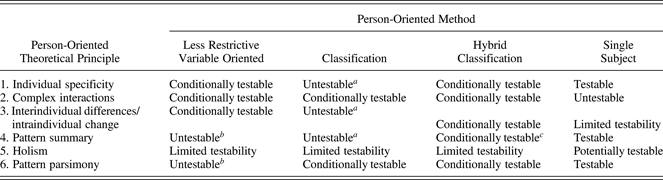
As summarized in Table 2, LGM is only able to test three person-oriented principles, and the interpretability of these tests is conditional on the legitimacy of a priori dismissing two other principles. However, LGMs are robust to a number of commonly violated distributional assumptions for the repeated measures and latent factors (see Bollen & Curran, Reference Bollen and Curran2006; Muthén & Asparouhov, Reference Muthén, Asparouhov, Fitzmaurice, Davidian, Verbeke and Molenberghs2006). Of the models considered in this article, LGM poses the least risk of atomistic fallacy (estimates of population parameters are based on data from all individuals) but most risk of ecological fallacy (some, but not all, aspects of change held equal across individuals). Promising new methods of detecting model fit or misfit for each individual (see Coffman & Millsap, Reference Coffman and Millsap2006) and for detecting individual heterogeneity in factor loadings (Kelderman & Molenaar, Reference Kelderman and Molanaar2007) can, however, help alleviate concerns about committing an ecological fallacy.
Synopsis of match and mismatch between person-oriented theory and model-based person-oriented methods
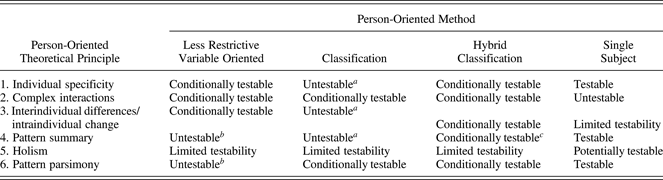
aThese principles are untestable and conditionally consistent or consistent with the method.
bThese principles are untestable and inconsistent with the method.
cIn the growth modeling but not Markov modeling framework.
Case II. Classification Methods
We consider one classification method for continuous change and one for discontinuous change.
Latent class growth analysis (LCGA)
The first classification method considered here, LCGA (Muthén, Reference Muthén, Marcoulides and Schumacker2001; Nagin, Reference Nagin1999, Reference Nagin2005; Nagin & Land, Reference Nagin and Land1993), is used to model qualitative individual differences in continuous developmental change, for a population of persons. The conventional LGM accounts for associations among a repeatedly measured variable using a single population-level trajectory that varies quantitatively across persons, but LCGA accounts for the same associations among repeated measures using multiple class-specific trajectories that differ qualitatively between class but do not differ quantitatively within class, apart from random noise. This is illustrated in Figure 2c, where LCGA is shown to capture systematic associations among repeated measures using between-class mean differences in level and slope, but not systematic with-class variability in level and slope (Bauer & Curran, Reference Bauer and Curran2003, Reference Bauer and Curran2004). For example, Reinecke (Reference Reinecke2006) used a LCGA to evaluate trajectories of delinquency across four time points (7th–10th grade) and identified three trajectories: none (60%), low with slow linear increase (32%), and high with rapid linear increase (8%). Reinecke's (2006) LCGA is presented via path diagram in Figure 1b. The dotted circle denotes the latent classification variable that sorts children into class-specific delinquency trajectories. Arrows extending from the dotted circle point to what can vary over class to give classes qualitatively different trajectory shapes (e.g., factor loadings, means of latent intercept and slope factors, and within-occasion residual variances). Notably, the absence of the curved arrows that were in Figure 1a indicates the lack of systematic, quantitative variability among individuals' latent delinquency intercept and slope scores, within class.
Latent Markov model
The LCGA is used to model qualitative differences in continuous developmental change, but the second classification method considered here, the latent Markov model (Langeheine & van de Pol, Reference Langeheine and van de Pol1990; Wiggins, Reference Wiggins1973), is used to model qualitative individual differences in discontinuous, stage-sequential developmental change for a population of persons.Footnote 1 In the latent Markov model, an observed repeated measure (that is usually categorical, but see Schmittmann, Dolan, van der Maas, & Neale, Reference Schmittmann, Dolan, van der Maas and Neale2005) serves as an indicator of a latent classification variable at each of several time points. For example, consider the path diagram of Mannan and Koval's (Reference Mannan and Koval2003) latent Markov model for investigating alternative sequential patterns of adolescent smoking behavior; it is depicted in Figure 1c. The squares denote the repeated measure of self-reported smoking behavior, which was polytomous (four observed categories: never, irregular, quit, regular) and was administered at four time points (Grades 6, 8, 10, and 12). The dotted circles denote a latent classification variable at each time point; each of these latent classification variables has four latent statuses (never, irregular, quit, regular). Mannan and Koval (Reference Mannan and Koval2003) found that, initially (i.e., at grade 6) 69% of students were in the never latent status, 24% were in the irregular latent status, 6% were in the quit latent status, and 1% were in the regular latent status. The arrows linking the squares and the dotted circles denote conditional response probabilities of self-reporting a particular smoking category given membership in a particular true/latent smoking status (important because adolescents appreciably underreport smoking; Mannan & Koval, Reference Mannan and Koval2003). These conditional response probabilities are held to be the same over time to identify the model. Regressing the latent classification variable at time t − 1 on the latent classification variable at time t allows persons to change/transition latent status membership over time. This forms a longitudinal sequence of latent statuses (e.g., never latent status at Grade 6, irregular latent status at Grade 8, irregular latent status at Grade 10, regular latent status at Grade 12). Mannan and Koval's (Reference Mannan and Koval2003) four latent statuses at each of four time points yield 256 potential sequences (e.g., never–never–never–never or irregular–irregular–regular–regular). They found that progressive sequences from irregular to regular and quit to regular were increasingly common through 10th grade, and that the longer students remained in the regular status, the less likely they were to transition out (also known as canalization of a developmental pathway). The fact that the latent classification variables are regressed on each other (instead of having the observed repeated measures regressed on each other) allows the transition probabilities between latent statuses to be measurement error free.
Principles untestable with classification methods
The LCGA and latent Markov model cannot test the pattern-summary principle. If there are associations among observed repeated measures, LCGA can only account for these associations via the estimation of multiple trajectory classes, even if in the real world, there is quantitative variation (growth factors) not qualitative variation (growth classes) in trajectories (Bauer, Reference Bauer2007; Bauer & Curran, Reference Bauer and Curran2004). In addition, if there are associations among observed repeated measures, the latent Markov model can only account for these associations via the estimation of multiple statuses/time point even if in the real world there is quantitative variation at each time point (latent continuum) not qualitative variation at each time point (latent discrete statuses). Hence, classes/statuses may or may not reflect qualitatively distinct subgroups. The interpretation of classes/statuses as real-world qualitative population subgroups is an additional assumption imposed by the analyst.Footnote 2 Confusion arises in practice because researchers often inadvertently imply that classification methods can affirm the pattern-summary principle. For example, Nurious and Macy (Reference Nurious and Macy2008) initially state that “person-oriented research is based on the premise that meaningful subgroups exist” (p. 393), and then go on to review classification studies extracting K = 3 or 4 classes, claiming that “collectively, these results illuminate … the existence of distinct subgroups …” (p. 403). Ratelle, Guay, Vallerand, Larose, and Senecal (Reference Ratelle, Guay, Vallerand, Larose and Senecal2007) state that their “first goal was to discover various motivational profiles that are naturally occurring among samples of college and high school students. The terminology naturally occurring is important here because it echoes a person-oriented approach in which the central goal is to identify the existing profiles by allowing them to emerge instead of forcing them through a priori categories (e.g., median split)” (pp. 734–735). To clarify, classification methods cannot be used to illuminate the existence, to discover, or to allow the emergence of qualitative population subgroups because classification methods extract classes/statuses irrespective of whether variation is truly qualitative or quantitative in the population.
Classification methods also cannot be used to directly test the individual-specificity and interindividual-differences/intraindividual-change principles. Classification methods include no systematic individual-specific components to development, only class/status-specific components, and permit no interindividual variability in intraindividual change, only interclass/status variability in intraclass/status change. In the LCGA this is because the model assumes that all persons within class homogeneously follow the same class trajectory and that within class persons' scores differ only due to random noise, not systematically. Similarly, in the latent Markov model transition probabilities from one latent status to another are allowed to vary only between statuses, over time, not within status, over persons (Langeheine, Reference Langeheine, Eye and Clogg1994). That is, all persons in the never–irregular–irregular–irregular–regular sequence are given the same probability of transitioning from an irregular to regular status from 10th to 12th grade, regardless of their current stressful life events or peer group pressures. Transition probabilities are only allowed to differ between, for example, the never–never–never–never smoking sequence and the never–irregular–irregular–regular smoking sequence. It is also equivalent to state that the latent Markov model assumes persons are interchangeable within status, and therefore within sequence. Furthermore, it is sometimes argued that, if the pattern-summary principle is entirely upheld/valid, then classification models are conditionally consistent with individual-specificity and interindividual differences/intraindividual change, even though no truly individual-specific or individually varying parameters are estimated (e.g., Cairns et al., Reference Cairns, Bergman and Kagan1998). That is, it is argued that classes/statuses are sufficient to summarize individual members (e.g., high entropy), while still doing justice to individual differences (as represented exclusively by between-class/status differences).
Principles conditionally testable using classification methods
Consequently, the pattern-parsimony principle can only be conditionally assessed, under the assumption that the pattern-summary principle is true. That is, in the LCGM, if the trajectory classes used as a statistical device to explain associations among repeated measures do represent qualitatively different population subgroups (i.e., if the pattern-summary principle is true), then we can meaningfully test whether there are few versus many of these real-world trajectory classes (pattern-parsimony principle). In the Markov framework, we typically would only similarly test the pattern-parsimony principle if we have multiple indicators of latent status per time point (not just one indicator, as in Mannan & Koval, Reference Mannan and Koval2003).Footnote 3
In addition, the complex-interactions principle can only be conditionally assessed, under the assumption that the pattern-summary principle is true. Under this assumption, we can then meaningfully interpret interactions that are captured as changes in the prevalence of LCGM trajectory classes as a function of predictor values. We can also meaningfully interpret interactions that are captured as changes in latent Markov transition probabilities as a function of predictor values (see Nylund, Reference Nylund2007). Moreover, we can do so without having to correctly specify a particular functional form of the relationship between predictors and the repeated measure (as in the LGM). We recommend that when using classification methods researchers explicitly state that they are testing the pattern-parsimony and complex-interactions principles conditional on the assumption that pattern summary is true.Footnote 4
Two important caveats are in order. First, although the pattern-parsimony principle is technically conditionally testable using classification methods, typically, a small number of latent classes/statuses (e.g., three to seven) is all that the LCGM or multiple-indicator latent Markov model can support (Bauer & Curran, Reference Bauer and Curran2004), eroding the falsifiability of this principle. Second, although one of the advantages of classification methods is the intuitive and accessible interpretation of potentially nonlinear, potentially complex interactions, in line with the complex-interactions principle, this advantage is unfortunately not capitalized on to a great extent in many applications. Often few (e.g., Reinecke, Reference Reinecke2006) or no (e.g., Mannan & Koval, Reference Mannan and Koval2003) predictors and only lower order interactions are included. With only a few predictors, and only lower order interactions, an LGM might just as easily capture the effects as an LCGA, without having to categorize persons and risk creating artificial groupings. For example, Reinecke (Reference Reinecke2006) regressed gender and educational level on their LCGA latent classification variable and found that male adolescents with low education were more likely to be in the high delinquency trajectory and female adolescents were more likely to be in the nonoffending trajectory. These same conclusions have been obtained from a LGM (e.g., Windle, Reference Windle2000).
Principles with limited testability using classification methods
The standard LCGA and standard latent Markov model do not allow investigation of the holism principle because they identify only univariately defined sequences or trajectories. However, parallel-process LCGAs or latent Markov models could be specified for multiple behaviors, and interrelated, to somewhat, but not fully, minimize this theory–method mismatch (see Flaherty, Reference Flaherty2008; Nagin & Tremblay, Reference Nagin and Tremblay2001; and online appendix). If the conditional probability of membership in LCGA trajectory class k on one behavior given membership in trajectory class j on the other behavior was greater than chance, or if sequential transition probabilities for one behavior varied across current status membership on the other behavior, we would have evidence supporting the reciprocity aspect of the holism principle.
Classification methods: Trade-offs/compromises
Of all the methods discussed here, classification methods are most widely associated with the label person-oriented method (Bergman & Trost, Reference Bergman and Trost2006). Thus, it is notable that even these methods are unable to test some person-oriented principles. As recapped in Table 2, the classification methods reviewed here can conditionally test two principles (given that the pattern-summary principle is true) and can provide limited testing of one principle (holism) but cannot test the other three principles. Note also that the number and prevalence of extracted classes/statuses are not robust to a number of commonly encountered data conditions (see Eggleston, Laub, & Sampson, Reference Eggleston, Laub and Sampson2004; Jackson & Sher, 2008).
Conclusions from classification methods do not pose much risk of atomistic fallacy because classification methods are typically not used to make conclusions about the aggregate population. However, they do pose some risk of ecological fallacy when generalizing from the class level to the individual level (particularly given the aforementioned difficulties falsifying the pattern-parsimony principle). It can be tempting to downplay the risk of committing an ecological fallacy on substantive grounds with classes being a “good enough” depiction of development for a particular application area. Yet, this reasoning merits caution because it is seldom based on empirical evidence.
Case III. Hybrid Classification Methods
Thus far, we have seen that the conventional LGM assumes that all individuals have the same trajectory functional form (factor loadings) and the same number of growth factors. These assumptions constrict our ability to empirically assess the individual-specificity and interindividual-differences/intraindividual-change principles. We have also seen that the classification modeling assumption that individuals are interchangeable within class constricts our ability to empirically assess person-oriented principles individual specificity and interindividual differences/intraindividual change. The hybrid models considered here—growth mixture models (GMMs; for continuous change) and mixed latent Markov models (for discontinuous change)—relax these two assumptions.
GMMs
For continuous longitudinal change, a GMM (Muthén & Shedden, Reference Muthén and Shedden1999; Verbeke & Lessafre, Reference Verbeke and Lesaffre1996) is obtained either by relaxing the LGM assumption that all variation in individual trajectories is quantitative, or by relaxing the LCGA assumption that all variation is qualitative. For instance, Reinecke (Reference Reinecke2006) converted the LCGA in Figure 1b into a GMM in Figure 1d by estimating individual variability for the latent delinquency intercept and latent delinquency slope factor within-class. This is denoted in Figure 1d by the addition of curved arrows to the latent intercept and latent slope factors. This difference between the LGM, LCGA, and GMM is also illustrated by comparing Figure 1a, 1b, and 1d. Figure 2d illustrates that the GMM allows associations among repeated measures to reflect a qualitative mixture of latent classes with different functional forms (e.g., an early-onset/decreasing class, an elevated-stable class, and an adolescent-limited class). GMM also allows each trajectory class to be heterogeneous, such that growth parameters (rate or magnitude of change) vary quantitatively across persons within each class.
Mixed latent Markov models
The mixed latent Markov model (e.g., Langeheine & van de Pol, Reference Langeheine and van de Pol1990) relaxes the assumption of standard latent Markov models that individuals are interchangeable within a latent sequence. It does so by allowing the probability of transitioning from one latent status to another to vary, not only over time, but also over latent person-groups, called chains (pending identification restrictions). For instance, Mannan and Koval (Reference Mannan and Koval2003) extended their latent Markov model into a mixed latent Markov model with two chains: a high-risk chain and a low-risk chain. The dotted circle in Figure 1e denotes the latent classification variable that sorts persons into latent chains, and the arrows extending from the dotted circle denote that the initial (Grade 6) latent status probabilities as well as the transition probabilities are allowed to vary across latent chain (pending identification restrictions). One can think of Mannan and Koval's (Reference Mannan and Koval2003) mixed latent Markov model as having a low-risk chain with 256 potential sequences and a high-risk chain with 256 potential sequences, or one can think of their mixed latent Markov model as having only 256 potential sequences, each with two chains. Under the latter conceptualization, there is within-sequence heterogeneity in initial status and in transition probabilities. That is, it is within-sequence, and there are interchain differences in intrachain change. Mannan and Koval (Reference Mannan and Koval2003) also considered further restrictions on transition probabilities for the mixed latent Markov model (e.g., no backward transitions, nonzero transitions for one chain only), which are often needed, particularly when there are few measurement occasions (see Langeheine & van de Pol, Reference Langeheine and van de Pol1990).
Principles conditionally testable using hybrid classification methods
Of the methods reviewed thus far, hybrid methods allow empirical assessment of the widest range of person-oriented principles, but some issues will be raised shortly about how successfully. The pattern-summary principle can be empirically assessed with GMM by comparing the fit of a GMM to a LGM, to discern whether classification of individuals is really necessary (e.g., Hirsh-Pasek & Burchinal, Reference Hirsh-Pasek and Burchinal2006; Sterba, Prinstein, & Cox, Reference Sterba, Prinstein and Cox2007). The pattern-parsimony principle can be empirically assessed with the GMM (and mixed latent Markov model, but typically this is only done if there are multiple indicators per time point). This assessment would involve determining whether the best-fitting number of trajectory classes (or statuses per chain) is equal to or less than a predefined “small” number.
Assuming that the pattern-summary principle is upheld, the individual-specificity principle is conditionally testable in a growth modeling framework by comparing the fit of models that require within-class homogeneity (LCGA) and models that allow systematic within-class heterogeneity across individuals (GMM; as done by Reinecke, Reference Reinecke2006). In addition, under the same assumption, the individual-specificity principle is conditionally testable within a Markov modeling framework by comparing the fit of models that require within-class homogeneity (latent Markov) versus models that allow within-class heterogeneity across chains (mixed latent Markov; as done by Mannan & Koval, Reference Mannan and Koval2003). Moreover, compared to, say, the LGM, hybrid methods considerably relax the a priori assumptions that must be met to test the individual-specificity principle. To illustrate, in the GMM, tests of individual specificity are conditional on persons within class k, not all persons, having the same trajectory functional form and number of growth factors. Likewise, in the mixed latent Markov model, tests of individual specificity are conditional on the assumption that persons within a particular chain, not all persons, have the same initial status and transition probabilities. Again, assuming that the pattern-summary principle is upheld, the interindividual-differences/intraindividual-change principle can be empirically assessed, within the Markov framework, by testing whether transition probabilities vary across chain or, within a growth modeling framework, by testing whether slope growth factors have significant variances within class. Finally, the complex-interactions principle would be conditionally testable in the hybrid classification models for the same reasons as discussed under classification models.
The results of such hypothesis testing regarding the interindividual-differences/intraindividual-change, individual-specificity, pattern-summary, pattern-parsimony, and complex-interactions principles may, however, be misleading in hybrid models because these models are particularly vulnerable to specification errors in ways that impinge on the ability to test these hypotheses. One difficulty is that hybrid classification models allow both within-class/chain variation and between-class/chain variation to reproduce the associations among the repeated measures—sometimes statistically equivalently (Bartholomew & Knott, Reference Bartholomew and Knott1999; Bauer & Curran, Reference Bauer and Curran2004; Horn, Reference Horn2000; Molenaar & von Eye, Reference Molenaar, von Eye, Eye and Clogg1994). In the Markov framework, this means that it is difficult to distinguish, on purely statistical grounds, whether (a) transition probabilities vary across time but not across chains, (b) transition probabilities vary across chains, but not across time, or (c) transition probabilities differ across both time and chains, (providing there are enough time points and/or indicators to even allow all of these sources of variability; Collins, Hyatt, & Graham, Reference Collins, Hyatt, Graham, Little, Schnabel and Baumert2000). Similarly, in the latent growth framework, this means that it is difficult to distinguish, on purely statistical grounds, whether a model with (a) more growth factors within class but fewer classes or (b) fewer growth factors within class but more classes is most realistic (Bauer & Curran, Reference Bauer and Curran2003). Moreover, the GMM may fit better than the LCM for reasons having nothing to do with the underlying latent structure: that is, simply because classes better account for skew/kurtosis of repeated measures than do factors (Bauer & Curran, Reference Bauer and Curran2004; Lubke & Neale, Reference Lubke and Neale2006). In sum, whereas the LGM decomposes the associations among repeated measures to highlight relations among variables (and assumes no classes), the LCGA decomposes the same associations to highlight the relations among persons (and assumes no factors). The GMM attempts to do both simultaneously, which renders it nonrobust to a number of assumption violations. For example, in the GMM, if a researcher misspecifies the growth model within class k, the model may, unbeknownst to the researcher, compensate for this by overextracting spurious additional latent classes (Bauer, Reference Bauer2007; Bauer & Curran, Reference Bauer and Curran2003, Reference Bauer and Curran2004; Lubke & Neale, Reference Lubke and Neale2006). This can lead to recovery of spurious Person × Context × Time interactions (Bauer & Curran, Reference Bauer and Curran2003), limiting empirical evaluation of the complex-interactions principle.
For these reasons it is undesirable for authors to explicitly state (e.g., Keller, Spieker, & Gilchrist, Reference Keller, Spieker and Gilchrist2005; Schaeffer, Petras, Ialongo, Poduska, & Kellam, Reference Schaeffer, Petras, Ialongo, Poduska and Kellam2003, or otherwise imply, e.g., Mun, Windle, & Schainker, Reference Mun, Windle and Schainker2008; Sterba et al., Reference Sterba, Prinstein and Cox2007) that finding more than one GMM class constitutes direct evidence of unobserved population subgroups. Finding more than one GMM class only constitutes statistical evidence that a mixture distribution for the repeated measures is preferable to a (usually) normal distribution. The researcher then chooses whether or not to overlay the additional assumption that the classes represent unobserved population subgroups (Bauer, Reference Bauer2007). To clear up this confusion, we recommend that researchers using hybrid methods explicitly state that the empirical assessment of the aforementioned principles is conditional on this additional assumption.
Principles with limited testability using hybrid classification methods
Standard hybrid methods also cannot fully test the holism principle for the same reasons as were discussed in the classification methods section. However, the same modeling extensions that were described in the classification methods section, can better approximate it.
Compromises and trade-offs: Hybrid classification methods
As summarized in Table 2, the hybrid methods reviewed here allow conditional testing of five principles—if additional assumptions are invoked, including that extracted classes truly represent population subgroups—and allow limited testing of the sixth principle. As discussed above, however, these hybrid models are not robust to specification errors, and so these tests require cautious interpretation, sensitivity analyses (to examine the effects of minor model modifications on extracted classes), and external validation (Bauer & Curran, Reference Bauer and Curran2004).
Of the models considered thus far, hybrid methods pose least risk of ecological fallacy. For example, GMM holds fewer parameters equal across all persons than the LGM and holds fewer parameters equal across class members than the LCGA. Hybrid methods also pose little risk of atomistic fallacy, as they are not typically used to draw population-level conclusions.
Case IV. Single-Subject Methods
Methods considered thus far have all assumed that some aspects of a longitudinal behavioral course, such as the number of latent growth factors or the probability of transitioning from a particular latent status to another, are descriptive of all individuals (for LGM and latent Markov models) or some individuals (for LCGA, GMM, and mixed latent Markov models). Moreover, standard versions of methods considered thus far (latent growth curve, LCGA, GMM, latent Markov, and mixed latent Markov) have only been able to define longitudinal stability and change univariately (i.e., on a single, behavioral outcome such as externalizing, delinquency, or smoking). Single-subject methods such as dynamic factor analysis (Molenaar, Reference Molenaar1985) or p-technique factor analysis (Cattell, Cattell, & Rhymer, Reference Cattell, Cattell and Rhymer1947), relax these assumptions. They allow the description of a continuous, longitudinal etiologic process to be completely tailored to a particular individual. They exclusively capture intraindividual etiologic processes, and they can define these processes multivariately, not simply univariately.
However, achieving these objectives requires a fundamentally different kind of data set than was employed in methods discussed thus far. Data sets used for the methods discussed thus far (growth modeling or Markov modeling) included several occasions, many individuals, and one dependent variable. For these methods, the data matrix is composed of individuals (rows) × occasions (columns), for a single dependent variable. Data sets used for dynamic factor analysis and p-technique, in contrast, include many occasions, many dependent variables, and one individual (i.e., a multivariate time series). Consider, for example, Shifren, Hooker, Wood, and Nesselroade's (Reference Shifren, Hooker, Wood and Nesselroade1997) data set, which included 71 occasions of measurement and 20 dependent variables from the Positive and Negative Affect Schedule (PANAS) measured on one individual (i.e., upset, afraid, nervous, hostile, ashamed, distress, irritable, scared, guilty, jittery, interest, inspired, proud, alert, active, determined, attentive, enthusiastic, strong, and excited). To implement dynamic factor analysis and p-technique models, they arranged their data matrix with 71 occasions as rows × 20 variables as columns for that single individual. Whereas cross-sectional factor analyses of the PANAS scale (e.g., Watson, Clark, & Tellegen, Reference Watson, Clark and Tellegen1988) have previously found that two factors well explain within-time across-persons associations in PANAS symptoms, Shifren et al. wanted instead to find out what factor structure explains across-time within-person associations in PANAS symptoms.
Next, we discuss how single-subject methods capture longitudinal behavioral processes within individual and how they define such processes multivariately. Single-subject methods summarize the regularity of an individual's longitudinal series of observed repeated measures using what are termed latent process factors. These process factors explain the across-occasion associations among observed repeated measures, within a single person. Specifying one process factor to account for the single person's PANAS repeated measures effectively posits a unidimensional emotion liability, and specifying more than one factor effectively posits a multidimensional emotion liability (e.g., a positive process and a negative process as shown in Figure 1f). By comparing alternative models with less or more process factors, we can test how many underlying dimensions are needed to explain interoccasion symptom associations for that particular person. Because the process factors in Figure 1f are each defined by 10, not 1, measured variables, the person's longitudinal behavioral process is defined multivariately, not univariately. Comparatively, note that whereas conventional factor models for data on many persons at one time point assume that the same number of factors holds across individuals (i.e., interindividually) within time, these single-subject methods (dynamic factor, p-technique) assume that the same number of process factors holds across time (i.e., interoccasionally) within person.
Dynamic factor analysis
The p-technique factor model in Figure 1f is critically limited in that it does not account for the fact that the single person's time series of internalizing symptoms is time ordered, and thus may have serial dependencies. For example, if a person's positive emotion process factor had a high score at time t – 1 because he/she was strongly feeling inspired, proud, and excited because of getting accepted into graduate school, he/she may also tend to have a high positive emotion process factor score at time t because some of those feelings are likely to linger into the next day. Dynamic factor models expand upon the p-technique factor model in Figure 1f to account for such serial dependencies. There are several ways that dynamic factor models can account for serial dependencies (Nesselroade, McArdle, Aggen, & Meyers, Reference Nesselroade, McArdle, Aggen, Meyers, Moskowitz and Hershberger2002); we describe and illustrate one in Figure 1g. First, lagged versions of the dependent variables are created—here lagged symptoms, for example, lag-1 irritable, lag-1 enthusiastic (see Wood & Brown, Reference Wood and Brown1994). Then, to account for serial dependencies, lag-0 measured variables load on lag-0 and lag-1-positive and -negative emotion process factors, and lag-1 measured variables load on lag-1 and lag-2 process factors. Error terms associated with corresponding lag-0 and lag-1 measured variables are allowed to correlate, as shown in Figure 1g (Hershberger, Reference Hershberger and Marcoulides1998). By comparing alternative models with and without lagged factors/symptoms, we can tell whether there is any meaningful serial dependency, that is, whether the process factors are dynamic. For didactic implementations, see Hershberger (Reference Hershberger and Marcoulides1998), Nesselroade et al. (Reference Nesselroade, McArdle, Aggen, Meyers, Moskowitz and Hershberger2002), Wood and Brown (Reference Wood and Brown1994), and Zhang (Reference Zhang2006).
Principles testable using single-subject methods
Single-subject methods such as dynamic factor analysis and p-technique factor analysis would seem to be the quintessential person-oriented methods. An advantage of single-subject methods for person-oriented research is that they do not assume the individual-specificity principle, pattern-summary principle, pattern-parsimony principle, or holism principle to be true or false a priori, but instead allow them to be empirically evaluated. Evaluation of the holism principle is possible if a researcher has access to multivariate time series data for one person. However, procedures for doing so have not yet been formalized, perhaps because of the underutilization of single-subject methods for person-oriented research. Evaluation of the individual-specificity, pattern-summary, and pattern-parsimony principles, described below, requires access to multivariate time series data for more than one person, such as for 12 persons, in Shifren et al. (Reference Shifren, Hooker, Wood and Nesselroade1997).
To test the pattern-summary and pattern-parsimony principles, first, a separate dynamic factor model would be fit to each of several persons' time series data. Shifren et al. (Reference Shifren, Hooker, Wood and Nesselroade1997) fit this model to 5 of the 12 persons' data. (Shifren et al. found that the other 7 persons had essentially no variability in their scores on the PANAS symptoms, thus preventing estimation of process factors to explain interoccasion variability.) Second, conventional tests for measurement invariance would be conducted to compare these persons' models, for instance, to determine if the number and nature of process factors is the same for Person 1 as for Persons 2, 3, and so forth. More specifically, the same series of measurement invariance tests that are typically used to compare conventional factor models across levels of a variable (e.g., male vs. female) for many persons can be used to compare dynamic factor models across individuals (Person 1 vs. Person 2) for many time points (see Borsboom & Dolan, Reference Borsboom and Dolan2007; and online appendix). In doing so, Shifren et al. (Reference Shifren, Hooker, Wood and Nesselroade1997) found that a two-factor lag-1 model (as in Figure 2g) fit best for two persons, a one-factor lag-1 model (not shown in Figure 2) fit best for two persons, and a two-factor lag-0 model (as in Figure 2f) fit best for the last person. Within the pairs of people having same best-fitting model model, a similar pattern of significant factor loadings was found; however, the magnitude of the loadings differed somewhat. If Shifren et al. (Reference Shifren, Hooker, Wood and Nesselroade1997) had found full measurement invariance across these five persons, this would have suggested that the within-individual longitudinal affect processes are similar across individuals (called poolability). See Nesselroade and Molenaar (Reference Nesselroade, Molenaar and Hoyle1999) and Chow, Nesselroade, Shifren, and McArdle (Reference Chow, Nesselroade, Shifren and McArdle2004) for details concerning poolability and Browne and Zhang (Reference Browne and Zhang2005) for implementation. The pattern-summary principle would be supported to the extent that groups of persons share the same best-fitting dynamic factor model (i.e., the same number of process factors and similar loadings of symptoms on process factors). This principle was minimally upheld in Shifren et al. (Reference Shifren, Hooker, Wood and Nesselroade1997), because groups of two persons shared the same best-fitting model. The pattern-parsimony principle would be supported to the extent that the number of groups yielding fundamentally different best-fitting dynamic-factor models is small. This principle was not upheld in Shifren et al. (Reference Shifren, Hooker, Wood and Nesselroade1997), because three different varieties of best-fitting models were found among five persons. The individual-specificity principle would be supported to the extent that some parameters (e.g., the within-lag covariance between positive and negative process factors) still vary within subgroups sharing same best-fitting model and/or some persons have unique best-fitting models. This principle was upheld in Shifren et al. (Reference Shifren, Hooker, Wood and Nesselroade1997) because one person had a unique best-fitting model.
Principles untestable with single-subject methods
Drawbacks of these single-subject methods for person-oriented developmental research are that empirical evaluation of the complex-interactions principle and interindividual-differences/intraindividual-change principle are still difficult. Regarding the complex-interactions principle, investigation of Person × Context × Time interactions is probably most easily accomplished once time series data is pooled across multiple persons. In a dynamic factor analysis or p-technique analysis for a single person, incorporating time-invariant person, or context, or Person × Context predictors of process factors would not be helpful because they would just be constant values for that one person, and incorporating time-variant person, or context, or Person × Context predictors of process factors would only be useful for explaining interoccasion variability.
In addition, the interindividual-differences/intraindividual-change principle is difficult to assess using the standard dynamic factor analysis model (or p-technique model) because these models assume no systematic intraindividual change, growth, or development in means, variances, or covariances of measured variables (called stationarity; Jones, Reference Jones, Collins and Horn1991; Nesselroade & Molenaar, Reference Nesselroade, Molenaar, Valsiner and Connolly2003), and any such trends are typically removed prior to model fitting. However, mean trends can now be incorporated into the dynamic factor analysis model following Molenaar, de Gooijer, and Schmitz, (Reference Molenaar, de Gooijer and Schmitz1992), for example, using the implementation in Hershberger (Reference Hershberger and Marcoulides1998; also see online appendix). Still, nonstationarity in variances and covariances of measured variables is not easily relaxed (Molenaar, Reference Molenaar, Eye and Clogg1994). Past implementations of dynamic factor analysis used mainly short-term intensive longitudinal designs (often hourly or daily rather than weekly, monthly, or yearly), which decreased the likelihood of finding marked developmental trends in mean behavior across occasions. Hopefully, the burgeoning interest in all sorts of intensive longitudinal designs and daily diary studies among developmentalists (e.g., Walls & Schafer, Reference Walls and Schafer2006) will fuel further advances in dynamic factor analysis theory and software to relax some of these remaining strict assumptions.
Single-subject methods: Trade-offs/compromises
As summarized in Table 2, dynamic factor analysis tests four person-oriented principles but has difficulty handling the other two. Adopting single-subject methods and, for example, finding support for the holism or individual-specificity principles, can serve as a potent wake-up call regarding the dangers of using methods that define an etiologic process univariately or methods that automatically assume between-individual differences and within-individual differences have interchangeable meaning. However, it can be difficult to know what next steps to take when little aggregation is warranted according to strict measurement invariance testing criteria (e.g., Curran & Wirth, Reference Curran and Wirth2004; Nesselroade et al., Reference Nesselroade, Gerstorf, Hardy and Ram2007; and Commentaries). Researchers are currently conducting robustness studies to understand the consequences of pooling dynamic factor models that are only partially invariant across persons (Nesselroade et al., Reference Nesselroade, Gerstorf, Hardy and Ram2007). Of the models considered in this article, the single-subject methods, together with tests for poolability when time series for multiple persons are available, pose no risk of ecological fallacy and also little risk of atomistic fallacy.
Conclusions
The person-oriented approach is becoming increasingly influential in developmental psychopathological research (e.g., Cicchetti & Canon, Reference Cicchetti and Cannon1999; Emde & Spicer, Reference Emde and Spicer2000; Gottleib & Halpern, Reference Gottleib and Halpern2002; Sameroff & Mackenzie, Reference Sameroff and Mackenzie2003). Researchers have been advised that “it is often more natural to employ person-oriented methods if a person-oriented perspective is believed to be valid” (von Eye & Bergman, Reference von Eye and Bergman2003, p. 578). Accordingly, person-oriented methods, particularly model-based varieties, are seeing increasing use in developmental psychopathology research (e.g., Bauer, Reference Bauer2007; Kaplan, Reference Kaplan2008). However, there is a considerable gap between the breadth of person-oriented methods available, and those actually used in empirical applications. For example, a brief review of articles that reported using person-oriented methods and were published in Development and Psychopathology over the past 10 years indicated that classification-type methods were used in the vast majority of cases. Specifically, 12% of these articles used less restrictive variable-oriented methods, 85% used model-based or heuristic classification or hybrid classification methods, and 3% used single-subject methods. We submit that the overwhelming dominance of classification-type methods has more to do with their frequent linkage to person-oriented theory in prior reviews and less to do with their carefully weighed suitability in each application. Typically, applications did not provide a rationale for (a) why the selected person-oriented method was chosen over other person-oriented methods, (b) whether or how the selected person-oriented method enabled testing relevant aspects of person-oriented theory, or (c) what the assumptions or statistical vulnerabilities of the selected person-oriented method were.
In response, our review showed that methods labeled person-oriented differ widely in the person-oriented theoretical principles that they can and cannot empirically test, must assume true, or are incompatible with. However, this in itself is not a problem. No statistical models, person oriented or otherwise, are perfect representations of the underlying substantive metatheory, allow testing of all relevant hypotheses, require no restrictive assumptions, and are robust to misspecification and misinterpretation. However, the problem lies in that our review also found that the trade-offs/compromises distinguishing particular person-oriented methods are underappreciated, and that the distinctions between person-oriented methods and theory are also underappreciated or even blurred.
We feel that for the person-oriented approach to continue to fruitfully affect developmental psychopathology research, the dialogue about theory–method match needs to become more concrete and specific. We need to move beyond simply making casual allusions to the person-oriented approach when categorizing persons in some manner, and we need to improve our awareness of what hypotheses new model-based person-oriented methods can and cannot test. First, we recommend that researchers explicitly state the methodological assumptions of person-oriented models used and carefully posit hypotheses that are testable using these models. Second, we call attention (echoing Molenaar, Reference Molenaar2004, Reference Molenaar2007) to the underutilization of single-subject person-oriented methods despite the upsurge in intensive longitudinal designs, and even though they can empirically test aspects of person-oriented theory that the often-used classification methods cannot. Third, in this review we hoped to dispel the myth that categorization/classification is required to implement the person-oriented approach. We urge researchers to explore the limits of higher order interaction effects that can be recovered using less-restrictive variable-oriented methods before turning to classification methods (which may create groups that do not exist) to aid interpretation of these effects. Fourth, we find it unfortunate that standard versions of popular model-based person-oriented methods (except for single-subject methods) provide only univariately defined trajectories/sequences. We urge researchers to incorporate parallel-process modeling extensions, along with class-specific predictors and outcomes, to try to approximate a more holistically defined longitudinal behavioral course. With the continued refinement of person-oriented theory and with the continued development of more flexible and realistic companion methods, we expect the compromises and trade-offs that need be made in pursuit of a person-oriented theory–method match to shrink in kind.
Future Directions
In this Keynote Article, we evaluated the testability of a widely cited—but certainly not utterly comprehensive—set of person-oriented theoretical principles using popular model-based person-oriented methods. One direction for future work is to articulate which nonmodel-based (i.e., heuristic, descriptive) methods can test which principles. Model-based person-oriented methods have frequently been dismissed on grounds of being complex, complicated, and often requiring strong assumptions (e.g., Bergman et al., Reference Bergman, Magnusson and El-Khouri2003, p. 45); for these reasons, Bergman et al. (Reference Bergman, Magnusson and El-Khouri2003) state “our bias here is descriptive” (p. 46). However, the trade-off of model-based methods' typically greater ability to specify and test precise hypotheses has not been made explicit, in the context of testing person-oriented principles.
Another direction for future work is to articulate which model-based methods allow testing of other concepts from holistic–interactionistic theory not highlighted here. For example, prominent concepts such as the dynamic, self-organizing, nature of individual development and its potential dependence on turning-point events were not covered here. Dynamics of individual development can refer to a variety of time-dependent processes, such as a self-regulatory mechanism that oscillates between limits, converges on an attractor state, or progresses or regresses across stages, some of which become more or less likely over time. Some methods discussed here (Markov models) do allow time-dependent shifting (as described for Mannan & Koval's, Reference Magnusson, Cairns, Bergman and Kagan2003, smoking behavior example). Others (growth models) are less dynamic in that persons follow one growth curve for the duration of a study and no self-regulation is assumed to occur (Boker & Graham, Reference Boker and Graham1998). However, methods such as differential equations models, although not traditionally labeled as person-oriented models, are specifically geared toward studying self-regulating or organizing systems (see Boker & Graham, Reference Boker and Graham1998). Turning-point events have been accommodated in a variety of models, such as classification methods (Nagin, Pagani, Tremblay, & Vitaro, Reference Nagin, Pagani, Tremblay and Vitaro2003) and less-restrictive variable-oriented methods (e.g., Cudeck & Klebe, Reference Cudeck and Klebe2002), but discussion of these topics was outside the scope of the present review.