Introduction
A multitude of different types of victimisation have used Stockholm syndrome as a description of the paradoxical relationship between victims and their aggressors following harmful interactions or happenings. Though the feelings of loyalty and sentiment initially appear irrational and conflict with conventional wisdom, they nevertheless are present as evidence of the consequence of victimisation (Cantor & Price, Reference Cantor and Price2007). Stockholm syndrome is a manipulation of power and trust by the captor and, as such, it has been theorised that this syndrome relates to other forms of captivity and relationships beyond the traditional association with kidnapping (Adorjan, Christensen, Kelly, & Pawluch, Reference Adorjan, Christensen, Kelly and Pawluch2012). In athletics, Stockholm syndrome is the resulting condition of victimisation of young athletes, affecting them in an enigmatic, yet very real way.
Conceptual Theory
Typification, or creating social constructions based on common postulations, is often used by claims-makers in social contexts to depict the characteristics of various problems. Furthermore, the notion of domain expansion has been used to support the explanation of certain syndromes in a method other than its original intent (Best, Reference Best and Best1995). Together, typification and domain expansion help support the assertion that victimisation as explained by Stockholm syndrome has been prevalent in the youth athletics hierarchy for decades.
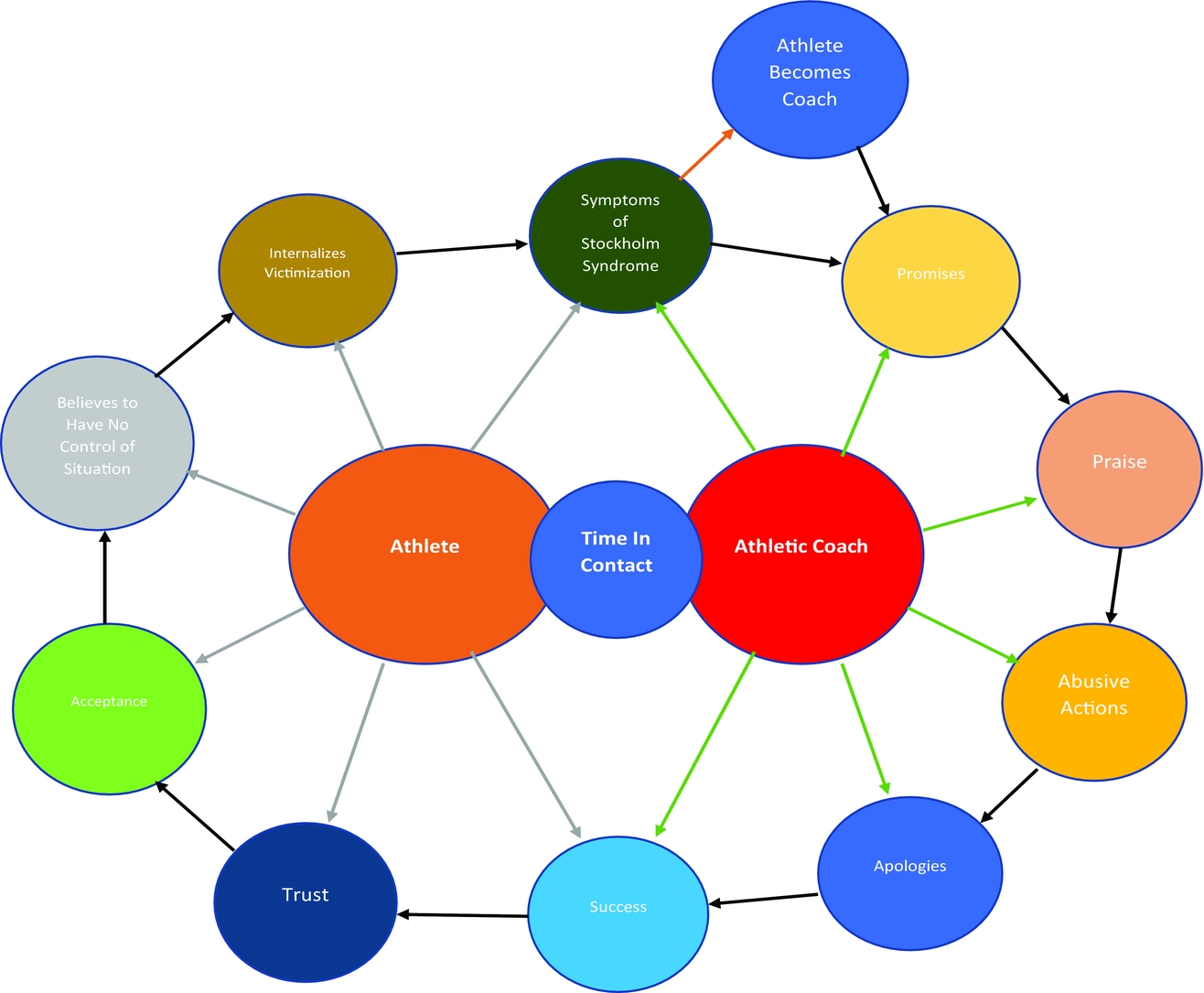
The idea that Stockholm syndrome is relevant to the continued victimisation of young athletes is paradoxical, appearing absurd at the surface level, but proving highly on-point upon further inspection. In fact, given the rational link between the actions of athletic coaches and the victimisation of young athletes, it is perhaps reasonable to assume that continued victimisation of youth athletes is not only plausible, it is obvious. Figure 1 shows the connection between elements of Stockholm syndrome and the pattern of victimisation of young athletes by coaches indicating the potential for domain expansion. This conclusion will be validated with research that can be applied to each of the identified levels that coaches influence.
FIGURE 1Map of Link to athletes and Stockholm syndrome.
What is Stockholm Syndrome?
Stockholm syndrome was typified by psychiatric and criminological research as a condition resulting from circumstances in which there is face-to-face contact between captors and captives, with captors causing extreme fright or terror in their victims which renders them helpless, powerless and submissive. Victims see no means of escape and fear for their lives and, under such circumstances, any act of kindness on the part of the captors or even the absence of beatings, abuse or rape leads victims to see their captors as “good guys” (Symonds, Reference Symonds1980). Farley (Reference Farley1987) later added the condition that for victimisation to be designated as Stockholm syndrome, it needed to result from a social problem triggered by the action (or inaction) of individuals or cultures.
Stockholm syndrome is a psychological term used to explain the bond that develops between captives and captors. This syndrome is often explained as a two-part development: unconscious and conscious actions. Unconsciously, victims begin to identify with their captors after prolonged time spent with them; consciously, it is a coping strategy meant to provide victims with hope in a situation where there is little hope to begin with (Jameson, Reference Jameson2010). Stockholm syndrome provides a way to make sense of a situation that would otherwise be considered by many as incomprehensible, including situations of sexual assault and abuse, verbal or physical harassment, and threats to wellbeing (Adorjan et al., Reference Adorjan, Christensen, Kelly and Pawluch2012). Research has indicated that young athletes are vulnerable to experiences of physical, sexual and emotional abuse, which supports the likelihood of these athletes suffering from Stockholm syndrome (Kirby, Greaves, & Hankivsky, Reference Kirby, Greaves and Hankivsky2000).
Unlike a single traumatic event, repeated trauma can only occur when the victim is in a state of captivity and under the captor's control. ‘The psychological impact of subordination to coercive control has many common features, whether it occurs within the public sphere of politics or within the private sphere of sexual and domestic relations’ (Herman, Reference Herman1992, p. 377). In its application to the sports world, coaches may use acts of emotional abuse – including verbal berating and denial of attention – in an ongoing way with young athletes. In fact, as many as 75% of athletes reported being victims of some form of emotional abuse by coaches while playing sports (Stafford, Alexander, & Fry, Reference Stafford, Alexander and Fry2015). By nature, emotional abuse is an ongoing, repeatable behaviour (Smullens, Reference Smullens2007), which correlates it to the concept of repeated trauma resulting in the manifestation of Stockholm syndrome.
Finally, it is important to note that there is no single, clear, concise definition of Stockholm syndrome. Even extensive reviews of the literature and available case studies indicate that there is extreme ambiguity in criteria and definition of this condition (Vecchi, Reference Vecchi2009). Furthermore, many criteria do not hold true across all identified instances of Stockholm syndrome. However, ‘One assumption that has been supported in the present cases is that the hostages and the hostage-takers must maintain a reasonable level of interpersonal contact’ (de Fabrique, Van Hasselt, Vecchi, & Romano, Reference de Fabrique, Van Hasselt, Vecchi and Romano2007, p. 33). With on-going access to, and repeated periods of time with, young athletes, coaches have this level of interpersonal contact.
Relevance in Athletics
As stated by Herman (Reference Herman1992), it is not necessary for the act of captivity to be in a private domain; it can also be in the public view. With this in mind, one important characteristic of Stockholm syndrome – power imbalance – creates contrived emotional bonds between captor and captive. Under this definition, some claim-makers imply that Stockholm syndrome is not limited to situations involving abduction or hostage-taking. Rather, Stockholm syndrome encompasses ‘a host of situations and conditions not immediately recognisable as manifestations of the syndrome’ (Adorjan et al., Reference Adorjan, Christensen, Kelly and Pawluch2012, pp. 454–455). Although Adorjan et al. (Reference Adorjan, Christensen, Kelly and Pawluch2012) never said so directly, their research implies that instances of power imbalances may be occurring in public view without anyone, including the young athlete, realising that the coach–athlete relationship possesses characteristics reflective of Stockholm syndrome. With the power to provide or deny playing time, require certain drills or physical exercises, cut players from the team, and determine the starting lineup, coaches possess immense power over young athletes. They are also given a fair amount of freedom by these athletes’ parents, who entrust their children to the coach's decisions and behaviours. If a coach chooses to push the limits or appropriateness of power over young athletes, the coach–athlete relationship could quickly manifest into one reflective of captive–captor tendencies.
Stockholm Syndrome and the Hierarchy of Athletics
Stockholm syndrome centres on the dynamics of the relationships that develop between captor and captive. The paradoxical development of positive emotions by the captive for his/her captor's feelings are frequently reciprocated by the captors (Auerbach, Kiesler, Strentz, Schmidt, & Serio, Reference Auerbach, Kiesler, Strentz, Schmidt and Serio1994), which is a standard condition for Stockholm syndrome to be present. In the athletic world, athletes often face difficult situations and are asked to complete seemingly impossible tasks. Given that de Fabrique et al. (Reference de Fabrique, Van Hasselt, Vecchi and Romano2007) state that the victim develops symptoms of Stockholm syndrome as a coping mechanism to increase the likelihood of survival, it is plausible that the Stockholm syndrome theory is relevant to athletics.
The Captor
Head coaches, or the captors, are in control of youth athletes in competitive sports. They have their own set of interests and internal visualisations of what it means to be a coach and how coaches should act. Furthermore, coaches feel immense pressure to obtain winning results to justify their position of employment, and often relate their professional futures to successful game outcomes (David, Reference David2005).
People excuse—or even celebrate—such behavior as a passion. But, let's call it by its real name: abuse. (Charles M. Blow, New York Times, April 2013)
Emotionally and psychologically, abusive behaviour has historically been excused as passion or even as a necessary component of competitive athletics. In fact, many countries have recently recognised the mental violence and psychological abuse present in sports. Yet these incidents of coaches abusing their power over young athletes are rarely documented by public and judicial authorities and are often excused as part of the game, particularly when winning results are achieved or when athletes do not speak out (David, Reference David2005). This has allowed bullying and poor treatment of athletes to go undetected and unchanged for decades.
Similarly, head coaches have a supremacy over athletes based on their age, gender (i.e., male coach/female athlete), knowledge and access to resources, authority to make choices and ability to reward or discipline (Tomlinson & Yorganci, Reference Tomlinson and Yorganci1997). In studying athletes’ desires, Stirling and Kerr (Reference Stirling and Kerr2009) found that holistic development was as important to young athletes for developing their athletic abilities. Conversely, coaches reported that the holistic approach to coaching was detrimental to athletic performance. This belief among coaches can result in ignoring athletes’ desires and focusing solely on winning at any cost, which has the potential to create an asymmetric, captor–captive relationship between coaches and athletes. Similarly, coaches may physically abuse athletes in ways not immediately recognisable as an imbalance or misuse of their power, such as by denying proper hydration or over-training them (Pinheiro, Pimenta, Resende, & Malcolm, Reference Pinheiro, Pimenta, Resende and Malcolm2014).
It is important to note that there is an inherent imbalance of power in the coach–athlete relationship because the very nature of the coach's role gives him/her authority over young athletes (Swigonski, Enneking, & Hendrix, Reference Swigonski, Enneking and Hendrix2014). This imbalance of power leaves the captives – the athletes – fearful of reporting incidences, excusing them as part of the commitment they made or a shortcoming on their own part. Instances such as these are not isolated. In fact, Stirling and Kerr (Reference Stirling and Kerr2009, p.232) interviewed an adolescent athlete and found that this athlete's sentiments conveyed findings of helplessness: ‘She was the best technical coach around so I had to tolerate the rest of it [the abuse]. . .I had to be tough and just “suck it up”.’
As already indicated, victimisation is based on an imbalance of power (Stirling, Bridges, Cruz, & Mountjoy, Reference Stirling, Bridges, Cruz and Mountjoy2011). As young athletes are exposed to this victimisation over prolonged periods of time, they begin to accept their treatment as par for the course and, often, even begin to support the controlling coach, justifying his or her actions based on the positive athletic results. Such rationalisations of abuse are a manifestation of Stockholm syndrome.
Coaches, to develop successful athletes and win athletic competitions, justify their abusive behaviours using winning records as evidence of the payoff of such treatment. In fact, despite many coaches coming to the United States with coaching records marred by abusive coaching behaviours, the number of complaints towards the coach's abuse of power significantly decreased if the coach was successful and able to produce elite athletes (Ryan, Reference Ryan1995). Consequently, young athletes often feel immense pressure to tolerate actions that would normally be unacceptable because they fear negative repercussions. Collectively, this lays the perfect foundation for the captor, or head coach, to create an environment in which Stockholm syndrome exists.
Table 1 displays the comparison of coaches and their behaviours to those that have been accepted as being involved in situations of Stockholm syndrome: Hijackers and Kidnappers.
TABLE 1Athletic coach to Hijacker/Kidnapper comparison.
The Captive
An element of Stockholm syndrome is a change in the captive's regard for his or her captor, shifting from negative feelings to positive ones as time wears on in a stressful encounter (Auerbach et al., Reference Auerbach, Kiesler, Strentz, Schmidt and Serio1994). Similarly, Kuleshnyk (Reference Kuleshnyk1984) hypothesised that the longer the siege, the more likely the development of the symptoms of the syndrome. Other researchers, such as Freud (Reference Freud1936), equate this phenomenon to identification, explaining that captives involuntarily connect with their captors or with those invoking feelings of anxiety as a means of protection from potential abuse by the captor.
It is important to note that there is a clear distinction between athletes and true hostages, such as those in kidnapping situations. In the context of athletics, the term “captive” is meant to signify that the young athletes are inferiors, falling victim to the head coach in physical (including age), mental and financial capacities. As a result, they become “mental captives” and “financial captives” to head coaches. These forms of captivity, though not actual physical confinement, appear to be widespread and result in similar responses to those of hostages. Table 2 displays characteristics of athletes that potentially suffer from Stockholm syndrome and the similarities they have to cases involving Stockholm syndrome in hostages.
TABLE 2Athlete to hostage comparison.
Reluctance to report inappropriate coaching behaviour enhances the risk of abuse in an athletic situation (Stirling et al., Reference Stirling, Bridges, Cruz and Mountjoy2011). Contrary to the common belief that certain abusive behaviours predominately come from strangers, children know their abusers 90% of the time and the majority of them are in positions of authority in the child's life, like a coach (Finkelhor & Ormrod, Reference Finkelhor and Ormrod2000). Athletes, as the captives, often hesitate to report emotional, psychological or other abuse by the head coach because they fear repercussions. As youths, the victimisation to which the athletes are subjected is often a new experience. These athletes may also be unaware of the extent of the abuse, unfamiliar with how to handle it or confused as to if it is even truly abuse. A coach's words and actions greatly affect the physical and emotional welfare of the athlete, making the head coach position one of potential abuse if unregulated (Ryan, Reference Ryan1995). However, decades of abuse by head coaches have not evoked change, leaving athletes feeling that this is just part of the commitment they made with athletics. Over time, the captives begin to justify the coach's actions, internalising it as a shortcoming of their own or as the proper way to behave, particularly when winning results are achieved under the coach's supervision. This is how the cycle of abuse and creation of Stockholm syndrome in athletics continues.
Conclusion
Based on the information found in past research and the asymmetric power in the hierarchy of athletics, it is both relevant and important to consider the domain expansion of Stockholm syndrome to athletics. The proposal that coaches could be creating a situation of captivity for their athletes is not necessarily the traditional form of Stockholm syndrome, but is supported by the close resemblance to other types of victimisation to which Stockholm syndrome is also considered relevant.
The domain expansion and application of Stockholm syndrome has potential due to the way the syndrome is defined. However, as stated in this paper, there is a lack of research because of the nature of the problems connected with the original definition. The potential for research related to Stockholm syndrome in athletics is extensive due to the wide-ranging sports environment. The environment of athletics, and the access coaches have to young athletes, provides a rich context for the development of studies likely to support this domain expansion.
After evaluation, and assuming further studies support domain expansion, it is important that ideas associated with Stockholm syndrome are applied to athletics. Though these authors have argued the connection, it is also understood that using this term in the wrong context can create unintended consequences. The potential for crossover diagnosis with other acts such as bullying, battery and harassment is valid, though potentially linked to Stockholm syndrome. The argument that other types of victimisation are needed for the effects of Stockholm syndrome to exist is also valid.







 You have
Access
Introduction
A multitude of different types of victimisation have used Stockholm syndrome as a description of the paradoxical relationship between victims and their aggressors following harmful interactions or happenings. Though the feelings of loyalty and sentiment initially appear irrational and conflict with conventional wisdom, they nevertheless are present as evidence of the consequence of victimisation (Cantor & Price, Reference Cantor and Price2007). Stockholm syndrome is a manipulation of power and trust by the captor and, as such, it has been theorised that this syndrome relates to other forms of captivity and relationships beyond the traditional association with kidnapping (Adorjan, Christensen, Kelly, & Pawluch, Reference Adorjan, Christensen, Kelly and Pawluch2012). In athletics, Stockholm syndrome is the resulting condition of victimisation of young athletes, affecting them in an enigmatic, yet very real way.
Conceptual Theory
Typification, or creating social constructions based on common postulations, is often used by claims-makers in social contexts to depict the characteristics of various problems. Furthermore, the notion of domain expansion has been used to support the explanation of certain syndromes in a method other than its original intent (Best, Reference Best and Best1995). Together, typification and domain expansion help support the assertion that victimisation as explained by Stockholm syndrome has been prevalent in the youth athletics hierarchy for decades.
The idea that Stockholm syndrome is relevant to the continued victimisation of young athletes is paradoxical, appearing absurd at the surface level, but proving highly on-point upon further inspection. In fact, given the rational link between the actions of athletic coaches and the victimisation of young athletes, it is perhaps reasonable to assume that continued victimisation of youth athletes is not only plausible, it is obvious. Figure 1 shows the connection between elements of Stockholm syndrome and the pattern of victimisation of young athletes by coaches indicating the potential for domain expansion. This conclusion will be validated with research that can be applied to each of the identified levels that coaches influence.
Map of Link to athletes and Stockholm syndrome.
What is Stockholm Syndrome?
Stockholm syndrome was typified by psychiatric and criminological research as a condition resulting from circumstances in which there is face-to-face contact between captors and captives, with captors causing extreme fright or terror in their victims which renders them helpless, powerless and submissive. Victims see no means of escape and fear for their lives and, under such circumstances, any act of kindness on the part of the captors or even the absence of beatings, abuse or rape leads victims to see their captors as “good guys” (Symonds, Reference Symonds1980). Farley (Reference Farley1987) later added the condition that for victimisation to be designated as Stockholm syndrome, it needed to result from a social problem triggered by the action (or inaction) of individuals or cultures.
Stockholm syndrome is a psychological term used to explain the bond that develops between captives and captors. This syndrome is often explained as a two-part development: unconscious and conscious actions. Unconsciously, victims begin to identify with their captors after prolonged time spent with them; consciously, it is a coping strategy meant to provide victims with hope in a situation where there is little hope to begin with (Jameson, Reference Jameson2010). Stockholm syndrome provides a way to make sense of a situation that would otherwise be considered by many as incomprehensible, including situations of sexual assault and abuse, verbal or physical harassment, and threats to wellbeing (Adorjan et al., Reference Adorjan, Christensen, Kelly and Pawluch2012). Research has indicated that young athletes are vulnerable to experiences of physical, sexual and emotional abuse, which supports the likelihood of these athletes suffering from Stockholm syndrome (Kirby, Greaves, & Hankivsky, Reference Kirby, Greaves and Hankivsky2000).
Unlike a single traumatic event, repeated trauma can only occur when the victim is in a state of captivity and under the captor's control. ‘The psychological impact of subordination to coercive control has many common features, whether it occurs within the public sphere of politics or within the private sphere of sexual and domestic relations’ (Herman, Reference Herman1992, p. 377). In its application to the sports world, coaches may use acts of emotional abuse – including verbal berating and denial of attention – in an ongoing way with young athletes. In fact, as many as 75% of athletes reported being victims of some form of emotional abuse by coaches while playing sports (Stafford, Alexander, & Fry, Reference Stafford, Alexander and Fry2015). By nature, emotional abuse is an ongoing, repeatable behaviour (Smullens, Reference Smullens2007), which correlates it to the concept of repeated trauma resulting in the manifestation of Stockholm syndrome.
Finally, it is important to note that there is no single, clear, concise definition of Stockholm syndrome. Even extensive reviews of the literature and available case studies indicate that there is extreme ambiguity in criteria and definition of this condition (Vecchi, Reference Vecchi2009). Furthermore, many criteria do not hold true across all identified instances of Stockholm syndrome. However, ‘One assumption that has been supported in the present cases is that the hostages and the hostage-takers must maintain a reasonable level of interpersonal contact’ (de Fabrique, Van Hasselt, Vecchi, & Romano, Reference de Fabrique, Van Hasselt, Vecchi and Romano2007, p. 33). With on-going access to, and repeated periods of time with, young athletes, coaches have this level of interpersonal contact.
Relevance in Athletics
As stated by Herman (Reference Herman1992), it is not necessary for the act of captivity to be in a private domain; it can also be in the public view. With this in mind, one important characteristic of Stockholm syndrome – power imbalance – creates contrived emotional bonds between captor and captive. Under this definition, some claim-makers imply that Stockholm syndrome is not limited to situations involving abduction or hostage-taking. Rather, Stockholm syndrome encompasses ‘a host of situations and conditions not immediately recognisable as manifestations of the syndrome’ (Adorjan et al., Reference Adorjan, Christensen, Kelly and Pawluch2012, pp. 454–455). Although Adorjan et al. (Reference Adorjan, Christensen, Kelly and Pawluch2012) never said so directly, their research implies that instances of power imbalances may be occurring in public view without anyone, including the young athlete, realising that the coach–athlete relationship possesses characteristics reflective of Stockholm syndrome. With the power to provide or deny playing time, require certain drills or physical exercises, cut players from the team, and determine the starting lineup, coaches possess immense power over young athletes. They are also given a fair amount of freedom by these athletes’ parents, who entrust their children to the coach's decisions and behaviours. If a coach chooses to push the limits or appropriateness of power over young athletes, the coach–athlete relationship could quickly manifest into one reflective of captive–captor tendencies.
Stockholm Syndrome and the Hierarchy of Athletics
Stockholm syndrome centres on the dynamics of the relationships that develop between captor and captive. The paradoxical development of positive emotions by the captive for his/her captor's feelings are frequently reciprocated by the captors (Auerbach, Kiesler, Strentz, Schmidt, & Serio, Reference Auerbach, Kiesler, Strentz, Schmidt and Serio1994), which is a standard condition for Stockholm syndrome to be present. In the athletic world, athletes often face difficult situations and are asked to complete seemingly impossible tasks. Given that de Fabrique et al. (Reference de Fabrique, Van Hasselt, Vecchi and Romano2007) state that the victim develops symptoms of Stockholm syndrome as a coping mechanism to increase the likelihood of survival, it is plausible that the Stockholm syndrome theory is relevant to athletics.
The Captor
Head coaches, or the captors, are in control of youth athletes in competitive sports. They have their own set of interests and internal visualisations of what it means to be a coach and how coaches should act. Furthermore, coaches feel immense pressure to obtain winning results to justify their position of employment, and often relate their professional futures to successful game outcomes (David, Reference David2005).
People excuse—or even celebrate—such behavior as a passion. But, let's call it by its real name: abuse. (Charles M. Blow, New York Times, April 2013)
Emotionally and psychologically, abusive behaviour has historically been excused as passion or even as a necessary component of competitive athletics. In fact, many countries have recently recognised the mental violence and psychological abuse present in sports. Yet these incidents of coaches abusing their power over young athletes are rarely documented by public and judicial authorities and are often excused as part of the game, particularly when winning results are achieved or when athletes do not speak out (David, Reference David2005). This has allowed bullying and poor treatment of athletes to go undetected and unchanged for decades.
Similarly, head coaches have a supremacy over athletes based on their age, gender (i.e., male coach/female athlete), knowledge and access to resources, authority to make choices and ability to reward or discipline (Tomlinson & Yorganci, Reference Tomlinson and Yorganci1997). In studying athletes’ desires, Stirling and Kerr (Reference Stirling and Kerr2009) found that holistic development was as important to young athletes for developing their athletic abilities. Conversely, coaches reported that the holistic approach to coaching was detrimental to athletic performance. This belief among coaches can result in ignoring athletes’ desires and focusing solely on winning at any cost, which has the potential to create an asymmetric, captor–captive relationship between coaches and athletes. Similarly, coaches may physically abuse athletes in ways not immediately recognisable as an imbalance or misuse of their power, such as by denying proper hydration or over-training them (Pinheiro, Pimenta, Resende, & Malcolm, Reference Pinheiro, Pimenta, Resende and Malcolm2014).
It is important to note that there is an inherent imbalance of power in the coach–athlete relationship because the very nature of the coach's role gives him/her authority over young athletes (Swigonski, Enneking, & Hendrix, Reference Swigonski, Enneking and Hendrix2014). This imbalance of power leaves the captives – the athletes – fearful of reporting incidences, excusing them as part of the commitment they made or a shortcoming on their own part. Instances such as these are not isolated. In fact, Stirling and Kerr (Reference Stirling and Kerr2009, p.232) interviewed an adolescent athlete and found that this athlete's sentiments conveyed findings of helplessness: ‘She was the best technical coach around so I had to tolerate the rest of it [the abuse]. . .I had to be tough and just “suck it up”.’
As already indicated, victimisation is based on an imbalance of power (Stirling, Bridges, Cruz, & Mountjoy, Reference Stirling, Bridges, Cruz and Mountjoy2011). As young athletes are exposed to this victimisation over prolonged periods of time, they begin to accept their treatment as par for the course and, often, even begin to support the controlling coach, justifying his or her actions based on the positive athletic results. Such rationalisations of abuse are a manifestation of Stockholm syndrome.
Coaches, to develop successful athletes and win athletic competitions, justify their abusive behaviours using winning records as evidence of the payoff of such treatment. In fact, despite many coaches coming to the United States with coaching records marred by abusive coaching behaviours, the number of complaints towards the coach's abuse of power significantly decreased if the coach was successful and able to produce elite athletes (Ryan, Reference Ryan1995). Consequently, young athletes often feel immense pressure to tolerate actions that would normally be unacceptable because they fear negative repercussions. Collectively, this lays the perfect foundation for the captor, or head coach, to create an environment in which Stockholm syndrome exists.
Table 1 displays the comparison of coaches and their behaviours to those that have been accepted as being involved in situations of Stockholm syndrome: Hijackers and Kidnappers.
Athletic coach to Hijacker/Kidnapper comparison.
The Captive
An element of Stockholm syndrome is a change in the captive's regard for his or her captor, shifting from negative feelings to positive ones as time wears on in a stressful encounter (Auerbach et al., Reference Auerbach, Kiesler, Strentz, Schmidt and Serio1994). Similarly, Kuleshnyk (Reference Kuleshnyk1984) hypothesised that the longer the siege, the more likely the development of the symptoms of the syndrome. Other researchers, such as Freud (Reference Freud1936), equate this phenomenon to identification, explaining that captives involuntarily connect with their captors or with those invoking feelings of anxiety as a means of protection from potential abuse by the captor.
It is important to note that there is a clear distinction between athletes and true hostages, such as those in kidnapping situations. In the context of athletics, the term “captive” is meant to signify that the young athletes are inferiors, falling victim to the head coach in physical (including age), mental and financial capacities. As a result, they become “mental captives” and “financial captives” to head coaches. These forms of captivity, though not actual physical confinement, appear to be widespread and result in similar responses to those of hostages. Table 2 displays characteristics of athletes that potentially suffer from Stockholm syndrome and the similarities they have to cases involving Stockholm syndrome in hostages.
Athlete to hostage comparison.
Reluctance to report inappropriate coaching behaviour enhances the risk of abuse in an athletic situation (Stirling et al., Reference Stirling, Bridges, Cruz and Mountjoy2011). Contrary to the common belief that certain abusive behaviours predominately come from strangers, children know their abusers 90% of the time and the majority of them are in positions of authority in the child's life, like a coach (Finkelhor & Ormrod, Reference Finkelhor and Ormrod2000). Athletes, as the captives, often hesitate to report emotional, psychological or other abuse by the head coach because they fear repercussions. As youths, the victimisation to which the athletes are subjected is often a new experience. These athletes may also be unaware of the extent of the abuse, unfamiliar with how to handle it or confused as to if it is even truly abuse. A coach's words and actions greatly affect the physical and emotional welfare of the athlete, making the head coach position one of potential abuse if unregulated (Ryan, Reference Ryan1995). However, decades of abuse by head coaches have not evoked change, leaving athletes feeling that this is just part of the commitment they made with athletics. Over time, the captives begin to justify the coach's actions, internalising it as a shortcoming of their own or as the proper way to behave, particularly when winning results are achieved under the coach's supervision. This is how the cycle of abuse and creation of Stockholm syndrome in athletics continues.
Conclusion
Based on the information found in past research and the asymmetric power in the hierarchy of athletics, it is both relevant and important to consider the domain expansion of Stockholm syndrome to athletics. The proposal that coaches could be creating a situation of captivity for their athletes is not necessarily the traditional form of Stockholm syndrome, but is supported by the close resemblance to other types of victimisation to which Stockholm syndrome is also considered relevant.
The domain expansion and application of Stockholm syndrome has potential due to the way the syndrome is defined. However, as stated in this paper, there is a lack of research because of the nature of the problems connected with the original definition. The potential for research related to Stockholm syndrome in athletics is extensive due to the wide-ranging sports environment. The environment of athletics, and the access coaches have to young athletes, provides a rich context for the development of studies likely to support this domain expansion.
After evaluation, and assuming further studies support domain expansion, it is important that ideas associated with Stockholm syndrome are applied to athletics. Though these authors have argued the connection, it is also understood that using this term in the wrong context can create unintended consequences. The potential for crossover diagnosis with other acts such as bullying, battery and harassment is valid, though potentially linked to Stockholm syndrome. The argument that other types of victimisation are needed for the effects of Stockholm syndrome to exist is also valid.