

1. Introduction
Stops/affricates in Japanese and Korean are categorized very differently phonologically. Japanese is described as having a combination of laryngeal and length contrasts – voiced and voiceless singletons and voiceless geminates, as shown in (1a). Korean, on the other hand, has a three-way, primarily laryngeal contrast among stops/affricates – fortis (tense), aspirated, and lenis (lax) (1b).
(1)
a. Japanese
voiced voiceless voiceless geminate
[made] ‘until’ [mate] ‘wait (imperative)’[matːe]‘wait (request)’
[maʥi] ‘seriously?’ [maʨi] ‘town’[maʨːi] matches
b. Korean
lenis (lax) aspirated fortis (tense)
[tata] ‘close it (imperative)’ [patʰaŋ] ‘foundation’ [matʹaŋ] ‘deserved’
[kaʦa] ‘Let's go’ [maʦʰa] ‘horse carriage’ [kaʦʹa] ‘fake’
Phonologists have unanimously analyzed the Japanese contrasts as involving a combination of prosodic structural representations and segmental features. As shown in (2a), singletons /d/ and /t/ are associated with a single timing slot (no mora), while the geminate /tː/ is associated with two slots, having a mora (Homma Reference Homma1981, Vance Reference Vance1987). The voicing distinction, on the other hand, can be captured by the feature [voice] (Itô and Mester Reference Itô and Mester1986), with /d/ being [+voice], while /t/ and /tː/ being [-voice] (see Lombardi Reference Lombardi1991, Reference Lombardi1995 on the use of the privative [voice]). Alternatively, the voicing distinction can be captured by the glottal tension parameter [slack vocal folds] using the revised set of laryngeal features by Halle and Stevens (Reference Halle and Stevens1971), as shown in (2b). Voiced /d/ is specified for [slack vocal folds], while voiceless /t/ and /tː/ (still distinguished from each other prosodically) are not specified for any feature underlyingly, yet acquire [spread glottis] (a parameter of glottal width) at the output of phonology (cf. Avery and Idsardi Reference Avery, Idsardi and Alan Hall2001). The parentheses indicate that this feature is present on the surface only. Both feature analyses capture the active phonological behavior of voiced segments (in sequential voicing: Itô and Mester Reference Itô and Mester1986), while the second one also captures the gradient phonetic behavior of voiceless segments (in vowel devoicing: Tsuchida Reference Tsuchida1997). The second laryngeal feature specification is also consistent with instrumental work on various aspects of the glottal activity during the production of Japanese stops (e.g., Hirose and Ushijima Reference Hirose and Ushijima1978 on voiced, Yoshioka et al. Reference Yoshioka, Löfqvist and Hirose1982 on voiceless, Fujimoto et al. Reference Fujimoto, Maekawa, Funatsu, Kobayashi, Hirose and Nakamura2010 on geminates).
(2) Specifications for Japanese /d,t,tː/
a. XXX X (μ)
||\/
/d/ /t//tː/
[voice]+−−
b. Glottal Width
[spread glottis] − (+) (+)
[constricted glottis] − − −
Glottal Tension
[stiff vocal folds] − − −
[slack vocal folds] + − −
Unlike the two-dimensional (length and laryngeal) feature specification for Japanese stops, the Korean three-way contrast has been primarily analyzed using a single dimension – laryngeal features, although not without disagreement about their precise phonetic correlates (Chomsky and Halle Reference Chomsky and Halle1968; Halle and Stevens Reference Halle and Stevens1971; Iverson Reference Iverson1983a, Reference Iverson1983b; Lombardi Reference Lombardi1991, Reference Lombardi1995; Y. Y. Cho and Inkelas Reference Cho, Inkelas and Kim-Renaud1994; see Y. Y. Cho Reference Cho, van Oostendorp, Ewen, Hume and Rice2011 for a review; but see below for alternative proposals). Taking Lombardi's (Reference Lombardi1991, Reference Lombardi1995) analysis of Korean as a starting point (yet with binary features for comparison), (3a) presents one possible feature specification, with fortis and aspirated stops assigned [constricted glottis] and [spread glottis] respectively, and lenis unspecified for any of the features (cf. Y. Y. Cho and Inkelas Reference Cho, Inkelas and Kim-Renaud1994). Importantly, all three stops are analyzed as singletons, in contrast to the analysis of Japanese in (2). Again, another way to represent laryngeal features is using Halle and Stevens’ (Reference Halle and Stevens1971) framework, as shown in (3b). This analysis, proposed by Iverson (Reference Iverson1983a, Reference Iverson1983b), specifies fortis stops for [constricted glottis] and [stiff vocal folds], and aspirated stops for [spread glottis] and [stiff vocal folds]. As before, lenis stops in this analysis are unspecified for any of the features, but acquire a [slack vocal folds] configuration (voicing) phonetically in intervocalic position (see Avery and Idsardi Reference Avery, Idsardi and Alan Hall2001). This feature specification is motivated by the phonological behavior of fortis and aspirated stops (e.g., post-obstruent tensing and coda neutralization), while also capturing some important articulatory observations. Specifically, results of numerous instrumental investigations of laryngeal and aerodynamic activity in the production of Korean stops (C.-W. Kim Reference Kim1965, Hardcastle Reference Hardcastle1973, Kagaya Reference Kagaya1974, Hirose et al. Reference Hirose, Lee and Ushijima1974, Dart Reference Dart1987, Jun et al. Reference Jun, Beckman and Lee1998, among others) have been interpreted to show that (i) aspirated stops are produced with the largest glottal opening, while fortis stops often show the smallest opening, and (ii) aspirated and (particularly) fortis stops are produced with high glottal tension, in contrast to the low tension of lenis stops (see T. Cho et al. Reference Cho, Jun and Ladefoged2002 for a review). The raising of the glottis, which was found consistently for fortis and to a lesser extent for aspirated stops (H. Kim et al. Reference Kim, Honda and Maeda2005, Reference Kim, Maeda and Honda2010) may also reflect higher glottal tension during the production of these consonants. Aspirated stops are in addition characterized by higher subglottal pressure. Both laryngeal effects can be related to higher F0 on the following vowel for fortis and aspirated stops, compared to lenis stops.
(3) Specifications for Korean /t,tʰ,tʹ/
a. XXX
|||
/t//tʰ//tʹ/
[spread glottis] − +−
[constricted glottis]−−+
b. Glottal Width
[spread glottis]−+−
[constricted glottis]−−+
Glottal Tension
[stiff vocal folds]−++
[slack vocal folds](+)−−
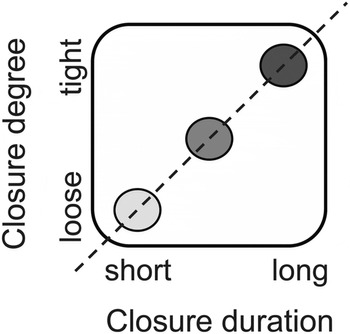
The point of our comparison is that phonological representations for Japanese /tː/ and Korean /tʹ/ reviewed above seemingly have little in common: they share none of the positive values of features and are different in terms of their structural prosodic organization (mora vs. no mora). Japanese /t/ and /d/ are also partly different from Korean /t/ and /tʰ/ in their laryngeal feature specifications: [+spread glottis] is phonologically absent in Japanese, while [+slack vocal folds]/[+voice] is phonologically absent in Korean. Yet, as our review of previous articulatory studies in section 2 will show, these two sets of contrasts pattern phonetically rather similarly in two languages. Moreover, as will be seen from the results of the current electropalatographic (EPGFootnote 1) investigation, the two sets are also phonetically strikingly similar in their supralaryngeal and durational characteristics. Specifically, both Japanese and Korean alveolar stops, produced intervocalically, fall on a continuum from tight/strong to loose/weak constrictions and from long to short closure durations – in the order /tː > t > d/ and /tʹ > tʰ > t/. The tight-loose and long-short continuum of supralaryngeal constrictions is schematically represented in Figure 1, to be taken up in more detail in section 3.3.
A hypothesized continuum of supralaryngeal closure degree and closure duration in the phonetic realization of length and laryngeal contrasts.

Seemingly nothing in the feature specifications in (2) and (3) predicts the similar phonetic patterning of the two sets of consonants, as laryngeal features are understood to provide motor commands to the glottis only, rather than to the tongue tip or the lips (Halle and Stevens Reference Halle and Stevens1971, Avery and Idsardi Reference Avery, Idsardi and Alan Hall2001). Similarly, the prosodic length distinction is expected to be realized in the duration of the closure, rather than in the degree of the constriction. A possible way to bridge the gap between phonology and phonetics of these contrasts is to assume that the Korean three-way contrast makes use of both laryngeal and non-laryngeal features. One such, fairly influential proposal, has been advanced by C.-W. Kim (Reference Kim1965, Reference Kim1970), and more recently by H. Kim (H. Kim Reference Kim, van Oostendorp and van de Weijer2004a, Reference Kim, Moulton and Wolf2004c; H. Kim et al. Reference Kim, Maeda and Honda2010). As shown in (4), it posits that fortis and aspirated stops are specified for the feature [tense], which is defined as involving the tensing of both the glottis and the supralaryngeal articulators – the tongue blade, the dorsum, and the lips. As tighter closures and longer durations are an expected consequence of this tensing (see H. Kim et al. Reference Kim, Honda and Maeda2005, Reference Kim, Maeda and Honda2010 for MRI evidence), this predicts a similar patterning of Korean /tʹ/ and Japanese /tː/. However, the analysis does not predict spatial and temporal differences between Korean /tʹ/ and /tʰ/, nor does it predict the similarity between Korean /tʰ/ and /t/ on the one hand, and Japanese /t/ and /d/ on the other. Yet, as we will see, these within-language differences and between-language similarities require an explanation.
(4) Specifications for Korean /t,tʰ,tʹ/ (alternative analysis I)
XXX
|||
/t/ /tʰ//tʹ/
[tense]−++
[spread glottis]−+−
Yet another alternative analysis of Korean contrasts involves the assumption that fortis stops are in fact geminates, while aspirated and lenis stops are singletons (Martin Reference Martin and Yang1982, J.-I. Han Reference Han1996, Avery and Idsardi Reference Avery, Idsardi and Alan Hall2001, Ahn and Iverson Reference Ahn and Iverson2004, M.-R. Kim and Duanmu Reference Kim and Duanmu2004). One version of this analysis, using Halle and Stevens’ (Reference Halle and Stevens1971) feature set, is shown in (5) (adapted from Avery and Idsardi Reference Avery, Idsardi and Alan Hall2001). Here, only aspirated stops are specified underlyingly (for Glottal Width, which is by default realized as [spread glottis]). Fortis stops are underspecified laryngeally, but receive [constricted glottis] on the surface. Crucially, the fortis stops are underlyingly long, which predicts that they should be phonetically realized – at least in duration – differently from the other stops, and similarly to Japanese geminates. As we will see, however, this prediction is only partly confirmed by our data. Regardless of this, the analysis makes no predictions about different spatial realizations of the three consonants, nor about differences in duration between /t/ and /tʰ/.
(5) Specifications for Korean /t,tʰ,tʹ/ - (alternative analysis II)
XXX X
||\/
/t//tʰ//tʹ/
Glottal Width√(√)
[spread glottis]−(+)−
[constricted glottis]−−(+)
In this paper we maintain the traditional extended feature specifications of Japanese and Korean stops as in (2b) and (3b) (to be slightly revised in section 6), but propose to supplement them with independently motivated supralaryngeal enhancement rules. These rules phonetically implement geminates and fortis (laryngeally [stiff]) consonants with tighter constrictions and longer durations, while implementing voiced/lax consonants (laryngeally [slack]) with looser constrictions and shorter duration.
The paper is organized as follows. Section 2 reviews articulatory studies of the supralaryngeal characteristics of the Japanese length and voicing contrasts (section 2.1 and section 2.2) and the Korean laryngeal contrasts (section 2.3). section 3 reviews patterns of phonetic realization of similar contrasts in other languages, proposes a set of phonetic implementation rules, and states predictions for Japanese and Korean stops and affricates. Subsequent sections present the current study – its method (section 4) and results (section 5), and discuss the findings and their wider theoretical implications (section 6).
2. Supralaryngeal correlates of contrasts in Japanese and Korean
In this section, we review existing articulatory studies of the Japanese length and voicing contrasts and the Korean laryngeal contrasts.
2.1 Japanese length contrast
The phonetics of the geminate/singleton contrast in Japanese has attracted considerable attention in the literature; however, most studies have focused exclusively on duration differences. Thus, acoustic investigations revealed that Japanese geminate stops are about twice as long as single stops, confirming their phonological patterning as having extra prosodic length, a mora (Homma Reference Homma1981, Beckman Reference Beckman1982, M. Han Reference Han1994, Hirata and Whiton Reference Hirata and Whiton2005). A few recent acoustic studies have suggested that durational differences between geminates and singleton stops may be accompanied by creakiness on the adjacent vowels (a shallower spectral tilt: Kawahara Reference Kawahara2006, Idemaru and Guion Reference Idemaru and Guion2008; see Kawahara Reference Kawahara and Kubozono2015 for a review). Creakiness can be interpreted as a result of tighter laryngeal and/or supralaryngeal settings during the production of geminates, supporting some previous impressionistic observations (Sakuma Reference Sakuma1929, cited in Vance Reference Vance1987: 40). Whether this is indeed the case, however, has not to our knowledge been thoroughly investigated.
A handful of articulatory (X-ray microbeam (XRMB) and articulography) studies of Japanese geminates (Ishii Reference Ishii1999, cited in Kawahara Reference Kawahara and Kubozono2015; as well as Löfqvist Reference Löfqvist2006, Reference Löfqvist2007; Fujimoto et al. Reference Fujimoto, Funatsu and Hoole2015) were concerned primarily with the dynamics of consonant articulatory gestures (e.g., peak velocity) or their coordination with the preceding vowel gesture. A few observations about the degree of constriction, however, can be extracted from some of these studies. A display of articulatory trajectories for /pː/ and /p/ in Ishii (Reference Ishii1999) (reproduced in Figure 6 in Kawahara Reference Kawahara and Kubozono2015) shows that the lower lip reaches a higher vertical position (and stays there considerably longer) for the geminate than for the singleton. The same was also observed for geminate labials in Löfqvist (Reference Löfqvist2006), while Löfqvist (Reference Löfqvist2007) noted a more extreme movement of the tongue tip and dorsum during the closure of geminate alveolar and velar stops, compared to their singleton counterparts. Both studies also observed robust duration differences between geminate and singleton gestures.
Of interest is a compilation of X-ray, EPG and XRMB data for all consonants and vowels of Japanese produced by a single speaker published by the National Language Research Institute (NLRI 1990). Although the data were not evaluated quantitatively (having a single token per category), some interesting observations can be noted for intervocalic geminate and singleton stops produced in the context [taː_a]. Based on X-ray images, the tongue body for /t:/ and /ʨː/ appears to be slightly more advanced, with the tongue blade making a more extensive constriction against the roof of the mouth, compared to /t/ and /ʨ/ respectively. A similarly more extensive constriction (but with the velum) can be seen for velars /kː/ vs. /k/. EPG data show somewhat more linguopalatal contact for /t:,ʨː/ than for /t,ʨ/, both at the front of the palate (the alveolar/post-alveolar regions) and the back of the palate (the palatal region). For velars, the palate does not capture the tongue contact sufficiently enough to observe any differences. The number of EPG frames with complete closures (when present) is twice as many for geminates as singletons. Similar duration differences in closures can also be seen in XRMB trajectories for the tongue tip (/t:/ vs. /t/) and the tongue dorsum (/k:/ vs. /k/), while spatial differences are not immediately apparent. Some of these observations were confirmed in a recent preliminary EPG investigation of three Japanese speakers by Kochetov (Reference Kochetov2012). Specifically, the study found a greater linguopalatal contact for geminate velar /kː/ and alveolar /tː/, compared to the single /k/ and /t/. Taken together, these results suggest that the length distinction in Japanese stops may be accompanied by the relative tightness of the closure, similarly to other languages to be reviewed further.
2.2 Japanese voicing contrast
While the absence or presence of vocal-fold vibration and glottal abduction are the primary correlates of the Japanese (singleton) voiceless/voiced contrast in stops and affricates, these consonants have been shown to differ in certain supralaryngeal properties. Vance (Reference Vance1987: 19) and Okada (Reference Okada1999), for example, mention that the intervocalic bilabial and velar stops /b/ and /ɡ/ (but not the alveolar /d/) can be produced with a weaker closure, variably leniting to [β] and [ɣ].
Early single-speaker EPG studies by Shibata (Reference Shibata1968) and Fujii (Reference Fujii1970) that examined alveolars /d/ and /t/ reported less linguopalatal contact for the voiced consonant. The same can be observed in EPG data displays in NLRI (1990) for /d,ʥ/ vs. /t,ʨ/ produced by one speaker. Subsequent larger sample EPG studies that used pressure-sensitive (PS-EPG) artificial palates (Matsumura et al. Reference Matsumura, Kimura, Yoshino, Tachimura and Wada1994, Wakumoto et al. Reference Wakumoto, Masaki, Honda and Ouhe1998) found that the lesser linguopalatal contact for voiced /d/ was accompanied by a weaker force, compared to voiceless /t/. These two studies, however, were primarily concerned with testing the new method, and did not provide much detail on voiced-voiceless differences. In a recent EPG study of five Japanese speakers producing intervocalic voiced /b,d,ɡ/ and voiceless /p,t,k/, Kochetov (Reference Kochetov2014) found that the former consonants showed less linguopalatal contact than the latter, indicative of the expanded back oral cavity which presumably facilitates vocal-fold vibration.
Two other studies explored the voiced/voiceless contrast in velar stops using cine-MRI. A comparison of sagittal vocal tract images from four Kansai dialect (Tachibana et al. Reference Tachibana, Kitamura and Fujimoto2012) and seven Tokyo dialect speakers (Fujimoto et al. Reference Fujimoto, Kitamura, Hatano, Fujimoto, Bimboat, Cerisara, Fougeron, Gravier, Lamel, Pellegrino and Perrier2013) producing the same utterances with /ɡ/ and /k/ revealed that the tongue dorsum was generally lower for the voiced consonant, showing less contact with the velum. The tongue dorsum for /ɡ/ also achieved its maximum constriction later than for /k/, suggesting a lesser force involved in its articulation. A weaker constriction for /ɡ/ can also be observed in X-ray tracings obtained from a single speaker in NLRI (1990).
Most of the studies mentioned above did not examine durational differences between the consonants. EPG and/or XRMB displays data in NLRI (1990), however, show that the duration of the closure for the voiced /b,d,ɡ/ is typically twice as short as the closure for the (single) voiceless /p,t,k/. Seemingly related to that is the process of optional deaffrication of voiced /ʥ/ between vowels, in contrast to the consistent affricate realization of the voiceless /ʨ/ (Vance Reference Vance1987: 24–25). In sum, the laryngeal contrast between Japanese voiced and voiceless stops appears to go hand in hand with some supralaryngeal and durational differences that are similar to those found in other languages. Yet, again, the relation between these two articulatory dimensions has not been systematically investigated.
Table 1 summarizes articulatory studies of supralaryngeal correlates of the length and voicing distinctions in Japanese. The studies are arranged in a chronological order, listing the method, numbers of speakers, and consonants (stops/affricates only) investigated. Importantly, the columns on the right indicate whether spatial or temporal differences were found between two types of contrasts – voiceless (singleton) vs. voiced and voiceless singleton vs. geminate. It can be seen that considerable work has been done on the Japanese stop/affricate contrasts, yet none of the studies have examined voicing and length contrasts together, with the exception of NLRI (1990). As mentioned earlier, this work is a compilation of data displays from a single speaker, with no quantitative analyses performed. The current study is intended to address this limitation, at least partly.
A summary of the studies on Japanese length and voicing contrasts reviewed in sections 3.1 and 3.2. ‘T’ and ‘D’ are any voiceless and voiced stops/affricates; ‘>’ is ‘more constricted or longer’; ‘=’ is not different; ‘n/a’ is not examined or not possible to examine given the method.

2.3 Fortis stops: a tighter closure and longer duration
As mentioned in section 1, Korean contrasts in stops and affricates are primarily distinguished at the laryngeal level, with fortis stops often produced with a less open glottis, with high glottal tension and raising; aspirated stops are produced with a large glottal opening, as well as some degree of glottal tension and raising (see T. Cho et al. Reference Cho, Jun and Ladefoged2002 for a review). Given this, most earlier articulatory studies focused on the laryngeal characteristics of these consonants (see section 1). Some supralaryngeal and duration differences, however, have also attracted attention.
As part of his pioneering experimental investigation of Korean laryngeal contrasts, C.-W. Kim (Reference Kim1970) used electromyography (EMG) to study muscle activity during the production of labial stops /pʹ,ph,p/ by four speakers. He concluded that there was considerably more lip muscle activity during the fortis and aspirated stops than during the lenis stop. Since C.-W. Kim's (Reference Kim1970) focus was capturing the commonality among the fortis and aspirated (and their difference from the lenis), he does not mention the difference between /pʹ/ and /ph/. The means for speakers and vowel contexts provided in Kim's article (p. 55), however, suggest an overall greater muscle activity for fortis than for aspirated labials (except for one speaker's production of these consonants before rounded vowels). The author also reported results of a static palatography investigation of /tʹ,th, t/ produced by three speakers, showing more contact between the tongue and the palate for the fortis and aspirated stops compared to the lenis stop. Yet in a more recent static palatography study of five speakers of Seoul Korean, Anderson, et al. (Reference Anderson, Ko, O'Grady and Choo2004) did not find consistent differences in tongue-palate contact or place among the three laryngeal classes in alveolar stops and affricates /tʹ,ʦʹ/ vs. /th,ʦh/ vs. /t,ʦ/. In contrast, a single-speaker EPG study of the same consonants by Shin (Reference Shin1997) had confirmed C.-W. Kim's (Reference Kim1970) observation that fortis and aspirated consonants had more linguopalatal contact than their lenis counterpart. Importantly, the author also observed significantly greater contact for fortis than aspirated stops and affricates, effectively producing a three-way distinction /tʹ,ʦʹ/ > /th,ʦh/ > /t,ʦ/. Linguopalatal contact differences were accompanied by articulatory closure duration differences in the same order, /tʹ,ʦʹ/ > /th,ʦh/ > /t,ʦ/ (see also Silva Reference Silva1992 and J.-I. Han Reference Han1996 on similar acoustic duration differences). Baik's (Reference Baik1997) single-speaker EPG study of alveolar stops showed the same three-way duration difference, but only a two-way difference (/tʹ,th/ > /t/) in linguopalatal contact. His measure, ‘contact width’, however, was based on only a subset of activated electrodes, in contrast to the measurements of contact at the front, back, and the entire palate by Shin (Reference Shin1997). In an EPG study of word-initial stops in various prosodic contexts, T. Cho and Keating (Reference Cho and Keating2001) found similar linguopalatal contact and duration differences: their three speakers produced fortis /tʹ/ and aspirated /th/ with longer articulatory closure durations and more tongue-palate contact compared to lenis /t/. Among the former two, /tʹ/ was produced with more contact and a longer articulatory closure (‘seal duration’) than /th/. Duration and contact measurements were strongly correlated for all the speakers, so that more contact for a consonant implied its longer closure duration.
The same three-way differences (fortis > aspirated > lenis) were found for consonants of other places of articulation using the electromagnetic articulography (EMA) method. Son. et al.’s (Reference Son, Kim and Cho2012) data from seven speakers showed that the lip closure was the tightest and longest for fortis /pʹ/, while being much looser and shorter for lenis /p/; aspirated /p/ was intermediate in terms of these parameters, although more similar to /pʹ/ than to /p/. Again, there was a strong correlation between the constriction degree (lip aperture) and duration. Other articulatory differences, such as the tongue movement and relative resistance to coarticulation (see Shin Reference Shin1997), were also found, being manifested in the same direction: fortis > aspirated > lenis. In an another EMA study of three speakers, Brunner et al. (Reference Brunner, Fuchs and Perrier2011) found that word-medial /kʹ/ showed the greatest tongue displacement and the longest closure, followed by /kh/ and then by /k/. Other kinematic differences distinguishing the three-way contrast included the tongue peak velocity, acceleration and deceleration phases, and the size of the movement loop. These results were interpreted as evidence for distinct constriction degree targets for the three stops – a conclusion that will be important for our proposal.
In a series of stroboscopic cine-MRI investigations, H. Kim and colleagues examined laryngeal and supralaryngeal articulators and their timing during the production of Korean stops and affricates by two speakers. Results for alveolar consonants (H. Kim Reference Kim2004b, H. Kim et al. Reference Kim, Honda and Maeda2005) revealed that the distance between the tongue blade and the hard palate decreased in the order fortis /tʹ,ʦʹ/ > aspirated /th,ʦh/ > lenis /t,ʦ/ (except for /ʦh/ vs. /ʦ/ for one speaker). The same was observed for the articulatory closure duration and, for one speaker, for pharyngeal width: fortis consonants tended to have the longest closure and the most advanced tongue position, followed by aspirated and then lenis consonants. The greater tongue raising for fortis and aspirated consonants was simultaneous with the larynx raising, and (for aspirated consonants) was coordinated with the glottal opening. In a follow-up study employing the same two speakers, H. Kim at al. (Reference Kim, Maeda and Honda2010) examined initial and medial labial, alveolar, and velar stops. They confirmed the earlier observed relative three-way tongue blade position and pharyngeal width for alveolars (lower and wider in the order /tʹ/ > /th/ > /t/). The same measurements for velar and labial stops, however, did not reveal consistent differences. Yet both speakers showed a lower tongue blade for /k/ than for /kʹ,kh/. Regardless of the place of articulation, duration showed a two-way distinction in initial position (fortis/aspirated > lenis) and a three-way distinction in medial position (fortis > aspirated > lenis), consistent with the studies reviewed above. Laryngeal events, such as the glottal opening (for the aspirated) and raising (for the fortis), were found to be timed at the release of the closure.
Overall, results of these studies thus suggest that Korean stops have independent, yet tightly coupled laryngeal and supralaryngeal mechanisms, with supralaryngeal differences exhibiting either a three-way (fortis > aspirated > lenis) or a two-way contrast (fortis/aspirated > lenis). This is summarized in Table 2, following the same format as in Table 1 for Japanese. Notably, most studies examined both spatial and temporal characteristics of the three-way contrast. Some discrepancies in the results can be attributed to the small number of speakers and/or the use of different methods or kinds of measurements. In the current study we use EPG, and thus the same articulatory method as in Shin (Reference Shin1997) and T. Cho and Keating (Reference Cho and Keating2001), but employ a larger number of speakers.
A summary of studies on Korean stop/affricate contrasts reviewed in this section. T’, Th, and T are any fortis, aspirated, and lenis stops/affricates, respectively; ‘>’ is ‘more supralaryngeally constricted or longer’; ‘=’ is not different; ‘n/a’ is not examined or not possible to examine given the method.

To sum up, the review of articulatory studies provides important evidence for a three-way supralaryngeal spatial and temporal realization of Japanese and Korean stop contrasts. This evidence in some cases (and particularly for Japanese) is partial and suggestive, requiring further research. As will be shown in the next section, the phonetic behavior of length and laryngeal contrasts in Japanese/Korean is not unique, suggesting common ways of implementing seemingly different feature specifications.
3. Phonetic implementation of length and laryngeal contrasts across languages
In this section, we review patterns of phonetic realization of similar contrasts in various languages. We proposes a set of phonetic implementation rules and make predictions for Japanese and Korean stops and affricates.
3.1 Geminates vs. singletons
It has been observed that there is a close relation between temporal and spatial aspects of geminate consonant production. Specifically, articulatory investigations of geminates in languages as diverse as Tamil (Ramasubramanian and Thosar Reference Ramasubramanian and Thosar1971), Italian (Farnetani Reference Farnetani, Hardcastle and Marchal1990, Payne Reference Payne2006), and Berber (Bouarourou et al. Reference Bouarourou, Vaxelaire, Ridouane, Hirsch, Sock, Sock, Fuchs and Laprie2008, Ridouane Reference Ridouane, Fougeron, Kühnert, D'Imperio and Vallée2010) found that the long duration of these consonants is accompanied by a greater degree of tongue-palate contact compared to the corresponding singletons. Presumably, sustaining a longer closure in geminates requires greater articulatory force, and this in turn results in a tighter constriction between the lower and upper articulators (cf. Son et al. Reference Son, Kim and Cho2012). Formalizing this observation, Ridouane (Reference Ridouane, Fougeron, Kühnert, D'Imperio and Vallée2010: 11) proposed the phonetic implementation rule in (6), which assigns an ‘enhancing feature [tense]’ to geminate segments (which are phonologically represented as a consonant associated to two timing slots). The implementation of this rule results in geminates being different from singletons not only in duration, but also in the tightness of the supralaryngeal constriction (and possibly also in laryngeal tension). According to Ridouane, the feature [tense] in this case serves to enhance the geminate/singleton contrast by contributing additional articulatory and acoustic properties (see Stevens and Keyser Reference Stevens and Keyser1989 on phonetic enhancement; see H. Kim and Clements Reference Kim, Clements, Rialland, Ridouane and van der Hulst2015 on the enhancing role of [tense] in particular).
(6) Ridouane's (Reference Ridouane, Fougeron, Kühnert, D'Imperio and Vallée2010) enhancement rule
X X
\/
t → [+tense]
To restate this rule in more phonetically concrete terms, geminates are assigned phonetic targets that ensure the production of tight, forceful closures. We revise Ridouane's (Reference Ridouane, Fougeron, Kühnert, D'Imperio and Vallée2010) rule as in (7), assuming the Articulatory Phonology (Browman and Goldstein Reference Browman and Goldstein1992) gestural variables of Constriction Degree and Constriction Location. The parameter [closed], which instructs the articulator to produce a closure, is additionally specified for the way this closure should be produced; that is, ‘tight’. More precisely, this can be specified in the motor control domain as a more distant ‘virtual target’ (e.g., beyond the alveolar ridge), as proposed by Löfqvist and Gracco Reference Löfqvist and Gracco1997 (see Löfqvist Reference Löfqvist2006 for an exploration of this hypothesis for Japanese and Swedish labial geminates).
(7) Phonetic enhancement rule for supralaryngeal gestures: geminates
X X
\/
/tː/ → Constriction Degree [closed: tight]
(Constriction Location [alveolar] …)
3.2 Voiced vs. stiff
Articulatory studies of voicing contrasts in stops and affricates in various languages have noted that voiced segments tend to have weaker closures and shorter duration compared to the corresponding voiceless segments. For example, EPG studies revealed consistently lesser linguopalatal contact for voiced stops than voiceless stops in German (Fuchs and Perrier Reference Fuchs, Perrier, Solé, Recasens and Romero2003, Fuchs Reference Fuchs2005), Hindi (Dixit Reference Dixit1990), Italian (Farnetani Reference Farnetani, Hardcastle and Marchal1990), Norwegian (Moen and Simonsen Reference Moen, Simonsen, Kokkinakis, Fakotakis and Dermatas1997), and English (Fletcher Reference Fletcher1989, Moen and Simonsen Reference Moen, Simonsen, Kokkinakis, Fakotakis and Dermatas1997). Similar results were found for affricates, with voiced ones having less linguopalatal contact (anterior, posterior, or both) during closures compared to their voiceless counterparts (Dixit and Hoffman Reference Dixit and Hoffman2004 on Hindi, Recasens and Espinosa Reference Recasens and Espinosa2006 on Catalan, Liker and Gibbon Reference Liker and Gibbon2012 on Croatian). The weaker contact for voiced stops is motivated by the need to expand the back oral cavity to facilitate vocal-fold vibration and to maintain low intraoral air-pressure; this, in turn, results in a forward displacement of the tongue, producing a weaker constriction (Perkell Reference Perkell1969, Westbury Reference Westbury1983, Kohler Reference Kohler1984). The shorter duration for voiced stops and a tendency for voiced affricates to deaffricate have been widely documented across languages (Ohala Reference Ohala and MacNeilage1983), and appear to be related to the degree of contact weakening.
While voicing (slack voice) favours looser closures and shorter durations, there is a strong tendency for stiff voice articulations (consonants produced with “a slight degree of laryngealization […] associated with a contraction of the vocalis muscles” (Ladefoged and Maddieson Reference Ladefoged and Maddieson1996: 55)) to exhibit the opposite. In many languages, voiceless stops are distinguished from voiced stops not only by the lack of voicing during the closure, but also by greater overall ‘articulatory strength’ (Jakobson et al. Reference Jakobson, Fant and Halle1963: 36–39, Lavoie Reference Lavoie2001), including tight, forceful supralaryngeal closures. This, for example is the case for English, as the pressure exerted on an artificial palate by the tongue tip for /t/ was found to be greater than for /d/ (Tiede et al. Reference Tiede, Perkell, Zandiour, Matthies, Stockmann, Solé, Recasense and Romero2003). As is the case for English and many other languages, however, the primary correlate of the contrast is laryngeal, while supralaryngeal tensing is a consequence (Catford Reference Catford1977, Ladefoged and Maddieson Reference Ladefoged and Maddieson1996: 95–99, but see H. Kim and Clements Reference Kim, Clements, Rialland, Ridouane and van der Hulst2015 for a different proposal). It is therefore reasonable to assume that supralaryngeal effects are produced by general enhancement rules for the laryngeal Glottal Tension (and possibly Glottal Width) features, in a similar way to the rule in (7). These rules, stated in (8), would ensure that the articulator makes a looser closure for voiced stops like /d/, while producing a tighter closure for stiff-voice (fortis) stops. Looser and tighter closures (as a result of less and more distant virtual targets) are inherently shorter and longer in duration, respectively (Löfqvist and Gracco Reference Löfqvist and Gracco1997). The implementation of the rules would therefore automatically result in a shorter constriction for /d/ and a longer constriction for /t/.
(8) Phonetic enhancement rules for supralaryngeal gestures: voiced and stiff voice
a. /d/ GT [slack vocal folds] → Constriction Degree [closed: loose]
(Constriction Location [alveolar] …)
b. /t/ GT [stiff vocal folds] → Constriction Degree [closed: tight]
(Constriction Location [alveolar] …)
3.3 Predictions for Japanese and Korean
The review of phonetic implementation of length and laryngeal contrasts in various languages suggests that the three-way patterns found in Japanese and Korean are not unique and fit well into the more general typology of phonetic realizations of similar contrasts. This means that the general enhancement rules proposed above should ensure that supralaryngeal realizations of Japanese and Korean contrasts are roughly similar. That is, this predicts that both Japanese geminate /tː/ and Korean fortis /tʹ/ are produced with tighter closures and longer durations (based on (7) and (8b)). Also predicted are looser closures and shorter durations for both Japanese voiced /d/ and Korean lenis /t/ in intervocalic position (based on (8b)). Further, Japanese /t/ is expected to be less constricted (and much shorter) than its geminate counterpart (based on (7)). Korean /tʰ/, on the other hand, might be more similar to /tʹ/, assuming that both are specified for [stiff vocal folds] (see 3a). It should be noted that the basis for assigning this feature to aspirated stops is not as solid as for the fortis ones. Iverson (Reference Iverson1983b:194) noted that “[t]he fully abducted vocal folds for the aspirated series […] apparently are stiff, though perhaps not to the same extent (Kagaya, Reference Kagaya1974: 175).” Kagaya in turn concludes, based on his fibrescopic data and the results of Hirose et al.’s (Reference Hirose, Lee and Ushijima1974: 174–175) EMG study, that the glottis for fortis stops is about twice as stiff as for aspirated stops. Interpreting Kagaya's aerodynamic results, Hardcastle (Reference Hardcastle1973: 269–270) concludes that stiffened vocal folds are a property of fortis but not aspirated stops. This also agrees with Ladefoged and Maddieson's (Reference Ladefoged and Maddieson1996: 55–57) discussion of Korean laryngeal contrasts. Given this, the aspirated series may not be specified for [stiff vocal folds] (contra (3b)), and this would predict that they are produced supralaryngeally with somewhat looser closures and shorter duration than the fortis series. Distinct articulatory targets for the aspirated and fortis stops were in fact proposed by Brunner et al. (Reference Brunner, Fuchs and Perrier2011) based on results of their EMA study, and further confirmed in their simulations (see section 2.3). We will therefore consider predictions of both specifications.
To sum up, the supralaryngeal enhancement rules, as well as previous findings for Japanese and Korean, suggest that the two phonologically very different sets of contrasts should line up roughly similarly on the spatial/temporal continuum of articulatory targets, schematically represented in Figure 1 (section 1). Some independent support for the predicted similarity between the Japanese and Korean categories comes from second-language learning and loanword adaptation. Thus, it has been observed that Korean speakers who learn Japanese as a second language tend to map Japanese geminate stops/affricates onto their L1 fortis consonants, and Japanese voiced singletons onto their lenis consonants. (The mapping of voiceless singletons is more complex and context-dependent: see S.-J. Kim Reference Kim1996, Y.-K. Kim Reference Kim2004). These mappings are also mirrored in patterns of the adaptation of Japanese loanwords into Korean, where geminates are adapted as fortis and voiced obstruents are adapted as lenis with voiceless singletons showing more contextual variation (Ito et al. Reference Ito, Kang, Kenstowicz, Hsieh and Kenstowicz2006). Similarly, in Korean loanwords into Japanese, Korean lenis and aspirated stops in word-medial position are adapted as voiced and voiceless singletons respectively, while Korean fortis stops vary between voiceless singletons and geminates (H. Kim Reference Kim2008). This is also consistent with phonological analyses of Korean fortis consonants as underlying geminates with tensing being their redundant phonetic property (J.-I. Han Reference Han1996, Avery and Idsardi Reference Avery, Idsardi and Alan Hall2001).
Despite the apparent phonetic similarity between the Japanese and Korean stops/affricates, the articulatory properties of these contrasts have not been systematically compared. Moreover, there have been hardly any studies that examined Japanese length and voicing contrasts together, or that examined manner contrasts (stops vs. affricates) within length and voicing contrasts (see Table 1).
4. Method
The goal of the current study is to fill these gaps by comparing linguopalatal contact and duration in coronal stops and affricates across and within Japanese and Korean, testing the prediction of similar patterning of the three categories (Figure 1) – geminate/fortis, voiceless/aspirated, and voiced/lenis.
4.1 Participants
The Japanese participants were five female speakers of standard Japanese from several locations along the eastern/southern coast of Honshu: Shizuoka (JF1), Shiga (JF2), Ibaraki (JF3), Hyogo (JF4), and Kyoto (JF5). The Korean participants were three females (KF1 [one of the authors], KF2, and KF3) and two males (KM1 and KM2), all of them from Seoul, South Korea.Footnote 2 All the participants resided in Toronto at the time of the experiment and had various degrees of exposure to English.
4.2 Materials
The stimuli for the experiment included a combination of nonsense and real words of the type [maCa], with the consonant being /tː,t,d,ʨː,ʨ,ʥ/ for Japanese and /tʹ,tʰ,t,ʦʹ,ʦʰ,ʦ/ for Korean. The [maCa] frame was selected for consistency between the two languages (as the items included real Japanese and Korean words), and for comparison with some previous studies (see H. Kim et al. Reference Kim, Honda and Maeda2005). Japanese speakers were instructed to place high accent on the first syllable. As mentioned earlier, Japanese intervocalic /ʥ/ is subject to variable deaffrication, while the Korean intervocalic lenis /t,ʦ/ are produced as voiced.
The stimuli were randomized, interspersed with distracters, and presented in a carrier phrase (Japanese: [soɾe de ____ mo dekiɾu] ‘You can make _____ out of it’; Korean: [iʦe ___ ɾako malhεjo] ‘Say ___ now’). Each utterance was repeated three times, and the entire list (together with filler items) was read three to six times per recording session. Two sessions were held for all speakers (except JF1 and JF3, who had four sessions) to ensure replicability of the findings. In total, 1926 tokens were collected from the Japanese speakers (on average 205 per speaker), and 396 tokens were collected from the Korean speakers (on average 79 per speaker).Footnote 3
4.3 Instrumentation and procedure
A WinEPG system by Articulate Instruments (Wrench et al. Reference Wrench, Gibbon, McNeill, Wood, Hansen and Pellom2002) was used to collect articulatory data at a sampling rate of 100 Hz and audio data at 22,050 Hz. The system uses acrylic palates with 62 electrodes, custom-made for each participant. Reading-style palates were used for all participants except for JF4, JF5, KF3, and KM2, who used newly-manufactured ‘Articulate’ palates (Wrench Reference Wrench2007).
4.4 Annotation and analysis
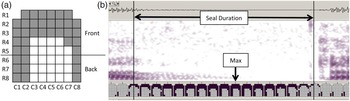
The analysis of articulatory data was performed using the Articulate Assistant software (Wrench et al. Reference Wrench, Gibbon, McNeill, Wood, Hansen and Pellom2002). Measurements were taken at the point of maximum contact for each consonant. We adopted a standard measure – the amount of linguopalatal contact over the entire palate and its front and back regions (Gibbon and Nicolaidis Reference Gibbon, Nicolaidis, Hardcastle and Hewlett1999). This measure can be interpreted as reflecting how tightly (more contact) or loosely (less contact) a given consonant constriction is produced. Specifically, the variables were the Amount of Contact Degree Q (overall) over the entire palate (the number of ‘on’ R1–R8 electrodes divided by 62), the Amount of Contact Qa5 (anterior) in the front five rows of the palate (the number of ‘on’ R1–R5 electrodes divided by 38, the total number of R1–R5 electrodes), and the Amount of Contact Qp3 (posterior) in the back three rows of the palate (the number of ‘on’ R6–R8 electrodes divided by 24). These measurements are illustrated in Figure 2 (a) for a sample token of [tː] (JF3), where Qa5 is 0.76 (29/38) and Qp3 is 0.38 (9/24). All three variables were used, as differences in amount of contact can be manifested in the tightness of the constriction only (Qa5), in the tongue body raising or lateral bracing (Qp3), or in both (Q) (see Shin Reference Shin1997, T. Cho and Keating Reference Cho and Keating2001). However, as the results were essentially the same for Qa5 and Q, only Qa5 results are presented below (section 3.1.2), while Q values are used in scatterplots of amount of contact and duration (section 3.2).
(a) A sample linguopalatal contact profile for [tː] (JF3), with grey cells representing ‘on’ electrodes, segmented by rows (R1-R8) and columns (C1-C8). (b) A sample annotation of a stop closure (matːa, JF3), indicating the seal duration interval and the frame of maximum contact.

The duration variable was Seal Duration (in seconds) – the duration between the first and last frames of the complete closure (cf. T. Cho and Keating Reference Cho and Keating2001), as illustrated in Figure 2 (b). It should be noted that seal duration for stops and affricates is typically higher than zero, unless the closure is incomplete, lenited. Lenition occurred in our data mainly with voiced/lenis affricates. Another possible case of zero seal duration is when the closure is made at the upper teeth rather than at the alveolar ridge (for dental sounds), and thus cannot be captured by the artificial palate. In such cases, a partial constriction in the front rows of the palate is accompanied by an acoustic closure in the waveform and the spectrogram. A close inspection of all tokens showed that this was the case in our data for all but one instance of lenis /t/ produced by KM1, all tokens of lenis /t/, four tokens of fortis /tʹ/, and two tokens of aspirated /tʰ/ produced by KM2, and four tokens of lenis /t/ produced by KF3. In these cases, seal duration values were taken to be the acoustic closure duration of the consonant.
Values for each variable were averaged across multiple repetitions and sessions, resulting in a dataset consisted of 36 values per speaker: 6 words (3 contrasts * 2 manners) * 3 repetitions * 2 sessions. (For consistency, values for JF1's and JF3's sessions 1 and 2, as well as 3 and 4, were averaged.) Statistical analysis employed repeated measures (RM) ANOVAs with the between-subjects factors Language (2 levels: Japanese and Korean) and within-subjects factors Contrast (3 levels: geminate/fortis, voiceless/aspirated, and voiced/lenis), Manner (2 levels: stop and affricate), Session (2 levels: session 1 and 2), and Repetition (3 levels: repetitions 1, 2 and 3). Bonferroni post-hoc tests, adjusted for multiple comparisons, were performed to explore multiple pairwise differences. Spearman correlations were further performed to examine the relation between amount of contact Q and seal duration, both within the two groups and separately for each speaker. As the focus of this paper is on differences between the two languages and within the place contrasts, only the results for Language and Contrast are presented below. (With respect to the other factors, no consistent results were obtained for Session and Repetition, while Manner was significant for Qa5 (more contact for affricates than stops) and Seal Duration (shorter for affricates than stops)).
4.5 A note on the method
EPG, which tracks, in time, the contact between the tongue and an artificial palate, is a well-established method of phonetic investigation of lingual articulations (Gibbon and Nicolaidis Reference Gibbon, Nicolaidis, Hardcastle and Hewlett1999, Stone Reference Stone, Hardcastle, Laver and Gibbon2010), and has been used successfully in studies of supralaryngeal differences in voicing and length contrasts, as summarized in Tables 1 and 2. Notably, the number of participants employed in this study for each language (n = 5) is higher than in typical articulatory studies conducted on Japanese and Korean (the median is 3.5 and 3.0, see Tables 1 and 2). As with any articulatory method, however, EPG has its limitations. Among these are the relatively high cost of producing custom-made palates (which limits the number of participants) and certain restrictions on the kinds of data that can be obtained. Specifically, lingual articulations that are produced beyond the artificial palate – those at the upper teeth or further back at the velum or uvula may not be tracked successfully. Further, while the method shows us exactly where the tongue-palate contact took place, it does not tell us about the degree of the constriction or its strength. (The latter can be measured using pressure-sensitive EPG, a method that is no longer commercially available.) Nevertheless, EPG is superior to other methods in terms of providing high spatial resolution information about lingual constrictions, as opposed to small numbers of sensors on the tongue in EMA and typically sagittal-only images of the tongue and the palate in MRI (Stone Reference Stone, Hardcastle, Laver and Gibbon2010). EPG also provides relatively high temporal resolution in contrast to the static palatography method, which permits the collection of single linguopalatal contact images, with considerable restrictions on word materials, speech style, and quantitative analyses (Anderson Reference Anderson2008).
5. Results
We first discuss the results obtained for the amount of linguopalatal contact, and then turn to the question of seal duration.
5.1 Amount of linguopalatal contact
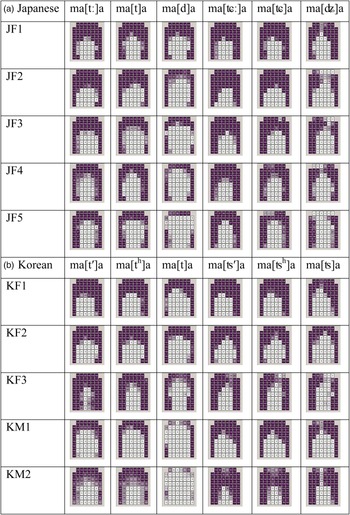
Figure 3 presents sample average linguopalatal contact profiles for the Japanese (a) and Korean (b) consonant contrasts, respectively. All the consonants show a constriction at the front of the palate (usually in the first two to five rows) and some side contact further back, indicative of their alveolar/post-alveolar articulations. Overall, geminate/fortis consonants tend to have more contact than voiceless/aspirated consonants, and both categories have considerably more contact than voiced/lenis consonants. Note that voiced/lenis affricates have a tendency to lenition of the closure, as seen in a narrow central channel in some of the /ʥ/ or /ʦ/ profiles. The lack of alveolar closure for lenis /t/ produced by Korean male speakers can be attributed to the more front, apico- dental articulation of these sounds (cf. Anderson et al. Reference Anderson, Ko, O'Grady and Choo2004, H. Kim Reference Kim2004b). These and other differences are further examined statistically.
Mean linguopalatal profiles at the maximum contact for the Japanese (a) and Korean (b) stops and affricates (based on the first 6–12 tokens). Black = contact in all tokens; white = no contact in any tokens; shades of grey = contact in one or more tokens.

5.1.1 Contact at the front of the palate (Qa5)
A repeated measures ANOVA for Qa5 revealed a main effect of Contrast (F(2,16) = 77.165, p < .001). A Bonferroni post-hoc test showed that Qa5 was higher for geminate/fortis than for voiceless/aspirated (p = .008) and voiced/lenis consonants (p < .001), as well as higher for voiceless/aspirated than for voiced/lenis consonants (p < .001). The factor Language was not significant (F(1,8) = .025, p = .878), nor were its interactions with the other factors.
As there was a significant Contrast * Manner (F(2,16) = 6.094, p = .011) interaction, separate analyses were performed for stops and affricates. For stops, the analysis revealed a main effect of Contrast (F(2,16) = 47.861, p < .001), with Bonferroni post-hoc tests showing significant differences between all three contrast pairs: geminate/fortis had higher Qa5 than their voiceless/aspirated (p = .044) and voiced/lenis stops (p < .001), and voiceless/aspirated stops had higher values than voiced/lenis stops (p = .001). There was no significant effect of Language (F(1,8) = .155, p = .704), and no related significant interactions. For affricates, there was a main effect of Contrast (F(2,16) = 80.871, p < .001), with significant differences involving all three levels: geminate/fortis affricates had higher Qa5 than their voiceless/aspirated (p = .007) and voiced/lenis counterparts (p < .001); voiceless/aspirated affricates showed higher values than voiced/lenis affricates (p < .001). Again Language (F(1,8) = .109, p = .749) was not significant and did not interact with other factors.
Figure 4 plots Qa5 means and standard errors by consonant contrast, manner, and language. It can be seen that the highest amount of contact is shown by geminate/fortis consonants, followed by voiceless/aspirated consonants, and then by voiced/lenis consonants, for both language groups (Japanese /t:,ʨː/ > /t,ʨ/ > /d,ʥ/; Korean /tʹ,ʦʹ/ > /th,ʦh/ > /t,ʦ/). The difference between the last category and the other two is considerable, while the difference between the first two categories is smaller (especially for the Korean /tʹ/ vs. /th/ pair). It should be kept in mind that lower Qa5 values for /t/ produced by some of the Korean speakers are due to the more front articulation of this consonant. Similar contrast differences can be seen in individual results, shown in Figure A1 (Appendix). Notably, all speakers show the three-way average differences in the same direction, except for the reverse /tʹ/ vs. /th/ difference by KM2. As noted in section 4.4, this speaker had several fronted tokens of /tʹ/, reducing the mean for Qa5.
Mean amount of contact in the front five rows of the palate by consonant contrast, manner, and language.

5.1.2 Contact at the back of the palate (Qp3)
A repeated measures ANOVA for Qp3 showed a main effect of Contrast (F(2,16) = 12.332, p = .001). A Bonferroni post-hoc test revealed that Qp3 was significantly higher for geminate/fortis and voiceless/aspirated consonants than for their voiced/lenis counterparts (p = .003; p = .047). The difference between geminate/fortis and voiceless/aspirated consonants was not significant. The factor Language (F(1,8) = .109, p = .750) and any interactions with it were not significant.
Given a significant Manner * Contrast interaction (F(2,16) = 3.703, p = .048), separate analyses were performed for stops and affricates. For stops, the analysis confirmed the main effect of Contrast (F(2,16) = 10.482, p = .001), with Bonferroni post-hoc tests showing significant differences between the voiced/lenis and the other two categories (p = .004 and p = .044), reflecting less palatal contact for the former. For affricates, there was also a main effect of Contrast (F(2,16) = 3.677, p = .049), yet none of the pairwise differences reached the significance level. There were no other significant effects or interactions.
Figure 5 plots Qp3 means and standard errors by consonant contrast, manner, and language. It can be seen that the posterior linguopalatal contact is much lower (up to about 40% of the region) compared to the anterior contact discussed above (Figure 5). Overall, Qp3 values are on average higher for geminate/fortis and voiceless/aspirated consonants on the one hand, and voiced/lenis consonants on the other, with the difference considerably reduced for affricates. Amount of contact tends to be higher for affricates than stops, which is clearly seen for voiced/lenis consonants. Individual results for Qp3 are shown in Figure A2 (Appendix), largely confirming the group observations.
Mean amount of contact in the back three rows of the palate for contrast, manner, and language.

5.2 Seal duration
Recall that seal duration involves the temporal difference between the first and last frames of the complete closure. When a consonant is lenited, showing no alveolar closure, seal duration equals zero. Most of the speakers in both groups showed substantial rates of such lenition of voiced/lenis affricate closures (deaffrication) – overall 62% for Japanese and 55% for Korean. There were also some instances of lenition of voiceless/aspirated affricates (1% for Japanese and 5% for Korean) and voiced /d/ in Japanese (6%). As mentioned in section 2.4, the apparent lack of closure for Korean stops (which accounted for 45% of /t/, 3% of /tʹ/, and 2% of /th/) was attributed to fronting (the apico-dental articulation), and seal duration values for these tokens were based on the acoustic closure duration of the consonant.
A repeated measures ANOVA for seal duration showed a main effect of Contrast (F(2,16) = 347.540, p < .001), with a Bonferroni post-hoc test revealing that values significantly differed for all three categories, decreasing in the order geminate/fortis > voiceless/aspirated > voiced/lenis (all p < .001). The factor Language was also significant (F(1,8) = 6.271, p = .037), with Seal Duration being overall longer for Japanese than Korean. There was, however, a significant Contrast * Language interaction (F(2,16) = 53.746, p < .001). Given this, as well as a significant Manner * Contrast (F(2,16) = 5.536, p = .015) interaction, separate RM ANOVAs were performed for (i) each contrast separately by manner and language, and (ii) each manner separately by language. The first set of analyses revealed significant Language differences for geminate/fortis stops and affricates (F(1,8) = 32.096, p < .001; F(1,8) = 25.213, p = .001), with seal durations being longer for Japanese geminates than Korean fortis consonants. There were no significant Language differences for voiceless/aspirated and voiced/lenis stops and affricates.
The second set of analyses for Japanese alone revealed significant effects of Contrast for both manners (F(2,8) = 215.206, p < .001; F(2,8) = 198.555, p < .001), and significant pairwise differences between geminates and voiceless consonants (both stops and affricates: p = .001), geminates and voiced (both stops and affricates: p < .001), and voiceless and voiced consonants (stops: p = .005; affricates: p = .002).
The second set of analyses for Korean alone also revealed significant effects of Contrast for both manners (F(2,8) = 40.421, p < .001; F(2,8) = 154.161, p < .001). Significant pairwise differences included fortis and aspirated stops and affricates (p = .005; p = .011), fortis and lenis stops and affricates (p = .003; p < .001), and aspirated and lenis affricates (p = .001). The differences between aspirated and lenis stops did not reach significance, being marginal (p = .06).
Figure 6 plots seal duration means and standard errors by consonant contrast, manner, and language. It can be seen that the geminate/fortis consonants have the longest seal duration, followed by voiceless/aspirated consonants, and then by voiced/lenis consonants. There are, however, some clear language-particular differences: the Japanese geminates are about twice as long as voiceless singletons, while the differences between the Korean fortis and aspirated consonants are much smaller. Comparing the languages, Japanese geminates are much longer than Korean fortis consonants, with the other categories being remarkably similar in the two languages. Individual results are shown in Figure A3. It is worth noting that all speakers consistently show a three-way duration distinction: /t:,ʨː/ > /t,ʨ/ > /d,ʥ/ for Japanese and /tʹ,ʦʹ/ > /th,ʦh/ > /t,ʦ/ for Korean, consistent with the observations stated above.
Mean seal duration (sec.) by contrast, manner, and language.

To investigate the relation between Seal Duration and amount of contact Q, Spearman two-tailed correlations were performed for stops and affricates, separately by language group and by individual speaker. The two variables were found to be significantly positively correlated for both stops (Japanese: r s(90) = .746, p < .001; Korean: r s(54) = .720, p < .001) and affricates (Japanese: r s(90) = .843, p < .001; Korean: r s(54) = .581, p < .001). Figure 7 plots mean Q and seal duration values for stops and affricates by language group, with the trend in each sub-plot represented by a fit line. It can be seen that for both language groups, greater amount of contact implies longer duration (and vice versa). Both languages also show a very clear separation between voiced/lenis and the other two categories, and the voiced and lenis categories have similar values in both groups. The separation between the geminate/fortis and voiceless/aspirated categories, however, is greater for Japanese due to the overall much higher Q and (especially) duration values for the geminates. Individual plots are shown by language in Figure A4 and A5. (All correlations for individual speakers were significant at the p < .001 level, except for JF1's affricates and KM2's stops having p < .01 and p < .05 respectively; r s values were on average .894 for Japanese and .832 for Korean).
Amount of contact over the entire palate by seal duration (sec.) by consonant manner and language (averaged across speakers).

6. Discussion
In this study, we investigated the production of Japanese and Korean coronal stops and affricates by five speakers of each language. We focused on the amount of linguopalatal contact and articulatory closure duration for three Japanese categories – geminate, (singleton) voiceless, and (singleton) voiced, and three Korean categories – fortis, aspirated, and lenis. The results, summarized in Table 3, revealed that the amount of linguopalatal contact in the anterior region (Qa5) clearly differentiated all three series of stops/affricates. Specifically, geminate/fortis and voiceless/aspirated consonants showed substantially more anterior contact than their voiced/lenis counterparts (Japanese /t:,ʨː,t,ʨ / > /d,ʥ/; Korean /tʹ,ʦʹ,th,ʦh/ > /t,ʦ/). Importantly for our analysis, geminate/fortis consonants also showed more anterior contact than singleton voiceless/aspirated consonants (Japanese /t:,ʨː/ > /t,ʨ/; Korean /tʹ,ʦʹ/ > /th,ʦh/), although this difference was overall smaller in magnitude. Altogether, this provides evidence for a three-way supralaryngeal contrast in both languages. In the posterior region (Qp3), this contrast is reduced to a two-way contrast in stops (geminate/fortis, voiceless/aspirated > voiced/lenis), and neutralized in affricates. Remarkably, there were no significant differences in contact degree between the language groups for any of the three categories, despite the fact that their (underlying) featural classifications are drastically different.
A summary of results for the factor Contrast. (*** = significant at p < .001, ** = significant at p < .01, * = significant at p < .05, (*) = non-significant but marginal p < .07), n.s. = other non-significant at p ≥ .07)

Turning to duration, the three consonant categories were also well differentiated by the seal duration variable, which shows how long a complete coronal closure is produced. The results showed that the geminate/fortis consonants were the longest, followed by voiceless/aspirated, and then voiced/lenis consonants (Japanese /t:,ʨː/ > /t,ʨ/ > /d,ʥ/; Korean /tʹ,ʦʹ/ > /th,ʦh/ > /t,ʦ/, although marginal for Korean /th/ vs. /t/). The magnitude of the difference between the first two contrasts, however, was much greater for the Japanese group than for the Korean group, reflecting the fact that length is the primary correlate of the geminate/singleton contrast in Japanese, and suggesting that the length of fortis consonants in Korean is secondary, and derived. At the same time, duration results for the other two categories were remarkably similar, mirroring the results for amount of contact. Correlations between spatial and temporal measures (amount of contact and seal duration) were significant for both Japanese and Korean speakers, suggesting that greater linguopalatal contact implies longer duration, and vice versa.
Our findings for Japanese are important, as they provide the first articulatory evidence (apart from Kochetov Reference Kochetov2012 and seemingly from NLRI 1990; see section 2.1) for the relation between duration and amount of contact in geminates. This relation was suggested based on impressionistic observations (Sakuma Reference Sakuma1929) and acoustic analysis (Kawahara Reference Kawahara2006, Reference Kawahara and Kubozono2015; Idemaru and Guion Reference Idemaru and Guion2008), but not previously explored articulatorily. These results add to the cross-linguistic evidence for the importance of non-durational properties of geminate consonants (cf. Ramasubramanian and Thosar Reference Ramasubramanian and Thosar1971, Farnetani Reference Farnetani, Hardcastle and Marchal1990, Payne Reference Payne2006, Bouarourou et al. Reference Bouarourou, Vaxelaire, Ridouane, Hirsch, Sock, Sock, Fuchs and Laprie2008, Riduouane 2010 on geminates in Italian, Tamil, and Berber; see section 2.1). The finding of the relatively weak (loose and short) realization of Japanese intervocalic voiced /d/ is unexpected, as previous descriptive phonetic accounts do not report weakening of alveolar /d/, in contrast with bilabial and velar stops /b/ and /ɡ/ (Vance Reference Vance1987, Okada Reference Okada1999; but see Shibata Reference Shibata1968, NLRI 1990, Matsumura et al. Reference Matsumura, Kimura, Yoshino, Tachimura and Wada1994, Kochetov Reference Kochetov2014, among others). This could be because the degree of alveolar weakening is smaller and not as clearly auditorily perceptible. Interestingly, our results show that spatial lenition of the stop /d/ is often greater than that of the affricate /ʥ/, which has been noted to be prone to deaffrication (Vance Reference Vance1987). Regardless of this difference, the results add to the growing body of cross-linguistic work documenting supralaryngeal correlates of voicing (Dixit Reference Dixit1990, Moen and Simonsen Reference Moen, Simonsen, Kokkinakis, Fakotakis and Dermatas1997, Fuchs Reference Fuchs2005, among others; see section 2.2).
Our results for Korean stops and affricates may not be as novel, given the previous extensive articulatory work on supralaryngeal properties of the three-way contrast (C.-W. Kim Reference Kim1970; Shin Reference Shin1997; T. Cho and Keating Reference Cho and Keating2001; H. Kim et al. Reference Kim, Honda and Maeda2005, Reference Kim, Maeda and Honda2010; Brunner et al. Reference Brunner, Fuchs and Perrier2011; see Table 2 in section 2.3). It should be noted, however, that many of these works were based on relatively small samples of speakers (median 3), and therefore the data obtained from five speakers in the current study are an important contribution. The fact that our linguopalatal contact results are very similar to those of EPG studies by Shin (Reference Shin1997) and T. Cho and Keating (Reference Cho and Keating2001) indicate that the supralaryngeal differences in question are robust in the language, and that the EPG method is an appropriate tool for investigation of such differences.
Altogether, these results support our prediction that the two sets of phonologically distinct categories are implemented phonetically in a very similar way, at least at the supralaryngeal level. Indeed, the three categories in each language lined up roughly on the diagonal between the potential ‘loose/short’ and ‘tight/long’ extremes (cf. Figures 1 and 7). Particularly remarkable is the similarity between the Japanese voiced and the Korean lenis stops/affricates, as well as between the Japanese (single) voiceless and the Korean aspirated segments. Recall that loose and short closures (Constriction Degree [closed: loose]) for Japanese /d,ʥ/ were expected to result from the enhancement of the feature [slack vocal folds] (see (2b) and (8)). The same rule presumably applied in the case of Korean /t,ʦ/, which, based on (3b), are underspecified for laryngeal features, yet receive [slack vocal folds] intervocalically prior to phonetic implementation (Iverson Reference Iverson1983b, Avery and Idsardi Reference Avery, Idsardi and Alan Hall2001). The application of these rules is repeated in (9a) below.
The similarity in the supralaryngeal realization of Japanese /t,ʨ/ and Korean /th,ʦh/ is somewhat less expected under the traditional specification. Based on (2b) and (3b), both have the feature [spread glottis] (although only on the surface in Japanese; see Tsuchida Reference Tsuchida1997, Avery and Idsardi Reference Avery, Idsardi and Alan Hall2001), but the Korean consonants are also specified for the feature [stiff vocal folds]. Yet, as discussed in section 3.3, the basis for this specification is not as clear as for Korean fortis consonants (Hardcastle Reference Hardcastle1973, Kagaya Reference Kagaya1974, Iverson Reference Iverson1983b). If linguopalatal contact can in any way reflect the stiffening/tensing of the glottis, our results fail to provide evidence for the [stiff vocal folds] specification of the Korean aspirated stops/affricates. This conclusion is corroborated by the presence of significant differences between Korean /th,ʦh/ and /tʹ,ʦʹ/ both spatially and durationally. Assuming our enhancement rules (9c), this would be predicted if the aspirates were not specified for [stiff vocal folds], while the fortis consonants were. The revised feature specification for Korean aspirates is shown in (9b). Clearly, more instrumental research into the laryngeal settings of Korean stop/affricate contrasts is needed to settle the case.
Both Japanese geminates and Korean fortis consonants were found to show the tightest and longest constrictions within each language dataset. This was predicted by our feature specifications and enhancement rules, as shown in (9c) (see also (7) and (8b)). Prosodically specified length in Japanese stops/affricates is enhanced by the consonants’ tighter closures. Korean fortis stops/affricates, which are specified for [stiff vocal folds], are also enhanced by tight closures, and these are automatically accompanied by longer durations (given more distant virtual targets: Löfqvist and Gracco Reference Löfqvist and Gracco1997, Löfqvist Reference Löfqvist2006, Brunner et al. Reference Brunner, Fuchs and Perrier2011). The two different sources of duration – prosodically specified in phonology vs. phonetically enhanced – explain the robust durational difference between Japanese /t:,ʨː/ and Korean /tʹ,ʦʹ/ found in the current study. This further underscores an important distinction between primary (phonological) and secondary (phonetically enhancing) properties of contrasts. In Japanese, prosodic (moraic) length is at the core of the phonology (Homma Reference Homma1981, Beckman Reference Beckman1982, among others), while in Korean it is a secondary, enhancing property of laryngeal contrasts.
(9) Enhancement of Japanese and Korean contrasts: summary
Japanese Korean (V_V)
Features Supralaryngeal gestures Features
a. /d/ X, [slack] → CD [closed: loose] ← X, ([slack])/t/
b. /t/ X, ([spread]) → CD [closed] ← X, [spread]/tʰ/
c. /tː/ XX, ([spread]) → CD [closed: tight] ← X, [constricted, stiff]/tʹ/
In sum, the results of the study support the role of supralaryngeal enhancement rules and feature representations in (9). This, in turn, largely confirms the appropriateness of previous phonological analyses of Japanese (e.g., Itô and Mester Reference Itô and Mester1986, Avery and Idsardi Reference Avery, Idsardi and Alan Hall2001) and Korean contrasts (Iverson Reference Iverson1983a, Reference Iverson1983b; apart from [stiff] for the aspirated), and the insights provided by the revised laryngeal feature framework by Halle and Stevens (Reference Halle and Stevens1971). In contrast, our results are only partly consistent with two alternative feature specifications for Korean (see (4) and (5)). Recall that the use of the feature [tense] (C.W. Kim Reference Kim1965, Reference Kim1970; H. Kim Reference Kim, van Oostendorp and van de Weijer2004a, Reference Kim, Moulton and Wolf2004c; H. Kim et al. Reference Kim, Maeda and Honda2010) for both fortis and aspirated consonants predicts their equally tighter closures and longer durations. This contradicts our findings, as well as findings of various other studies summarized in Table 2. While this framework correctly predicts the similarity of Korean fortis consonants to Japanese geminates in constriction degree, the clear similarity between Korean aspirated and lenis consonants and Japanese voiceless and voiced consonants (respectively) is not predicted.
The second alternative approach posits that Korean fortis consonants are geminates (Martin Reference Martin and Yang1982, Avery and Idsardi Reference Avery, Idsardi and Alan Hall2001, M.-R. Kim and Duanmu Reference Kim and Duanmu2004, among others), and are therefore predicted to be phonetically realized very similarly to the Japanese geminates. While this is consistent with our spatial results, the robust temporal differences between two languages remain unexplained. Finally, this approach makes no predictions about different kinds of closures for the three consonant types, nor about differences in duration between the aspirated and the lenis. It is not, however, inconsistent with the enhancement rules proposed in the current paper.
Aside from supralaryngeal and length effects, any feature system proposed for Korean obstruents should be capable of handling observed acoustic differences in F0. Earlier work had noted consistently higher F0 for fortis and aspirated stops (see T. Cho et al. Reference Cho, Jun and Ladefoged2002 for a review). Yet more recent work (Silva Reference Silva2006, Kang Reference Kang2014, among others) has documented a change in progress in Seoul Korean resulting in a stable three-way difference, with aspirated and lenis consonants having the highest and the lowest F0 respectively (i.e., aspirated > fortis > lenis). The new F0 distinction has presumably arisen as a compensation for the merger of voice-onset time (VOT) in aspirated and lenis stops word-initially. The differences between fortis and aspirated stops in F0 can be attributed to different laryngeal sources: the stiffening of the vocal folds, and high subglottal pressure (with some degree of stiffness), respectively (Kagaya Reference Kagaya1974). This is consistent with the feature system in (9), given the [stiff] specification for the fortis and an assumption that high subglottal pressure in aspirated stops is a side effect their [spread] specification. Presumably, aspirated stops produced by younger Seoul Korean speakers are characterized by even higher supraglottal pressure, resulting in higher F0 than for fortis stops. This certainly warrants a thorough laryngeal articulatory investigation involving older and younger speakers of Seoul Korean.
Overall, the findings of this study regarding supralaryngeal and length differences should be confirmed for other places and manners of articulation, as well as for other vowel and prosodic contexts. There are also important differences between the two languages that are well beyond the scope of this study. These differences are in the phonemic extent and phonotactic distribution of the relevant contrasts. The Japanese length distinction, for example, involves not only stops/affricates, but also fricatives and nasals, while the voiced/voiceless contrast is limited to obstruents (stops, affricates, and fricatives). The Korean laryngeal contrast includes all obstruents, with sibilant fricatives having a reduced, two-way contrast between fortis and lenis. In Japanese, the voicing contrast occurs both word-medially and word-initially, while the length contrast is limited to the word-medial position. The Korean laryngeal contrasts, on the other hand, all occur word-medially and word-initially. How do articulatory properties of Japanese and Korean consonants compare in various phonotactic contexts? An answer to this question is expected to provide some further insight into articulatory patterning of length and laryngeal contrasts.
7. Conclusion
Our articulatory investigation of Japanese and Korean length/laryngeal contrasts in stops and affricates has uncovered strong similarities between the two phonologically different sets of consonants in constriction degree and duration. These similarities can be attributed to articulatory phonetic pressures exerted on the production of geminate/singleton, voiced/voiceless, and fortis/lenis contrasts – all resulting in the mapping of different phonological categories onto a similar set of articulatory targets. This is done using independently motivated phonetic enhancement rules. Many-to-one mappings of this kind are perhaps not so uncommon, as the phonetic space is finite and subject to multiple physiological and auditory pressures. For example, secondary palatalization contrasts in consonants and rounding contrasts in front vowels have seemingly little in common phonologically. However, their phonetic exponents utilize the same acoustic dimension, namely, difference in F2. This creates near-equivalence at the phonetic (articulatory and perceptual auditory) level despite the robust phonological distinction, leading to interactions between vowel backness/rounding and consonantal palatalization. For example, back rounded vowels have front allophones next to palatalized consonants, while consonants are often phonetically palatalized next to front (rounded or unrounded) vowels (Jakobson Reference Jakobson1971; Flemming Reference Flemming1995). What is interesting about such mappings is that they severely restrict phonological/phonetic typology, as well as create ambiguity for the learner, potentially leading to sound change. The near-equivalence at the phonetic level explains the typological observation that languages rarely exhibit both secondary palatalization and front rounded vowel contrasts. Instead, the two types of contrasts tend to be complementary across languages, and there are cases of palatality historically shifting from consonants to vowels and vice versa (Jakobson Reference Jakobson1971). Similarly, we would expect geminate/singleton and fortis/lenis contrasts to be avoided in the same language, and that the two should be subject to reinterpretation and evolution into each other. Historical development of fortis obstruents from geminate contrasts and vice versa is in fact well attested across languages (e.g., Nakh-Daghestanian languages: Trubetzkoy Reference Trubetzkoy1931; see also Lavoie Reference Lavoie2001). In fact, Korean fortis obstruents could have been historically geminates (ultimately developing from clusters; Lee Reference Lee1985), while Japanese-Korean L2 and loanword adaptation patterns provide evidence for the mapping in the reverse direction (S.-J. Kim Reference Kim1996, Y.-K. Kim Reference Kim2004, Ito et al. Reference Ito, Kang, Kenstowicz, Hsieh and Kenstowicz2006, H. Kim Reference Kim2008). To conclude, articulatory analysis of phonetic implementation of phonological contrasts is a fruitful area of research that can provide intriguing insights into the phonology/phonetics interactions, cross-language typology, and sound change.
Appendix
Mean amount of contact in the front five rows of the palate by consonant contrast, manner, and speaker.

Mean amount of contact in the back three rows of the palate for contrast, manner, and speaker.

Mean seal duration (sec.) by contrast, manner, and speaker.

Amount of contact over the entire palate by seal duration (sec.) by consonant manner and speaker for Japanese.

Amount of contact over the entire palate by seal duration (sec.) by consonant manner and speaker for Korean.