

1. INTRODUCTION
Work in sociolinguistic typology, particularly Trudgill (Reference Trudgill2011) but also McWhorter (Reference McWhorter2011) and Dahl (Reference Dahl2004), has proposed relationships between types of language contact and simplificatory and complexificatory language change. The central claims of this literature are that intensive contact leads to grammatical simplification, whilst both isolation and stable contact involving child bilingualism lead to the growth and maintenance of complexity. This work has pointed to many compelling case studies of language histories which feature both intensive contact and grammatical simplification, one of which is the history of North Germanic. In this paper, we examine the proposed causal link between contact and simplification for two changes in the history of Norwegian. If the link is correct, it is predicted that the changes must have originated in localities where contact took place: either Low German settlements in Norway, or in Sweden, where the Low German presence was larger.
2. BACKGROUND
2.1. The “Trudgill conjecture”
The notion that all languages have an equivalent degree of complexity was at one time very much part of the conventional wisdom of the linguistics community. Hockett wrote that “the total grammatical complexity of any language, counting both morphology and syntax, is about the same as any other” (Reference Hockett1958:180–181). The idea was that simplification at the level of morphology would be compensated for by complexification at the level of syntax, and vice versa.
However, this invariance of linguistic complexity hypothesis or equicomplexity hypothesis has always been implicitly rejected by those sociolinguists, creolists, and dialectologists who discerned that language contact of certain sorts led to simplification—as in the development of creoles (Sampson, Gil & Trudgill Reference Sampson, Gil and Trudgill2009). It had always been obvious to them that, if the same language could be more or less simple at different points in time, then different languages could be more or less simple at the same point in time. More recently, the thesis has come under renewed examination, and the equicomplexity hypothesis has been quantitatively demonstrated to be unfounded by a number of writers such as Kusters (Reference Kusters2003), Shosted (Reference Shosted2006), and Sinnemäki (Reference Sinnemäki, Sampson, Gil and Trudgill2009) (note, however, cautionary voices especially within Creole studies such as Aboh & deGraff (Reference deGraff and Aboh2017)).Footnote 1
But then, if some languages are more complex than others, the question arises as to why this is. How does it come about that complexity is not evenly distributed across human languages? How is it that some languages and dialects are, in some important sense, simpler than others? Sociolinguists have for a long time had part of an answer to this question. If language contact leads to simplification, then the more contact a language has experienced, the less complex it will be.
But from work in sociolinguistic typology (Trudgill, Reference Trudgill2011), it has become clear that we are not just talking here about all forms of contact. The crucial form of contact for producing simplification is the form which leads to foreign language/dialect learning by adults and adolescents who have passed the “critical threshold” (Lenneberg, Reference Lenneberg1967), beyond which the majority of human beings are incapable of learning a new variety perfectly. As Dahl says, when it comes to language learning, especially informal untutored language learning, “human children indeed seem to have an advantage compared to […] adult members of their own species” (Dahl, Reference Dahl2004:294). Where such learning occurs, there will be a tendency for phenomena that are “L2 difficult” to disappear (Dahl, Reference Dahl2004). Such scenarios are instantiated most starkly in the conditions that give rise to creoles (DeGraff, Reference DeGraff and DeGraff1999; DeGraff, Reference DeGraff, Cinque and Kayne2005).
Simplification, as illustrated by a comparison of creoles with their source languages, takes the form of a number of processes, most notably:
1. The regularization of irregularities: in regularization, obviously, irregularity diminishes so that, for example, irregular verbs and irregular plurals become regulars—less L2-difficult to remember than irregular ones.
2. An increase in lexical and morphological transparency: for example, forms such as twice and seldom are less transparent than two times and not often, and any (partial or complete) replacement of the former by the latter would represent simplification. These two factors are often linked—forms such as cows are more transparent or analytic, and iconic, than forms like kine. Any reduction in opacity also represents a reduction in L2 difficulty.
3. The loss of syntagmatic redundancy, as in the case of grammatical agreement, where information is repeated. Here, reduction in redundancy will take the form of reduction of the number of repetitions, as in the loss of agreement. For L2 learners, this represents a reduction in the number of operations a speaker has to remember to carry out.
4. The loss of morphological categories: the loss of the morphological expression of grammatical categories may be compensated for by the use of more analytical structures, as in usage in Modern English of prepositions instead of the dative case of Old English. Or categories may be lost altogether, as in the loss of grammatical gender from Afrikaans, in which case there is simply less to learn.
Varieties which have undergone any of these processes, 1–4, are less complex than they were before they underwent those processes. An important concomitant of the fact that adult language-contact leads to simplification is that absence of this type of contact will tend to lead to the maintenance of existing complexity. But we cannot suppose that differential complexity across languages is due simply to different degrees of simplification. It is clear that it is also due to different degrees of complexification. Indeed, contact between languages, if it is of the appropriate type, can actually lead to greater complexity. This is due to additive borrowing, in which grammatical categories are transferred from one language to another and added to the features that the language already possesses without replacing any existing features. A language which acquires an additional grammatical category from a neighboring language is clearly more complex than it was before. But what type of contact is it that tends to lead to additive complexification? The answer is that we can expect to see the addition of complexity to languages in longterm, coterritorial contact situations which involve childhood, and therefore prethreshold and proficient, bilingualism. It is this kind of development which gives rise to the phenomenon of the Sprachbund, where languages acquire features and structures from each other.
But this is only additive complexity, where morphological categories are acquired from another language. What about other aspects of complexification? If we assume that complexification consists of the reverses of process 1–4 above, then where does irregularity “come from”? What are the “origins” of opacity? Under what sociolinguistic conditions does grammatical agreement develop? And what about the language-internal creation of morphological categories? Where, that is, does complexity come from “in the first place”? Trudgill (Reference Trudgill2011) suggests that linguistic complexification is most likely to develop in languages spoken in communities with certain social characteristics, the most favorable environments for complexity-development being in communities with: low amounts of adult language contact; high social stability; small size; dense social networks; and large amounts of communally shared information.
This constellation of features does not necessarily lead to complexification; rather, it is simply the case that these features represent a precondition for complexity development. Such societies are hospitable to complexity development, but do not inevitably produce it.
2.2. North Germanic
The North Germanic languages appear to offer a paradigm case of simplification under intensive contact. Over the course of the Middle Ages, the Continental branch (Swedish, Danish, and Norwegian) was subject to intensive contact with Low German through the Hanseatic League. Hanseatic merchants represented as much as half the population of cities such as Bergen and Stockholm for extended periods of time (Jahr, Reference Jahr and Jahr1999:123; Nesse, Reference Nesse2002:83; Rambø, Reference Rambø, Elmevik and Jahr2012:47; Blaxter, Reference Blaxter2017:47–48). These merchants, all of whom were men, were temporary residents who migrated to Scandinavia as teenagers. In most cases there were various barriers in place to prevent their integrating fully into the local population, such as a ban on marrying locals (Nesse, Reference Nesse, Elmevik and Jahr2012:82; Mähl, Reference Mähl, Elmevik and Jahr2012:117; Nedkvitne, Reference Nedkvitne2014:30–33; Burkhardt, Reference Burkhardt and Harreld2015:133–159). As such, they clearly represented a steady supply of nonnative speakers who might be expected to have learned the local languages imperfectly. From a linguistic standpoint, we do indeed find massive structural simplification in the Continental North Germanic languages over the last 700 years: they have undergone phonotactic and phonological simplifications, largely lost nominal case and subject-verb agreement, and regularized their remaining paradigms.Footnote 2 In the Insular North Germanic languages, Icelandic and Faroese, which had no such contact with Low German, complex features are much better maintained. Our basic hypothesis, then, is that Low German contact was responsible for structural simplification in Continental North Germanic.
Our best localized dataset for Middle North Germanic is for Middle Norwegian, so it is on the genesis of these simplificatory changes in Norwegian that this paper concentrates. We can derive two possible predictions from our hypothesis. If simplificatory changes arose due to Low German contact, then they must have arisen in the localities where that contact took place. Norway was the site of the smallest Hansa presence and within Norway the Hansa were concentrated primarily in Bergen, and to a lesser extent Oslo and Tønsberg. The Hansa presence in Bergen in particular was substantial: perhaps as many as 4000/8800 (45%) in summers by 1500 (Fossen, Reference Fossen1979:761; Helle, Reference Helle1982:489,743,762; Nedrebø, Reference Nedrebø1990:37; Nedkvitne, Reference Nedkvitne, Elmevik and Jahr2012:22; summarized in Blaxter, Reference Blaxter2017:47–48). This encourages the idea that Low German contact features in Norwegian should have spread from one of these three cities, most likely Bergen. However, urbanization was slow and inconsistent in Norway, with cities making up no more than 5% of the population by 1300 (Holt, Reference Holt2007) (this is an upper bound; the estimate given by De Vries (Reference De Vries2007:39) for the whole of Scandinavia two centuries later is much lower). Sweden and Denmark, by contrast, had larger cities with still larger Hansa populations (Blomkvist, Reference Blomkvist and Hammarström1979; Dahlbäck, Reference Dahlbäck, Nilsson and Lilja1998; Mähl, Reference Mähl, Elmevik and Jahr2012:116–117; Nedkvitne, Reference Nedkvitne, Elmevik and Jahr2012:19). This suggests the alternative prediction that Low German contact features diffused into Norwegian from Swedish (or possibly Danish). Thus, for the remainder of this paper, we will examine two simplificatory changes in the history of Norwegian and try to identify their places of origin within Scandinavia.
3. CORPORA
The research described in this paper is based on two corpora. The Diplomatarium Norvegicum (DN) contains all charters from or concerning Norway dating from the middle ages (the vast majority date between 1300 and 1550). The corpus used here is restricted to the charters written (at least partially) in a North Germanic language which are original (not copies or forgeries). In total, this comprises 10,683 documents containing around 2.7 million words of text. The vast majority of these are dated to a specific day and year; a large subset have been localized to one or more places within Norway (localizations most commonly reflect the place of origins of signatories, the locations of meetings, and the places of publication). Some examples of previous research undertaken with these sources include Pettersen (Reference Pettersen1975, Reference Pettersen1991), Mørck (Reference Mørck1980, Reference Mørck2013), Sundquist (Reference Sundquist2002, Reference Sundquist2006, Reference Sundquist, Jonas, Whitman and Garrett2012), and Wetås (Reference Wetås2008). For more detail on this corpus, see Blaxter (Reference Blaxter2017).
The Diplomatarium Svecanum (DS) is a parallel collection of Swedish charters but, unlike the DN, has not been entirely digitized. The corpus used here contains two samples of digitized charters: 1,023 original charters dating between 1334 and 1379, and 1,810 original charters dating between 1399 and 1425. These are dated but have not been localized.
4. SOURCES OF EVIDENCE
Changes diffusing from Bergen, Oslo, or Tønsberg should be easy to identify within the data. Alternatively, three sources of evidence can help us to identify whether a change spread into Norwegian from Swedish.
Firstly, we can look at relative chronology in Norwegian and Swedish texts; if a variant diffused from Sweden into Norway, we would expect to see it earlier in Swedish texts.
Secondly, we can look at Norwegian texts from the areas which changed from Norwegian to Swedish control in the middle ages, Bohuslän and Jämtland. Texts from Jämtland shift gradually from the Norwegian to the Swedish written standard over the period under study, reflecting the gradual movement of Jämtland from the Norwegian to Swedish sphere of influence (Larsson, Reference Larsson2012:50; Njåstad, Reference Njåstad2003:150–153; Slungård, Reference Slungård2015), and so might also be expected to show the change earlier if it spread into Norwegian from Swedish. Bohuslän changed hands later and less gradually, but was nevertheless a border region that might be expected to be particularly susceptible to Swedish influence.
Both of these types of evidence are subject to the problem of interference from the different written standards: if it were the case that one written standard allowed a spoken variant to be represented whilst the other did not, this would give the impression that it was more frequent in one region than the other independently of its status in speech.
The third form of evidence is geographical distribution in Norwegian sources. If a change diffused into Norwegian from Swedish, its point of entry must have been a site of contact with Swedish: either somewhere in east Norway, along the border with Sweden, or the Norwegian cities where merchants and clergy from elsewhere in Scandinavia were most often found (Blaxter, Reference Blaxter2017:57). Accordingly, one or more of these areas would be expected to be very innovative compared with the rest of Norway. This is the most useful form of evidence, since it is less subject to interference from writing practices.
5. RISE OF SVARABHAKTI VOWELS
5.1. Definition of the variable
Old Norse allowed complex coda clusters with rising sonority, particularly clusters of obstruent+/r/. These coda clusters were eliminated by the insertion of epenthetic (‘svarabhakti’) vowels in all North Germanic varieties (Indrebø, Reference Indrebø1951:118; Seip, Reference Seip1955:68,72; Schulte, Reference Schulte, Bandle, Jahr, Karker, Naumann, Teleman and Braunmüller2005:1084–1085; Hagland, Reference Hagland and Haugen2011:506). This is a simplificatory change in two senses: it eliminates a marked syllable type and reduces the total number of syllable types distinguished.
In terms of orthographies, we can distinguish between representations of the cluster with a vowel intervening between the C and the <r> and those without. We can also potentially distinguish between different svarabhakti vowel qualities, although this is not strictly relevant to the simplificatory change itself. As with any investigation into sound change from written evidence, we cannot truly know whether shifting orthographies kept pace with changes in the spoken language. The traditional assumption has been that these sound changes happened much earlier in speech than in writing (Indrebø, Reference Indrebø1951; Seip, Reference Seip1955) but this seems to have been based on isolated early attestations of svarabhakti vowel spellings in names on coins, which could instead be interpreted as Latinized. Later scholars have contested this assumption (Farstad, Reference Farstad1991:56). As will be shown below, the orthographic changes follow a course which is consistent with their reflecting ongoing sound change: we find an s-curve over time and a relatively clear pattern of geospatial diffusion. Given this, although the possibility that this is a purely orthographic phenomenon can never be totally excluded, Occam’s razor suggests we should assume that we are seeing good evidence for an ongoing sound change in these data.
5.2. The dataset
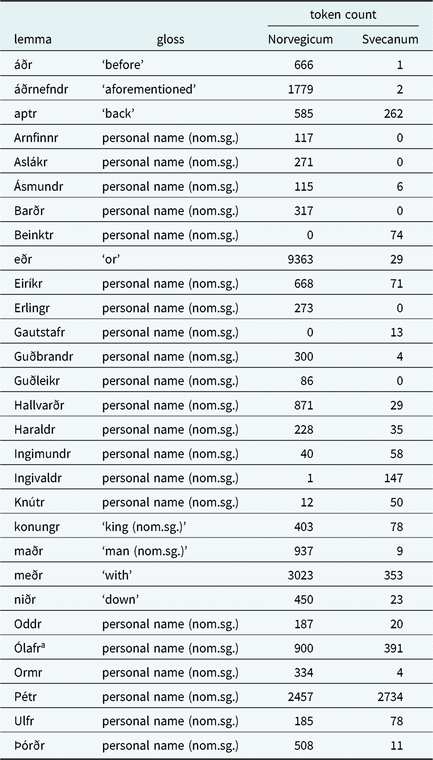
All instances of 29 different forms containing etymological coda /Cr/ were identified in the corpus; these were selected simply as the most frequent words containing /Cr/ which were not ambiguous with any common forms containing /CVr/. After excluding documents known to be copies or forgeries and tokens which were ambiguous with other forms (most notably cases where it was not possible to determine from context whether a noun ending in -Vr was an analogical -ar genitive singular or a nominative singular in -r), this totaled 25,076 tokens in 6,675 documents in the DN and 4,482 tokens in 1,347 documents in the DS. Type-token counts are given in Table 1.
Svarabhakti vowel token counts by form and corpus

a A particular ambiguity arises with the cluster /fr/: the orthographies < fur fwr fvr > could indicate [vur], but, since < fu fw fv > are also common ways of representing [v], they could equally represent [vr]. In each case, the latter interpretation was favoured if the same spelling was used elsewhere in the document to represent [v].
5.3. Chronology
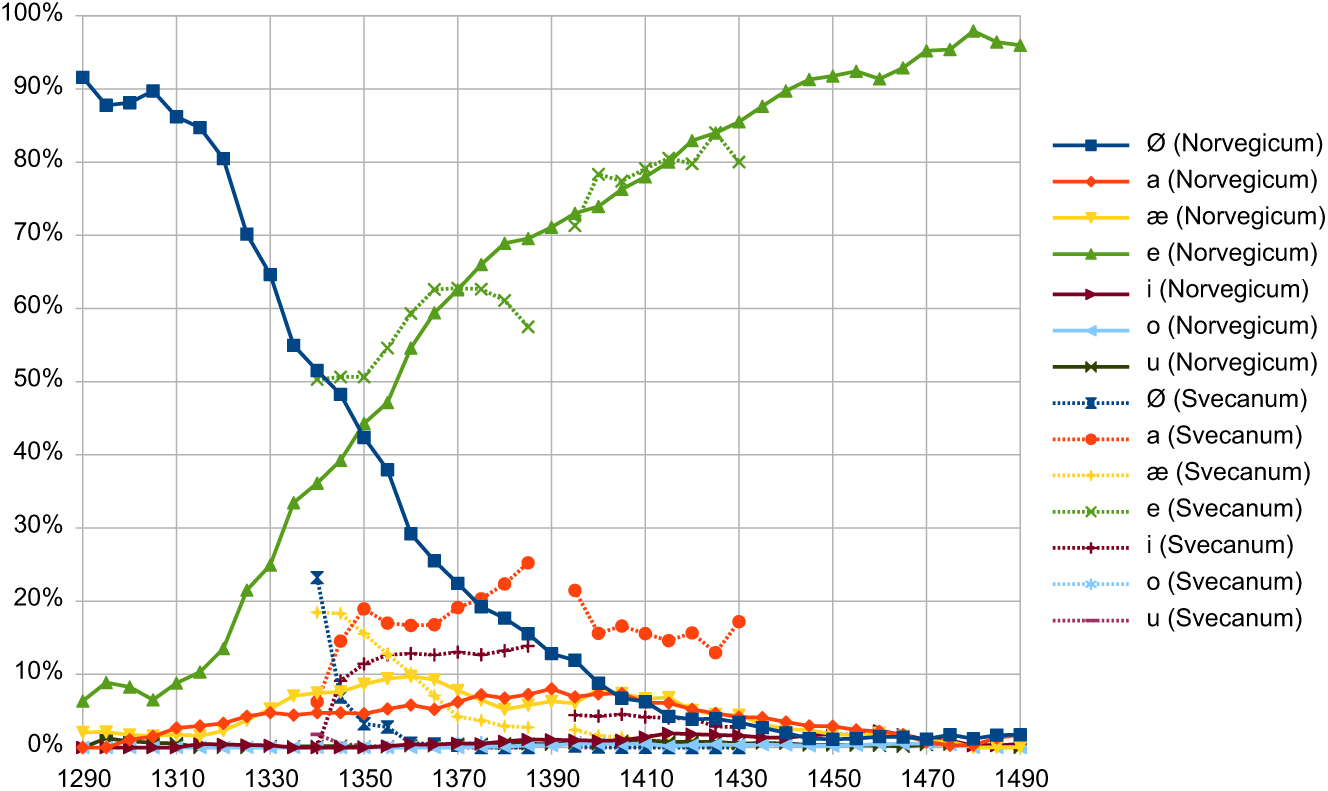
Figure 1 gives the mean rates of different variants in each document by 5-year period and corpus (this is given rather than the overall rates of different variants to avoid overweighting longer documents). As can be seen, in the earliest period covered by the DN (solid lines), most tokens have no svarabhakti vowel. The rates of various svarabhakti vowel spellings increase steadily from shortly after the beginning of the 14th century; <e> spellings come to dominate, so that by the end of the 15th century these are almost categorical. We can thus see two changes in the data: the disappearance of <Cr> clusters, and the rise of <Cer> spellings over options.
Mean proportion of each variant per document by 5-year period and corpus.

Turning to the Swedish data (dotted lines), we see that the trajectory of the rise of <Cer> is strikingly similar to that identified for Norwegian. The disappearance of <Cr> spellings, however, appears to take place rather earlier. In 1345–1350, the earliest period for which we have Swedish data, <Cr> spellings represent on average 26.53% of Swedish tokens, compared with 50.55% of Norwegian tokens; these spellings disappear almost entirely from all later Swedish data, while declining in Norwegian more gradually. What is more, there is relatively little Swedish data in this first 5-year period: 26.53% reflects just 10 tokens distributed across 14 documents (with a total of 35 tokens, including all variants). Thus, given the abrupt fall in rate of <Cr> after this date, it seems quite possible that the true rate was rather lower than 26% already in 1345.
5.4. Geographical distribution
The data are noisy and unevenly distributed in time and space, meaning that it would be hard to gain a clear idea of overall distribution simply by plotting the occurrences of different spellings on a map. Accordingly, kernel density estimation (KDE) was used to calculate approximate rates of different spellings at each point in time and space. KDE is a method of estimating the rate of a variable in n-dimensional space: at each point, a weighted average is taken of all the data where weights are a function of distance from the point of interest. This function is called the kernel function. For our purposes, the most appropriate kernel function in time is a Gaussian kernel (so data further from the year of interest are weighted progressively lower on a Gaussian curve) and the most appropriate spatial kernel is an adaptive uniform kernel (so the estimation at each point in space is an average of the n nearest neighbors). Where documents could reasonably be localized to more than one place (such as where the home locations of two signatories differed), they were localized to all of these places but their weight at each divided by the total number of localizations; where documents were localized to a region instead of a point (such as when they were localized to a parish), they were localized to every known point in that region and, again, their weight at each point divided by the total number of points.Footnote 3 For this dataset, the bandwidth (standard deviation) of the temporal kernel was set at 20 years and the bandwidth of the geospatial kernel was set at the equivalent of 5 texts.
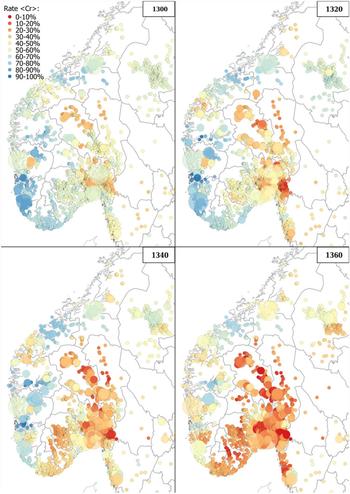
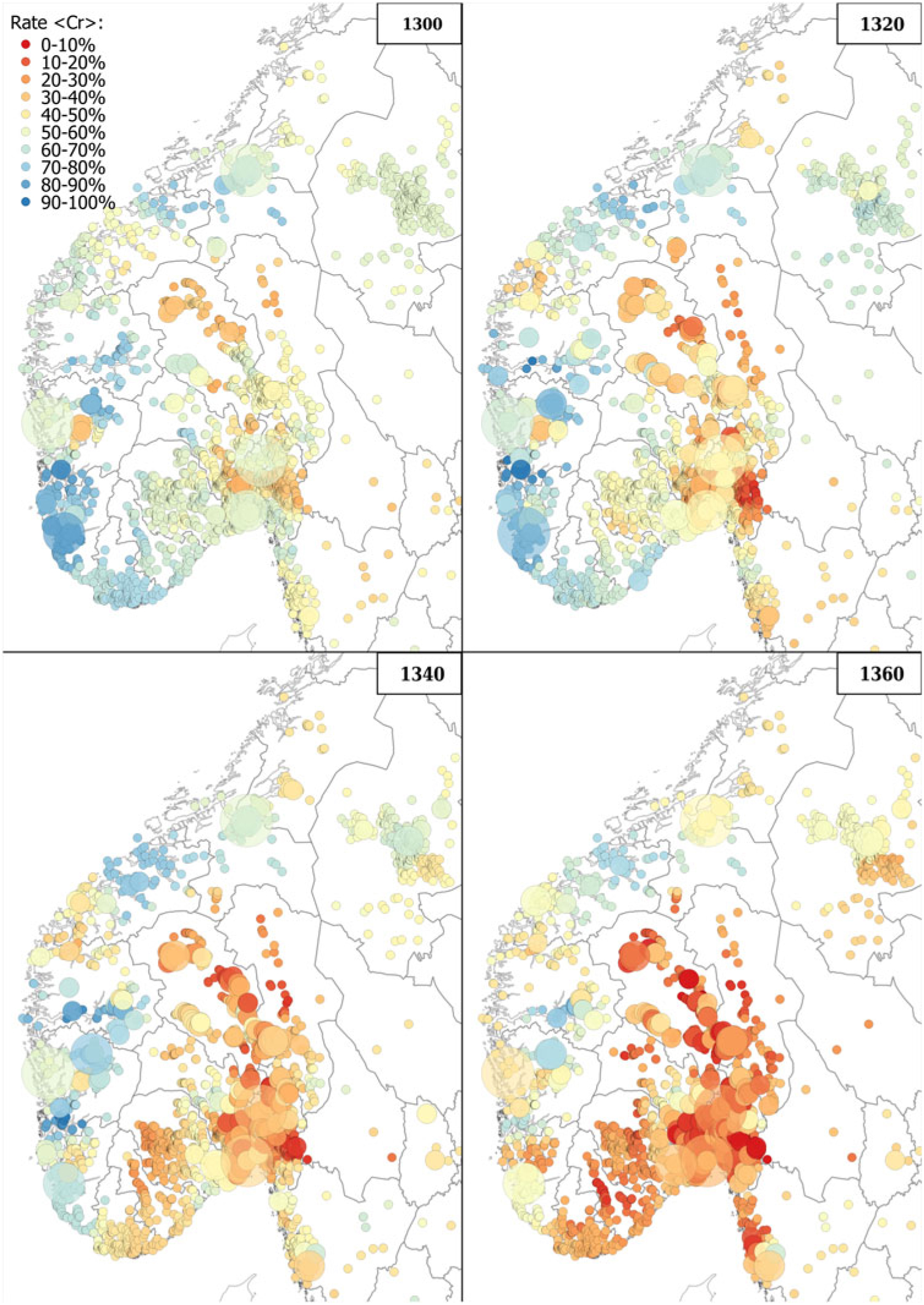
The results are visualized in Map 1. This map shows the estimated rate of the conservative variant (<Cr>) versus all other variants: the bluest points are those with the most conservative usage, the reddest points those with the most innovative usage. Point size indicates the amount of evidence for a particular point at a given time. At the earliest point for which we have good geographical data, around the turn of the 14th century, we already see the change underway in many areas in Norway: it is found at this point primarily in eastern Norway, both the southeast (northern Østfold, Akershus, Vestfold) and inland (Oppland). Over time, it increases in frequency within these areas and spreads beyond them, diffusing to the northwest via Romsdalen and around the south coast to the southwest.
KDE for the spread of svarabhakti vowels 1300–1360.
5.5. Analysis
On balance, the evidence is consistent with the prediction that svarabhakti vowels spread from Swedish into Norwegian. Texts in the DS show a higher rate of svarabhakti vowel spellings than contemporary texts in the DN. This alone might be explained as an artifact of the two writing systems. However, when we look at geographical distribution within Norway, we also find a picture consistent with diffusion from Swedish. The earliest innovative region is along the border with Sweden in the northeastern part of Østfold; over the first half of the 14th century, we see the innovation spreading throughout the southeast and northwards into Gudbrandsdal. The most conservative regions, which retain <Cr> clusters longest, are those furthest from this point of entry in the southeast: the west coast and the northwest. The picture we see here is consistent with contagion diffusion (also referred to in linguistics as the wave model of diffusion from the German Wellentheorie (Schmidt, Reference Schmidt1872)), with the innovative forms diffusing outwards continuously from a point of origin. This makes identification of such a point of origin relatively unproblematic.
In conflict with this picture, Jämtland and Bohuslän are not especially innovative areas. However, this is not an insurmountable objection. The evidence of the DS suggests that, although the change happened earlier in Swedish, it was still ongoing in the first half of the 14th century. Thus, if we had richer localized Swedish sources, we might expect to find considerable geographical differentiation within Swedish at this point. It is perfectly plausible that Bohuslän and particularly Jämtland were simply conservative areas within Sweden.
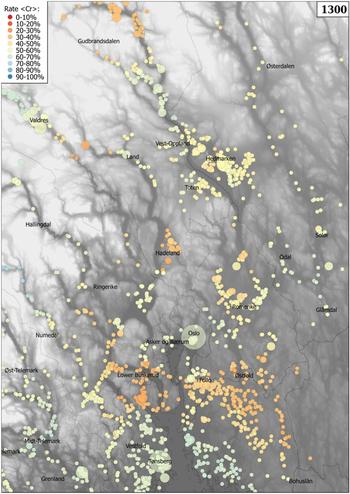
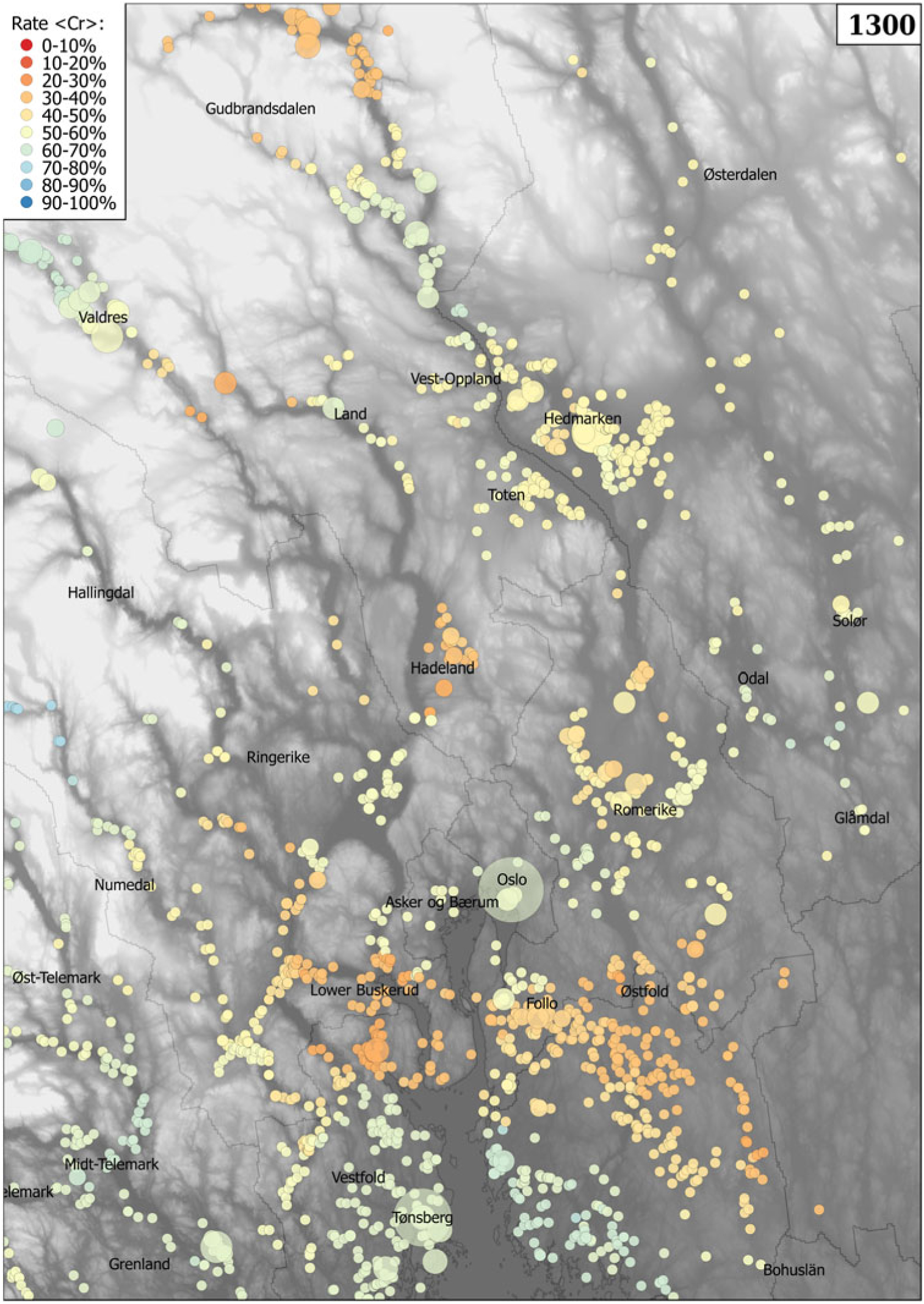
Also complicating this picture is the fact that Oslo and Tønsberg seem to remain conservative islands for some time during the early stages of the change. Map 2 shows the KDE for Østlandet alone in 1300 (this map also gives elevation in greyscale). We can see from this figure that both areas south of Oslo, such as Østfold and Lower Buskerud, and areas further north, such as Hadeland, show a higher rate of the change than the city between them does. Two interpretations of this evidence are possible. Firstly, we might suggest that this is an example of contra-hierarchical diffusion (Bailey et al., Reference Bailey, Wikle, Tillery and Sand1993): that as the loss of svarabhakti vowels diffused through rural southeastern Norway, the urban areas resisted it for some time. Alternatively, we should consider the possibility that this is just an artifact of written records. It might have been the case that text production was more established and so written norms were slower to respond to spoken language change in the cities than in rural areas; in this case, a survey of spoken Old Norwegian from this period would not have found Oslo and Tønsberg to be particularly conservative. Neither interpretation, however, interferes with our account of diffusion from Swedish.
KDE for the distribution of svarabhakti vowels in Østlandet, 1300.
6. LOSS OF THE GENITIVE
6.1. Definition of the variable
The loss of case is one of the most substantial developments between Old Norse and the modern Continental North Germanic languages and perhaps the defining simplificatory change. This is not a simple or unitary change. Nominatives, genitives, and datives were all lost in different contexts at different times, with some modern Norwegian and Swedish dialects retaining genitives and datives better than others (Eyþórsson et al., Reference Eyþórsson, Johannessen, Laake and Åfarli2012; Berg, Reference Berg and Haug2015a). Syntactic context played a role, with the typical pattern that structural case was retained longer than lexical case. Morphological context was also clearly important, with propria, appellatives, and pronouns all behaving differently (Wetås, Reference Wetås and Faarlund2003, Reference Wetås2008); this is seen most clearly in the fact that pronouns alone retain the nominative-accusative distinction in the modern languages. It is interesting to wonder, as Yager et al. (Reference Yager, Hellmold, Joo, Putnam, Rossi, Stafford and Salmons2015) do, whether the intermediate stages in these processes of case loss might have involved DOM or similar systematized grammatical patterns. An additional complicating factor is that the end result was not a uniform lack of morphology; in the case of the genitive in particular, one suffix, -(V)s, instead became a phrasal clitic, a development which has been heavily studied in Swedish, Danish, and English (cf. Norde, Reference Norde1997; Börjars, Reference Börjars2003; Perridon, Reference Perridon2013).
Nevertheless, for our purposes, it is useful to look at the larger picture by examining the social and geospatial patterns by which case was lost. Here, we do this by looking at the decline of one case, the genitive, in one context. It would be interesting to go further and investigate whether the geospatial diffusion of the loss of the genitive is similar for all morphosyntactic contexts (although the findings of Berge (Reference Berge1974) for Norwegian and Norde (Reference Norde1997) for Swedish are encouraging in this regard); it would also be interesting to investigate whether the geospatial diffusion of the loss of other cases resembled that of the genitive. These questions are left for future research.
The genitive case in Old Norse had a variety of functions: we find both lexical genitives (objects of prepositions, adjectives and nouns, arguments of verbs) and structural genitives (possessives). In Norwegian, as in other continental North Germanic languages, lexical genitives have entirely disappeared and possessive genitives are retained only variably, changes which took place largely in the middle ages (Larsen, Reference Larsen, Jahr and Lorentz1993; Seip, Reference Seip1955:307–309; Haugen, Reference Haugen1976:294). In this section we will examine the loss of genitive objects of the preposition millum ‘between’. As millum ceased to take objects in the genitive we find a variety of alternative constructions: datives, accusatives, bare stems, and sometimes even nominatives. Since our focus is on the loss of genitive and not on precisely how the system restructured, we will limit our variants to genitive vs. non-genitive.Footnote 4
6.2. The dataset
For Norwegian, all instances of millum (including its morphological variants ímillum and ámillum and all spelling variants) were identified, for a total of 3,565 instances in original texts; all of their objects (a total of 5,144 NPs) were identified and each categorized by their case morphology. Morphosyntactic changes in Middle Norwegian mean that simply counting the number of genitive-marked nominals is a poor measure of the retention of the genitive. In some texts case is marked on just a single element in each NP whereas in earlier texts it is marked on all nominals: if we were to count the number of genitive-marked nominals, we would thus see a decline, even if millum continued consistently to govern the genitive. We must also contend with forms ambiguous for case. Accordingly, each text was categorized according to whether: objects of millum included at least one unambiguously genitive-marked element vs. objects of millum included unambiguously non-genitive marked elements but no genitive-marked elements. The former type is classified as retaining genitive objects of millum, the latter as having lost them. In total, 692 texts were classified as retaining genitive objects of millum and 773 as having lost them.
For the Swedish comparison, we can turn to the work of Norde (Reference Norde1997:145–166). Norde examined the loss of genitives in a variety of contexts, including the objects of prepositions and specifically mællom, in a corpus containing texts of a variety of genres including charters. Although not perfect, Norde’s figures for the rate of genitives among the objects of prepositions (til, mællom and fore … skuld/sakir) provide a reasonable comparison for the Norwegian dataset, especially since there were no clearly identifiable differences in rates of genitive usage among the different prepositions Norde examined (Reference Norde1997:152–158).
6.3. Chronology
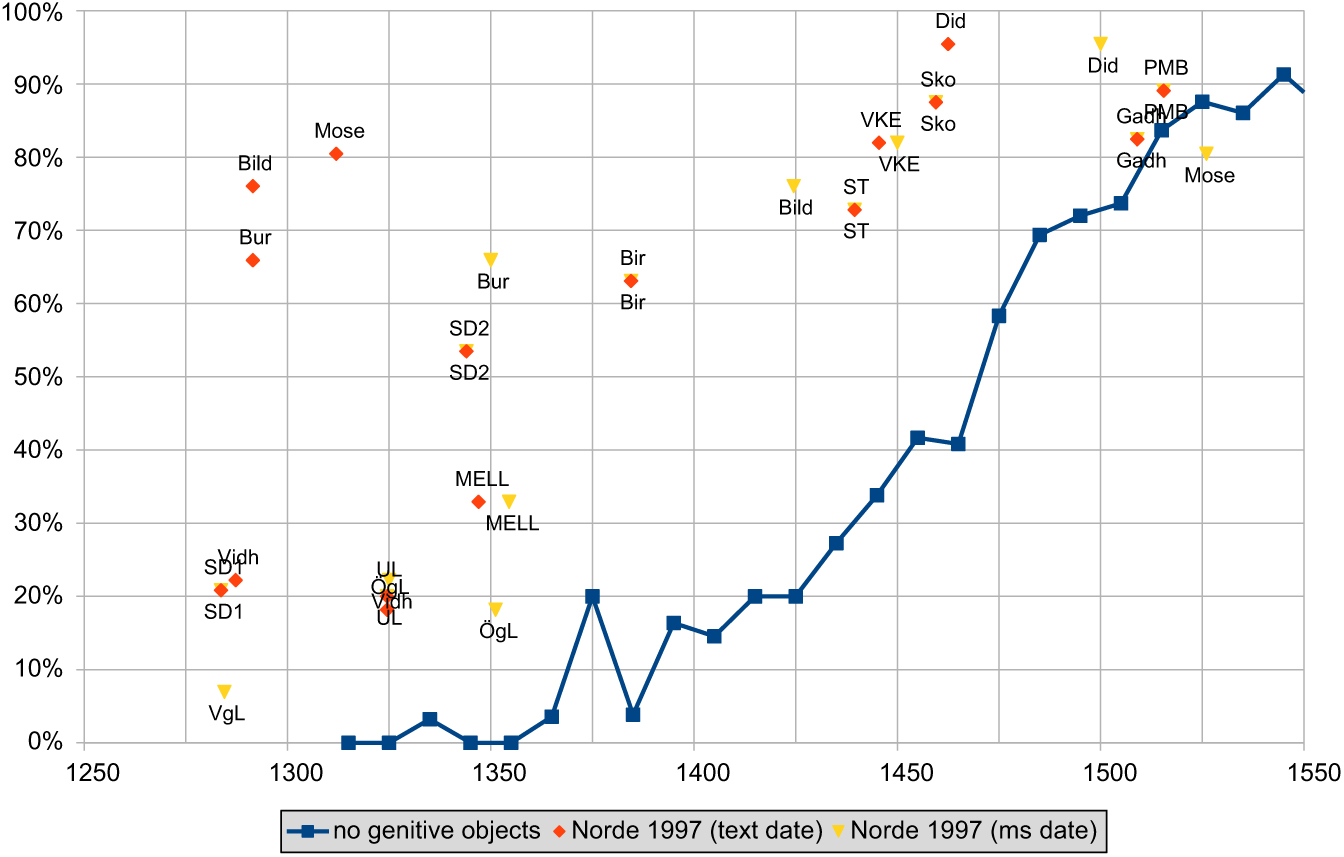
Figure 2 shows the proportion of texts in which millum no longer takes a genitive by decade in the DN and the rate of non-genitive case marking among objects of prepositions in the individual texts studied by Norde (Reference Norde1997) (abbreviations refer to the individual Swedish texts; for more detail, see Norde (Reference Norde1997:18–21)). As can be seen, the change in Norwegian gets under way in the late 14th century and is diffusing rapidly throughout the 15th century. By contrast, the earliest Swedish documents in the late 13th century already show some evidence of the loss of prepositional genitives, and by the end of the 14th century the change is well-advanced.
Proportion of documents losing the genitive with millum by 10-year period in the DN and rate of non-genitive case marking among objects of prepositions in texts studied by Norde (Reference Norde1997) by text and manuscript dates.

6.4. Geographical distribution
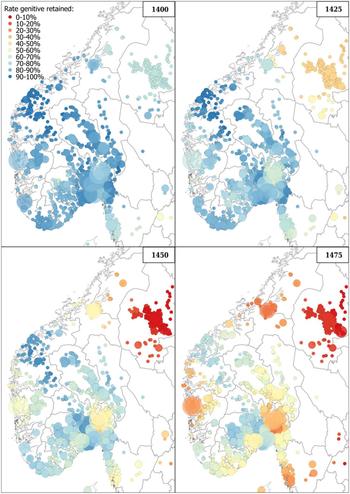
KDEs for the loss of the genitive with millum in the DN are visualized in Map 3. The reddest points are the most innovative, where the estimated rate of retention of genitives is lowest, while the bluest points are those where the genitive is best retained. The bandwidth (standard deviation) of the temporal kernel is 30 years and the bandwidth of the geospatial kernel is the weighted equivalent of 14 texts.
KDE for the loss of the genitive 1400–1475.

As can be seen from the map, the change is found earliest in Jämtland and Bohuslän, the areas which by this time were shifting to Swedish control. It then increases rapidly in the Norwegian cities of Trondheim, Oslo, and Bergen and spreads outwards from these to the surrounding countryside.
In this case, unlike the case of svarabhakti vowels, we do not see continuous expansion of a single innovative region centered around a point of origin. Instead, we see multiple leading regions, each centered on a city, separated by conservative rural areas. In terms of diffusion theory, this is clearly not contagion diffusion but hierarchy diffusion (also referred to in linguistics as the gravity model (Trudgill, Reference Trudgill1974)), in which a change jumps between centers of population density rather than spreading continuously and so degree of change is a function not only of time and distance from the point of innovation, but also of the relative populations of the two localities. For our purposes, this complicates the issue of identifying a point of origin, since multiple disparate regions can be (nearly) equally innovative in spite of the fact that just one of them is the true place of innovation.
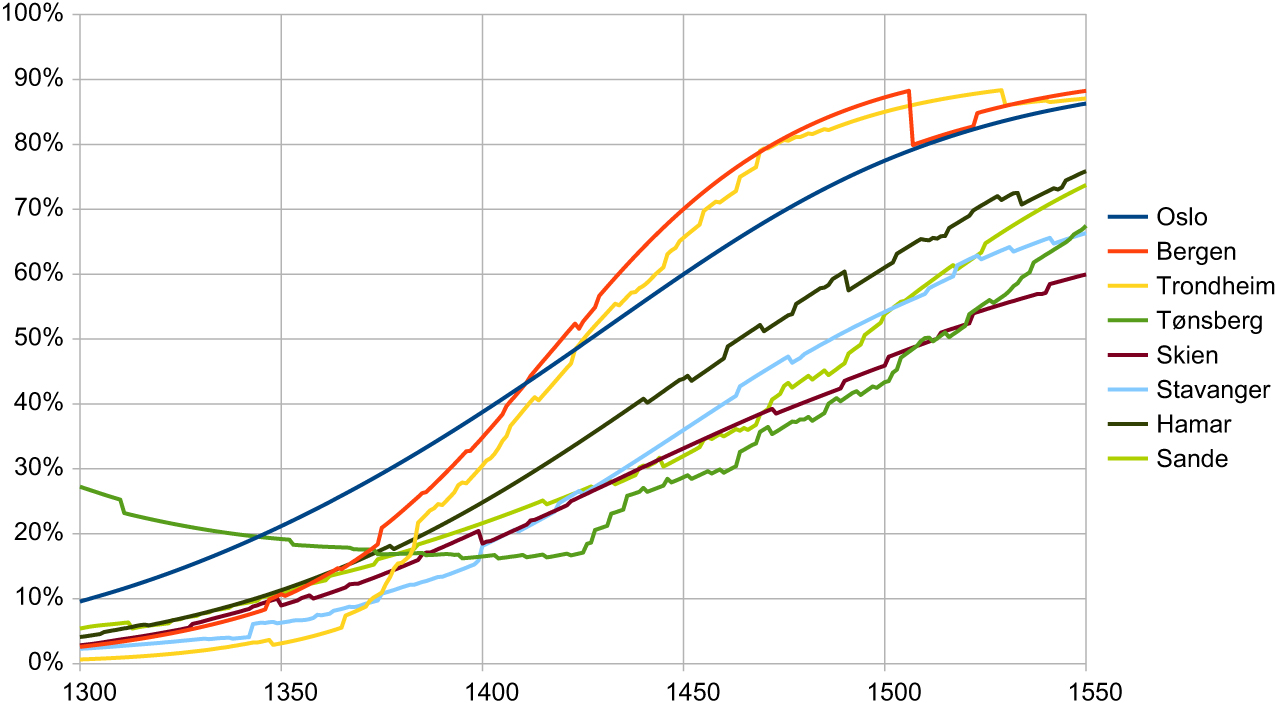
To help distinguish among the different urban areas, KDEs centered on each of the cities were calculated; the bandwidth of the temporal kernel is 60 years (a higher bandwidth is used here because over-smoothing is not an issue: we are not interested in the detail, but in the broad sweep of change). These calculations are visualized in Figure 3.
KDE for the loss of the genitive in cities 1300–1550.

The apparently innovative position of Tønsberg in the earliest period covered is due to just two, interdependent examples, the interpretation of which is doubtful (Blaxter, Reference Blaxter2017:263–264). Thus, putting Tønsberg aside, we see a clear picture: within Norway proper, the change begins in Oslo, which is overtaken as the most innovative region by Bergen and Trondheim only in the early 15th century.
6.5. Analysis
For the loss of the genitive, the evidence for diffusion from Sweden is stronger but rather more complex than for the rise of svarabhakti vowels. Firstly, direct comparison with Norde’s (Reference Norde1997) study demonstrates that prepositional genitives show a decline earlier in Swedish texts than in Norwegian texts. We also see that Bohuslän and particularly Jämtland, the areas which switched to Swedish control during the middle ages, are very innovative. As with svarabhakti vowels, these observations could potentially be put down to a difference in the writing systems, but nevertheless point towards diffusion from Swedish.
Geospatial distribution of the change within Norway reveals a striking hierarchy diffusion pattern, with urban areas (and in particular Oslo, Bergen, and Trondheim) leading compared to the rest of the country. Three possible interpretations of these patterns should be considered. Firstly, taking into account the fact that Oslo is the most innovative city in Norway in the early part of the change, we can posit that the change diffused from Swedish into Norwegian first in Oslo; such diffusion might have been across the nearby border in Østfold or Akershus, or might itself have been hierarchy diffusion from a Swedish city. The change was then spread from Oslo to other Norwegian cities by hierarchy diffusion, and outwards from these into rural regions by contagion diffusion.
Secondly, it is likely that leading urban centers within Norway were also the very localities with the largest numbers of migrants from elsewhere in Scandinavia: merchants and the aristocracy in particular were highly mobile in medieval Scandinavia, and the charters often attest to individuals living and owning land in both Norway and Sweden. Thus we might propose that all of the cities were themselves the points of contact with Swedish and so all constitute the points of origin of the change in Norwegian.
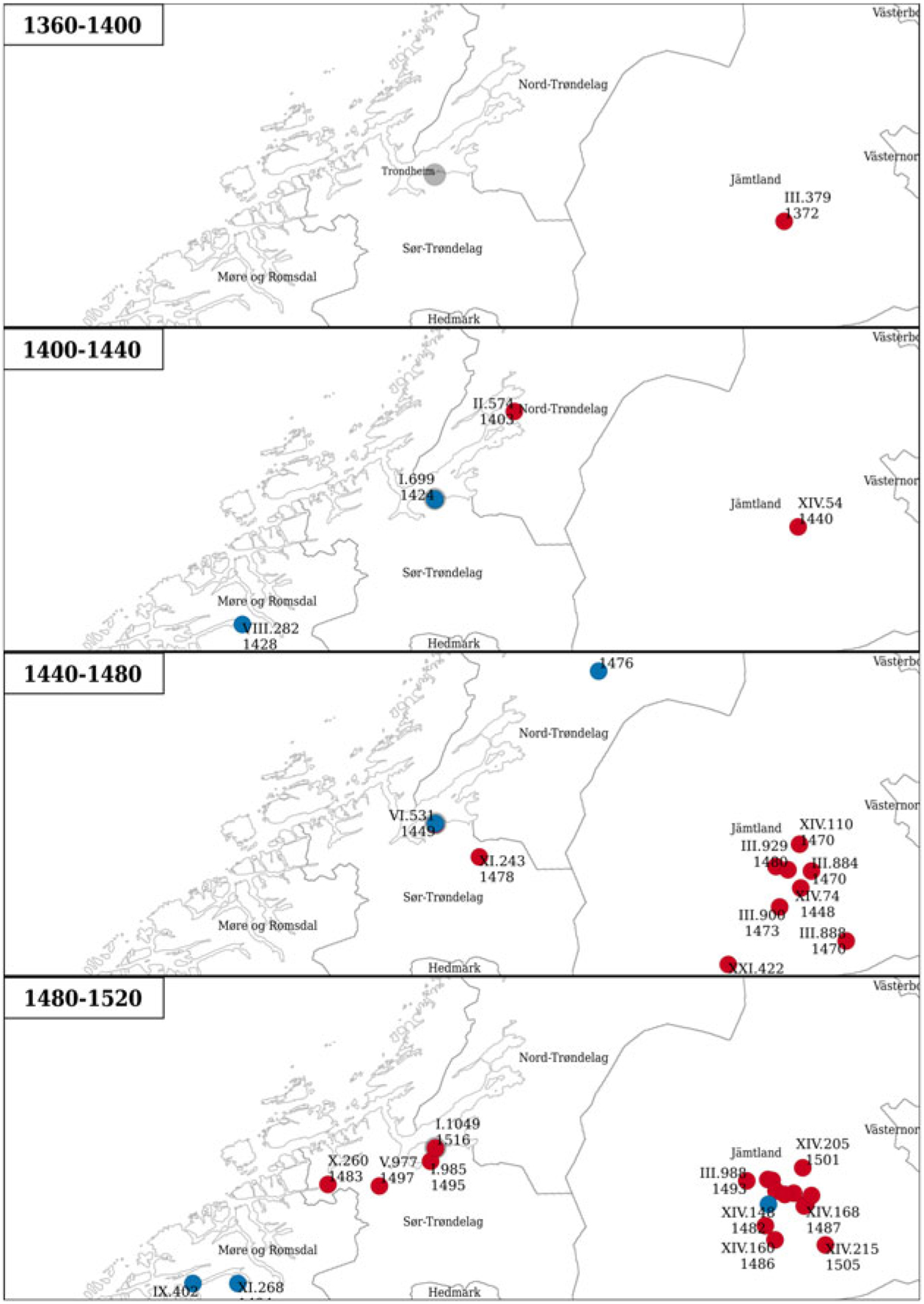
Thirdly, we could take seriously the innovative status of rural Trøndelag (note particularly the panel for 1425 in Map 3) and suggest that the change spread by contagion diffusion from rural Jämtland into Trøndelag and thence into Trondheim, from where it spread by hierarchy diffusion to the other Norwegian cities. Here, again, we have to consider the real nature of the raw data underlying our highly smoothed visualizations. In Map 4, the individual charters in this region are mapped in four periods, stretching from 1360 to 1520; red points indicate charters which show the change, blue points those which do not. We can see from this map that the innovative status of rural Trøndelag really reflects just two charters: DN II.574, dated to 1403 and from Nord-Trøndelag (with <alt þet þeym foor j melliom> ‘everything that happened between them.DAT’), and DN XI.243, dated to 1478 and localized to both Trondheim and a farm in Tyldalen in Sør-Trøndelag (with <giorth myllom oss> ‘made between us.DAT’). DN II.574 really is strikingly early, but it is problematic to give decisive weight to a single token.
Charters in Trøndelag by loss of the genitive 1360–1520.

Regardless of which of these three accounts is favored, one aspect is clear: contact with Swedish must have played a pivotal role in the diffusion of the change into Norwegian. Thus, we can confidently assert that this change must first have been innovated in East North Germanic.
7. DISCUSSION
In 2.2, above, we derived two possible predictions from the hypothesis that grammatical simplification in the history of Norwegian was due to intensive contact with Middle Low German: either the simplificatory changes must have been innovated in the Norwegian Hansa centers, Bergen, Oslo, and Tønsberg, or they must have begun life in Sweden or Denmark, where contact with Low German was still more intense. In order to test these predictions, we have examined two variables, one phonological and one morphosyntactic.
Our phonological change, the loss of coda /Cr/ clusters and rise of svarabhakti vowels, was found already to be ongoing in the earliest period covered by our corpora. Both relative rates of the change in the DN and DS and its geographical distribution within Norway clearly suggest that the change diffused into Norwegian from Swedish, entering Norway somewhere along the southeastern border with Sweden. On the face of it, this is consistent with our initial predictions. However, the timing of the change introduces an important complication: on the basis of the chronology of the change visualized in Figure 1 the latest conceivable date of innovation of the change must be around 1250, and this is extremely early in the story of Low German contact in Sweden and Norway. Cities like Stockholm were growing rapidly due to German trade in the mid-13th century, but large-scale German immigration was only just beginning at this time (Mähl, Reference Mähl, Elmevik and Jahr2012:113–114; Blaxter, Reference Blaxter2017:46–47). Accordingly, we must conclude from our evidence here that contact with Low German remains a very plausible source of the innovation of this change, but that further work with earlier Swedish sources is desirable to pin down its chronology and place of innovation more accurately. Furthermore, it is, of course, also possible that the change in Swedish has its origin further south, in Denmark. This, too, could be consistent with a role for Low German contact, but more work on Old Danish is needed to explore this point.
Our morphosyntactic change, the loss of the genitive with the preposition millum, tells a more straightforward story. Comparison of our data with earlier work clearly demonstrates that this change took place earlier in Swedish. Within Norwegian, we see a hierarchy diffusion pattern led by Oslo in the southeast. By far the most convincing story is that this change too spread into Norwegian from Swedish.
Thus, overall, both of our datasets speak for changes spreading from Swedish, and not for innovation in the Norwegian Hansa centers of Bergen, Oslo, and Tønsberg. Since the Hansa presence, and so contact with Middle Low German, was greater in Sweden than Norway (and more so again in Denmark), this is in line with one of our predictions and so in line with the hypothesis that simplificatory change in the history of North Germanic was due to this contact. Nevertheless, it also highlights the need for further research to truly pin down the origin of these changes. Were they innovated in Sweden? If so, our hypothesis would have it that they arose first in one of the Swedish centers of contact with Low German, such as Stockholm. Or were they, in fact, innovated further south, in Denmark? Furthermore, if these and other simplificatory changes in the history of Norwegian were in fact innovated further to the south or east, we are left with the question of why it was these changes in particular that successfully diffused throughout the North Germanic language area. Comparable geospatial work on equivalent Old Danish and Old Swedish sources is called for in order to tell the full story of these changes in the North Germanic language family as a whole.