Introduction
Seed traits such as mass, dormancy and germination are crucial to plant fitness (Baskin and Baskin, Reference Baskin and Baskin2014; Gremer and Venable, Reference Gremer and Venable2014). Interpopulation variability in seed traits is common and related to differences in climate, geography and habitat (Tautenhahn et al., Reference Tautenhahn, Heilmeier, Götzenberger, Klotz, Wirth and Kühn2008; Bu et al., Reference Bu, Du, Chen, Wang, Xu and Liu2009; Saatkamp et al., Reference Saatkamp, Cochrane, Commander, Guja, Jimenez-Alfaro, Larson, Nicotra, Poschlod, Silveira, Cross, Dalziell, Dickie, Erickson, Fidelis, Fuchs, Golos, Hope, Lewandrowski, Merritt, Miller, Miller, Offord, Ooi, Satyanti, Sommerville, Tangney, Tomlinson, Turner and Walck2019). Variability of seed traits also exists at the intrapopulation level where it is considered a bet-hedging strategy for enabling the species to produce numerous seeds optimized for different climatic conditions (Mitchell et al., Reference Mitchell, Johnston and Bassel2017). This intrapopulation variation increases the probability of generational survival in an unpredictable or changing environment (Slatkin, Reference Slatkin1974; Zhao et al., Reference Zhao, Zhang, Zhao, Mo, Zhang, Gao and Wang2016). Coastal deserts frequently exhibit spatiotemporal variation in salinity and soil moisture (Castillo et al., Reference Castillo, Fernández-Baco, Castellanos, Luque, Figueroa and Davy2000), hence environmental conditions for germination and seedling establishment are highly variable in time and space (Gremer and Venable, Reference Gremer and Venable2014; El-Keblawy et al., Reference El-Keblawy, Gairola, Bhatt and Mahmoud2017). However, intrapopulation variation in germination of Arabian desert halophytes has received little attention. Studying intrapopulation variability of seed germination could improve our understanding of how desert halophyte species cope with high salinity and drought during seed germination.
Seed germination varies (1) within maternal individuals (Gutterman, Reference Gutterman and Fenner2000), (2) within populations (Narbona et al., Reference Narbona, Ortiz and Arista2006; Pérez-García, Reference Pérez-García2009; Santelices et al., Reference Santelices, Espinoza, Magni, Cabrera, Donoso and Peña2017) and (3) among populations (Nordborg and Bergelson, Reference Nordborg and Bergelson1999). Latitude, altitude, temperature, light, moisture, soil nutrients and habitat disturbance have been linked to interpopulation variation of seed dormancy and germination (Baskin and Baskin, Reference Baskin and Baskin2014; El-Keblawy et al., Reference El-Keblawy, Gairola, Bhatt and Mahmoud2017). Intrapopulation variation of seed dormancy enables temporal distribution of germination, which is critical for population persistence in the unpredictable climates of arid zones.
Most plant species of the Arabian desert germinate during winter, when temperature is lower and rainfall events more likely (Böer, Reference Böer1997). Germination timing is strongly influenced by abiotic factors of light, temperature, plant-available moisture and salinity (El-Keblawy and Bhatt, Reference El-Keblawy and Bhatt2015; Bhatt and Santo, Reference Bhatt and Santo2016). Periods of sufficient moisture for germination are uncommon in arid systems. They are unpredictable in their occurrence and in whether the moisture will persist long enough for seedling establishment. Therefore, germination in these arid systems is regulated to respond to multiple abiotic factors (Ashraf and Foolad, Reference Ashraf and Foolad2005; Bewley et al., Reference Bewley, Bradford, Hilhorst and Nonogaki2013; Bhatt et al., Reference Bhatt, Bhat and Thomas2019a,Reference Bhatt, Bhat, Lozano-Isla, Gallacher, Santo, Batista-Silva, Fernandes and Pompellic, Reference Bhatt, Bhat, Al-Nasser, Caron and Santo2020b).
Halophytic species can be used in phytoremediation of saline-sodic or salt-affected land, thus extracting salt to biomass, establishing plant cover and lowering a saline water table (Panta et al., Reference Panta, Flowers, Lane, Doyle, Haros and Shabala2014). The ability of halophytes to accumulate salt in shoot systems is dependent on each species’ adaptive strategies (Graifenberg et al., Reference Graifenberg, Botrini, Giustiniani, Filippi and Curadi2003; Tester and Davenport, Reference Tester and Davenport2003; Rabhi et al., Reference Rabhi, Ferchichi, Jouini, Hamrouni, Koyro, Ranieri, Abdelly and Smaoui2010). In field and glasshouse trials, several halophytic species absorbed the equivalent of 2 to 6 tonnes salt ha−1 yr−1 (Panta et al., Reference Panta, Flowers, Lane, Doyle, Haros and Shabala2014). Approximately 140 halophytic taxa from 31 plant families have been recorded on the Arabian Peninsula, which constitutes about 4% of the total flora (Ghazanfar et al., Reference Ghazanfar, Altundag, Yaprak, Osborne, Tug, Vural, Khan, Böer, Öztürk, Al Abdessalaam, Clüsener-Godt and Gul2014). Halophytes are used for medicine, fodder, phytoremediation, biofuel and ornamentals (El Shaer, Reference El Shaer2010; Qasim et al., Reference Qasim, Gulzar, Shinwari, Aziz and Khan2010; Rabhi et al., Reference Rabhi, Ferchichi, Jouini, Hamrouni, Koyro, Ranieri, Abdelly and Smaoui2010; Abideen et al., Reference Abideen, Ansari and Khan2011; Manousaki and Kalogerakis, Reference Manousaki and Kalogerakis2011; Ali et al., Reference Ali, Iqbal, Ali and Afzal2012; Gairola et al., Reference Gairola, Bhatt and El-Keblawy2015; Bañuelos et al., Reference Bañuelos, Velázquez-Hernández, Guerra-Balcázar and Arjona2018). Describing and conserving this genetic resource should be a priority. Abiotic factors such as temperature, light, salinity and their interactions have been shown to have an effect of germination in many halophytic species, including Anabasis setifera, Atriplex canescens, Halocnmum strobilaceum, Halothamnus iraqensis, Haloxylon salicornicum, Halopeplis perfoliata, Limonium stocksii, Salsola vermiculata, Salsola schweinfurthii, Suaeda aegyptiaca and Seidlitzia rosmarinus (Zia and Khan, Reference Zia and Khan2004; El-Keblawy and Bhatt, Reference El-Keblawy and Bhatt2015; Bhatt and Santo, Reference Bhatt and Santo2016). Interpopulation differences in seed dormancy and germination has been identified in Anabasis setifera (El-Keblawy et al., Reference El-Keblawy, Gairola and Bhatt2016a,Reference El-Keblawy, Gairola and Bhattb), Limonium avei (Santo et al., Reference Santo, Mattana, Grillo, Sciandrello, Peccenini and Bacchetta2017), Salsola drummondii (Elnaggar et al., Reference Elnaggar, El-Keblawy, Mosa and Navarro2019), Suaeda aegyptiaca (El-Keblawy et al., Reference El-Keblawy, Gairola, Bhatt and Mahmoud2017) and Suaeda vermiculata (El-Keblawy et al., Reference El-Keblawy, Al-Shamsi and Mosa2018). Interpopulation variation has been attributed to differences in both population genetics and maternal environment (Baloch et al., Reference Baloch, DiTommaso and Watson2001; Donohue et al., Reference Donohue, Dorn, Griffith, Schmitt, Kim and Aguilera2005; Narbona et al., Reference Narbona, Ortiz and Arista2006), although these studies have not used genotype by environment trial designs, instead relying on studies of maternal plants grown in similar microclimates and seeds produced during similar periods.
Successful seedling establishment is dependent of rainfalll in a rain event, and on the occurrence of later rain events that extend plant-available moisture levels through the growing season. Intrapopulation variation of dormancy and germination enables the population to spread germination across multiple rain events in the season if they occur. Temporal distribution of germination can also reduce competition among seedlings, both inter- and intraspecific, for limited resources (Brändle et al., Reference Brändle, Stadler, Klotz and Brand2003; Donohue et al., Reference Donohue, Casas, Burghardt, Kovach and Willis2010). In contrast to the many studies of interpopulation variation, the authors know of no studies on germination and dormancy variation of Arabian halophyte seeds obtained from different maternal plants within a population. This information may have practical use in knowing whether it is beneficial to select seeds from maternal individuals, or whether population selection is sufficient. Thus, the aim of the present study was to identify if maternal seed source within a population influences (1) seed weight, dormancy and germination, (2) light and temperature requirement for germination and (3) if the extent of intrapopulation variation differs among species.
Materials and methods
Species
Arthrocnemum macrostachyum, H. iraqensis, H. salicornicum and S. rosmarinus each have potential for rehabilitating degraded desert rangelands and salt-affected soils. All are perennial branched shrubs belonging to Amaranthaceae. They are commonly found in Arabian coastal deserts (Ghazanfar, Reference Ghazanfar, Oztürk, Waisel, Khan and Görk2006; Freitag et al., Reference Freitag, Atamov, Çetin and Aslan2009), are highly resistant to salinity and contribute to soil stabilization (Huang et al., Reference Huang, Zhang, Zheng and Gutterman2003; Omar et al., Reference Omar, Al-Mutawa and Zaman2007; Amiraslani and Dragovich, Reference Amiraslani and Dragovich2011; Mahmoodi et al., Reference Mahmoodi, Khoshhal, Mousavi and Pourkhosravani2013). The species are also used for fodder, medicine, fuel wood and as windbreaks (Ashraf et al., Reference Ashraf, Awan and Mahmood2012; Bidak et al., Reference Bidak, Kamal, Halmy and Heneidy2015). Haloxylon salicornicum was shortlisted as having potential for desert landscaping, along with other native species (Phondani et al., Reference Phondani, Bhatt, Elsarrag and Horr2016), and A. macrostachyum was identified as a suitable species for phytoremediation (Redondo-Gómez et al., Reference Redondo-Gómez, Mateos-Naranjo and Andrades-Moreno2010).
Seed collection
Mature seeds were collected from ten maternal plants per species, December 2018 in Kuwait (Table 1). Maternal plants were at least 5 m apart but otherwise selected randomly along a 180 to 200 m line transect. Seeds were cleaned immediately after collection and germinated within one week. Seed mass was determined by weighing three 25-seed replicates from each maternal plant of each species using an analytical balance (Sartorius Analytical Balance mod. ENTRIS224-1S, Bradford, MA, USA; accurate to 0.1 mg).
Seed collection and location details of selected species

Germination
Four 25-seed replicates were germinated for each combination of 4 species, 10 plants and 2 photoperiod regimes. Seeds for each replicate were placed in 9 cm diameter Petri dishes containing two sheets of filter paper (Whatman No. 1). Replicates were placed in incubators set at night/day 12/12 h temperature of 15/20°C for photoperiods of either 0 (dark) or 12 (light) hours light per day from a 50 W white fluorescent lamp (Sylvania Led T5 Tubes, Sylvania Portugal Lda, Lisboa, Portugal). This temperature regime has previously been found suitable for germination of this species in natural conditions. Petri dishes of dark replicates were wrapped in two layers of aluminium foil. Germination was defined as the protrusion of a radicle by ≥2 mm through the external integument (Allen and Alvarez, Reference Allen and Alvarez2020). Germinated seeds of the light treatments were counted daily, and dark treatments were assessed at the end of the experiment.
Data analysis
A nested analysis of variance (ANOVA) with species as a fixed factor and maternal plants as random and nested within species was performed to assess whether seed weight and germination traits differed among species. A one-way ANOVA was then also performed for each species, with maternal plant as the fixed factor, to determine the species-specific influence of maternal plant for germination in light, germination in darkness, mean germination time, SYN uncertainty and seed weight. Correlation among seed weight and germination traits was determined using Pearson correlations. Analyses were performed using SPSS 26 (IBM Corporation, Armonk, NY, USA) and a Bonferroni correction was applied to avoid increased risk of Type I error.
A nested analysis of variance (ANOVA) was performed to assess the influence of the maternal plant and species on seed weight and germination, with species as a fixed factor and maternal plant as random and nested within species. A one-way ANOVA was then performed for each species to determine the species-specific influence of maternal plant on germination in light, germination in darkness, mean germination time, synchrony, uncertainty and seed weight. Rand Index was used to measure the similarity between data groupings and Euclidian distance for principal components analysis using Minitab 18.1.0.0 (Minitab LLC, Pennsylvania State University, PA, USA). Results were considered significant when P ≤ 0.01. Principal component analysis was conducted on all germination features using Minitab. The summary function of principal components analysis was used to calculate the proportion of the variance of each parameter explained by each principal component. For hierarchical clustering, Pearson's correlations were used to compare the similarities between the studied species using the ‘cor’ function on the Sigmaplot v. 14.0 (Systat Software Inc., Chicago, USA) and its Excel package with the complete linkage method and the Euclidean distance measure were used for hierarchical clustering with the R index in the Minitab.
Results
All species produced a higher germination percentage in light than in darkness, with the difference ranging from 7.2% in S. rosmarinus to 9.2% in H. salicornicum (Table 2). Seed germination varied strongly among maternal plants of H. salicornicum in both light and dark treatments (P < 0.0001). Seed germination among maternal plants of A. macrostachyum was not significant after application of the Bonferroni correction (P = 0.0189) and was not significant for the other two species (Table 2).
Influence of the maternal plant and species on seed weight and germination

Analyses were a nested ANOVA with species as fixed, and maternal plant as random and nested within species (P 1), and a one-way ANOVA of maternal plants within each species (P 2). The Bonferroni correction makes values of α < 1.67 × 10⁻³ non-significant.
P > 0.05 (*), P < 0.01 (**), and P < 0.001 (***).
Mean germination time (MGT) varied strongly among maternal plants of H. iraquensis (P < 0.0001), H. salicornicum (P < 0.0001) and S. rosmarinus (P < 0.0001), and significantly affected A. macrosctachyum (P = 0.0058). A maternal effect on seed weight, synchrony and uncertainty was also highly significant in all species except S. rosmarinus (Table 2).
Germination percentage in light and dark treatments were strongly correlated for H. salicornicum, S. rosmarinus and A. macrostachym (r = 0.965, 0.881, 0.873, respectively), but not significant for H. iraquensis (Table 3). MGT was negatively correlated with germination in light for H. salicornicum (r = −0.720) and for germination in both light (r = −0.650) and darkness (r = −0.710) for A. macrostachym (Table 3). However, these correlations were not significant after application of the Bonferroni correction. Likewise, seed weight was negatively correlated with germination under darkness (−0.655) in H. iraquensis, only if the Bonferroni correction was not used. MGT was strongly correlated with both synchrony and uncertainty for H. iraquensis (−0.906, and 0.914, respectively) and S. rosmarinus (−0.891, and 0.943, respectively) but not for the other species (Table 3).
Pearson correlations (r) and their significance (α = 0.05) of traits measured on ten plants per species

The Bonferroni correction makes values of α < 8.3 × 10⁻⁴ non-significant.
P > 0.05 (*), P < 0.01 (**), and P < 0.001 (***).
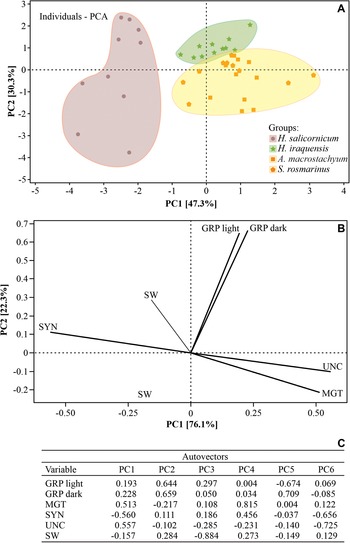
Maternal plants of H. salicornicum were placed in a distinctly uniform cluster by PCA, separated from plants of other species (Fig. 1). Maternal plants of H. iraquensis also formed a distinct cluster with 70% similarity, which overlapped with a cluster of >71% similarity formed by maternal plants of A. macrostachyum and S. rosmarinus. The sum of PC1 and PC2 comprised 77.6% of the observed variation. Factors separating plant species in the PCA are demonstrated in Fig. 1B,C. Germination in darkness (0.659) and in light (0.644) had a strong positive effect on clustering, while synchrony had a strong negative effect (−0.560). Uncertainty (0.557), and MGT (0.513), had a similar positive influence on species separation. The strength with which each feature promoted clustering is distinct, while germination (both 12/12 h of light/dark cycles or complete darkness), seed weight and synchrony promoted germination (Fig. 1B,C).
(A) Principal component analysis to A. macrostachyum (square), H. iraquensis (star), H. salicornicum (circles) and S. rosmarinus (pentagon) showing the spatial distribution of each plant species. The large circles represent the three clusters formed by the Euclidean distance method considering ~70% of similarity. (B) Loading plot graph showing the direction and length of the lines are directly proportional to variables importance in separating groups. PC1, principal component 1; PC2, principal component 2. Abbreviations: GRP, germination percentage; MGT, mean germination time; SYN, synchrony; UNC, uncertainty; SW, seed weight.

Discussion
Usually, seeds collected from different individuals from any particular population are mixed together to test their germination response, which provides an average response at the population level. However, intrapopulation variability in the germination response is well known (Martin et al., Reference Martin, Grzeskowiak and Puech1995; Schütz and Milberg, Reference Schütz and Milberg1997; Pérez-García, Reference Pérez-García2009). Intrapopulation variability in seed germination could be mechanism to overcome the risk of failed recruitment against unpredictable environmental conditions such as drought and salinity. This variability enables a species to deal with uncertainty via asynchronized germination. The different species showed differences in intrapopulation variability, indicating that each species has a different strategy for coping with the extreme coastal desert conditions of high salinity and drought.
Seeds of all the studied species matured at a similar time, hence microclimatic variation of collection sites was minimized. Intrapopulation variation of germination response among individuals could be due to genetic or maternal plant effects (Baloch et al., Reference Baloch, DiTommaso and Watson2001; Donohue et al., Reference Donohue, Dorn, Griffith, Schmitt, Kim and Aguilera2005). The existence of variability in germination within the population of selected species could be helpful in spreading their germination in time and space because the favourable conditions for germination and seedling establishment are spatiotemporally highly variable in arid deserts (Gremer and Venable, Reference Gremer and Venable2014; El-Keblawy et al., Reference El-Keblawy, Gairola, Bhatt and Mahmoud2017). This variability would ensure that seeds of these species will germinate during different times of the growing season between December to March when the temperature is low and the chances of rainfall are higher during this time of year under Arabian desert conditions (Böer, Reference Böer1997), that can leach out the salinity.
Variability in seed germinability improves overall reproductive success in unpredictable desert conditions. Intrapopulation seed size variation affects seed dispersal, germination, seedling emergence and establishment (Hawke and Maun, Reference Hawke and Maun1989; Baskin and Baskin, Reference Baskin and Baskin2014). The studied species exhibited differences in the amount of seed mass variation within maternal individuals. Factors such as maternal condition, microenvironment and genotype might be responsible for variability of seed size (weight), dormancy and germination within individuals of the same population (Platenkamp and Shaw, Reference Platenkamp and Shaw1993; Benech-Arnold et al., Reference Benech-Arnold, Sanchez, Forcella, Kruk and Ghersa2000; Galloway, Reference Galloway2002). High inter-annual climatic variability and inherent water-limitations are usually a strong determiner of seed germination and seedling survival in arid conditions (Chesson et al., Reference Chesson, Gebauer, Schwinning, Huntly, Wiegand, Ernest, Sher, Novoplansky and Weltzin2004; Torres-Martinez et al., Reference Torres-Martinez, Weldy, Levy and Emery2016). Maintaining variation in seed mass and germination distributes germination throughout the winter season (October to March) when chances of rainfall are high. This benefits population persistence and reduces the risk of a local extinction event (Levy et al., Reference Levy, Ziv and Siegal2012; Mitchell et al., Reference Mitchell, Johnston and Bassel2017) in this environment of harsh and spatiotemporally unpredictable conditions for life. In other words, we can speculate that the higher the MGT and the lower the SYN, the greater the reproductive chance of the species, exceptionally in hostile environments such as deserts (Pompelli et al., Reference Pompelli, Ferreira, Cavalcante, Salvador, Hsie and Endres2010; Miranda et al., Reference Miranda, Oliveira, Correia, Almeida-Cortez and Pompelli2011; Moncaleano-Escandon et al., Reference Moncaleano-Escandon, Silva, Silva, Granja, Alves and Pompelli2013; Lozano-Isla et al., Reference Lozano-Isla, Campos, Endres and Pompelli2018; Bhatt et al., Reference Bhatt, Bhat, Lozano-Isla, Gallacher, Santo, Batista-Silva, Fernandes and Pompelli2019c, Reference Bhatt, Batista-Silva, Gallacher and Pompelli2020a). Among the studied species, H. salicornicum showed the highest variation in seed germinability within the individuals of the same population followed by A. macrostachyum, S. rosmarinus and H. iraqensis. This highest variation in seed germinability within the individuals is due to high uncertainty in germination and high synchrony. For the sake of clarity, the existence of such variation in seed germination could be related to their reproductive strategy to survive under harsh condition by spreading their germination throughout the winter season. However, the interspecific variation in germination among the studied species might be helpful in allowing their coexistence in same community.
Overall, freshly collected seeds of all the selected species showed high germination percentages and showed similar germination patterns. Higher germination response of freshly collected seeds have been reported previously for these species, believed to be an adaptation strategy that coincides with the rainfall patterns in the Arabian desert (Bhatt et al., Reference Bhatt, Bhat and Thomas2019a,Reference Bhatt, Bhat, Murru and Santob,Reference Bhatt, Bhat, Lozano-Isla, Gallacher, Santo, Batista-Silva, Fernandes and Pompellic). In the Arabian desert, most halophytes mature during November–December when temperature is low, and the chances of rainfall are high. This might be how these species have evolved to prevent seedling recruitment in summer under such extreme conditions.
Seed weight did not influence seed germination in light or darkness of any species. H. iraquensis exhibited a significant correlation between seed weight and germination in darkness (P = 0.0399) but this was non-significant after application of the Bonferroni correction (Table 3). Seed size ranged from 2.8 mg in A. macrostachyum to 48.0 mg in H. iraquensis. Small seeds may require light to germinate, since endosperm reserves are sufficient for only a short epicotyl elongation to the soil surface (Milberg et al., Reference Milberg, Andersson and Thompson2000). However, intrapopulation variation in seed weight did not influence light requirement for germination in this or a similar study (Rojas-Aréchiga et al., Reference Rojas-Aréchiga, Mandujano and Golubov2013). All species exhibited higher germination in light but nevertheless germinated well in darkness, indicating a preference for non-burial but ability to cope with it (Milberg et al., Reference Milberg, Andersson and Thompson2000). The high germination percentages indicate an absence of dormancy at the time of seed maturation, as has been reported for other Arabian halophytes (Bhatt et al., Reference Bhatt, Pérez-García, Carón and Gallacher2016; El-Keblawy et al., Reference El-Keblawy, Gairola, Bhatt and Mahmoud2017; Ghazanfar et al., Reference Ghazanfar, Böer, Khulaidi, El-Keblawy, Alateeqi, Gul, Böer, Khan, Clüsener-Godt and Hameed2019). Seeds are ready to germinate immediately if there is sufficient moisture present.
Low germination synchrony is common in xeric plant species and has been linked to desert population persistence (Song et al., Reference Song, Kelman, Johns and Wright2012; Lozano-Isla et al., Reference Lozano-Isla, Campos, Endres and Pompelli2018; Nimac et al., Reference Nimac, Lazarević, Petek, Vidak, Šatović and Carović-Stanko2018; Bhatt et al., Reference Bhatt, Batista-Silva, Gallacher and Pompelli2020a). In the present study, individuals within the population showed significant variation in MGT, depending on the species. The variation in mean germination timing within the individuals of the same population of selected species might be advantageous because it can limit the synchronous germination and ultimately reduce the risk of germination failure. This strategy may benefit the species through preventing local extinction when conditions suitable for seedling survival do not persist (Tielbörger et al., Reference Tielbörger, Petruủ and Lampei2012). Our results are in accordance with the results obtained for other species such as Ceratonia siliqua, Euphorbia nicaeensis, Nothofagus glauca and Tuberaria macrosepala (Narbona et al., Reference Narbona, Ortiz and Arista2006; Pérez-García, Reference Pérez-García2009; Zaidi et al., Reference Zaidi, González-Benito and Pérez-García2010; Santelices et al., Reference Santelices, Espinoza, Magni, Cabrera, Donoso and Peña2017).
Among the studied species, seeds of H. iraqensis germinated quickly (within 3 d) followed by H. salicornicum (5 d), S. rosmarinus (7 d) and A. macrostachyum (8 d). The fast germination of H. iraqensis and H. salicornicum indicates that seeds of these species might cope with low and unpredictable rainfall. A similar pattern was observed in other Arabian halophytes, including Salsola rubescens (El-Keblawy et al., Reference El-Keblawy, Bhatt and Gairola2013), Halocnemum strobilaceum and Halopeplis perfoliate (El-Keblawy and Bhatt, Reference El-Keblawy and Bhatt2015), Atriplex canescens (Bhatt and Santo, Reference Bhatt and Santo2016), Salsola schweinfurthii (Bhatt et al., Reference Bhatt, Pérez-García, Carón and Gallacher2016), Salsola vermiculata (Bhatt et al., Reference Bhatt, Phartyal, Phondani and Gallacher2017b) and Haloxylon salicornicum (Bhatt et al., Reference Bhatt, Phartyal and Nicholas2017a). In the present study, intrapopulation variation of MGT from a day to a week after rainfall could be a complementary adaptive strategy with ecological significance.
A high seed germination after a light rainfall event is risky, since germinated seeds might not have sufficient moisture to ensure seedling survival. In this study, MGT variation was low in H. iraquensis (1.3–1.9 d) and S. rosmarinus (2.1–3.9 d).
Seeds of H. iraqensis, H. salicornicum and S. rosmarinus have winged perianths that assist their dispersal by wind (Burtt and Lewis, Reference Burtt and Lewis1954) as well as regulate their dormancy status and soil seed bank dynamics (Bhatt et al., Reference Bhatt, Bhat, Lozano-Isla, Gallacher, Santo, Batista-Silva, Fernandes and Pompelli2019c). The presence of these dispersal structures (winged perianths) provides a greater probability that some seeds will germinate in a suitable microhabitat, and thus improve population persistence under these extreme environmental conditions. Dispersal far from mother plants can also reduce intraspecific competition among seedlings. A. macrostachyum seeds lack dispersal structures and thus seedling density is greatest near maternal plants. Seeds are small and thus more easily buried, which might assist survival in habitats where surface salinity can vary greatly among periods between rainfall events. Uniformity of germination timing may be higher because seeds are too small to contain many mechanisms that disperse germination timing. However, S. rosmarinus and H. iraquensis also exhibited uniformity in germination timing despite being larger and containing wings for wind dispersal. H. iraquensis exhibited more intrapopulation variation than S. rosmarinus, since this species can form a semi-cluster, with characteristics that shade among these species. However, this finding occurs only when the analysis is made with a 75% cut base. If the cutting base is 70%, the two species form very distinct groups; a value that should be considered as important, especially if considered the high degree of disturbance of the environment where they occur. H. salicornicum, with an intermediate seed weight, was strongly represented as a distinct cluster and produced high germination percentages regardless of light exposure.
Using PCA enabled us to determine the main factors contributing to discrimination of genotypes. If there is high correlation between the measured and derived variables, then PCA may simplify evaluation indexes (Berner, Reference Berner2011). In this study, species were organized into three large clusters, one of which encompassed two species. Thus H. salicornicum and H. iraquensis share characteristics that distinguish them from A. macrostachyum and S. rosmarinum, while the latter two are similar. The geospatial arrangement of H. salicornicum plants within the PCA indicates that this species has a very high amplitude among maternal plants within species. In contrast, H. iraquensis formed a single group but had less diversity among plants within species. The PCA also confirms that the high germination ability of H. iraquensis is the primary characteristic distinguishing it from other species, while synchrony, without acronym calculated in H. salicornicum is the primary characteristic for the separation of this species from the others. Some scholars recently used PCA as an auxiliary tool to improve the discussion about clustering of species and treatments, involving both seed germination (Bhatt et al., Reference Bhatt, Bhat, Lozano-Isla, Gallacher, Santo, Batista-Silva, Fernandes and Pompelli2019c; Calone et al., Reference Calone, Sanoubar, Noli and Barbanti2020; Liu et al., Reference Liu, Zhao, Zhang, Liu, Jia and Liang2020; Wang et al., Reference Wang, Wu, Tian, Dai, Xie, Xu and Chen2020) and morphophysiological characteristics (dos Santos et al., Reference dos Santos, Mendes, Martins, Batista-Silva, dos Santos, Figueirôa, Souza, Fernandes, Araújo and Pompelli2019; Pompelli et al., Reference Pompelli, Mendes, Ramos, Santos, Youssef, Pereira, Endres, Jarma-Orozco, Solano-Gomes, Jarma-Arroyo, Silva, Santos and Antunes2019; Adar et al., Reference Adar, Najih, Gouskir, Chebak, Mabrouki and Bennouna2020; Corte-Real et al., Reference Corte-Real, Oliveira, Jarma-Orozco, Fernandes, dos Santos, Endres, Calsa and Pompelli2020; Prabu et al., Reference Prabu, Vanniarajan, Vetrivanthan, Gnanamalar, Shanmughasundaram and Ramalingam2020).
Conclusion
Intrapopulation variability in seed mass and germinability exist among the studied species, although the extent of variability depends on species. Seed weight (mass) showed no correlation with light requirement during germination. Seeds of all species germinated better in light but also could germinate in darkness at a lower percentage, indicating a preference for non-burial but ability to cope with it. Among the studied species, A. macrostachyum showed the lowest and H. salicornicum the greatest intrapopulation variability. The presence of intrapopulation variability can be considered as an adaptation strategy that can increase the reproductive success of these species in coastal Arabian deserts.
Acknowledgements
This work was made possible through financial support by Kuwait Institute for Scientific Research (KISR). We also thank the scholarships granted by the National Council for Scientific and Technological Development (CNPq Grants 163524/2017-3) to MFP. The first author thanks Flavio Lozano-Isla, PhD Student at the University of Hohenheim, Stuttgart, Germany for his valuable contributions to statistical analysis.
Author contributions
A.B. conceived and designed the experiments. A.B. and M.F.P. performed the experiments. A.B., D.J.G., A.J.O. and M.F.P. analysed the data. A.B., D.J.G., A.J.O. and M.F.P. wrote the manuscript. All authors contributed substantially and approved the final submission.
Conflicts of interest
All authors declare that they have no conflict of interest.