Implication
Consumption of meat or milk from cloned animals is not the problem of the future but of today. According to recent reports, there is no indication that differences exist in terms of food safety for meat and milk of somatic cell nuclear transfer (SCNT) clones and their progeny compared with those from conventionally bred animals, respectively. However, meat from animal clones is still forbidden from entering the food chain because of potential hazards such as food consumption risks or reproductive problems. This study was performed to analyze the toxicities of the diets containing SCNT cloned-cattle meat on the reproductive physiology in rats.
Introduction
One of the most important reasons to produce cloned animals such as cattle (Kato et al., Reference Kato, Tani, Sotomaru, Kurokawa, Kato, Doguchi, Yasue and Tsunoda1998), goat (Baguisi et al., Reference Baguisi, Behboodi, Melican, Pollock, Destrempes, Cammuso, Williams, Nims, Porter, Midura, Palacios, Ayres, Denniston, Hayes, Ziomek, Meade, Godke, Gavin, Overstrom and Echelard1999), swine (Polejaeva et al., Reference Polejaeva, Chen, Vaught, Page, Mullins, Ball, Dai, Boone, Walker, Ayares, Colman and Campbell2000) and sheep (Wilmut et al., Reference Wilmut, Schnieke, McWhir, Kind and Campbell1997) is for food. The development and use of milk or meat products from clones count on their safety for food. The development of such products seeks to demonstrate their safety, equivalent nutritional value and additional health benefit for human consumption (Tome et al., Reference Tome, Dubarrym and Fromentin2004). Several articles revealed that the compositions of the milk and meat from clones were of no significant differences in the foods derived from normal and cloned animals (Walsh et al., Reference Walsh, Lucey, Govindasamy-Lucey, Pace and Bishop2003; Takahashi and Ito, Reference Takahashi and Ito2004; Tian et al., Reference Tian, Kubota, Sakashita, Izaike, Okano, Tabara, Curchoe, Jacob, Zhang, Smith, Bormann, Xu, Sato, Andrew and Yang2005).
Recently, the European Food Safety Authority (EFSA) and US Food and Drug Administration (FDA) reported that there were no traceable food safety risks for meat and milk of clones and their progenies compared with conventionally bred animals. Food safety was to perform a risk assessment that could identify the potential hazards that could be introduced into animal through cloning, and to characterize any food consumption risks that could arise from these potential hazards (Rudenko et al., Reference Rudenko, Matheson, Adams, Dubbin and Greenlees2004). Because of these potential hazards, the milk and meat from animal clones have been forbidden from entering the food chain (Galli et al., Reference Galli, Duchi, Lagutina and Lazzari2004).
Very few data have been reported to the consequence of consuming products from animal clones. They revealed that the results obtained in rats fed with the diets containing milk or meat from normal or cloned cattle did not show any differences on physiologic condition, body composition, fasting glycemia, biochemical properties and immunoglobulin subtypes (Tome et al., Reference Tome, Dubarrym and Fromentin2004; Yamaguchi et al., Reference Yamaguchi, Ito and Takahashi2007; Yang et al., Reference Yang, Tian, Kubota, Page, Xu, Cibelli and Seidel2007).
As it stands, the effects of the cloned-cattle meat diets on reproductive and developmental toxicity have not yet been reported. Therefore, the objective of this study was to analyze the test substance-related reproductive and developmental parameters in rats fed with the diets containing cloned-cattle (Korean native beef, Hanwoo) meat.
Material and methods
Testing facility
All rats examined were conducted at the Laboratory Animal Research Center (Chungbuk National University, Cheongju, Chungbuk, Korea) and Biotoxtech Co. Ltd (Cheongwon, Chungbuk, Korea). The study protocol and standard operating procedures were reviewed and approved by the testing facility’s Animal Welfare Committee. The experiments performed here were conducted according to the ‘Guide Principles in the Use of Animals in Toxicology’, which was adopted by the Society of Toxicology.
Meat-based diet
Two female Hanwoo (30 and 24 months old) clones produced by somatic cell nuclear transfer (SCNT) from National Institute of Animal Science were used for this experiment. SCNT procedure was carried out as described previously (Hwang et al., Reference Hwang, Chang, Ko, Yang, Min, Yoon, Nho, Kim and Seong2009; Yang et al., Reference Yang, Im, Kim, Yang, Oh, Park, Seong, Kim, Ka and Lee2008). A normal Hanwoo meat was purchased in market with same sex and age and the clone’s meat were freeze-dried and then grinded into powder. The 5% to 10% of the meat powders were mixed with a feed for rat (38057, Agribrands Purina Korea, Seongnam, Gyeonggi, Korea), and the mixture was processed as the pellet (meat-based diets) in Korea Food Research Institute. The meat-based diets were sterilized by 17 kGy of gamma irradiation for 18 h.
Test species and animal husbandry
Sprague Dawley (SD) rat strain was chosen, because extensive background information is available from the literature and used commonly to reproductive and developmental toxicity. Animal pathogen and virus-free (APF/AVF) rats were purchased from Samtako Bio Korea Inc. (Osan, Gyeonggi, Korea) certified by Institute for Laboratory Animal Research. After acclimating period for 7 days, male (7 weeks old) and female (8 weeks old) rats were fed with the meat-based diets for 2 weeks (female) or 4 weeks (male) before mating. The testing facility veterinary staff administered an animal health-monitoring program.
Observation and examination of animals
All paternal rats were given a gross pathological examination. After euthanisia, reproductive organs were weighed and collected for all rats. The left cauda epididymis was weighed and sperm was collected for evaluation of motility and morphology. The cauda epididymis from each rat were placed in 2 ml of warmed (37°C) Earles’ buffer. Radioimmunoassay (RIA) for plasma testosterone was carried out with a testosterone I125 RIA Kit (ICN Biochemicals Inc., Diagnostic Division, Immunotech, France) according to the manufacturer’s protocol. Radioactivity was determined by gamma scintillation counting. All samples were run in duplicate in a single assay to avoid inter-assay variation.
All female rats selected for reproductive study were ranked by their body weight (BW) and assigned to control and experimental groups (25 per group). The randomization resulted in mean BW on day 0 that were statistically similar among groups. BW and food consumption were measured twice a week. Individual clinical signs were recorded once each day before euthanasia. On gestation day 21, female rats were euthanized by carbon dioxide asphyziation, examined for gross pathologic changes and measured body part and organ weight. The uterus of each rat was opened and the rate of implantation and resorption were recorded. Corpora lutea were counted and numbered for each ovary.
For the developmental study, 25 female rats per each group were selected and mated. After delivery, neonates were weighed, sexed and examined for external alterations. Every other neonate in each litter was examined by verification of the externally identified sex for physiological development test.
Statistical analysis
All tests were applied at the 0.05 significance level. Data were assessed for normality and variance homogeneity by Levene’s test. Tests of significance were performed using Dunnett’s test after ANOVA analysis (Dunnett, Reference Dunnett1980; Mylchreest et al., Reference Mylchreest, Malley, O’neill, Kegelman, Sykes and Valentine2006).
Results
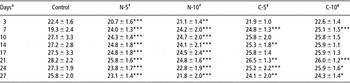
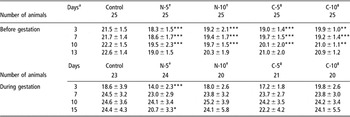
Daily food consumption is significantly different in male rats fed with meat-based diets compared with control, especially in normal-cattle meat groups (P < 0.05, P < 0.01 or P < 0.001; Table 1). Before gestation periods, the food consumption in female rats is significantly lower in both normal- and cloned-cattle meat diets than that of control (P < 0.05; P < 0.01; P < 0.001; Table 2).
Food consumption in male rats fed with the meat-based diets

aDays after acclimating periods.
†Normal beef; ‡Cloned beef (% on food) (25 rats per each group).
Significant differences as compared with control: *P < 0.05; **P < 0.01; ***P < 0.001.
Data were expressed as mean ± s.d. (g per animal per day).
Food consumption in female rats before and after gestation periods

aDays after acclimating periods.
†Normal beef; ‡Cloned beef (% on food).
Significant differences as compared with control: *P < 0.05; **P < 0.01; ***P < 0.001.
Data were expressed as mean ± s.d. (g per animal per day).
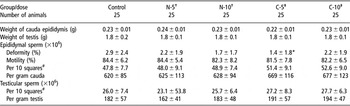
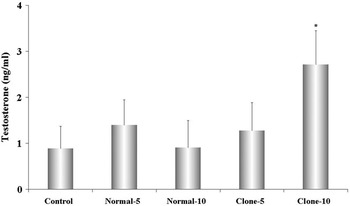
For male reproductive parameters, the cloned-cattle meat diets affect positively in decreased sperm deformity in C-5 group (P < 0.05; Table 3) and an increased plasma testosterone level in C-10 group compared with that of control- and normal-meat groups (P < 0.05; Figure 1), respectively.
Effects of the meat-based diets on male reproductive parameters

†Normal beef; ‡Cloned beef (% on food).
Calculated using Makler Counter Chamber, expressed as mean ± s.d.
*Significant difference as compared with control (P < 0.05).
Effects of meat-based diets on plasma testosterone concentration in male rats – normal and clone beef (% on food); *significant difference as compared with control (p < 0.05); The rats examined were chosen randomly from 10/25 rats.

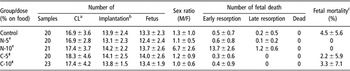
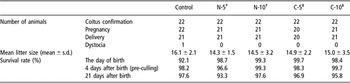
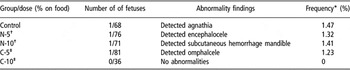
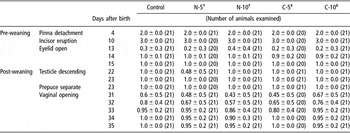
No test substance-related differences are observed in Caesarean section analysis (Table 4) and delivery (Table 5) in dams compared with control- and normal-meat groups. And no obvious negative effects of cloned-cattle meat diets were determined in external abnormalities (Table 6) and neonatal development during pre- and post-weaning periods (Table 7).
Caesarean section analysis in dams fed with the meat-based diets
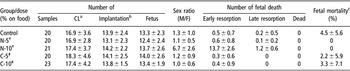
aCorpus lutea.
bImplantation rate (%) = (number of implantation/number of corpus lutea) × 100.
cFetal mortality (%) = (number of fetal death/number of implantation) × 100, expressed as mean ± s.d.
†General beef; ‡Cloned-beef (% on food).
Effects of cloned-cattle meat diets on delivery in dams and neonates

†General beef; ‡Cloned beef (% on food).
External examination of neonates from dams fed with the meat-based diets

* .
†General beef; ‡Cloned-beef (% on food).
Physiological development test in neonates from dams fed with the meat-based diets

†Normal beef; ‡Cloned beef (% on food); expressed as mean ± s.d.
Pre-weaning period: number of dams; post-weaning period: number of litters.
Discussion
One of the most important factors in food safety is potential hazards. The key scientific issue is whether and to what degree the genomic reprogramming that occurs when a differentiated nucleus drives the development of a clone might result in gene expression that raises food safety concerns (Animal Biotechnology: Science-based concerns, 2002). Indeed, cloned embryos exhibit abnormal patterns of DNA methylation and gene expression, leading to high rates of embryonic, fetal, perinatal and neonatal deaths as well as offspring with various abnormalities (Kang et al., Reference Kang, Koo, Park, Choi, Chung, Lee and Han2001; Safety of Genetically Engineered Foods, 2004; Kelly, Reference Kelly2005). On the other hand, the health and well-being of somatic cell clones showed physiologically, immunologically and behaviorally normal (Tian et al., Reference Tian, Xu and Yang2000; Lanza et al., Reference Lanza, Cibelli, Faber, Sweeney, Henderson, Nevala, West and Wettstein2001; European Food Safety Society Scientific Committee, 2008) and exhibited puberty at the expected age with high rates of conception upon artificial insemination (Enright et al., Reference Enright, Taneja, Schreiber, Riesen, Tian, Fortune and Yang2002; Govoni et al., Reference Govoni, Tian, Kazmer, Taneja, Enright, Rivard, Yang and Zinn2002; Savage et al., Reference Savage, Maull, Tian, Taneja, Katz, Darre and Yang2003).
Several reports revealed that the meat and milk compositions from clones by SCNT were largely not different from those of normal comparators (Walsh et al., Reference Walsh, Lucey, Govindasamy-Lucey, Pace and Bishop2003; Takahashi and Ito, Reference Takahashi and Ito2004). Like previous reports, the nutritional compositions of cloned Hanwoo meat were not different with normal Hanwoo meat (data not shown). Very few data, however, are available on the consequence of consuming products from SCNT clones. Therefore, little is known about the effects of the diets containing cloned-animal meat or milk on mammalian reproduction.
There were no abnormal findings in BW and food intake during 3 (Tome et al., Reference Tome, Dubarrym and Fromentin2004) or 14 weeks (Yamaguchi et al., Reference Yamaguchi, Ito and Takahashi2007) of experimental periods in rats. Unlike previous reports, lower food consumption is observed both in male and female rats fed with the cloned-cattle meat diets. However, it may not be affected directly on physiological and reproductive parameters in rats. Especially, the neonates from the dams fed with cloned-cattle meat diets showed a normal neonatal development during post-weaning periods. And there were no cloned-meat related differences in absolute organ (brain, heart, liver, spleen, adrenal, kidney, ovary, etc.) weight and necropsy finding compared with control- and normal-meat groups (data not shown).
These results lead us to conclude that there are no obvious negative effects on the reproductive physiology in rats fed with cloned-cattle meat diets compared to their comparators.