Dairy cow management during the prepartum period is important, not only due to subsequent influences on postpartum performance, but also for the welfare of cows at this critical time. Cows often undergo dramatic changes in management practices during the last one or two months of gestation (i.e. dry period), including cessation of milking, changes in diet, housing systems and social environment, which can be stressful to dry cows. Dynamic social re-grouping (i.e. the regular entry of new cows and removal of cows to other groups) is a common practice for dry cows on UK dairy farms (Fujiwara et al., Reference Fujiwara, Haskell, Macrae and Rutherford2018), but frequent regrouping of prepartum cows has been shown to increase agonistic social interactions at the feed-face (Schirmann et al., Reference Schirmann, Chapinal, Weary, Heuwieser and von Keyserlingk2011; Lobeck-Luchterhand et al., Reference Lobeck-Luchterhand, Silva, Chebel and Endres2014). Talebi et al. (Reference Talebi, von Keyserlingk, Telezhenko and Weary2014) suggested that reduced stocking density can attenuate the negative impact of regrouping, but overstocking of dairy cows may be common especially on large farms to maximise profit while reducing cost (Estevez et al., Reference Estevez, Andersen and Nævdal2007).
Overstocking of dairy cows results in altered feeding behaviour, increased feed competition and decreased lying time (e.g. Huzzey et al., Reference Huzzey, DeVries, Valois and von Keyserlingk2006; Fregonesi et al., Reference Fregonesi, Tucker and Weary2007; Proudfoot et al., Reference Proudfoot, Veira, Weary and von Keyserlingk2009) and can induce physiological stress responses (Huzzey et al., Reference Huzzey, Nydam, Grant and Overton2012; Fustini et al., Reference Fustini, Galeati, Gabai, Mammi, Bucci, Baratta, Accorsi and Formigoni2017). Therefore, it is important to provide adequate space for prepartum dairy cows, especially where dynamic social grouping is unavoidable.
This study aimed to investigate the effect of overstocking during the entire dry period in an industry-relevant setting. We hypothesised that, during the dry period, high stocking density would result in more frequent agonistic social interaction, altered feeding and lying behaviour, the activation of physiological stress responses and negative energy balance in cows.
Materials and methods
The experiment was approved by the SRUC Animal Welfare and Ethical Review Body and took place at the SRUC Dairy Research and Innovation Centre (Dumfries, UK) between 26th November 2014 and 4th July 2015.
Animals and housing
Forty-eight prepartum Holstein Friesian cows (parity ≥1, calving over a seven month period) were dried off 60 ± 4 d before their expected calving date. They were housed in a cubicle pen until 21 ± 4 d before their expected calving date (far-off dry group) and then moved to a straw yard until the first milking after parturition (close-up dry group) (Supplementary Fig. S1). Dry-offs and movements of cows from far-off to close-up dry groups occurred once per week on Wednesday. A yoke feed barrier (0.4 m width) and a post-and-rail feed barrier (4.8 m width) were used as the feed-face for cubicle pens and straw yards, respectively. Fresh feed was delivered once daily between 11 : 00 and 14 : 00 and was pushed up between 17 : 00 and 19 : 00. Cows had ad libitum access to a water trough.
Treatments
Cows were randomly allocated, balanced by parity, into either high (n = 25) or low (n = 23) stocking density groups at dry-off. In the cubicle pens, the H group had 0.5 feed yokes and 1.0 cubicle per cow, and the L group had 1.0 feed yoke and 1.5 cubicles per cow. In the straw yards, the H group had 0.3 m of linear feed-face space and 6.0 m2 of lying space per cow, and the L group had at least 0.6 m of linear feed-face space and at least 12.0 m2 of lying space per cow. More details of methodologies, treatment settings and data collection points are summarised in the Supplementary file and Supplementary Fig. S2.
Herd data collection
The average daily milk yield from five to 30 d after parturition (MY first month) were obtained from the herd management programme (DairyPlan Herd Management Software, GEA Farm Technologies, UK). Somatic cell counts at the first recording after calving (SCC first month) was downloaded from The Cattle Information Service and imported into herd management software (InterHerd; National Milk Records, UK). Body condition score (BCS: 0–5 scale with 0.5 intervals; Mulvany, Reference Mulvany1977 modified) and locomotion score (LS: 1 = sound, 5 = severely lame: Manson and Leaver, Reference Manson and Leaver1988) were measured three times: at dry-off, −21 ± 4 d (transition) and −7 ± 5 d (pre-calving) prior to the expected calving date. The quality of the first milk after parturition (colostrum) was measured using a colostrum densimeter (KRUUSE colostrum densimeter, KRUUSE, Denmark). Colostrum Ig concentrations (mg/ml) were corrected at 20 °C using the formula by Mechor et al. (Reference Mechor, Gröhn and van Saun1991). The incidence of mastitis, metabolic disorders and other infectious diseases during the first month after calving was recorded as per standard farm practice.
Physiological data collection
Faecal samples were collected individually at dry-off, on d7 (week2) and d35 (week5) after dry-off, and at transition and pre-calving. Samples were sealed in plastic bags and stored at −20 °C. Steroids from the faecal samples were extracted by mixing each of the raw faecal samples (0.50 ± 0.01 g) with 80% methanol (5.0 ml), centrifuging for 20 min at 2500 × g to obtain the supernatant and stored at −20 °C until analysis (Palme and Möstl, Reference Palme and Möstl1997). Concentrations of faecal glucocorticoid metabolites (FGCM: 11,17-di-oxoandrostane) were measured using a competitive enzyme immunoassay (Palme et al., Reference Palme, Robia, Messmann, Hofer and Möstl1999). Intra-assay Coefficient of Variability (CV) of samples and inter-assay CV calculated for the 11,17-DOA assays were <13.0 and 4.2% respectively.
At dry-off and pre-calving, blood was collected from the coccygeal vessel into 10-mL sterile plain tubes and 10 mL sterile tubes containing sodium fluoride. After centrifugation (3000 × g for 10 min), serum and plasma were collected and stored at −20 °C until analysis. Concentrations of serum nonesterified fatty acids (NEFA), β-hydroxybutyric acid (BHB) and plasma glucose (Glu) were measured by an Instrumentation Laboratory IL600 wet chemistry system using reagents supplied by Randox (BHB), Alpha Laboratories (NEFA) and Instrumentation Laboratory (Glu) by the Dairy Herd Health and Productivity Service at the Royal (Dick) School of Veterinary Studies, University of Edinburgh.
Behavioural data collection and processing
At dry-off, all cows were fitted with a triaxial accelerometer (IceTag Pro: IceRobotics Ltd, UK) on a hind leg to monitor activity levels throughout the experimental period. Data were downloaded using IceManager (IceRobotics Ltd), which provided lying and standing duration per minute. Lying and standing durations were calculated as described by Tolkamp et al. (Reference Tolkamp, Haskell, Langford, Roberts and Morgan2010), and daily lying proportion (LP) was calculated by dividing lying duration by the sum of daily lying and standing durations. The last 2 d of activity data were removed from the dataset to eliminate the effect of pre-calving behavioural changes (Kok et al., Reference Kok, van Knegsel, van Middelaar, Hogeveen, Kemp and de Boer2015).
Behaviour at the feeding area (feed-face, feed alley, loafing area) was recorded with waterproof infrared CCTV cameras (1/3″ Sony Colour CCD, EZ420IR-30, ezCCTV.com Ltd, Herts, UK) connected to a digital video surveillance system (GeoVison, version 8, GeoVision Inc., Taiwan).
Three-h video clips were watched by a single observer on the first (observation A), third (observation B) and sixth (observation C) days after weekly regrouping throughout the experimental period (32 weeks) starting at the time of feed delivery. Focal cows were marked with individually allocated numbers on both sides of their rumps using hair dye. Intra-observer reliability was assessed before the start of each observation type, by watching the same video clips for three different days twice over.
A cow was recorded as ‘feeding’ when its head completely crossed the line between the feed alley and the feed bunk. Latency for each cow to start feeding was calculated for each of the observation days. Information from cows that did not appear at the feeding area within the observation period was treated as censored data. Five-min scan sampling recorded whether individual cows were feeding or standing in the alley during the 3 h after feed delivery. A cow was recorded as ‘standing in the feed alley’ when its shoulder was within the feed alley or loafing area including water trough, and the cow was not feeding. For each of the treatment groups, feeder occupancy at each time point (i.e. the percentage of available feeding space occupied by cows) and the percentage of cows at the feed-face (i.e. the number of cows at the feed-face/the number of cows in the group × 100) were calculated and averaged for the following three 60-min periods: 0–60, 60–120 and 120–180 min after feed delivery. For individual cows, the total number of times a cow was either feeding or standing in the feed alley in the 3 h after feed delivery was obtained, and estimated times (min) spent feeding and standing in the alley (multiplied by five) were calculated per observation day.
The number of displacements at the feed-face were continuously observed for 20 min on three occasions (0–20, 40–60 and 80–100 min) after feed delivery on two observation days per week (observation A and C). A displacement was recorded when the cow withdrew its head from the feeder and/or moved back more than a half cow body-length from the feed-face after the aggressive interaction, as well as the identity of the cow that displaced another cow (actor) and that were displaced by the actor cow (recipient). Non-focal cows were recorded as cow X with no individual distinction. The number of displacements a cow initiated and received during the three-20 min observation periods were summed to obtain values per cow per observation day.
Statistical analysis
Statistical analyses were performed using Genstat® 16th Edition (VSN International Ltd, Hemel Hampstead, UK). LS was categorised as either lame (LS ≥ 3) or non-lame (LS ≤ 2), and parity as either primiparous (P: parity at dry-off = 1, i.e. first lactation cows dried-off for the second calving) or multiparous (M: parity at dry-off ≥2). The number of cows receiving any veterinary treatment during the subsequent lactation period was analysed using a χ2 test. A linear mixed model using residual maximum likelihood procedures (REML) or a generalised linear mixed model using a binomial distribution with a logit function (GLMM) was used to analyse all of the biological, physiological and behavioural data. The models included treatment (H, L), parity (M, P) and other variables of interests as fixed effects and cow as a random effect (except for feeder occupancy and the percentage of cows feeding). Other variables of interest ranged depending on the analyses and are described in each section. Interactions between treatment and other variables were fitted for all statistical models by backward stepwise selection, and only significant interactions (P > 0.05) were included in the final model. A post-hoc analysis (Fisher's unprotected least significant difference test) was conducted when there were significant interactions or differences between more than two categories (e.g. sampling points) to investigate the direction of the effect. Normality of the residuals was checked graphically.
REML was used to analyse the change in BCS during the dry period, dry period length (DPL), gestation period length (GPL), corrected colostrum Ig, ‘MY first month’, ‘SCC first month’, FGCM concentrations, feeder occupancy, the percentage of cows at the feed-face, LP, time spent feeding and standing in the alley, and the number of displacements. The data for FGCM, standing time in the alley and the number of displacements were analysed following a logit transformation. The data for latency to start feeding could not be normalised by a logit transformation and were converted to binary data to indicate the likelihood of the cow starting to feed within 5 min after fresh feed delivery (Yes = 1, No = 0). GLMM was used to analyse the change in lameness score during the dry period, the change in metabolic parameters between dry-off and pre-calving (Δpre-dry: ΔGlu, ΔNEFA, ΔBHB), and the likelihood of the cow starting to feed within 5 min after fresh feed delivery.
Sampling point was included as a fixed effect in the final models for BCS, LS (dry-off, transition, pre-calving) and for FGCM (dry-off, week2, week5, transition, pre-calving). LP, feeder occupancy and the percentage of cows at the feed-face, feeding and social behaviour (0–60, 60–120 and 120–180 min after feed delivery) included treatment, observation day (A, B, C), feed barrier type (feed yoke, post-and-rail) and group size as fixed effects and ‘experimental-week × treatment’ as a random effect. Other variables of interests included in the models for LP, feed-related behaviour and displacements were lameness score (lame, non-lame), day from weekly regrouping (0–6) for activity data, observation day (A, B, C) and group size for feed-related behaviour and displacements. The effect of changes over week from dry-off (1–10) and housing type (cubicle/yoke, straw/post-rail) were partially confounded with each other, and so these factors were combined and fitted in the models as a ‘housing-week’ variable (week1–week6 as C1–C6 and week7–week10 as S1–S4). This approach was taken as the main aim of this study was to evaluate the overall effect of stocking density on dry cows in a real production system, rather than specifically looking at the effect of regrouping or housing type.
Test statistics, P-values, means or predicted means and standard errors of means (sem) are reported. For transformed data, means obtained were back-transformed and corresponding 95% confidence intervals [95% CIs] were reported.
Results
Descriptive and physiological data
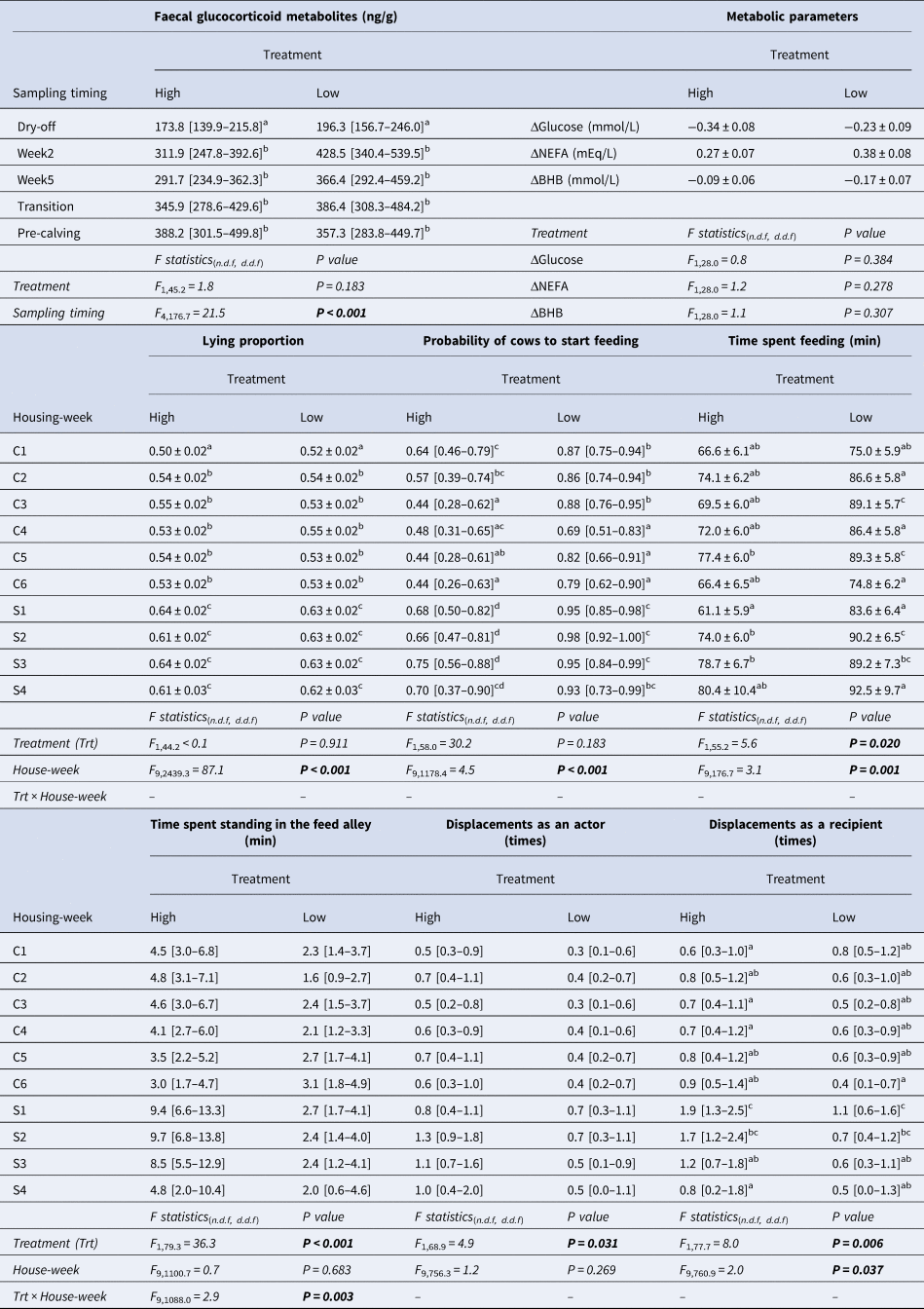
Neither treatment nor parity had a significant effect on mean dry period length (60.3 ± 6.7 d), mean gestation length (279.7 ± 7.9 d), changes in BCS and the proportion of lame cows during the dry period, ‘MY first month’ (H: 38.5 ± 1.6, L: 36.7 ± 1.6 kg) or ‘SCC first month’ (H: 81.5 [55.0–120.6] × 103, L: 58.2 [38.8–87.4] × 103). The corrected colostrum Ig level (H: 1058 ± 2, L: 1059 ± 2 mg/ml) and the number of cows that received veterinary treatments during the first 30 d of the subsequent lactation period (H: n = 10, L: n = 7; P > 0.1) were also not significantly affected by treatment or parity. FGCM concentrations were significantly higher at all sampling points during the dry period compared to dry-off (F 4,176.7 = 21.5, P < 0.001, Table 1), but there were no differences between treatment groups or parities. Treatment or parity also did not significantly affect the change in metabolic parameters from dry-off to pre-calving (ΔGlu, ΔNEFA, ΔBHB: Table 1).
Concentration of faecal glucocorticoid metabolites (ng/g) at the five sampling points during the dry period, metabolic profile change from dry-off to pre-calving and effects of housing-week on lying proportion, feeding behaviour and the number of displacements (as an actor or a recipient) in each of the treatment groups (High: high stocking density, Low: low stocking density)

Data presented as means ± sem or back-transformed means [95% CIs]. For each of the parameters, different superscripts within the same column indicate significant differences at P < 0.05.
Feed-face occupancy
Regardless of the feed barrier type, the feed bunk was significantly more crowded in the H group compared to the L group during the first 3 h after feed delivery (0–60 min: F 1,80.0 = 33.5, P < 0.001; 60–120 min: F 1,79.9 = 102.2, P < 0.001; 120–180 min: F 1,81.1 = 197.9, P < 0.001; Fig. 1A). During the first 60 min after feed delivery, the feed bunk in the H group was more crowded when the post-and-rail feed barrier was used compared to when the yoke feed barrier was used, but this effect was not seen in the L group (F 1,263.0 = 10.9, P = 0.001). Observation day C was significantly more crowded than observation day A and B from 0–60 min (F 2,223.2 = 9.8, P < 0.001) and 60–120 min after feed delivery (F 2,221.2 = 13.6), and observation day B had a lower density than observation day A and C from 120–180 min after feed delivery (F 2,212.6 = 3.9, P = 0.023; Fig. 1a).
Feed-face occupancy (%: A, left panels) and percentage of cows at the feed-face (B: right panels) in the 3 h after feed delivery at the yoke feed-face and the post-and-rail feed-face. Different types of solid lines represent the High stocking group and different types of dotted lines represent the Low stocking group on observation days A, B and C.

The percentage of cows at the feed-face was significantly lower in the H group compared to the L group during the first 2 h after feed delivery (0–60 min: F 1,81.0 = 90.1, P < 0.001; 60–120 min: F 1,82.2 = 10.6, P = 0.002; Fig. 1b). There was a significant interaction between treatment and housing type 0–60 min after feed delivery (F 1,263.9 = 4.1, P = 0.045), where the yoke feed-face in the H group had a lower percentage of cows compared to the post-and-rail feed-face. After 2 h from the feed delivery, significantly more cows were observed at the feed-face in the H group compared to the L group (F 1,80.9 = 8.4, P = 0.005) and at the yoke feed-face compared to the post-and-rail feed-face (F 1,250.9 = 11.2, P = 0.001).
Activity data
There was no overall treatment effect on lying proportion (LP), but LP significantly increased from C1 to C2 and from C6 to S1 (F 9,2439.3 = 87.1, P < 0.001; Table 1), regardless of the treatment groups. LP also significantly increased on the day after regrouping and remained higher than on the day of regrouping for the following 6 d (F 6,2433.6 = 6.0, P < 0.001; Table 1). There was no significant effect of parity nor lameness score on LP.
Feeding behaviour
L cows had a higher probability to start feeding ≤5 min after feed delivery compared to H cows (H: 0.60 [0.47–0.70], L: 0.92 [0.86, 0.96]; F 1,58.0 = 30.2, P < 0.001), and spent more time feeding than H cows during the first 3 h after feed delivery (H: 75.1 ± 4.4, L: 86.8 ± 4.8 min; F 1,55.2 = 5.8, P = 0.020). There was a significant interaction between treatment and lameness score (F 1,223.7 = 4.5, P = 0.035), where non-lame cows in the L group were more likely to start feeding ≤5 min after feed delivery than lame cows in the L group (non-lame: 0.95 [0.90–0.97], lame: 0.82 [0.67–0.91]; P = 0.028). Regardless of the treatment group, the probability of cows starting to feed declined from C1 to C4 but increased during the weeks in the straw yard (F 9,1178.4 = 4.0, P < 0.001; Table 1). The probabilities were the lowest on observation day A, and increased from observation day B to observation day C (A: 0.74, [0.65–0.81], B: 0.76, [0.68–0.83], C: 0.82, [0.74–0.87]; F 2,1164.7 = 3.9, P = 0.021). Cows were more likely to start feeding ≤5 min after feed delivery as the group size increased (F 1,1204.2 = 10.7, P = 0.001), but there were no effects of parity or lameness score.
Feeding time was increased from C1 to C2 in both of the treatment groups and stabilised until S4 except for a significant decline at C6 and S1 (F 9,1084.8 = 3.1, P = 0.001; Table 1). Cows spent more time feeding on observation day C than on observation days A and B (A: 74.3 ± 3.5, B: 77.8 ± 3.5, C: 85.1 ± 3.5 min; F 2,11.3 = 11.3, P < 0.001). Parity, lameness score or group size also did not significantly affect time spent feeding during 3 h after feed delivery.
H cows spent significantly longer time standing in the feed alley in the 3 h after feed delivery (H: 5.3 [4.3–6.5], L: 2.3 [1.8–3.0] min; F 1,79.3 = 39.3, P < 0.001). H cows stood in the feed alley for a longer time than L cows from C1 to C4 and S1 to S3, but this treatment difference was greater during the weeks in the straw yards than the weeks in the cubicle pens (F 9,1088.0 = 2.9, P = 0.003; Table 1).
Number of displacements at feed-face
H cows displaced other cows and were displaced by other cows more frequently than L cows (actor: F 1,68.9 = 4.9 P = 0.031, recipient: F 1,77.7 = 8.0, P = 0.006). Housing-week significantly affected the number of displacements as a recipient (F 9,760.9 = 2.0, P = 0.037), but not as an actor. Regardless of treatment, cows were more likely to be displaced in S1 and S2, with no difference at other times (Table 1). Parity did not affect the number of displacements as an actor (P: 0.7 [0.5–0.9], M: 0.5 [0.4–0.7] times; F 1,45.5 = 2.5, P = 0.121), but primiparous cows were displaced more often than multiparous cows (P: 1.0 [0.8–1.3], M: 0.6 [0.5–0.8] min; F 1,44.8 = 10.4, P = 0.002). The number of displacements both as an actor and as a recipient significantly decreased as group size increased (actor: F 1,770.5 = 13.2, P < 0.001; recipient: F 1,700.5 = 19.2, P < 0.001). Neither observation day or lameness score significantly affected the number of displacements as an actor or a recipient.
Discussion
The current study investigated the impact of high stocking density during the entire dry period on cow physiology, metabolism and behaviour in an industry relevant setting (e.g. changes in housing type, group composition and group size). The treatment for the H group was in line with the minimum space allowance and a half of the feed-face space allowance set by the industry (Red Tractor Assurance for Farmers – Dairy Scheme, 2017: see Supplementary File). A high stocking density treatment for dry dairy cows resulted in restricted access to the feed-face and a constantly crowded feed-face during the peak feeding period (the first 60–90 min after feed delivery). Behavioural observations suggest that overstocking of the feed-face forced cows to interact with other cows or wait in the feed alley rather than feeding, reducing the time available for cows to engage in feeding activity during the peak feeding period, confirming the hypothesis.
Increased competition at the feed-face with low space allowance has been shown to decrease peak-time feeding activity of cows (DeVries et al., Reference DeVries, von Keyserlingk and Weary2004; Huzzey et al., Reference Huzzey, Nydam, Grant and Overton2012). Indeed, the time spent feeding during the 3 h after feed delivery was 15 min less in the high stocking density treatment. Moreover, cows were less likely to approach the feed-face and start feeding immediately after feed delivery. Similar to previous studies (Huzzey et al., Reference Huzzey, DeVries, Valois and von Keyserlingk2006; Proudfoot et al., Reference Proudfoot, Veira, Weary and von Keyserlingk2009), the current study found that increased stocking density or increased competition at the feed-face increased the time spent standing inactive in the feeding area. The findings from the current study are in agreement with the previous studies conducted on prepartum cows in a more controlled setting and with a shorter experimental period (e.g. DeVries et al., Reference DeVries, von Keyserlingk and Weary2004; Huzzey et al., Reference Huzzey, DeVries, Valois and von Keyserlingk2006; Proudfoot et al., Reference Proudfoot, Veira, Weary and von Keyserlingk2009; Huzzey et al., Reference Huzzey, Nydam, Grant and Overton2012). This suggests that the impact of high stocking density on dry cow behaviour can be applicable to a commercial setting.
Stocking density did not affect the concentration of faecal glucocorticoid metabolites (FGCM) or serum NEFA, BHB and plasma glucose at any point during the dry period. These results did not support our hypothesis drawn by previous studies. Huzzey et al. (Reference Huzzey, Nydam, Grant and Overton2012) and Fustini et al. (Reference Fustini, Galeati, Gabai, Mammi, Bucci, Baratta, Accorsi and Formigoni2017) found that overstocking during the prepartum period and an associated increase in competition increased the level of circulating cortisol in cows. Huzzey et al. (Reference Huzzey, Nydam, Grant and Overton2012) also found elevated plasma NEFA and glucose concentrations during the overstocked period, indicating that overstocking resulted in negative energy balance. However, Silva et al. (Reference Silva, Dresch, Machado, Moraes, Lobeck-Luchterhand, Nishimura, Ferreira, Endres and Chebel2014) found no difference in the prepartum serum cortisol levels and metabolic profiles between understocking and control treatments (1 : 1 ratio of cow to yoke/cubicle).
The discrepancy between studies may be due to a harsher lying space allowance in the previous studies (3.3 m2/cow in Fustini et al., Reference Fustini, Galeati, Gabai, Mammi, Bucci, Baratta, Accorsi and Formigoni2017 and 0.5 cubicles/cow in Huzzey et al., Reference Huzzey, Nydam, Grant and Overton2012). This was almost half of the allowance for the H group in the current study. Indeed, the current study found no overall treatment effect on daily lying proportions, but a decreased lying time has been reported when each cow had less than one cubicle (Fregonesi et al., Reference Fregonesi, Tucker and Weary2007). Therefore, the different outcomes in stress responses to high stocking density may be due to different lying space allowances.
Concentrations of FGCM were higher during the dry period than at dry-off regardless of treatment. This may indicate a biological adaptation to the transition from late gestation to early lactation (NRC, 2001), but the level of increase was most prominent in the first week after dry-off. This may be due to a reduction in total faecal volume after dry-off. Additionally, cows can be exposed to various changes in management during the dry period such as abrupt cessation of milking and alterations in diet, group composition and housing (Fujiwara et al., Reference Fujiwara, Haskell, Macrae and Rutherford2018), all of which can be stressful. The current study confirmed that locomotion score and body condition score were not influenced by prepartum social environment, and there were no treatment differences in disease incidence, somatic cell count or milk yield during the postpartum period, but the outcomes are in agreement with previous studies (Silva et al., Reference Silva, Dresch, Machado, Moraes, Lobeck-Luchterhand, Nishimura, Ferreira, Endres and Chebel2014; Fustini et al., Reference Fustini, Galeati, Gabai, Mammi, Bucci, Baratta, Accorsi and Formigoni2017). The absence of statistical differences may be due to large individual variations and/or a small number of cows used for the data analyses,
We found factors other than stocking density that affected cow behaviour. Cows gradually delayed the time to start feeding after feed delivery over the weeks in the cubicle pen, although feeding time was increased from the first to the second week of the dry period. Cows increased their feeding time over the weeks in the straw yard, which may be explained by a higher motivation of cows for feed due to increased energy requirements during late pregnancy (Jouany, Reference Jouany2006) or due to easier access to the feed-face (Endres et al., Reference Endres, DeVries, von Keyserlingk and Weary2005; Huzzey et al., Reference Huzzey, DeVries, Valois and von Keyserlingk2006). Indeed, the post-and-rail feed-face occupancy for the H group exceeded 100% during the first 10 min after feed delivery. This means that cows decreased the distance to neighbouring cows to less than 0.30 m per cow. It is important to note that the effects of housing type and weekly changes were partially confounded, and it is impossible to distinguish between them.
Lame cows were less likely than non-lame cows to start feeding in the low stocking group, but not the high stocking group, possibly because the L group theoretically allowed all cows to feed at once (i.e. less competition for access to the feed-face) and lame cows took more time to approach the feed-face. The limited feed space in the high stocking group imposed the same restriction on access to the feed-face for all of the cows, and having lameness may not have been the only reason to delay the time to start feeding after feed delivery.
Cows were less likely to lie down on the day of regrouping, during the first week of the dry period and during the weeks in the cubicle pen compared to the weeks in the straw yard. von Keyserlingk et al. (Reference von Keyserlingk, Olenick and Weary2008) reported a significant decrease in lying bouts and lying time on the day of regrouping, especially among cows moved to a new group. It is possible that cows interacted with unfamiliar cows in places other than the feeding area, which contributed to the decreased lying time on the day of regrouping and the first week in the dry cow group. A change in the floor surface from hard concrete to a deep straw-bedded floor may have enabled cows to lie down and stand up more easily (Tuyttens, Reference Tuyttens2005).
Cows were more likely to access the feed-face and feed for longer on the sixth day after regrouping than the first day after regrouping. This may suggest that social stabilisation had occurred (Kondo and Hurnik, Reference Kondo and Hurnik1990), although there were no differences in the number of displacements between the two observation days. Since a weekly regrouping practice made it difficult to pinpoint when social stabilisation had occurred or would occur, it is possible to argue that cows are still in the process of social stabilisation within the group on the sixth day.
Primiparous cows were more likely to receive active responses compared to multiparous cows, although there was no parity effect on the number of displacements initiated, suggesting that primiparous cows are more likely to be a target for displacements. Proudfoot et al. (Reference Proudfoot, Veira, Weary and von Keyserlingk2009) also found that both primiparous and multiparous cows increased the frequency of displacing other cows at high stocking density, but only primiparous cows were more frequently displaced with an increased stocking density.
In conclusion, high stocking density during the dry period altered feeding activity and increased competition at the feed-face. At high stocking densities, cows took longer to approach the feed-face and spent less time feeding. Cow activity level was not influenced by stocking density alone, but the effects of housing/feed-face type appeared to be more pronounced with an increased stocking density. However, the behavioural changes associated with increased stocking density were not reflected in the physiological stress, metabolic responses, postpartum health or productivity of the cow. Investigating the impact of overstocking at an individual animal level would help determine whether a competitive social environment during the dry period potentially affected not only the behaviour but also the welfare of prepartum cows, and which animals would be more susceptible to the negative effects of overstocking.
Supplementary material
The supplementary material for this article can be found at https://doi.org/10.1017/S002202991900058X
Acknowledgement
The work was partly funded by the Rural & Environment Science & Analytical Services Division of the Scottish Government and SRUC. Authors are thankful to Dr Sarah Hall, Jennifer Coe and Liz Burrough for their support with laboratory analyses, Dr Helen Brown for her statistical support and to the technicians and farm staff from the SRUC Animal Behaviour and Welfare team, the Dairy Research and Innovation Centre, and Crichton Royal Farm.