In variationist sociolinguistics, inherent structured variation within a grammatical sector is considered the sine qua non of the vernacular (Weinreich et al., Reference Weinreich, Labov, Herzog, Lehmann and Malkiel1968). The foundational assumption is that language variation is governed by probabilistic constraints and that systematic choices among variants are constrained by social and linguistic factors (Labov, Reference Labov1963 et seq.). A further assumption is that these factors operate most robustly, and most systematically, in vernacular speech, where corrective norms exert less influence (Labov, Reference Labov, J. and J.1984). Circumscribing the variable context is vital, as it defines the loci of variation and categoricity in the grammar. This procedure, coupled with rigorous linguistic interpretation and robust statistical modeling, has substantially advanced understanding of the linguistic system and how it changes. The challenge we face in this paper is the following. When linguistic variables have curtailed variability, how can they be reconciled with standard conceptions of variation so as to contribute to the building knowledge base of the field? Most linguistic variables in the literature exhibit the expected structured variation. In this paper, we chronicle a collection of variables from our own research that exhibit an apparently exceptional characteristic—not variation, but partitioning. We then explore what this type of variation contributes to the ontology of language variation and language change and suggest that a combination of inherited historical patterns and functional requirements may explain the unexpected profile of these linguistic variables.
Central to our discussion are four grammatical phenomena that are putatively ideal candidates for variationist study: the genitive (1), the comparative (2), the dative (3), and relative pronouns (4).
(1)
a. He was the manager of the Toyland of the T. Eaton Company, the T. Eaton Company's Toyland, and so they were fairly well off. (N/Q/f/72)Footnote 1
b. He was the movie star's son … the son of the movie star, he died. (R/O/m/11)
(2)
a. A cottage can be a lot quirkier … it is obvious that cottages are more quirky. (N/j/m/47)
b. I would say it was much more strict when I began teaching. … They've introduced much stricter curriculum ideas, and you know, that kind of thing. (N/P/m/73)
(3)
a. I emailed them a letter … I wrote a letter to them. (I/8/m/32)
b. It's like, ‘I've known you for so long. Give me some pizza.’ And I finally gave up ’cause he got annoying so I gave it to him. (R/6/f/12)
(4)
a. Neighbours who are everything from a woman who runs a exercise place to a guy that works in a nursery. (R/j/m/47)
b. The biggest change that my grandmother's always teasing me about is we're not as fluid with our speaking. She says a lot of talking Ø she notices is putting into like sweeping generalizations. (N/k/f/25)
Each system is reported to have systematic variation in the written language (both historical and contemporary), with a complex set of constraint effects operating on variant choice (e.g., Ball, Reference Ball1996; Hinrichs & Szmrecsanyi, Reference Hinrichs and Szmrecsanyi2007; Hinrichs, Szmrecsanyi, & Bohmann, Reference Hinrichs, Szmrecsanyi and Bohmann2014; Mondorf, Reference Mondorf, Rohdenburg and Mondorf2003; Szmrecsanyi & Hinrichs, Reference Szmrecsanyi, Hinrichs, Nevalainen, Taavitsainen, Pahta and Korhonen2008; Wolk, Bresnan, Rosenbach, & Szmrecsanyi, Reference Wolk, Bresnan, Rosenbach and Szmrecsanyi2013). In the spoken language, a different reality obtains (cf. D'Arcy, Reference D'Arcy2014; D'Arcy & Tagliamonte, Reference D'Arcy and Tagliamonte2010; Jankowski & Tagliamonte, Reference Jankowski and Tagliamonte2014; Tagliamonte, Reference Tagliamonte, Torres-Cacoullos, Dion and Lapierre2014). Variation is apparent in the aggregate, but analysis reveals at least one attribute that divides the system. When such key elements are taken into account, variation virtually disappears. Thus, it seems that contrary to current variationist epistemology, not all change gives rise to the familiar structured heterogeneity. We suggest that when an extant linguistic system is modified from above (i.e., outside the community), a possible outcome is the entrenchment of separate subsystems in the vernacular while the written language retains structured variation on account of functional complexity and/or inherited historical patterns.
DICHOTOMIES OF LANGUAGE CHANGE
Change may arise through internal systemic shifts, but it can also be initiated or buttressed by external circumstances, such as war, cultural revolution, resettlement, migration, geological phenomena, and so on. For the most part, these linguistic influences have been treated as discrete and antithetic. For example, in historical linguistics, language change is viewed as a contrast between endogenous and exogenous—that is, internally versus externally triggered. In variationist sociolinguistics, language change is framed in terms of above and below. Changes from below arise from “a gradual shift in the behavior of successive generations, well below the level of conscious awareness” (Labov, Reference Labov1966:206). Changes from above result from the operation of social forces and consist of importations from external languages or dialects (Labov, Reference Labov2010:185). These pathways are distinguished from one another along a number of parameters, though our research is beginning to show that the line between the two is not always clear-cut.
Change from below (or from within; Labov, Reference Labov2006:203) is the “normal type of internal change,” originating within the linguistic system (Labov, Reference Labov2010:§51.2; examples are also found in Beddor, Reference Beddor2009; Reference Beddor, Solé and Recasens2012; Garret & Johnson, Reference Garret, Johnson and Yu2013; Kirby, Reference Kirby and Yu2013; Ohala, Reference Ohala and Jones1993; Stevens & Harrington, Reference Stevens and Harrington2014). Outside the phonology, such changes are generally initiated through the mechanisms of reanalysis and extension (e.g., Harris & Campbell, Reference Harris and Campbell1995). Because actuation is internal, change from below is evolutive. This means that it is explicable with reference to the community-based linguistic system (e.g., Andersen, Reference Andersen1973), emerging from the inherited structure of grammatical systems (i.e., via adult to child transmission; cf. Labov, Reference Labov2007). This kind of change is systematic and initially unconscious. That is, despite early descriptions (Labov, Reference Labov1966:128) above and below are only partially defined along the continuum of consciousness. The key attribute of change from below is the point of actuation (system internal) and the trajectory of development (evolutive). Although the etiology of endogenous change is discernable with reference to language-internal factors alone, the diffusion of change in social context must be motivated by speaker-based factors (Armstrong & Mackenzie, Reference Armstrong and Mackenzie2013:124). Change originates in speakers, not languages (Milroy & Milroy, Reference Milroy and Milroy1985:347), necessitating a distinction between the conditions that give rise to a change and those that have to do with its diffusion (see also Joseph & Janda, Reference Joseph, Janda, Joseph and Janda2003, among others; Stevens & Harrington, Reference Stevens and Harrington2014:2). As an innovation moves from speaker to speaker or from group to group, its diffusion is exogenous, propelled by influences outside the community grammar, what Andersen (Reference Andersen1973) referred to as adaptive change (cf. Milroy, Reference Milroy and Hickey2003:219).
Change from above (or from without; Labov, Reference Labov2006:203) refers to the importation of elements from other systems (Labov, Reference Labov2010:§51.2). It is sporadic, conscious, and “usually recognize[d] … by the fact that it involves high-prestige features” (Labov, Reference Labov2010:§9.1). Indeed, the motivations for change from above derive from overt social pressures in society, of the type imposed by teachers and the conscious responses of certain sectors of the population (e.g., the middle class). The effect is socially observable in public performances and reactions. Crucially, change from above is fragmentary. It involves isolated features from outside the local speech community, and so may affect only parts of the linguistic system rather than sweeping through the language as a whole. This renders the outcome less predictable and less systematic than change from below. Consequently, it is not particularly informative with respect to the “systematic forces that mold the history of dialect divergence” (Labov, Reference Labov2010:§9.1). Nonetheless, it remains an important phenomenon for explaining the synchronic patterns of language in use.
The outcomes of these different pathways of change are less well documented, prompting Sankoff (Reference Sankoff and Bayley2013:261) to ask: “Does change from above have a different profile from change from below?” The four variables we examine are arguably the result of change from above, whether direct or indirect, suggesting that this type of change may well have a distinct profile. The constraints we report on here, which operate to partition these systems, are well documented. Indeed, the extensive quantitative results reported in the literature describe their operation in detail; however, few analyses fully explore the extent and nature of the variable contexts as we do here. Therefore, we cannot make any definitive claim as to how widespread or generalizable the partitioning may be. Instead, we document the ways the vernacular systems of our data operate. We suggest that the traditional dichotomization of language change as from above or from below is explained not only through the manner of actuation, with reflexes in transmission or diffusion and distinct pathways through social structure, but may also affect the living language in fundamentally distinct ways. In this respect, evidence regarding the nature of linguistic change may be retrievable from footprints left in the variable grammar.
DATA AND VARIABLES
The four linguistic variants that are central to our discussion developed as historical changes in English: the of genitive, comparative more, the to dative, and the wh– relative pronouns. Our goal is to document and synthesize across their contemporary patterning. The data come from contemporary Canada, where we have access to some of the largest representative corpora of vernacular spoken English. All four variables have previously been subjected to full-scale quantitative study in these materials (D'Arcy, Reference D'Arcy2014; D'Arcy & Tagliamonte, Reference D'Arcy and Tagliamonte2010; Jankowski & Tagliamonte, Reference Jankowski and Tagliamonte2014; Tagliamonte, Reference Tagliamonte, Torres-Cacoullos, Dion and Lapierre2014).
Data
Our analyses are (mostly) based on the Toronto English Archive (Tagliamonte, Reference Tagliamonte2003–2006). For one variable, the dative, the analysis includes the Ontario Dialects Archive (Tagliamonte, Reference Tagliamonte2007–2010; Reference Tagliamonte2010–2013).Footnote 2 The Toronto English Archive database comprises more than 350 hours of recorded spontaneous speech, representing approximately 1.8 million words. The speakers—all of whom were born and raised in metropolitan Toronto—range between the ages of 9 and 92 (years of birth: 1912–1994) and are stratified by gender, occupation, and education. The Ontario Dialects Archive is similarly constituted and comprises speakers born and raised in small cities and towns across Ontario. All of the data were collected following sociolinguistic interviewing techniques (Labov, Reference Labov1970, Reference Labov1971), and individuals are represented by anywhere from one to three hours of informal conversational data. The discourse is varied but is uniformly lively and interactive and includes numerous narrative sequences. The materials thus capture the contemporary vernacular norms of these localities. Although Canadian English is a relatively standard variety, many nonstandard variables are present in the data, including nonagreement, multiple negation, verb forms, double comparatives, and zero inflection, as in (5a) to (5g). Variation is not restricted to any particular social group in the sample but reflects the broader, community grammar.
(5)
a. So the rest of the world don't know what they're doing. (O/d/m/83)
b. We didn't get no damage. (T/G/f/76)
c. You get a lot of them come back to us. (T/T/m/49)
d. They had selled their things. (N/S/f/34)
e. She come out and she says, ‘In the name of God, what have you got now?’ (N/b/m/85)
f. They're speaking a little more fancier. (N/E/m/36)
g. It's amazing how quick–Ø the people do panic. (N/v/f/55)
Variables
The variables are well known in the variationist literature as well as in historical linguistics and corpus linguistics. For example, relativization—the domain of the wh– relatives—has been described as “one of the most researched topics in the history of the English language” (Nevalainen & Raumolin-Brunberg, Reference Nevalainen, Raumolin-Brunberg and Poussa2002:109). A common characteristic of studies of the genitive, the comparative, the dative, and relativization is that the research has drawn (most of) its evidence from standard language and from written genres. The findings have uniformly reported robust variation and multidimensional patterns of variation (e.g., Gries, Reference Gries, Brend, Sullivan and Lommel2002; Guy & Bayley, Reference Guy and Bayley1995; Hilpert, Reference Hilpert2008; Hinrichs & Szmrecsanyi, Reference Hinrichs and Szmrecsanyi2007; Hinrichs et al., Reference Hinrichs, Szmrecsanyi and Bohmann2014; Kytö & Romaine, Reference Kytö, Romaine, Nevalainen and Kahlas-Tarkka1997, Reference Kytö, Romaine and Wright2000, Reference Kytö, Romaine, Kytö, Rydén and Smitterbeg2006; Leech & Culpeper, Reference Leech, Culpeper, Kytö, Rydén and Smitterberg1997; Ljung, Reference Ljung, Fries, Müller and Schneider1997; Mondorf, Reference Mondorf, Rohdenburg and Mondorf2003, Reference Mondorf2009; Nevalainen & Raumolin-Brunberg, Reference Nevalainen, Raumolin-Brunberg and Poussa2002; Rissanen, Reference Rissanen and Fisiak1984; Romaine, Reference Romaine1980; Rosenbach, Reference Rosenbach2003, Reference Rosenbach2005, Reference Rosenbach2006; Schlüter, Reference Schlüter2001; Tagliamonte, Smith, & Lawrence, Reference Tagliamonte, Smith and Lawrence2005; Tottie, Reference Tottie, Melchers and Warren1995; Wolk et al., Reference Wolk, Bresnan, Rosenbach and Szmrecsanyi2013). Our prior work on these variables has also uncovered considerable conditioning, both external and internal (D'Arcy, Reference D'Arcy2014; D'Arcy & Tagliamonte, Reference D'Arcy and Tagliamonte2010; Jankowski & Tagliamonte, Reference Jankowski and Tagliamonte2014). However, in this paper, we abstract away from the social aspects of variation to probe the linguistic patterns of variant choice.Footnote 3
The genitive
The ancient genitive form is the synthetic Germanic –s. The analytic Latinate of construction developed late in Old English. During Middle English, a semantic division emerged: –s became associated with human and other animate possessors (the turtle's face), and of specialized for inanimate possessors (spokes of the bike) (Altenberg, Reference Altenberg1982:146–147; Rosenbach, Reference Rosenbach2002:180, 190–192). This correlation continues in contemporary English (e.g., Biber et al., Reference Biber, Johansson, Leech, Conrad and Finegan1999:302–303; Ljung, Reference Ljung, Fries, Müller and Schneider1997:25; Rosenbach, Reference Rosenbach2005:614; Reference Rosenbach2008:152) and has critical ramifications for variation within the sector. It also has ramifications for variationist methods when applied to data such as ours. Specifically, vernacular discourse largely revolves around people: family, friends, colleagues, etc. As a consequence, the initial sample of 100 speakers resulted in just 304 nonhuman antecedents in 953 tokens (Tagliamonte & Jarmasz, Reference Tagliamonte and Jarmasz2008). To mitigate the natural imbalance in the data, only inanimate genitives were extracted from a further 90 speakers (Jankowski & Tagliamonte, Reference Jankowski and Tagliamonte2014:313).
Our analysis focuses on those contexts where either variant could have been used or where such alternation would not change the meaning (see Hinrichs & Szmrecsanyi, Reference Hinrichs and Szmrecsanyi2007:445; Jankowski & Tagliamonte, Reference Jankowski and Tagliamonte2014:310; Rosenbach, Reference Rosenbach2002:29). Idioms and set phrases (for God's sake, Murphy's Law), descriptives (men's room), and partitives (some of the people) were excluded, as either these do not vary or their propositional content is affected by the change in form. Also excluded were human proper names (Marisa's dog) and units of temporal measure (years of my life, height of summer), as these exhibited exceptional rates of use: 99% –s and 95% of, respectively (Jankowski & Tagliamonte, Reference Jankowski and Tagliamonte2014:311).
This approach ultimately yielded 1,368 genitive tokens for analysis, distributed as in Table 1 (190 speakers, ages 17–92). Consistent with the literature, the variant proportions suggest that the genitive alternation is robust in these materials.
Overall distribution of genitives

Source: Data from Jankowski & Tagliamonte (Reference Tagliamonte, Torres-Cacoullos, Dion and Lapierre2014:314, Table 2).
A number of factors constrain variation. Relative end weight dictates that shorter constituents will precede those that are “heavier” (Hinrichs & Szmrecsanyi, Reference Hinrichs and Szmrecsanyi2007:453–455; Szmrecsanyi & Hinrichs, Reference Szmrecsanyi, Hinrichs, Nevalainen, Taavitsainen, Pahta and Korhonen2008:292–293, 299–300). This predicts that when a possessor consists of fewer words than the possessum, the possessor will take the –s genitive (Americans’ grand plans). Conversely, the of genitive is more likely when the possessum consists of fewer words than the possessor (the feelings of certain professors; nb. determiners do not contribute to possessum length). Final phonological segment operates such that a final sibilant in the possessor disfavors the synthetic genitive (nuns, research) (Hinrichs & Szmrecsanyi, Reference Hinrichs and Szmrecsanyi2007:452). Semantics are also relevant, functioning via a possessor relation constraint. This effect is based in typology and differentiates between prototypical and nonprototypical relationships (Grafmiller, Reference Grafmiller2014; Rosenbach, Reference Rosenbach2002; Wolk et al., Reference Wolk, Bresnan, Rosenbach and Szmrecsanyi2013). Prototypical possessors include body parts, kinship terms, whole/part relationships of concrete inanimate things, and permanent/legal ownership. Because the “possessor and possessum form a very tight, if not inseparable, relation” that “should be encoded by more implicit linguistic means” (Rosenbach, Reference Rosenbach2002:123), these are predicted to take synthetic –s (Wolk et al., Reference Wolk, Bresnan, Rosenbach and Szmrecsanyi2013:398). Nonprototypical possessors, which comprise all other relations, are expected to favor the analytic genitive, of. Persistence, a processing constraint, predicts that if an –s genitive has been used within the previous 100 words, then the likelihood increases that the next genitive will be –s, whereas if the previous genitive was analytic, it is less likely that the next instance will be synthetic (Hinrichs & Szmrecsanyi, Reference Hinrichs and Szmrecsanyi2007:455; Szmrecsanyi, Reference Szmrecsanyi2006:87–101). Finally, the determining predictor in the genitive system is animacy: the –s variant favors humans and other animate beings, as well as collective nouns, whereas concrete or abstract inanimate possessors largely retain the analytical of variant (Hinrichs & Szmrecsanyi, Reference Hinrichs and Szmrecsanyi2007; Mair, Reference Mair2006a; Rosenbach, Reference Rosenbach2002, Reference Rosenbach2006).
The comparative
The default comparative mechanism in Old English was synthetic, –ra/–ost (the predecessors of modern –er/–est). The analytic mode, more/most, diffused slowly until approximately the end of the fourteenth century, then began to increase markedly in historical texts (Mitchell, Reference Mitchell1985). However, the analytic forms did not continue to spread; their use peaked during Late Middle English (Pound, Reference Pound1901:19), after which synthetic comparison experienced a resurgence (Kytö & Romaine, Reference Kytö, Romaine and Wright2000:172). In the modern language, the majority of comparison is synthetic, and a linguistic “division of labor” obtains (Mondorf, Reference Mondorf2009:127). Synthetic comparison is specialized for short (and frequent) adjectives, while analytic comparison favors longer (and less frequent) adjectives. As will be shown, this has synchronic consequences, particularly for the vernacular grammar.
Analyses of English adjective comparison distinguish between suppletive forms (good, better, best), which block analytic forms (*more good), and nonsuppletive forms, where alternation between synthetic and analytic comparison is licensed (happier, more happy) (D'Arcy, Reference D'Arcy2014; Hilpert, Reference Hilpert2008; Kytö, Reference Kytö and Svartvik1996a; Kytö & Romaine, Reference Kytö, Romaine, Nevalainen and Kahlas-Tarkka1997, Reference Kytö, Romaine and Wright2000, Reference Kytö, Romaine, Kytö, Rydén and Smitterbeg2006; Leech & Culpeper, Reference Leech, Culpeper, Kytö, Rydén and Smitterberg1997; Mondorf, Reference Mondorf, Rohdenburg and Mondorf2003, Reference Mondorf2009). Unlike typical linguistic variables, the variants may also co-occur (e.g., more sillier). Among nonsuppletive adjectives, however, certain forms are exceptional in that comparison is restricted to one mode or the other. These include adjectives whose citation form consists of more than three syllables (e.g., more adaptable, more intellectual) and adjectives ending in –ic(al) and –ous. Both are conventionally analytic (e.g., more magical) (e.g., Bauer, Reference Bauer1994; Hilpert, Reference Hilpert2008; but see Mondorf, Reference Mondorf2009:11, 37–38).
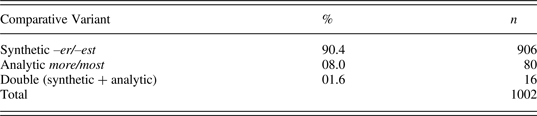
The Toronto materials include a total of 1002 comparative contexts for analysis, distributed as in Table 2 (127 speakers, ages 20–92 years).
Overall distribution of comparatives
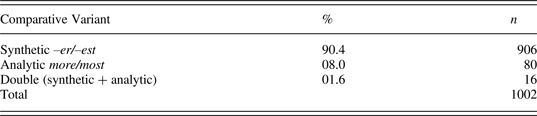
Source: Data from D'Arcy (Reference D'Arcy2014:234, Table 3).
The vast majority of comparatives in these materials are synthetic—just over 90%. Variation is not trivial, however, in that it is constrained by a robust set of contextual effects.
Phonologically, the choice between comparative variants is affected by the final segment of the citation form. Consonant clusters favor analytic comparison, as do final /li/ and /r/, whereas final /i/ and /l/ favor the synthetic mode (Hilpert, Reference Hilpert2008; Lindqvist, Reference Lindqvist, Lindquist, Klintborg, Levin and Estling1998, Reference Lindqvist and Kirk2000; Mondorf, Reference Mondorf, Rohdenburg and Mondorf2003, Reference Mondorf2009). Stress is also implicated; forms with final stress typically favor analytic comparison (Hilpert, Reference Hilpert2008; Leech & Culpeper, Reference Leech, Culpeper, Kytö, Rydén and Smitterberg1997; Mondorf, Reference Mondorf, Rohdenburg and Mondorf2003, Reference Mondorf2009). The operation of morphological complexity is visible in the fact that complex adjectives favor the analytic comparative while monomorphemic ones favor the synthetic form (Mondorf, Reference Mondorf, Rohdenburg and Mondorf2003, Reference Mondorf2009). Syntactic constraints include syntactic position—attributives favor analytic comparison (Leech & Culpeper, Reference Leech, Culpeper, Kytö, Rydén and Smitterberg1997), than complementation—a following than favors the analytic form (Hilpert, Reference Hilpert2008; Leech & Culpeper, Reference Leech, Culpeper, Kytö, Rydén and Smitterberg1997; Lindqvist, Reference Lindqvist, Lindquist, Klintborg, Levin and Estling1998), and premodification—a preceding degree modifier favors analytic comparison (Hilpert, Reference Hilpert2008; Leech & Culpeper, Reference Leech, Culpeper, Kytö, Rydén and Smitterberg1997; Lindqvist, Reference Lindqvist, Lindquist, Klintborg, Levin and Estling1998). Frequency is also a key determinant because more frequent adjectives tend to be compared synthetically (Hilpert, Reference Hilpert2008; Quirk, Greenbaum, Leech, & Svartvik, Reference Quirk, Greenbaum, Leech and Svartvik1985). A final constraint is the number of syllables in the citation form of the adjective. Most of the variation occurs in disyllabic adjectives (Bauer, Reference Bauer1994; Hilpert, Reference Hilpert2008; Kytö & Romaine, Reference Kytö, Romaine, Nevalainen and Kahlas-Tarkka1997; Leech & Culpeper, Reference Leech, Culpeper, Kytö, Rydén and Smitterberg1997; Mondorf, Reference Mondorf, Rohdenburg and Mondorf2003, Reference Mondorf2009). We will demonstrate the crucial repercussions this effect has for variation in the comparative sector.
The dative
The dative has been variable between the double object (give me some) and the prepositional dative (give some to me) for centuries. The double object construction is the historic one. The prepositional dative was not widely available in Old English (Mitchell, Reference Mitchell1985; Traugott, Reference Traugott, Lehmann and Malkiel1982) and appeared only sporadically in Early Middle English, limited to give, grant, show, teach, and tell. By Late Middle English, it was the majority form (Allen, Reference Allen, Kemenade and Los2006:214; Fischer & wan der Wurf, Reference Fischer, wan der Wurf, Hogg and Denison2006:108; McFadden, Reference McFadden and Lighfoot2002:1113), though in the Modern period, the prepositional dative has ebbed overall (Wolk et al., Reference Wolk, Bresnan, Rosenbach and Szmrecsanyi2013:393).
The data were searched by seeking out verbs from current lists of verbs that subcategorize for the dative (Bresnan, Cueni, Nikitina, & Baayen, Reference Bresnan, Cueni, Nikitina, Baayen, Boume, Krämer and Zwarts2007; Wolk et al., Reference Wolk, Bresnan, Rosenbach and Szmrecsanyi2013) as well as by examining every verb in the interview materials.Footnote 4 Any constructions that could alternate between the two variants without a change in meaning were included. Constructions in which the dative construction is likely a benefactive (e.g., found me a job vs. found a job for me) were excluded due to the fact that this is an independent construction. A number of other types (noun phrase shift, reverse double objects, cases of elided recipients and themes, etc.) outlined in Wolk et al. (Reference Wolk, Bresnan, Rosenbach and Szmrecsanyi2013:390–392) were also excluded because they do not alternate without a change in meaning.
This procedure resulted in 2101 tokens, distributed as in Table 3 (200 speakers, ages 17–92 years). As with comparatives, the variation is skewed toward the historical variant, in this case the double object.
Overall distribution of datives

Source: Based on Tagliamonte (Reference Tagliamonte, Torres-Cacoullos, Dion and Lapierre2014).
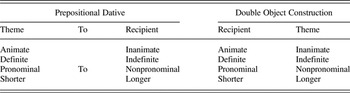
A number of constraints are consistently reported to operate on the dative alternation, including animacy, definiteness, type of subject (e.g., noun phrase vs. pronoun), construction length, and complexity. According to the literature, these trends are so strong and consistent that their influence on the dative alternation has been referred to as “quantitative harmonic alignment” (Bresnan & Ford, Reference Bresnan and Ford2010:181). Harmonic alignment is the existence of “a statistical pattern in which all else being equal, animate, definite, pronominal, discourse accessible and shorter arguments tend to precede inanimate, indefinite, non-pronominal, less discourse accessible or longer arguments in both dative constructions” (ibid.:183). Table 4 shows each dative construction. For the prepositional dative, the first element is a theme. In this case, animate, definite, pronominal, shorter, discourse accessible items come first (shaded). For the double object construction, the first element is a recipient. Here, too, animate, definite, pronominal, shorter items come first. The main point of contrast is the order of the grammatical function, that is, theme versus recipient. This overarching pattern has been found in dative constructions across varieties of English, including American, Australian, New Zealand, and British varieties, as well as in written and spoken discourse (Bresnan et al., Reference Bresnan, Cueni, Nikitina, Baayen, Boume, Krämer and Zwarts2007; Bresnan & Hay, Reference Bresnan and Hay2008; Collins, Reference Collins1995; Grimm & Bresnan, Reference Grimm and Bresnan2009; Theijssen, ten Bosch, Boves, Cranen, & van Halteren, Reference Theijssen, ten Bosch, Boves, Cranen and van Halteren2013; Thompson, Reference Thompson and Landsberg1995).
Contrastive order in dative constructions

The relative pronouns
The English relative pronoun system has been variable since Old English, when at least three relativization strategies operated: the inflected demonstratives se and seo, invariant þe, and zero (i.e., deletion). The wh– forms entered the paradigm during Middle English, when the interrogative pronouns (hwa, hwilc, etc.) were introduced to the relative domain (Romaine, Reference Romaine1980:222). The last to develop a relativizing function was who (Romaine, Reference Romaine1980:223); its earliest attestation occurs in a Paston letter from 1426 (Rydén, Reference Rydén1983:127).
The development of the relative markers in subject position (a woman who runs a exercise place) has been studied extensively by Ball (Reference Ball1996). In this context, which was already well established by the 16th century and could be used for reference to both nonhuman and human antecedents. As Ball (Reference Ball1996) documented, however, the situation changed markedly during the 17th century, when the frequency of who gradually came to mark human antecedents, and that endured with nonpersonal antecedents. According to Ball (Reference Ball1996:247), this shift “laid the foundation for the modern dominance of who for personal subject restrictive relatives.” Indeed, the restriction of who to human antecedents is a foundational and longitudinal characteristic of this variant (Romaine, Reference Romaine1982a:61; Rydén, Reference Rydén1983:128; Traugott, Reference Traugott1972:155–156).
In this analysis, we focus on restrictive relative clauses only, the locus of variation between wh– forms, that, and zero. This is the context that has received the bulk of attention in variationist sociolinguistics (e.g., Ball, Reference Ball1996; D'Arcy & Tagliamonte, Reference D'Arcy and Tagliamonte2010; Guy & Bayley, Reference Guy and Bayley1995; Levey, Reference Levey2006; Nevalainen & Raumolin-Brunberg, Reference Nevalainen, Raumolin-Brunberg and Poussa2002; Tagliamonte et al., Reference Tagliamonte, Smith and Lawrence2005; Tottie, Reference Tottie, Melchers and Warren1995, Reference Tottie, Nevalainen and Kahlas-Tarkka1997; Tottie & Rey, Reference Tottie and Rey1997).Footnote 5 As we will demonstrate, the longitudinal linguistic variability among relative pronoun forms and the systemic functional split between who and that endures in contemporary speech communities.
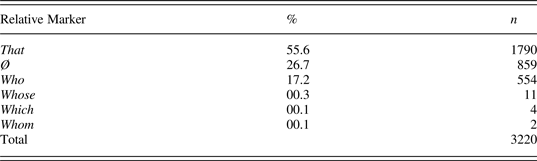
To isolate the restrictive relative clauses and make our results comparable to earlier research, we followed the methods outlined in Tagliamonte et al. (Reference Tagliamonte, Smith and Lawrence2005:84–86), which are based on those of Tottie and Harvie (Reference Tottie, Harvie and Poplack2000). According to this procedure, only those relative clauses that “serve to identify their antecedent” (Denison, Reference Denison and Romaine1998:278) were included in the analysis. Accordingly, a broad range of nonrestrictive clause types were excluded, most of which were identified by specific syntactic characteristics (e.g., antecedent = whole sentence or proper noun). Also excluded were adverbial relative clauses, as these allow where and when, which are functionally distinct from, and pattern to the exclusion of, other wh– relative markers (Tottie & Harvie, Reference Tottie, Harvie and Poplack2000:206). Finally, we excluded tokens of whiz deletion, in which the relative marker and the verb be are deleted, as well as incomplete utterances and clauses with resumptive pronouns. This procedure provided 3220 relative clauses for analysis, with an overall distribution as shown in Table 5 (82 speakers, ages 10–92 years).
Overall distribution of relative markers
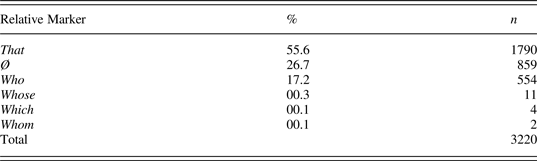
Source: Data from D'Arcy & Tagliamonte (Reference D'Arcy and Tagliamonte2010:389, Table 2).
The majority of restrictive relative clauses in these materials appear with that, nearly 56%. The next most frequent form, accounting for nearly 27% of the data, is the zero form. Notably, the wh– paradigm is almost categorically represented by who; occurrences of whose, which, and whom are negligible. A number of factors constrain the variation between that, who, and Ø.
Sentence structure is a critical determinant for the use of a zero relative. For example, the null form is highly favored in existential contexts and in possessive clauses (Ball, Reference Ball1996; Quirk et al., Reference Quirk, Greenbaum, Leech and Svartvik1985). On the other hand, length of the relative clause is implicated in the use of overt relative markers (that, who), which are favored in longer clauses (Cofer, Reference Cofer1975). This is presumably a processing constraint; the relative marker clarifies structure and aids comprehension of what follows. Because length does not map directly to complexity (Chomsky, Reference Chomsky1975), Tagliamonte et al. (Reference Tagliamonte, Smith and Lawrence2005) also tested for complexity, distinguishing between simple relative clauses (verb + nonclausal argument) and complex ones (clausal argument). Length and complexity are not orthogonal (simple clauses may be either short or long but complex clauses are long); an interaction group is required to model these effects (see Tagliamonte et al., Reference Tagliamonte, Smith and Lawrence2005:97–98). Adjacency has also been implicated, again as a processing constraint: overt who and that are favored over zero when material intervenes between the matrix and subordinate clause (Cofer, Reference Cofer1975; Guy & Bayley, Reference Guy and Bayley1995). Finally, type of antecedent is relevant, though the effect does not appear to be universal. It has been suggested that indefinites favor who and that (Huddleston, Reference Huddleston1971), whereas definites and pronominal antecedents favor zero (Guy & Bayley, Reference Guy and Bayley1995), and yet Tottie and Harvie (Reference Tottie, Harvie and Poplack2000) reported that indefinites favor zero. Kautzsch (Reference Kautzsch2002) reported a differential effect across dialects, and a lack of parallelism is likewise reported by Tagliamonte et al. (Reference Tagliamonte, Smith and Lawrence2005).
Perhaps the most challenging of the underlying constraints in the study of English relative pronouns is the interaction of the syntactic status of the gap or trace in the restrictive relative clause (subject, nonsubject), and the animacy type of antecedent (human, nonhuman, etc.). These two factors have strongly constrained the choice of relative marker since at least Early Modern English. Indeed, for every combination of antecedent type and grammatical role, there are very different frequencies of that, zero, and wh–. As a consequence, Ball (Reference Ball1996:233) suggested that the interaction of these factors creates “different populations” of variant choice across contexts, a partitioning of the relative sector that operates in the same way in formal writing and vernacular speech (Aarts, Reference Aarts1993; Ball, Reference Ball1996; Guy & Bayley, Reference Guy and Bayley1995; Kautzsch, Reference Kautzsch2002; Quirk, Reference Quirk1957; Tagliamonte et al., Reference Tagliamonte, Smith and Lawrence2005). In fact, much of the writing on the relative system in Early Modern and Modern English appears to take for granted that who is used for human (or personal) antecedents, which for nonhuman (or nonpersonal) antecedents, and that for either (Denison, Reference Denison and Romaine1998:278; Quirk, Reference Quirk1957:97–98; Swan, Reference Swan1995:473). Although which essentially fails to surface in the Toronto materials; or in other vernacular materials for that matter (see Tagliamonte et al., Reference Tagliamonte, Smith and Lawrence2005:87), the foundational association of who with human antecedents effectively blocks its use with nonhuman ones. This, as we will demonstrate, has crucial repercussions for variation in the restrictive relativizer sector.
CATEGORICITY WITHIN VARIATION
Based on the extant literature, these four variables are ideal for variationist inquiry because, as part of structured sets, they capture dynamic form/function asymmetry. They are also relatively frequent, which enables distributional and probabilistic modeling. Crucially, studies report not only active variation but also strong and multiple internal constraints operating on the choice mechanism. On genitives, Wolk et al. (Reference Wolk, Bresnan, Rosenbach and Szmrecsanyi2013:392) stated, “the genitive alternation exhibits robustly fluctuating variant proportions,” which in an earlier draft they had summarized as “variability galore.” On comparatives, Mondorf (Reference Mondorf2009:201) noted, “The true extent of variability in this area appears to have been underestimated in the past … comparative alternation is a showcase of grammatical variation.” On the dative, Bresnan et al. (Reference Bresnan, Cueni, Nikitina, Baayen, Boume, Krämer and Zwarts2007:75) suggested that “dative verbs have more syntactic flexibility than we thought, occurring more freely in alternative constructions.” And on relative pronouns, Ball (Reference Ball1996:243) wrote, “We find a wide range of variation both in the relative paradigm and in relative frequencies within a regional paradigm.”
Such observations allude to the type of variation that yields valuable insights into grammar, linguistic change, mechanisms of change, their implications for social meaning, and so on. However, when we apply the techniques and methods of variationist sociolinguistics to vernacular spoken language, a different reality obtains. Variationist sociolinguistics advocates exhaustive scrutiny of data. Cross-tabulation exposes the intersection of factors, and inspection of individual items uncovers lexical effects, constructions, and formulae that may reflect the influence of frequency and/or semantic perseverance. When the grammatical variables under study are subjected to these procedures, it becomes clear that a nontrivial proportion of their characteristic aggregate variation is the artifact of collapsing distinct linguistic sectors (i.e., mixing apples and oranges). Specifically, for each variable there is at least one grammatical factor that splits the system, partitioning the variable context in vernacular use. For a variationist, such a result is at odds with both observations and expectations of robust and structured variability. We now turn to highlighting the linguistic partitions that underlie these variables.
The genitive
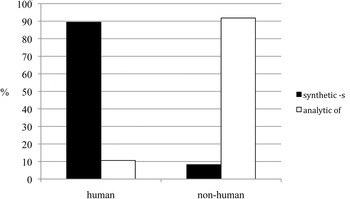
Consider the genitive. Animacy is crucially implicated in the distribution of genitive variants, splitting the system (Hinrichs & Szmrecsanyi, Reference Hinrichs and Szmrecsanyi2007; Mair, Reference Mair2006a; Rosenbach, Reference Rosenbach2002, Reference Rosenbach2006). The key distinction is whether the head noun is human or not. Figure 1 shows that 89% of human possessors take the synthetic genitive and 92% of nonhuman possessors take the analytic genitive; there is extremely limited functional overlap between the genitive variants. This result, though dramatic, marks a well-established, historical distinction that has operated for centuries. However, the total specialization that is captured here has not been reported in studies of written texts and seems to exist only in vernacular speech, where human possessors—for all intents and purposes—categorically trigger the –s genitive (Hinrichs & Szmrecsanyi, Reference Hinrichs and Szmrecsanyi2007).
Distribution of genitive variants by animacy of the possessor, n = 1,368 (Jankowski & Tagliamonte, Reference Jankowski and Tagliamonte2014:316, Figure 5).

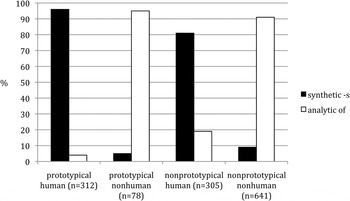
In addition, a second constraint is involved—possessor relation (Rosenbach, Reference Rosenbach2002; Wolk et al., Reference Wolk, Bresnan, Rosenbach and Szmrecsanyi2013). Its effect renders the partitioning of the sector by animacy even more dramatic. As discussed, prototypical possessors (body parts, kinship terms, etc.) favor the –s genitive, and this holds in Toronto. Overall, 78% of prototypical possessors occur with –s (n = 390). When animacy is factored in, as in Figure 2, this variability largely disappears. Prototypical human possessors are realized with the synthetic form 96% of the time (his friend's brother), whereas prototypical nonhuman possessors are realized with the analytic genitive 95% of the time (joints of the body). In short, these two contexts pattern in complementarity and are virtually categorical. This is because animacy and possessor relation are not wholly orthogonal predictors. In Figure 2, prototypical possessors are mainly human (n = 312) and nonprototypical ones are mainly nonhuman (n = 78); for the full discussion, see Jankowski and Tagliamonte (Reference Tagliamonte, Torres-Cacoullos, Dion and Lapierre2014:316–317). The result is a robust partition within the data.
Distribution of genitive variants by animacy and possessor relation, n = 1,336 (based on Jankowski & Tagliamonte, Reference Jankowski and Tagliamonte2014:317, Figures 6 and 7).

On the other hand, the nonprototypical domain—though also heavily skewed—provides a margin of variability. Thus, although rigorous accountable methods were applied in the extraction and coding of the data, resulting in 1368 tokens, the analysis of variation is limited to nonprototypical possessors (social relations, states, and abstract possession), just 946 tokens. Even in this category, however, are forms that display categorical behavior; inanimates (e.g., the wall of the apartment building, the edges of the problems) take the of genitive at a rate of 99% (n = 262). This reduces the envelope of variation further, to just 684 tokens. In other words, half of the original dataset (48.8%) is not appropriate for probabilistic modeling. It is heavily partitioned, segmented, and effectively invariant.
The comparative
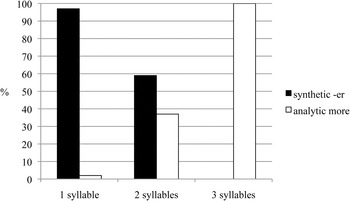
In the case of the comparative, Table 2 indicates that variation is weighted toward the historical synthetic variant (90%, n = 1002). This result is consistent with prior research, but it also masks underlying, categorical partitions within the data. As illustrated in Figure 3, the number of syllables in the citation form of the adjective divides the variants into distinct sectors.Footnote 6 Monosyllabic adjectives, which constitute the bulk of the data, take synthetic –er in 97% of cases (n = 860). Trisyllabic adjectives are compared categorically via analytic more (n = 14). The apparently sole locus of productive variation is disyllabic adjectives (n = 128).
Distribution of comparative variants by syllable structure, n = 1,002 (D'Arcy, Reference D'Arcy2014:234, Table 3).

This system presents an additional nuance. There are 1745 nonsuppletive comparative contexts in these materials, yet as discussed, only 1002 of them constitute possible sites of variation. These forms have the potential to alternate, but as Figure 3 illustrates, in these vernacular materials variation is restricted to disyllables.Footnote 7 This constitutes a mere 7% of the original extraction set, and just 13% of the subset. At best, comparative alternation can be considered a niche variable, as the window for variation (in the variationist sense) is quite narrow and is marginalized within the sector. This appearance of “variability” is further reduced when lexical items are considered. Of the 54 disyllabic adjective types that are attested in the data, only 8 actually alternate (dirty [n = 2], friendly [n = 7], gentle [n = 3], healthy [n = 2], quiet [n = 6], quirky [n = 2], simple [n = 3], and sloppy [n = 2]). From a variationist perspective, this is not the patterning expected of a bona fide linguistic variable. It is also notable that for this variable, super tokens—variant forms from the same speaker in the same stretch of discourse and the key evidentiary hallmarks of structured heterogeneity (Tagliamonte, Reference Tagliamonte2006, Reference Tagliamonte2012)—are exceptionally rare (see D'Arcy, Reference D'Arcy2014).
The dative
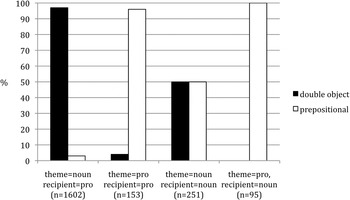
For the dative, the effect of pronoun versus noun phrase as recipient and theme is generally the strongest effect on variation (e.g., Bresnan & Ford, Reference Bresnan and Ford2010:15, Table 5), exceeding all other predictors. Figure 4, however, exposes a striking distributional pattern. Variation is limited to constructions with noun phrases for both theme and recipient. Elsewhere, as summarized by Tagliamonte (Reference Tagliamonte, Torres-Cacoullos, Dion and Lapierre2014), prepositional datives virtually never occur in constructions with a nominal theme and a pronominal recipient (give her a coffee), and yet they occur (nearly) categorically with pronominal themes (regardless of recipient type) (give it to her; give the coffee to her).
Distribution of dative variants by (pro)nominal status and theta role, n = 2,101 (based on Tagliamonte, Reference Tagliamonte, Torres-Cacoullos, Dion and Lapierre2014, Table 2).

Distribution of dative variants by animacy of theme and recipient, n = 192 (based on Tagliamonte, Reference Tagliamonte, Torres-Cacoullos, Dion and Lapierre2014, Table 3).

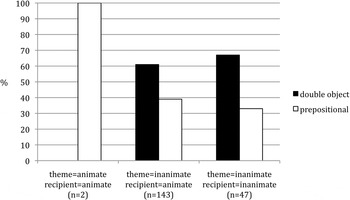
The redefined locus of variation is therefore theme noun + recipient noun constructions. Even here, however, structured heterogeneity does not fully obtain. One construction is virtually unattested in the Toronto materials (and in vernacular British data also; see Tagliamonte [Reference Tagliamonte, Torres-Cacoullos, Dion and Lapierre2014])—animate theme with animate recipient (give the dog to the vet), while another changes the meaning to a locative and so is excluded altogether—inanimate recipient with animate theme (sent a psychiatrist to the house; see Wolk et al. [Reference Wolk, Bresnan, Rosenbach and Szmrecsanyi2013:390]). The consequence is that variation is circumscribed to a very small corner of the dative sector: inanimate themes, regardless of recipient type. This constitutes just 9% of the original extraction set (n = 190); the remainder is simply not variable.
The relative pronouns
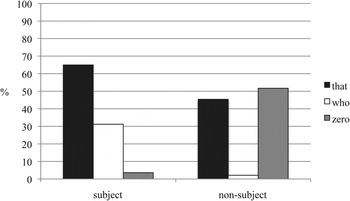
The final linguistic variable that we consider is relativization. The overall results in Table 5 suggest a healthy alternation between that, a zero relative, and who in restrictive clauses. The remaining forms (whose, which, whom) together account for a mere 0.5% of the total dataset; we set them aside from this point. This overall picture seemingly indicates a ternary choice mechanism, and yet in actuality, the variation is effectively binary (D'Arcy & Tagliamonte, Reference D'Arcy and Tagliamonte2010). As is well established in the literature, this is because the relative pronoun forms have specialized according to syntactic function, subject (1a) and nonsubject (i.e., direct object, indirect object, object of preposition; [1b]). As illustrated in Figure 6, in subject position, only who and that vary productively; zero is rare. In nonsubject position, only that and zero are robust; who is rare. In other words, there is a sharp division across contexts, and only that is actively operational across the restrictive domain. The key role of syntactic function is a bona fide, longitudinal constraint for relative pronouns. That it should operate in these speech materials is not surprising, but the extent to which it divides the restrictive relative sector in these speech materials is striking. In more formal styles and written genres, the number of competing forms is greater.Footnote 8
Distribution of restrictive relative pronouns according to syntactic function, n = 3,202 (based on D'Arcy & Tagliamonte, Reference D'Arcy and Tagliamonte2010:391, Table 3).

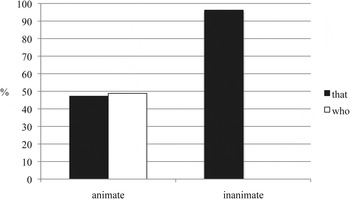
Underlying this main effect is a factor that again partitions the restrictive relative system: animacy of the antecedent. This predictor strictly concerns subject relatives, the domain of who, which is specified for animate reference (human and otherwise; cf. Figure 6). Figure 7 illustrates the defining role of animacy in this syntactic context.
Distribution of subject restrictive relative pronouns according to animacy of the antecedent, n = 1,610 (based on D'Arcy & Tagliamonte, Reference D'Arcy and Tagliamonte2010:392, Table 4).

Only in the animate contexts is variation robust. As with syntactic function, this observation is not new or unique; the restriction of who to animate antecedents is inherent to its development as a relative pronoun. However, this has a decisive consequence for inanimate antecedents. In this category, over 96% of tokens are introduced by that (n = 606). In the variationist tradition, we exclude such near categorical contexts from our models as standard practice (Guy, Reference Guy, Ferrara, Brown, Walters and Baugh1988:131), and for good reason. In this case, animacy would dominate the model, not because it is a true (i.e., probabilistic) predictor but because it is the ultimate predictor, variation being restricted to a specific context (animate subject reference). Our main point is that there is a fundamental, systemic divide operating on the variable, one that produces categoricity within the vernacular grammar.
ATYPICAL SOCIOLINGUISTIC VARIABLES
Style represents a long and diverse continuum of contextual, interactional, and topical influences, but the vernacular is the baseline. It represents the model first acquired, before the standardizing influence of prestige and/or education becomes an overlay on usage, eroding the regularity of the constraints on linguistic variation (Labov, Reference Labov, J. and J.1984:29). All four variables discussed here exhibit healthy overall form/function asymmetry (cf. Tables 1–3, 5), and for each the literature reports a complex and multidimensional variable grammar. However, the operation of key linguistic constraints lays bare dramatic contrasts and disproportionate distributions in vernacular data on a scale that is generally unfamiliar in variationist research. The genitive is split by animacy of the possessor; the comparative by the syllabic structure of the adjective; the dative by the interaction of (pro)nominal status and theta role; and the relative system by the syntactic status of the clause. Individual forms are then shunted to a restricted corner of the system, where they specialize for some specific function. Genitive –s is used for human possessors and of for inanimates; comparative –er is used for disyllables and is lexically specialized with few actively variable forms; the prepositional dative is restricted to nominal recipients and the double object construction to pronominal recipients; and relative who is used for human antecedents in subject relatives. In each case, the locus of variation is highly restricted, undermining the impression from overall frequencies of variable occurrence.
It is important to emphasize that observations regarding the restrictions on these variables are not new. Each constraint is well attested in the literature and none has emerged or evolved. Indeed, reexamination of the literature shows hints of partitioning for these variables—for instance, “division of labor” (Mondorf, Reference Mondorf2009:127), “different populations” (Ball, Reference Ball1996:233)—yet exhaustive delimitation of the contexts of variability or lack thereof is not fully explored. What is new is the realization that something outside the variationist norm obtains with these variables and that their patterns are either particular to or exaggerated in vernacular language. Despite occasional recognition of the potential for partitioning, the literature regularly reports the operation of variation and constraints in written materials.Footnote 9 However, as we have demonstrated, in the vernacular, variation is reduced. This contrast therefore challenges blanket assumptions about structural heterogeneity in the vernacular. The question is: Are these linguistic variables exceptional or is there a principled explanation for their behavior in casual spoken language?
We suggest that the exceptional distributional qualities are not arbitrary and that they have the potential to lead to an expanded understanding of pathways and outcomes of linguistic change. As we will outline, there is reason to believe that analytic of, analytic more, the prepositional dative, and the wh– relative pronouns are united by a similar history. Each variant evolved from historical change that accelerated during Middle English through language contact and ultimately, through underlying grammatical mechanisms—in particular, analogy.
Analogy in language change
French and Latin influence were heightened during the Middle and Late Middle English periods. They were clerical and liturgical languages, respectively, with robust literary histories and traditions, whereas written traditions in English had faltered in the century after the Norman Conquest. Later in Middle English, a literary standard gradually emerged among the educated literate strata. These individuals were capable of shifting between French, Latin, and English easily. In this kind of social milieu, it is particularly important to consider the impact of multilingualism on developmental pathways of linguistic change.
The genesis of the analytic genitive comes late in the Old English period (Fischer, Reference Fischer and Blake1992:226; Mustanoja, Reference Mustanoja1960:74). However, it remained infrequent for centuries; vigorous competition did not develop until Middle Middle English, when the historical synthetic genitive lost ground dramatically to the innovative analytic form (Rosenbach, Reference Rosenbach2002; Rosenbach & Vezzosi, Reference Rosenbach and Vezzosi2000; Thomas, Reference Thomas1931). Indeed, by the 14th century, the of form accounted for the vast majority of genitives in learned writing (Mustanoja, Reference Mustanoja1960:75). The synthetic genitive began to increase again during the 16th century; since then, variation between –s and of is said to be robust.Footnote 10 Notably, the rise of the analytic form aligns with the apex of French prestige in the history of English; due to its structural equivalency with the de genitive of Romance languages, its spread is believed to have been helped by contact with French (Fischer, Reference Fischer and Blake1992; Hinrichs & Szmrecsanyi, Reference Hinrichs and Szmrecsanyi2007; Mustanoja, Reference Mustanoja1960). Consistent with its Latinate roots, the of genitive has had formal connotations since at least the 17th century. Altenberg (Reference Altenberg1982:268–269) described it as being “generally restricted to situations demanding some degree of formality and politeness or when the language is raised to the level of rhetoric.”
The history of the analytic comparative is strikingly similar to that of the analytic genitive. The default comparative mechanism in Old English was synthetic, –ra/–ost. The analytic mode, more/most, diffused slowly until approximately the end of the 14th century, when its use began to accelerate in historical texts (Mitchell, Reference Mitchell1985), peaking during Late Middle English (Pound, Reference Pound1901:19). A somewhat contentious issue concerns its origins. Historically, the analytic forms were argued to have been introduced during the 13th century (Kytö, Reference Kytö and Svartvik1996a; Kytö & Romaine, Reference Kytö, Romaine, Nevalainen and Kahlas-Tarkka1997, Reference Kytö, Romaine and Wright2000, Reference Kytö, Romaine, Kytö, Rydén and Smitterbeg2006; Mitchell, Reference Mitchell1985; Mustanoja, Reference Mustanoja1960; also Pound, Reference Pound1901) as a change from above, introduced via analogy with either French (Morris, Reference Morris and Richard1872) or Latin (Mitchell, Reference Mitchell1985; Mustanoja, Reference Mustanoja1960; Pound, Reference Pound1901; Strang, Reference Strang1970). Mitchell (Reference Mitchell1985:84–85) reported a few examples of analytic comparison from Old English, but because these come from texts translated from Latin, they tend to be treated parenthetically. More recently, González-Díaz (Reference González-Díaz2006) provided evidence that the analytic forms emerged in the second half of the ninth century, well before the Middle English Period. Under this analysis, they are a native development (see, too, Curme, Reference Curme1931; Faiss, Reference Faiss1977; Mondorf, Reference Mondorf2009). González-Díaz (Reference González-Díaz2006:730–733) ruled out a connection with Latin, but she cannot preclude one with French (see also Mondorf, Reference Mondorf2009:121). In Old English, use of analytic comparison was incipient. It was only during Middle English that its frequency escalated. Thus, while more and most may have evolved from below, the resulting forms were analogous to the (prestigious) French construction (on grammatical change in contact situations, see also Heine & Kuteva, Reference Heine and Kuteva2005; Johanson, Reference Johanson, Jones and Esch2002). This may well have contributed to their spread, suggesting that notions of prestige were involved at a critical time in their development and diffusion. As with the analytic genitive, timing is particularly critical: analytic more was a development internal to the vernacular grammar, but it remained infrequent, low-level, and incipient until the Middle Middle English period (e.g., González-Díaz, Reference González-Díaz2006; Kytö & Romaine, Reference Kytö, Romaine, Nevalainen and Kahlas-Tarkka1997).
The history of the dative construction is less well documented, but it appears to follow a similar trajectory (Wolk et al., Reference Wolk, Bresnan, Rosenbach and Szmrecsanyi2013:384–385). The prepositional construction was rare in Old English (Mitchell, Reference Mitchell1985; Traugott, Reference Traugott and Hogg1992) and a construction resembling the double object was variable (McFadden, Reference McFadden and Lighfoot2002). According to De Cuypere (Reference De Cuypere2010), the alternation was already subject to constraints of animacy and pronominality. Again it is the Middle English period when the new form accelerates (Fischer & wan der Wurf, Reference Fischer, wan der Wurf, Hogg and Denison2006; Visser, Reference Visser1963–1973), leading to (apparently) robust variation.
It is widely assumed that the loss of case distinctions during Middle English triggered the rise of the prepositional dative (e.g., Fischer & wan der Wurf, Reference Fischer, wan der Wurf, Hogg and Denison2006; McFadden, Reference McFadden and Lighfoot2002), yet Düringer (Reference Düringer and Horn1923:30) argued that its sole function cannot have been to replace dative inflections (see also Allen, Reference Allen, Kemenade and Los2006; Rantavaara, Reference Rantavaara1962). Gerwin (Reference Gerwin2014:412) argued that the “real boost” was provided by contact with French and the borrowing of loan verbs with the preposition à (e.g., obey, avail, command [Visser, Reference Visser1963–1973:624]). These loans increased the rate of the prepositional dative, but also buttressed, through analogy, the “already burgeoning” to dative with native verbs (see also Allen, Reference Allen, Kemenade and Los2006:215). As summarized by Gerwin (Reference Gerwin2014:143), in Late Middle English, the prepositional construction was “en vogue,” a trend that was particularly evident in French-based texts (Trips & Stein, forthcoming). In short, there is mounting evidence from historical linguistics that the rising use of the prepositional dative in Middle English was influenced by French. In contemporary use, the prepositional dative is favored in more formal written registers, whereas the double-object construction is favored in registers approaching the oral end of the spectrum (Bresnan et al., Reference Bresnan, Cueni, Nikitina, Baayen, Boume, Krämer and Zwarts2007; Wolk et al., Reference Wolk, Bresnan, Rosenbach and Szmrecsanyi2013). This division may well reflect historical influences (cf. the analytic genitive).
In the case of relativization, the wh– forms were introduced when the interrogative pronouns (e.g., hwa, hwilc) came to be used as relatives, initially as generalizing forms in Old English but then expanding to refer to a clearly definable antecedent during Middle English (Romaine, Reference Romaine1980:223; also Mustanoja, Reference Mustanoja1960:191). The consensus in the historical literature is that their relativizer function gained prestige under Latin influence and then strengthened in Middle English under French influence (Mustanoja, Reference Mustanoja1960:199–200; Nevalainen & Raumolin-Brunberg, Reference Nevalainen, Raumolin-Brunberg and Poussa2002; Romaine, Reference Romaine1982a:213). Romaine (Reference Romaine1982a:234) suggested that “even though wh– is internal to the system (i.e., from the ME interrogative), its use as a relativizer can be thought of as a borrowing from a Romance acrolectal adstratum in Middle English.”
This interpretation is supported by their linguistic pathway: The wh– relatives entered the language through the most complex and least frequently relativized syntactic positions in the case hierarchy (Romaine, Reference Romaine1980:233). Following from this, they were also initially confined to formal contexts (Jones, Reference Jones1972:140). Meier (Reference Meier1967:280) argued that early epistolary uses came from models provided in Latin letter-writing manuals and notarial form books (see also Rydén [Reference Rydén1983] on the critical role of French and Latin models for English constructions). Stylistic diffusion is sustained by Ball (Reference Ball1996:248), who reported “a clear lag” in the use of wh– relative pronouns between literary texts and spoken usage. This distinction is reflected in modern usage by the fact that their “infiltration” into the written language “can be seen as completed,” whereas they have yet to affect the spoken language (Romaine, Reference Romaine1982b:212).
Romaine (Reference Romaine1980:224) observed that the entry of who “had the effect of making English structurally more similar to Latin and French, which for reasons of prestige would have been desirable.” The footprints of diachronic prestige are also evident in the longitudinal stability of social constraints on their use (D'Arcy & Tagliamonte, Reference D'Arcy and Tagliamonte2010). Timing, however, is critical. The wh– relatives remained incipient until roughly the Middle Middle English period (e.g., Ball, Reference Ball1996; Romaine, Reference Romaine1980, Reference Romaine1982b). As we have outlined, this was a time when French had few native speakers in England yet “was quite commonly spoken and enjoyed the status of a prestige language” (Ingham, Reference Ingham2010:1), and Latin played a key superstratal role in Medieval England as well (e.g., Hickey, Reference Hickey and Hickey2010; Mufwene, Reference Mufwene, Schreier and Hundt2013; Munske, Reference Munske and Sture1982).
Sociohistorical context
In the multilingual setting that characterized the educated elite of the Middle English period, English forms that were structurally analogous to their Romance counterparts would have carried social cachet. Indeed, numerous authors have argued, independently, that this is why the innovations in question diffused so rapidly during Middle English. They were used by the literate classes, groups who themselves held prestige in the broader sociopolitical context. That the majority of Middle English speakers were illiterate may in part explain the anomalous patterning of these variables in the vernacular. The innovations were not widely available in the speech community. The fact that the major drivers were “top down” is evident in patterns of linguistic diffusion; each innovation spread through formal, literary genres, initially restricted in some cases to complex syntactic constructions. In short, each innovation appears to have been a formal, learned variant. The wh– relatives are the paradigm case, but there is evidence that the analytic genitive, comparative, and dative followed similar pathways. These forms remained embryonic until the social milieu changed, fostering their use in written channels as buttressed by the “Romance acrolectal adstratrum” (Romaine, Reference Romaine1982a:213). In contrast, the historical variant was the vernacular variant, and it populated matter-of-fact text types reflecting spoken or colloquial genres and registers.Footnote 11 These changes, which may have been evolutive in origin, were arguably adaptive in their actuation. In other words, a language external mechanism (social prestige) worked in tandem with a language internal mechanism (structural analogy) to propel the new forms into the written language (cf. Johanson, Reference Johanson, Jones and Esch2002).
In Middle English, formalized ideologies of standard language were incipient. By the end of the 16th century, however, normative ideas about English linguistic practice were entrenched (Kytö & Romaine, Reference Kytö, Romaine, Kytö, Rydén and Smitterbeg2006:189), and complaints regarding (in)correct usage had replaced those concerning the relative status of French and English (Milroy & Milroy, Reference Milroy and Milroy1985:26). Notably, these complaints habitually focused on the inadequacies of English relative to Latin, Greek, and “other more fashionable non-classical languages such as French and Italian” (Milroy & Milroy, Reference Milroy and Milroy1985:27). By the middle of the 18th century, a written standard had emerged that was almost as invariable as that of prescribed Present Day English (Strang, Reference Strang1970:107). Thus, the codification of the language resulted in a set of conventions for written language. However, it likely did not reflect how language was used by the majority of speakers at the time, especially in their everyday speech. Written language has always had special status as the bastion of “the standard”—this is where ideologies of pure, correct, elegant, precise, informational, logical, and the like are enshrined. Indeed, the function of written language (and the writing system) is to enforce or maintain standardization (Milroy & Milroy, Reference Milroy and Milroy1985:51), a function that remains unchanged despite diachronic shifts in the underlying internal structure of written registers across the Modern period (Biber & Finegan, Reference Biber, Finegan, Rissanen, Nevalainen and Kahlas-Tarkka1997).
CONCLUSION: CHANGE AND THE SPEECH COMMUNITY
Our understanding of variation in the genitive, comparative, dative, and relatives has been largely, though not exclusively, based on written data. Where speech has been considered, variation is either marginalized or favored in registers other than informal, spoken, conversational interactions (Börjars, Denison, Krajewski, & Scott, Reference Börjars, Denison, Krajewski, Scott, Börjars, Denison and Scott2013; Guy & Bayley, Reference Guy and Bayley1995; Hilpert, Reference Hilpert2008; Kytö, Reference Kytö1996b; Kytö & Romaine, Reference Kytö, Romaine, Nevalainen and Kahlas-Tarkka1997; Mair, Reference Mair2006a; Quirk, Reference Quirk1957; Szmrecsanyi & Hinrichs, Reference Szmrecsanyi, Hinrichs, Nevalainen, Taavitsainen, Pahta and Korhonen2008; Tottie, Reference Tottie, Melchers and Warren1995; though see Hinrichs et al., Reference Hinrichs, Szmrecsanyi and Bohmann2014; Jankowski, Reference Jankowski2012; Jankowski & Tagliamonte, Reference Jankowski and Tagliamonte2014; Tagliamonte et al., Reference Tagliamonte, Smith and Lawrence2005). We suggest that the predominance of written language data in the available information on these variables is not without consequence. In essence, the nature of the variation in written versus spoken data may be qualitatively different because, for these variables, variation in the vernacular is neither inherent nor heterogeneous.
Marked differences between written and spoken language are well attested and expected (Biber, Reference Biber1988, Reference Biber1995; Biber et al., Reference Biber, Johansson, Leech, Conrad and Finegan1999). Written English, particularly standard written English, is thought to be highly uniform and governed by prescription. In contrast, speech has long been recognized as the locus of synchronic variation (Labov, Reference Labov, J. and J.1984; Milroy, Reference Milroy1992). Now consider the variables we have discussed here. The extant literature tells us that variation in these systems is robust and structured in written language. Our research on the same variables in spoken language exhibits something intrinsically different. This sets up a radical juxtaposition. The vernacular is widely held to be heterogeneous, yet these variables expose it as organized and surprisingly controlled. The written language is claimed to be rule-governed and regular, yet these variables depict it as dynamic and richly variable.
Change from below is considered the default type of linguistic change. It is “systematic,” arising from the vernacular (Labov, Reference Labov1994:78). Change from above is imposed from outside the community grammar. It is typically introduced by the dominant social groups, constituting borrowings from communities (broadly defined) that have higher prestige in the view of the innovators (Labov, Reference Labov1994:78). Careful and formal language is affected first, reflecting a “superposed dialect learned after the vernacular is acquired” (ibid.). Both the historical trajectories and the contemporary patterning of genitives, comparatives, datives, and relativization suggest that the innovative forms were not diffused via the vernacular. A distinctive footprint remains; structured heterogeneity is evident in the written language, yet casual spoken language is marked by partitioned subsystems and minimal variation.
Labov (Reference Labov1994:78) remarked that in change from above, the new features are frequently “inconsistent with the vernacular system.” Citing Fries and Pike (Reference Fries and Pike1949), he continued: “This inconsistency may prevent the change from above from being integrated with the rest of the system, and the borrowed element with its associated changes may form a separate subsystem for many generations.” Elaborating on Fries and Pike (Reference Fries and Pike1949), Andersen (Reference Andersen1973), and Labov (Reference Labov1994), the features we have considered here, where the systems are not aggregate but coexistent and reflect the separate origins of the variants, suggest that change from above—including those innovations simply interpreted as such—may never fully nativize. Instead, a functional divide may become entrenched in the vernacular and endure for centuries. In other words, it may be the case that change from below, incremented via transmission (Labov, Reference Labov2007), results in what we have come to understand as structured, orderly heterogeneity. In contrast, when diffusion is the primary conduit of change, the outcome may be linguistic variables without fully variable patterns in the vernacular, at least not within the accessible time frame of our corpora. In other words, a possible outcome of adaptive change is heterogeneity in the written language while the vernacular tolerates the overlay only in narrow sectors of the system.
Variation, after all, is not absent. Examples (1)–(4) come from the same speaker in the same stretch of discourse, the proverbial “super tokens” of linguistic variability and the paramount embodiments of form/function asymmetry (e.g., Tagliamonte, Reference Tagliamonte2006). However, when we peer beneath grammatical variation for these features, the points of overlap are exceptional. We do not want to argue that separate subsystems must obtain in every instance of change from above (it appears, for example, that the vernacular can successfully squelch a prestige innovation, as in the case of which in restrictive relative clauses [Hinrichs, Szmrecsanyi & Bohmann, forthcoming]). Rather, we suggest that one of the possible outcomes is a marked speech/writing divide, with the written language bearing the hallmarks of structured heterogeneity and the spoken language exhibiting subsystemic partitioning. Perhaps one variant is considered more precise, or more elaborated, or more elegant. Perhaps one is considered more informational or more “correct.” Perhaps one is used overwhelmingly by a particular (or prestigious) social group. These factors conspire for one variant to be taken up in the language “from above” and permit its use in written registers and/or formal styles for aesthetic impact. Such variables develop linguistic patterns in the written language, complete with probabilistic trends and complex constraints. The vernacular, however, can remain impenetrable, making the distribution and patterning of variants appear rigid.
Variationist sociolinguistics has spent half a century studying the structured heterogeneity of vernacular systems. We offer two new perspectives. First, we suggest that what can be variable grammatically need not be variable in the same way in every register of the language. The inherent structured heterogeneity of the vernacular has been a foundational assumption of the field, but these four features demonstrate that speech is not always the key locus of this kind of variation. Second, the vernacular can be remarkably resistant to fully incorporating imposed variants. It can be hospitable to prestige forms, but it also has a keen internal fortitude that keeps these variants straightforwardly separated. Such a view allows for the possibility of sociolinguistic partitioning—variation in the exponents of form, but (near) categoricity in the manifestation of function. If this scenario is accurate, new research questions arise full force. Crucially, consistent comparisons across written and spoken registers matched for date and place are needed. This will make it possible to substantiate the range of possibilities across variable systems and their social reflexes. Future research will then be able to evaluate whether we have simply tapped a stage in the trajectory of development of these variables or whether the dialectic between variation in the written and spoken language that is inferred by our work is a defining characteristic of linguistic heterogeneity in the social world.Footnote 12