INTRODUCTION
This article investigates the role that social changes and speaker ideologies play in French grammatical gender assignment and the conditions under which language policies can contribute to the actuation and progression of linguistic changes.
French possesses a grammatical gender system, which means that French grammar sorts all nouns into classes that determine patterns of agreement with other linguistic expressions (Hockett Reference Hockett1958; Corbett Reference Corbett1991). For example, the noun lune ‘moon’ has feminine grammatical gender (henceforth g-gender) since, when it appears in a noun phrase such a (1a), it co-occurs with the feminine form of the article la and the feminine form of the adjective belle. The noun soleil ‘sun’, by contrast, has masculine g-gender, as shown by the fact that it must appear with the masculine forms of article and adjective (1b).
(1)
a. la belle lune ‘the beautiful moon’
b. le beau soleil ‘the beautiful sun’
French animate nouns display a complex relationship between g-gender and interpretation,Footnote 1 particularly with respect to the mapping between masculine/feminine g-gender and male/female social gender (henceforth s-gender). With some nouns, there appears to be no relation between grammatical and social gender. For example, the noun personne ‘person’ has only feminine g-gender and applies naturally to both men and women, as shown in (2).
(2)
a. la personne qui est partie en premier
‘the (male or female) person who left first’
b. *le personne qui est parti en premier
Such a pattern is, however, exceptional. With many human nouns, masculine g-gender aligns with male s-gender, and feminine g-gender aligns with female s-gender. We find this pattern both when masculine and feminine nouns are distinguished by their endings (e.g. patient/patiente in (3)), and when a single noun form appears in both masculine and feminine agreement configurations in (4), which Corbett (Reference Corbett1991) calls the common gender pattern.Footnote 2
(3) Different noun form
a. le patient ‘the male patient’
b. la patiente ‘the female patient’
(4) Common gender
a. un locataire ‘a male tenant’
b. une locataire ‘a female tenant’
The main focus of this article is an even larger class of nouns that exemplify yet a third g-gender/s-gender mapping relation: the noms de métier et de fonction ‘professional nouns’. As shown in (5) and (6), a noun phrase with masculine grammatical gender, such as le président or le ministre, can be used to pick out either men or women; however, a noun phrase with feminine g-gender, such as la présidente/la ministre, exclusively picks out women.
(5) Different noun form
a. le président ‘the (male or female) president’
b. la présidente ‘the female president’
(6) Common gender
a. le ministre ‘the (male or female) minister’
b. la ministre ‘the female minister’
This article provides a quantitative study of the use of these noms de métier et de fonction, and we study the evolution of the use of feminine vs. masculine g-gender in expressions referring to women in the transcripts of the Assemblée nationale (the French House of Representatives). These transcripts feature a large amount of intra-speaker variation in g-gender, and an example of such variation is found in (7): On January 29, 1997, socialist deputy Jean-Marc Ayrault uses the masculine g-gender to address a female minister in (7a), and on December 19 of that year, he uses the feminine in (7b).
(7) Madame le/la ministre ‘Madam Minister’
a. M. Jean-Marc Ayrault: Madame le ministre de l'environnement, plus de 6 000 personnes ont défilé, samedi dernier, dans les rues de Nantes, pour protester contre l'autorisation donnée par le Gouvernement à EDF de remblayer la zone humide du Carnet dans l'estuaire de la Loire. (29/01/1997)
b. M. Jean-Marc Ayrault: Monsieur le président, madame la ministre, mes chers collègues, tout à l'heure, le président Bayrou me reprochait d'avoir dit que nous étions venus pour voter le projet de loi de finances. (19/12/1997)
The use of grammatical gender in expressions referring to women has been the subject of enormous amounts of prescription and language planning in France and in the Assemblée nationale itself (see Houdebine Reference Houdebine1987; Houdebine-Gravaud Reference Houdebine-Gravaud1998; Burr Reference Burr, Hellinger and Bußmann2003; Viennot Reference Viennot2014; among others), and these actions can be naturally divided into two main waves of activism at the end of the twentieth century. The first started around 1984, when Yvette Roudy, France's first women's rights minister, headed a commission aimed at feminizing the noms de métier et de fonction. Two years later, the commission recommends the use of feminine grammatical gender (eg. la ministre) and, in some cases, nouns with feminine endings (eg. la présidente). Then, on March 11, 1986, the Socialist Prime Minister Laurent Fabius legislated the use of the language recommended by the commission in official documents.
In order to see what effect this policy had on speech in the Assemblée nationale, we constituted a corpus of the transcripts of the debates, focusing on the period from 1982–2017.Footnote 3 From this corpus we automatically extracted all female terms of address, that is, strings of the form Madame le/la N. This resulted in a full dataset containing 99,480 tokens. We focused on terms of address because the conditions on the use of the title (Madame/Monsieur) make it easy to automatically identify female referents of grammatically masculine expressions. In particular, although it is possible to use masculine g-gender to address a female minister, as shown in (8b), the social gender of the referent must nevertheless be linguistically reflected in the female title Madame. In other words, titles in French track s-gender in a way that g-gender does not, and this makes terms of address particularly useful for corpus studies on g-gender alternations.
- (8)
a. To M. Strauss-Kahn: Monsieur le ministre, vous avez tort.
b. To Mme. Royal: Madame le ministre, vous avez tort.
‘Mr./Madam minister, you are wrong.’
In the general case, it is not so easy to identify female referents from grammatical properties of the noun phrase. As shown in (9), a masculine noun phrase can have either a female or male referent, so the context of each utterance must be examined by hand in order to determine whether the referent is male or female, and it is not feasible to do this with the 723,915 tokens of ministre in the corpus or any of the other nouns of interest. We therefore leave extending this investigation to argument noun phrases and pronouns to future work.
(9) About M. Strauss-Kahn/Mme. Royal: Le ministre a tort. ‘The minister is wrong.’
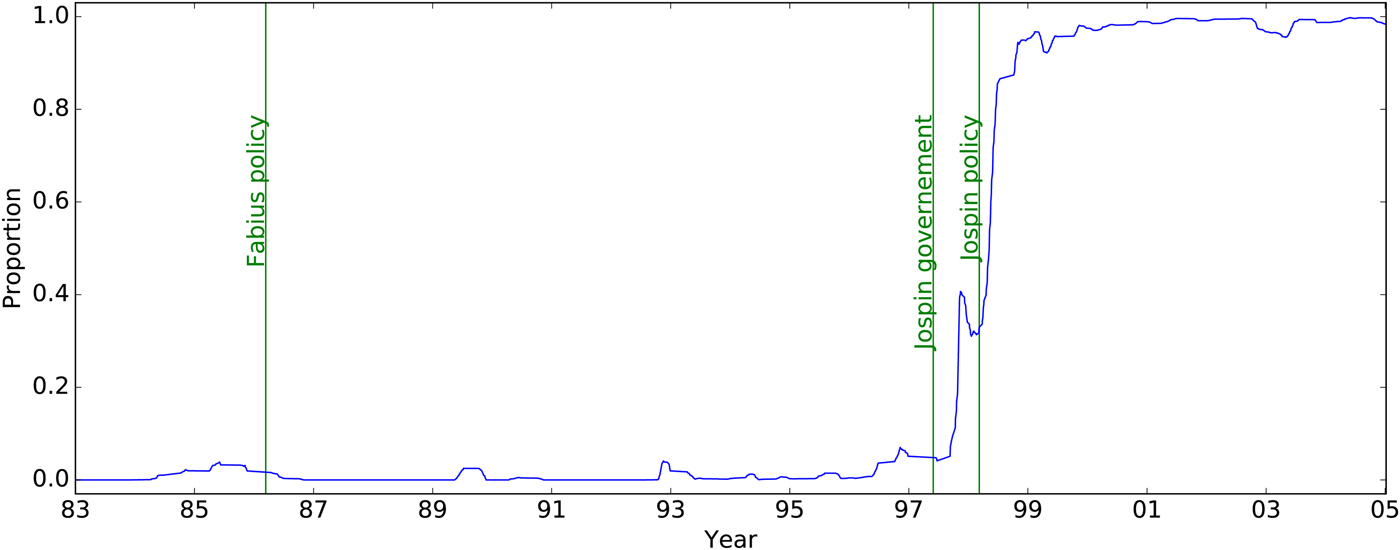
Figure 1 shows the proportion of the use of feminine vs. masculine grammatical gender in female terms of address (Madame le/la N) in the Assemblée nationale from 1983 to 2005. Consistent with reports based on qualitative observations (Houdebine Reference Houdebine1987; Brick & Wilks Reference Brick and Wilks1994), this figure shows that use of the feminine form is extremely limited throughout the 1980s, and that Fabius’ language policy in 1986 had little to no effect on the speech of politicians.
Proportion of uses of Madame la N vs. Madame le N (1983–2005).

However, twelve years later, on March 6, 1998, the Socialist Prime Minister Lionel Jospin issued a statement (a circulaire) recalling to the government that they are supposed to be using feminine gender and (if appropriate) feminized forms. He acknowledged that the Fabius’ policy was never obeyed/enforced and commissioned a new study from the Commission générale de terminologie et néologie, which was published in June 1999 and ended up making very similar recommendations to the one in 1984–1985 (Becquer, Cerquiglini, Cholewka, Coutier, Frécher, & Mathieu Reference Becquer, Cerquiglini, Cholewka, Coutier, Frécher and Mathieu1999). Figure 1 shows that, after this second wave of activism, the results are very different with use of the feminine form rising dramatically in 1997–1998, around the time of Jospin's statement.
The contrast between the mid 1980s and the mid 1990s is striking and raises the following question: What changed from 1986 to 1998 that allowed the feminine form to take over, possibly aided by (the exact same) language policy?
Our main claim in this article is that changes in the use of feminine grammatical gender and differences in the effectiveness of Fabius/Jospin's language policy are (indirectly) the result of changes in gender ideologies in France between the mid 1980s and mid 1990s. In particular, we argue that the mid 1990s saw the emergence of a new social type or persona (Zhang Reference Zhang2005; Podesva Reference Podesva2007; Eckert Reference Eckert2008; among others) for female politicians, which only feminine g-gender can construct. We hypothesize that Jospin's reinforcement of Fabius’ policy in 1998 was successful because it strengthened an existing association between feminine g-gender and a female political persona; whereas, Fabius’ original policy was unsuccessful because it tried to build on ideological structure that was not shared by a large portion of the Assemblée nationale. Our case study thus suggests that linguistic prescriptions will only be successful if they build on existing ideologies in the speech community and highlights the role that meta-linguistic and other discourses can play in the actuation and spread of linguistic change.
The article is laid out as follows. We first go deeper into the Assemblée nationale dataset and investigate which linguistic and social factors condition the rise of the feminine in the late 1990s. We then argue that the linguistic change just documented coincides with an important social change: the emergence of a new stereotypically feminine persona for female politicians. Following research in French political history and social science, we describe the discursive construction of this new persona in the context of the parité debate on the equal representation of women and men in elected office. This leads us to argue that the relationship between feminine g-gender and the new persona is mediated by the social meaning of grammatical gender marking in French. Following remarks by McConnell-Ginet (Reference McConnell-Ginet and Corbett2013), we propose that the social meaning of French feminine g-gender marking makes it optimal for constructing the emerging stereotypically feminine persona, and thus we argue that the replacement of the masculine g-gender by feminine g-gender in the Assemblée nationale is a consequence of the social meaning of g-gender marking and changes in the way speakers in the Assemblée nationale conceptualize their fellow female politicians. Finally, we conclude with a general discussion of the role that social structure and speaker ideologies play in linguistic change.
VARIATION AND CHANGE IN THE ASSEMBLÉE NATIONALE
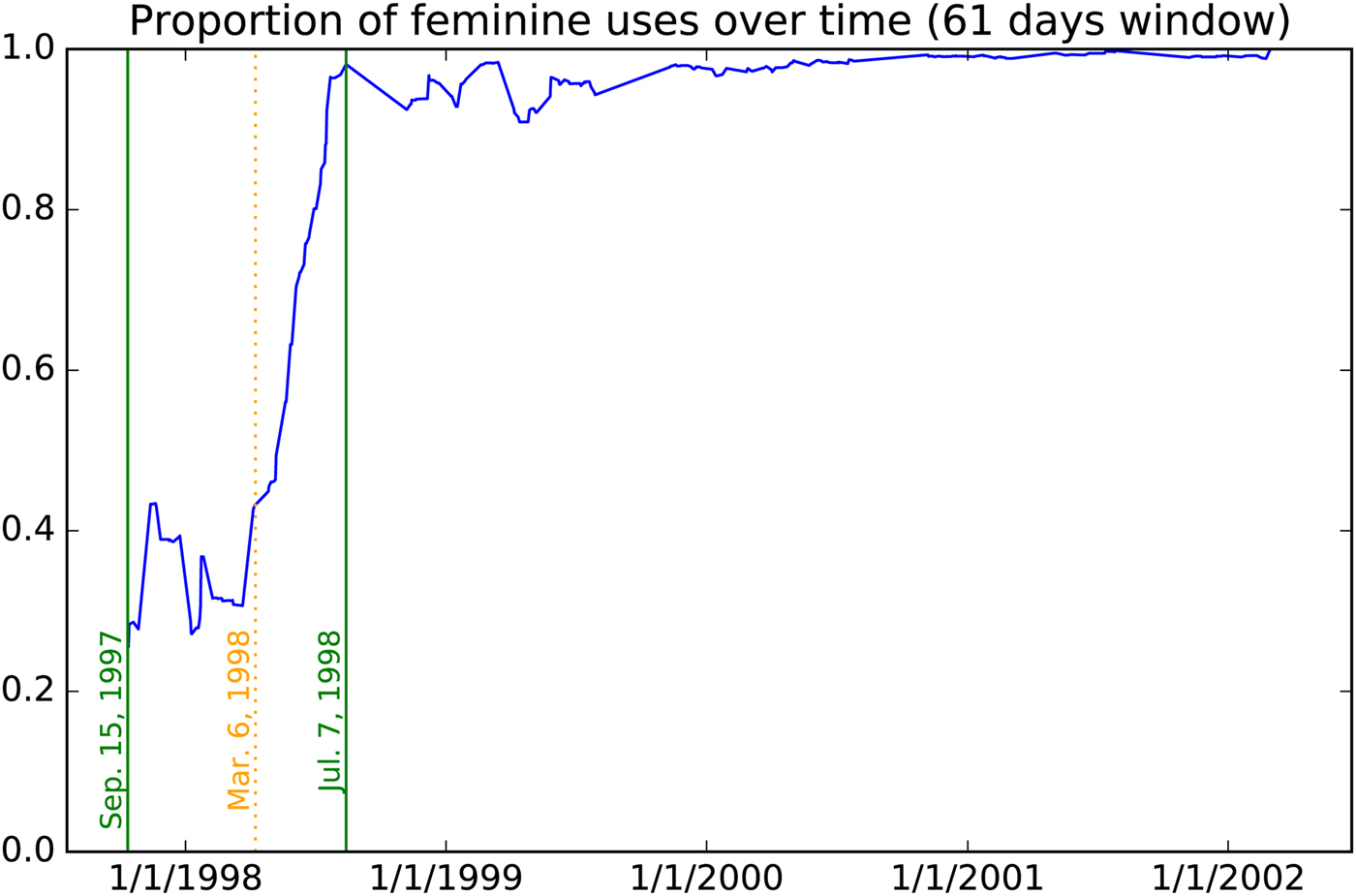
Based on Figure 1, we know that the change happened around 1996–1999; however, to properly understand its dynamics, we need to get a more fine-grained look at the linguistic and social factors that condition the changing use of Madame le/la N. In order to restrict our attention to the time period where there is variation for statistical analysis, we took the proportion of feminine uses on all of the occurrences thirty days before and thirty days after each session. Tracking the change through a sixty-one-day window is necessary because each session of the Assemblée nationale features few (if any) occurrences of a female term of address, so, with such small numbers, looking at the proportion of feminine vs. masculine g-gender on each day is not enlightening.
Using this methodology, Figure 2 shows the rise of feminine g-gender in the eleventh legislature. Limiting the quantitative study to the eleventh legislature allows us to study change within a single community of practice, since the membership of the Assemblée remains constant throughout this time period. Based on the observation of the pattern shown in Figure 2, we focus our quantitative study on the period between September 15, 1997 (after the summer break) to July 7, 1998 (the end of the spring session).
Replacement of masculine by feminine g-gender in the eleventh legislature.

Within the period identified in Figure 2, we have 5,056 occurrences of female terms of address: 2,149 feminine (Madame la N) and 2,807 masculine (Madame le N), that is, an overall rate of use of the feminine of 43%. We then coded these occurrences for the linguistic and social factors described below.
Linguistic factors
The main linguistic conditioning factor investigated in this article is the identity of the function noun. In the introduction, we saw that ministre ‘minister’ was one of the function nouns that participate in the g-gender alternation. The other nouns in our corpus that alternate are président(e), secrétaire d’État, député(e), garde des sceaux, and rapporteur/rapporteuse.Footnote 4
(10) Président(e) ‘president’
a. M. Thierry Mariani: Madame le président, nous devons en principe disposer de cinq minutes après l'annonce du scrutin. Je n'ai pas eu le temps de regagner l'hémicycle! (23/10/1996)
b. M. Thierry Mariani: Madame la présidente de la commission, qu'en sera-t-il des catégories de délinquants étrangers qui ont de gros problèmes de santé, etc.? (16/12/1997)
(11) Secrétaire d’État ‘secretary of state’
a. M. Gilbert Meyer: Madame le secrétaire d’État aux petites entreprises, au commerce et à l'artisanat, depuis le 1er janvier 1997… (3/03/1998)
b. M. Gilbert Meyer: Madame la secrétaire d’État aux petites et moyennes entreprises, au commerce et à l'artisanat, la loi relative au développement et à la promotion du commerce et de l'artisanat… (7/10/1997)
(12) Député (e) ‘deputy’
a. M. Jean-Claude Gayssot: Madame le député, si j'ai bien compris, mon prédécesseur vous avait fait des promesses d'engagement au printemps dernier. (24/10/1997)
b. M. Jean-Claude Gayssot: Madame la députée, comme vous le savez, le schéma directeur national des liaisons ferroviaires à grande vitesse, approuvé par décret en 1992, a prévu, pour la desserte de l'ouest de la France, la réalisation du TGV Bretagne… (24/10/1997)
(13) Garde des sceaux ‘justice minister’
a. M. Gérard Gouzes: Madame le garde des sceaux, alors que nous débattons du budget de la justice pour 1998, tout le monde commente le retard accumulé année après année… (21/10/1997)
b. M. Gérard Gouzes: Madame la garde des sceaux, combien de temps nous faudra-t-il encore pour définir de manière simple, de manière transparente, de manière cohérente, la place de chacun des acteurs de l'acte judiciaire dans notre vieux pays?… (02/06/1998)
(14) Rapporteur/rapporteuse ‘reporter’
a. M. Pierre Mazeaud: Madame le rapporteur, terminez, je vous en prie!… (29/10/1997)
b. M. Yves Cochet: Vous gênez M. Cacheux, madame la rapporteuse. (02/06/1998)
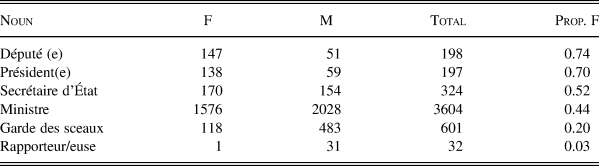
The distribution of feminine g-gender by function noun is displayed in Table 1, and shows that the proportion of feminines is not uniform across nouns (see also Fujimura Reference Fujimura2005 for similar observations in a press corpus): the highest rates of la are found with député(e) and président(e), and the lowest rate is found with garde des sceaux. Since there is only a single use of rapporteuse in (14b), we excluded this noun from the statistical analysis.
Distribution of grammatical gender by function noun.

We note that the observed function noun hierarchy corresponds to the hierarchy of governmental power and prestige, so it is possible that associations between the masculine form and institutional power play a role in creating the distribution in Table 1. However, this is not the only possible interpretation. Linguistic properties of the nouns, and in particular whether they have formally distinct masculine and feminine forms, might also play a role. Finally, speaker status may also have an effect. Note that speakers in the parliamentary debates are either deputies or ministers, and that these two groups mostly address each other. Hence most occurrences of ministre are uttered by a député(e), and vice versa. Thus it may be the case that the observed lexical differences are in part due to deputies and ministers having different usage preferences.Footnote 5 Be that as it may, the number of distinct function nouns in the corpus does not allow us to go beyond speculation as to the causes of lexical differences. We therefore leave further exploration of the source of lexical effects in g-gender alternations to future research involving a more lexically diverse corpus.
Social factors
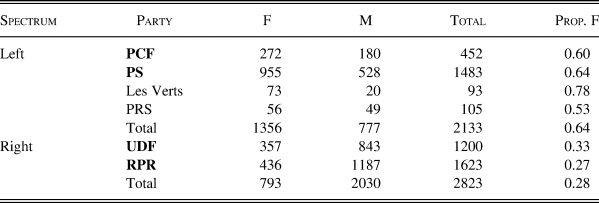
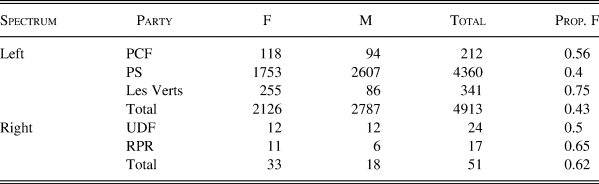
Given that we are studying the speech of politicians, it is natural to wonder whether speakers belonging to different political parties will show different patterns of use. Indeed, as shown in Table 2, there is a large difference in the use of the feminine between the more left wing parties—including the Socialists (PS), the Communists (PCF) and the Greens (Les Verts)—who use the feminine around 64% of the time, and the right wing parties—Union pour la Démocratie Française (UDF) and Rassemblement pour la République (RPR)—who use the feminine in only 30% of the cases.
Distribution of grammatical gender by speaker political party.

In order to ensure that we have enough data for the statistical analysis, we focus only on the larger political parties, presented in boldface in Table 2.
We also investigated whether the political party of the addressee made a difference to whether they are referred to using the masculine or the feminine. The results are shown in Table 3. The corpus that we are using has a particular structure to it: while individuals across the political spectrum ask questions and make points during the debates, the individuals that are addressed are overwhelmingly members of the cabinet, which at the time was held by the left and headed by the Socialist party. Thus, 88% of the terms of address are directed to a socialist woman, so that there is actually very little variation in this factor in our corpus. We therefore do not include it in the statistical analysis, and note that almost the same statistical results are found if we restrict the dataset to only socialist addressees.
Distribution of grammatical gender by addressee political party.

Since we are studying the use and interpretation of grammatical gender, it is also natural to wonder whether there is some relation between the social gender of the speakers and their use of the feminine in our corpus. In the eleventh legislature, ten out of thirty-five members of the cabinet (le gouvernement) are female (29%), and sixty-three out of 577 deputies of the Assemblée nationale are female (10.9%).Footnote 6 Furthermore, in our subcorpus, forty-nine out of 393 speakers are women (12.5%).
As shown in Table 4, female politicians use slightly more feminine forms than male politicians in our corpus. However, since the proportion of female politicians is higher on the left, multivariate statistical analysis is required to disentangle the influence of speaker gender and political affiliation.
Distribution of grammatical gender by speaker social gender (Four major political parties).

INTERPRETING THE TRANSCRIPTS
Before we see the statistical results, we briefly outline the conditions under which the transcripts of the debates were produced. Before a reorganization that occured in 2008, the compte rendu intégral ‘full transcript’ was the official, edited record of what was said in the Assemblée nationale.Footnote 7 It was produced by professional stenographers who recorded the speech in real time and with the help of audio recordings. Thus, the question of the reliability of the transcription process arises. Since 2005, videos of the debates are archived in addition to the transcripts. However, none of the unofficial recordings made by the transcribers in the 1990s were archived. Fortunately, the television station FR3 recorded a sizeable subset of our dataset, the Questions au Gouvernment ‘questions to the cabinet’, and it was possible to consult this subset at the Institut National de l'Audiovisuel. We checked all the occurrences of Madame le/la N in forty-eight recordings of the Questions au Gouvernement spread out across the time period that we are studying. We found that the rate of reliability was 85% (266/314), with divergences between the video and the text being limited to the very beginning of the time period (where feminine occurrences in the video were transcribed as masculine in the transcripts) and the very end of the period (where masculine occurrences in the video were transcribed as feminine).Footnote 8 Given this test, we are generally confident in the reliability of our data, even though it may be possible that the actual change was slightly less abrupt than the transcripts would suggest.
STATISTICAL ANALYSIS
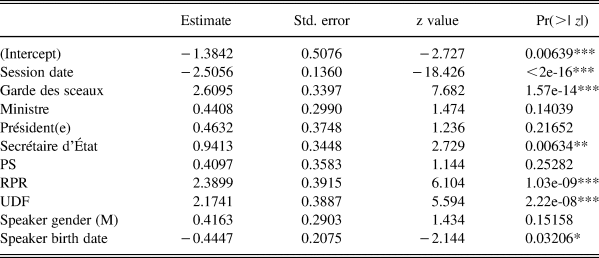
The patterns just described suggest that g-gender variation in the eleventh legislature may be subject to both linguistic and social conditioning factors; however, in order to properly assess their importance, we built generalized linear mixed effects models in R using the lme4 package (Bates, Maechler, Bolker, & Walker Reference Bates, Maechler, Bolker and Walker2015), with speaker identity (393 speakers) as a random effect and the following fixed effects: session date (before/after March 6, 1998), speaker political party (PCF, PS, UDF, RPR), speaker social gender (F, M), speaker age (based on birth date before/after 1941) and function noun (président(e), député (e), ministre, secrétaire d’État, garde des sceaux).
The results of the statistical analysis are shown in Table 5. We find a significant effect of date, which is unsurprising given that change is very clearly in progress in 1997–1998. We also find a significant lexical effect of the function noun, with président(e) and ministre not being significantly different from député (e), but garde des Sceaux and secrétaire d’État appearing in the masculine significantly more. As discussed above, it is not clear what to make of this pattern, so we leave open whether or not it is generated by meaning/ideological considerations (as we argue the other patterns are) or whether more grammatical factors are at play.
Fixed effects of the generalized linear mixed model. Dependent variable: probability of masculine grammatical gender. Levels of independent variables in the intercept: Speaker gender—F; Party—PCF; Noun—député(e).

With respect to the social factors, we found that speaker age was significant, with speakers born in the 1920s and 1930s (those of Yvette Roudy's generation) using more masculine than younger speakers. Political party was also significant, with the Socialists behaving like the Communists, and the two right wing parties (UDF and RPR) differing significantly; however, we found no effect of speaker social gender. This suggests that women's slightly higher rate of use of the feminine shown in Table 3 is actually the result of left wing parties having more female members than right wing parties, rather than female politicians marking aspects of their gender class through language.
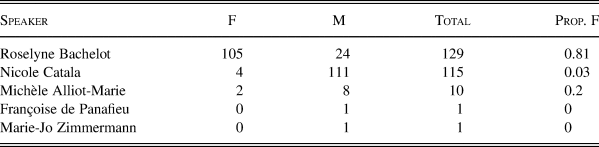
The fact that political party emerged as significant in the statistical analysis also shows that grammatical gender bears social meaning, at least in our dataset. In other words, from these results, we know that there must be at least some extra little bit of information that is communicated through the use of the feminine vs. the masculine that makes speakers on the leftmost part of the political spectrum more likely to use it. A natural first hypothesis might be that, in the late 1990s, politicians in the Assemblée nationale are using grammatical gender in female terms of address to mark their political affiliation: la would mark membership in a left wing party and le would mark membership in a right wing party. However, we argue that this simple hypothesis cannot account for the linguistic behaviour of the women of the most right wing party: RPR. As shown in Table 6, there are five RPR women who speak in our corpus. Four of them (Nicole Catala, Michèle Alliot-Marie, Françoise de Panafieu, and Marie-Jo Zimmermann) behave like their male colleagues, strongly favouring the masculine; however, one (Roselyne Bachelot) has a rate of 81% and is one of the highest users of the feminine in the corpus.
Grammatical gender use by the women of the Rassemblement pour la République.

We now would like to know: What distinguishes Bachelot from her female right wing colleagues? We propose that the answer to this question lies in a study of changing gender ideologies in late twentieth-century France.
PARITÉ AND CHANGING FRENCH GENDER IDEOLOGIES
The extreme user of the feminine described above, Roselyne Bachelot, was a long time member of the Assemblée nationale (1988–2012) and, during this time, she held a number of important right wing party and governmental functions, including three ministerial portfolios (ecology, health, and solidarity) during the Chirac and Sarkozy presidencies. So it is extremely unlikely that she would be using feminine grammatical gender to indicate some disaffiliation with her political party. This being said, Bachelot does differ from many of her RPR colleagues in that she is one of the most prominent supporters of the parité political movement. Indeed, at the time of the change studied in this article (1995–1998) she was head of the Observatoire sur la parité entre les hommes et les femmes ‘Center for parité between men and women’, and she supervised the report La parité dans la vie publique ‘Parité in public life’, a study of the situation of women in politics, published in December 1996.
The parité movement
Used in this context, the French word parité refers to both a philosophical position (Gaspard, Servan-Schreiber, & Le Gall Reference Gaspard, Servan-Schreiber and Le Gall1992) and a political movement aimed at ensuring that men and women have equal access to electoral mandates and elected office. It was a very successful political movement in the late 1990s, and its success continues in the twenty-first century. Its earliest legislative successes date to around the time of the linguistic change described above. For example, on June 19, 1997 (at the very beginning of the change) Prime Minister Jospin announces his intention to amend the constitution and pass a law making parité a goal for the government. As shown above, most of the members of the Assemblée nationale shift from using Madame le N to Madame la N directly after: from Fall 1997 to Summer 1998. Then, on June 17, 1998, the first draft of the bill to amend the constitution to include the statement La loi favorise l’égal accès des femmes et hommes aux mandats et fonctions ‘The law promotes equal access to mandates and functions by women and men’ is formulated, and on July 8, 1999, Jospin's constitutional amendment passes. The first parité law passes on June 6, 2000, and, during the years 2000–2014, many other pro-parité laws are passed aimed at enforcing equal representation in both government and educational institutions. Since the rise of the parité sociopolitical movement coincides with the rise of the use of feminine g-gender in the Assemblée nationale, we conclude that it is highly likely some aspect of support for parité played a role in the actuation of the change.
A second argument that the rise of the feminine is related to the parité movement comes from the way in which support for this movement propagated through the Assemblée nationale. As documented in Bereni (Reference Bereni2007:ch. 6), prior to 1995, pro-parité positions were almost exclusively held publicly by politicians on the radical left: the Greens, the Communists and the Mouvement des citoyens party (Bereni Reference Bereni2007:343). However, in 1996–1997, support grew within the Socialist party, largely as part of a democratic renewal project headed by Lionel Jospin. By contrast, with the exception of Bachelot, who Bereni (Reference Bereni2007:374) calls the avocate esseulée de la parité au RPR ‘RPR's solitary parité advocate’, right wing deputies were largely hostile to the proposal of a constitutional amendment in favour of gender-balanced electoral representation in this period. However, the year 1997–1998 saw a major increase in support for parité across the body of the Assemblée nationale. An important turning point for the right was on March 23, 1998, when right wing President Jacques Chirac publicly announced his support for Jospin's proposed constitutional amendment, and then, finally, when the time came to pass the constitutional amendment in the summer of 1999, it passed with the support of 94% of the Assemblée, including the vast majority of right wing deputies.
The emergence of the feminine politician persona
The parité movement was both accompanied and invigorated by enormous attention from the press. Media debates about electoral quotas began in 1993 with Servan-Schreiber & Gaspard (Reference Servan-Schreiber and Gaspard1993) and Viennot (Reference Viennot1993), and were at their most intense in the winters of 1996 and 1999 (Ramsay Reference Ramsay2003; Julliard Reference Julliard2012). As observed by Freedman (Reference Freedman1997), Garréta (Reference Garréta2001), Scott (Reference Scott2005), and others, documented in great detail by Julliard (Reference Julliard2012), and studied from a quantitative perspective by Guaresi (Reference Guaresi2018), this coverage was characterized by the appearance of new discourses surrounding the nature, behaviour, and social position of female politicians. Following the aforementioned authors, we argue that these discourses were instrumental in constructing a new persona (identity or social type) for women in politics.
Although most advocates of parité legislation consider themselves feminist, not all feminists supported the parité movement. In fact, as discussed in Sintomer (Reference Sintomer2007), radical deconstructionists and (in his words) ‘republican universalists’ were anti-parité. The most influential paritaristes ‘pro-parité activists’ came from three main ideological camps: essentialist differentialist feminists, republican paritarists, and pragmatic egalitarians (Sintomer Reference Sintomer2007:151). The differentialist feminists were extremely influential in both politics and the press, in part because one their main figures was the philosopher Sylvie Agacinski-Jospin, wife of the Prime Minister (Scott Reference Scott2005; Bereni Reference Bereni2007; Julliard Reference Julliard2012). Based on psychoanalytic principles, Agacinski (Reference Agacinski1998, Reference Agacinski1999) and the well-known philosopher Julia Kristeva (Reference Kristeva1999) argued that men and women constitute two fundamentally different kinds of citizens; therefore, electoral quotas are legitimate to ensure that these two basic parts of French society are democratically represented.
For example, arguing against l'effacement des sexes ‘the erasure of the sexes’, Agacinski (Reference Agacinski1999:4) says,
L'effacement « français » procède en noyant les deux sexes dans un humanisme abstrait d'où surnage le modèle unique d'un être humain sexuellement neutre. L'effacement « américain » procède en noyant les femmes dans un particularisme généralisé où se retrouvent des minorités de toutes sortes (ethniques, religieuses, culturelles, etc.), et les deux sexes finissent par être considérés comme de pures « constructions », quand ils ne sont pas la conséquence de modèles culturels hétérosexuels (« heterosexual matrix »), comme chez Judith Butler.
Le nouveau féminisme français récuse à la fois ces deux types de neutralisation des sexes en affirmant la dualité sexuelle comme la seule différence universelle au sein de l'humanité. C'est pourquoi il a pu concevoir l'idéal de la parité en politique.
‘‘French’ erasure proceeds through drowning both sexes in an abstract humanism over which floats the unique model of a sexually neutral human being. ‘American’ erasure proceeds through drowning women in a generalized particularism where are found minorities of all sorts (ethnic, religious, cultural, etc.), and the two sexes finish by being considered ‘constructions’, when they are not the consequence of heterosexual cultural models (‘heterosexual matrix’), as with Judith Butler.
The new French feminism refuses both of these erasures at the same time through affirming sexual duality as the only universal difference at the heart of humanity. This is why it was able to conceive of the ideal of political parité.’
This line of argumentation, defended by very powerful public intellectuals, constructs ‘the female politician’ as a distinct type of politician from ‘the male politician’. Since, before the public debates on parité, female politicians had been viewed as subtypes of male politicians, Agacinski argues (1999:6) that ‘L'idéal ne fut donc plus de devenir des hommes comme les autres, mais d'affirmer la différence dans l’égalité’ (‘The ideal was no longer to become men like everyone else, but to affirm difference in equality’).
Although the republican paritarists and pragmatic egalitarians were less essentialist than the differentialists, these activists also constructed male and female politicians as qualitatively distinct. In particular, one of their principal arguments in favor of electoral quotas was that including more women in government would have a positive effect on France, since (by nature or by material circumstance) female politicians have different properties and view the world differently than do male politicians (Freedman Reference Freedman1997; Scott Reference Scott2005; Sintomer Reference Sintomer2007; Achin Reference Achin2007; Julliard Reference Julliard2012; among others). The theme that female politicians are distinct from male politicians because they are more concrete-thinking, more sensitive, and more honest runs through parité debate in the press from 1996–1999. For example, one of the most important documents in this debate was the Manifeste des dix—a pro-parité ‘manifesto’ published in L'express on June 6, 1996 by ten current and former female ministers (Barzach, Bredin, Cresson, Gisserot, Lalumière, Neiertz, Pelletier, Roudy, Tasca, and Veil). This manifesto was very important because it presented the first united front between high profile left wing politicians (such as Yvette Roudy) and right wing politicians (such as Simone Veil).Footnote 9 Again, this text, quoted below, proposes that women's (stereotypically) feminine qualities constitute an argument for increasing their representation in the Assemblé e nationale (Scott Reference Scott2005).
Noyau de notre culture républicaine, pas toujours démocratique, le jacobinisme a d'abord et surtout été une affaire d'hommes. … Centralisateur et hiérarchique, donneur de leçons et arrogant autant qu’éducateur, rhétorique et rationaliste jusqu’à l'abstraction chimérique, le jacobinisme est en quelque sorte un concentré de qualités viriles … La relation aux autres tels qu'ils sont, la sensibilité, le concret, le souci du quotidien étaient ainsi rejetés du champ politique. Et les femmes avec.
‘Center of our republican culture, not always democratic, Jacobinism was first and foremost a male business. … Centralizing and hierarchical, as pedantic and arrogant as educational, rhetorical and rationalistic up to the point of chimerical abstraction, Jacobinism is in some way a concentration of virile qualities … Relating to others as they are, sensitivity, concreteness, caring for everyday things were thus rejected from the political realm. And women with them.’
At the same time that male and female politicians were being differentiated in the press, the female politician persona, as distinct from the male politician, was also being constructed in literature from the mid to late 1990s. Although there were certain early works describing the life of female politicians, such as Huguette Bouchardeau's Reference Bouchardeau1988 book Choses dites de profil, the number of new biographical and autobiographical studies documenting female politicians’ personal experiences exploded after 1995, constituting a whole new literary genre in the late 1990s (Freedman Reference Freedman1998; Ramsay Reference Ramsay2003). A sample of works detailing what it was like to be a female politician at the time of the parité debates is given in (15).
(15) 1995: Yvette Roudy, Mais de quoi ont-ils peur? Un vent de misogynie souffle sur la politique
1996 Ségolène Royal, La vérité d'une femme
1997: Frédèrique Bredin, Députée: journal de bord
Elisabeth Guigou, Être femme en politique
Gisèle Halimi, La nouvelle cause des femmes
1998: Corinne Lepage, On ne peut rien faire, Madame le ministre…
1999: Roselyne Bachelot & Gisèle Fraisse, Deux femmes au royaume des hommes
According to Ramsay's (Reference Ramsay2003) study of these works, ‘many of the texts in the emerging new body of studies by and on political women… share aspects of Bouchardeau's exploration of subjective understandings (or fictions) of political life from the particular perspective of women. They focus on values, emotions or identity’. Ramsay therefore proposes that ‘these texts work to constitute and legitimate a rethinking and a “rewriting” of traditional political history and help construct the unique yet multiple identity of the political women’ (Ramsay Reference Ramsay2003:xiv).
A final argument in favour of the development of a new stereotypically feminine persona in the late 1990s comes from the shape of feminist reactions against the parité movement. In the same way that pro-parité feminists argued that male and female politicians’ differences would positively impact France, many anti-parité feminists criticized the claim that men and women differ in properties like pragmatism, sensitivity, and honesty. For example, the philosopher Elisabeth Badinter (Badinter Reference Badinter1996, Reference Badinter1999, Reference Badinter2003) objects that ‘le Manifeste de la parité entérine les caractéristiques féminines les plus éculées’ (‘The parité manifesto endorses the most tired female stereotypes’; Badinter Reference Badinter1996:4), and she denies that female and male politicians differ qualitatively in their properties, saying (1996:4),
En vérité, les avocates de la parité ne tentent pas seulement de nous faire croire qu[e les femmes] sont essentiellement différentes des hommes, mais aussi qu'elles sont meilleures qu'eux. Avec elles, la politique si décriée deviendrait enfin plus humaine, plus chaleureuse et plus efficace. Pardon d’être sceptique, mais, à côtoyer les femmes de pouvoir, je les trouve très semblables à leurs collègues masculins: mêmes qualités, mêmes défauts.
‘In reality, the parité advocates not only want to make us believe that [women] are essentially different than men, but also that they are better than them. With them, much criticized politics would finally become more humane, warmer and more efficient. Excuse me for being skeptical, but, from spending time with powerful women, I find them very similar to their male colleagues: same qualities, same faults.’
Thus, in this time period, we see two opposing visions of the nature of female politicians: one in which they are characterized by ‘feminine’ qualities, advocated for by the paritarists, and one in which, for better or for worse, they display the same properties as their male colleagues.Footnote 10 In what follows, we refer to the stereotypically female persona as the differentialist persona and we refer to the less feminine persona as the nondifferentialist persona.
Linguistic manifestations of persona construction
In the previous section, we argued that, in the late 1990s, there were two principal personae available for female politicians: a new stereotypically feminine one and an older nondifferentialist persona that is more similar to male political personae. Here we suggest that speakers in the Assemblée nationale in 1997–1998 use grammatical gender in their construction of these different personae. Our quantitative data is limited by who happens to talk publicly in the Assemblée nationale, and for how long; therefore, sadly, data for individual speakers is often quite sparse. Nevertheless, we believe that the patterns described below suggest a link between feminine g-gender use and feminine persona construction, and (for women) masculine g-gender use and masculine persona construction.
Returning to one of the highest users of the feminine in our corpus, Roselyne Bachelot (81%), we can observe that not only is she a principal advocate of parité, but she also cultivates an extreme feminine style. In a study of the gender presentation of Bachelot and her fellow powerful female right wing colleague, Michèle Alliot-Marie, Bard (Reference Bard2012:10) remarks on how Bachelot's manner of dressing is designed to distinguish her from her male colleagues.
Roselyne Bachelot théorise le recours à la couleur vive d'une manière féministe. Elle privilégie le rose, une couleur archiféminine. Manière pour elle d'arborer la féminité comme un drapeau, dans un monde d'hommes, de jouer d'une différence devenue très visible.
‘Roselyne Bachelot theorizes the use of bright colours in a feminist manner. She privileges pink, an ultra feminine colour. A way for her to fly femininity like a flag, in a world of men, to take advantage of a difference that had become very visible.’
Bachelot very publicly espouses the ‘feminine’ properties of pragmatism, sensitivity, honesty, and so on, which she argues women will bring to politics. For example, in a 1986 interview,Footnote 11 she says,
Je crois que la femme a un message de femme à apporter. Moi j'avoue que quand je vois quelque chose qui me fait pleurer, j'ose pleurer. Je suis quelqu'un de sensible; je ne veux pas devenir un homme manqué dans la politique. C'est ça que je veux apporter au monde politique.
‘I think that women have a woman's message to bring. Me, I admit that when I see something that makes me cry, I dare to cry. I am a sensitive person; I don't want to be a failed man [tomboy] in politics. That's what I want to bring to the political world.’
Alliot-Marie, on the other hand, very clearly constructs the less feminine political persona (Ramsay Reference Ramsay2003; Bard Reference Bard2012). According to (Bard Reference Bard2012:10), ‘Michèle Alliot-Marie incarne un type de féminité autoritaire, raide, évocatrice du masculin’ (‘Michèle Alliot-Marie incarnates a type of femininity that is authoritarian, firm, evoking masculinity’). She holds a similar anti-parité feminist position to Badinter, and is likewise skeptical about qualitative differences between men and women, saying in a recent interview with Le Lab about electoral quotas: ‘Ce que je dis est que les femmes ont les mêmes capacités que les hommes, qu'elles ont la même intelligence’.Footnote 12 Additionally, she does not have a particularly feminine way of dressing, and once remarked to a colleague who wanted her to change her hair and glasses: ‘Je ne suis pas potiche’ (‘I am not a bimbo’; Bard Reference Bard2012:11). Unfortunately for us, she does not talk very much in 1997–1998; however, it is suggestive that she uses feminine g-gender only 20% of the time (2/10 occurrences).
A similar comparison has also been drawn among left wing politicians, Ségolène Royal and Martine Aubry, who appear to show the same basic pattern as Bachelot and Alliot-Marie, respectively. For example, Montini (Reference Montini2017) reports that:
Marine Aubry est présentée comme sérieuse, austère, si ce n'est pas autoritaire et froide. … Miroir inversé de Ségolène Royal, enfermée dans un excès de « féminité » (coquette, dans l'extrême émotion, imprévisible, voire folle etc.), Martine Aubry se trouve ramenée à une manque de « féminité ».
‘Martine Aubry is presented as serious, austere if not authoritarian and cold. … Mirror image of Ségolène Royal, covered in an excess of ‘femininity’ (coquette, extremely emotional, unpredictable, even crazy, etc.). Martine Aubry finds herself brought back to a lack of ‘femininity’.’
Ramsay (Reference Ramsay2003:197) also reports that ‘descriptive epithets from the period of [Aubry's] entry into government generally attribute masculine qualities to this political woman called a ‘superwoman’ and seen to possess ‘authority’, ‘moral intransigence’, ‘frankness’, ‘acerbic humour’ and ‘the determination of a bulldozer’. Furthermore, unlike Royal who was one of parité’s earliest advocates within the Socialist party, Aubry was one of the last Socialist women to publicly support the constitutional amendment (Bereni Reference Bereni2007).
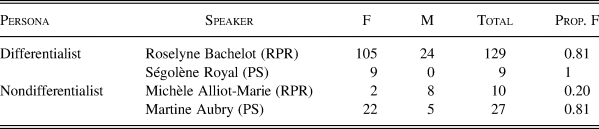
Accordingly, although there is a correlation between political affiliation and the likelihood of adopting one or the other persona, we expect the use of g-gender to also depend on the persona adopted by the speaker. This is indeed what we find when we examine the usage of Bachelot, Alliot-Marie, Royal, and Aubry, summarized in Table 7. We find significant differences between Royal and Aubry's use of the feminine (indeed, Royal never uses the masculine in our corpus) just as between Bachelot and Alliot-Marie's use (Fisher's exact test, p-value < 0.05).
Grammatical gender use by Bachelot, Alliot-Marie, Royal, and Aubry.

Since, as mentioned above, the vast majority of addressees are socialists, unfortunately we do not have enough data to assess whether there are differences in how speakers address Alliot-Marie and Bachelot: Alliot-Marie is addressed twice and Bachelot once (all in the feminine) in the whole corpus. However, since they are both socialist ministers, both Royal and Aubry are frequently addressed and, here again, we see a significant difference (Fisher's exact test, p-value < 0.05) between the two: Aubry is addressed with 37% feminine (867/2340), while Royal is addressed with 58% feminine (56/96). Thus, the different persona construction of these two socialist ministers may be influencing how others refer to them in addition to how they themselves speak.
GRAMMATICAL GENDER AND SOCIAL MEANING
In the previous section, we argued that, in 1997–1998, there was a link between use of Madame la N and the construction of the differentialist feminine persona and the use of Madame le N and the construction of the nondifferentialist persona. However, we have not yet said anything about why this particular pairing of linguistic form and abstract identity should arise. Here we argue that identity construction with g-gender is mediated by the social meanings of feminine and masculine g-gender.
The question of meaning in relation to grammatical gender marking has long been a controversial one. The view of the influential Académie française (1984, 2014) is that there is no meaning associated with masculine or feminine marking. Nevertheless, the dominant view emerging in the fields of linguistics and psychology, which we adopt in this article, is that grammatical gender assignment is multi-factorial: it takes into account a variety of linguistic, cognitive, and meaning-related factors (Tucker, Lambert, & Rigault Reference Tucker, Lambert and Rigault1977; Corbett Reference Corbett1991; Dahl Reference Dahl, Unterbeck, Rissanen, Nevalainen and Saari2000; McConnell-Ginet Reference McConnell-Ginet and Corbett2013; Culbertson, Gagliardi, & Smith Reference Culbertson, Gagliardi and Smith2017; Bonami & Boyé Reference Bonami, Boyé, Baerman, Bond and Hippisley2019; and many others). With respect to linguistic factors, the phonological form of certain nominal endings may induce a strong preference for masculine or feminine g-gender (Tucker et al. Reference Tucker, Lambert and Rigault1977; Holmes & Segui Reference Holmes and Segui2004, Reference Holmes and Segui2006; Matthews Reference Matthews2010). Furthermore, we know that cognitive factors like frequency may induce a strong preference for masculine or feminine g-gender (see also Dye, Milin, Futrell, & Ramscar Reference Dye, Milin, Futrell, Ramscar, Kiefer, Blevins and Bartos2017). Perhaps this is why the highly frequent noun personne ‘person’ is categorically feminine (*le personne). However, in addition, as observed in many works in linguistics (for example, Michard Reference Michard1996, Reference Michard1999; Houdebine-Gravaud Reference Houdebine-Gravaud1998; Michel Reference Michel2016; among others) and psychology of language (discussed below), there is a nonarbitrary relation between a noun's grammatical gender and its meaning.
Nevertheless, specifying the semantic interpretation of grammatical gender marking presents a puzzle. On the one hand (pace Académie française), there is clearly some link between grammatical gender and social gender interpretation. It is a robust generalization from psycholinguistic studies that, at least when minimal context is provided, masculine g-gender most often triggers reference to socially male individuals. This has been shown through a variety of association tasks (Chatard, Guimont, & Martinot Reference Chatard, Guimont and Martinot2005; Brauer & Landry Reference Brauer and Landry2008; Gygax, Gabriel, Lévy, Pool, Grivel, & Pedrazzini Reference Gygax, Gabriel, Lévy, Pool, Grivel and Pedrazzini2012), possible continuation tasks (Gygax, Gabriel, Sarrasin, Oakhill, & Garnham Reference Gygax, Gabriel, Lévy, Pool, Grivel, Pedrazzini, Sarrasin, Oakhill and Garnham2008; Sato, Gygax, & Gabriel Reference Sato, Gygax and Gabriel2013), eye tracking experiments (Irmen & Schumann Reference Irmen and Schumann2011), and can also be seen in the interpretation of neologisms (Bonami & Boyé Reference Bonami, Boyé, Baerman, Bond and Hippisley2019).Footnote 13 For example, Gygax and colleagues (Reference Gygax, Gabriel, Lévy, Pool, Grivel, Pedrazzini, Sarrasin, Oakhill and Garnham2008) gave francophone participants a possible continuation task asking them whether a sentence with a male or female denoting noun phrase was a possible continuation of a sentence containing a ‘generic masculine’ plural, as shown in (16). In the experiment, Gygax and colleagues (Reference Gygax, Gabriel, Lévy, Pool, Grivel, Pedrazzini, Sarrasin, Oakhill and Garnham2008) varied the gender-stereotypicality of the noun phrase from stereotypically female, such as assistants sociaux in (16a), to stereotypically male, such as professeurs ‘professors’.
(16) Is the second sentence a sensible possible continuation of the first one?
a. Les assistants sociaux marchaient dans la gare.
‘The social workers were walking through the station.’
b. Du beau temps étant prévu plusieurs femmes n'avaient pas de veste.
‘Since sunny weather was forecast, several of the women weren't wearing a coat.’
Gygax and colleagues found that participants were significantly more likely to agree that sentences with male referents were possible continuations for sentences with ‘generic masculines’ than sentences with female referents. Furthermore, when participants did agree that sentences with female referents were possible continuations, they took significantly longer to do so than when they judged sentences with male referents. This result contrasted with a parallel result they found for English in which social gender stereotypes was the main determinant of possible continuations, and there was no significant difference in reaction times. In other words, upon reading a masculine-marked noun phrase, French speakers are highly likely to interpret it as referring to men.
On the other hand, it is clear that social gender is not part of the literal semantic meaning of grammatical gender marking. This can be seen from the very phenomenon that we are studying: although many speakers disprefer it or object to this usage, it is not contradictory to utter Madame le ministre.Footnote 14
The solution to this puzzle that we adopt in this article follows remarks made by (McConnell-Ginet Reference McConnell-Ginet and Corbett2013). We propose that, although g-gender is not denotationally meaningful, its social meaning is related to social gender. More specifically, we propose that masculine/feminine g-gender marking is associated with (or, in the words of Silverstein (Reference Silverstein1976) and Ochs (Reference Ochs, Duranti and Goodwin1992)—indexes) sets of properties, which, following Eckert (Reference Eckert2008), we call indexical fields. The domains into which we interpret g-gender marked expressions are enriched with ideological structure: speaker/listeners’ pre-existing beliefs concerning how different properties and categories are likely to pattern together in their communities.Footnote 15
In line with McConnell-Ginet, we propose that feminine gender marking indexes properties/stances ideologically associated with women, and masculine gender marking indexes properties/stances ideologically associated with men, as in (17). Here ‘[feminine]’ (respectively ‘[masculine]’) denotes the indexical field associated with feminine (respectively masculine) grammatical gender. Furthermore, there is an ideological relation between the properties in the indexical field of feminine/masculine and being a woman/man respectively, given in (18).
(17) Indexical fields associated with French grammatical gender on human nouns:Footnote 16
[feminine] = {f 1…fn}, that is, properties/stances ideologically associated with women
[masculine] = {m 1…mn}, that is, properties/stances ideologically associated with men
(18) Ideological structure: f 1 ⇒ female, … fn ⇒ female, m 1 ⇒ male, … m n ⇒ male
When a gender-marked noun phrase is used in context, a subset of the properties in the field indexed by the noun phrase's grammatical gender will be attributed to its referent; however, which subset ends up being attributed will change depending on the utterance context.Footnote 17 Thus, listeners hearing a masculine-marked expression in minimal context will attribute a subset of the properties in the indexical field to the referent. Since, by virtue of their ideological structure, they will believe those properties to be more likely to hold of men than of women, they will be likely to assign male reference to the noun phrase, creating the male-biased interpretations found in psycholinguistic experiments such as those reported by Gygax and colleagues (Reference Gygax, Gabriel, Lévy, Pool, Grivel, Pedrazzini, Sarrasin, Oakhill and Garnham2008). In other words, under this view, the social gender inference found in uses of masculine nouns arises as a context-sensitive implicature (Grice Reference Grice, Davidson and Harman1975).
Of course, now we would like to know exactly which properties appear in the indexical field of masculine/feminine g-gender, and this is not an easy question. In synchronic research, fine-grained differences in interpretation between socially meaningful expressions can be diagnosed through experiments (Campbell-Kibler Reference Campbell-Kibler2007; Levon Reference Levon2014; Podesva, Reynolds, Callier, & Baptiste Reference Podesva, Reynolds, Callier; and Baptiste2015; among others). However, the study presented in this article is a diachronic one. Although it is unlikely that g-gender's indexical fields have radically changed in the past twenty years, there is no guarantee that they are currently identical to those of the mid 1990s. Of course, the discourses described above do give us some idea of the properties that many French speakers took to hold of male and female politicians at this time, so we might hypothesize that properties such as pragmatic, sensitive, and honest should be included in [feminine] in the 1990s, while abstract, tough, and dishonest should be included in [masculine]. However, due to the historical nature of this study, this hypothesis cannot really be verified or falsified.
FROM SOCIAL CHANGE TO LANGUAGE CHANGE
Another area where we assume that ideological structure influences meaning is in the interpretation of the nouns themselves. Following work in cognitive science (Rosch Reference Rosch1975; Kamp & Partee Reference Kamp and Partee1995; Hampton Reference Hampton1998; Reference Hampton2007; Gärdenfors Reference Gärdenfors2000, Reference Gärdenfors2014; Douven, Decock, Dietz, & Égré Reference Douven, Decock, Dietz and Égré2014; among many others), we assume that speakers associate prototypes with the concepts denoted by these nouns, which play an important role in determining their interpretation. The prototypes of a concept are its most characteristic instances, and whether or not something is categorized as falling under a concept depends on how similar it is to the concept's prototypes. In the context of grammatical gender and professional nouns, we propose that the prototypes of concepts denoted by nouns like ministre, garde des sceaux, députée and so on are the personae that speakers associate with these social roles. Since the prototypes define the extension of the concept, if the set of prototypes associated with ministre changes over time, then the shape of this concept will also change.
Given this system, we argue that the rise of feminine grammatical gender in the Assemblée nationale in the late 1990s is predictable from the rise of the feminine political persona described earlier and the indexical fields proposed in (17) under certain basic assumptions concerning how social changes are related to linguistic changes.
First, social changes and discourse about them construct and change speaker/listener ideologies (Butler Reference Butler1993, Reference Butler1997; Foucault Reference Foucault1976; Livia & Hall Reference Livia, Hall, Livia and Hall1997; among many others). More specifically, we propose that before the mid 1990s, all of the prototypes associated with ministre had the stereotypically male properties in (19a). However, through a complex discursive process associated with the parité movement, ministre gained a new prototype in the late 1990s: the differentialist female politician, which has stereotypically feminine properties (19b).
- (19)
a. ministre ⇒ m 1,…mn (stereotypically masculine properties) ministre in 1986
b. ministre⇒ m 1,…mn (stereotypically masculine properties) ministre in 1998
⇒ f 1…fn (stereotypically feminine properties)
Second, speaker/listener ideologies constrain what truth-conditional and social meanings can be assigned to linguistic expressions (Silverstein Reference Silverstein, Clyne, Hanks and Hofbauer1979, Reference Silverstein2003; Irvine & Gal Reference Irvine, Gal and Kroskrity2000; among many others). In particular, because of the ideological structure in (18), individuals who are ministers and who do not have stereotypically masculine properties (i.e. who are very dissimilar from the ministre prototypes) in 1986 lie at the periphery of the ministre concept. However, in 1998, ministers with stereotypically feminine properties are now central, typical examples of the concept.
Finally, an expression's truth-conditional and/or social meaning is what primarily drives its use. The indexical fields [feminine] and [masculine] will influence whether a speaker will say le ministre or la ministre when describing a female minister. As described above, when a speaker uses le ministre, they attribute a subset of [masculine] to their referent.Footnote 18 Likewise, when they use la ministre, they must attribute a subset of [feminine] to their referent. In 1986, all of the prototypical ministers have only stereotypically masculine properties, so only the masculine can be naturally used: there are no prototypes that have the properties included in [feminine]. In 1998, by contrast, ministre has (at least) two prototypes: one with stereotypically masculine properties and one with stereotypically feminine properties. There is no conflict in using either masculine or feminine, and so we predict that use of the feminine should increase in this time period. More specifically, we predict that speakers should use la more often when describing individuals who are closer to the differentialist female persona and le more often when describing individuals who are closer to the nondifferentialist persona. We suggest that this prediction is borne out since, as discussed above, Ségolène Royal, who is closer to the differentialist persona than Martine Aubry, was addressed more frequently with the feminine.
The difference in the ideological structure between 1986 and 1998 has consequences for how we understand the directives underlying Fabius and Jospin's language policies: with Jospin's, the directive boils down to changing from describing female politicians as being closer to the nondifferentialist masculine persona and to describing them as being closer to the differentialist feminine persona. Although speakers may agree or disagree with whether this is a good thing to do, it is an option that existed in the linguistic system before Jospin prescribed it. Fabius’ policy, by contrast, required that speakers first build or accommodate the ideological structure that supports the use of the feminine with ministre, and then switch to using the feminine to describe female politicians. We hypothesize that accommodating new ideological structure is difficult, so this is why Fabius’ policy was disadvantaged compared to Jospin's.
We further suggest that ideological accommodation plays a role in explaining the patterns of speaker variation. We saw above that both male and female speakers interested in constructing and promoting the differentialist female persona were higher users of the feminine than those who were not so invested. Since use of feminine g-gender marking is only consistent with ideologies that have a persona with properties in [feminine], we suggest that speakers such as Bachelot and politicians on the left are using the feminine both to signal the fact that they possess such ideological structure and as a way of trying to force their interlocutor to accommodate this structure if they do not already have it. Thus, grammatical gender and ideological accommodation is being used as a tool to further the ongoing social changes that the speakers are participating in (see also Abbou (Reference Abbou2011a,Reference Abboub) for more information on activist uses of French grammatical gender marking).
CONCLUSION
In this article, we presented a new study of variation and change in French grammatical gender in the Assemblée nationale. We argued that the actuation of the change from masculine grammatical gender to feminine grammatical gender in references to women was linked to broader social changes associated with gender ideologies in France in the late 1990s, namely, the development of the feminine political persona. We proposed that the social conditioning that we observed based on political party is the result of a combination of the indexical meaning of grammatical gender and the rate at which speakers across the political spectrum modify their ideologies to include this persona. Our article therefore presents new quantitative evidence concerning the sociolinguistic consequences of the parité political movement and, more generally, it contributes to the study of language and gender in late twentieth-century France.
This article also makes a contribution to what Weinreich, Labov, & Herzog (Reference Weinreich, Labov, Herzog, Lehman and Malkiel1968:102) call the ‘actuation problem’ for historical linguistics, and, more specifically, to our understanding of the role that linguistic prescription and language policies can play in the actuation of linguistic changes. Previous work on language planning has stressed the importance of having members of the community at the top of the social order support the proposed change (Ehrlich & King Reference Ehrlich and King1992; Pauwels Reference Pauwels1998, Reference Pauwels1999; among others); however, our study shows that this condition, although possibly necessary, is not sufficient: Fabius and Jospin had the same prestigious governmental position and similar levels of political power; however, Jospin's linguistic prescription succeeded where Fabius’ failed. We argued that differences in the social context between 1986 and 1998 created a qualitative difference between what Fabius proposed speakers do and what Jospin proposed: Jospin ordered speakers to switch from one well-formed linguistic option in their language to another; whereas, Fabius ordered speakers to both switch which form they use and accommodate a new ideological structure. Our study therefore suggests that language policies will only be successful if they are consistent with ideologies in the speech community; thus, nonlinguistic discursive work also has a role to play in building the ideological structure that is a precondition for substantive policy-induced language change.