On a Wednesday night, Ben Heppner lost his voice spectacularly. This became evident when he cracked on the high Gs and As while singing the first strophe … and I made a quick calculation that he had … lots more high Gs and As not even counting the act 3 quintet. This was when my eyes closed in despair.
Carolyn AbbateFootnote 1Audience anxiety over tenor high notes and subsequent despair upon hearing cracking can override involvement in opera's music and plot. Although the experience recounted by Carolyn Abbate refers to repertoire not germane to this article, the worry and disappointment over failed tenor notes cross national operatic repertory lines. The fear of a crack is omnipresent in moments such as the A♯s in ‘Pourquoi me réveiller’ from Massenet's Werther (1892) or the interpolated high C at the end of ‘Che gelida manina’ in Puccini's La bohème (1896). High notes as big moments, powerful and loud, have become such an intrinsic part of modern operatic singing that one can easily forget that prior to the mid-nineteenth century most tenors sang high notes at a much more delicate dynamic, employing a light, mixed voice, sometimes even falsetto. Carrying the chest voice into the upper register was the exception rather than the rule for tenors until the 1830s and 1840s, when performers such as Gilbert-Louis Duprez began to use an almost shout-like technique as a trademark of their singing. By century's end, soft tenor high notes were virtually eliminated from Italian opera.Footnote 2 In French opera the tradition lasted longer – particularly at the Opéra-Comique – but here again, by the final decades of the century, soft high notes were rare. And yet the implied effects of such late-century exceptions can be striking and intriguing. This article investigates the physical practice of producing voix mixte by exploring musical evidence and pedagogical treatises, as well as the original tenor performers themselves and their reception in the press.Footnote 3 One tenor in particular, Jean-Alexandre Talazac, almost single-handedly pioneered a new ideal: perpetuating the art of singing softly in the high register, but in combination with an ability to trumpet high notes as well, in the now-familiar, loud tenor vocalism.
My work focuses on the end of the practice in the late nineteenth century, when the lighter mode of vocal production had nearly vanished from the operatic stage.Footnote 4 Dramatically marked instances of what I call ‘léger mode’ occur when the tenor is asked to sing high notes softly in vocally exposed moments. In exploring these moments I suggest that, by singing high notes softly in a post-Duprez operatic world, tenors use a vanishing performance style to mark these passages musically as representations of vocal and masculine vulnerability. The historical evidence also argues for a renewed focus on what soft tenor singing might do for opera today.
My choice to begin with Abbate's anxious words is not arbitrary. The breadcrumbs she left for us in her seminal 2004 article encourage us to contemplate the ‘drastic’ event – performance – more fully.Footnote 5 In their 2012 history of opera, Abbate and Roger Parker focused on the singing voice as a primary historical agent, one that acts mysteriously, magically and powerfully on opera's reception.Footnote 6 The 2015 colloquy on voice studies convened by Martha Feldman further amplifies the pressing need for scholarship that engages with actual practice, as well as the idea of ‘voice’.Footnote 7 Thus my goals in this article are twofold. First, I present a historical argument, advocating for the recovery of a nearly lost aspect of nineteenth-century operatic performance practice. Second, on a methodological level, I articulate a way forward for the drastic study of operatic singing.Footnote 8 Specifically, I would like to present a kind of musicological experiment in which the drastic world of performance collides with the gnostic world of interpretation, for Abbate's thoughts from over a decade ago can still provoke consternation on the problem of musicological writing that deals with music in and as performance. After all, while it is absurd to contemplate lofty hermeneutics in the midst of the performance act – something Abbate explores in order to bait the reader – the behind-the-scenes research and interpretation of historical evidence combines with the very real practice of rehearsal in preparing the performance.Footnote 9 Put another way, in arguing for renewing the vocalism of voix mixte, I am suggesting a commitment to the drastic that would not exist without the gnostic.
Composing voix mixte
By the late nineteenth century, operatic singing had become louder. So had orchestras and instruments themselves, responding in part to technological developments, larger theatres (and audiences) and increasing compositional demands. In response, the techniques pioneered by Duprez to increase vocal amplitude in the high range became the new standard for tenor trumpeting.Footnote 10 Wagnerian heft further cemented this shift in the history of singing. For early and some mid-nineteenth-century French opéra comique lead roles, the ténor léger was considered the ideal voice and high notes were sung in a clear but gentle manner.Footnote 11 The influence of heavier heroic tenor roles led to a new tenorial ideal in French operas premiering in the 1870s and 1880s. In many tenor roles created during these years, composers call for a mixture of the fort and the léger, the new sound and the old – with some moments that are strikingly defined by soft tenor singing. These usually occur when the tenor character is in a position of vulnerability: he is in love, but anxiously wondering whether his love is returned. Just as one might locate the supplication and romantic sensitivity within a crisis of control and masculinity, so too does the tenor's vocalism at these moments match this vulnerability with soft, risky singing at a high pitch level. To gain a better understanding of this vocalism, I will turn briefly to several examples of léger mode in late nineteenth-century French works. For the sake of clarity, I have limited my examples to those in which the composer indicates a soft dynamic intended specifically for the vocal line. As I hope will become clear, the léger mode seems to invoke a light vocalism and an affect of emotional vulnerability – and even the voice of one tenor in particular.
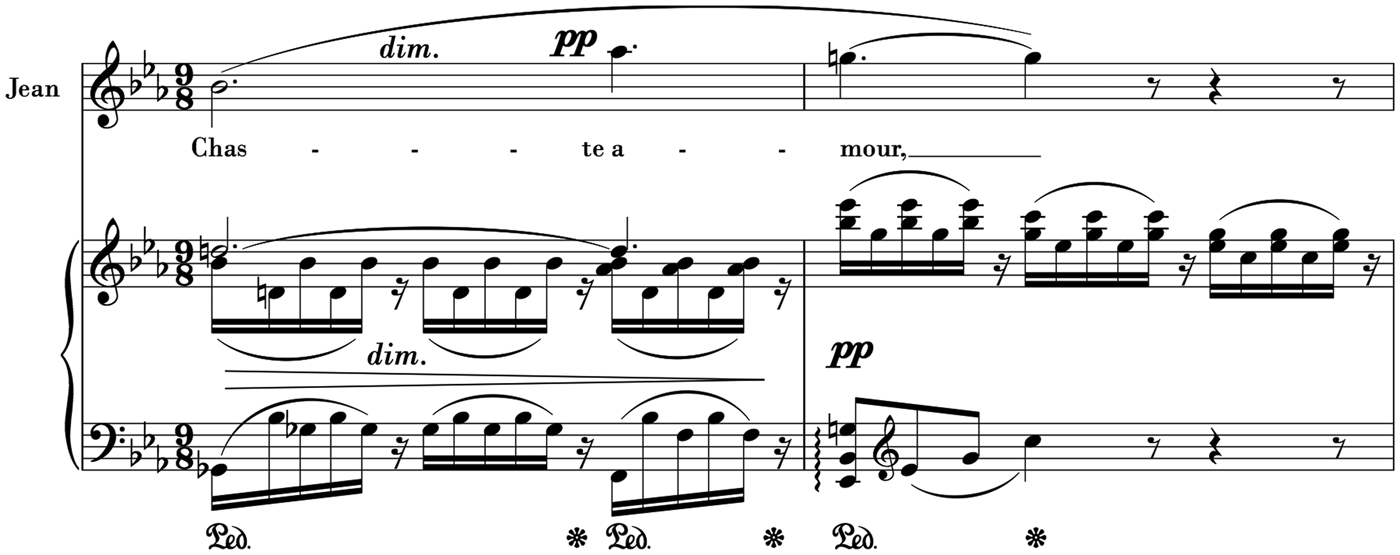
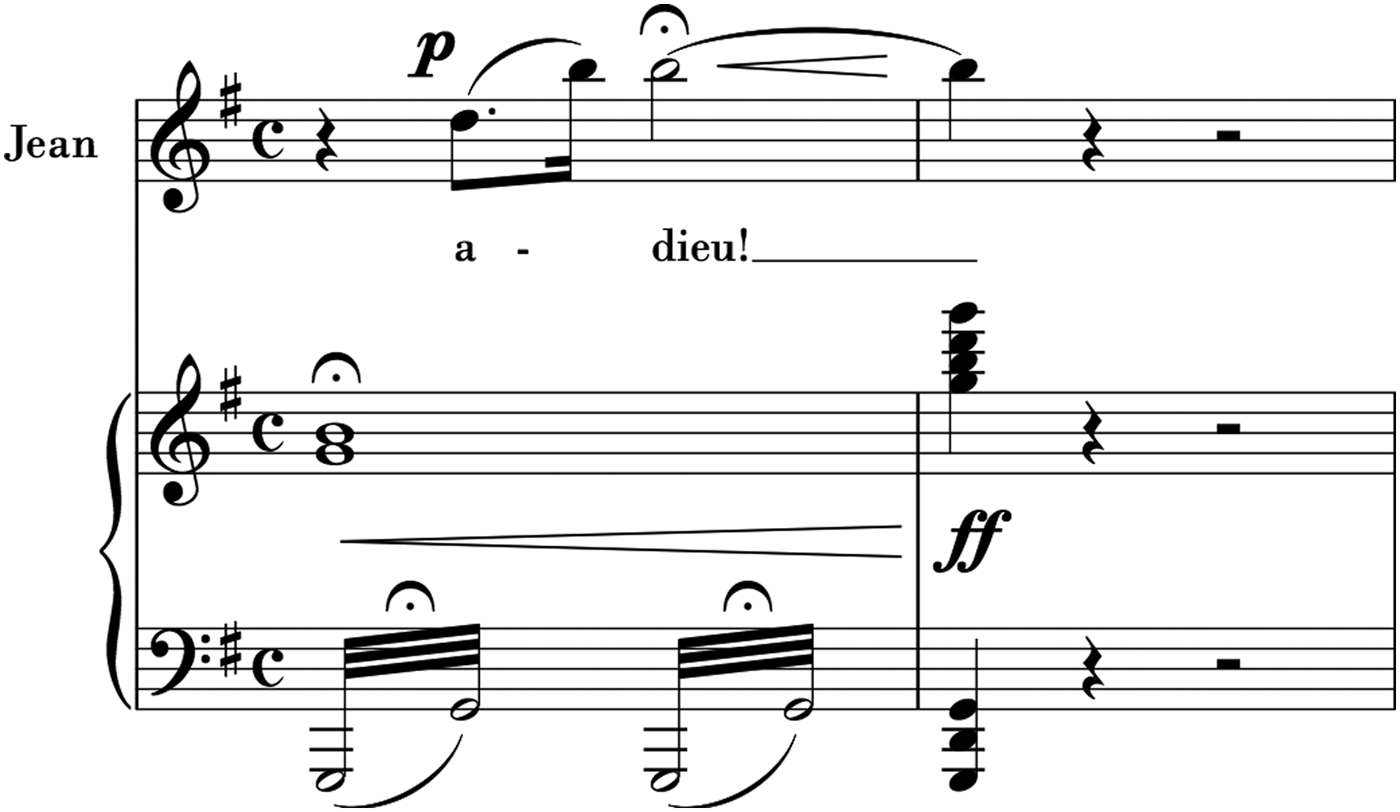
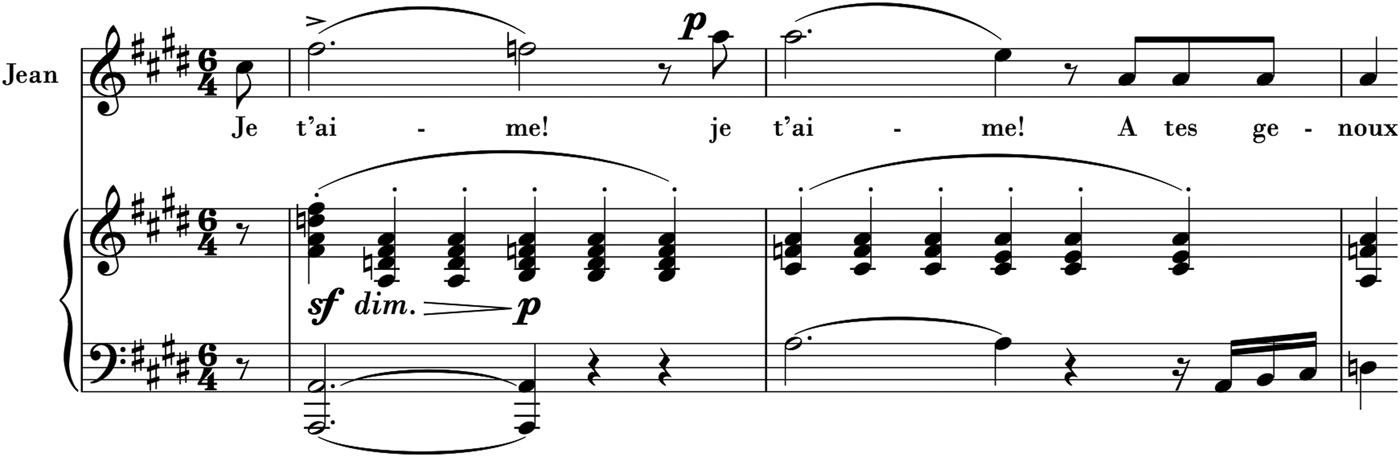
Premiered in 1880 at the Opéra-Comique, Léo Delibes's Jean de Nivelle was one of several new opéras comiques produced by the theatre's director, Léon Carvalho, that exhibit qualities of both the comique and the grand genres. The mixed generic qualities extend even to the vocal writing for the title tenor role. When Jean sings high As, B♭s and Bs, they are usually robustly declaimed and marked forte. But there are a few instances in which the tenor is asked to sing high softly, most notably in Jean's Act I duet with Arlette: a passage ascending to a soft A♭ when singing of ‘chaste love’ (Ex. 1a) and at the end of the duet with a striking ‘adieu’ on a B♮ that begins softly and crescendos to forte (Ex. 1b). These soft utterances reflect Jean's concern that his love for Arlette is unrequited. Another example occurs near the end of the opera, when Jean makes his vulnerable proclamation of love, singing ‘Je t'aime’ – first forte, and then higher, but piano, on a high A (Ex. 1c).
Delibes, Jean de Nivelle, Jean's Act I duet with Arlette.

Delibes, Jean de Nivelle, end of Act I duet.

Delibes, Jean de Nivelle, Act III duet.

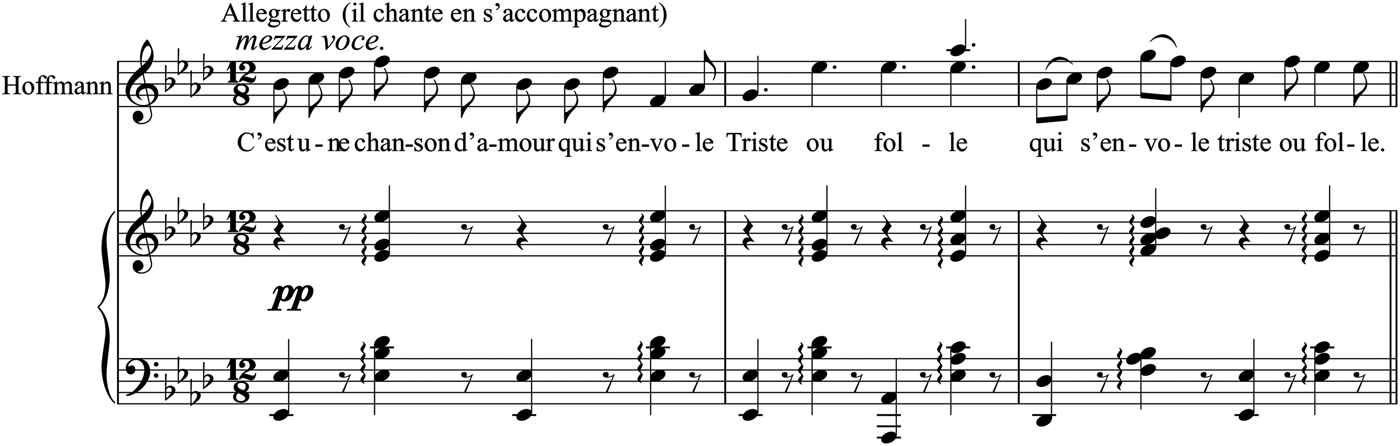
In another of Carvalho's productions, Offenbach's Les Contes d'Hoffmann (1881), Hoffmann sits at the piano in Act III to sing an onstage love song for Antonia. Although Hoffmann is traditionally understood as a heavier, almost dramatic tenor role with many moments of heroic singing in the upper voice (Gs and As), this scene features the character's most sincere expression of romantic love in the opera, and is marked mezza voce. As a vulnerable moment of diegetic singing, Hoffmann's ‘C'est une chanson d'amour’ risks disclosing both the extent of his love and the limits of his singing to Antonia, the professional singer. The risk pays off and their ensuing duet begins with Hoffmann singing an entire section in léger mode (Ex. 2).
Offenbach, Les Contes d'Hoffmann, beginning of Hoffmann's duet with Antonia.

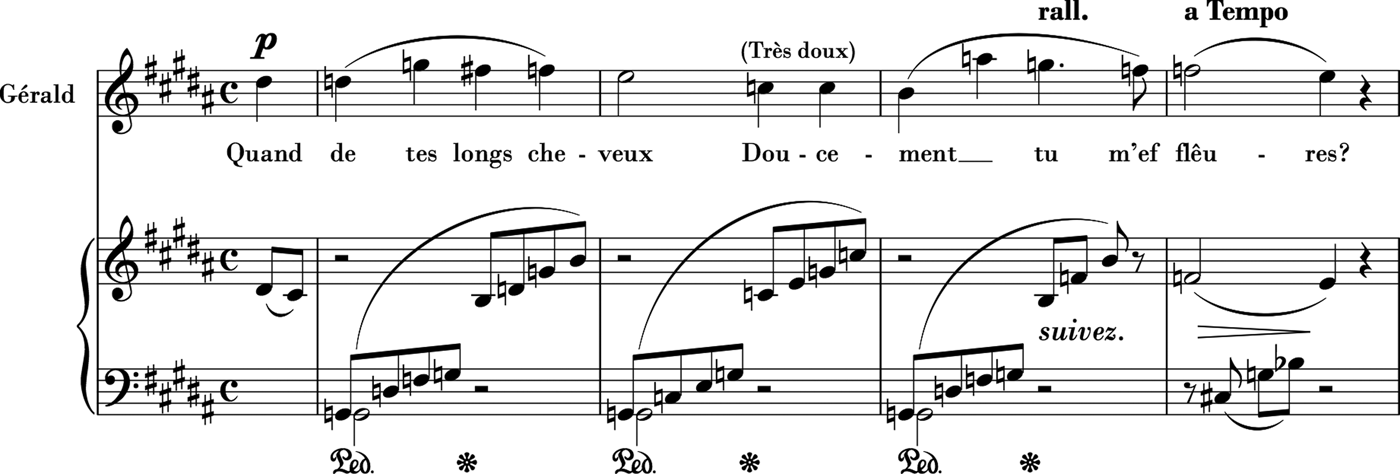
Continuing on at the Opéra-Comique, Delibes followed Jean de Nivelle with an even more successful opera, Lakmé (1883). In addition to inflecting the music with exotic colour, Delibes also mixed generic conventions and again asked the tenor to sing both lightly and more forcefully, composing several touchingly soft passages for Gérald. The attraction between Lakmé and Gérald is nearly instant when they meet, but when Lakmé’s father discovers that a foreigner has dared to step on consecrated soil, he promises vengeance. While Lakmé fights her love because she fears desperately for the safety of Gérald, the tenor is utterly sure of his feelings for Lakmé and convinced that his happiness depends on her. When he reveals his helplessness to resist her, he sings a soaring piano line that ascends to a high A marked ‘Très doux’ in their Act II duet (Ex. 3).
Delibes, Lakmé, Gérald's Act II duet with Lakmé.

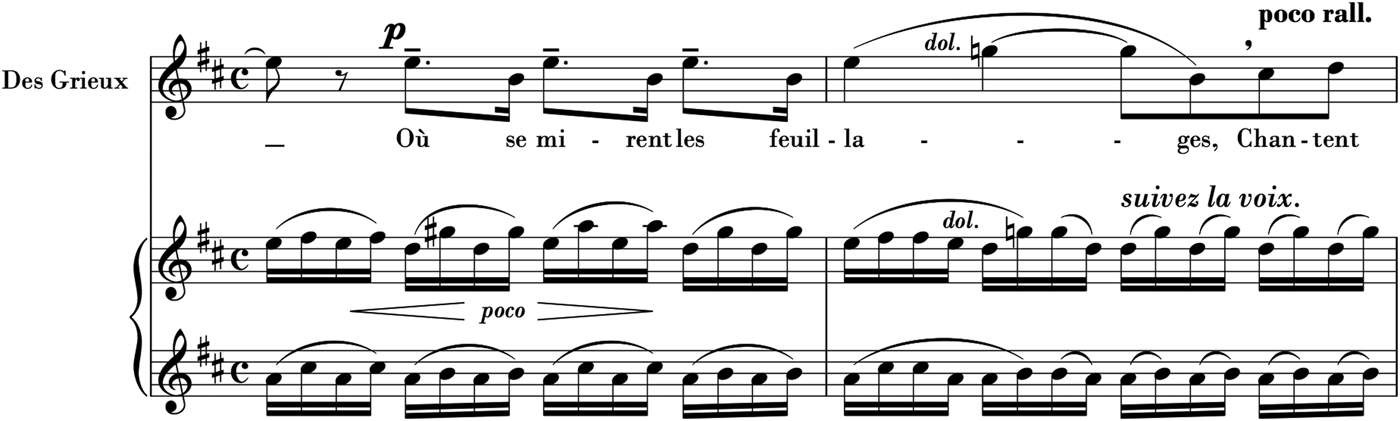
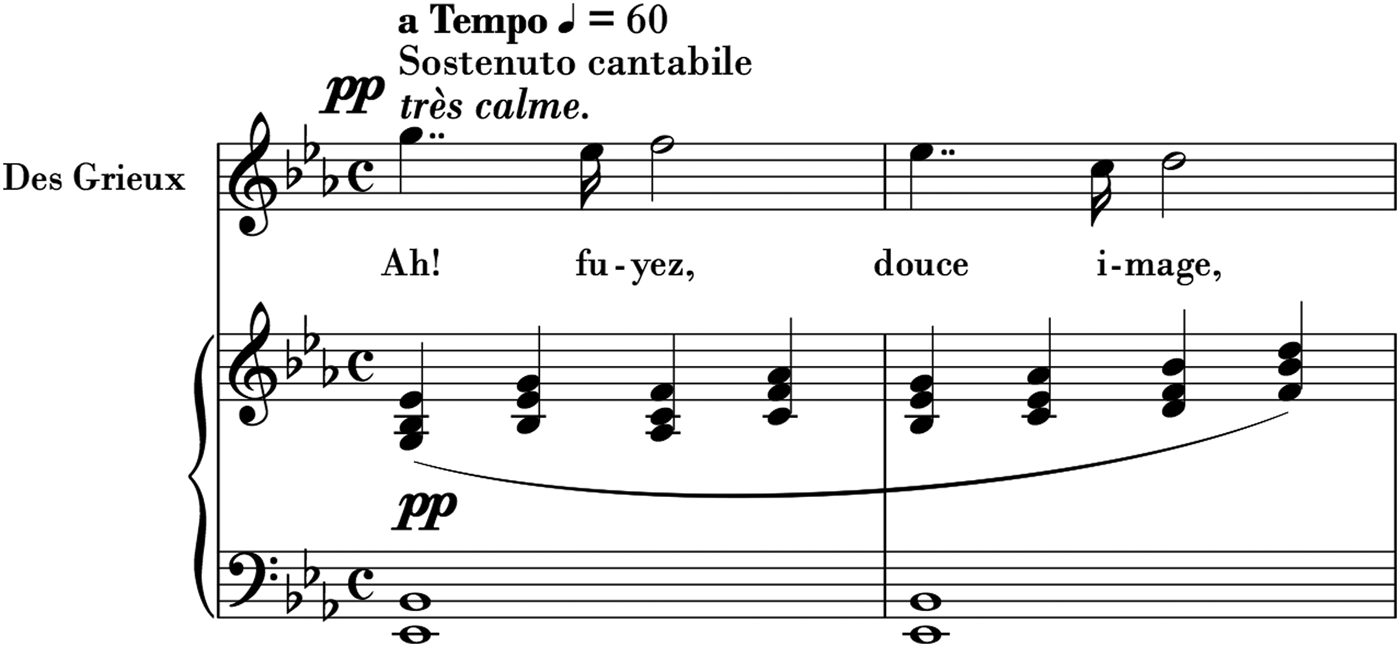
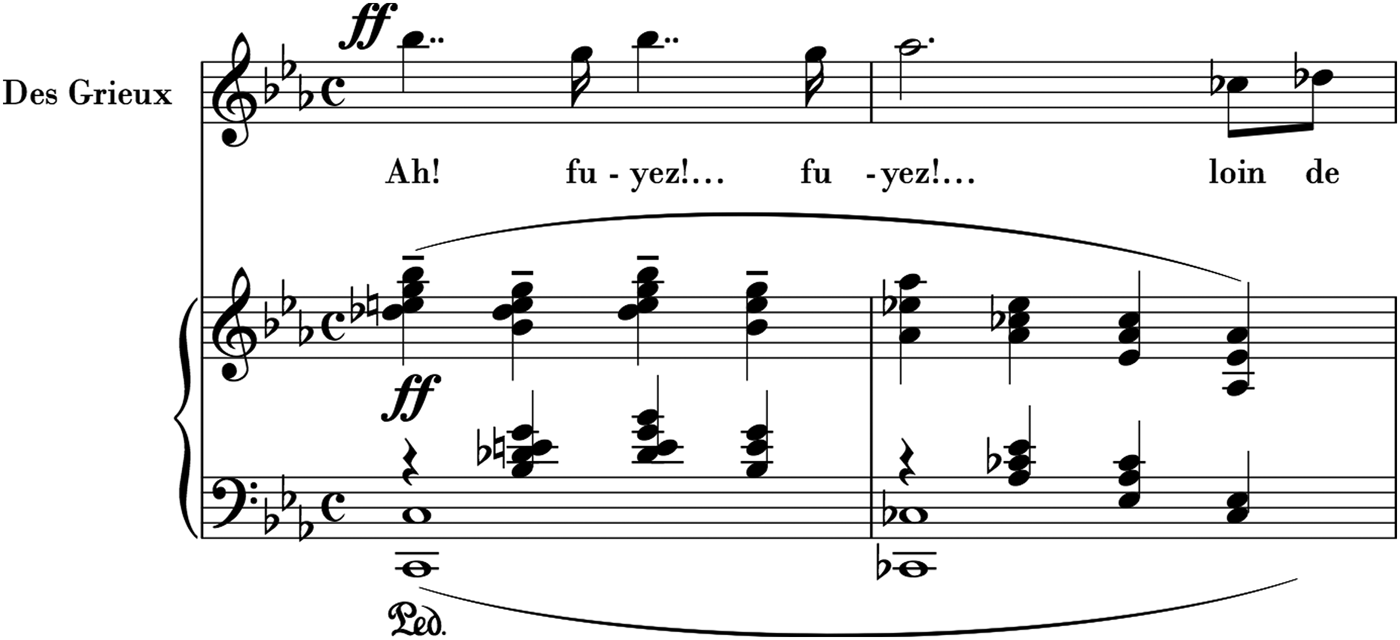
In Massenet's Manon (1884), the vocalism required of Des Grieux almost demands the skills of two different singers. After dismissing his fear that happiness is fleeting, Des Grieux sings of his love as a sweet dream in an intimate aria to Manon. This well-known aria, ‘En fermant les yeux’, is almost entirely in léger mode. It begins with poignant strings whose dream-like texture supports the lyricism of the soft, fluid vocal line (Ex. 4a). The lightness and sweetness of this aria contrast sharply with the dramatic, heavy vocalism called for in Des Grieux's Act III aria, ‘Ah! Fuyez, douce image’, when the tenor begins in léger mode but grows increasingly despairing as he bitterly disavows his memories of love (Exx. 4b and 4c).
Massenet, Manon, Des Grieux's La Rêve, Act II aria (‘En fermant les yeux’).

Massenet, Manon, Des Grieux's Act III aria (‘Ah! Fuyez, douce image’), beginning.

Massenet, Manon, Des Grieux's Act III aria (‘Ah! Fuyez, douce image’).

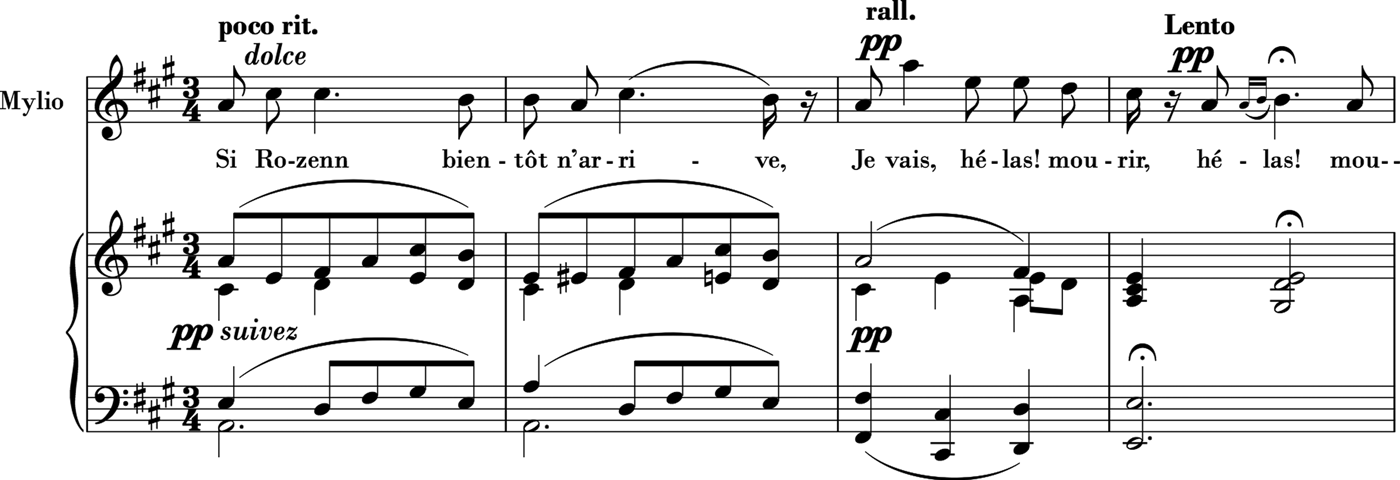
The most vivid example comes from Le Roi d'Ys (1888), eventually Edouard Lalo's greatest operatic success. Composed in 1875, it was first rejected by the Opéra in 1879. Some scenes were performed in concert in subsequent years before Lalo revised the work in 1886 and in this form it was performed to great acclaim at the Opéra-Comique. Le Roi d'Ys, though, as with the earlier cases, is not a light-hearted comic work – Lalo originally wrote it as a grand opéra and used a Wagnerian approach of dramatic continuity.Footnote 12 To transform the work into opéra comique he simplified the structure to three acts and introduced a ‘number’ layout. The plot is based on a Breton legend and the music has some nationalistic as well as exotic aspects; it even uses actual Breton folk tunes. Throughout the opera, the tenor character, Mylio, has many heroic moments, almost Wagnerian in vocal heft, and he is consistently required to sing at a high tessitura and volume. There are several fortissimo As throughout the work and a high C near the end.Footnote 13 However, before the cataclysmic flood in Act III, Mylio and his betrothed, Rozenn, prepare for their wedding, and the tenor sings an aubade, ‘Vainement, ma bien-aimée’, a prolonged moment in léger mode with softer dynamics indicated for the high notes and an overall use of soft singing, presumably to woo the heroine.Footnote 14 Mylio has already been guaranteed Rozenn's hand in marriage; she is behind a closed door preparing for the wedding. But the aria expresses his fear that she might not come out, that the marriage might not proceed (he'll ‘die’ if he loses her; Ex. 5).
Lalo, Le Roi d'Ys, Mylio's Act III Aubade (‘Vainement, ma bien-aimée’).

Mylio's earnest love and vulnerability are emotional qualities characteristic of all of the examples presented here. Romantic love tinged with anxiety provides the dramaturgical context for the softer, more exposed vocalism of voix mixte. Mylio, Des Grieux, Hoffmann, Gérald and Jean all have robust, declamatory moments, but they also risk much for their beloveds, emotionally and vocally, in moments of intimate openness. Their urgent ardour aligns them with the emergence of what Heather Hadlock has described as a modern opéra-comique hero, often suited to the expression of amour fou.Footnote 15 In each case, voix mixte serves as the composer's intended vocal colour for these sweet, soft and intimate situations. Collectively, the examples demonstrate a compelling dramaturgy for voix mixte vocalism, but they also invite questions about performance in the late nineteenth century.
A new tenor?
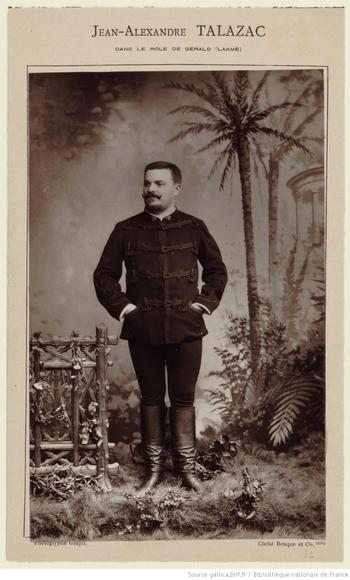
What makes these five examples all the more interesting is the fact that they were written for one particular singer: Jean-Alexandre Talazac (1851–1896; see Fig. 1), a premier ténor who was able to sing with a variety of timbres in the high register. After completing his voice studies at the Paris Conservatoire, Talazac was first engaged by the Opéra-Comique in 1878, so he would have been familiar with the theatre's convention of casting the lead tenor as a ténor léger who could sing lightly, sweetly and softly in the high range. Presumably Talazac was able to execute the appropriate vocal effects, and indeed, not only was his voice widely acclaimed for its beauty, purity and brilliance, but he could also hold an audience rapt.Footnote 16 Talazac's prodigious skills included the ability to sing high softly in voix mixte and also, despite being occasionally labelled a light tenor, the vocal heft to muster the bolder, more heroic sounds required in all of his role creations. Several reviewers remarked on these two vocal modes, and one had particularly noted that, in his performance of Gérald, Talazac sang ‘with as much gentleness as strength’.Footnote 17 Another critic specifically praised his charming and artful use of voix mixte as Hoffmann.Footnote 18 Such was Talazac's impact on opera in Paris in the early 1880s that he was deemed ‘the first tenor of Paris’ and ‘of inestimable value’ to the Opéra-Comique.Footnote 19
Jean-Alexandre Talazac as Gérald in Lakmé, Bibliothèque nationale de France.

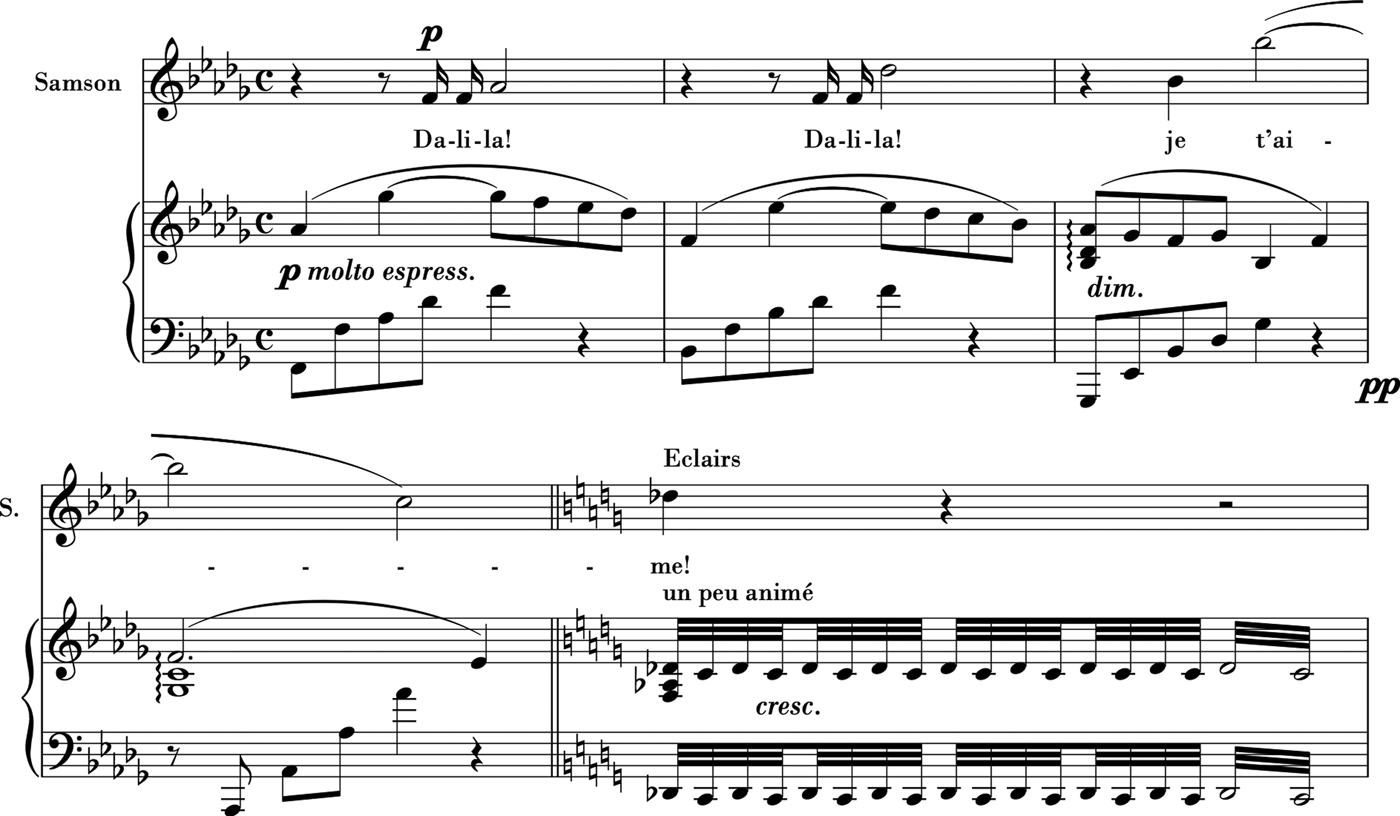
Talazac also sang the first staged Parisian production of Saint-Saëns's Samson et Dalila in 1890 (the opera was premiered in Weimar in 1877). Although predominantly a heavy, dramatic role, Samson also sings a vocally vulnerable high B♭ at a piano dynamic (Ex. 6) when he confesses his love to Dalila for the third time, in the duet that evolves from her Act II aria, ‘Mon cœur s'ouvre à ta voix’.
Saint-Saëns, Samson et Dalila, Samson's Act II duet with Dalila.

Talazac's ability to sing expressively in both light and heavy modes must have been a large part of his appeal. The coincidence of premieres in roles that require such versatility suggests that the composers wrote with him in mind, and we know that Lalo and Massenet did so.Footnote 20 At the very least, Talazac's presence in these first performances demonstrates that the ability to sing with voix mixte was important for the roles. Indeed, Talazac was consistently praised in the critical reception of these operas for his sweet soft singing, the ardour of his expression and his dramatic prowess. We might then think of Talazac as a unique and new type of tenor, one able to master the new technique of loud, chested high notes, while also harking back to the lighter vocalism more common earlier in the century.Footnote 21
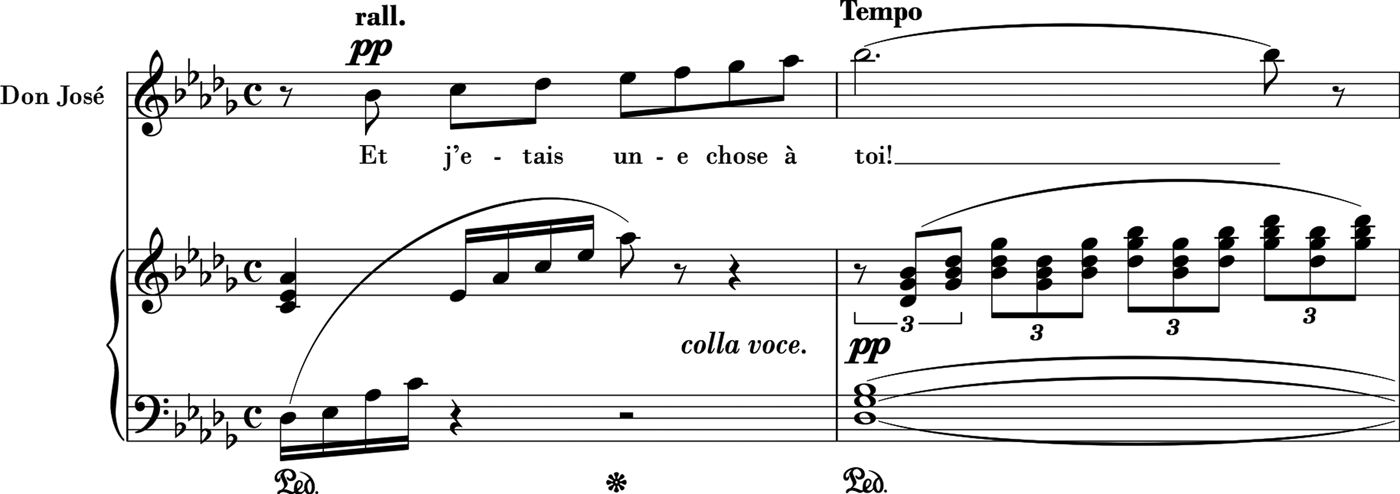
If Talazac's vocalism was a key component of the success of the aforementioned tenor roles, what then of another more familiar tenor moment in Bizet's Carmen? Here, Don José is asked to sing a B♭ pianissimo, a striking moment in an aria – indeed, in a role – that requires much impassioned and declamatory singing. Unlike the example from Lalo's Le Roi d'Ys, which was an entire aria in the léger mode, Don José’s Flower Song contains only one phrase that is marked as such. Near the end of the aria Don José sings two phrases starting on forte A♭s – heavy singing, particularly considering the startlingly soft high moment that concludes the aria (Ex. 7). Susan McClary has written that Don José ‘sings masochistically’ but labelled the soft high B♭ ‘highly vulnerable’, indicating an emotional shift.Footnote 22
Bizet, Carmen, end of Don José’s Flower Song (‘Et j’étais une chose à toi. Carmen, je t'aime!’).

And indeed there is a shift. After repeatedly emphasising that his only wish in prison was to see Carmen again, Don José changes direction (as does Bizet's music): instead of Carmen being the object, he makes himself her object, grammatically and figuratively. In his ascent to the B♭, Don José seems to be giving himself over to Carmen. He wants not just to be with Carmen, but also to become hers. Perhaps Don José’s singing at the end of the Flower Song reflects both a sexual panic and a moment of romantic desperation. He chooses a path of passivity, revealing how Carmen grips him emotionally. A singer executing the passage softly would feel the music's meaning – the sound and sensation of the vocal function would be weaker, more exposed, and strikingly opposed to his usually hefty, heroic singing. This type of oneness belongs to Carmen – the soft B♭ of a tenor sounds more like a mezzo-soprano in terms of timbre. Consequently, musically and poetically, Don José is indeed hers at this point in the aria. A second moment of oneness occurs with the final line ‘je t'aime’, which is almost painfully yearning as the leading tone is sustained and unresolved for such a long time, painting the depth of desire Don José feels for Carmen.Footnote 23 Here dynamic quieting and scalar rise evoke a sense of selfless surrender, of extreme vulnerability and longing. Don José may have many egotistical moments, but this is not one of them.
The question of the effect of this voix mixte B♭ seems almost moot, however, given the fact that most recorded tenors (including many twentieth-century greats such as Jussi Bjoerling, Richard Tucker and Placido Domingo) do not sing the note softly at all, but rather fortissimo. It is as if the only way for them to manage the aria without succumbing to typical high note fear is to maintain the robust style of singing and therefore avoid any possibility of sounding weak or unable to sing a full high B♭.Footnote 24 Although some singers have attempted the moment on recordings, I have never heard it attempted in a live performance. Roberto Alagna sang a falsetto version of the note on a recording of anthologised arias, causing many a singer to snicker at the obvious register break. Nicolai Gedda and Jon Vickers have used various degrees of head voice that move in the direction of voix mixte. Perhaps the note should be more falsetto in affect than voix mixte precisely because of its desexing aspect; perhaps it was even intended to sound difficult and strained. It is quite challenging for a tenor to sing sustained dramatic lines loudly and then suddenly switch to high soft singing, and such strain creates a moment of vocal vulnerability. A beautiful voix mixte could heighten the ambiguity of gender while playing into our modern preferences for beautiful singing at all times, and it would still make an impressive effect. However, a more realistically strained sound might be even more striking and reflect the limits of Don José’s pleadings. Such re-imaginations of the Flower Song compel us to wonder: if most tenor heroes of the twentieth century were unwilling or unable to dare to sing the pianissimo dynamic, what then of the tenor who premiered the role?
If Bizet thought about creating a moment that sounded strained, he probably chose the right performer with Paul Lhérie (1844–1937; Fig. 2). Lhérie was not as acclaimed as Talazac, nor was he known for his ability to sing high notes softly. In fact, seven years after creating Don José, he became a baritone, casting further doubt on his capacity to use a voix mixte. Reviews from early performances of Carmen confirm Lhérie's lack of vocal finesse. For example, Adolphe Jullien observed the tenor's vocal strain in the role:
Mr. Lhérie exerts himself much in the role of José; he gesticulates and emotes too much, but indeed he performs passionately. It is unfortunate that his voice, adequate but too prone to hoarseness in the passages of demi-caractère [possibly implying the softer passages], absolutely betrays itself pushing the great cries of rage and passion which abound in the second part of the role.Footnote 25
In light of critics’ comments and Lhérie's conversion to baritone, it is likely that he did not follow Bizet's pianissimo indication either, or that if he did, it did not come off well. Regardless, the implication is clear: adopting the vocal technique to sing louder and more robust high notes left tenors less adept at singing more delicate, softer passages in the high range. Therefore, in excavating the tenor sounds of the nineteenth century, we also need to account for how singers understood vocal technique.
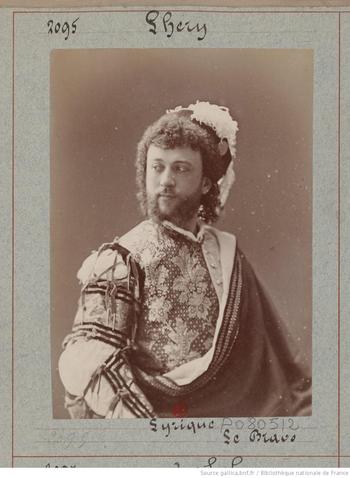
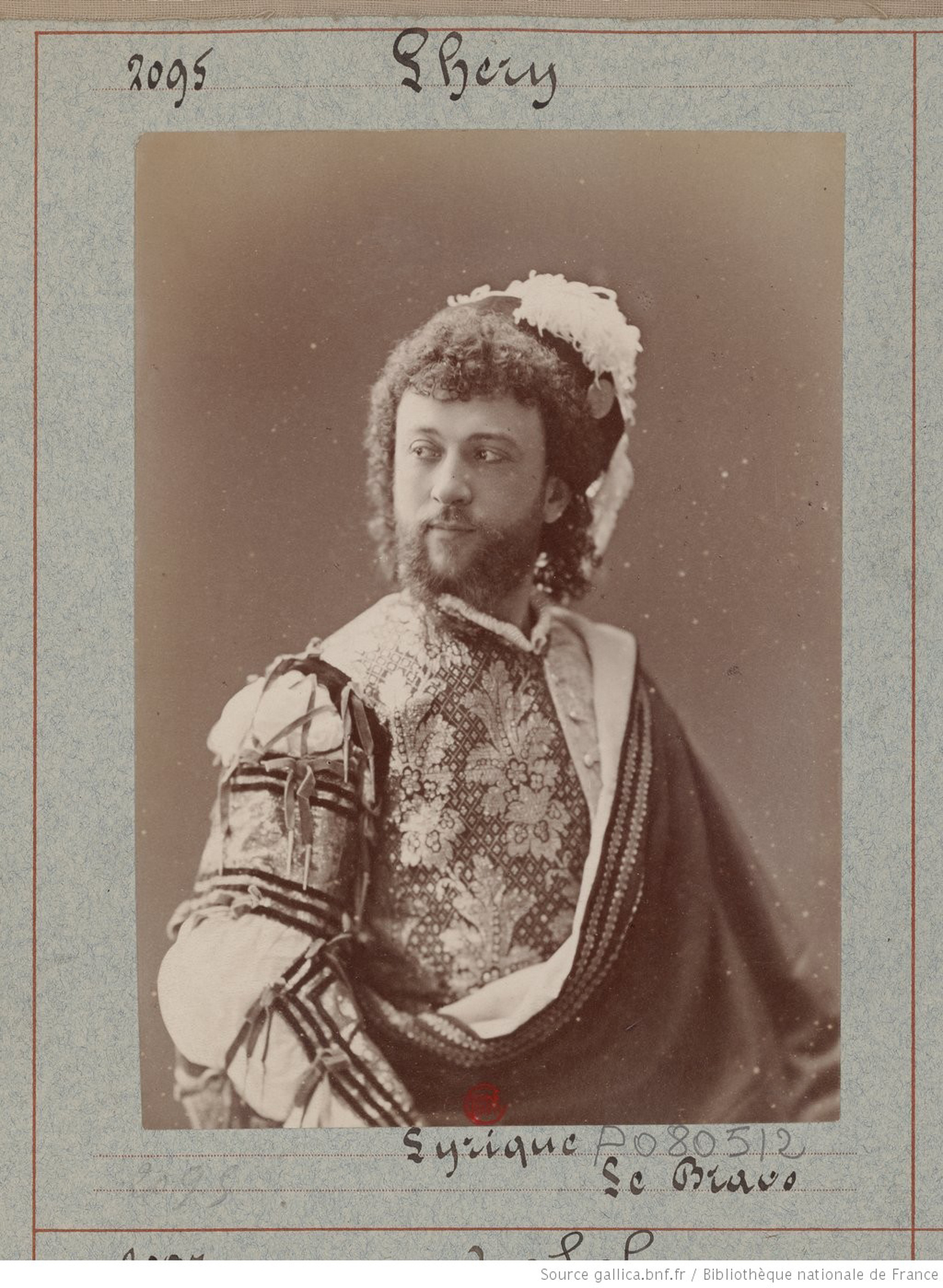
Paul Lhérie in Salvayre's Le Bravo (1877), Bibliothèque nationale de France.
Teaching voix mixte
Although there are obviously many differences between pedagogical writings and actual singing practice, treatises are nonetheless useful for understanding certain ideas of voice production, especially when we consider the pedagogical writings of important performers such as Manuel Garcia fils (1805–1906), Jean-Baptiste Faure (1830–1914) and Gilbert-Louis Duprez (1806–1896).Footnote 26 In the nineteenth century, as we have seen, critics employed the term voix mixte to describe the enigmatic soft high notes of tenors, but pedagogical treatises also defined it as a technique aligned with a middle-high vocal register that mixed head and chest tones. Confusingly, Garcia labelled this range ‘falsetto’ while denoting the higher range ‘head’ voice. James Q. Davies has suggested that Garcia viewed the mixed voice as an impossibility, in that head and chest voices could not actually be employed at the same time.Footnote 27 This confusion of labelling indicates the difficulty of understanding vocal categories through pedagogical treatises.
Nevertheless, nineteenth-century vocal treatises offer a compelling account of the timbral world of singing, one that includes both light and dark vocalism.Footnote 28 For our purposes, two facets of the treatment of voix mixte in French vocal pedagogy will become clear. First, and more generally, it will become evident that different pedagogues describe the phrase voix mixte in various and confusing ways. Second, we will see that pedagogues describe voix mixte as a link between chest and head (or falsetto) registers, both in the sense that two vocal mechanisms are employed simultaneously and in the sense that voix mixte was (and should be) used by singers in the middle high register, between the ranges corresponding to low (chest) and high (head) registers.Footnote 29 The latter of these ideas conflicts with a more reception-orientated understanding, as critics and commentators identify voix mixte as a mysterious, alluring timbre used by male singers when singing softly and delicately in their uppermost vocal range. The following exploration of vocal pedagogical approaches to high singing ultimately gives pride of place to the perception of the listener rather than to the realm of vocal pedagogy.
Generally speaking, the treatises mention voix mixte and voix sombrée as timbres often used by singers in the high register. The two colours are described variously, but voix mixte was the lighter of the two, as this was the label used often when singers (particularly tenors) sang high and softly. The treatises describe voix mixte as a mixed voice used in the upper range (above the chest voice), sounding clear and sharp, but softer and more flexible than the full sounds of a tenor such as Duprez.Footnote 30 Light vocal emission is also called voce finta (feigned voice), and voce di mezzo petto (half-chest voice), sometimes shortened to mezza voce.
Garcia fils was the most eminent vocal pedagogue of the nineteenth century. He came from a highly esteemed family of vocalists – his sisters were soprano Maria Malibran (1808–1836) and mezzo-soprano Pauline Viardot (1821–1910), who was also a composer and teacher, and his father, Manuel Garcia père (1775–1832), was a favourite tenor of Rossini, creating Almaviva in Il barbiere di Siviglia (1816). Garcia père was one of France's foremost vocal pedagogues, having taught many important singers of the early nineteenth century, including his three children and the tenor Adolphe Nourrit (1802–1839). Garcia père began the pedagogical legacy that was continued and consolidated by his son. He emphasised both power and flexibility, and his son's important vocal treatise expounds on issues of vocal weight and timbre.
When writing about the tenor voice in his 1847 treatise, Garcia fils had this to say about the interplay of vocal registers:
The falsetto united with the chest register is, for the tenors more than for the baritones, a successful and natural resource. The much too elevated tessitura of the music composed today for tenors does not permit them to do without the falsetto register. But the use of that resource … should be determined by the ability of the organ to blend together the timbres of the two registers …. The head voice, offering a still more striking contrast with the chest voice, will also be used with more reservation.Footnote 31
As mentioned earlier, there is an odd terminological choice here. Garcia fils reverses today's commonly accepted understandings of falsetto and head voices (see Table 1). As is made even more explicit in his pitch register charts, the range immediately above chest voice is labelled ‘falsetto’, with head tones set above that region. This makes for confusing reading today since we normally associate falsetto with a man's ‘false’ voice, one that sounds thin, high and breathy, sometimes in imitation of a female voice. Head voice, on the other hand, is usually considered the default register for high male singing.
Division of vocal registers: Richard Miller and Manuel Garcia fils

Derived from Manuel Garcia, Traité complet de l'art du chant (Paris, 1847) and Richard Miller, Training Tenor Voices (New York, 1993).
Garcia's description of voix mixte further frustrates terminological precision. On ‘the thin character of the high tones of the so-called mixed voice’, he writes:
In France, the highest part of the chest voice, including from f1 to c2, is given the name of mixed voice [voix mixte], whether the voice presents in this range the characters of the somber timbre, or, on the contrary, the tones are excessively clear and sharp. In Italy this same range is called, in the first case, voce di petto, and in the second, voce di mezzo petto. Whatever the character of these tones may be, they belong to the chest register, but with a modification of volume.Footnote 32
Here Garcia outlines the range in which voix mixte is often employed and notes the comparable Italian terms (voce di petto and voce di mezzo petto). The description is by no means clear. He defines voix mixte as part of the chest register and then divides it into two types – voix sombrée (voce di petto), and a clear and sharp timbre with no French label, but bearing the Italian marker of voce di mezzo petto.Footnote 33 Perhaps voce di mezzo petto is what is more generally understood by the term voix mixte and voix sombrée is another avenue to the high range (the then-new high chest voice). Garcia also notes that there is a significant difference in volume. This implies two things: that voix mixte was a much softer sound and that Garcia assumed this softer sound was more often employed by singers than the louder voix sombrée, at least in the 1840s. The implication is not conclusive, however, for if Garcia cannot provide more than an ambiguous description of voix mixte, how can we expect to define it more concretely?
As I hope will become clear, what perhaps matters most is defining not the vocal function or technique, but rather the timbre and effect of voix mixte. Interestingly, although Garcia refers to voix mixte as such in his writings, his explication of other registral sounds often relies on timbral description. For example, he employs the phrase voix sombrée, but more often he details the effect of such a sound as timbre sombre, referring to the darkened or covered-sounding colour of such singing. This use of timbral description affirms that the resulting sound is more important than the vocal technique that yields such a sound. Indeed, as Davies has argued, Garcia rejects the possibility of true voix mixte because he believes that one cannot sing using two different physical mechanisms simultaneously.Footnote 34 However, he still acknowledges the phrase as something particularly French and enigmatic. Thus a timbre can exist even without a firm understanding of the vocal mechanism at work.
And indeed, it is the effect of soft, high, floated tenor singing that remained longer in the French operatic repertory than in the Italian repertory, particularly in operetta, and in those works presented at the Opéra-Comique.Footnote 35 The mixed voice is neither emphasised nor often mentioned in Italian pedagogy during the nineteenth century, but it is explored in the writings of the famous French baritone and pedagogue Jean-Baptiste Faure, who, like Garcia, sees voix mixte as an impossible unification of chest and head registers. Faure rejects the term in another sense: he acknowledges that the term is also used in France to describe a softer sound in the high register, equivalent to the Italian mezza voce, but he calls this a mistake too.Footnote 36 Faure's rejection of the phrase voix mixte (and of many other terms) speaks to his frustration with the nineteenth-century explosion of confusing and inconsistent pedagogical terminology. Here, his admission that voix mixte is used (and in his mind, misused) in two ways underscores the idea that vocalism can be understood both as vocal function involving physiological mechanisms, and as a sound that can be described variously by listeners.
Faure also classifies tenors as either fort ténor or premier ténor.Footnote 37 He deems the fort type as exceptional, loud and most appropriate for dramatic roles, naming Duprez and his precursors Andrea Nozzari (1775–1832), Gaetano Crivelli (1768–1836) and Domenico Donzelli (1790–1873). Premier types are by far the most common, with lighter sounds (particularly in the upper register) and greater agility. Faure lists tenors Nourrit and Talazac, among others, but emphasises the uniqueness of qualities within this category and points out that head voice or falsetto may be used from A♭ upward.Footnote 38
It is important to note the emphasis on individuality in the premier category. According to Faure, tenors of this type displayed a variety of timbres, colouring sound to different degrees in their own voices and cultivating vocal characters that were quite distinct one from another. They were often able to sing high in a number of ways, as Nourrit seems to have done – using voix mixte, voix sombrée, voix de tête, voix de poitrine, voix fausse, etc. The sphere of tenors reflects a kaleidoscope of terminology in theory and of vocal colours in performance. The kaleidoscopic nature of these issues resonates with broader early nineteenth-century French cultural life, where the technology gained such popularity that the word connoted generally rapid and changing sensations and impressions. The jumble of terms and colours leads to multivalent interpretations, reinforcing the notion of the kaleidoscope as a metaphor for French grand opéra, as Anselm Gerhard has postulated.Footnote 39 It follows that moments of léger mode are marked not just for their rarity, but also for their link to this kaleidoscopic realm of vocal colours and variegated ideas of what high singing meant for the tenor in French operatic contexts.
Tenors and masculinity
Interestingly, Duprez himself sets the tension between these timbres into stark relief in his own treatise, deeming this high tenor range capable of combining the power of the masculine voice with the sweetness and charm of the feminine voice.Footnote 40 In so doing, Duprez calls attention to another problem in understanding nineteenth-century tenorial sound: the extent to which the tenor's singing could be gendered masculine or feminine, a gendering that persists to this day. Davies has observed that the gendering of voice was a concern early in the nineteenth century, with the tenor Adolphe Nourrit bearing the brunt of the criticism as Duprez's star rose.Footnote 41 By the end of the century, however, the enigmatic nature of voix mixte could also entrance, as Karen Henson has suggested in the case of the tenor Victor Capoul (1839–1924), whose soft high notes could be both androgynous and heroic.Footnote 42 Indeed, nineteenth-century critics have variously deemed voix mixte tones as ‘soft and sweet’, ‘effeminate’ and ‘delicious’.Footnote 43 And critics, like some pedagogues, also sometimes equated voix mixte with mezza voce – half voice – a softer, gentler sound.Footnote 44
The tension between voix mixte and voix sombrée in Garcia's treatise may imply a corresponding tension in the prevailing contemporary vocal aesthetic of singers and opera audiences alike. Nourrit, who was almost universally praised for his beautiful and expressive singing, particularly during the early part of his career, is a case in point. His voice was capable of both power and finesse in the upper register, and he often employed a reinforced falsetto in that range (what I would call voix mixte or léger mode). However, after the rise of louder tenors such as Duprez, critic Henry Chorley described Nourrit in retrospect as having an
elegance so highly prized and loudly regretted … by a portion of the Parisian cognoscenti, border[ing] so closely upon a mannered over-grace and over-sweetness, that I never heard that fine singer, and never saw that elegant and careful actor, without feeling that neither his clear and metallic voice – nasal in its falsetto – nor his graceful postures, belonged to the greatest school of art.
He then qualified this, saying that ‘When I heard Nourrit, too, his best days had long passed.’Footnote 45 Nourrit was only thirty-four at the time of this review, and was still singing well, as this was before he began to feel the effects of the liver disease that would afflict him in his last years. Chorley's remarks indicate that the new tenor vocal aesthetic that Duprez epitomised had taken hold; Nourrit's self-perception and reputation were re-evaluated, and his variety of timbre now seemed overwrought.
The harsh review Nourrit received from Gustave Planche in 1836 on the premiere of Meyerbeer's Les Huguenots stated that he ‘sang more as a careful professional than a passionate lover’ and is also indicative of the changing vocal aesthetic:
During the fourth act, he succumbed to the awkward ramifications of his vocal nature. He did well to recover and revive his character's image – we could justifiably see him as a Huguenot warrior, though less as an aggrieved lover. However, he gallantly fought against the unfortunate impression already established. He remodulated the sounds of his head voice, in which he indulges excessively, and which also give his voice the imprint of the third sex.Footnote 46
Although Planche also praised Nourrit's performance, the critic seems to equate head voice (voix mixte or falsetto) with the idea of a third sex, and judges that the sound itself was something to avoid, perhaps suggesting a shift in the way tenorial high notes were being perceived. Planche implies that Nourrit's use of head voice and his very ‘nature’ impeded the tenor's ability to persuade the audience of his portrayal as a warrior and lover. The reference to the third sex is interesting, pejoratively giving tenor head tones hermaphroditic, even homosexual associations. This scenario mixes issues of sex (anatomical qualities) and gender (observable qualities), a distinction Thomas Laqueur questions by arguing that sex is also a cultural construct, resulting from the desire to explain gender differences. Laqueur also notes that in the case of hermaphroditism, doctors were concerned with assigning a sex, one or the other. This concern suggests that opera critics such as Planche may also have wanted to assign a sex to voix mixte tones, and that although some may have enjoyed such singing, others were uncomfortable with its sexual ambiguity, thus prompting imaginings of a ‘third sex’.Footnote 47
The contradictory descriptions of Nourrit's upper register parallel more generally the conflicting descriptions of voix mixte throughout the century. They suggest that the enigmatic aspect of this timbre seems to be described variously, precisely because it cannot be firmly pinned down. The pitches themselves lie in the upper extreme of the male range, well within female capabilities, and the corresponding soft volume removes them from the typical vocal colour of male speech. Ambiguity of definition and perception yields a timbre with striking gender implications and an overall aura of masculine mystique. The tenor who uses voix mixte is affecting his voice by doing something physiological, thereby creating a timbre that in a sense belies anatomy – the man's large larynx and its resultant low, dark sound. A tenor singing in this manner engages in an act that subverts his gender identity – looking like a man, and usually sounding like a man, but producing sounds that evoke gender ambiguity. Gert Hekma has written that qualities identified in men of the nineteenth century as being homosexual or of the third sex were not fixed, but could be anything construed as feminine, such as ‘the voice, an effete theme in clothing or a nonmasculine style in self-presentation’.Footnote 48 Nourrit, then, might pass as normative until he sings in voix mixte – the anomalous boundary-blurring of his vocal colours revealing him, or his voice, possibly to belong to the third sex. The fact that Duprez would later take over the role of Raoul, as well as other leading roles created by Nourrit (in Robert le diable, La Juive and La Muette de Portici) perhaps cemented the new tenor ideal.
Singing voix mixte
Having heard Duprez and witnessed his rise to prominence at the Opéra, Nourrit decided that he would never regain his status without learning to increase the intensity and volume of his voice from Italian teachers.Footnote 49 Nourrit went to Naples to learn a new vocal technique, a more idiomatically Italian approach to vocalisation and diction, a darker, more uniform sound, and, of course, to sing the do di petto. It was during this period of study that he supposedly lost his ability to sing with his acclaimed voix mixte. Before committing suicide, Nourrit lamented the loss of his ‘natural voice’, adding that ‘with my new studies my mixed voice [voix mixte] and head voice [voix de tête] had vanished’.Footnote 50 By equating his ability to sing high using mixed and head voices with his natural voice, Nourrit implies a particular aesthetic of vocal expression. The new tenorial sound probably lacked the emotional immediacy of Nourrit's many vocal colours, often praised and sometimes derided (as discussed above). Davies has called Nourrit ‘the doyen of vocal mixing’ and claims that Nourrit's approach reflects a different era of male–male intimacy. For Davies, voix mixte in a sense governed what it meant to be French in the early nineteenth century: ‘For patriots, the emotional register of the voix mixte was precious, enough so that it became necessary to ensure its preservation via the national education system.’Footnote 51 The voice was indeed preserved, but perhaps in a less institutional fashion. Regardless, the anecdotal story of Nourrit reminds us of the real difficulty of singing as work, as a daily practice vulnerable to a host of bodily and environmental circumstances.
Maribeth Clark peripherally addresses the changing vocal aesthetic that claimed Nourrit's voix mixte and voix de tête as early casualties, although she attributes it to the shift in focus from acting to vocal endowment. Her reading of Nourrit's reception suggests the tenor's histrionic performance style was going out of vogue as Duprez's vocal power came to the fore. Her interpretation relies on two sources that describe Nourrit's ability to make the audience forget about singing as he completely embodies his role.Footnote 52 I would argue that a performance that makes an audience forget about the singer's voice transcends idiosyncrasies of vocal technique. The singer would require the most dependable vocal technique, so that he can manipulate his voice to imbue the music and text with the appropriate pathos, all while acting the role physically. Clark's focus on Nourrit's acting ability ignores the vocalism, indeed, the vocal ‘acting’, inherent in expressively sung performances. In other words, in employing a variety of vocal colours, dynamics, phrasing and articulation, a singer can portray emotions and expressive intent quite clearly, even without more familiar and visible modes of acting with the facial expression and bodily gestures. The aesthetic change that revolutionised operatic singing in the nineteenth century is more a question of vocal taste than of acting. Audiences began to prefer being moved viscerally by sheer sonority (ring and volume) than by characterisation and dynamic vocalism.
And yet, while the inconsistent and ambiguous pedagogical and anatomical definitions persist today, the perception of voix mixte as soft, high singing with a hint of mystery – sweetness, effeminacy or desire, depending on the context and the audience – is quite stable. Henson likes to imagine voix mixte as a light chest voice that gives the impression of a kind of false falsetto.Footnote 53 The salient feature is the effect of voix mixte on audiences. In this aesthetic context, voix mixte may be defined as a clear, soft vocal timbre used in the upper register and described enigmatically as precious, dulcet, erotic or effete.Footnote 54
False falsettos, head voice, chest voice: the problem of inconsistent and confusing vocal terminology was made manifest in nineteenth-century treatises. Even from today's more scientifically advanced perspective, the terms present more bewilderment than clarity. It is highly unlikely that tenors used predominantly ‘chest’ voice to achieve soft high notes: the type of sound belted out in an apparent chest voice on high notes is characteristic of loud singing, not soft. Additionally, the thyroarytenoid muscles are the primary actuators of this darker ‘chest’ sound, and must be blended with an increasingly greater proportion of ‘head’ voice as the voice sings higher and higher. In classical singing, a large proportion of head voice (cricothyroid action) is present in most high tones. Without this head voice component, the singing sounds increasingly gruff, foggy and ‘woofy’, while also losing pitch centredness.Footnote 55 Without a gradual blending of voices, registral breaks remain readily apparent to the listener, sounding like a crack or a sudden flip into a different mechanism.Footnote 56
Tenor pedagogue Richard Miller describes the proportion, or mix, of chest and head voice as gradually shifting over the course of a singer's range in order to maintain unity of vocal quality throughout the registers. Instead of allowing for a léger mode, though, Miller cites voce finta as a timbre reserved for a special effect, defining it as a feigned voice, sounding disembodied, but with a certain sweetness and plaintiveness.Footnote 57 Miller's pedagogy reflects twentieth-century aesthetics in stating that falsetto has no place in legitimate operatic tenor singing, and that soft high notes must be produced using much the same sound as full-throated singing, using voce piena in testa (full head voice). The emphasis on colouristic consistency reflects the largely homogenised state of operatic singing today. Thus, without modern pedagogical guidance, we need to consider how a synthesis of the historical sources explored in this article might allow us to reconstruct the technique for attaining this magical voix mixte timbre.
Vocal vulnerability
What a singer perceives as the vocal function may differ from that of the teacher's instructions and will possibly differ again from an audience's perception of the sound. Interestingly, when referring to early nineteenth-century Italian opera, Rodolfo Celletti uses the term falsettone for voix mixte, defining it as a reinforced falsetto synonymous with head voice, and employed primarily by Italian tenorini or contraltino tenors in Rossini's operas.Footnote 58 This alignment with falsetto – a term that has a pejorative connotation in modern pedagogy (almost threatening for tenors today) – is worthy of note. In spite of Miller's condemnation of the sound, the ‘false voice’ might in some way be a physiological pathway to achieving the now-furtive voix mixte. Perhaps it would be helpful to outline the laryngeal setup of these various vocal functions. The most familiar posture to us today is voix sombrée, the newest timbre in the nineteenth century. This covered, darker, louder, more heroic sound is achieved with a low laryngeal position and full glottal closure. Voix claire (sometimes called voix blanche) is a brighter, sometimes nasal timbre, achieved with a high laryngeal position and full glottal closure. Voce finta is a mellower, somewhat breathy and soft tone that results from the lowered larynx and partial glottal closure (intentionally allowing some air to escape during phonation).
Finally, based on the pedagogical and reception sources I have explored, as well as my own perceived technical framework as a tenor, the mysterious voix mixte timbre is achieved (I would argue) by maintaining a low laryngeal position and singing with a reinforced falsetto; in other words, the approximate equivalent of Celletti's falsettone or the modern countertenor's head tones.Footnote 59 I often use a reinforced falsetto – my perception of the vocal function – to sing soft high passages. The audience – whether it comprises informed singers or not – often perceives my sound as a pretty head voice or voix mixte, or even as full-throated. No one has ever, however, suggested to me that it might be falsetto. Since Celletti also aligns voix mixte with head voice, perhaps the timbral difference between a reinforced falsetto, head voice (voce piena in testa) and voix mixte is negligible, and even beside the point.
Regardless of the accuracy of my hypotheses about nineteenth-century timbres and the possibility of falsetto as a gateway voice, what we are left with is a complex web of confusing vocal terminology, variously capable tenors, and soft high notes implying different effects at a time when their operatic rarity marks them explicitly. While it seems likely that in Lalo's Le Roi d'Ys Talazac used a léger mode in singing the aria ‘Vainement, ma bien-aimée’, a corresponding moment in Bizet's Flower Song may never have been achieved by Lhérie or subsequent interpreters of the role. If they did not always follow the markings, why should tenors today?
Modern pedagogy has produced a vocal aesthetic that valorises loud high notes, the facility to achieve them consistently, and a uniform sound. This aesthetic is considered the apogee of tenor singing and the yardstick by which singers are measured. Beyond performative historicity or ‘authenticity’, a singer disregarding today's performance standards (loud high notes) for those of an older tradition (voix mixte) would destabilise audience expectations and could open up new ways of listening to tenors, with less fear of cracking and more interest in stylistic choices made to some dramatic end. Voix mixte and léger moments are striking because they give the singer powerful strength when making a light, weaker sound. In an era when robust high notes are the norm, removing that sonic armour and risking a soft, fragile sound marks the singing and the man as vulnerable, perhaps weak, but also opens the door for a kind of aural seduction, a strength in delicate singing.Footnote 60 Perhaps it is time to strike out against a performance tradition that values homogenised and loud sound over colouristic variety and vulnerability in the upper register.
One might argue that the question of voix mixte is really one of genre, the contrast between comique and grand conventions in French opera. However, late nineteenth-century French repertory has become part of an operatic canon with casting that consistently prioritises hefty tenor singing. Bringing the léger mode back to these roles would realign the generic difference, but also provide a new way of hearing tenors. For a tenor to sing in voix mixte is to strive for what Davies has called ‘a beautiful masculinity’.Footnote 61 Performing in léger mode also demonstrates a virtuosic vocalism that evokes vocal frailty even as it proves vocal ability. In other words, it takes a very strong technique to evoke vocal weakness. This kind of technical skill is a vocal virtuosity analogous to what Emily Wilbourne has observed in the case of a singer portraying a stuttering character in Francesco Cavalli's Il Giasone (1649).Footnote 62 Tenors who risk soft high notes thus demonstrate vocal prowess while attempting to sound vulnerable or even weak.
The performative aspects of these high, soft utterances allow the singer freedom of expression in eliciting emotional audience response. The vocality becomes part of the character's complexity and allows him to enter a realm of openness (sexual arousal or vulnerability) not often accorded to male singers of the Romantic repertory in modern stagings. This may occur via vocal introspection and finesse or strain, depending on the desired effect, but not through vocal excess – shouts or belted high notes. Integrating interpretive depth with these performative realities can sharpen the focus of musical inquiry and revolutionise a performance tradition that tends to make listeners (such as Carolyn Abbate) worry about tenor high-note execution instead of being struck by timbral characterisation. Such an integration of the gnostic with the drastic – a historical interpretation of nineteenth-century tenor singing and technique for performance in the twenty-first century – opens up a new space for musicological inquiry into the voice.