Introduction
Increasing concerns about our global food system have led to the development of a variety of alternative food networks (AFNs) or values-based food networksReference Tilman, Cassman, Matson, Naylor and Polasky2–Reference Altieri8. AFNs are ‘new and rapidly mainstreaming spaces in the food economy defined by, among other things, the explosion of organic, Fair Trade, and local, quality and premium specialty foods’Reference Goodman, Goodman, Kitchin and Thrift9. The degree to which these alternatives interact, complement or compete with one another is not well understood. This study illuminates the interactions between two stakeholders in AFNs: Consumer food co-operatives (hereafter called co-ops) and Fair Trade (specifically Domestic Fair Trade or DFT).
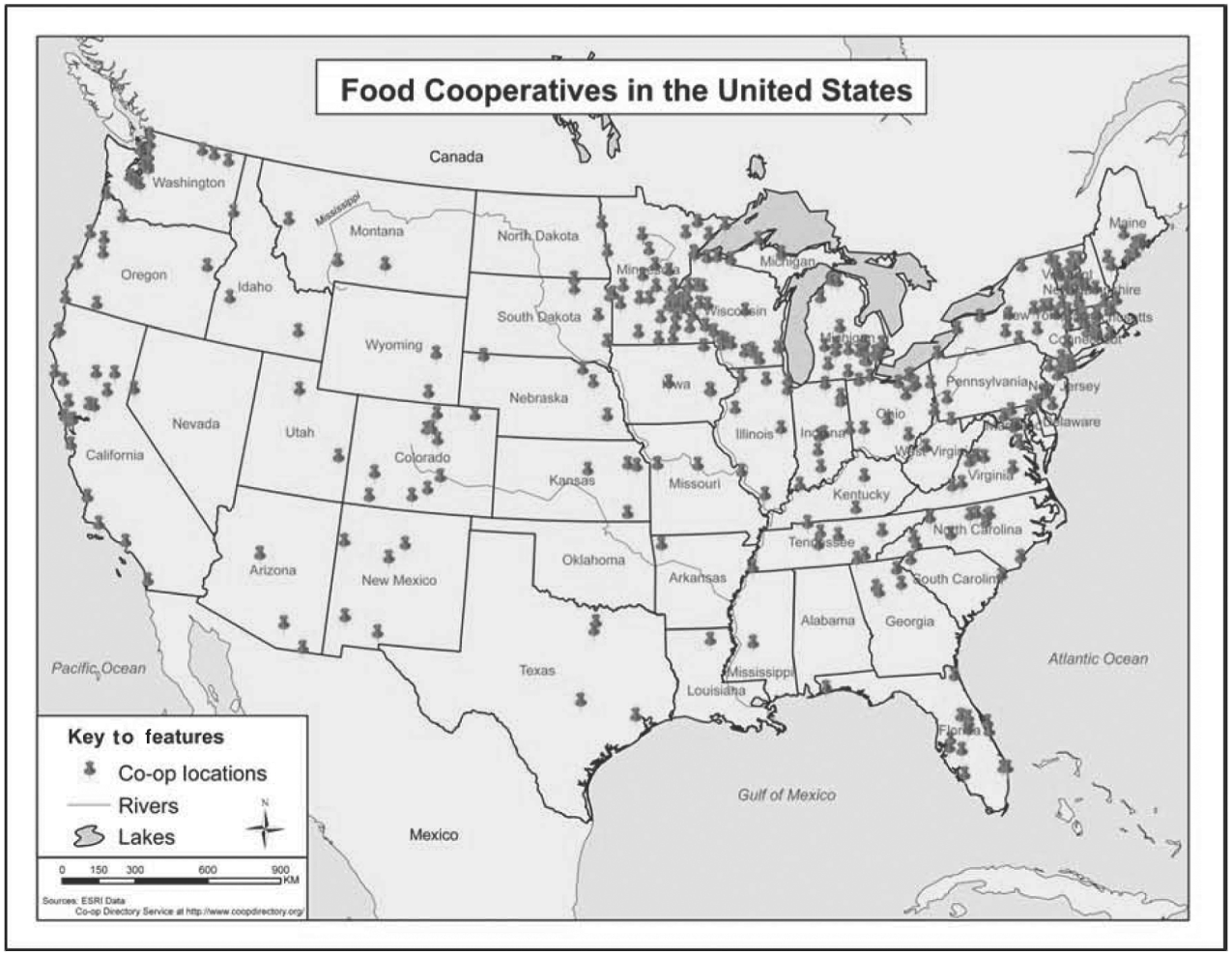
Co-ops in the USA have been viewed as a political and economic alternative to conventional supermarkets since the 1960sReference Cox10. The very nature of consumer food co-ops lends itself to being a complementary avenue for alternative movements. Food co-ops operate according to a common set of seven principles that are agreed upon by the international co-operative community: voluntary and open membership, democratic control, member economic participation, autonomy and independence, education, training and information, co-operation among co-operatives and concern for community11–13. There are currently 394 food co-ops in the USA (Fig. 1). Many of these stores focus primarily on natural foods, but some offer a full line of grocery items14.
Location of food co-ops in the USA.

The Fair Trade movement has brought issues of social justice to the food production conversation and now factors such as social equality, fair trading relationships, labor rights, etc. Reference Fridell15 have a place along with environmental and human health concerns. Fair Trade products are produced and traded in accordance with these principles—wherever possible verified by credible, independent assurance systems. Indeed, the World Fair Trade Organization, a global network of Fair Trade groups notes that: ‘Fair Trade is a trading partnership, based on dialog, transparency and respect, that seek greater equity in international trade. It contributes to sustainable development by offering better trading conditions to, and securing the rights of, marginalized producers and workers—especially in the South’ 16. Further noted by the Fairtrade Foundation in the UK: ‘Fairtrade is a strategy for poverty alleviation and sustainable development. Its purpose is to create opportunities for producers and workers who have been economically disadvantaged or marginalized by the conventional trading system’17.
Although some consider social justice problems to be an issue exclusive to marginalized economies, recent campaigns have exposed injustices and devastating impacts of globalization on rural communities in the USAReference Crowell and Sligh18. There has been a growing movement within the USA (and other countries within the global northFootnote 1) focused on situating the principles of international Fair Trade within a domestic context. In 2007, the Domestic Fair Trade Association (DFTA) was formed to find solutions to the issues facing farms in the USA. Their main goals are ‘to support family-scale farming, to reinforce farmer-led initiatives such as farmer co-operatives, and to bring these groups together with mission-based traders, retailers and concerned consumers to contribute to the movement for sustainable agriculture in North America’1.
Movements within AFNs
AFNs generally act in opposition to the global, industrial and environmentally degrading conventional food systemReference DuPuis and Goodman20. They seek to redistribute value through food networks in the opposite direction to the bulk commodity system and to re-instill trust between the producer and consumer as articulated by new forms of governance and political associationReference Morgan, Marsden and Murdoch21. Typical AFNs in the USA come in the form of farmers’ markets, community-supported agriculture, organics, Fair Trade and local food campaignsReference Hendrickson and Heffernan3, Reference Watts, Ilbery and Maye22.
‘Buy local’ food campaigns have been prominent in recent years and it is now common to see a local label on produce in retail food stores. Nutritional, economic and environmental benefits are associated with buying local foods, but there is ongoing debate as to how local scale impacts natural resource use and crop seasonality, if local farmers receive sufficient benefits, and whether local foods are accessible to lower income consumersReference Goodman, Goodman, Kitchin and Thrift9, Reference DuPuis and Goodman20, Reference Hinrichs23, Reference Duram and Oberholtzer24, pointing out that the ontology of local is taken as a given, not as a category that is socially constructed. Although it is easy to support the local food movement as inherently good, when assessing an AFN, there is still a need for a mechanism to ensure the social and ecological benefits of these alternative food systemsReference Born and Purcell25.
JaroszReference Jarosz26 explores AFNs in particular locations in order to understand relationships of trust and cooperation. Instead of focusing on the ‘local,’ she looks at regional food networks embedded in rural landscapes that are nested within globalized agro-industrial commodity and capital flows. When it comes to the pursuit of progressive local-scale development, there is a need to emphasize the formation and mobilization of a consciousness of justice and a multi-scale understanding of place that can then be linked with other local-scale ventures and/or larger scale actorsReference Pendras27.
Addressing initiatives, such as community-supported agriculture, farmers’ markets, local food campaigns and certain organic communities, AllenReference Allen28 points out the gap between the intent and the outcome in these networks. Indeed, social justice (or democracy or sustainability), not localization or globalization, should be the focus for changing the structure of the current food systemReference Born and Purcell25. Organic initiatives are an example where social justice needs to be addressed and a convergence of movements may bring about equitable change in the food system. As organic sales have grown, the distance between producer and consumer has increased, causing some organic agriculture to look quite similar to conventional productionReference Raynolds29. One indication of this conventionalization of organic agriculture is the employment of migrant wage labor and the abandonment of many sustainable agronomic practicesReference Buck, Getz and Guthman30.
Integrity of any alternative agricultural system should cultivate competition among producers for the highest possible standards instead of one that pushes practices toward the lowest common denominatorReference Jaffee and Howard31. RaynoldsReference Raynolds29 discusses a convergence of the Fair Trade and organic movements in order to re-assert the organic movement's founding concepts, and DuPuisReference DuPuis32 introduces Fair Trade markets as potential alternatives for smaller organic farmers to gain access to mainstream buyers. Overall, there needs to be further empirical research and analysis in the places and space of production and there is a need for research to connect Fair Trade production and markets at all scales (e.g., global, national, regional, local and household)Reference Goodman33.
International Fair Trade is intended to provide an alternative to the conventional market where the masses are excluded from active participation, the degradation of the environment is tolerated, and where labor becomes another commodity through the objectification of human relationshipsReference Boersma34. Fair Trade exists because international commodity chains lack transparency and this creates distrust in global food systemsReference Farnworth and Goodman35. Consumers in the global north perceive unfairness in the structure of conventional food trade and consumer research has focused on the socio-psychological aspects that motivate purchasesReference Andorfer and Liebe36. Indeed, some researches go so far as to state that a Fair Trade purchase ‘is essentially a bundle of a base product and a donation to the supplier’Reference Reinstein and Song37. Fair Trade is bolstered by the fact that unfair economic relationships are the direct result of trade priorities and criteria set by the global north, but impacting producers in the global southReference Renard38. Thus ‘Fair Trade seeks to transform North/South relations by fostering ethical consumption, producer empowerment and certified commodity sales’Reference Raynolds39.
Some voice concern about adopting an international term for a domestic movementReference Brown and Getz40, but others would argue that there is potential for DFT to develop links with other values-based consumer campaigns and to expand consumers’ conceptualization of Fair Trade1. These links have the potential to broaden the understanding and applicability of the Fair Trade principles that are focused on restructuring markets at homeReference Hinrichs and Allen41, Reference Jaffee, Kloppenburg and Monroy42.
DFT can help resolve some of these issues and create more of a civic coordination among participants in the food networkReference Renard38. Many of these local food systems have developed in uneven patterns and in idiosyncratic ways and could benefit from a set of standards that might bring a more systematic and cohesive approach to alternative food systemsReference Hinrichs and Allen41. Alternative systems in the USA could benefit from local autonomy through DFT. This local autonomy as described by Bellows and HammReference Bellows and Hamm43 is not an isolated process of self-sufficiency, but rather the ability to negotiate power and needs from a local starting point across geographic space and across barriers of social constructs.
A co-operative model of food and agriculture has developed as a social and economic movement, through which consumers have personal relationships with co-operative members who, in turn, have direct links to southern partners through International Fair TradeReference Fridell44. Co-ops typically have a place in the International Fair Trade market; so introducing and integrating DFT could have the potential to provide more support for the Fair Trade movement and bring more consumer and producer education to the workings of Fair Trade in the north and the south. ‘By utilizing “Fair Trade”’ as a universal term to describe a broader range of alternative market initiatives, consumers might be better educated to make the links between the processes driving small farmers in both north and south to economic collapse and off the land’Reference Jaffee, Kloppenburg and Monroy42.
In a study conducted by Howard and AllenReference Howard and Allen45, consumer willingness to pay for DFT points to co-operative food stores and buying clubs as promising outlets for establishing DFT. Their study suggests efforts to establish DFT should begin by targeting retail outlets frequented by these types of alternative consumers, namely consumer food co-operatives. Incorporation of DFT into co-ops can set the stage for empowerment where contractual mechanisms exist between consumers and producers on the construction of collective choicesReference Dubuisson-Quellier and Lamine46. Through this type of mechanism and co-operation, DFT networks can link regional consumers and producers.
Because the DFT movement is so young, there is very little information on how it actually intersects with different groups of stakeholders within AFNs and whether it is a movement capable of creating ethical linkages across social and physical space. Indeed, interaction between DFT and co-ops seems particularly logical because of their common principles, and the fact that both are propelled by stakeholders with similar goals for equity in food production and consumption. In light of all of the emerging AFN players, the question arises: do co-ops and DFT goals overlap and work in unison to promote social and political change throughout alternative food systems?
Methods
This research explores the experiences and practices of co-ops to understand how DFT influences the AFN movement in the USA. This research sought to identify reasons for co-ops’ involvement with the DFTA and the methods of integrating DFT principles into their organizational practices. Further, the research illuminates how the institutional goals of DFT are practiced within day-to-day operations of co-ops in the USA. In order to investigate these relationships, we answer two specific questions: first, how do co-op managers describe their co-op's experiences with the integration of DFT? Secondly, what are the key focus points for DFT at the organizational level and how do those compare with what food co-operatives are actually implementing? Through the exploration and analysis of these questions, this study illuminates the extent to which the DFT movement is present within co-ops.
The National Co-operative Grocer's Association (NCGA) acts to unify business services for natural food co-ops in the USA. They ‘represent 128 food co-ops operating 165 stores in 35 states with combined annual sales of over US$1.4 billion and over 1.3 million consumer–owners’47. The NCGA is an organizational member of the DFTA, which means that all co-ops are loosely affiliated with this organization. For this study, however, we specifically focus on co-ops that are individual members of the DFTA, which is beyond the umbrella affiliation that co-ops have through the NCGA umbrella.
Co-ops with specific interest in the DFT movement were selected for participation in this study in order to best understand the fledgling nature of these inter-relationships within the broader context AFNs in the USA. In total, there are six consumer food co-ops that are independent members of the DFTA, and five agreed to participate in this research. Thus, a manager at five co-ops participated in an interview and these texts were transcribed. Qualitative analysis (constant comparative method) was conducted on the interview transcript dataReference Boeije48–Reference Merriam50. The participating co-ops are located across the USA: Massachusetts (2), New York (1) and Minnesota (2). Although each of these co-ops has a similar structure and organization, some characteristics vary, which makes each of their experiences with the integration of DFTA into their business unique (Table 1).
Structure of sampled food co-ops.
This study also included a document analysis of key documents from four years of DFTA annual meetings (2007–2010). Specifically, this textural analysis included: meeting minutes, program outlines, meeting schedules, topics of presentations and discussion topics. Content analysis was used to determine the key focus points of DFT at the organizational levelReference Silverman and Marvasti51. Finally, the qualitative cross-case comparison analysis was used to combine findings from the interview data and document dataReference Boeije48, Reference Merriam50. This provides an assessment of how co-op experiences parallel or diverge from DFT organizational goals.
Findings
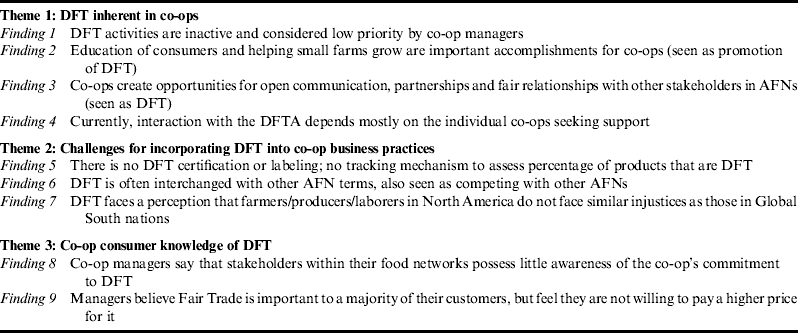
Based on the results from the interviews with co-op managers, two common themes emerged: (1) DFT concepts are inherent within co-op activities, and (2) many challenges exist for incorporating DFT into co-op business practices (Table 2).
DFT: common themes among co-op managers.
DFT inherent in co-op
The consensus among all co-op managers was that DFT was an extension of their existing values and beliefs. Yet, co-ops reported placing a low priority on the specific DFT work. In fact, several noted inactivity (Finding 1) related to DFT. Indeed, becoming paying members of the DFTA and supporting the organization are the two primary activities that co-ops noted when asked to describe their DFT activities. They have time for little else, according to co-op manager 4, DFT is ‘on the back burner, so to speak’. Multiple times during the interviews, the managers noted that becoming a member of the DFTA takes a considerable amount of time and money. Busy co-op managers say they simply do not have additional time to specifically address DFT issues ‘separate’ from other topics of relevance to their members and consumers. They feel that their co-ops already integrate Fair Trade principles into their business practices, so devoting additional time and resources to the DFTA was not necessary. ‘Food co-ops can do very well by using FT principles and DFT principles… with or without the [DFTA] organization’ (co-op manager 3).
Co-op managers say they promote DFT through educating consumers (Finding 2) in the form of store demos, articles in monthly newsletters and in-store bulletin boards. Through this education, other stakeholders within the food chain are also becoming more aware of Fair Trade issues. Another aspect of the DFT movement is increased communication and partnerships (Finding 3) among AFNs. Co-op managers mentioned that the issues of DFT were sometimes a topic for discussion with other co-operatives and with local farmers. ‘Fair trade is a topic that comes up, but I wouldn't say it is a reason for the communication…more that there's been more communication about that because of enhanced communication between co-ops overall’ (co-op manager 1).
On the other hand, co-op manager 3 said that the concept of DFT opened up communication, which had a positive impact: better business opportunities for them and their producers (Finding 4). ‘We've literally been able to write fair trade agreements with producers and it's helped them grow their business and it's helped us get the right product. And we're doing that even when those farms aren't certified [organic] because it just makes sense. I mean they're principles that make sense both financially and ethically’. In this case, the co-op is using Fair Trade principles to build collaboration with local farmers rather than using ‘certified organic’ as a criteria for identifying farmers.
Challenges for incorporating DFT in co-ops
Co-op managers said that despite the various opportunities for supporting and getting involved in the DFTA, they are often unable to participate or promote DFT in significant ways. The organization solicits participation in committees, but the co-ops are mostly inactive, as members and staff do not have time to build interactions.
In their interviews, co-op managers were asked to estimate the percentage of items in their store that they considered DFT products. Three of the interviewees indicated that most of the domestic products they carry embody the principles of DFT but they are not labeled as such. Indeed, there is currently no certification or labeling (Finding 5) for DFT, so no tracking mechanism is in place. Unless an organization is a member of the DFTA and the co-op investigates a producer's DFTA membership, they cannot technically consider a product DFT. Few co-ops spend time conducting this verification.
While the lack of labeling is an issue with DFT, the introduction of another label within the AFN marketplace is a significant concern. Consumers must read and understand a lot of information at a typical co-op and it may be too much to introduce one more label or term. There is already oversaturation of labeling, criteria and adjectives in the grocery marketplace; adding another label would add to the confusion (co-op manager 4, 2010).
Managers often view their relationships within local food networks as an embodiment of DFT. Co-op manager 3 went on to explain that they sell local foods, which they define as items grown within 151 miles of the co-op:
We call it ‘Area 151’ and the food products that we buy in that area are 17% of our total food purchases in a year. So, while we strive to have open and fair relationships with all of those organizations (all those businesses) we cannot say that they are fair trade.
Although DFT overlaps with local food, it may also compete with international Fair Trade (Finding 6), which is a fairly recognizable label that extends beyond co-ops and natural food stores into the mainstream marketplace (co-op manager 4). There is a lot attention going to local food initiatives right now and international FT is a largely accepted and recognized label, therefore trying to incorporate yet another movement or label is too much for consumers (co-op manager 2, 2010).
Some Americans lack an understanding of the need for Fair Trade in the US context (Finding 7). Two co-op managers described this challenge:
I think as North Americans, it's hard for people to conceive that there should be a justification for fair trade. They may look at that making the leap from looking at Central American or a South African country that have poor people and what fair trade can do for them (they can grasp that or think of that), but I think it's a harder leap when you're talking about that being in our same country. (co-op manager 2)
I think a lot of people in this country just assume that there's no need for DFT rules and regulations because after all, this is the USA and we don't do terrible things like they do in ‘third world countries’. So, it's more than education, it's breaking perceptions. That will be tough…and to do that without admonishing will be a difficult task’. (co-op manager 5, 2010)
These co-op managers explained that there is a strong network for international Fair Trade issue, but a lack of consumer understanding when it comes to our domestic food system. For example, some consumers assume that organic certification includes social/economic concepts to help family farms.
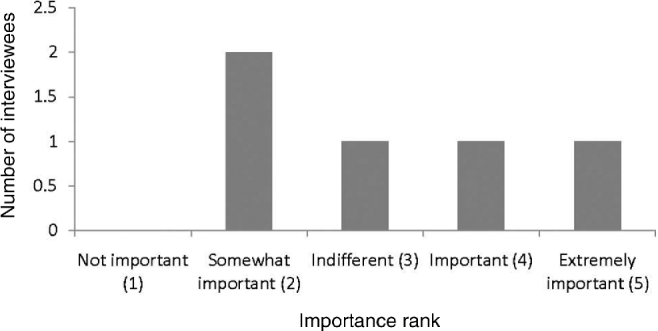
Managers believe that their customers view Fair Trade as ‘somewhat important’ (Fig. 2). However, all interviewees said their ranking was an average and that there are definitely ‘core customers’ who care very deeply about the issue. On the other hand, some customers probably do not think about DFT at all. Indeed, managers say that most shoppers do not care about DFT, and would not pay more for a product just because it claimed to be DFT (Findings 8 and 9). Manager 3 stated pointedly, ‘…there's certainly a core group that would place it higher, but I think right now, in this climate, they could take it or leave it’.
Co-op manager ranking: ‘How important is fair trade to your customer?’.
The findings from these interviews lead to a better understanding of each co-op's experience with integrating DFT into their business. Next, the analysis explores the extent to which DFT goals at the organizational level are manifest in co-ops.
DFTA Focus and Co-ops
The DFTA is a non-governmental organization that plays a key role in the Fair Trade movementReference Brown and Getz40 as it seeks to ‘promote and protect the integrity of DFT principles through education, marketing, advocacy and endorsement’52. The DFTA upholds these diverse and multi-faceted principles:
… family-scale farming, capacity building for producers and workers, democratic & participatory ownership & control, rights of labor, equality & opportunity, direct trade, fair & stable pricing, shared risk & affordable credit, long-term trade relationships, sustainable agriculture, appropriate technology, indigenous peoples’ rights, transparency and accountability, education and advocacy, responsible certification and marketing and animal welfare52.
The DFTA clearly recognizes the important position that co-ops play in building AFNs. In fact, the DFTA adopted a resolution supporting the ‘2012: International Year of Co-operatives,’ which states that they
… recognize and promote the vital role of co-ops in the food system and in the economic and social well-being of communities from the global level to the local; encourage stakeholders in the food system to consider how the values and principles of the co-operative movement relate to those of Fair Trade and can contribute to health, justice and sustainability53.
Indeed, co-ops fit into the DFTA membership structure as a retailer. The DFTA has four different membership categories: (1) farmer organization, (2) farmworkers’ organization, (3) retailer/processor/marketer/manufacturer and (4) non-governmental organization54. All members pay annual dues based on their sales or operating budget, and these vary from under US$100 to several tens of thousands of dollars. Members are expected to formally endorse the principles of DFT and constantly make progress toward the goal of full compliance55.
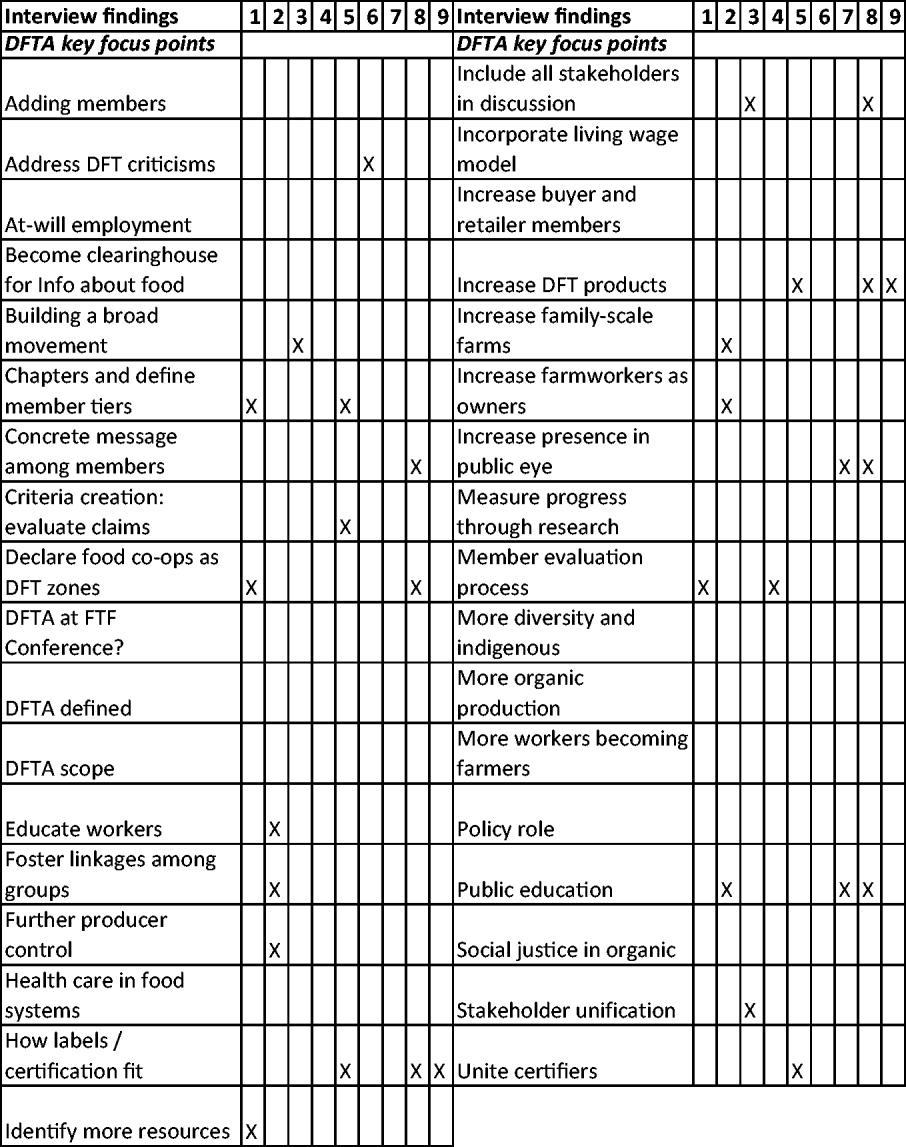
In addition to its informative website, the DFTA holds an annual meeting where members participate in the decision-making process for the association and discuss issues and concerns. Document content analysis was used to create a list of key topics from each DFTA annual meeting, held in 2007–2010 and Fig. 3 provides a comparison of the interview findings and meeting focus point findings. This illuminates how the experiences conveyed by the co-op managers relate to what occurs at the professional level. This cross-case comparison further explores the findings that emerged from the interview portion of this study.
Comparing overlap between co-ops and DFTA.
The nine interview findings are listed across the top of the matrix and the DFTA key focus points are listed in alphabetical order in the left-hand column. Interview findings that are linked to one of the focus points are shown by an X in the corresponding box. The result of this comparison is a visual representation of how the co-op findings merge or overlap with the professional-level goals of the group. Consequently, we are able to see which issues both the co-op managers and the DFTA find important.
The results from this comparison indicate that more key points are applicable to Findings 2 and 8 than to the other findings. Thus, the co-ops' emphasis on education of consumers fits well with the goals of the DFTA. Further, the fact that co-ops work to help small-scale farmers is in line with DFT goals. Finally, increasing awareness of DFT is a point where the co-ops and the professional organization are united. Interview Findings 1 and 5 both related to four of the key points, thus DFT labeling is of interest to both the organization and the co-ops, but at the same time the co-ops lack time for promoting DFT issues. The remaining interview findings related to three or fewer of the key focus points, which indicates that co-ops do not intersect with a large number of DFTA goals.
Recommendations
These findings provide insight into co-ops’ experiences and how DFTA goals have been realized in co-ops over the past 5 years. Although several key goals do overlap between these two stakeholder groups, there is much room for increased collaboration. At this point, the overlap between co-ops and DFT exists at the conceptual level, as both share a common vision for a more equitable agricultural system. Unfortunately for the DFT movement, co-ops tend to promote these common goals without recognizing them as DFT. If the DFTA is to succeed in linking with co-ops to educate their consumers, several changes must occur. The following discussion is centered on key recommendations for the future of the DFT movement within food co-ops.
Membership
Because membership is a fairly lengthy, expensive and time-consuming process, many co-ops do not currently see the need to join this professional organization. Certainly, DFT principles can be carried out by co-ops without them going through the paperwork and expense of individual membership in the DFTA. However, the fact is that co-ops do not recognize or advertise their actions as DFT. If the DFTA seeks to be the unifying organization in the movement, it must advertise the benefits of membership and provide incentives for expanding their member base. To succeed, the DFTA must provide their members with a clearer picture of what DFT is and what the future holds for the movement. This organization must create a network of members who spread the word and motivate others to become involved in the growing movement. Co-ops are the ideal venue for education about DFT issues, as this consumer base is already informed about food issues and considers information a necessary component of food shopping. Given that co-ops are places to promote DFT, it is surprising that very few co-ops are actually involved with the movement's pivotal organization. Increasing co-op membership would be a valuable undertaking for the DFTA.
Co-ops as DFT zones
The idea that food co-ops should be declared ‘DFTA zones’ initially came from the 2009 DFTA annual meeting. Clearly co-ops have a unique position in the Fair Trade marketplace for a number of reasons. Co-ops have more personal relationships with various stakeholders in the food network than other retail spaces might. They integrate the social and political aspects of food consumption into their business model. They have access to other AFNs in the country due to the strong co-op network. Finally, co-ops have an educated ‘foodie’ consumer base that could take the DFT movement to the next level of acceptance among the general public. Our findings indicate that the co-ops are beginning to realize that DFT has the potential to build new channels of communication among multiple stakeholders throughout the AFN. Therefore, if the DFTA promotes co-ops as DFT zones, they may be able to address their goal of uniting stakeholders. However, key barriers remain, especially related to geographic variations across the food landscape.
Local/regional Fair Trade
This is an issue of scale. Our findings suggest that the national DFTA organization may be unable to accomplish the real-world goals of linking farmers to consumers in the USA. Indeed, the popularity and success of the local food movement indicates that alternative networks are focusing on local-scale relationships rather than national-level organizations. Creating regional chapters was discussed at the 2009 DFTA annual meeting. This may also allow DFT goals to be promoted by locavores, who also seek to avoid large-scale, industrial food distribution. Grassroots local food initiatives would see little value in a national organization of DFTA, but might be willing to promote the concept of local Fair Trade (as an off-shoot of Domestic Fair Trade).
Further complicating the issue of scale is how the organic agricultural movement has evolved. DFT provides an opportunity to define a set of structures that could be used to help consumers understand how their food is produced, which would build an educated consumer base. This could help farmers earn a fair wage for their products. DFT could be developed into a label that would provide consumers with confidence that their purchase is helping a family farmer remain viable. As it now stands, the local food movement is coming to the forefront of American society: consumers want to know their farmer. If we each go to a growers’ farmers market, we can meet the people whose hard work created our food. However, this lacks viability at a larger scale, as distant populations are unlikely to meet their farmers, even if she/he is a smaller scale ‘family farm’.
This research suggests that promoting DFT may be an effective way to educate and involve locavores in the broader Fair Trade movement. However, to do this effectively, more DFT products must be labeled (and this implies a certification to verify the label). Regional chapters of the DFTA could carry out the necessary regional evaluations and strive to determine criteria for compliance with DFT principles at this geographic scale: local/regional Fair Trade.
While overarching DFT standards could be used to unify the movement and increase awareness among stakeholders participating in various links of the food chain, regional implementation would maintain local richness in these AFNs. Given the controversies and dilemmas of industrial organic and the fact that certified organic only verifies production methods/materials, DFT can fill the need of providing a valid, social certification for small-scale independent family farms.
Conclusion
Findings from interviews and document analysis support the idea that DFT is a ‘movement of movements’. Although the term may not always be used, Fair Trade principles are being incorporated into co-ops through their relationships with local and regional producers. Analysis of the DFTA meetings indicates that their key focus points involve integrating social justice into organics, becoming a broader movement, and working to foster linkages among different food stakeholder groups. Co-ops provide an ideal meeting place for these many AFN players and DFTA must build stronger working relationships with co-ops if they are to reach their common goal of eliminating inequalities in the US agricultural system.
Ultimately, this study points to the need for broader collaboration among AFN stakeholders, specifically co-ops and Fair Trade within the US domestic setting. In order to succeed, the DFT movement must educate consumers and producers about the need for a socially equitable system of food production and sales in the global north. DFT, if it is to evolve successfully, could include social concerns to balance the production-only criteria of certified organic production. A DFT label could ensure a set of social standards that certified organic does not address. Certified organic is a production standard in a codified system of ‘allowable’ substances in the field. Indeed, if stakeholders can be convinced of the efficacy of Fair Trade as a unifying principle for AFNs, it could provide verification of the social sustainability that industrial organic does not provide.
Whether DFT objectives will become a broader movement for social and political change throughout conventional and alternative food systems is yet to be determined. The movement is new and there are still many barriers to be overcome. Insights and findings from this study, however, indicate that there is great potential to unify numerous stakeholders. Specifically, linkages between locavores and organic farming could be realized through DFT principles and articulated by co-ops.
In light of the various emerging stakeholders in AFNs, both co-ops and DFT could promote a broader movement for social and political change throughout conventional and alternative food systems. With the help of concerned co-op consumers, the DFT movement has the potential to build an equitable alternative food system within the US domestic context that supersedes social divides and physical space. If it is successful, co-ops and DFT could empower farmers and consumers to create meaningful, fair relationships that succeed outside the globalizing food economy.