1 Introduction
It is commonly stated (see section 2) that Old English (OE) conjunct clauses, i.e. main clauses starting with the conjunction and ‘and’ or ac ‘but’, and with an overt subject, typically have the verb in clause-final or clause-late position, as in (1) and (2) (throughout the article the subject is in italics, and the finite verb is in boldface).
-
(1)

-
(2)


This claim can be traced back about a century, but it has achieved prominence mainly through repeated mention in Mitchell (Reference Mitchell1985). In Bech (Reference Bech2001a, Reference Bech and Brinton2001b), I examined the empirical grounds for this claim, with reference to clauses with the finite verb in absolute final position, and concluded that conjunct clauses are rarely verb-final. However, verb-final clauses are often conjunct clauses, and I argued that these two perspectives must be kept apart. I further suggested that discourse function and information-structural features play a role in this ‘asymmetrical’ distribution.
Since the 2001 article, in which I used my own collected data, the York–Toronto–Helsinki Parsed Corpus of Old English Prose (YCOE, Taylor et al. Reference Taylor, Warner, Pintzuk and Beths2003) has come into existence. I therefore found it opportune to revisit the topic at this time, to see whether the results are the same when much more extensive data are considered. In addition, I find it important to examine previous research on this topic in some detail, as it is demonstrable that imprecise referencing is at the core of the misconceptions concerning conjunct clauses and word order in Old English.
This paper is divided into two main parts: First I review previous research on this matter, dating back to the nineteenth century, and then I present the empirical findings from the YCOE, which have been elicited by means of extensive corpus queries.
2 Previous research
Before I present and discuss the empirical findings, I would like to devote some space to previous research on conjunct clauses and word order. I find this a worthwhile pursuit, because scholarship tends to be obscured in the mists of time, and references are often repeated uncritically. The academic community is currently drawing attention to the dangers of culling references from other researchers’ papers rather than reading the original sources oneself, so in seeking to dispel what I regard as a linguistic myth concerning Old English, I therefore start by dusting off old research on this matter.
2.1 A century of conjunct clauses and word order
Scholars have been commenting on the relation between word order and conjunct clauses for more than a century. The first paper I have been able to locate is one by Todt from 1894, dealing primarily with word order in Beowulf, but also with reference to two of the Anglo-Saxon Chronicles and to Cura Pastoralis (Todt Reference Todt1894: 226). According to Todt, ‘[i]n S. C. [AS Chronicles] und C. P. [Cura Pastoralis] findet sich Schlussstellung hier und da . . . Besonders häufig findet sich aber Stellung d) [i.e. end position] in S. C. in mit “und” coordinierten Sätzen in der Erzählung rasch sich entwickelnder Handlung’ (Reference Todt1894: 234–5).Footnote 2 Todt distinguishes between end position of the verb, and a verb position after several sentence elements (1894: 229), and points out that in order to really speak of end position, there has to be an essential element such as an object or an adverbial complement present, which can be used as a diagnostic for end position (1894: 229–30). What is important to note in Todt's work, and to be kept in mind in the following, is that his wording is ambiguous. It can be taken to mean that end position is common in and-clauses, but if his comment is seen together with his data, it emerges that what he actually means is that in clauses with the verb in end position, and is common. Todt first classifies clauses according to word order (Reference Todt1894: 231), and then he looks at what characterizes the clauses in the different word order categories. This is a different matter than first finding all and-clauses and then looking at what characterizes those in terms of word order. Note also that the data are very limited. A few years later, Dahlstedt (Reference Dahlstedt1901) refers to Todt, reproducing the opaque wording: ‘Lastly, there is from older to later times a tendency to level subordinate and principal clauses . . . The end-position of the finite verb in principal clauses is perhaps influenced by Latin; but otherwise it may be due to the analogy with clauses containing a personal pronoun, or with subordinate clauses . . . This position is especially to be found after and (Cura Past.; Todt, Sweet)’Footnote 3 (1901: 14).
In Kuhn's Reference Kuhn1933 habilitation thesis, the idea of end position for verbs in conjunct clauses takes further hold. According to Kuhn, in the West-Germanic languages, conjunct clauses once had the same word order as subordinate clauses (verb in a late or final position), which we know because this type of word order is still found in Old English and in older German (Reference Kuhn1933: 62). Kuhn is not in possession of data on this topic himself, so he, too, refers to Todt, who ‘gibt an, daß Endstellung des Verbs in Hauptsätzen in der Sachsenchronik besonders häufig nach ond “und” vorkommt’ (Reference Kuhn1933: 63).Footnote 4 Just as in Dahlstedt (see above), the sentence is unclear: does Kuhn mean that Todt sees this from the perspective of verb-final order, or does he mean that the perspective is and-clauses? The topichood of Endstellung would indicate the former, but the fact that the chapter is about the word order of conjunct clauses, and Kuhn says ‘häufig nach ond’, indicate the latter. As mentioned above, what Todt means is not that end position is common after and, but that in his examples of clauses with the verb in end position, there is frequently a conjunction. Hence, the reference is not precise. In the same decade, Fourquet (Reference Fourquet1938) comments that as regards heavy clause elements in the first part of the Anglo-Saxon Chronicle (until 891), there is a disconcerting liberty with respect to clause position (1938: 42). He ascribes this to two factors, one of which is the nature of the beginning of the clause: in clauses starting with a conjunction, the verb is postponed, both in clauses with an expressed subject and in clauses without an expressed subject (1938: 38–43). Andrew (Reference Andrew1940) distinguishes between common, conjunctive and demonstrative order. Conjunctive order is the normal verb-final word order in subordinate clauses, and Andrew chooses to call it conjunctive order ‘since it is found also after co-ordinating conjunctions’ (Reference Andrew1940: 1).
We make a leap to modern times. In 1964, both Campbell and Mitchell had something to say about conjunct clauses and word order. In a review of Bacquet (Reference Bacquet1962), Campbell, with reference to Kuhn (Reference Kuhn1933), rebukes Bacquet for not being ‘aware that all conjunctions including ond and ac require subordinate word order, i.e. the subject follows the conjunction, and the verb may be in the third or any later place’ (1964: 191). And according to Mitchell, ‘[l]ater writers also fail to take account of the influence of ond, ac, and ne . . . Bacquet similarly overlooks the tendency of ond and ac to send a verb to the end of the clause . . .’ (Reference Mitchell1964: 118). Campbell (Reference Campbell and Rosier1970), similar to Andrew (Reference Andrew1940), operates with three main word orders: common, demonstrative and subordinate, and once again stresses the subordinate nature of conjunct clauses: ‘In subordinate order, a conjunction begins the clause, e.g. þa he com, “when he came”. In this order, however, the verb is free, i.e. it may be indefinitely delayed. This is the order used after all conjunctions, even ond’ (Reference Campbell and Rosier1970: 93).
In 1978, Kohonen refers to many of the previously mentioned works, and sums them up as follows: ‘The clauses introduced by the and/ac conjunctions had a well-known tendency for verb-final word order, noted both in OE and OHG [Old High German]’ (Reference Kohonen1978: 36). Kohonen provides statistics, though for Old English only from one text, Ælfric's first series of Catholic Homilies (Reference Kohonen1978: 75). Distinguishing between three word orders, SV, S.V. (i.e. verb-final clauses, and clauses in which the finite verb is in a late, but not final, position) and VS, he finds that in and/ac clauses, S.V. order occurs in 33 per cent of the cases, versus 10 per cent in other main clauses (1978: 90).
The claim that conjunct clauses are characterized by verb-final/verb-late order has remained unquestioned in large part because of its repetition in Bruce Mitchell's seminal two-volume work Old English Syntax (Reference Mitchell1985). Mitchell begins by saying that ‘such OE conjunctions as ond and ac are frequently followed by the element order S. . .V, which is basically subordinate. Failure to recognize this this has led many scholars astray’ (Reference Mitchell1985 I: 694). Here Mitchell leans on Campbell (Reference Campbell and Rosier1970: 93, quoted in Mitchell Reference Mitchell1985 I: 714), who states that ‘[f]ailure to recognise that even co-ordinating conjunctions are syntactically subordinating has often led scholars to quote clauses which are opened by such conjunctions without the conjunctions, which alone make their word-order possible’. Mitchell further states that ‘the influence of ond often postpones the verb’ (Reference Mitchell1985 I: 712), and that S. . .V word order, ‘sometimes called “subordinate” – is common in clauses introduced by ond, ac . . . and in subordinate clauses’ (1985 II: 967). To be sure, Mitchell also acknowledges that conjunct clauses may display other word orders: ‘All the basic orders are found after ond in both early and late prose’ (Reference Mitchell1985 I: 710), but it is clear from the numerous other quotes that Mitchell regards conjunct clauses as being typically S. . .V. However, there are no statistics to support Mitchell's use of frequency adverbs such as frequently, often and common.
As regards the definition of S. . .V order, Mitchell regards clauses in which an adverb element or a pronominal object intervenes between the subject and the finite verb as variants of SV order, and thus not as S. . .V (Reference Mitchell1985 II: 965), though he expresses some uncertainty about the status of pronominal objects (1985 II: 966). Hence, S. . .V clauses are clauses in which the intervening element is a nominal object, a nominal or adjectival complement, a participle or an infinitive. S. . .V. . . order, i.e. verb-late order (see example (2)), is regarded as a subtype of S. . .V order (Reference Mitchell1985 II: 967). Mitchell's general views on word order are also reflected in Mitchell & Robinson's A Guide to Old English, a textbook for beginner students of Old English.
Another prominent mention of word order in conjunct clauses occurs in Traugott (Reference Traugott and Hogg1992: 277), who states that ‘co-ordinate clauses introduced by and are V2 if a locative adverbial phrase or an adverb like ne or þær is present . . . Otherwise, they tend to be verb-final, like subordinate clauses.’ Pintzuk (Reference Pintzuk1995), with reference to Bacquet (Reference Bacquet1962),Footnote 5 Campbell (Reference Campbell and Rosier1970), van Kemenade (Reference Kemenade1987),Footnote 6 Mitchell (Reference Mitchell1964, Reference Mitchell1985) and Traugott (Reference Traugott and Hogg1992), comments that ‘[i]t has often been suggested, generally without comment or explanation, that conjunct clauses in Old English are more like subordinate clauses than main clauses . . . In particular, it is noted that Old English conjunct clauses are more frequently verb-final than main clauses’ (1995: 249). This is repeated in Pintzuk & Haeberli (Reference Pintzuk and Haeberli2008: 375). Pintzuk's formulation is actually more careful than the works she refers to, because she says that conjunct clauses are more frequently verb-final than main clauses are, whereas her references say that conjunct clauses are frequently verb-final. As we shall see, it is in fact the case that conjunct clauses are more frequently verb-final than main clauses are, but that is different from saying that they are frequently verb-final. Pintzuk points to parallelism as a factor for the word order of conjunct clauses; the word order of a conjunct clause depends on the word order of the matrix clause (1995: 249–50).
In Bech (Reference Bech2001a, Reference Bech and Brinton2001b), I examined the word order of conjunct clauses more closely, since upon reading Old English texts, I had the impression that there was a discrepancy between the empirical facts and what previous scholarship had said on the matter of conjunct clauses and word order. Consequently, I first looked at the distribution of word order in conjunct clauses, and then at the distribution of conjunct clauses in the different word order patterns (2001a: 86–93, Reference Bech and Brinton2001b). What I found was that the single most common word order in conjunct clauses is regular SVX order, and that conjunct clauses are rarely verb-final, i.e. with the finite verb in absolute final position. The latter is also confirmed by Cichosz (Reference Cichosz2010: 115). In addition, some word orders are what I termed ‘symmetric’, others ‘asymmetric’. For example, the XVS word order is symmetric, in the sense that few conjunct clauses take this word order, and few XVS clauses have an initial conjunction. As regards verb-final order, on the other hand, it is asymmetric, in the sense that few conjunct clauses are verb-final, but a great number of the verb-final clauses have an initial conjunction. In other words, what I did was to keep apart the two perspectives that I believe have been mixed up in previous research and in subsequent references. I then studied this symmetrical and asymmetrical distribution from the point of view of the interplay between clause type and information structure. In those studies, I also provided data for verb-late clauses, but I focused on the clauses with the finite verb in absolute final position. However, since most of the research that I have referred to previously in this section does not distinguish between finite verb in final position and finite verb in late position, I include both in this study. Furthermore, in my 2001 studies, I included all SXV clauses regardless of X element, i.e. also clauses containing short adverbs and pronominal objects, which – recall – Mitchell regards as a subtype of SV (see above). In this article, I will therefore take specific note of clauses in which a full nominal object, a complement, an infinitive or a participle is placed between the subject and the verb, to enable a more precise comparison between the empirical data from the YCOE corpus and Mitchell's claims.
To round off this overview of previous research, I include a quote from a much-used textbook of Old English, i.e. Baker (Reference Baker2012). Baker, probably with reference to either Mitchell (Reference Mitchell1985), or Mitchell & Robinson (Reference Mitchell and Robinson2007), says that ‘[t]he Subject . . . Verb word-order is commonly found in subordinate clauses and clauses introduced by and/ond and ac “but”, though it does sometimes occur in independent clauses. The subject comes at the beginning of the clause and the finite verb is delayed until the end (though it may be followed by an adverbial element such as a prepositional phrase)’ (2012: 118). Although this sentence, too, is rather fuzzy – is he talking about the distribution of S. . .V order in conjunct clauses, or is he talking about the distribution of conjunctions in S. . .V clauses? – instructors and students alike commonly interpret this as saying that conjunct clauses are typically verb-final. In other words, the myth lives on.
2.2 Summary of previous research
The main points emerging from the overview of previous research are the following:
-
1. The studies usually do not make the essential distinction between the two perspectives of (a) considering the frequency of different word orders in conjunct clauses, and (b) considering the frequency of conjunct clauses in the different word order patterns. Hence, over time, references have become distorted and also less refined.
-
2. Most of the studies do not offer empirical data themselves; hence claims have been made and repeated on the basis of very little material. The pathway of the conjunct clause myth seems to be as follows: Todt (Reference Todt1894) offers some data from very limited text material, saying that of his examples of verb-final clauses, many have an initial conjunction. It is, crucially, not the other way round. Kuhn (Reference Kuhn1933) refers to Todt, but the reference is opaque and the perspective becomes fatally distorted. Then Campbell (Reference Campbell1964) refers to Kuhn, and reuses this reference in Campbell (Reference Campbell and Rosier1970). Mitchell (Reference Mitchell1985) sets great store by Campbell (Reference Campbell and Rosier1970), to the extent of quoting him verbatim in his own work, as well as using these ‘findings’ in the various editions of Mitchell & Robinson's textbook A Guide to Old English. Finally this trickles down to a present-day university textbook such as Baker (Reference Baker2012). But at some point in this chain of references, the chain twisted, so that what is referred to now as a well-known fact is not only based on extremely scanty data, but is actually an incorrect rendering of the original data results.
-
3. Though the term ‘verb-final’ is often used, verb-late word order is often included. Also, it varies which elements intervening between the subject and the verb are accepted as diagnostics for verb-final/verb-late order.
-
4. Those who have provided empirical data (Kohonen Reference Kohonen1978; Pintzuk Reference Pintzuk1995; Bech Reference Bech2001a, Reference Bech and Brinton2001b) agree that conjunct clauses, though not the same as subordinate clauses, are different from main clauses and should be kept apart.
-
5. When frequency adverbs such as frequently, commonly, often are used, it is not clear, or it varies, whether they are used in an absolute sense, or in comparison to something else. For example, Mitchell seems to use frequently in an absolute sense, whereas Pintzuk compares conjunct clauses to main clauses.
In sum, then, in the matter of conjunct clauses and word order, there are a number of aspects that should have been kept apart, but which have not been kept apart, with the result that the matter has become rather murky and confused. Section 3, which presents the method and results of the empirical study, aims to dispel the murkiness.
3 Empirical data from the YCOE
This section presents empirical facts elicited from the York–Toronto–Helsinki Corpus of Parsed English Prose (YCOE, Taylor et al. Reference Taylor, Warner, Pintzuk and Beths2003). It will be shown that (i) conjunct clauses are by no means typically verb-final/verb-late; (ii) but they are more frequently verb-final/verb-late than other main clauses; (iii) verb-final/verb-late main clauses are typically conjunct clauses. In order to throw verb-final/verb-late order into relief, I also take into consideration other word orders, most notably SVX (subject--verb), XVS (archetypal verb-second) and XSV (archetypal non-verb-second).
3.1 Corpus and method
The YCOE corpus consists of 1.5 million words of syntactically annotated Old English texts of different genres, and I queried the entire corpus for the purposes of this study.Footnote 7 First I identified all conjunct clauses in the corpus, i.e. all clauses starting with a coordinating conjunction,Footnote 8 and which contain an overt subject in the form of a common noun (phrase), a proper noun, a pronoun, a determiner (sometimes a single determiner constitutes the subject), a quantifier, or the indefinite pronoun man ‘one’, as well as a finite indicative verb.Footnote 9 The total number of such conjunct clauses in YCOE is 25,339.Footnote 10 With that as a starting point, the next task is to examine the word order patterns of the conjunct clauses, in particular verb-final and verb-late order.
3.2 Verb-final word order
3.2.1 Conjunct clauses with verb-final order
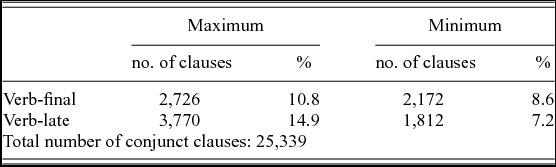
First we have to find out what the proportion of verb-final clauses is out of all conjunct clauses. In a first query, I searched for all clauses with an initial conjunction, an overt subject, a finite indicative verb in absolute final position, and some element(s) intervening between the subject and the verb, i.e. adverbials (words and phrases), prepositional phrases, complements, objects (nominal and pronominal), participles, or infinitives.Footnote 11 YCOE returned the number 2,726, which means that 10.8 per cent (2,726/25,339) of all conjunct clauses are verb-final in this sense. Some examples are given in (3)–(8); note that clauses in which one or several elements precede the subject are also included (6)–(8).
-
(3)
-
(4)
-
(5)
-
(6)
-
(7)
-
(8)


Recall, however, that Mitchell (Reference Mitchell1985 II: 965–6) does not regard clauses in which an adverbial or a pronominal object occurs between the subject and the verb as S. . .V, but rather as variants of SV order. It is, however, not entirely clear exactly what Mitchell means by this. Clauses which contain an (i.e. one) intervening adverb(ial) (element), and which are also possible constructions in Present-day English, e.g. God then made a man from earth, are definitely SV in his view. Clauses containing a preverbal adverbial element which would be placed in another position today are also apparently SV, e.g. They for many years were there, since Mitchell does not include such constructions under S . . .V (Reference Mitchell1985 II: 967). As concerns clause constructions with a preverbal pronominal object (see example 6), he considers those to be SV, but is uncertain about their status. Furthermore, it is not clear how he regards clauses in which there are several adverbial elements between the subject and the verb, as in (9), or whether he distinguishes between adverbials, such as færinga and eac (not obligatory) and adverbial complements, such as on hine (obligatory).
-
(9)

In order to arrive at data material that emulates Mitchell more closely, I made additional queries for clauses in which one adverbial element (10) or one pronominal object (11) intervenes between the subject and the final verb.Footnote 12
-
(10)
-
(11)


A total of 554 such clauses were found, and if these are subtracted from 2,726, we end up with 2,172 conjunct clauses with verb final order, i.e. 8.6 per cent. So far, then, the occurrence of verb-final order in conjunct clauses cannot be said to be frequent. However, as we have seen, verb-late order is usually included in the category ‘verb-final’, and we will address this topic in section 3.3. But first, let us have a look at verb-final order and conjunct clauses from another perspective.
3.2.2 Verb-final clauses with an initial conjunction
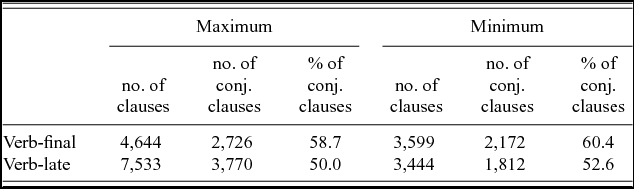
In the previous section, the starting point was conjunct clauses; in this section it is verb-final clauses. We want to know how many verb-final clauses (non-conjunct and conjunct) there are in YCOE, so we search for all clauses with an overt subject and a finite indicative verb in absolute final position.Footnote 13 The number is 4,644. We already know that of these, 2,726 are conjunct clauses,Footnote 14 so in a first calculation we find that 58.7 per cent of all verb-final clauses are conjunct clauses (2,726/4,644). This is the maximum of the raw data. If we eliminate the clauses with an adverb or a pronoun between the subject and the verb (1,045),Footnote 15 as Mitchell does, and subtract those from the total number of verb-final clauses, we get 3,599 clauses. We saw above that the number of verb-final conjunct clauses after removing adverb and pronoun clauses is 2,172, so in this second calculation, the proportion of verb-final clauses with an initial conjunction is 60.4 per cent (2,172/3,599).
In other words, this is what Todt observed in 1894 in his small data sample. He identified verb-final clauses, and then he observed that very many of them are conjunct clauses. The implication is not, however, bidirectional; the fact that verb-final clauses are often conjunct clauses does not mean that conjunct clauses are often verb-final. The mixing up of these two perspectives is the distortion that has happened over time.
3.3 Verb-late word order
3.3.1 Conjunct clauses with verb-late order
As mentioned, most of the works referred to in section 2.1 also take verb-late clauses into consideration when discussing the word order of conjunct clauses, and group them with verb-final clauses. Since there is no query term for ‘verb-late’ in the YCOE, and ‘verb-late’ can mean different things, verb-late clauses have to be elicited by means of several query steps, and I describe these below, as we proceed. The purpose of this article is to arrive at data set that is as close to Mitchell's definition as possible, though, as we shall see, this raises some problematic issues with respect to analysis. To remedy this situation, the data counts will be laid out as transparently as possible and presented from different points of view in the interim summary in section 3.4.
The first step was to find conjunct clauses in which the subject precedes some other element(s) than the finite verb, and the finite verb is not in final position. The subject may follow the conjunction directly (word order: conj+S+X+Vfin+X), or there may be another element before the subject (word order: conj+X+S+X+Vfin+X).Footnote 16 Examples are given in (12)–(17).
-
(12)
-
(13)
-
(14)
-
(15)
-
(16)
-
(17)


YCOE returned a total of 3,770 hits. However, this query gives us some unwanted hits as well. First, it includes clauses in which a verb of saying is in final position before direct speech, which might be argued to be less relevant in this context. In sentences containing indirect speech, e.g. She said that she was tired, the complement relation is integrated in the clause syntax, as it presupposes that what is said takes the form of a proposition that can be expressed in a nominal subclause. Sentences containing direct speech, on the other hand, represent a more ‘external’ syntactic combination, as the direct speech can take different forms, from clauses to single words, e.g. She said: ‘Ouch!’ In other words, if the direct speech forms a clause, that is incidental, whereas indirect speech must have clausal form. It is therefore not obvious that the syntax of constructions containing direct speech has the integrated structure that enables syntactic-typological reasoning; it is closer to a text structure containing a sequence of two main clauses. Mitchell does not seem to include them either (1985 II: 967–9). For the time being, then, I exclude the 65 instances I found of this construction.Footnote 17
More importantly, however, this query also yields clauses in which an infinitive or participle follows the finite verb, and these have to be excluded, as Mitchell specifies that with periphrastic verb phrases, the finite verb must come after the non-finite form in order for a clause to be regarded as S. . .V. . . (Reference Mitchell1985 II: 967). Following Mitchell, therefore, we want only clauses with the non-finite verb preceding the finite verb, as in (18)–(21), and not clauses with the non-finite verb following the finite verb, as in (22)–(24). This means that not even a clause like (24), in which a full nominal object precedes the verb phrase, would be regarded as verb-late. In fact, it is unclear where in Mitchell's scheme such a sentence would fit it, since it can be neither S. . .V. . . nor SV.Footnote 18 Within the framework of generative syntactic theory, Pintzuk & Haeberli (Reference Pintzuk and Haeberli2008) and Haeberli & Pintzuk (Reference Haeberli, Pintzuk, Jonas, Whitman and Garrett2012) argue that in a language with head-final structure, the finite auxiliary may come to precede the non-finite verb through verb (projection) raising. In other words, a construction may be head-final even if the finite verb is not in final position, so from this point of view it is not justified to exclude such clauses. In addition, processes such as topicalization, scrambling and extraposition may obscure the basic order of the constituents, especially in main clauses. I will not enter into a discussion here of movement-based analyses, as agreement has yet to be reached concerning the basic structure of Old English main clauses, and Mitchell, though he is often referred to in works taking a generative perspective, is only concerned with surface order. Since the concept of ‘verb-late’ is problematic whatever the framework, the solution here will be to allow readers to choose their own perspective by providing the data in a transparent fashion. It will, however, become apparent that the result is basically the same no matter how the data are counted.
As a result of the above considerations, additional queries were made which identified sentences like (22)–(24), giving a total of 350.Footnote 19 So far, then, we have 3,355 (3,770 – 65 – 350) conjunct clauses with verb-late order, or 13.2 per cent of all conjunct clauses (3,355/25,339).
-
(18)
-
(19)
-
(20)
-
(21)
-
(22)
-
(23)
-
(24)


In order to arrive at a data set that is a close to Mitchell's typology as possible, we continue to remove irrelevant instances. As with verb-final clauses, Mitchell would not regard verb-late clauses in which the verb is preceded by an adverb or a pronominal object as verb-late, but rather as SV. Hence, the same procedure for verb-late clauses was carried out as for verb-final clauses, i.e. all the clauses were identified in which one adverb (element) or one pronominal object intervenes between the subject and the verb, as in (25)–(27),Footnote 20 see also (12), (15) and (16) above.
-
(25)
-
(26)
-
(27)


These clauses – 1,543 – were then subtracted from the total, and we end up with a total result of 1,812 verb-late conjunct clauses, which is 7.2 per cent of all conjunct clauses. If we add the verb-final clauses to this, the total proportion is 15.8 per cent (8.6 + 7.2 per cent), i.e. 15.8 per cent of all conjunct clauses are verb-final or verb-late. This can hardly be construed as ‘frequently’ or ‘common’. If we decide to disagree with Mitchell and regard clauses in which an adverb or a pronoun intervenes between the subject and the verb as verb-final/verb-late after all, the frequency of conjunct clauses with verb-final/verb-late order rises to 24.0 per cent (2,726 + 3,355/25,339), whereas a count that includes all the previously excluded clauses would give a frequency of 25.7 per cent (see table 1). None of these frequencies are high enough to claim that coordinating conjunctions are syntactically subordinating (see section 2.1).Footnote 21
Frequency of verb-final and verb-late word order in conjunct clauses, maximum and minimum count

3.3.2 Verb-late clauses with an initial conjunction
As we did with verb-final clauses, we can also consider verb-late clauses from another perspective. We want to find out how many verb-late clauses there are in the corpus in total, and how many of these have an initial conjunction. In this section, therefore, the point of departure is verb-late clauses. Again, this is a fundamentally different perspective than considering the proportion of verb-late word order in conjunct clauses.
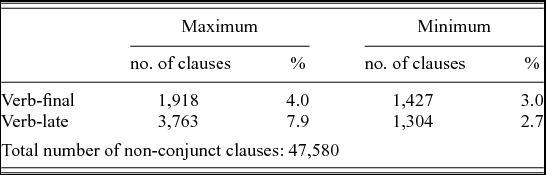
First I searched for all non-conjunct verb-late clauses with the subject in first or second position.Footnote 22 The total number was 3,763. From these I subtracted clauses in which a verb of saying is in final position before direct speech, as I did with the conjunct clauses. The number of such clauses was 562,Footnote 23 hence the total number of non-conjunct verb-late clauses is now 3,201 (3,763 – 562). Furthermore, clauses with the non-finite verb following the finite verb had to be subtracted as well, as these are not verb-late in Mitchell's scheme.Footnote 24 The total number was 265, and thus the total number of non-conjunct verb-late clauses is now 2,936 (3,201 – 265).
However, as has been mentioned several times already, Mitchell does not regard clauses in which there is an adverb or a pronoun between the subject and the verb as verb-late. Consequently, we subtract those as wellFootnote 25 – 1,632 instances – which leaves us with a total of 1,304 non-conjunct verb-late clauses. From section 3.3.1 we know that there are 1,812 verb-late conjunct clauses. The total number of verb-late clauses is thus 3,444 (1,812 + 1,632), and we see that 52.6 per ent of all verb-late clauses are conjunct clauses (1,812 out of 3,444). In other words, the same kind of ‘asymmetry’ is at work with verb-late clauses that we saw with verb-final clauses: Conjunct clauses are not frequently verb-late (7.2 per cent), but verb-late clauses are frequently conjunct clauses (52.6 per cent).
3.4 Interim summary with tables
The data provided in sections 3.2 and 3.3 are summarized in tables 1 and 2. Here I provide a less restrictive (maximum) and a more restrictive (minimum) count. ‘Less restrictive’ means that clauses with an adverb or a pronoun between the subject and the verb are included, as well as verb-late clauses with direct speech following the verb, and clauses in which the auxiliary precedes the non-finite verb. ‘More restrictive’ follows Mitchell in eliminating these types from the counts of verb-final and verb-late. One could also envisage an ‘intermediate’ count leaving out the clauses with adverb or pronoun, and keeping the others, depending on theoretical framework. The point here is to show that whichever way we choose to count, the trend is very clear: conjunct clauses are not frequently verb-final/verb-late, but verb-final/verb-late clauses are frequently conjunct clauses. These two perspectives have been mixed in previous research.
Frequency of conjunct clauses in verb-final and verb-late word order patterns

As previous research has pointed out (Kohonen Reference Kohonen1978; Pintzuk Reference Pintzuk1995; Bech Reference Bech2001a, Reference Bech and Brinton2001b), conjunct clauses are somewhat more likely to be verb-final or verb-late than non-conjunct clauses are, and this is confirmed in table 3. From the data given in previous sections, we know the number of non-conjunct verb-final and verb-late clauses. An additional query was made to identify all non-conjunct clauses in the corpus, and the number is 47,580.Footnote 26 Table 3 shows the distribution of verb-final and verb-late word order in non-conjunct clauses, and may be compared to table 1.
Frequency of verb-final and verb-late word order in non-conjunct clauses

3.5 Distributional differences between and-clauses and ac-clauses
This article has been concerned with establishing the empirical facts concerning verb-final and verb-late clauses, and not with discussing the reasons for the distribution, which, for reasons of space, will have to be the topic of another study (but see section 3.6.4 for some suggestions). Here I will briefly consider an issue which has not been investigated so far, namely possible distributional differences between and-clauses and ac-clauses.
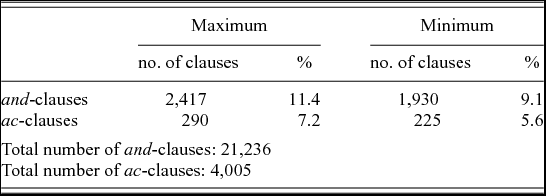
First I took the output file for conjunct clauses and separated out and-clauses and ac-clauses.Footnote 27 And-clauses are by far the most frequent ones, with 21,236 clauses against 4,005 ac-clauses. The next step was to find out whether there is any difference in distribution, and I focus on verb-final clauses here, since they are the least controversial. We want to determine whether and-clauses are more frequently verb-final than ac-clauses are, or vice versa. Consequently, I took the output files for and- and ac-clauses, and carried out query 2 from section 3.2.1 on the and-file and the ac-file separately. The results are shown in table 4; here as well, I provide a less restrictive and a more restrictive count.
Frequency of verb-final word order in and-clauses and ac-clauses

As table 4 shows, there is a difference between and-clauses and ac-clauses, with a lower frequency of verb-final order in ac-clauses. A chi-square test gives a p-value of <0.00001, which means that the difference is highly significant. In other words, we can reject the null hypothesis that the distribution is due to chance. However, since the data set is very large, chi-square alone is not sufficient, since anything can become statistically significant if the data set is large enough. We also need to calculate the effect size, which shows the strength of the association between the data. In this case, the effect size is trivial at 0.05 (see Cohen Reference Cohen1988). This means that although there is a statistically significant difference in the distribution, the magnitude of the difference is too small to be meaningful. With respect to verb-final order then, the statistical results show that and-clauses and ac-clauses can be conflated. It may be that there would be different results for other word orders; for example, the fact that Old English allows initial objects, which may be contrastive, might be mirrored in the distribution of and-clauses vs ac-clauses in relation to XSV word order. For the purposes of this article, however, it is not necessary to make the distinction.
3.6 Conjunct clauses and other word orders
In order to throw the verb-late and verb-final orders into relief, this section briefly considers other types of word orders in relation to conjunct clauses, more specifically SV, the ‘unmarked’ order; XV, the prototypical verb-second order, and XSV, the prototypical verb-third order. In particular, it will be shown that the single most common word order for conjunct clauses is in fact regular SV order. For these word orders, the queries are not as detailed as for verb-final and verb-late; the aim is rather to get a general impression of the distribution.
3.6.1 SV order
I searched for all conjunct clauses with the order conj + S + Vfin,Footnote 28 as exemplified in (28).
-
(28)

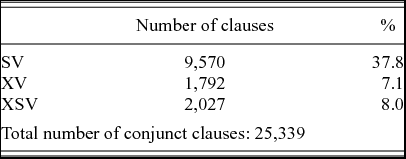
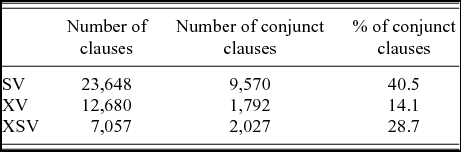
YCOE returned 9,570 hits. This means that 37.8 per cent of all conjunct clauses have the order SV (9,570/25,339). It is this order, and not verb-final/verb-late order, that is the single most common word order for conjunct clauses. Turning it around, we first find that there are 14,078 SV non-conjunct clauses,Footnote 29 which means that there are 23,648 SV clauses in total (9,570 + 14,078). Of these, 40.5 per cent are conjunct clauses (9,570/23,648). Hence, with this word order there is ‘symmetry’: conjunct clauses are frequently SV, and SV clauses are frequently conjunct clauses. Recall that with verb-final/verb-late order, it was different: conjunct clauses are not frequently verb-final/verb-late, but verb-final/verb-late clauses are frequently conjunct clauses.
Note that a clause like (29), which belongs with the SV pattern, is not captured by the simple query for SV, because the word order is conj + S + Vocative + V; i.e. YCOE has tagged this as two elements preceding the verb, and the query I used above specifies that the verb must be the second element. SV clauses with a left-dislocated element + resumptive subject + verb (30) are thus not captured either, and there may be other patterns that more detailed queries would find and include. This means that the frequency of SV order in conjunct clauses in reality is even higher than the figures given above, but the point, that conjunct clauses frequently have SV order, is clearly demonstrated by the data given above.
-
(29)
-
(30)


3.6.2 XV order
I searched for all conjunct clauses with the word order conj + X + V and an overt subject in some position following the verb. The initial element was defined as any kind of adjective or adverb, a prepositional phrase, a predicative, or a nominal element in accusative, genitive or dative case.Footnote 30 Examples are provided in (31)–(36).
-
(31)
-
(32)
-
(33)
-
(34)
-
(35)
-
(36)


YCOE found 1,792 such clauses, which means that 7.1 per cent of all conjunct clauses have this word order (1,792/25,339). The low frequency is not surprising, since this type of clause is often narrative-advancing, i.e. it is often an episode-marker introduced by the adverb þa ‘then’ (Enkvist & Wårvik Reference Enkvist, Wårvik, Ramat, Carruba and Bernini1987; Pintzuk Reference Pintzuk1995: 242; Wårvik Reference Wårvik2011; Bech Reference Bech, Meurman-Solin, López-Couso and Los2012). The total number of XV non-conjunct clauses is 10,888,Footnote 31 hence there are 12,680 XV clauses in total (10,888 + 1,792). This means that 14.1 per cent of all XV clauses are conjunct clauses (1,792/12,680). In other words, conjunct clauses are not likely to have this kind of verb-second order, and clauses with this word order are not very likely to be conjunct clauses.
In this count, clauses with the word order XXV, as in (37), would not be captured; such clauses should probably be included in a more detailed search.
-
(37)

3.6.3 XSV order
Finally I searched for all conjunct clauses with the word order conj + X + S + V. The initial element was defined as any kind of adjective or adverb, a prepositional phrase, a predicative, or a nominal element in accusative, genitive or dative,Footnote 32 see examples (38)–(41).
-
(38)
-
(39)
-
(40)
-
(41)


YCOE returned 2,027 hits, and thus 8.0 per cent of all conjunct clauses have this word order (2,027/25,339). As with the other patterns, I then turned it around. I searched for all XSV non-conjunct clauses, of which the number is 5,030.Footnote 33 The total number of XSV clauses is thus 7,057 (2,027 + 5,030). Consequently, out of all XSV clauses 28.7 per cent are conjunct clauses (2,027/7,057). For this word order, then, there is ‘asymmetry’; conjunct clauses are not likely to have this word order, but clauses with this word order are quite commonly conjunct clauses.
Note that this query as well is too simple to catch all possible word orders within this pattern. So clauses like (42), in which there are two initial elements, an object and an adverbial, or (43), containing two initial adverbials, are not captured here. A more detailed account of XSV word order would probably also want to include these. The query also includes clauses in which the first constituent is a sentence adverbial such as witodlice ‘verily’ or soðlice ‘truly’, as in (44), and they would have to be excluded in a more detailed overview.
-
(42)
-
(43)
-
(44)


3.6.4 Interim summary with tables
Tables 5 and 6 give a summary of the data presented in sections 3.6.1–.3.
Frequency of SV, XV and XSV word order in conjunct clauses

Frequency of conjunct clauses in the SV, XV and XSV word order patterns

As mentioned and exemplified above, the word orders I have discussed here do not account for all word orders or all constellations within the different word order patterns, since the main focus of this article was the relation between coordination and verb-final/verb-late word order. A secondary aim was to show that the word orders occur with different frequencies within the conjunct clause type, and the data presented demonstrate this.
Although this article has been concerned with establishing the empirical facts, a few suggestions concerning some possible reasons for the distribution are in order, if only to indicate a path for further research. I have previously suggested (Bech Reference Bech2001a, Reference Bech and Brinton2001b) that the distribution has to do with the intersection between the discourse function of clause types (conjunct vs non-conjunct) and the discourse function of different word orders in a language that permits word order variation.
As we saw in table 4, most conjunct clauses are and-clauses, signalling continuation or addition of some kind, and table 5 shows that the most frequent word order in conjunct clauses is regular SV order. When the word order is SV, the subject is usually topical and given, and the verb is unmarked; hence, the new information is likely to be found in the objects, adverbials or predicatives. In other words, when an action, or a series of events, or a description is depicted as continuing or additive, the new piece of information is likely to be the patient or beneficiary, or the time and location, or a quality, while the subject and the verb are backgrounded. It therefore makes sense that SV order should be the single most common word order in conjunct clauses. XV order, on the other hand, is rare in conjunct clauses, since this order typically marks episode boundaries by means of initial þa ‘then’ (see section 3.6.2), or a new and/or heavy subject, and hence would not naturally combine with coordination.
What, then, of the word orders with ‘asymmetrical’ distribution, i.e. verb-final/verb-late, and XSV order? Conjunct clauses can have verb-final or verb-late order, but, as we have seen, not by any means as frequently as has traditionally been claimed. In verb-final and verb-late clauses, there is stronger focus on the verb; it is dynamic and heavy (Bech Reference Bech, Meurman-Solin, López-Couso and Los2012: 74–5) and hence prone to be placed in final position in a language which allows variation and is sensitive to information structure. In coordinated clauses, whose function is to signal continuation and addition, and in some cases contrast, it is certainly possible to focus on the verb, but it is not the most common focus domain. If we change perspective and look at the distribution within the group of verb-final/verb-late clauses, we see that more than half have an initial conjunction (table 2). In other words, coordination does not correlate with verb-final/verb-late order to any great extent, but verb-final/verb-late order correlates with coordination. I suggest that the reason for this distribution is that in verb-final/verb-late sentences, in which the verb is in focus, the non-verbal elements are less prominent and likely to convey given information, and as such are linked with the previous context. Consequently, coordination frequently occurs within this word order type.
An asymmetrical distribution is also found with XSV order. Conjunct clauses are rarely XSV (table 5), but XSV clauses are relatively frequently conjoined (table 6). Like XV clauses, XSV clauses can be episode markers, but unlike XV clauses, XSV clauses normally have a given subject. The initial X element is often an adverbial element that marks a shift in time or place, or an adverbial of reason, and since the function of conjunct clauses is to signal continuation, addition and contrast, XSV order is not likely to be used very frequently for this purpose. But if we look at the function of the XSV order itself, it becomes clear that the X position is also a position for elements with anaphoric reference to the previous context, either adverbials or contrastive and non-contrastive objects; hence many of the XSV clauses are conjoined. It could also be mentioned that of the XSV clauses that start with a conjunction many have an initial object (see Bech Reference Bech2001a: 121–4), which provides a direct link to the previous clause, either through a cohesive or a contrastive relation. In other words, when a writer wants to continue the story by means of coordination, XSV word order is one of several word order possibilities, but it is not one that is frequently used, because other word orders, notably SV, would normally be better suited to organizing the information associated with coordination. To the extent that XSV order is used, however, it is quite frequently used with coordination, since the initial X element is one that often conveys some kind of anaphoric reference.
The brush strokes with which this section has been painted are broad, and do not quite do justice to what I believe is a fine-grained system in which discourse function and word order interact in producing very precise information patterns. What this discussion shows, however, is that it might be fruitful to consider clause structure in Old English both from the perspective of the function of clause types and from the perspective of word order function. Since Old English had word order variation, it is likely that the word orders were used for different communicative purposes.
4 Conclusion
On the basis of extensive data from the York–Toronto–Helsinki Parsed Corpus of Old English Prose (YCOE), this article has provided evidence that the oft-repeated claim that Old English conjunct clauses are like subordinate clauses in being typically verb-final or verb-late does not hold. However, if the perspective is turned around, and the word orders themselves are taken as point of departure, it becomes clear that a large proportion of the verb-final and verb-late clauses starts with a conjunction. In other words, conjunct clauses are not typically verb-final/verb-late, but verb-final/verb-late clauses are typically conjunct clauses. These two perspectives have been mixed up in the course of a century of research. Another main aim of the present article was to trace the research on this topic back in time, to establish how this misconception concerning conjunct clauses could have arisen. It was found that misunderstandings, failure to consider the data material properly and imprecise referencing have caused this error.
The empirical findings give rise to issues that may be considered in future research. For example, while it is clear that conjunct clauses are not typically verb-final/verb-late, they nevertheless show these word orders somewhat more frequently than non-conjunct clauses do. Furthermore, the ‘asymmetry’ or ‘symmetry’ of the word orders in relation to clause type is interesting: for example, conjunct clauses are rarely verb-final, but verb-final clauses are very frequently conjunct clauses. XV clauses, on the other hand, show symmetry: conjunct clauses are rarely XV, and XV clauses are rarely conjunct clauses. Other word orders show a different distribution again. I suggest that the distribution has to do with the interplay between the function of word order and the function of clause types, but more work is needed to shed light on the underlying mechanisms. Now that the record concerning the empirical data has hopefully been set straight, the groundwork for further investigations into the matter has been laid.