1. Introduction
Fornyrðislag is the Old Norse version of the traditional Germanic alliterative meter. Kuhn (1933) noted that poems in fornyrðislag some-times contain sentences where the finite verb occurs late in the sentence, even in independent clauses where the verb normally occurs early both in poetry and prose. Kuhn explained this peculiarity as influence from West Germanic poetry. The present article argues against Kuhn’s explanation of foreign influence and offers the preservation of archaic syntax as an alternative explanation.
Section 2 contains an overview of Old Icelandic syntax and Kuhn’s syntactic analysis of Germanic poetry. Section 3 explains Kuhn’s theory of West Germanic influence on fornyrðislag. Section 4 presents data on late placement of the verb and shows that it correlates with a known linguistically archaic feature. Section 5 sums up the results and their rele-vance.
2. Overview of Old Icelandic Syntax
2.1. Prose
By the time of the oldest preserved manuscripts, the placement of the finite verb in Icelandic prose exhibits symmetric V2 behavior. Thus, in all types of main and embedded clauses, the verb must occur in the first or second position. The second position is, in most cases, normal and unmarked, but the first position is often a valid stylistic choice. The following two quotes from AM 237 fol (Þorvaldur Bjarnarson 1878:162, 165; this is a diplomatic edition but I have used normalized Old Norse spelling for convenience) show both possibilities, with finite verbs in bold.Footnote 1
(1)


Usually considered the oldest Icelandic manuscript, AM 237 fol is dated to the mid-12th century. In this manuscript, the finite verb is never placed later than the second position, and this is true for Old Icelandic prose in general. Thus, one does not find sentences like the following:
(2)
It can be assumed that 12th and 13th century Icelanders would have found a clause like this ungrammatical or, at the very least, unsuitable for prose. In poetry, as we shall see, different rules apply.
2.2. Kuhn’s (1933) Discoveries
In an article published in 1933, the philologist Hans Kuhn made a large number of observations on the word order of poetry in the Old Germanic languages, including Old Icelandic. The best known of these were re-ferred to by Kuhn as the Satzpartikelgesetz ‘law of sentence particles’ and the Satzspitzengesetz ‘law of sentence openings’. These are now usually referred to as Kuhn’s laws. The validity and proper interpretation of Kuhn’s laws remains a hotly debated topic (for recent views see, for instance, Feulner 2010, Kristján Árnason 2002, and references cited there) and goes beyond the scope of this article. It suffices to note that I do not believe that the views set forth here are dependent on any particular interpretation of Kuhn’s laws. Since Kuhn believed that finite verbs functioned as “sentence particles” he saw their position in the sentence as related to a host of other phenomena. Nothing, however, pre-vents one from considering the finite verb’s behavior outside of this somewhat controversial framework.
One of the phenomena described by Kuhn is a dichotomy in the behavior of finite verbs in Old Icelandic poetry. To describe this, Kuhn’s distinction between BOUND and UNBOUND clauses needs to be intro-duced. Bound clauses are subordinate clauses and main clauses introduced by a coordinating conjunction. Unbound clauses are main clauses not introduced by a conjunction. Kuhn pointed out that in most types of Old Icelandic poetry, finite verbs in unbound clauses must occur in the first or second syntactic position, just as they do in prose. In contrast, in bound clauses, the finite verb can occur anywhere in the sentence, and late V2-violating placement is common—a stark difference to the word order of prose. The example in 3, from Sturla Þórðarson, Hákonarkviða 9; Finnur Jónsson 1908–1915 IIB:20, illustrates both points. I have bolded the finite verbs in this and subsequent examples.
(3)
‘The dog of wood swallowed every house in the Vermir’s settlement with his hot mouth and the fierce dog of the willow went howling over the gates.’
The strophe quoted, from a late 13th century poem, consists of two clauses. The first is a main clause not introduced by a conjunction and thus an unbound clause. Such clauses must have the finite verb in first or second position, and indeed, this one has its verb right at the outset. The second clause is a main clause introduced with the conjunction ok ‘and’, and is, thus, a bound clause. Bound clauses in poetry can have the finite verb in any position, and this one has it at the end, a syntactic arrange-ment not found in contemporary prose.
Even the elaborate dróttkvætt meter, the mainstay of Old Norse court poetry, follows Kuhn’s dichotomy. Despite its notoriously intricate word order—where sentences are frequently intertwined with each other—the V2 requirement is strictly followed in unbound clauses, and only in unbound clauses. The example in 4 is from Þjóðólfr ór Hvini, Haustlǫng 2; Finnur Jónsson 1908–1915 IA 14, IB 14; North 1997:16–19.
(4)
‘An unshort time ago, the wolf of the maiden flew noisily towards the commanders of hosts in an old eagle skin. The eagle sat down where the gods carried the horse of harvest-Gefn to the cooking fire. The fortress-Týr of the mountains was not accused of cowardice.’Footnote 2
This strophe, from one of the most archaic poems preserved, contains four clauses. The three unbound clauses all have their finite verb in the first or second position, but the subordinate clause, introduced by Þars ‘where’, has a late placement of the verb.
Kuhn explained the late placement of the verb in bound clauses as an archaic Germanic feature, preserved in a systematic way in poetry after it was lost in ordinary language. Comparisons with other Germanic lan-guages make this seem very probable, and recent commentators agree:
the distinction between unbound and bound clauses found in Old Germanic poetry has the characteristics of an archaism, instantiating the missing link in the development from partial V2 in Early Germanic to full V2 in Northwest Germanic. (Þórhallur EyÞórsson 2009:75)
There thus seems to be a general agreement that Old Norse poetry can reflect syntactic features from earlier stages of the language.
2.3. Differences among Meters
To complicate the picture above somewhat, different poetic meters dis-play different syntactic properties. The rules described in section 2.2 are valid for the large corpus of dróttkvætt poetry and most other meters used by the court poets. The so-called Eddic meters, best known for their use in mythological and heroic folk poetry, have some properties of their own. Poetry in the ljóðaháttr meter features the systematic abandonment of the syntactic properties observed by Kuhn. Not only is V2 freely violated in unbound clauses, but Kuhn’s laws of sentence particles and sentence openings are also abandoned wholesale. To at least some extent, these seem to be the effects of a strong preference for the stylistic fronting of the most important semantic element, but other factors may be at work as well. The syntax of ljóðaháttr is a rich subject for study (see, most recently, Þórhallur EyÞórsson 2009:71–75) but is not my focus here.
The fornyrðislag meter is the most direct Old Norse descendant of the common Germanic alliterative verse. In general, the distinction between bound and unbound clauses is observed in it, as in the following strophe from Helgakviða Hjǫrvarðssonar 10:Footnote 3
(5)
‘You, Hiǫrvarðr, leader of the host, are not a king of wholesome counsel though you are renowned. You had fire eat the settlements of the kings, yet they did you no harm.’
The strophe in 5 contains two unbound clauses, starting with ertattu ‘you are not’ and léztu ‘you had’, and both have the finite verb as their first constituent. The two bound clauses, starting with Þóttu ‘though you’ and enn ‘yet’ both have late placement of the finite verb. However, while the difference between bound and unbound clauses is normally observed in fornyrðislag, there are some exceptions. Those exceptions are the subject of this article.
3. V2 Violations in Unbound Clauses in Fornyrðislag
3.1. Kuhn’s Theory
There are a number of instances in fornyrðislag poetry where unbound clauses have late placement of the verb, in violation of the general principle. The following are some examples from the Eddic poems.
(6)
‘They sat down on the coast to rest.’Footnote 4
The question arises whether these exceptions to the rule can be explained in some principled way. Kuhn argued that they could. His idea was that poems dealing with subject matters known from West Germanic sources showed linguistic and metrical affinity to West Germanic alliterative poetry (Kuhn 1933, 1936, 1939). In his view, this was evidence that the poems in question had been translated or adapted from West Germanic originals. Often, it would seem, those original poems were German.
In Kuhn’s classification, most of the heroic poetry in the Codex Regius of the Poetic Edda belongs to the Fremdstofflieder, or foreign matter poems, while most fornyrðislag poetry preserved in other manuscripts, as well as the mythological poems of the Codex Regius, belong to the heimische Dichtung, or native poetry.Footnote 5 In the following text, I need to use these concepts to discuss and evaluate Kuhn’s theory, but this does not mean that I endorse this particular way of splitting the corpus.
In Kuhn’s theory, the foreign matter poems in the Codex Regius are Atlakviða, Brot af Sigurðarkviðu, Hamðismál, Fáfnismál, Guðrúnarhvǫt, Grípisspá, Guðrúnarkviða I, Guðrúnarkviða II, Guðrúnarkviða III, Helreið Brynhildar, Oddrúnargrátr, Reginsmál, Sigrdrfumál, Sigurðarkviða in skamma, and Vǫlundarkviða. The foreign matter poetry not preserved in Codex Regius consists of Hildibrandskviða, Hlǫðskviða, and fragments in Vǫlsunga saga. The native poems in the Codex Regius are Helgakviða Hjǫrvarðssonar, Helgakviða Hundingsbana I, Helgakviða Hundingsbana II, Hymiskviða, Vǫluspá, and Þrymskviða. The native poems in other manuscripts include Baldrs draumar, Grottasǫngr, RígsÞula, Hervararkviða, Hrókskviða, Innsteinskviða, Víkarsbálkr, Sigurðarbálkr, Erfikvæði um Magnús berfœtt, Merlínússpá, and a sub-stantial number of shorter poems and fragments.
With this classification in mind, I turn to Kuhn’s explanation of the late placement of the verb in unbound clauses. Kuhn pointed out that late placement of the verb in unbound clauses is frequent in surviving West Germanic poetry. He believed that the fornyrðislag exceptions could thus be explained as a result of West Germanic influence. If this were true, one would expect the exceptions to be more frequent in foreign matter poems than in native poems. Indeed, Kuhn discerned a significant differ-ence in this respect. In the 3360 long lines of native poetry in his investigation, he found 63 instances of late placement of the verb (1.9%). In 1820 long lines of foreign matter poems, he found 88 such instances (4.8%) (Kuhn 1933:61–62). This is a significant difference, unlikely to be coincidental.
Building on earlier work by Heusler (1906), Kuhn made a distinction between older and newer foreign matter poetry. In Heusler’s system, the older poems are Atlakviða, Brot af Sigurðarkviðu, Hamðismál, Hlǫðskviða, and Vǫlundarkviða. The newer poems constitute the rest. Kuhn points out that the old poems have a V2 violations ratio of 31/620 (5.0%), while the newer poems have a ratio of 57/1200 (4.8%), not a significant difference. Assuming the correctness of Heusler’s chrono-logy, it would thus appear that there is no chronological explanation for the frequency of V2 violations. It is, rather, purely a matter of foreign influence.
3.2. Criticism of the Classical German Account
The classical German account of the origins and development of the Norse heroic poems can be said to consist of Heusler’s work on Eddic chronology (1906), Kuhn’s series of articles on West Germanic traits in Old Norse poetry (1933, 1936, 1939), and Mohr’s articles (1938, 1939) on the similarities between newer Eddic poetry and Danish ballads. Although these works have been extremely influential, they have always had their critics. In recent years, the criticism has become extensive and, in my view, convincing (see, in particular, Fidjest⊘l 1999 and Sävborg 2003). Let me very briefly summarize the case against the Heusler-Kuhn-Mohr account
• Heusler’s chronology is based on very subjective stylistic criteria. It finds little or no support in seemingly more objective and reliable lin-guistic criteria.
• Kuhn tried to show that the foreign matter poems have German features, but the extant corpus of alliterative German poetry is so meager that firm conclusions cannot be based on it. Additionally, many of the foreign matter poems show few or none of the linguistic traits Kuhn is concerned with, while some of the native poems (such as Vǫluspá) do show them.
• Mohr’s theory assumes the existence not only of German poems no longer extant but of a whole genre (novellistische Spielmannslieder) which is not attested at all. His chronology of ballads does not fit well with modern research.
With this in mind, it is necessary to critically examine the phenomena discovered by Kuhn outside the framework within which they were originally described.
4. Towards an Alternative Explanation
4.1. V2 Violations in the Codex Regius
While Kuhn (1933:61–62) lists the total number of V2 violations in dif-ferent groups of poetry, he does not list them individually for each poem. In order to get a clear picture, I have thus done my own analysis. My numbers are similar to those listed by Kuhn but tend to be slightly lower. I am not certain about the reason for the discrepancies. Sometimes, the syntactic analysis of the poetry is not straightforward, and I may have rejected more ambiguous cases than Kuhn did. It is also possible that Kuhn simply had a keener eye for this and spotted some instances that I missed. I read each poem carefully twice, but it is inevitable that I have made some mistakes. It may be some consolation that since I list each instance, any future analysis can build on and improve upon my work.
Many of the poems in the fornyrðislag corpus contain formulaic repetitions of individual long lines or half-stanzas. When estimating the frequency of a linguistic phenomenon in a poem, it seems methodo-logically preferable to exclude these repetitions. In this, I am modeling my work after Fidjest⊘l’s (1999) analysis of the frequency of the um/of expletive particle (see section 4.3). Where the text of the manuscript is ambiguous or seemingly corrupt, I have used the reading of the edition used in each case. Undertaking independent textual criticism would have been time consuming and increased the possibility of bias on my part.
I have taken a fairly broad view of what constitutes fornyrðislag, but there are inevitably some borderline cases that require a judgment call. I have included Hamðismál and Hlǫðskviða: Although those poems show an affinity with málaháttr they can still be viewed as composed in a var-iant of fornyrðislag. I have also included Viacutekarsbálkr and Merlínússpá, despite the fact that they contain some strophes in kviðuháttr.Footnote 6 I have left out Atlamál, which is clearly in málaháttr throughout, and Hárbarðsljóð, composed in a free metrical form. Atlakviða is very much a borderline case, showing both an affinity with málaháttr and other irregularities. I have included it here, but I can certainly see an argument for leaving it out.
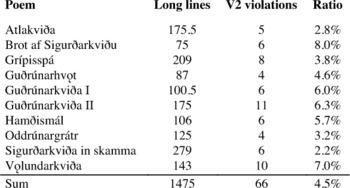
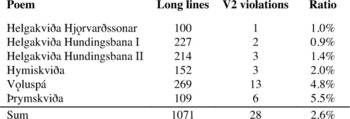
Below, I have listed and tabulated the V2 violations known to me in the Codex Regius poems containing 75 long lines or more. I have omitted the very shortest poems, where random variations are likely to have an excessive effect. The foreign matter poems (7–16) and native poems (17–22) are listed separately. I use the Neckel–Kuhn 1983 edition throughout.Footnote 7
Foreign Matter Poems (Codex Regius)
(7)
(8)
(9)
(10)
(11)
(12)
(13)
‘Early in the morning all regrets over people’s misfortunes make sorrow come alive.’Footnote 8
(14)
(15)
(16)
‘Good thing I’ll have my webbed feet’, said Vǫlundr.’Footnote 9
Native Poems (Codex Regius)
(17)
(18)
(19)
(20)
(21)
(22)
Foreign matter poems in the Codex Regius.

Native poems in the Codex Regius.

The tables above show the foreign matter poems with a ratio of 4.5 violations per 100 long lines, while the native poems have a ratio of 2.6/100. At first glance, this is consistent with Kuhn’s explanation in terms of foreign influence. When one examines individual poems, how-ever, this explanation becomes less satisfactory. Only the three Helgi poems show a ratio consistently lower than that found in the foreign matter poems. The three mythological poems (Hymiskviða, Vǫluspá, and Þrymskviða) have a ratio similar to that found in the foreign matter poems. Since the mythological poems belong to the native poetry, Kuhn resorted to another explanation for the V2 violations that occur in them, namely, the influence from ljóðaháttr. The foreign influence hypothesis thus seems to have rather limited explanatory power.
4.2. V2 Violations in Other Poems
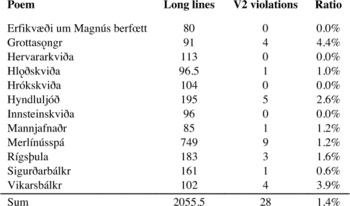
Let us now turn to poems in other manuscripts, where I have been able to find 12 poems in fornyrðislag with 75 long lines or more. These poems are more disparate than those in the Codex Regius. Not only are there mythological poems (such as Hyndluljóð) and heroic poems (such as Innsteinskviða), but also two poems in memory of contemporary kings: Sigurðarbálkr and Erfikvæði um Magnús berfœtt, as well as Merlínússpá, which is sui generis.
For convenience and ease of comparison, in each case I have used the same edition as Kuhn did (see Kuhn 1933:4). I have thus used the Heusler-Ranisch edition of Hervararkviða, Hlǫðskviða, Hrókskviða, Innsteinskviða, Mannjafnaðr, and Víkarsbálkr, and Finnur Jónsson’s edition of Erfikvæði um Magnús berfœtt, Sigurðarbálkr, and Mer-línússpá. For the text of Grottasǫngr, Hyndluljóð, and RígsÞula, I have used Kuhn’s (1983) updated version of Neckel’s edition; in the article under discussion, Kuhn (1933:20) used Neckel’s 1927 edition:
(23)
(24)
(25)
(26)
(27)
(28)
(29)
(30)
Poems not in the Codex Regius.

Erfikvæði um Magnús berfœtt, Hervararkviða, Hrókskviða, and Innsteinskviða contain no instances of V2 violation in unbound clauses (see table 3 above).
Taken as a whole, these poems have a lower V2 violations ratio than that of even the native poems in the Codex Regius. The only poems above to show a high frequency of V2 violations are Grottasǫngr and Víkarsbálkr, both of which are native poems. Presumably, Kuhn would have explained the instances in these poems as a coincidence or as a result of influence from ljóðaháttr. The only foreign matter poem on the list is Hlǫðskviða, which does not show a particularly high frequency of V2 violations.
On the whole, Kuhn’s explanation remains somewhat unconvincing. The poems in the Codex Regius have, by and large, a higher frequency of V2 violations than poems outside the Codex Regius, but one might wonder if foreign influence on the former group is the best explanation for this. The Codex Regius is a unique manuscript in many respects, representing a deliberate and early effort to collect traditional alliterative poetry. Poems in other manuscripts are usually integrated into prose narratives, and most of those manuscripts are significantly newer.
4.3. An Alternative Account
It is natural to ask whether one can offer another explanation for the late placement of the finite verb in unbound clauses in fornyrðislag. Recall that late placement of the finite verb in bound clauses was explained by Kuhn, in my view convincingly, as an archaic holdover from an earlier stage of the language. Could not the same phenomenon in unbound clauses also be an archaic feature? This seems like a very straightforward explanation that would remove the need to posit influence from hypothetical West Germanic poems, on the one hand, and from poems in ljóðaháttr, on the other.
Can it be confirmed that Proto-Norse poetry had instances of late placement of the finite verb in unbound clauses? As luck would have it, it can. The inscription on the Gallehus gold horn (dated ca. 400) contains what unmistakably qualifies as a Germanic long line (Schulte 2009:5).
(31)
The example in 31 contains an unbound clause, and its finite verb tawido ‘made’ is clearly in a late position (see Þórhallur EyÞórsson 2001:22–23 for a more detailed analysis). Some of the Eddic instances above have a similar structure. Here is one example:
(32)
The fornyrðislag meter is the most direct descendant of the common Germanic meter. It seems plausible that it would preserve some archaic linguistic features not found in more recently developed meters, such as dróttkvætt.
Given this, I propose that late placement of the verb is an archaic remnant of the freedom in word order present in the language at an ear-lier stage. If this were true, it would be reasonable to expect late placement to occur most prominently in the oldest poems and ever less in the newer ones. It has already been mentioned that Kuhn did not detect a significant difference between older and newer poems in this respect; however, since I do not believe Heusler’s chronology of the Eddic poems to be accurate, this is not necessarily a problem.
However, if the Eddic chronology of Heusler and his followers is not to be trusted, then what criterion can be used to evaluate the idea that late placement of the verb is an archaic feature? I propose to compare this putative archaic feature with another feature known to be archaic. The most suitable linguistic feature of this sort is the expletive particle um/of.
A conspicuous feature of Gothic and the West Germanic languages is the presence of unstressed prefixes, such as ga-/ge-. In Old Norse, the corresponding prefixes were almost completely lost, and very few traces of them remain in the oldest prose texts. In old poetry, however, the expletive particle variously written as of or um represents the remnants of the old prefixes. Thus, Old Norse rúni ‘friend, confidant’ corresponds to Old English gerúna ‘counselor, confidant’. In Haustlǫng, the oldest poem to preserve this word, it appears as of rúni.
In his detailed study of the expletive particle, Kuhn (1929) pointed out that it was most amply present in the oldest poetry and declined in usage as time went by. In a commendable study of the use of um/of in the 9th–12th centuries, Fidjestöl (1999:212–217) demonstrated a high corre-lation between the age of a poet and the frequency with which he used the expletive particle. One would expect the same tendency to hold true for Eddic poetry. On this basis, I use the frequency of the expletive par-ticle as a measure for how archaic the language of a given poem is. Fidjestöl (1999:224) has already tabulated occurrences of the expletive particle in poems of the Codex Regius, and I use his numbers. For the other poems, I have conducted my own search. Just as when I was searching for V2 violations, I have used the text of the editions and not resorted to independent textual criticism.
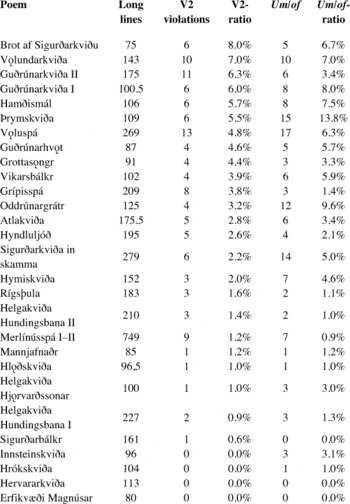
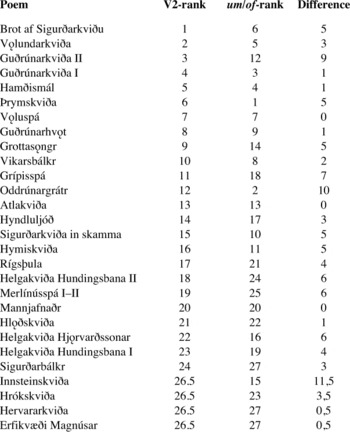
Identifying the expletive particle is usually a straightforward task. However, where the text is unclear it is sometimes difficult to distinguish it from the proposition um/of. There are two instances of this ambiguity in Grottasǫngr. Verse 7.4 né of sal gaucar ‘nor the cuckoos over the hall(?)’ is hard to interpret, but of seems more likely to be a preposition than an expletive particle, so I have not counted it. Conversely, verse 17.4 mitt of leiti/létti/hleyti ‘for my part(?)’ is somewhat obscure, but here of looks more like an expletive particle, so I have counted it (as did Kuhn 1929:22); for the latest attempts to grapple with these problems see Tolley 2008:48, 54; Dronke 2011:139–149. The findings are summar-ized in table 4, which shows that there is a strong tendency for poems with a high frequency of the expletive particle to also have a high fre-quency of V2 violations, and vice versa. One formal way to estimate the statistical dependence between two variables is to calculate Spearman’s rho. This non-parametric method was used by Fidjestöl (1999) in his study of the expletive particle and is also appropriate for my purposes here. Following Spearman’s method, one is concerned not with the absolute value of the variables, but with their rank. The poem with the highest frequency of V2 violations is assigned a rank of 1, the poem with the second highest frequency—a rank of 2, and so forth. Similarly, the poem with the highest frequency of the expletive particle is assigned a rank of 1, and so forth. The two different rankings can then be compared.
Frequency of V2 violations and the expletive particle.

V2 violations and occurrences of the expletive particle.

The dataset in table 5 gives a Spearman’s correlation coefficient of 0.81 (p < 0.001), consistent with a strong link between the two variables.
Table 5 allows us to identify outliers at a glance. The most noticeable outlier is Innsteinskviða, which contains no V2 violations but shows a moderately high frequency of the expletive particle. It is worth looking at the three instances of the particle in the poem.
(33)
What these data show is essentially the repetition of the expletive particle within similar formulaic expressions in close proximity. I count these as three instances since the repetition is not exact. Nevertheless, it is a less convincing case of archaic language than three independent occurrences of the expletive article would have been. I have no particular explanation for other outliers, and I think none is needed. The variation seems well within the bounds one would expect by random probability.
5. Conclusion
The behavior of the finite verb in Old Norse texts varies substantially among different text types. The most important types are summarized as follows:
• Fornyrðislag poetry: Late placement is frequent in bound clauses and occasionally occurs in unbound clauses.
• Dróttkvætt poetry: V2 is strictly observed in unbound clauses, but late placement is frequent in bound clauses.
• Old Icelandic prose: Symmetric V2 is observed. Late placement of the finite verb does not occur in any clause type.
It is commonly acknowledged that finite verb behavior in Dróttkvætt poetry preserves a more archaic stage of the language than prose does. In this article, I have further argued that the word order in fornyrðislag poetry represents an even more archaic stage of the language. This claim is supported by comparative evidence, namely, the high correlation be-tween the two variables: late verb placement in unbound clauses versus the use of the archaic expletive particle. In my view, the account presented here is better supported by the facts than Kuhn’s theory of West Germanic influence on some poems and ljóðaháttr influence on other poems. This analysis contributes to a better understanding of how Old Norse poetry can serve as a window into the development of Germanic syntax.
Some caveats, however, are in order. While I think it is reasonable to use the expletive particle as an indication for how archaic the language of a given poem is, this approach is not without its problems. It is conceivable that the use of the expletive particle is connected with the position of the verb in some more direct way than both being archaic features. Further work on the dating of Eddic poetry may yield a clearer answer on this front. The significant progress made in the dating of Anglo-Saxon poetry (see, for instance, Fulk 1992) inspires confidence that more rigorous results on Old Norse poetry can be obtained.
Finally, it must be stressed that Kuhn’s theory of West Germanic influence on Old Norse poetry rested on a number of linguistic and metrical criteria, and this article has only dealt with one of them. If West Germanic influence on the Kuhnian model can be established, it is possible that in some cases such influence reinforced archaic features already present. While I am generally skeptical about the Fremd-stofflieder theory, evaluating it as a whole is a complicated task, and it continues to provide a valid starting point for investigations (see, for instance, Suzuki 2010).