Epigraph
I now, Sir, proceed … to point out the necessity of making the education of the people the business of the Government.… No one, I suspect, will dispute that it is the duty of the Government not merely to punish all infractions of security, whether as regards person or property, but also to prevent, as far as possible, all such infractions. Neither will it be denied, I think, that among the most potent means of such prevention is a good education of the mass of the people.… As mere matter of policy, the education of the people ought to be considered as a part of the duties of the Government.… If we consider it the business of Government not merely to prevent evil, but also, by the concentrated force of the social system, directly to promote good—to increase, by all the means which its powers confer on it, the happiness and well-being of its subjects—then the mode in which the people are educated ought to be one of its first and most important objects of consideration.
(Mr. John Roebuck, MP for Bath, UK House of Commons Debate, July 30, 1833)
Across the nineteenth century, states throughout Western Europe and North America began institutionalizing systems of mass schooling (Soysal and Strang Reference Soysal and Strang1989). The United Kingdom was one of them. In 1833, the government provided twenty thousand pounds per year to voluntary schooling societies while requiring factory owners to offer laboring children two hours of elementary schooling per day. It then in 1870 established school boards and nondenominational schools nationwide, and by 1880 made elementary schooling compulsory (Evans Reference Evans1985; Holman Reference Holman1898; UK Parliament 2021a).
Traditional explanations for modern state development include increased militaristic competition (Tilly Reference Tilly2017); foreign and domestic political revolution, democratization, and the rise of programmatic distributive policies (Schleunes Reference Schleunes1989; S. C. Stokes Reference Stokes2007); increased economic competition among states in a consolidating, postmercantilist global economy (Hobsbawm Reference Hobsbawm1969; Landes Reference Landes2003); domestic politics and urban elite interests in continued control of the working and poor classes (Collins Reference Collins1977; Laqueur Reference Laqueur1976); and expansion of global empire, and, with it, increased ethnic diversity and immigration (Hall Reference Hall2009; E. T. Stokes Reference Stokes1980; Swartz Reference Swartz2019). With specific regard to education, these classic accounts suggest extraordinary social and economic change fomented the need for states to school (Green Reference Green2013). For example, state schooling was needed to create a coherent national culture out of many variegated subnational cultural backgrounds, as were the cases of France (Grew and Harrigan Reference Grew and Harrigan1991; E. Weber Reference Weber1976), Prussia and Austria (Schleunes Reference Schleunes1989), the United Kingdom (Allsobrook Reference Allsobrook1986; Colley Reference Colley1992), and the United States (Bailyn Reference Bailyn1972; Kaestle Reference Kaestle1983). As another example, risk of popular uprisings and unrest at home and abroad due to revolutionary, republican, democratic, and socialist movements represented a need for the state to preventatively appease an increasingly riotous population through concessional reform (e.g., Stern Reference Stern1977). From such perspectives, state systems of schooling arose to address perceived risk of social upheaval through mass socialization and inculcation of national duty and honor. Relatedly, another canonical explanation suggests industrialization and urbanization precipitated unprecedented cultural and linguistic heterogeneity in urban cores. This represented a need for the state to steer the construction and development of a standard culture, not only to render wildly diverse individuals comprehensible and recognizable to each other but also to render them visible to and mobilizable for the state (Anderson Reference Anderson2006; Gellner Reference Gellner1983).
This current article builds on these accounts. Specifically, it seeks to understand the frame of reference that made it conceptually possible for Mr. John Roebuck, MP, quoted in the epigraph, to argue in 1833 that the state should get into the business of schooling. Specifically, this article explains how and why statesmen came to see individuals in the aggregate, as an integrated, exogenously manipulatable “social system,” in the first place—and why they increasingly articulated schooling as core to this vision. With the United Kingdom as a single case of broader trends in the expansion of the state, I analyze for the first time the 1.3 million speeches ever given in both houses of parliament from 1803 to 1909. This comprehensive approach enables me to move beyond momentary Acts of Parliament to observe what statesmen have collectively debated, constructed, and articulated as the idea of the state and the business of government for an entire century. Building on cultural and institutional approaches centering rationalization as a focal explanation for the rise of state schooling, I find that broad cultural processes of social scientization throughout Western Europe and North America have a positive association with the discursive expansion of the state into education, even after accounting for the canonical explanations mentioned in the preceding text.
In what follows, I first advance my core argument: Nineteenth-century social science was a powerful force of cultural construction across the West. It elaborated and reified physiocratic and enlightenment theories of natural law and order, the reasoning individual, society as an entity with agency quasiindependent of the individuals comprising it, and the state that rationally planned for this society’s progressive development. This cultural framing made it increasingly conceivable for the state to intervene in schooling. Next, I engage with alternative explanations specific to the United Kingdom for the rise of schooling, including development, conflict, and imperial domination. Then, I detail how I designed the current research to test these explanations. Finally, I discuss the robustly positive relationship between social scientization and the topic of schooling within historical and theoretical accounts of state schooling and conclude with future directions.
Nineteenth-Century Social Scientization and the Expansion of the State
Nineteenth-century social science initiatives were both superordinate to the state and organized increasingly isomorphically within different states. On the one hand, these took the form of the International Statistics Congresses (1853–72), the International Statistics Institute (1885–present), and newly organized statistics journals publishing international and comparative population data and analyses (Flora Reference Flora1975; Schofer Reference Schofer1999). Such initiatives represented deliberate aims to make the quantitative study of distinct populations into a science that took states and their societies as naturalistic units of comparative empirical analysis. On the other hand, these initiatives took the form of states institutionalizing the decennial population census (United Kingdom in 1801) and incorporating statistics agencies and bureaus into the state apparatus across Western Europe and North America (United Kingdom in 1836). And they took the form of private and public societies, such as the Manchester Statistical Society (1833–present), the London (1834–87) turned Royal (1887–present) Statistical Society, the British Association for the Advancement of Science (1831–present), and the National Association for the Promotion of Social Science (1857–86), among others in Britain and the rest of the West (FitzPatrick Reference FitzPatrick1957; Perkin Reference Perkin2002).
Together, these initiatives zealously advanced social science as a tool to guide governance throughout Europe and North America. Even liberal and moderate Members of Parliament (MPs) constituted a sizeable majority of membership in early British social science initiatives and societies: for instance, more than a third of the founding signatories of the National Association for the Promotion of Social Science were MPs. This meant political and social policy routinely figured as the “applied” arena of the social sciences undergoing institutionalization (Goldman Reference Goldman2002). Moreover, early proponents of new social science, both internationally and domestically, self-consciously positioned it as relevant and necessary for a full gambit of social and state reform, preeminently that targeting crime, dissipation, indolence, unemployment, ignorance, unrest, and revolt. Since its onset, the presumptive social and political relevance of internationalist social science unabashedly made manifest its inherent Enlightenment teleology and ordered its ameliorative domestic research agendas (Turner Reference Turner2003).
In fact, the development and professionalization of the social sciences instigated less an original discovery of society and the socially attentive state than they did their further cultural construction and diffusion (Strang and Meyer Reference Strang and Meyer1993). These initiatives institutionalized the routine application of scientific epistemologies, principles, and objects in calculating and predicting lawlike regularities in populations of people. And they institutionalized the planning for these regularities by inventing and justifying new forms of institutions, such as state-sponsored learned academies and societies, statistics agencies, police forces, asylums and hospitals, and school systems (Barksdale Reference Barksdale1986; Porter Reference Porter1985, Reference Porter1986). In this context, social science entailed the respecification of core cultural myths and projects in the Western account, including the individuated human person with deep interiority (Meyer and Jepperson Reference Meyer and Jepperson2000; Wahrman Reference Wahrman2006); modeling of such individuated persons into aggregate units such as the public sphere, social system, nation, and humanity (Baker Reference Baker and Keith Michael1987a, Reference Baker and Keith Michael1987b); and reorganizing of the state into an impersonal, means-end, legal rational bureaucracy (Abrams Reference Abrams1988) responsible as the legal “guardian” or caretaker of the nation’s development and growth (Ramirez and Boli Reference Ramirez and Boli1987).
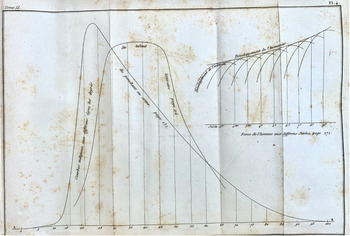
Two core routines of new nineteenth-century social science figured it as a mechanism for cultural rationalization, construction, and diffusion. The first routine of nineteenth-century social science was ontological elaboration (Meyer Reference Meyer2009 [1987]). Early-nineteenth-century social scientists did not simply take the universality of natural man for granted in measuring and devising their new theories of great men, the average man, the nation, and the state (Cousin and Wight Reference Cousin and Wight1856; Quetelet Reference Quetelet1968 [1842]). Instead, they also ascribed a whole host of other salient realities to be measured: age, sex, class, place of birth, religiosity, literacy, and later in the century, gender, and race. As an illustrative example, figure 1 is a reproduction of Quetelet’s statistical models of crime, literacy, and human development. Here we see not only different aspects of the person statistically modeled (propensity of crime and literary talent) but also demographically, indeed, naturalistically determined by age. Moreover, we see a statistical rendering of a theory of humanity: constituted by aggregated individual development in any given century, it has a developmental “force” that arcs upward and forward across all time.
Quetelet’s curves showing at different ages the propensity of crime (left), literary talent (middle), and the development of humanity (top right) as the mean development of the individual (bottom right).
Source: Quetelet Reference Quetelet1835.
Note: Author’s reproduction of the original first edition.

Nineteenth-century social scientists elaborated, in other words, traits that came to reconstitute the person, in large part laying both theoretical and empirical groundwork for contemporary, taken-for-granted notions of modern identity. They also elaborated how these traits could interact and compound propensities for social deviance or virtue writ large (such as the development of humanity; figure 1). Being an urban pauper was judged differently than being a country peasant (A. F. Weber Reference Weber1967). As an extension, social scientists also measured how the organization of society differentially “framed” individuals based on these different and interacting traits. Hence, Quetelet wrote in 1835, “Since the crimes which are annually committed seem to be a necessary result of our social organization … society prepares crime, and the guilty are only the instruments by which it is executed” (Quetelet Reference Quetelet1968 [1842]: 108). In so doing, social scientists animated society with an agency, indeed, “force” autonomous from and superordinate to the individual (figure 1). As a result of different types of societal organization, civilization as a whole could be more or less forward moving toward enlightenment notions of ever-greater perfectibility. A further core component of this ontological elaboration was therefore specific to the role of the polity. Nineteenth-century social scientists reconceptualized state administration from one of implementing arbitrary and absolute prerogative to one of legislators carefully monitoring, evaluating, and seeing to—that is, administering—the universal progress and development of civilization by ensuring the optimization of the “social system” (Turner Reference Turner2003; see epigraph). Importantly, state rationalization within this elaborated worldview meant it must increasingly be empirical (i.e., “positive”) and data driven to be effective at this responsibility (Baker Reference Baker1975; Comte Reference Comte1974 [1822]). And it must preemptively plan for and nurture the development of civilization with institutions such as compulsory education (Condorcet Reference Condorcet1976a [1793], Reference Condorcet1976b [1791]).
To be sure, elaborated universalistic theories of natural law and order, the reasoning individual natural man, society and the nation, civilizational progress and perfectibility, and positivism were derivatives of cosmopolitan physiocratic and enlightenment ontologies (Albertone Reference Albertone and Alan Charles2002; Popiel and Bloch Reference Popiel, Bloch and Alan Charles2002; Tröhler Reference Tröhler2016). Yet, these new nineteenth-century social science initiatives across Western Europe and North America went beyond mobilizing around enlightened theories, as past generations had done during the age of revolutions. They additionally sought to quantify, model, compare, and systematically plan and master them. If the first routine was ontological elaboration, then this was the second routine of new nineteenth-century social science: statistical reification. Constructs and categories with long-standing histories (such as the individual, society, and state) as well as their new problems and reasonable solutions (such as poverty relief, schooling, policing, and public health initiatives) were newly couched in mathematical, statistical, or otherwise quasiscientific terms. This was largely carried out through enthusiastic modeling, operationalization, and measurement (Baker Reference Baker1975, Reference Baker1990).
Statistics and quantitative measures were just one possible mode of articulating social scientific logics and theories, but proved especially poignant and persuasive, across Europe but especially in Britain for several reasons (Deringer Reference Deringer2018; Lugli Reference Lugli2019; Porter Reference Porter1995). First, these theories, inherently normative and political, became sanitized as part of what more critical scholars call bio- or techno-politics (Foucault Reference Foucault2008; Vernon Reference Vernon2005). Second, reification—rendering these theories into empirical reality with standard metrics—meant they had increasingly universal legibility and wider legitimacy. Together, these two consequences of cultural reification and elaboration facilitated widespread standardization and diffusion throughout the West, despite and even because of different and deliberate localized inflections, which produced exciting variation to be taxonomized and compared. This meant individuals with troublesome identities, populations needing managing and planning, and states that steered progress and development were part of a cultural package backed by new tabular population data throughout the West. Social science, in other words, jointly provided theoretical and statistical instrumentation to “see like a state” and to act like one, too; indeed, this instrumentation was, by design, abstracted and generic, so as to be neither specific to the state nor to the individuals it ministered (Scott Reference Scott1998).
As a core institution of cultural construction undergirding broader processes of rationalization in the West, then, nineteenth-century social science had three peculiar features. First, it was universalistic in both content and form. It specified time- and space-invariant entities, facts, and laws about human populations and their organization. And it promised a method to understand these social entities, facts, and laws that had universal application irrespective of time and place, facilitating diffusion of universalistic content. Second, nineteenth-century social science was totalizing in both content and form. In terms of form, for example, Quetelet introduced Laplace’s Central Limit Theorem into the study of human populations, still the workhorse of frequentist social science today, which meant both stars and men could be studied using the same techniques (Porter Reference Porter1986). In terms of content, nineteenth-century social science was making good on Bacon’s ambition of integrating scientific study of humans and human-made creations, including social structure and civilization, into a global science (Bacon Reference Bacon1960 [1620]). The assumption of and aspiration toward a totalized system of knowledge and causality that included humans and societies particularly exemplified the cultural content of nineteenth-century social science. Third, for these universalistic and totalizing features, nineteenth-century social science had a deeply religious character. It embedded political and social orders into natural and cosmological orders. The religious character of social science was additionally exhibited in its reforming and planning initiatives, representing both individual deliverance and collective salvation as progressive attainment of prosperity and justice through routine state regulation and reform—in the short run but also into perpetuity: indeed, into the afterlife of contemporaries. In this way, social science was less an aggressor against religious and traditional ontologies of the ancien régime than it was a translator of them: truths about the human condition that were once divinely revealed, scripturally recorded, and scholastically demonstrated now had different signifiers; they became empirically observed, theoretically modeled, and statistically tested. Precisely this religious character of social scientization made it such a powerful force of cultural construction across Western Europe and North America during the nineteenth century.
Social Science and the Schooling State
Based on these arguments, I expect broad cultural processes of social scientization across Western Europe and North America played a causally constitutive role in the discursive reconstruction of the idea of the state, as evidenced collectively in statesmen’s own deliberations and debates about the business of government. In particular, I expect processes of social scientization were positively associated with an expanded idea of a state that was raptly attuned to social welfare and order, discipline and punishment, and population control.
These newly conceivable domains of state governance were directly derivative of the teleological ontology of the new social sciences, which laid the conceptual foundation for enumerating and aggregating individuals into a population with entitivity, agency, specificity, and developmental momentum sustained across epochs of human civilization. This new, peculiar way of thinking about the population naturalized the very constructedness of society that philosophers previously theorized (e.g., Hobbes & Rousseau) and embedded it in a natural historical narrative, qua population, as an object of both study and exogenous manipulation. The state and its institutions became a new kind of technology. Social domains such as poor relief, healthcare, child welfare, and, indeed, education became especially conceivable for state tinkering and intervention as this ontology became institutionalized across the West. Scaled up and aggregated, the prosperity, health, reproduction, and development of populations became the existential ultimatum for states. Universal education was the lynchpin or central project of this new way of seeing and governing the social world. As its implicit theory went, universal education would affirm the uniqueness, rationality, and interiority of each individual; preempt individual crime and poor health by banishing ignorance and inculcating morality; thereby contribute to current societal development when scaled-up as population policy; and provide means for further future development and perpetual reproduction of society throughout time. To the extent the social sciences articulated and reified coherent and integrated notions of the natural, progress-oriented individuals and society, universalistic and timeless in character, then state schooling was necessary not only to sustain and legitimate the state but also this very theory of society propagated by the social sciences. In this way, state schooling arose as an idea both to implement and sustain this very peculiar cultural vision, helping to further construct many of the cultural myths of the modern nation-state (Ramirez and Boli Reference Ramirez and Boli1987).
In line with this reasoning, then, I expect increases in social scientization across Western Europe and North America are positively associated with increases in the prevalence of the topic of schooling in official political discourse about the business of government. As corollary, I additionally expect MPs’ discussions and debates on the topic of state schooling were inflected with statistical and social-scientific reasoning.
Alternative Explanations for the Rise of State Schooling
Over and beyond investigating the relationship between cultural processes of social scientization and the discursive expansion of the state into education, I explore canonical realist explanations of the rise of schooling. These include economic, social, and political development during the nineteenth century, which, interdependently, precipitated a suite of societal problems that demanded solutions through state systems of mass schooling. I engage these explanations and derive expectations in what follows.
Economic Development
Historical explanations of state schooling place great emphasis on the direct and indirect effects of economic transformations fomented by the Industrial Revolution (Cipolla Reference Cipolla1969; West Reference West1978). In these accounts, grassroots organizers, industrial elites and factory masters, and statesmen varyingly advocated for subsidiary state educational provision to meet increased demand for basic skills, including numeracy, literacy, industriousness, punctuality, docility, and hygiene (C. A. Anderson and Bowman Reference Anderson and Bowman1976; Hurt Reference Hurt1977; Mokyr Reference Mokyr2001). In the United Kingdom, some of the first governmental education provisions were included in the 1833 Factory Act, which not only reduced the legal amount of child labor but also jointly compelled 2 hours of elementary education per day (UK Parliament 2021a). Later in the century, socially and politically ascendant industrialists—those representing new British elite—would champion the cause of government schools not only to shore up their hard-won status against the religious and aristocratic elite but also to keep the working class dutifully subordinate (Laqueur Reference Laqueur1976). Together, historical explanations converge on how increased economic development spurred the state’s involvement in education through schooling; based on this line of reasoning, I expect the greater the economic development of the United Kingdom, the more prevalent the topic of schooling in parliamentary discourse.
Social Development
A core social transformation occurring throughout the eighteenth and nineteenth centuries across Western Europe and North America was intensification of urban growth. This growth can be understood in terms of geographic size, using conurbation of smaller towns as they each merged into each other and became more closely interconnected with better transport and communication. It can also be understood in terms of population density, using rural-to-urban migration patterns as countryside crafts, trades, and agriculture became increasingly mechanized in city peripheries (Allen Reference Allen2011; Knodel Reference Knodel1977; Merriman Reference Merriman2009). Classically, this meant urban centers were sites of increased cultural and socioeconomic diversity as well as anonymity, as distinct segments of the population became increasingly integrated in pursuit of new work in cities (Gellner Reference Gellner1983). Moreover, cities were increasingly perceived and depicted as centers of vice, with marked increases in rates of prostitution, crime, alcoholism, joblessness, and homelessness (A. F. Weber Reference Weber1967). In this context, systematized state schooling became a tool for mass socialization, especially of the working classes and poor in industrial cities such as Preston, Leeds, Manchester, and London (Frith Reference Frith1977; McCann Reference McCann1977). Schools were intended not only to inculcate morality and work ethic but also a pan-national identity and a common language that assimilated previously disparate periphery cultures and patois into the standardized one of the core (E. Weber Reference Weber1976). In this way, state schooling was seen as a solution to problems arising within densifying and diversifying urban cores during the nineteenth century. In line with explanations emphasizing social development, I expect the greater the urbanized population in the United Kingdom, the more prevalent the topic of schooling was in parliamentary discourse.
Political Development
A third canonical explanation for the development and expansion of state schooling emphasizes dramatic changes to the electorate and parliament during the “age of improvement” (Briggs Reference Briggs2014; Evans Reference Evans1985). Previous quantitative empirical work has shown episodic spurts in legislative activity, particularly from private members representing constituent interests on the backbenches, with the passing of the three Reform Acts of 1832, 1867, and 1884 (Cox and Ingram Reference Cox and Ingram1992). In political science accounts, this parliamentary reform and the rise of a new science of government partly signaled the intention of, if not fully realized, cleaning out rotten boroughs and, with it, decreasing old corruption and clientelism and increasing meritocratic appointment processes and programmatic distributive policies (S. C. Stokes Reference Stokes2007; Vernon Reference Vernon2017). In these explanations, democratization jointly reconstituted who ran the polity and the content of its order of business. Schooling from this view was an initiative that reflected new policy prerogatives of the ever-growing electorate and optimized utility of public government both as a distributive program and in its function to train and promote advancement among new civil servants. In less Whiggish and more critical accounts of parliamentary reform, increases in suffrage exacerbated an already racist, sexist, and capitalist regime, whereby rich, white, protestant men from industry and empire contrived government reform to maintain their own economic and social dominance. From this view, schooling was a new tool of social control and stratification that the newly enfranchised devised to keep their fortunes and power (Collins Reference Collins1971; Tyack Reference Tyack1976). Based on explanations centering on the rise of popular sovereignty and democratization of the nineteenth-century polity, I expect the greater the rates of suffrage in the United Kingdom, the more prevalent the topic of schooling in parliamentary discourse.
Domestic Conflict
Domestic conflict is a key explanation of nineteenth-century state schooling. Whether domestically in the United Kingdom (e.g., the Peterloo Massacre or Chartist protests) or throughout Europe (e.g., 1848 Peoples Revolutions), social upheaval due to dramatic change in societal conditions figured as a problem schooling could solve through inculcating civic and moral virtue, national identity, and literacy (Eisenstadt Reference Eisenstadt1971). In terms of the UK social protests, this meant schooling already riotous populations. In terms of European social protests, this meant preemptively curtailing dangerous influences of radical republicanism and socialism abroad. Indeed, perhaps since 1688, but certainly since Macaulay’s (1800–9) five-volume The History of England, a dominant Whiggish interpretation of British political development was that, in contrast to those on the continent, Britons avoided revolution by moderate, even-keeled reform (Macaulay Reference Macaulay1979; Pincus Reference Pincus2009). I expect experienced social conflict in the United Kingdom and abroad was associated with greater attention given to the topic of schooling in parliamentary discourse.
Colonial Domination
The last explanation I test is domination. According to OECD, in the 1750s, the populations of the British Caribbean and India were 370,000 and 185,000; in 1830, those numbers were 840,000 and 227,000, respectively (Maddison Reference Maddison2001). In terms of countries, 33 were colonized in 1815, whereas in 1914, that number grew to 67. Progressive acquisition, settlement, and domination of foreign lands and peoples over the century was part and parcel of Britain’s post-Abolition civilizing regime, wherein schooling of white settlers and natives was imperative for the functioning of empire and the maintenance and further elaboration of racial hierarchies (Hall Reference Hall2009; Seth Reference Seth2008; Whitehead Reference Whitehead2007). To these ends, colonial governments often followed suit in the wake of the Acts of Parliament occurring in the metropole to secure basic access to schooling for children of white settlers and colonialists. They often also facilitated cooperation of secular and religious schooling initiatives intended to civilize natives. Importantly, the periphery and metropole were interpenetrative (Reed and Adams Reference Reed and Adams2011). Certain pseudopsychological and racist logics—such as further cultivation and salvation of the “childlike savage” overseas as well the “savage child” on English city streets—were often activated in reforms for schooling across the empire. These reforms often served the interests of governing white bourgeois evangelicals, who were insecure about their economic, spiritual, and racial superiority (Goodman et al. Reference Goodman, Gary and William2009; Swartz Reference Swartz2019). Based on these arguments, I expect the greater the growth in number of foreign countries constituting the British Empire—the greater colonial expansion—the more prevalent the topic of schooling was in parliamentary discourse.
Research Design
Data
This research builds on previous studies of British parliamentary change during the nineteenth century (Abbott and DeViney Reference Abbott and DeViney1992; Cox and Ingram Reference Cox and Ingram1992). The United Kingdom serves as a single-case study to explore larger macrocultural trends in state expansion. For this study, I am broadly interested in understanding the discursive expansion of the state. I conceptualize discursive expansion as the broadening discursive register of recorded official parliamentary deliberation, wherein statesmen debate different, new, more forms of legislative and state action. The population of parliamentary speeches is ideal for this study, therefore, as these data contain all that was ever recorded of statesmen, including debates and speeches and bill readings. They represent all the topics up for debate—quite literally—throughout the whole nineteenth century. In this way, the parliamentary text data enable me to observe when certain domains came into sharper focus and whether that focus shifted, irrespective of whether those topics were translated into positive state structures through Acts of Parliament. The text data are fully digitized, marked up, hosted, and made freely available for download as hundreds of chronologically organized volumes of XML files by the UK Hansard Offices Archive (UK Parliament 2021b).
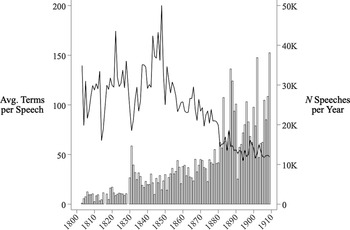
To capture the parliamentary speeches embedded in the volumes of XML files, I wrote a program using Python 3.6.4 to parse each volume, creating a data frame containing the raw text of each speech as well as relevant meta-data (chamber, date, and speaker). During 1803–1909, UK MPs gave circa 1.36 million speeches, with more and shorter speeches given in the more recent period compared to beginning the nineteenth century, which I visualize with the histogram and line plot in figure 2.
Mean length (line plot) and frequency (bar chart) of speeches given in the UK Parliament, 1803–1909.
Source: UK Parliament 2021b.
Note: The digitized parliamentary debates in 1816 and 1829 are missing from the archive altogether.

To analyze this data, I first implemented standard text-as-data complexity reduction techniques. This entails approaching each speech data-analytically as a “bag of words,” explicitly ignoring word order, capitalization, punctuation, declination, and conjugation. This allows one to compute frequencies of all canonical representations of a given word (e.g., “Regulate” and “regulated!” are each represented as “regul”). To do this I specifically preprocessed each text by removing whitespace, punctuation, and capitalization (i.e., “tokenizing”); removing digits; removing highly frequent but substantively inconsequential English-language and corpus-specific words (e.g., “stop words” such as and, in, the), and applying the Porter stemming algorithm, which removes and collapses plural and conjugated word endings (“party” and “parties” become “parti”). About ten thousand speeches were dropped altogether during preprocessing, as they were short replies comprising only stop words (e.g., “No, Sir.”). Of the remaining 1,068,684 speeches in the final analytic sample, half contain 21 terms or more, with a mean of 77 terms and standard deviation of 209 terms. There are 469,703 unique terms across all speeches.
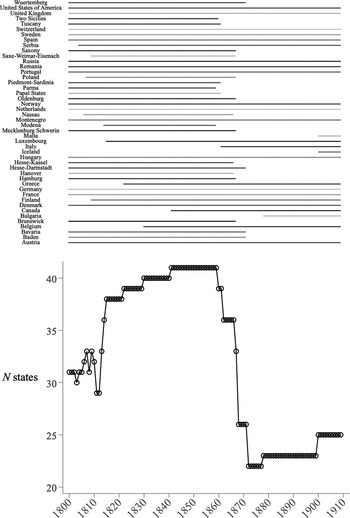
Alongside observing whether the discursive domain of state intervention expands during the nineteenth century, I designed this research to explore whether and to what extent variation in this expansion over time is systematically related to substantive features of the British state. For measures of these features, I rely on Version 10 of Varieties of Democracy (“V-Dem”) dataset, which has timeseries data on states worldwide (1789–present) with specific focus on “conceptualizing and measuring democracy” (Coppedge et al. Reference Coppedge, John, Carl, Staffan, Jan, David, Michael Bernhard, Adam, Allen, Anna, Kyle, Kelly, Pamela, Daniel, Brigitte, Rachel, Svend-Erik, Jeffrey and Daniel2020a). For this present study, I use data directly computed by the V-Dem project as well as data collated from third-party research institutes and data publishers, such as the Maddison Project for historical GDPs. The V-Dem dataset is thusly ideal for two reasons. First, it contains comprehensive data on the United Kingdom each year for the century. This means I can measure time-variant characteristics of the United Kingdom and explore relationships among changes in these characteristics and changes in articulated notions of the state in parliamentary discourse. Second, it also contains comprehensive country-year observations for all of Europe and North America (see figure A-1 in the appendix for which states were observed and when). Additionally, I collected data on the number of statistical journals in circulation, the number of international statistical congresses, and the number of fellows in the Royal Statistical Society based on previously reported research (Flora Reference Flora1975; Mouat Reference Mouat1885; Rosenbaum Reference Rosenbaum1984). Together, these data allow me to measure the broader shifting social, political, cultural context in which the United Kingdom is embedded.
Outcome of Interest: Schooling in Parliamentary Speeches
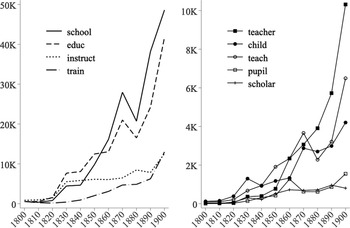
To measure shifting notions and discursive expansion of the state in parliamentary speeches, I first conceptualized “schooling” as polyvalent topic indicated by multiple keywords that MPs might have varyingly employed in their speeches. These keywords are schooling, schoolhouse, school, schoolteacher, teacher, teaching, schoolmaster, pupil, student, literacy, and child. I retrieved all synonyms of these keywords from the WordNet 3.0 dictionary using the Stanford Natural Language Toolkit (NLTK). This resulted in a master list of 48 keywords and synonyms, with varyingly proximate semantic meaning to the construct of state schooling. Next, I recruited three coders, who, with me, independently identified the terms indicating semantically unrelated topics (e.g., “shoal” ∼ school and “tyke” ∼ child); I omitted from this master list those words most reliably eliminated among coders (0.8). This resulted in a reduced indicator keyword list comprising 26 terms. I then wrote a function using Python to compute the frequency that each of these indicator keywords occurs in each speech across the corpus and then conducted reliability analysis on all keywords’ frequencies. Of the 26 keywords, I selected those that had item-test and item-rest correlations higher than 0.2, resulting in a final list of nine indicator keywords. In figure 3 I visualize trends in the frequencies of these keywords in speeches. With some variation, these line plots show a large, linear increase over time in occurrences of keywords indicating the topic of schooling, with a notable jump during the 1830s—the beginning of what has been termed “the age of improvement” or reform (Briggs Reference Briggs2014; MacDonagh Reference MacDonagh1958).
Frequencies of keywords indicating the topic of schooling in speeches given in the UK Parliament, 1803–1909.
Source: UK Parliament 2021b.
Note: I depict untransformed frequencies for two reasons. First, many more speeches are given later (figure 3). This means the curve on schooling would artificially decrease over time if means were depicted. Second, the growing number of speeches is part of the discursive expansion I seek to explain. In the models, I control for speech length (table 2).

Among these indicator keywords, I found a satisfactory reliability (alpha = 0.77) and I conducted latent factor analysis and found evidence of one dimension (eigenvalues for factor 1 = 2.9, factor 2 = 0.62). For the outcome of interest, schooling, I constructed a standardized index using the first factor from the latent factor analysis. This variable measures the degree the topic of schooling is present in a given speech. I chose to construct and measure the outcome at the speech level for several statistical and substantive reasons. First, specifying speeches as the unit of analysis grants me the statistical power to test the whole battery of focal and alternative explanations with appropriate controls, whereas using yearly observations of the total number of speeches dedicated (broadly construed) to schooling would leave the analyses underpowered with an n = 106 years. Substantively, measuring the topic of schooling continuously as a score on a standardized index enables me to investigate the degree of emphasis on the topic of schooling, a granular and relevant representation of how MPs varyingly chose to use bench time to discuss the topic. A coarser measure, for example a binary indicator of whether an MP mentioned a schooling keyword, would fail to capture in a meaningful sense whether that speech was about schooling or whether it only had a fleeting reference. With such a measurement, a speech with a single measure of “educ” would be counted as identical to a speech composed mostly of schooling-related terms. The third and final motivation for measuring schooling continuously at the speech level entails my conceptualization of the topic as being polyvalent. By using factor analysis, I am able to model and then measure how multiple terms, more or less frequently employed, in any one speech signals its focus or emphasis on the topic of schooling. This level and mode of measurement, in other words, enables me to capture at once the multiple dimensions and degree of the topic with a single composite measure.
Critically, in the models in the following text, I explain change in average emphasis on the topic of schooling over a 1-year period by statistically controlling for the average emphasis on the topic in the previous year’s speeches. In this way, I explain variation in the change of MPs’ engagement with the topic over time.
Focal Explanation: Social Scientization
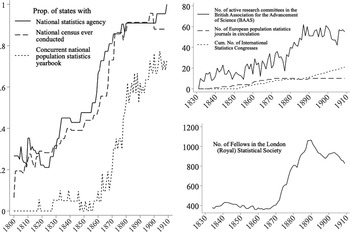
I seek to explore whether the ongoing development and professionalization of the social sciences, and, with them, the expanded application of scientific principles into domains of social policy and governance, are related to increased legislative discourse around new forms of state intervention into society, such as schooling. I measure social scientization as a supra- and cross-national cultural process using indicators from across North America and Europe and within the United Kingdom, which I identify, define, describe, and justify in table 1 and which I visualize in figure 4.
The indicators of social scientization I measure can be put into three classes. The first class of indicators measure social scientization occurring within the United Kingdom, both as a characteristic of the state apparatus and as the presence of civil society initiatives (table 1, panel A). The second class of indicators measures social scientization of other states in Europe and North America (table 1, panel B). Together, these represent a nascent and institutionalizing model of a scientized state apparatus. The third class of indicators measures social scientization as an international epistemic phenomenon (table 1, panel C). These represent the extent people were increasingly organizing around internationalist social science initiatives.
Indicators of nineteenth-century social scientization

Source: Coppedge et al. Reference Coppedge, John, Carl, Staffan, Jan, David, Michael Bernhard, Adam, Allen, Anna, Kyle, Kelly, Pamela, Daniel, Brigitte, Rachel, Svend-Erik, Jeffrey and Daniel2020a; Desrosières Reference Desrosières2011; Flora Reference Flora1975; MacLeod and Collins Reference MacLeod and Collins1981; Mouat Reference Mouat1885; Rosenbaum Reference Rosenbaum1984; Ventresca Reference Ventresca1995.
Trends in indicators of social scientization, 1803–1909.
Source: Coppedge et al. Reference Coppedge, John, Carl, Staffan, Jan, David, Michael Bernhard, Adam, Allen, Anna, Kyle, Kelly, Pamela, Daniel, Brigitte, Rachel, Svend-Erik, Jeffrey and Daniel2020a; Flora Reference Flora1975; MacLeod and Collins 1981; Mouat Reference Mouat1885; Rosenbaum Reference Rosenbaum1984.

Critically, I conceptualize these as tightly interrelated indicators of a larger, more sweeping cultural process occurring throughout the nineteenth century, not as individual explanations in and of themselves. As I tell in table 1, social scientists who were members of new professional societies analyzed the data census agencies collected, cleaned, collated, and published in statistical yearbooks. Results of these analyses were then published in international statistical journals and presented at international statistical congresses and conferences, which then articulated recommendations to respective state agencies responsible for continued enumeration, categorization, and amelioration of identified, indeed, theorized social problems. In this way, these variables jointly indicate an organized assemblage of processes that constituted new kinds of agency (counting and planning states) and agencies (state units doing that counting and planning) and expressly articulated a new policy-relevant epistemological regime. Social scientization, then, was a process whereby not only the state gets more science (e.g., instruments of observation, methods of analysis, theories for interpretation, and new programs and policies for intervention) but also more scientized (i.e., elaborately reorganized to produce and pursue such science). To be sure, these indicators are in one aspect measures of the expanding state. I distinguish them, however, from other indicators of structural elaboration as foremost conceptual drivers of such elaboration. Unlike, say, the state postal service or poor relief administration, governmental statistics agencies, censuses, and population yearbooks are institutionalized ontology and epistemology, not derivatives of them. They articulated a totalized, universalistic understanding of individuals, populations, and states (i.e., an ontology of society) and built instruments of observation and furnished data (i.e., an epistemology to study that society) that motivated and justified yet further programs of state intervention. By this conceptual reasoning, institutionalized social science provided the cognitive framing and reification necessary to conceive, advance, and normalize other kinds of state expansion. Albeit with a less critical inflection than the original, this conceptual distinction of state social science agency as a predictor of its expansion is consonant with philosophical notions of the ideological state apparatus (Althusser Reference Althusser2014).
I visualize trends in social scientization indicators in figure 4. Generally, trends in the indicators of social scientization show dramatic growth around mid-century, lagging schooling by a decade, but nonetheless congruent with the century trend.
These indicators exhibited a very high reliability (alpha = 0.98) and evidence for a unidimensional view of social scientization (eigenvalues of factor 1 = 10, factor 2 = 0.5). I interpret this as empirical support for my conceptualization of them as being tightly interrelated and indicative of a larger, integrated, and coherent cultural process occurring within and around the United Kingdom during the nineteenth century. For my focal explanatory variable, social scientization, I construct a standardized composite based on these indicators. This measure describes the degree of social scientization systemwide in a given year. In the models provided in the following text, I lag this and all other explanatory variables by one year. This means coefficients correspond to how much more legislators engage with schooling in the current year over the previous, due to observed intensification of social scientization in the previous year.
As a close corollary investigation, I analyze the degree MPs used scientized reasoning to articulate notions of schooling. I measure the degree of scientization of a speech using the same procedure with which I measure the dependent variable. I first computed the frequencies of nine keywords indicating scientized and empirical reasoning: statistics, number, evidence, average, population, figure, fact, estimate, and show. These had an acceptable reliability (alpha =.70) and the first latent factor an eigenvalue of 2.6 and the second an eigenvalue of 0.38, suggesting these individual keywords speak to a single, broader semantic sense of social science. I then constructed a standardized index, social science in speech. The models provided test whether the topic of state schooling was closely associated with social science reasoning in political discourse. Note, this is a two-way partial association of how MPs jointly articulated social-scientific thinking and notions of the schooling state in their speeches, not an estimate of a causal relation.
Alternative Explanations
I use growth in GDP per capita as a proxy of economic development. I measure this as percent change in the UK GDP the previous year. I proxy social development as increased urbanization. I measure this as percent change in the ratio of urban to total population in the previous year. Last, I proxy political development as the proportion of the population with the vote in the previous year. Because these indicators of development were very highly correlated (r = 0.88 – 0.91) and would lead to unstable estimates in statistical inferences due to multicollinearity, I successively test the relationship of each with schooling separately first and then construct a standardized factor of these three indicators to measure development generally (Dormann et al. Reference Dormann, Jane, Sven, Carsten, Gudrun, Gabriel, García Marquéz, Bernd, Bruno, Leitão, Tamara, Colin, Osborne, Björn, Boris, Skidmore, Damaris and Sven2013). These indicators of development exhibit evidence of both a high reliability (alpha = 0.97) and a single dimension (eigenvalue for factor 1 = 2.7, factor 2 = 0).
I measure domestic conflict in the United Kingdom as whether armed conflict in the United Kingdom occurred in the previous year and domestic conflict abroad as the proportion of states excluding the United Kingdom, within which armed conflict occurred the previous year. The first measure straightforwardly indicates the presence of social and political disorder in the United Kingdom. The second measure proxies the perceived threat that popular unrest from abroad would instigate unrest at home.
Last, I proxy the degree of British domination—UK colonial expansion—as the percent growth in the number of present-day countries in British possession in a given year throughout the nineteenth century (O’Neill Reference O’Neill2020).
Controls
Finally, I control three characteristics of parliamentary speeches. First, I control for speech length, a continuous measure of the number of terms in the preprocessed bag-of-words representation of the original raw speech. Second, I control for the chamber the speech was delivered in, a dichotomous measure indicating the speech was delivered in the House of Commons. Last, I control for the linear relationship of time using the year the speech was delivered in.
Data-Analytic Strategy and Findings
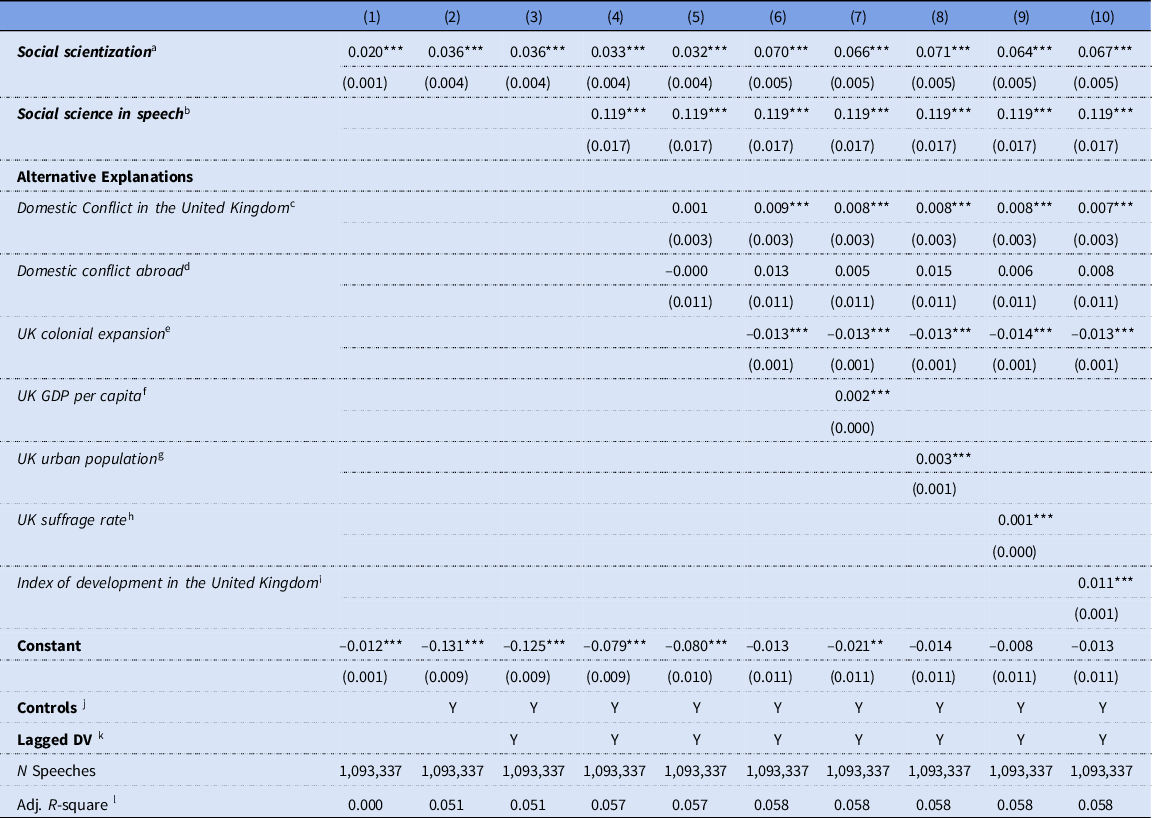
I test the preceding expectations by sequentially fitting 10 longitudinal ordinarily least squares regression models with robust standard errors. I begin with the following bivariate regression model,
 $$Schoolin{g_{sy}} = {\rm{\;}}{\beta _0} + {\rm{\;}}{\beta _1}\,Scientizatio{n_{y - 1}} + {\varepsilon _{sy}}{\rm{\;}}$$
where, for speech s given in year y,
 $Schooling$
is the standardized factor score of the topic of schooling and
 $Scientization$
is the standardized factor score of broad cultural processes of social scientization in the previous year. With Model 1, I find initial confirmatory evidence that increased scientization is associated with MPs’ increased attention to the topic of schooling (see table 2).
OLS results explaining the prevalence of the topic of schooling in UK parliamentary speeches, 1803–1909

Source: Coppedge et al. Reference Coppedge, John, Carl, Staffan, Jan, David, Michael Bernhard, Adam, Allen, Anna, Kyle, Kelly, Pamela, Daniel, Brigitte, Rachel, Svend-Erik, Jeffrey and Daniel2020a; O’Neill Reference O’Neill2020.
Note: Robust standard errors in parentheses.
a Social scientization is a standardized factor score measured in standard deviation units of the degree of social scientization in a given year based on seven systemwide and UK-specific indicators of social science institutionalization.
b Social science in speech is a standardized factor score, measured in standard deviation units, of the degree that social science terminology is prevalent in a given speech based on the frequency of 17 indicator keywords of social science.
c Domestic conflict in the United Kingdom is a lagged measure indicating whether there was domestic armed conflict in the United Kingdom the previous year.
d Domestic conflict abroad is the proportion of states in Europe and North America in which there was conflict in the previous year.
e UK colonial expansion is the percent change in the number of present-day countries that were in British possession in the previous year.
f UK GDP per capita is the percent change in GDP per capita from the previous year.
g UK urban is the percent change in the ratio of the urban population to the national population.
h UK suffrage rate is the proportion of the adult population with the legal right to vote.
i Index of development in the United Kingdom is a standardized factor score measured in standard deviation units of the degree of economic, social, and political development based on the three indicators in notes f, g, and h.
j Controls include speech length, which is the number of preprocessed terms of a given speech; year, which is centered at 1803; and House of Commons, which is a measure indicating whether a given speech was given in the House of Commons.
k The lagged dependent variable, schooling topic, is a standardized factor score, measured in standard deviation units, of the degree that the topic of schooling is prevalent in a given speech based on the frequency of 12 indicator keywords of the topic of schooling. I use the average schooling factor score of all speeches given in the preceding year to model the change in the political discourse.
l The adjusted R-squares for models 7, 8, 9 and 10 are each compared to Model 6 containing no indicators of development.
+ p < 0.10; * p < 0.05; ** p < 0.01; *** p < 0.001.
Next, I test whether this relationship persists after controlling for a battery of confounding variables measuring characteristics of speeches and secular trends:
 $$ (1) + Controls_{sy}'{\beta _{{2_{1 - 3}}}}{\rm{\;}}$$
where
 $\;Controls_{sy}'$
is a vector of three control variables, including speech length, speech year, and speech chamber.Footnote
1
The primary explanation is robust to the inclusion of these controls. I interpret the results of Model 1 and Model 2 as preliminary evidence that broad cultural processes of social scientization played a role in shaping the UK political discourse over the century: Increases in social scientization tended to be registered in MPs’ increased attention to the topic of schooling.
In Model 3, I home further in on the relationship of interest by including the lagged outcome on the right-hand side of the equation:
 $$ (2) + {\rm{\;}}{\beta _3}Sc\overline{hool}in{g_{y - 1}}$$
where
 $Sc\overline {hool}in{g_{y - 1}}$
is the average degree of engagement with the topic of schooling across all speeches given in the previous year. With the inclusion of the lagged outcome, I model the change in legislators’ engagement with schooling from one year to the next as an outcome of social scientization in the previous year. The core question asked here is whether MPs discussed schooling more, holding constant any previous attention given the topic, as a result of social scientization. The coefficient on scientization in Model 3 shows a positive effect (
 ${\beta _{Scientization}} =0.036,\;p < 0.001$
). I interpret this as initial credible evidence that MPs increasingly engaged with schooling as social scientization intensified throughout the century.
As a corollary analysis, in Model 4, I test whether MPs tended to use scientized reasoning to articulate their views on the topic of schooling:
 $$ (3) + {\rm{\;}}{\beta _4}ScientizedSpeec{h_{sy}}$$
where
 $ScientizedSpeech$
is the standardized factor score of the degree an MP used scientized diction or rhetoric in his speech. As this is a two-way, partial correlation, the question here is whether MPs used state schooling language in conjunction with social-scientific language, or vice versa. I find this relationship is consistently large and positive across all models, indicating MPs tended to use scientized language to articulate their views about schooling.
Is the relationship between the discursive expansion of the state into education and cultural processes of social scientization robust to alternative explanations emphasizing development, conflict, and domination? To begin answering this question, I next fit Model 5 with indicators of domestic conflict:
 $$ (4) + {\rm{\;}}{\beta _5}UKConflic{t_{y - 1}} + {\beta _6}WesternConflic{t_{y - 1}}$$
where, for year y,
 $UKConflict$
and
 $WesternConflict$
are two variables measuring domestic conflict in the United Kingdom and states in Western Europe and North America (see figure A-1 in appendix). With this model, I test whether increased presence of domestic conflict at home and abroad was positively associated with increasingly more engagement with schooling. I also test whether the primary explanation of interest, scientization, remains significant after taking into account these alternative explanations. In terms of the latter test, I find the primary explanation is robust to the inclusion of indicators of local and foreign domestic conflict. Contrary to expectations, however, when there was domestic conflict in the United Kingdom in one year, I initially find MPs engaged the topic of schooling the following year to the same degree they had previously—they did not turn to emphasize schooling more frequently in their speeches. However, in the subsequent models (6–10), I do find evidence consistent with this expectation. I do not find evidence of a positive relationship between domestic conflict occurring in other states in Western Europe and North America and the prevalence of the topic of schooling in speeches (see table 2). Together, I interpret these findings to mean that domestic conflict especially in the United Kingdom was an impetus for MPs to discuss and debate schooling.
In Model 6, I test whether progressive British imperial expansion and near global domination were positively related to the idea of the schooling state:
 $$ (5) + {\rm{\;}}{\beta _7}UKColonialGrowt{h_{y - 1}}$$
My focal explanation of scientization is robust and more than doubles in size when I account for the domination hypothesis. Statistically, the increase in magnitude of the main effect of scientization and the negative coefficient on imperial expansion shows imperial expansion was positively associated with intensification of social scientization yet negatively associated with topics of schooling, all else in the model considered. I provisionally interpret this to mean that the progressive acquisition and domination of foreign territories was less associated with the civilizing and developmental imaginaries inhering in schooling, in contrast to the rhetoric of contemporaries that suggested otherwise (Hall Reference Hall2009). Any real increases in colonial holdings did not correspond to substantively more attention given to schooling.
In the final models, I test explanations laying heavy emphasis on economic, social, and political development:
 $$ (6) + {\rm{\;}}{\beta _8}GDPGrowt{h_{y - 1}}$$
 $$ (6) + {\rm{\;}}{\beta _9}UrbanGrowt{h_{y - 1}}$$
 (6) $$ + {\rm{\;}}{\beta _{10}}Suffrag{e_{y - 1}}$$
 $$ (6) + {\rm{\;}}{\beta _{11}}Developmen{t_{y - 1}}$$
I find evidence mostly consistent with the expectations of how development precipitated the need for state schooling. Results from fitting models 7–10 suggest MPs increasingly engaged with the topic of schooling as GDP per capita grew, with increases in the urban population, and with larger proportions of popular representation. Last, in Model 10, I concurrently test each of these dimensions of development using the composite index. This allows me to test these expectations jointly without issues from multicollinearity (Dormann et al. Reference Dormann, Jane, Sven, Carsten, Gudrun, Gabriel, García Marquéz, Bernd, Bruno, Leitão, Tamara, Colin, Osborne, Björn, Boris, Skidmore, Damaris and Sven2013).Footnote 2 I find further corroboratory evidence in support of historical explanations emphasizing the complex of economic, social, and political development. Finally, I successively find that the relationship between social scientization and the prevalence of the topic of schooling is robust and remains within the range 0.064–0.071 and that MPs generally used scientized reasoning and language to discuss the topic, even after accounting for development in Models 7–10.
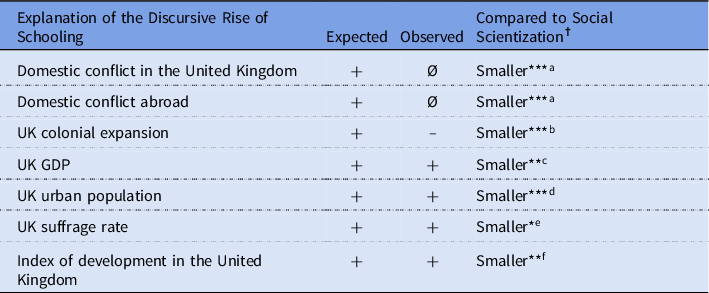
I conduct seven post hoc Wald F tests comparing the coefficient of scientization with the standardized coefficients on each of the alternative explanations from Models 5–10 (see table 3). These tests enable me to explore whether observed differences among the estimated relationships are statistically different from zero.
Summary of main expectations and observed regression results from regression analyses

† Comparisons of observed sizes are the results of post hoc Wald F linear hypothesis tests comparing the differences between each pair of standardized coefficients from table 2 to zero in models a through f.
a Model 5.
b Model 6.
c Model 7.
d Model 8.
e Model 9.
f Model 10
* p < 0.05; ** p < 0.01; *** p < 0.001.
I find evidence that social scientization is a stronger predictor of MPs’ engagement with schooling than are domestic conflict in the United Kingdom, domestic conflict abroad, colonial expansion, and political, economic, and social development. In other words, cultural processes of social scientization play a larger role in explaining the discursive rise of schooling in legislative proceedings than do the canonical explanations I test here. Based on the cumulative evidence in table 2 and the results of these post hoc Wald F tests (table 3), I conclude there is a substantive, positive relationship between cultural processes of social scientization and the discursive expansion of the state into education. MPs increasingly engaged with the idea of the schooling state as social scientization intensified throughout the nineteenth century. And when they did discuss schooling, they also used a scientized discourse to articulate their views on the topic.
Discussion
The descriptive analyses of the UK parliamentary discourse show the topic of schooling was all but nonexistent at the beginning of the nineteenth century (figure 3). Around the time Victoria took the throne, however, MPs increasingly deliberated the topic. To illustrate, the term school appeared around three thousand times in parliamentary speeches during the 1830s. By the 1900s, that same term occurred nearly fifty thousand times—more than a sixteen-fold increase. The term teach shows a similar if not as dramatic rise: around 1,500 occurrences appear in the 1830s; in the 1900s, that number is around six thousand, a fourfold increase. These are important findings. They suggest the parliamentary discourse during the nineteenth century, as one might expect, expanded in conjunction with actual intervention of the state into education using state-sponsored, state-inspected, and finally state-controlled schooling—what I related at the start of this piece. This might be expected because the legislative proceedings I analyze are the deliberative preambles to actual Acts of Parliament.
However, this finding suggests a more telling story with higher historical and theoretical stakes than the coupling of political rhetoric with legislative action. My analyses of the language of national political debate capture the systems of thought wherein core problems and programs of government increasingly consolidated around what is today a taken-for-granted if routinely politicized cultural trope: the schooling state. In this way, I track the changes in how legislators, when posing foundational questions about their own power, the aims of government, and what they need to know and do, as statesmen, to govern—in short, how a historically situated “political rationality” shifted (Rose and Miller 1992). That statesmen increasingly and unambiguously engage with schooling over the course of a century—the simple trendlines I show in figure 3—indicates a dramatic shift in the state idea and an important historical outcome demonstrated for the first time using a singularly comprehensive data-analytic strategy.
Indeed, I show how the state idea was deeply interwoven with broader cultural currents unfolding during the nineteenth century, within which the discourse of the state as well as statesmen were contingently situated. Cultural processes of social scientization were a powerful force of construction that refigured conceptions and retooled actions of the state. To be sure, there was striking amount of organized professional activity in the social sciences across the Western Europe and North America—within states and across them. This meant increasingly more international congresses and journals devoted to population statistics; increasingly more states with censuses, statistics agencies, and population statistics yearbooks; and increasingly larger membership in statistics and social science organizations. Across the board, organized social science dramatically increased over the course of the century (figure 4). Yet, it was the culture of rationalization of these organizations and networks that played the decisive role in constructing the conceivability of the schooling state, over and beyond the expansion of social science organization.
Schooling, at least in its late-nineteenth-century English sense, though certainly earlier in its Prussian and French senses, expressed the social scientific imagination. Inhering in notions and pursuits of mass, systematized education was a teleological futurity, whereby society could perpetually progress and develop (recall Quetelet’s curves). It was as much a hypothesis as a hope that schooling would deliver individuals from ignorance and vice and deliver society from the social disorder they would sew. My central contention has been that such a hypothesis could become conceivable and enter the political discourse—come out of MPs’ mouths—only in conjunction with a peculiar ontology of society. Social science provided one: a theory and set of corroborative empirical measurements that specified national society and human civilization as a timeless, organic entity made up of discrete individuals, who could all be varyingly schooled based on their own universal natural rights and unique proclivities (Condorcet Reference Condorcet1976b [1791]). Importantly, in this decidedly post-French Revolution, modern ontology, the nineteenth century was the historic moment in history, like none other before, that the state should become a socially ameliorative and scientifically investigative, indeed, “positive” polity and bear the responsibility of such a task (Comte Reference Comte1974 [1822]). The schooling state becomes conceivable precisely when the cultural myths it embodies not only become further elaborated but also statistically reified and put into actionable policy implications using a new science of the social. The robustly positive results of table 2 tell this story.
The findings reported here are an important contribution to the history of education and schooling. They show culture mattered in a big way but not in the same sense that it is usually understood in historical accounts of state schooling. In many histories, culture is often analytically handled as coterminous with nation and as a key explanatory variable for the rise of state schooling; the want of a nation foments state intervention in populations with systematized, scaled-up educational machinery that schooled individuals in matters of nation, literacy, and even personal conduct and hygiene. In contrast, I conceptualize culture, as it was constructed and carried by social science organization during the nineteenth century, as the very reasonableness and conceivability that states ought to get into the business of systematized schooling, in the first place, that it should routinely and preemptively address societal problems such as nation-building and economic development, and that individuals and nations could and should exist. The schooling state, in other words, was not as much a technical solution to a cultural problem as it was a new cultural category, now an institutionalized trope, itself integrated into an expanded and reified ontology that made it conceivable, indeed existentially critical, that states, societies, and human individuals could be observed, understood, and mastered scientifically. In this way, the results I report in table 2 also contribute to cultural explanations of state expansion, linking the construction of core institutional models of the nineteenth century to the development and professionalization of the social sciences and showing its direct relationship to the changing content of the state (Meyer Reference Meyer and George1999; Meyer et al. Reference Meyer, John, Thomas and Ramirez1997; Ramirez and Boli Reference Ramirez and Boli1987). And these findings contribute to a social science history of social science, demonstrating empirically how social science and statistical thinking shaped notions of the state and underwrote “liberal, mildly bureaucratic politics” along the way (Porter Reference Porter1986: 56–57).
Future Directions
The analyses here readily suggest the generative potential of future quantitative social science histories of social science, especially of its role in shaping core notions and understandings of modern society and the state. These future studies could focus on incorporating additional country cases and exploring to what extent institutional processes comparatively shape different national political discourses over time. My main argument that social scientization was a sweeping and powerful force of cultural construction across Western Europe and North America suggests the rise of the schooling state in the United Kingdom was just one case of broader Western cultural phenomenon. Yet, the United Kingdom might have been uniquely privy and responsive to cultural processes of social scientization. Economically and geopolitically dominant with a history of entrenched liberalism, but lagging behind other states in terms of schooling, the models and data of the institutionalizing social sciences might have been especially compelling in arguments to shore up the state, compared to other situations, such as Prussia, where an elaborate state already had a long history of political and cultural centrality by the nineteenth century. There, the bourgeoning social sciences might have been less tightly connected to expanded notions of the state. The tenability of conducting comparable analyses of political discourses to tease apart these differences appears increasingly supported, as many legislatures have turned to full digitalization of historical legislative proceedings.
Future historical sociologies of political discourses could implement new inductive methods from the computational social sciences, including, among others, Latent-Dirichlet Allocation (LDA) topic models and Dynamic Topic Models (DTMs). Both techniques would offer the advantage of exploring multiple, inductively derived topics jointly and to explore how the meaning of topics, such as schooling, come to take on different, historically situated inflections over time—a shift in real meaning that my coarse proxies of keyword indicators, even with the aid of WordNet, elide. Last, future historical sociological studies of state discourses in the present article’s deductive style could explore the relationship between scientization and other theoretically salient topics in political discourses, such as public health and epidemiology, policing, public works, among others. The point of these studies would be to evaluate the extent to which the schooling state as an idea was an instantiation of a broader institutional model undergoing construction and reification through the development and professionalization of the social sciences across the nineteenth century.
Acknowledgments
I would like to thank Patricia Bromley and John W. Meyer, my dissertation advisors, and the anonymous reviewers for reading and commenting on earlier drafts of this manuscript. I owe thanks to Christine Min Wotipka and her MA students for workshopping an earlier version of this paper. I would also like to acknowledge Daniel Tröhler, David Labaree, Ethan Hutt, Tom Popkewitz, and Mette Buchardt, who generously supported the early development of core ideas in this paper. The research reported here was supported by the Institute of Education Sciences, U.S. Department of Education, through Grant R305B140009 to the Board of Trustees of the Leland Stanford Junior University. The opinions expressed are those of the authors and do not represent views of the Institute or the U.S. Department of Education.
Appendix
Historical period (top) and annual number (bottom) of observed European and North American states, 1800–1909.
Source: Coppedge et al. Reference Coppedge, John, Carl, Staffan, Jan, David, Michael Bernhard, Adam, Allen, Anna, Kyle, Kelly, Pamela, Daniel, Brigitte, Rachel, Svend-Erik, Jeffrey and Daniel2020a, Reference Coppedge, John, Carl, Staffan, Jan and Lisa2020b.
Note: This figure shows the states across North America and Europe that I count when constructing system-side measures. “Germany” hermeneutically signifies the Kingdom of Prussia (1789–1812); Kingdom of Prussia under French occupation (1812–13); Kingdom of Prussia (1813–67); North German Confederation (1867–71); and German Empire (1871–1918). No Germanic state is doubly or multiply counted.