INTRODUCTION
Disturbance can play an important role in the structuring of biological communities, causing the abundance of some species to decrease and others to increase (Mouillot et al. Reference MOUILLOT, GRAHAM, VILLÉGER, MASON and BELLWOOD2013). There remains strong debate about the generality of how such processes influence diversity, but both empirical and theoretical work shows that in certain situations community diversity increases with disturbance due to differential responses of sympatric species (Fox Reference FOX2013, Huston Reference HUSTON2014).
Anthropogenic disturbances are widespread in tropical forests, and while their effects on animal diversity are generally assumed to be negative, in some cases they could mimic natural disturbances by having countervailing impacts on the abundance of different species. For example, the impacts of anthropogenic edge effects, or declining prevalence of extraction and habitat disturbance with decreasing proximity to agriculture, roads or villages (Lynam et al. Reference LYNAM, TANTIPISANUH, CHUTIPONG, NGOPRASERT, BAKER, CUTTER, GALE, KITAMURA, STEINMETZ, SUKMASUANG and THUNHIKORN2012, Peres Reference PERES2000, Vanthomme et al. Reference VANTHOMME, KOLOWSKI, KORTE and ALONSO2013), are highly variable across tropical species. Abundance can increase, decrease or show no correlation with distance to habitat edge depending on species-specific life histories and ecology and the intensity and type of anthropogenic activity (Brodie & Giordano Reference BRODIE and GIORDANO2013, Brodie et al. Reference BRODIE, GIORDANO and AMBU2014, Burton et al. Reference BURTON, SAM, BALANGTAA and BRASHARES2012, Kinnaird et al. Reference KINNAIRD, SANDERSON, O’BRIEN, WIBISONO and WOOLMER2003, Laurance et al. Reference LAURANCE, CROES, TCHIGNOUMBA, LAHM, ALONSO, LEE, CAMPBELL and ONDZEANO2006, Linkie et al. Reference LINKIE, DINATA, NUGROHO and HAIDIR2007, Lynam et al. Reference LYNAM, TANTIPISANUH, CHUTIPONG, NGOPRASERT, BAKER, CUTTER, GALE, KITAMURA, STEINMETZ, SUKMASUANG and THUNHIKORN2012, Rovero et al. Reference ROVERO, MARTIN, ROSA, AHUMADA and SPITALE2014, Vanthomme et al. Reference VANTHOMME, KOLOWSKI, KORTE and ALONSO2013). In Gabon, buffalo (Syncerus caffer), elephant (Loxodonta cyclotis) and gorilla (Gorilla gorilla) decreased in abundance near edges whereas many monkeys and some small ungulates were unaffected (Vanthomme et al. Reference VANTHOMME, KOLOWSKI, KORTE and ALONSO2013). Conversely, in Borneo the abundance of bearded pig (Sus barbatus), mousedeer (Tragulus spp.) and macaques (Macaca spp.) all increased near edges (Brodie & Giordano Reference BRODIE and GIORDANO2013). Our lack of a general understanding of how tropical animals respond to anthropogenic edge effects limits our ability to predict how community-level diversity is affected by this widespread habitat disturbance.
Even within a single species, there may be strong variability in responses to different types of edge. Gaur (Bos gaurus) in Thailand were more abundant close to agricultural fields but unaffected by proximity to roads or villages while sambar (Rusa unicolor) were more abundant near agricultural fields but less abundant near roads and villages (Lynam et al. Reference LYNAM, TANTIPISANUH, CHUTIPONG, NGOPRASERT, BAKER, CUTTER, GALE, KITAMURA, STEINMETZ, SUKMASUANG and THUNHIKORN2012). Primate abundance in Gabon was positively correlated with small roads but negatively associated with large roads (Vanthomme et al. Reference VANTHOMME, KOLOWSKI, KORTE and ALONSO2013). Such nuances should be examined in a larger range of localities, but these results suggest that all edges are not alike in their impacts on a single species.
Biodiversity at any location is structured by the combination of local drivers such as disturbance and regional factors such as the amount and spatial structure of available habitat area and varying human activity patterns (Gardner et al. Reference GARDNER, BARLOW, CHAZDON, EWERS, HARVEY, PERES and SODHI2009). Moreover, these impacts at different scales could potentially interact, such that the effects of local disturbance on biodiversity are modified by regional context (Amici et al. Reference AMICI, ROCCHINI, FILIBECK, BACARO, SANTI, GERI, LANDI, SCOPPOLA and CHIARUCCI2015, Clough et al. Reference CLOUGH, PUTRA, PITOPANG and TSCHARNTKE2009). Several studies have assessed edge effects on multiple species and at multiple sites (Linkie et al. Reference LINKIE, GUILLERA-ARROITA, SMITH, ARIO, BERTAGNOLIO, CHEONG, CLEMENTS, DINATA, DUANGCHANTRASIRI, FREDRIKSSON, GUMAL, HORNG, KAWANISHI, KHAKIM, KINNAIRD, KISWAYADI, LUBIS, LYNAM, MARYATI, MAUNG, NGOPRASERT, NOVARINO, O’BRIEN, PARAKKASI, PETERS, PRIATNA, RAYAN, SEUATURIEN, SHWE, STEINMETZ, SUGESTI, SUNARTO, SUNQUIST, UMPONJAN, WIBISONO, WONG and ZULFAHMI2013, Lynam et al. Reference LYNAM, TANTIPISANUH, CHUTIPONG, NGOPRASERT, BAKER, CUTTER, GALE, KITAMURA, STEINMETZ, SUKMASUANG and THUNHIKORN2012), but very few have explicitly assessed whether edge-induced disturbances are qualitatively different at different locations. Here we examine the impacts of several types of habitat edge on a suite of understudied rain-forest vertebrates at two locations in Sulawesi, Indonesia. Specifically, we hypothesize that edge-induced disturbances (1) increase the abundance of some species while decreasing the abundance of others, (2) differ in their impact within species across different edge types and (3) vary in their impacts between sites.
METHODS
Study area
Sulawesi, Indonesia, is the largest island in the biodiversity hotspot of Wallacea and contains highly endemic fauna, much of which is decreasing in population abundance (Priston et al. Reference PRISTON, WYPER and LEE2012, Stelbrink et al. Reference STELBRINK, ALBRECHT, HALL and VON RINTELEN2012). In comparison to surrounding areas (e.g. Borneo, Sumatra, and mainland Asia) the island is not well studied, and the ecology of Sulawesi's mammals and birds remains largely unknown (Priston et al. Reference PRISTON, WYPER and LEE2012). For example, we severely lack knowledge on even the most basic ecology of the island's largest vertebrates, two dwarf buffalo species, the lowland anoa (Bubalus depressicornis) and mountain anoa (B. quarlesi; Burton et al. Reference BURTON, HEDGES and MUSTARI2005).
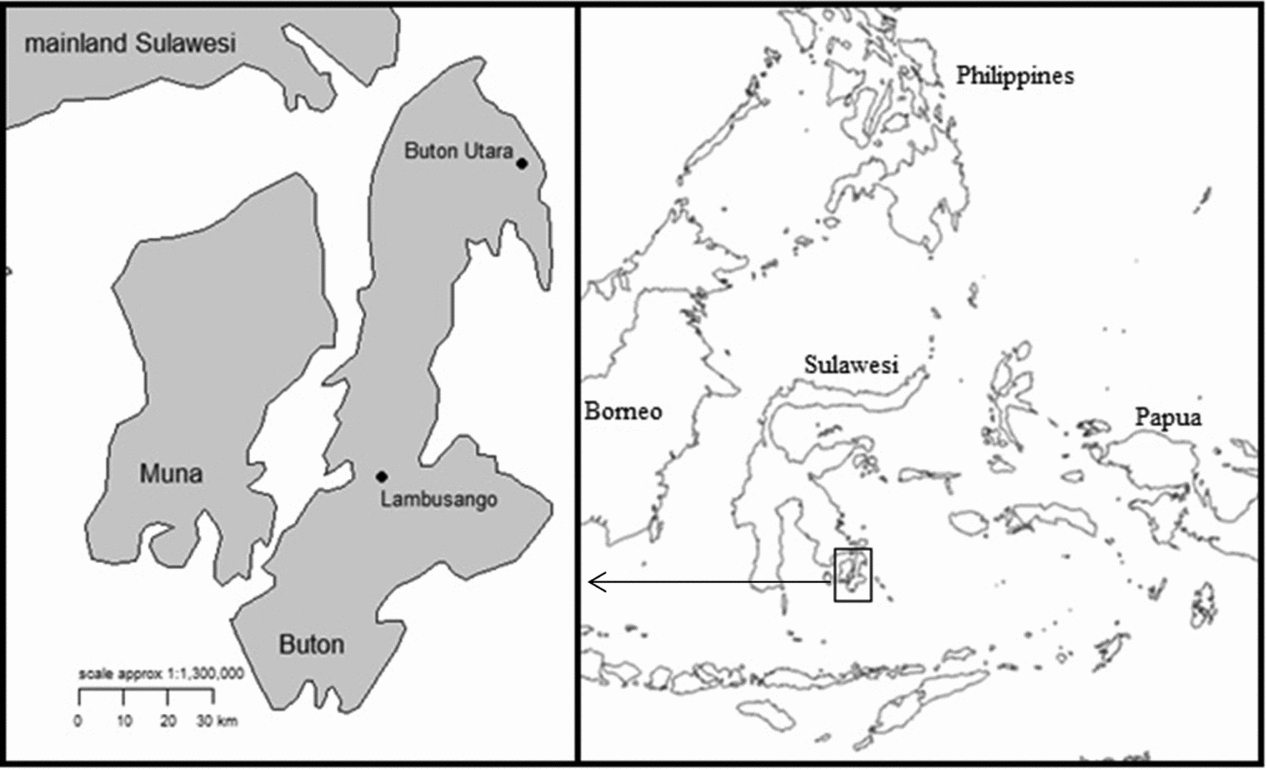
We conducted research on Buton, a ~4520-km2 island less than 5 km from the south-east coast of Sulawesi (123º12′–122º33′E, 5º44′–4º21′S), in the Buton Utara wildlife reserve (~820 km2) and Lambusango wildlife reserve (~285 km2) (Figure 1). The area sampled within Buton Utara was ~70 km away from the area sampled within Lambusango with agriculture, roads and villages in between. Agriculture surrounding both reserves included closed-canopy coconut, coco and cashew plantations, rice-paddies and other open-field crops. The closest road to both our sampling sites in the reserves was a predominantly dirt and gravel road which traverses Buton's coastline from north to south. The majority of Buton's villages, including those closest to both our sampling sites, are small with economies based on agriculture and fishing (Priston et al. Reference PRISTON, WYPER and LEE2012). In both reserves, we measured the agricultural edge as the distance from the sampling point to the nearest agriculture, road edge as the distance to the main Buton road, and village edge as the distance to the nearest village. Though the two reserves had very similar agriculture, roads, and villages near them, the magnitude of regional anthropogenic disturbance differed between the two. Buton Utara is a much larger reserve with a correspondingly larger proportion of core habitat. There are also fewer villages on its edge, and it is farther removed from the larger-scale agricultural land and urban areas in the far south-west of Buton. Preliminary social surveys indicate that these differences lead to Buton Utara generally having a lower intensity of human-caused disturbance such as illegal hunting and logging than Lambusango, and correspondingly higher relative abundance of species with low population abundance or density such as anoa and maleo (Macrocephalon maleo) (G. Froese, unpubl. data). Though satellite analysis suggests that much of the forests in both reserves has likely been selectively logged in the past several decades (Cannon et al. Reference CANNON, SUMMERS, HARTING and KESSLER2007), we did not detect obvious visual differences in forest structure between the two sites that could be attributed to past logging.
Map of the study area showing the location of the camera trap arrays on Buton Utara wildlife reserve (~820 km2) and Lambusango wildlife reserve (~285 km2). The reserves are located on Buton, a ~4520 km2 island less than 5 km from the south-east coast of Sulawesi, Indonesia. Sulawesi (~189216 km2) is the largest island in Wallacea, a little known yet important hotspot of biodiversity with a high proportion of endemic mammals and birds (Priston et al. Reference PRISTON, WYPER and LEE2012, Stelbrink et al. Reference STELBRINK, ALBRECHT, HALL and VON RINTELEN2012).

Field sampling
We deployed 46 camera trap stations from May–August 2013 and 2014 in two arrays: one in Buton Utara and one in Lambusango (Table 1). Stations were spaced less than 1 km apart, so individual animals of some species could have been detected at multiple stations. However, we assessed local abundance (i.e. the number of individuals occurring at each station) rather than population density, so this should not have biased our results. Each camera was placed within ~100 m of a pre-determined GPS location in an area we thought likely to maximize captures (e.g. facing a game trail or on top of a ridge). GPS locations were chosen to span gradients in distance to agriculture, roads or villages. Conversations with hunters and other users of forest resources indicated that they only spent time in easily accessible edge forest, never going near our farther camera traps (G. Froese, unpubl. data). Cameras were placed in locked steel cases attached to tree trunks with bolts. We used Reconyx HC500 HyperFire cameras set to operate 24 h d−1 and record three photographs in quick succession upon the detection of movement, after which the camera was inactive for 30 s.
Sampling effort and attributes of camera trap arrays in the two protected areas in which we sampled, Buton Utara wildlife reserve (~820 km2) and Lambusango wildlife reserve (~285 km2). The reserves are located on Buton, ~4520 km2 island less than 5 km from the south-east coast of Sulawesi, Indonesia. The areas sampled were both lowland moist deciduous forest with equivalent compositions of large vertebrates ~70 km apart with forest, agriculture, roads and villages in between. Separation refers to the distance between a given camera trap and the closest camera trap to it.

Data analysis
We estimated the local abundance of several species, defined as the number of individuals occurring at each camera trap station, in a similar manner to the methods outlined in Brodie & Giordano (Reference BRODIE and GIORDANO2013), using day as the temporal sampling unit for sampling in N-mixture models (Royle Reference ROYLE2004). We used the R package ‘Unmarked’ (Fiske & Chandler Reference FISKE and CHANDLER2011) for all analyses. N-mixture models account for imperfect detection of rare taxa by statistically distinguishing false absences (animals present but not detected) from true absences (Linkie et al. Reference LINKIE, DINATA, NUGROHO and HAIDIR2007, Rovero et al. Reference ROVERO, COLLETT, RICCI, MARTIN and SPITALE2013). We created three suites of occupancy models for each species to determine whether abundance increased, decreased or was uncorrelated with each type of edge effect (i.e. distance to agriculture, road or village), whether abundance differed between the two reserves, and whether the strength of the relationship between edge effects and abundance differed between the two reserves. Detection data were assembled into matrices with integers of zero or greater representing the maximum group size of a species captured on a given day. These integers may underestimate local abundance when two or more groups of the same species are observed on the same day. However, this method reduces the potential of recounting individuals present in more than one of the groups, and as it was consistent across trap stations it should not have caused systematic bias in our analysis.
For each suite of occupancy models we used two sampling covariates (time varying) and four site covariates (temporally constant; two for detection and two for abundance). Our sampling covariates were camera hours (the number of hours cameras operated each day; equal to 24 except for the days on which cameras were set up or taken down, and equal to 12 for two cameras that did not operate correctly at night), and year (0 for 2013, 1 for 2014). Detection site covariates were visibility (the estimated distance each camera was capable of detecting motion) and binary visibility (0 for unobstructed visibility, 1 for visibility obstructed by a strange hillside angle, tree fall, motion sensors failing after dark, etc.). Visibility and binary visibility were uncorrelated (Pearson's R = 0.08). These covariates were not directly related to questions of biological interest, but were included to ensure that model predicted differences in local abundance were not solely due to differences in camera's detection ability. Abundance site covariates were location (0 for Lambusango, 1 for Buton Utara) and edge (agricultural edge, road edge and village edge). To calculate edge at each camera we used Garmin Basecamp™ version 4.2.5. (Garmin Limited 2014) to measure the Euclidean distance from each camera station to the nearest agricultural edge, road edge or village edge. Agricultural edge ranged from 0 km (camera placed on the ecotone) to 3.39 km, road edge ranged from 0.32 km to 4.07 km, and village edge ranged from 0.5 km to 5.36 km. Because the range of variability differed between edge types, we limited our inference to the range over which they overlapped (0.5–3.4 km) in order to avoid extrapolating beyond the data for any given edge type.
We aimed to assess potential differences between the impacts of different edge types on local abundance, but only included one edge type per model due to correlations among edge types (Pearson's R for agricultural edge and road edge = 0.53, for agricultural edge and village edge = 0.57, for road edge and village edge = 0.92). Thus, for each species, we used three suites of models, each with a different edge type. We assessed 80 models for each edge type for each species, including all possible combinations of the six covariates and edge × location interactions. All continuous covariates were standardized to have mean = zero and variance = one. Each model used a zero-inflated Poisson distribution to account for the numerous zero detections (Joseph et al. Reference JOSEPH, ELKIN, MARTIN and POSSINGHAM2009). To calculate slope coefficients for the estimated local abundance of each species we used a model-averaging approach, rather than relying on a single best-fit model, to account for model-selection uncertainty (Rickart et al. Reference RICKART, BALETE, ROWE and HEANEY2011). For each model suite, we multiplied both the slope coefficient and the associated standard error in each model for edge, location, and edge × location, by that model's AIC weight, and then summed the results to create a model averaged slope coefficient and standard error (which in turn was multiplied by 1.96 to create a model-averaged 95% confidence interval). When a particular variable was not included in a model the estimate was considered to be zero. Parameters were considered to significantly influence species local abundance if the 95% confidence intervals of their slope coefficients did not include zero. For each species, significantly positive edge coefficients indicated local abundance increasing with increasing distance to edge, a positive location coefficient indicated higher local abundance in Buton Utara than in Lambusango, and a positive edge × location coefficient indicated edge effects have greater impact on local abundance in Buton Utara than in Lambusango.
RESULTS
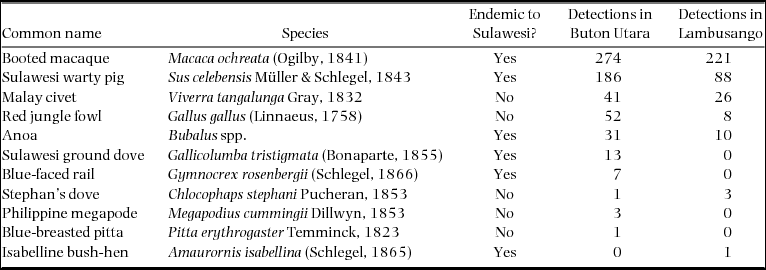
Over 3545 camera days (1780 in 2014 and 1765 in 2013; 1868 in Buton Utara and 1677 in Lambusango) we detected four species of large mammal and seven species of ground bird (Table 2). Small-bodied or arboreal taxa such as rats (Muridae), squirrels (Sciuridae), cuscus (Stigocuscus celebensis) and hornbill (Penelopides exarhatus) were detected but were not included in our analysis due to limited sample size. We performed analysis on all species with more than 30 total detections, as preliminary analysis suggested that this was an approximate threshold above which robust occupancy models could be fitted to the data.
Large mammals and ground birds of Sulawesi, Indonesia detected in Buton Utara wildlife reserve and Lambusango wildlife reserve by 46 camera stations (17 in Buton Utara and 29 in Lambusango) over 3545 camera days (1868 in Buton Utara and 1677 in Lambusango) in order from most to least detections. We identified the vast majority of anoa individuals as lowland anoa, but both species are thought to occur in Buton Utara (Burton et al. Reference BURTON, HEDGES and MUSTARI2005), and in our photographs young lowland anoa can be difficult to differentiate from mountain anoa, thus we performed analysis on anoa in general rather than risking errors in species classification.

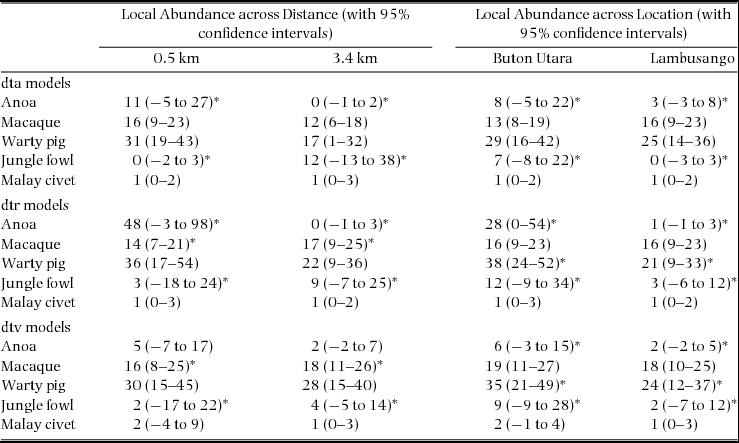
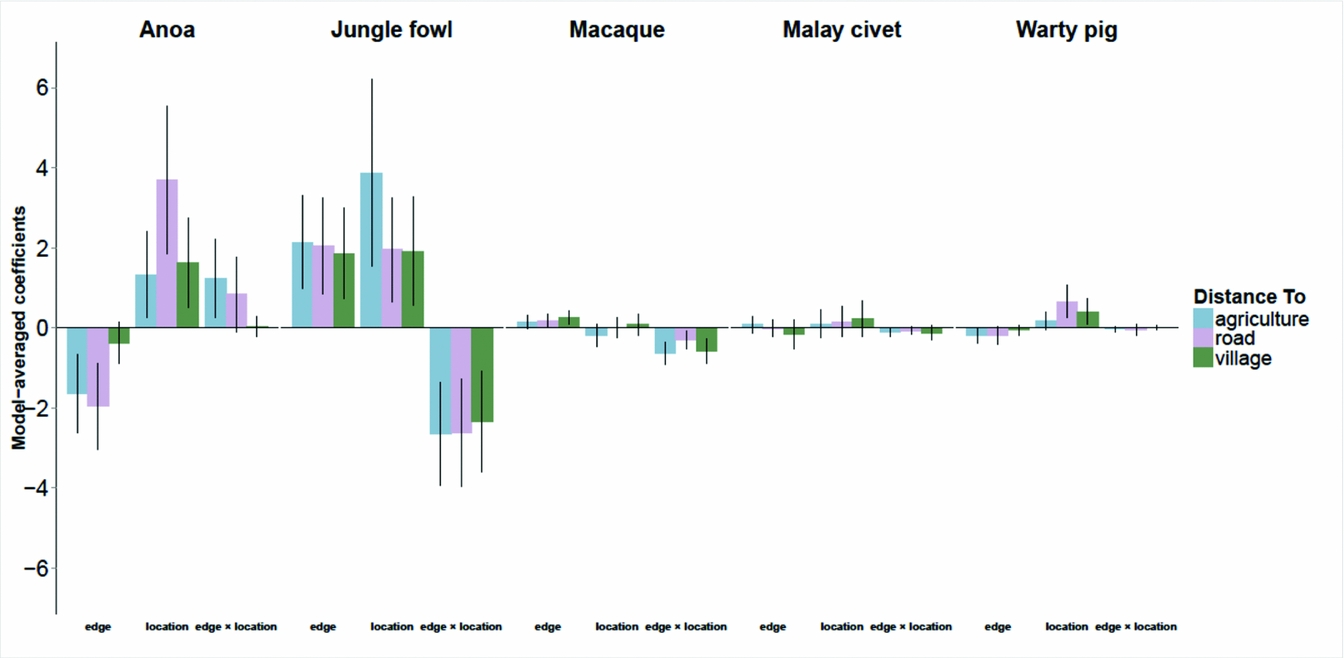
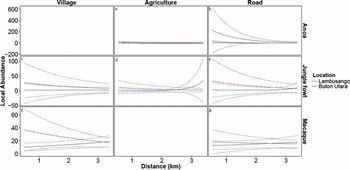
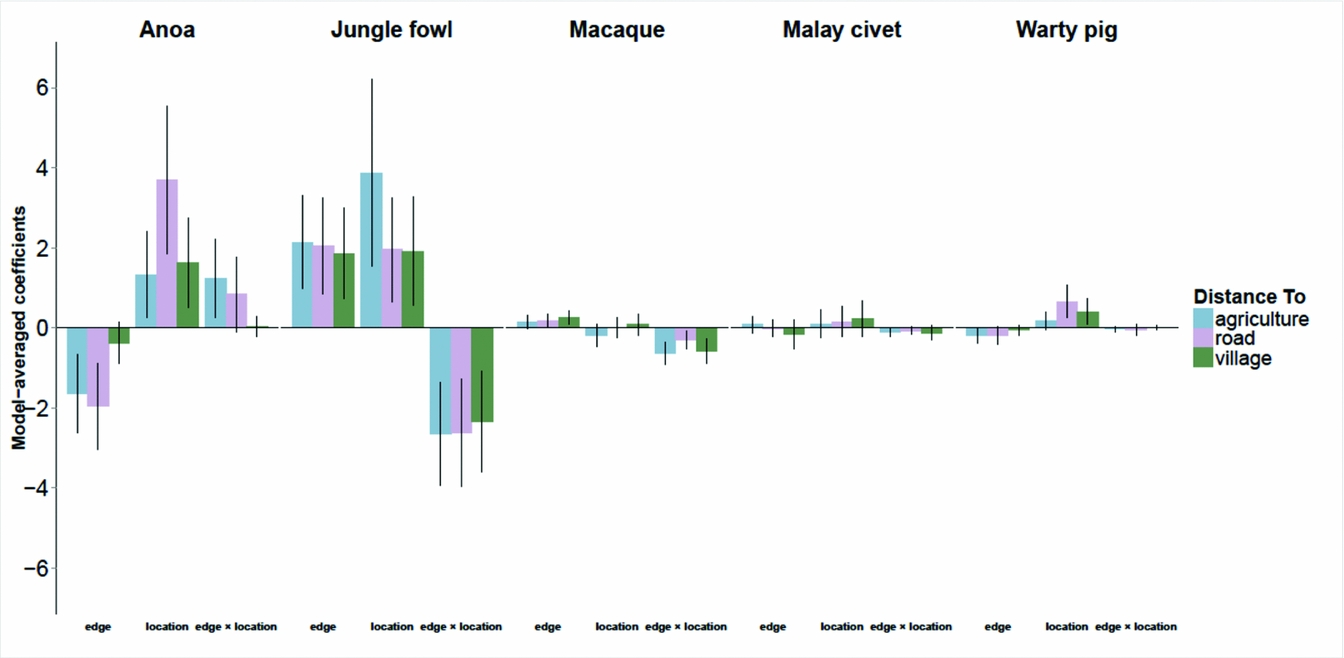
The top model varied both between species and between model suites within species. The estimated local abundance of anoa (Bubalus spp.) was significantly higher in Buton Utara than in Lambusango in the model suites using agriculture (slope = 1.34, SE = 0.55), roads (slope = 3.71, SE = 0.94), and villages (slope = 1.63, SE = 0.57), and increased closer to agriculture (slope = −1.63, SE = 0.50) and roads (slope = −1.95, SE = 0.55) but was not significantly related to villages (slope = −0.37, SE = 0.26) (Figure 2, Table 3). Distance to agriculture had stronger effects on local abundance in Buton Utara than in Lambusango (slope = 1.24, SE = 0.49), whereas the effect of roads (slope = 0.84, SE = 0.48) and villages (slope = 0.04, SE = 0.13) did not differ between reserves (Figure 2, 3).
Estimated local abundance (number of individuals at a camera trap) of five species across distance to agriculture (dta), road (dtr), and village (dtv) and the two reserves (Buton Utara wildlife reserve and Lambusango wildlife reserve). Confidence intervals simply show precision around local abundance estimates and are unrelated to significance in model-averaged slope coefficients. * pairs indicate significant differences, as determined if 95% confidence intervals of model-averaged slope coefficients overlapped zero (Figure 2).

Model-averaged slope coefficients for the estimated local abundance (number of individuals at a camera trap) of our five study species in Sulawesi, Indonesia in relation to edge effects, location across two reserves, and edge × location interactions across the three model suites using edge as distance to agriculture, road, and village. Error bars show 95% confidence intervals for coefficient estimates; if these did not include zero factors were deemed to significantly influence species local abundance. Positive edge coefficients represent local abundance increasing with distance, positive location coefficients represent higher local abundance in Buton Utara than in Lambusango, and positive edge × location coefficients represent edge being more strongly correlated to local abundance in Buton Utara than Lambusango.
Estimated change in local abundance (number of individuals at a camera trap) in both Buton Utara and Lambusango (with 95% confidence intervals) along a gradient in distance from 0.5 km to 3.4 km for the seven situations in which edge effects were significant (empty boxes represent situations in which edge effects were not significant). The edge × location interaction was not significant in anoa and distance to agriculture (a, note the extremely high confidence intervals), but was significant in anoa and roads (b), jungle fowl and villages (c), jungle fowls and agriculture (d), jungle fowl and roads (e), macaque and villages (f) and macaque and roads (g).

The estimated local abundance of booted macaque (Macaca ochreata) did not differ between reserves in the model suites using agriculture (slope = −0.18, SE = 0.14), roads (slope = 0.01, SE = 0.12), or villages (slope = 0.08, SE = 0.14), was not significantly related to agriculture (slope = 0.16, SE = 0.09), and increased farther from roads (slope = 0.19, SE = 0.07) and villages (slope = 0.26, SE = 0.09) (Figure 2, Table 3). The effects of agriculture (slope = −0.64, SE = 0.14), roads (slope = −0.29, SE = 0.12), and villages (slope = −0.58, SE = 0.16) were all more strongly correlated to local abundance in Lambusango than in Buton Utara (Figure 2, 3).
The estimated local abundance of the red jungle fowl (Gallus gallus) was significantly higher in Buton Utara in the model suites using agriculture (slope = 3.88, SE = 1.19), roads (slope = 1.96, SE = 0.67) and villages (slope = 1.92, SE = 0.69), and increased farther from agriculture (slope = 2.14, SE = 0.59), roads (slope = 2.06, SE = 0.61) and villages (slope = 1.86, SE = 0.58) (Figure 2, Table 3). The effects of agriculture (slope = −2.65, SE = 0.66), roads (slope = −2.62, SE = 0.68), and villages (slope = −2.34, SE = 0.64) were all more strongly correlated to local abundance in Lambusango than in Buton Utara (Figure 2, 3).
The estimated local abundance of Sulawesi warty pig (Sus celebensis) did not differ between sites in the model suite using agriculture (slope = 0.18, SE = 0.11), but in both the suites using roads (slope = 0.66, SE = 0.21) and villages (slope = 0.41, SE = 0.16) was significantly higher in Buton Utara, and was not significantly related to distance to agriculture (slope = −0.18, SE = 0.10), roads (slope = −0.19, SE = 0.12), or villages (slope = −0.06, SE = 0.06) (Figure 2, Table 3). Neither the effect of agriculture (slope = −0.03, SE = 0.04), roads (slope = −0.05, SE = 0.07), or villages (slope = 0.02, SE = 0.03) differed between reserves (Figure 2).
The estimated local abundance of the non-native Malay civet (Viverra tangalunga) did not differ between reserves in the model suites using agriculture (slope = 0.10, SE = 0.18), roads (slope = 0.15, SE = 0.19), or villages (slope = 0.23, SE = 0.22), and was not significantly related to distance to agriculture (slope = 0.08, SE = 0.11), roads (slope = 0.00, SE = 0.11), or villages (slope = −0.15, SE = 0.18) (Figure 2, Table 3). Neither the effect of agriculture (slope = −0.10, SE = 0.06), roads (slope = −0.07, SE = 0.05) or villages (slope = −0.12, SE = 0.09) differed between reserves (Figure 2).
DISCUSSION
Our results show that habitat disturbance via edge effects had contrasting effects on different forest vertebrates. Anoa species were more abundant near edges than in areas towards the interior of reserves. This is somewhat surprising because hunting, which tends to be most intense near human settlements, is likely a major threat to anoa and has structured patterns of abundance to the degree of driving local extinctions in North and South Sulawesi (Burton et al. Reference BURTON, HEDGES and MUSTARI2005). Although assessing the detailed effects of specific types of human activity is beyond the scope of our study, our results suggest that some habitat feature, be it naturally or anthropogenically associated with edges, is influencing anoa populations. One possibility that warrants further research is that habitat disturbance could increase understorey food availability. Wild cattle are grazers, and in Thailand the gaur is associated with forest edges (Lynam et al. Reference LYNAM, TANTIPISANUH, CHUTIPONG, NGOPRASERT, BAKER, CUTTER, GALE, KITAMURA, STEINMETZ, SUKMASUANG and THUNHIKORN2012) while at a site in Borneo, the banteng (Bos javanicus) was more abundant in selectively logged than in primary forest (Brodie et al. Reference BRODIE, GIORDANO and AMBU2014). Booted macaque and red jungle fowl increased in abundance away from edges, which is expected if human activity directly or indirectly reduces population abundance. Abundance of Sulawesi warty pig and Malay civet did not have a significant correlation with edge proximity, suggesting that these species may be robust to anthropogenic activity.
Though edges in general affected anoa, booted macaque and red jungle fowl, the magnitude of impact differed between edge types. Each edge type was the most important depending on the species in question: roads for anoa, villages for macaque and agriculture for jungle fowl. Most tropical rain forests are much richer in large-vertebrate diversity than the Sulawesi forests are, and similar differences between edges types have been found in Thailand and Gabon (Lynam et al. Reference LYNAM, TANTIPISANUH, CHUTIPONG, NGOPRASERT, BAKER, CUTTER, GALE, KITAMURA, STEINMETZ, SUKMASUANG and THUNHIKORN2012, Vanthomme et al. Reference VANTHOMME, KOLOWSKI, KORTE and ALONSO2013). Still, our results show that it is beneficial to classify edges as distinctly as possible. If we had used only, for example, villages as our edge metric we would not have appreciated the magnitude of edge effects on jungle fowl or detected any significant edge effects on anoa (despite the fact that villages were very strongly correlated with roads, only the latter was correlated with anoa abundance). Our study was limited in that no data were collected to address why different edge types have different impacts. But, especially in areas such as Sulawesi where little is known about the ecology of many species, gathering more nuanced information about the differential nature of disturbance provides a platform on which to ask further questions.
Of the seven situations in which edge effects were significant, six had a significant interaction between edge effect and location. For macaque and jungle fowl, edge effects differed across reserves not only in magnitude but also in direction. The overall pattern seen across our study for these species is that abundance decreased near edges, which had a larger effect in Lambusango, where edges were detrimental. But in Buton Utara the opposite pattern was observed, where abundance increased near edges. The impact of habitat disturbance on species richness can react in such a bidirectional manner depending on the scale at which measured (Dumbrell et al. Reference DUMBRELL, CLARK, FROST, RANDELL, PITCHFORD and HILL2008); our results show that the outcome of comparisons of local processes can be influenced by regional-scale processes. The manner in which we studied differences in edge effects across reserves here is novel, but could be easily applied to any study containing camera traps in multiple locations. Coupled with knowledge about regional differences in disturbance regimes and spatial structure of habitat, studies of such interactions could help reveal drivers of the variability of edge effects across landscapes by examining which regional characteristics are correlated with positive versus negative responses to edges.
It is important to note that the actual estimates of local abundance in our study should not be used for any biological inference, as several species had wide confidence intervals and implausibly high estimates of local abundance. Indeed, accurate estimates of population abundance will be difficult to achieve for many rare rain-forest animals. But our study had enough power for relative comparisons, which are arguably of more utility for addressing many ecological questions. We suggest that further camera-trap studies be conducted across Sulawesi, which would give both baseline knowledge of anoa and other species strongholds and areas of concern and enhance our knowledge on how edge effects are dependent on landscape-level context.
Here we have reinforced the highly variable nature of anthropogenic edge effects, a widespread form of local disturbance throughout the tropics. The impacts of edge effects may resemble natural disturbances in that they cannot be readily predicted in any general manner, but will display idiosyncratic responses to different kinds of habitat edges among species depending on the situation. The mechanisms behind such differences could be in part explained by the interactions between local processes and regional context. Even though we did not quantify regional differences in disturbance between the two reserves we studied, we found them to influence local disturbance processes. Examinations of ecological responses to local disturbance will benefit by incorporating regional factors, even if in an elementary manner such as here.
ACKNOWLEDGEMENTS
We thank the Indonesian Institute of Sciences (LIPI) and Kementerian Riset dan Teknologi Republik Indonesia (RISTEK) for providing permission to undertake this work (permit number 211/SIP/FRP/SM/VI/2013 & 143/SIP/FRP/SM/VI/2014). We also thank Balai Konservasi Sumber Daya Alam (BKSDA) for their assistance. Funding was provided by the Natural Sciences and Engineering Research Council Canada, the Canada Foundation for Innovation, the University of British Columbia, and Operation Wallacea. We thank Operation Wallacea for providing logistical and other in-kind support, particularly Chris Majors, David Tosh and Tom Martin. Most of all we thank the many people on Buton with whom we lived and worked, especially Pak Desa, Pak Dhoba, Simon, Idin, Bigi, Mus La Angke, Anton, Sitti Fatimah, Fajrhi and Jus.