I. SIGNIFICANCE OF INTERPHASE TO Li ION DEVICES
Lithium ion chemistry is realized with reversible intercalation/deintercalation of Li+ into/from host lattices of either graphitic anode or various cathodes based on layer or spinel-structured transition metal oxides or olivine-structured phosphates etc. Whereas the lithiation potential of graphite lies approximately 3.0 V versus that of standard hydrogen electrode (SHE), the typical cathode materials usually operate at 0.5–2.0 V versus that of SHE. The potential difference created by the corresponding lithiation or delithiation states of these anode and cathode materials varies from 3.0 to 5.0 V, which, coupled with the large Li+-storing capacities of each component (372 mAh/g for graphite and 150–240 mAh/g for various cathode chemistries), provides the energy densities in the range of 100–175 Wh/kg on cell level [Fig. 1(a)].Reference Goodenough and Kim1
(a) Schematic intercalation chemistries involved in lithium ion batteries (Reproduced with permission by the American Chemical Society from Ref. Reference Xu2). (b) Delay in understanding the difference between interphasial chemistries of the PC and the EC might have held back the emergence of lithium ion battery technology for up to four decades (Reproduced with permission by the Electrochemical Society from Ref. Reference Xu9).

In the former case (on anode), there is essentially no known electrolyte component (salt or solvent) that can remain thermodynamically stable in the potential region against reduction, thus decomposition of electrolyte, in most cases solvents, always occurs.Reference Xu2 These reductive compounds, usually in the form of Li salt after either a single- or multielectron process, are insoluble in the bulk electrolyte and remain as deposit on the anode surface.Reference Peled and Straze3 Their existence on graphitic anode prevents further reduction of electrolyte bulk (electron insulator) but still allows Li+-conduction (ion conductor). This aspect of “electrolyte attributes” earns these interfacial deposition layers the name “solid electrolyte interphase” or SEI.Reference Peled4 Since the emergence of Li ion technology, the efforts to understand this elusive component in Li ion device have been a main theme, as evidenced by the overwhelming literatures on SEI in the past two decades.Reference Wang and Balbuena5 The effect of various factors, including reductive pathway, electrolyte additives as sacrificial components, graphitic structure as well as Li+-solvation sheath, on the chemistry and formation mechanism of SEI have been extensively explored.
In the latter case (on cathode), since the potentials involved are not as “extreme” as that of graphitic anode, controversy once existed whether there is an SEI-equivalence formed on the surface of cathode.Reference Thomas, Bruce and Goodenough6 However, with the emergence of “5 V” class cathode chemistry, the presence of a cathode SEI seems inevitable. Thus far, there is little understanding about the oxidative chemistry of electrolyte components and how they form the passivating coating.Reference Yang, Ravdel and Lucht7, Reference Cresce and Xu8
There is no better example than the so-called “EC-PC disparity” in demonstrating how important interphasial chemistry is to the successful function of Li ion chemistry [Fig. 1(b)].Reference Xu9 The key component of Li ion technology, lithium ion-graphite intercalation compound (Li+-GIC) was discovered in 1950s by Hérold, who chemically lithiated graphitic structure using either vapor or molten lithium.Reference Hérold10 Many efforts were made immediately after to prepare Li+-GIC electrochemically with the obvious purpose of exploiting its potential as a high energy density anode material, but not a single success was reported in the following decades, primarily because propylene carbonate (PC), which was used as a major cosolvent in nonaqueous electrolytes at that time, failed to form a protective SEI and decomposed to exfoliate graphitic layers at 0.8 V versus that of Li.Reference Dey and Sullivan11 Consequently, no Li+-GIC could be formed in those nonaqueous media. It was once believed that these Li+-GIC could not be accessed via electrochemical routes, with the only exception of solid polymer electrolyte based on ether linkages, whose low ion conductivities rendered its application impossible.Reference Yazami and Touzain12
It was not known till the end of 1980s that PC’s close structural cousin, ethylene carbonate (EC), could circumvent the graphite exfoliation by a completely different interphasial chemistry despite the seemingly minute difference of a methyl group inset, [Fig. 1(b)], thus allowing the reversible lithiation/delithiation chemistry of graphitic anodes and constituting the foundation of Li ion batteries since the 1990s.Reference Nagaura13, Reference Fong, von Sacken and Dahn14 Therefore it is no exaggeration to state that the different interphasial chemistries caused by a single methyl group on the heteroatom ring is responsible for holding back the emergence of Li ion technology for nearly four decades.
II. INTERPHASIAL CHEMISTRY
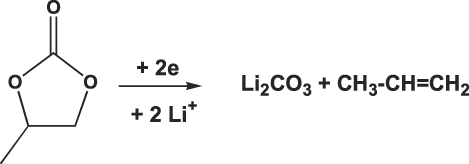
The earlier study on graphite exfoliation by PC has led to a simple two-electron pathway, where organic section is completely lost in the form of gas (propylene), leaving behind an inorganic Li salt (Li2CO3):Reference Dey and Sullivan11
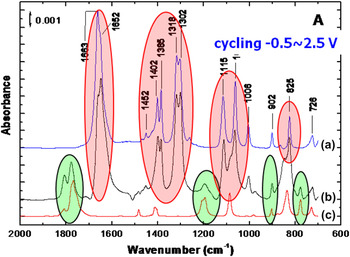
Fingerprint match between the FTIR spectra of synthesized standard reference lithium ethylene dicarbonate (LEDC) and a Ni-electrode surface polarized to 0.50 V versus that of Li (Reproduced with permission by the Electrochemical Society from Ref. Reference Zhuang, Xu, Yang, Jow and Ross21).

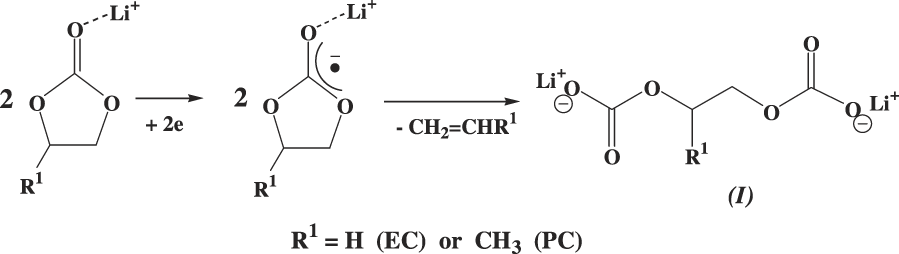
This early observation was overturned by Aurbach, who established on the basis of a series of surface spectroscopic data that what happens during surface reduction is a single-electron pathway leading to so-called alkyl carbonateReference Aurbach, Daroux, Faguy and Yeager15–Reference Aurbach, Markovsky, Schecter, Ein-Eli and Cohen17:

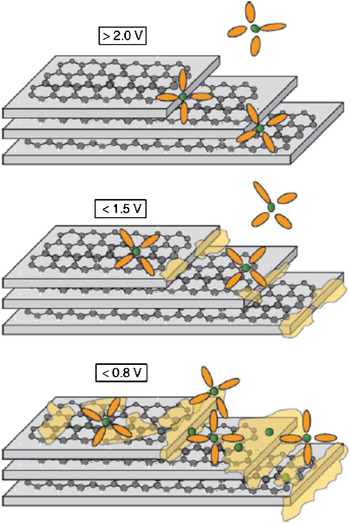
Schematic illustration of SEI formation mechanism that is not only stepwise but also graphitic structure-specific.

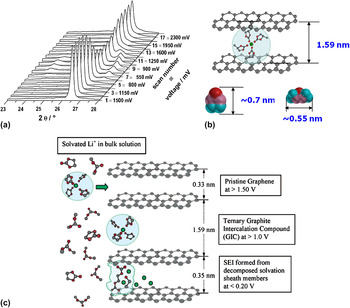
(a) In situ XRD evidence for the formation of a ternary GIC with PC molecules as cointercalants (Reproduced with permission by the Elsevier from Ref. Reference Aurbach, Gamolsky, Markovsky, Gofer, Schmidt and Heider35). (b) The expanded graphene layers (1.59 nm) could be wide enough to accommodate a typical solvated Li+ from nonaqueous electrolytes. (c) 3-D solvation model: the formation chemistry of interphase is dictated by the chemical structure of Li+-solvation sheath, which provides the precursor of an SEI partially penetrating edge sites of graphite (Reproduced with permission by the American Chemical Society from Ref. Reference Mizutani, Abe, Ikeda, Ihara, Asano, Harada, Inaba and Ogumi39).

Note that in this electron-deficient reduction pathway half of the organic moiety remained as SEI ingredient. These alkyl carbonate species are especially moisture-sensitive. In ex situ analytical experiments where moisture-exclusion measures were not strictly enforced, alkyl carbonate would readily decompose into Li2CO3Reference Xu, Lee, Zhang and Jow18:

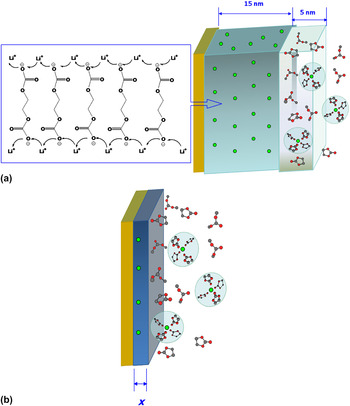
(a) New insights into SEI: the possible conduction mechanism of Li+ across the SEI. (b) New insights into SEI: dynamic equilibrium of interphase between continuous growth and dissolution.

This is probably why the earlier analysis found only Li2CO3 as the interphasial species on anode surfaces,Reference Dey and Sullivan11 and it was once believed (and still remains so among many even at present) that the major ingredient of SEI is Li2CO3.Reference Kanamura, Tamura, Shiraishi and Takehara19 However, the evidence of alkyl carbonate in SEI becomes overwhelming with continued investigations, and its unique chemical signature in various spectroscopic methods has been established (Fig. 2),Reference Peled, Golodnitsky, Menachem and Bar-Tow20, Reference Zhuang, Xu, Yang, Jow and Ross21 especially after the series of alkyl carbonate species were systematically synthesized in vitro and used as standard reference materials to establish corresponding spectroscopic databases.Reference Xu, Lee, Zhang and Jow18
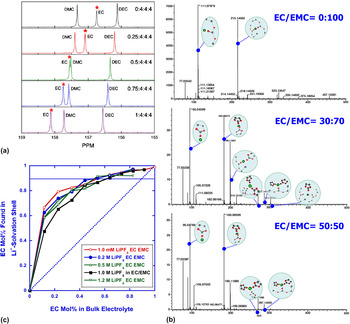
(a) 13C-NMR spectroscopy in carbonyl regions for equimolar mix of EC/DMC/DEC in absence or presence of varying concentration of LiPF6 (Reproduced with permission by Elsevier from Ref. Reference Matsuda, Fukushima, Hashimoto and Arakawa59). (b) ESI-MS of Li+-solvation sheath structures in selected typical electrolyte compositions (Reproduced with permission by the Electrochemical Society from Ref. Reference Morita, Asai, Yoshimoto and Ishikawa60). (c) The mapping of statistical distribution of cyclic carbonate molecules within the solvation sheath of Li+. Note that the diagonal straight line represents an ideal nonpreferential solvation behavior.

Recently, a very interesting work using x-ray photoelectron spectroscopy (XPS) showed how moisture control could affect ex situ surface analysis, which might be able to account for the widespread “myth” about Li2CO3.Reference Malmgren, Rensmo, Gustafsson, Gorgoi and Edström22 The binding energy for C1s electron in carbonyls of alkyl carbonate is somewhat lower than its full carbonate counterpart (such as Li2CO3), due to the presence of O–C bond, and the signal at 289 eV has been used as the chemical signature of the former; however, many XPS data reported in the literature often showed conspicuous peaks at >290 eV for cycled graphitic anode that is typical C1s binding energy for metal carbonate. Edström and coworkers convincingly demonstrated that, without using a vacuum transporter that ensures the moisture-exclusion during the sample loading, exposure of the sample to ambient for as brief as seconds is sufficient to shift the detected carbonyl C1s signals from 289 eV to 290 eV, leading to the conclusion that Li2CO3 was the major species in the SEI. This fact showed how sensitive these surface species are toward ambient moisture, and caution should always be taken when interpreting the ex situ analysis.
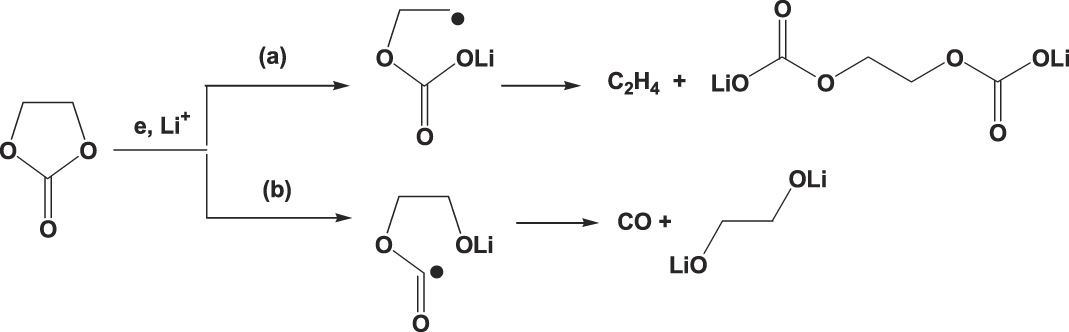
Besides alkyl carbonates, several other species were also identified as possible SEI ingredients on graphitic anodes, which include inorganic species such as the partial reduction products from hexafluorophosphate (PF6)- or other salt anions,Reference Kanamura, Tamura, Shiraishi and Takehara19 and organic species such as alkoxides, oxalates and possibly polymeric moieties. Both oxalate and alkoxide species were found by Zhuang et al. using Fourier transform infrared spectroscopy (FTIR) on the cycled graphitic anode,Reference Zhuang and Ross23 whereas a more recent work by Onuki et al., who labeled organic carbonate solvents with isotopic 13C, confirmed the existence of an acyl- instead of alkyl-oxygen cleavage pathway during the surface reductions, leading to alkoxides and COReference Onuki, Kinoshita, Sakata, Yanagidate, Otake and Ue24:
Consequence A of preferential solvation: formation chemistry of SEI is dictated by cyclic carbonate molecules that are favored by Li+ (Reproduced with permission by the American Chemical Society from Ref. Reference Mizutani, Abe, Ikeda, Ihara, Asano, Harada, Inaba and Ogumi39).

Interestingly, these species were not detected on simple electrode surfaces such as glassy carbon or Ni,Reference Zhuang, Xu, Yang, Jow and Ross21 making one speculate whether the rich functionalities on the graphite edge sites play a mediating role in directing the surface reduction pathways. Nevertheless, alkyl carbonate, especially the one generated by the reduction of EC and known as lithium ethylenedicarbonate (LEDC), is still considered as a main building block for the interphasial chemistry on graphitic anode surfaces.
Compared with solvents, the role of lithium salt anion in interphasial chemistry has been relatively neglected, aside from occasional identification of inorganic species such as LiF or LiPOXFy (partially reduced form of PF6-) in spectra.Reference Xu2, Reference Peled4, Reference Kanamura, Tamura, Shiraishi and Takehara19 They were generally considered inert or even detrimental islands embedded in the network of amorphous organic polymer or salt matrixes. However, the observations that both bis(oxalate)borate (BOB)Reference Xu, Zhang, Bruce and Jow25 and bis(perfluoromethanesulfonyl)imide (Beti)Reference Jeong, Inaba, Iriyama, Abe and Ogumi26 can stabilize graphitic anode even in the most exfoliating solvents shed new light onto the participation of anions into the formation chemistry of SEI. A more detailed appraisal was recently performed by Abraham and coworkers on how different salt anions affect the anode performance, and they concluded that reduction of these anions also played an important role in shaping an effective protection layer.Reference Xiao, Yang, Lucht, Kang and Abraham27
III. 3-D FORMATION MECHANISM
The elucidation on formation mechanism of SEI was not as straightforward as its chemistry but instead underwent a somehow controversial phase. It was realized very early on that the interphase on graphite must be formed in a different manner from that on metallic lithium, not only because the intrinsic potential of graphitic materials is approximately 3.0 V versus that of Li, but also because the surface of graphitic material is structured, in contrast with the simple 2-D surface like that of lithium metal. The former factor essentially prevents the instantaneous (and hence indiscriminating) reduction of electrolyte components, allowing certain components to be reduced preferentially before others during the process where the potential of graphite is gradually brought down to the lithiation region (∼ 0.20 V versus that of Li); whereas the latter presents an electrode surface with anisotropic sites, where reductive decomposition of SEI precursors proceed at both different potentials and kinetics. This graphite-specific mechanism was first discovered by Chu and coworkers using atomic force microscope (AFM), the simplified illustration of which is shown in Fig. 3.Reference Chu, Josefowicz and Farrington28 As such, the interphase is formed not only in a progressive manner starting from 1.50 V versus that of Li, the distribution of interphasial species is also inhomogeneous, with edge planes as the primary reaction sites being covered with an interphase well before basal sites.Reference Hirasawa, Sato, Asahina, Yamaguchi and Mori29, Reference Imhof and Novák30 More detailed analysis performed with XPS confirmed that the interphasial processes at edge- and basal sites of the graphite differ significantly from each other, with the former being thicker and enriched with inorganic species, and the latter much thinner and exhibiting more of organic (polymeric) characteristics.Reference Bar-Tow, Peled and Burstein31 This inhomogeneity obviously stems from the anisotropy of the graphite structure, as Li+ can only intercalate/deintercalate from the edge sites, whereas Li+ entrance through a basal plane is essentially forbidden.Reference Persson, Sethuraman, Hardwick, Hinuma, Meng, Ven, Srinivasan, Kostecki and Ceder32
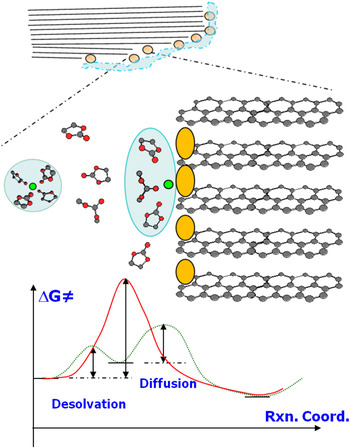
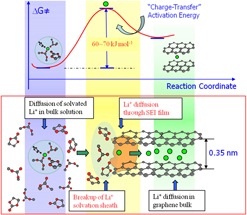
The energetic barrier during the journey of a Li+ from bulk electrolyte into graphite anode and its two contributing sources (1) Li+-desolvation and (2) Li+-migration through interphase (Reproduced with permission by the American Chemical Society from Ref. Reference Borodin and Smith61).

From a practical perspective, the above stepwise mechanism provides us an advantage to manipulate the interphasial chemistry, as it makes it possible for selected electrolyte components with higher reduction limits to be reduced ahead of others, whereas some that could otherwise be reduced by lithium metal would never be in this process due to the interphase being established before reaching their reduction limit.Reference Peled, Golodnitsky, Menachem and Bar-Tow20 The electrolyte additive strategy widely adopted by Li ion battery industry took full advantage of this stepwise mechanism.Reference Zhang33 By using trace amount of active ingredients, whose presence is too small to make any impact on the physical properties of bulk electrolyte (viscosity, ion conductivity, wettability toward separator, etc), the interphasial chemistries on graphitic anode will be entirely characterized by the additive. One prominent example of an electrolyte additive is vinylene carbonate (VC),Reference Jehoulet, Biensan, Bodet, Broussely, Moteau, Tessier-Lescourret, Holmes and Landgrebe34 whose reduction potential lies around 1.4 V versus that of Li, far above those of EC, PC or other acyclic carbonates (∼0.80 V versus that of Li). When a small percentage or even ppm level of VC is used in electrolytes, an interphasial chemistry distinctly different from that of the bulk electrolyte will be generated, resulting in an SEI that is thinner and more conductive, and more resistant against either solvent dissolution at elevated temperatures.Reference Aurbach, Gamolsky, Markovsky, Gofer, Schmidt and Heider35
The role of graphitic layer structure in the formation mechanism of SEI was further explored by Besenhard et al., who proposed that the interphase formed should not be a simple 2-D film covering graphitic surface, but instead should be a 3-D entity that partially penetrated the edge site of graphite.Reference Besenhard and Fritz36–Reference Wagner, Albering, Moeller, Besenhard and Winter38 The basis for their “3-D Interphase Model” comes from the experience that graphitic layer structure, held together by weak van der Waals force, is a rather accommodating host toward various intercalants.Reference Besenhard and Fritz36, Reference Mizutani, Abe, Ikeda, Ihara, Asano, Harada, Inaba and Ogumi39 Thus, it was believed that, prior to the stepwise reductive decomposition of electrolyte solvents as shown in Fig. 3, a “transition state” of ternary intercalation compound (Li-GIC) should exist, which is the direct product of solvent cointercalation between the graphene layers. The most convincing evidence supporting this argument comes from their in situ XRD of a graphitic anode in PC-based electrolyte, in which a new d002 peak at 20–24° indicates an expanded interlayer distance of 1.59 nm that can sufficiently accommodate a solvated Li+ [Fig. 4(a) and 4(b)].Reference Wagner, Albering, Moeller, Besenhard and Winter38 Based on the existence of this ternary Li-GIC, Winter and Besenhard inferred that the resultant interphase must be partially penetrating the edge-sites of graphite, leading to the so-called “3-D interphase”. Subsequent work by Abe and Ogumi et al.Reference Mizutani, Abe, Ikeda, Ihara, Asano, Harada, Inaba and Ogumi39, Reference Abe, Kawabata, Mizutani, Inaba and Ogumi40 and Xu et al.Reference Xu41, Reference Xu, Lam, Zhang, Jow and Curtis42 approached this issue from AC impedance analyses on “charge-transfer” resistance and the associated activation energy, and contributed to refine this “3-D interphase” mechanism further, as illustrated in Fig. 4c. In this improved model, it is believed that, upon the first lithiation of graphitic anode, the solvated Li+ would force the graphene structure to open up until the bulky Li+(solv)x is accommodated in the 1.59 nm interstitial, which corresponds to a transient ternary Li-GIC at potential ∼1.5 V versus that of Li. Whereas the potential of graphitic anode is driven under 1.0 V versus that of Li, the graphene interlayers turn into very reductive environment and solvent molecules in the solvation sheath subsequently are reduced by accepting electrons from the p-bands of sp2 carbons. This reduction process is accompanied by the shrinking of graphene interlayer distance back to 0.35 nm and remains in the following lithiation/delithiation cycles. The formed SEI, now partially penetrating graphene edge-sites, acts both as “glue” that prevents graphene layers from expanding as they do during the first lithiation, and as “filter” that forces solvated Li+ to desolvate before lithiation.
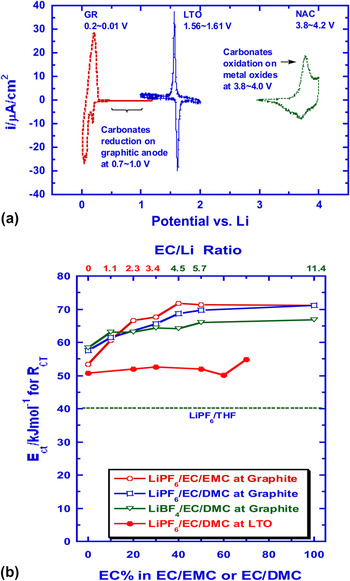
(a) LTO provides an ideal intercalation template that has pure contribution from Li+-desolvation due to the absence of an interphase (Reproduced with permission by the American Chemical Society from Ref. Reference Borodin and Smith61). (b) Comparison between the activation energy barrier as measured on graphite, where the high-energy barrier is the compounded results of both Li+-desolvation and the subsequent Li+-migration across the interphase, and LTO surfaces, where the contribution to activation barrier only comes from Li+-desolvation (Reproduced with permission by the American Chemical Society from Ref. Reference Borodin and Smith61).

So far, among the various models proposed by many researchers over the two decades of SEI studies, this “3-D Interphase Model” seems to be the one that can account for the diversified experimental observations to the best approximation.
IV. A FEW NEW INSIGHTS INTO SEI
Despite the progresses in understanding chemistry and formation mechanism of interphases, their physical picture remains unclear, such as how thick they are, how stable they are against solvent dissolution, what their morphology is, how Li+ is conducting through them, and how “absolute” are their electrolyte attributes during the cell operation. Whereas the early attempt of estimating SEI thickness was based on the passivation of metallic lithium, a few recent studies shed more light on this issue for graphitic anodes.
Due to the porous surface of the graphitic electrode and the uneven distribution of the surface ingredients, the accurate thickness of interphases has been difficult to quantify and even unclear to define.Reference Peled, Bar Tow, Merson, Gladkich, Burstein and Golodnitsky43 Judged from the maximum electron tunneling distance of most inorganic and organic materials as determined by scanning tunnel microscope (STM) technique, it was estimated that SEI should be at least 2 nm,Reference Alliata44 whereas various AFM and transmission electron microscope (TEM) data reported in early literatures vary in a wide range from 20 nm to 980 nmReference Campana, Kötz, Vetter, Novák and Siegenthaler45, Reference Zhang, Li, Liu, Tan and Cheng46 Various authors have also pointed out that, like the formation mechanism and chemistry,Reference Bar-Tow, Peled and Burstein31 the unique anisotropic structure of graphitic anode results in an inhomogeneous thickness of interphases, with edge-sites covered with thicker depositions than basal.Reference Peled, Golodnitsky, Ulus and Yufit47
Recently Lu and Harris designed a rather ingenuous experiment, which for the first time shed light on the structured morphology of interphase as well as a possible Li+-conducting mechanism through it.Reference Lu and Harris48 They formed an interphase on Cu-substrate in an electrolyte based on LiClO4, and then soaked it in another electrolyte based on LiBF4 that was labeled with 6Li isotopes for various durations. Depth profile of such interphase was subsequently mapped using secondary ion mass spectrum (SIMS) by monitoring the linear distribution of 11B, 6Li/7Li and 35Cl species, which revealed that, whereas inorganic (Li2O, Li2CO3) and organic species (alkyl carbonate, polymeric etc) constitute a deposition layer of ∼20 nm, the top 5 nm region on the solution side is easily permeable to bulk electrolyte [Fig. 5(a)]. In this sense, the dense layer of ∼15 nm that is impervious to solvents should constitute the real SEI.
New strategy is needed to target the interphasial chemistry at graphitic edge-sites to “catalyze” the disruption of Li+-solvation sheath.

In the same study, by comparing the 6Li/7Li ratio and its dependence on electrolyte soaking duration they also challenged the traditional belief that Li+-transport across interphases occurs via grain boundaries, vacancies or interstitials. Instead, since 7Li in the original SEI can be replaced by 6Li in time-scale of minutes, a mechanism involving ion-exchange probably happens, in which Li+ hops between neighboring salt anions in a Grotthuss-like manner [Fig. 5(a)]. This discovery corrects a long-standing misconception that the Li+ consumed in the process of SEI-formation becomes “immobilized” or “electrochemically inactive.” In fact, the unavailability of these interphasial Li+ is “dynamic” rather than “static.”
Another new perspective of SEI came from the high precision coulometry technique developed by Dahn et al.Reference Smith, Burns, Trussler and Dahn49–Reference Smith, Burns, Zhao, Xiong and Dahn52 Assuming that most of the electrolyte components consumed in the irreversible processes turn into surface ingredients that are insoluble in the bulk electrolyte solvents (i.e., lithium salts in chemical nature), then the thickness of the interphase is proportional to the amount of electrolytes consumed during its formation [Fig. 5(b)]. Monitoring the irreversible loss in capacity for each cycle, they found that the charge consumed by SEI and hence the SEI thickness (x) increases approximately with the square root of time, corresponding to a mechanism that the growth rate of SEI (dx/dt) is inversely proportional to the thickness:

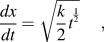
where k is a constant that is specific for each electrolyte/electrode system and temperature.
Contrary to intuitive belief held by many that SEI is formed in the initial cycling and the parasitic decompositions of electrolytes are prevented thereafter, the above parabolic relation states that mathematically the growth of SEI never stops; instead, one can only slow it down (reducing k) with effective electrolyte additive use or with better matching between electrode and electrolytes.Reference Burns, Jain, Smith, Eberman, Scott, Gardner and Dahn51, Reference Smith, Burns, Zhao, Xiong and Dahn52 In reality, Dahn et al. observed with their high-precision coulometry that the irreversible loss on most anode materials requires at least 25 cycles to stabilize asymptotically.Reference Smith, Burns, Trussler and Dahn49 It should be noted here that the SEI growth rate, estimated in the above manner to be 0.5 nm per cycle, should be related to the overall surface deposition rather than the effective interphase as identified by Lu and Harris as the dense layer.Reference Lu and Harris48 Dahn et al. further concluded that, for a given electrolyte/electrode system, SEI growth is only dictated by time and temperature, not by cycle count as many researchers might have believed.Reference Smith, Burns, Trussler and Dahn49, Reference Burns, Jain, Smith, Eberman, Scott, Gardner and Dahn51 This conclusion is based on the assumption that the cells under investigation must remain within the normal operation potentials, so that the time spent by electrolyte on the reactive surfaces of the electrodes is directly correlated to the irreversible losses, which is the precondition for the above parabolic law to hold true.
The most important feature of SEI, i.e., its electrolyte attributes of being an ionic conductor but electronic insulator, was also challenged in certain scenarios. For example, it has been well known that many compounds that have redox potentials in the vicinity of various cathode materials can serve as “overcharge protection” additives.Reference Xu2 However, both the activation (oxidation) and regeneration (reduction) of these redox shuttles have to happen essentially against the electrolyte attributes of SEI. Therefore, electrons have to find a path to tunnel through the interphase under certain conditions, which could include either a polarization high enough to drive the electrons, or the ready availability of electrons from the highest occupied molecular orbitals (HOMO) from the redox additive. Tang and Newman confirmed that the trans-SEI current that reduces ferrocenium could be described by simple Butler-Volmer equations, whereas passivation film on the glassy electrode surface expectedly slowed down the kinetics of this process.Reference Tang and Newman53 For an ideal “overcharge protection” additive that can work reversibly throughout the entire cell, the trans-SEI current should only induce reactions of the redox shuttles, which are reversible, instead of inducing oxidation/reduction of the main electrolyte components, which are irreversible.
A more direct challenge to the traditional notion of SEI’s electrolyte attributes comes from the new concept of Li ion flow battery proposed by Chiang et al.Reference Chiang, Carter, Ho and Duduta54 Adopting the flow battery configuration that has been mature for low voltage, vanadium-based aqueous chemistries, Chiang et al. suspended the active particles of both LiCoO2 cathode and graphitic carbon anode materials in slurries made from nonaqueous liquid electrolytes and circulated these slurries with a peristaltic pump, either continuously or intermittently, through the electrochemical chamber. Energy can be extracted from or stored into these moving phases (slurries) with typical reversible Li ion chemistry characteristics, such as capacity and voltage profiles; however, since these active particles are mobile and detached from their own electrode current collector, the existing picture of SEI film separating ionic conductor and electronic conductor no longer applies. Because the potentials of these electrode materials were driven to their corresponding operating ranges, i.e., 4.0–5.0 V for LiCoO2 or LiMn1.5Ni0.5O4 and 0.2 V for graphite, the oxidative as well as reductive decomposition reactions were expected to occur, leading to possible formation of interphase layers on individual particles. In other words, for the capacity to be accessible, electrons must be forced to tunnel through these multiple layers of interphases, similar to what a redox shuttle additive must experience under the overcharged conditions. Replacing graphite with the SEI-free lithiated titanate would relieve the strain at anode side, but cathode/electrolyte interface and its effect on the sustainability of the chemistry still merit more investigation.Reference Duduta, Ho, Wood, Limthongkul, Brunini, Carter and Chiang55
Apparently, the current knowledge of SEI is insufficient to provide a satisfactory rationale for these seemingly paradoxical phenomena. The more we know about SEI, the more we know we do not know about it.
V. PREFERENTIAL SOLVATION OF Li+
In recent studies, a seemingly improbable correlation was established between a bulk electrolyte property, i.e., Li+-preferential solvation phenomenon, and interphasial properties, such as SEI formation chemistry and Li+-migration process across SEI.
Based on the “3-D Interphase Model,” Xu et al.Reference Xu41, Reference Xu, Lam, Zhang, Jow and Curtis42 further proposed that the solvation sheath structure of Li+ plays a directing role in the interphasial chemistry, because it was those inner members within Li+-solvation sheath that serve as the primary precursors for the future SEI [Fig. 4(c)]. It is the first time that a link was proposed between a typical bulk electrolyte property (Li+-solvation sheath) and an interfacial property (interphasial compositions). This correlation inevitably leads us to the question about whether a preferential solvation of Li+ exists in nonaqueous electrolytes that usually consists of mixture of cosolvents.
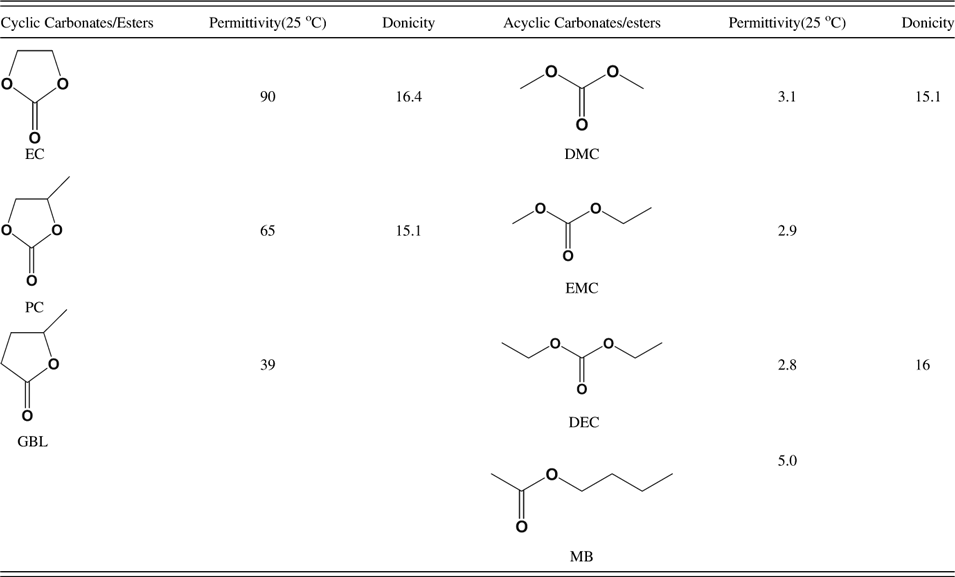
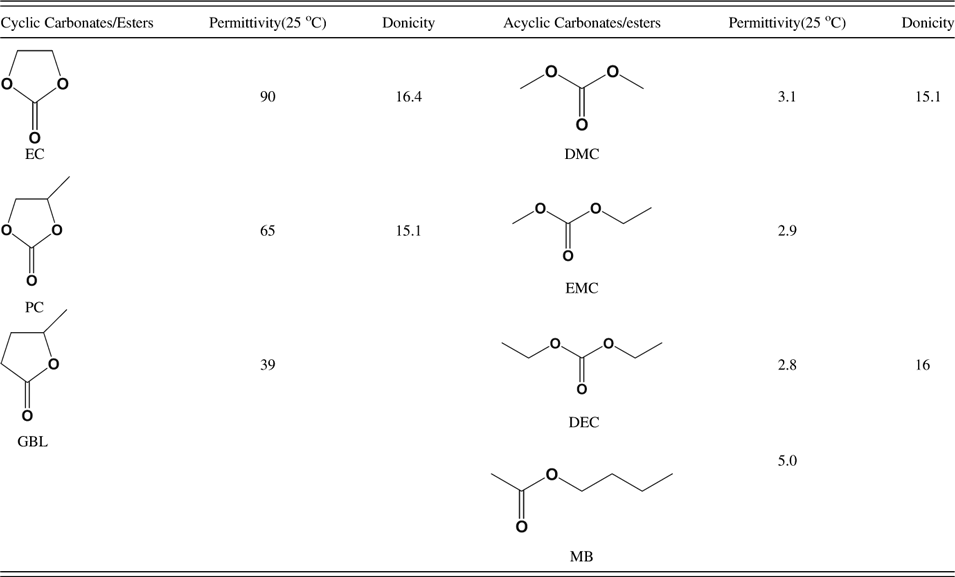
Typically, electrolytes widely used by the Li ion battery industry as well as the research community are composed of lithium salt usually, LiPF6 (lithium hexafluorophosphate) dissolved in a mixture of high-permittivity molecules, such as cyclic esters such as EC, and low viscosity molecules, such as acyclic esters, which include dimethyl carbonate (DMC), diethyl carbonate (DEC) and ethyl methyl carbonate (EMC).Reference Xu2Table I summarizes these two classes of cosolvents along with their related physical properties. Realizing that the solvent molecules recruited by Li+ into its primary solvation sheath are the precursors of interphasial chemistry, one wonders if Li+ prefers one of these cosolvents over the other. Examining the related literatures from as early as 1960s, it was found that no straightforward answer is available to this seemingly simple question.Reference Jeong, Inaba, Iriyama, Abe and Ogumi56–Reference Borodin and Smith61 A glimpse at Table I can immediately tell that cyclic and acyclic esters are completely different solvents if classified by permittivity, or similar solvents if judged by donicity. It was this disparity that induces the diversified answers over whether a preferential solvation happens at all, or if it does, whether EC or its acyclic counterparts are favored.
Key physical parameters that would determine the competitive solvation of Li+ in electrolytes of binary or higher orders.
Despite circumstantial evidences from spectroscopic analyses on graphitic anodes,Reference Xu, Lee, Zhang and Jow18, Reference Zhuang, Xu, Yang, Jow and Ross21, Reference Xu, Lam, Zhang, Jow and Curtis42 the first unequivocal report on possible Li+-preferential solvation came from NMR studies by Yang et al.Reference Yang, Xiao and Lucht62 By adding LiPF6 salt progressively to an equimolar mix of EC, DMC and DEC, they monitored that the chemical shift change in the carbonyls of EC, apparently caused by its coordination with Li+, is much more severe than its linear counterparts [Fig. 6(a)]. Furthermore, using 1H spin-echo pulse sequence, they were able to measure the self-diffusion coefficients of these carbonates in the absence or presence of lithium salt. The appearance of Li+ in the solution drastically slows down the movement of EC as compared with DMC and DEC, indicating the preferred binding between these two species.
More recently, Cresce et al.Reference Cresce and Xu63 managed to depict a quantitative picture of Li+-solvation sheath by using a mass spectrum technique with soft ionization means (electrospray ionization), where the statistical distribution of cyclic and acyclic carbonate molecules within the Li+-solvation sheath can be analyzed as a function of bulk electrolyte composition. Figure 6(b) showed spectra for the cationic species detected in a few selected compositions that consist of the typical cyclic (EC) and acyclic carbonates (EMC), with the major species structures interpreted by the graphic labeling. It is apparent that when EC population is higher than 30% in the bulk electrolyte solutions, the Li+-solvation sheath is already dominated by its presence. Thus, preferential solvation of Li+ undoubtedly does occur with EC, and most likely with other cyclic carbonates or similar molecules with high permittivity, such as γ-butyrolactone (Table I). Using the peak abundances for each solvated Li+, Cresce et al. were also able to quantitatively map the distribution of EC as found within the solvation sheath, as shown in Fig. 6(c). If there is no preferential solvation by Li+, then EC and EMC should enjoy the equal opportunity to enter the sheath, and the relation between EC-sheath population and EC-bulk composition should follow the diagonal straight line in the Figure. Instead, a very positive deviation toward EC content occurs in all the electrolyte compositions investigated, revealing this “favoritism” between EC and Li+.
Based on the above observation, one can easily imagine a Li+ conduction picture for electrolytes that are typically used by Li ion battery researchers and industry (i.e., 10% < EC < 50%), in which each individual Li+, while being almost exclusively coordinated with EC molecules, swims “freely” in the ocean of unbound acyclic carbonates due to low viscosity of the latter. In these electrolytes, there is “EC-enrichment” in Li+-solvation sheath and correspondingly “EC-depletion” in the bulk.
VI. IMPLICATIONS OF PREFERENTIAL SOLVATION TO INTERPHASIAL PROCESSES
The above preferential solvation of Li+ would cast two consequences on interphasial processes at graphitic anode.
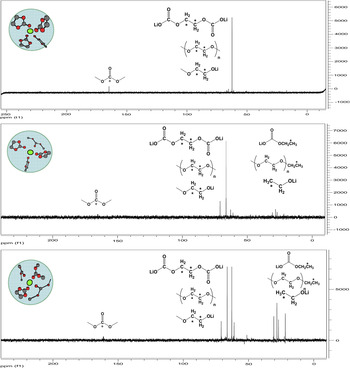
The more immediate issue is the formation chemistry of SEI. As depicted in Fig. 4(c), since the sheath members constitute the SEI after graphitic anode is lithiated, the interphasial composition in most Li ion batteries would bear dominant chemical signature of EC. This has been observed previously when a Ni working electrode was polarized to Li deposition potential, on which the surface species were identified by FTIR as from EC reduction exclusively, despite the fact that in the bulk electrolyte, EMC was actually the dominating cosolvent (70% by wt, or 66.3% by Mol).Reference Zhuang, Xu, Yang, Jow and Ross21 In fact, such a perfect fingerprint match was made between the cycled Ni-surface and the synthesized standard reference LEDC (Fig. 2) that the presence of any EMC-originated interphasial species was essentially excluded. Similar results were obtained later when interphasial species as collected from the cycled graphitic anodes were analyzed by 13C-NMR (Fig. 7), where the presence of EMC-generated reduction product did not show up in the spectra until the EMC content in the bulk approached 90% by wt (or 88.3% by Mol).Reference Xu, Lam, Zhang, Jow and Curtis42 The correlation between Li+-solvation sheath and interphasial chemistry is the rationale behind the above experimental observations.
Another less immediate but nonetheless extremely significant consequence relates to the kinetics of Li+-transport after SEI has been formed, i.e., the Li+-preferential solvation determines the rate of lithiation (charging) process at graphite anodes.
As depicted by Fig. 8, once formed, the SEI acts both as “glue” that pins the graphene together and prevents exfoliation, and as “filter” that forbids the solvent molecules in Li+-solvation sheath from entering the graphene interior, hence only “naked” Li+ can intercalate/deintercalate. The stripping of the solvation sheath, also known as “desolvation”, is an energy-consuming step, which is why graphitic or other intercalation-type anodes in Li ion batteries suffer from difficulty in charging. Naturally, how the solvation sheath is structured affects the energy barrier of this charging or lithiation process.
In a recent impedance analysis performed by Abe and Ogumi,Reference Mizutani, Abe, Ikeda, Ihara, Asano, Harada, Inaba and Ogumi39, Reference Abe, Kawabata, Mizutani, Inaba and Ogumi40, Reference Yamada, Iriyama, Abe and Ogumi64 the significance of “desolvation” has been sufficiently recognized and associated with the so-called “charge-transfer” component that usually constitutes the highest resistance in the Li ion cell at low temperatures or at high rates. Xu et al. continued the characterization on the basis of Ogumi et al., and determined that the activation energy barrier at composite graphite/electrolyte interphase ranges between 50 and 70 kJ/mol, where an apparent dependence on electrolyte composition exists.Reference Xu41, Reference Xu, Lam, Zhang, Jow and Curtis42 Interestingly, the above dependence bears close resemblance to the EC-distribution in Li+-solvation sheath [Fig. 6(b)], revealing again the correlation between Li+-solvation sheath structure and interphasial chemistry as discussed above.
From an energetic perspective, whereas a solvated Li+ in bulk electrolyte is a stable state due to the stabilization provided by lone pair electrons of the nucleophilic solvent molecules, an intercalated Li+ between graphene layers can be considered as a “meta-stable” state because Li+ is stabilized by the electrons in the 2p-bands of graphite. However, for a solvated Li+ to be intercalated into graphite, there must be a “transition state” where the Li+ has to be “naked” without either type of stabilization (Fig. 8). If examined closely, this “transition state” consists of two distinct steps: (1) the generation of the “naked” Li+, i.e., desolvation, and (2) the migration of the “naked” Li+ through the formed interphase. The activation energy barrier as shown in Fig. 8 is actually the compounded result of these two factors, as a unique SEI formed in each of the electrolyte composition has been interwoven with the subsequent Li+-intercalation.Reference Xu41 Thus, a new question was raised: how can we distinguish which of the two steps is mainly responsible for the activation energy barrier as measured at graphite/electrolyte interphase?
For deconvoluting the compounded effects of these two contributing factors, Xu et al. made use of lithiated titania (Li4Ti5O12, or LTO), which has been known to be interphase-free due to its high intercalation potential [∼1.5 V versus that of Li, Fig. 9(a)].Reference Xu, Cresce and Lee65 Since the lattice of LTO only allows naked Li+ to be intercalated, as does that of graphite, it is expected that the activation energy barrier as derived from LTO/electrolyte interface comes mainly from the contribution of Li+-desolvation effect, assuming that the barrier for the intercalation of naked Li+ into LTO is negligible. Figure 9(b) summarized such activation energy barriers in comparison with that derived from graphite/electrolyte interphase. Apparently, the contribution from Li+-desolvation process to the lithiation of LTO ranges around ∼50 kJ/mol. In comparison with the overall energy barrier of 60–70 kJ/mol at graphite/electrolyte interphase, one can conclude that the Li+-desolvation controls the kinetics of lithiation processes of intercalation anode materials, such as graphite and LTO.
Thus, the resistance of lithiating graphitic anode comes mainly from the breaking up the solvation sheath of Li+, which was made more difficult in most state-of-the-art electrolytes, in which the solvation sheath consists predominantly of EC, a molecule that strongly binds to Li+. In other words, preferential solvation of Li+ is directly related to how fast a Li+ can be transported from bulk electrolyte into graphene interlayer.
VII. NEW STRATEGY FOR HIGH POWER DENSITY Li ION DEVICES
The revelation on dictating role of Li+-desolvation in the lithiation kinetics of intercalation anode materials might shed more light on what an ideal SEI would be in Li ion batteries. Traditionally, the resistance associated with SEI has been recognized as the main barrier to overcome.Reference Imhof and Novák30 For tailoring an interphase that allows higher rate capability, Li ion industry has been adopting the strategy of forming a thinner SEI so that Li+-conductance can be maximized. Series of electrolyte additives have been designed, modeled and synthesized to meet this purpose. However, there are certain restrictions on how far we can go along this line of thought, because (i) the minimal thickness of SEI cannot be smaller than 2 nm, below which electron tunnel occurs and interphase can no longer protect bulk electrolyte from sustaining decompositions; and (ii) no matter how thin an SEI is, Li+-desolvation still need to happen at graphite/electrolyte interphase or LTO/electrolyte interface, whose contribution to the overall energy barrier remains a “constant.” Considering that this contribution actually dominates the entire lithiation process, an ideal interphase would be not only just small in physical thickness, but also be chemically desirable in a way that the new interphasial chemitry could “catalyze” the breaking up of Li+-solvation sheath, as illustrated in Fig. 10. Specifically, since Li+-intercalation only occurs at the edge sites of graphite, a new strategy of manipulating SEI chemistry should directly target these “active” sites by designing new electrolyte additives that can modify the physicochemical properties there. This new direction that has been underexplored in the past could result in breakthroughs in new power-intense graphitic anode materials.