






1. Introduction
Ultracompact X-ray binaries (UCXBs) are a subclass of low-mass X-ray binaries (LMXBs) with short orbital periods (
 $\lt 80$
min) and hydrogen-deficient donors (van Haaften et al. Reference van Haaften, Nelemans, Voss, Wood and Kuijpers2012; Armas Padilla et al. Reference Armas Padilla, Corral-Santana, Borghese, Cúneo, Muñoz-Darias, Casares and Torres2023). They are key gravitational-wave sources (Wang et al. Reference Wang, Chen, Liu, Chen, Wu, Tang, Guo and Han2021) and laboratories for studying binary evolution and accretion in H-poor environments (van Haaften et al. Reference van Haaften, Nelemans, Voss, Wood and Kuijpers2012). Many UCXBs are found in globular clusters (GCs), formed via dynamical interactions such as neutron star–red giant collisions (Hut et al. Reference Hut, Murphy and Verbunt1991; Ivanova et al. Reference Ivanova, Rasio, Lombardi, Dooley and Proulx2005). However, the most luminous systems, particularly during the early phases of UCXB evolution when they can reach ultraluminous X-ray source (ULX) luminosities (
 $L_X \geq 10^{39}\ \mathrm{erg\ s^{-1}}$
), are rare and observed only in extragalactic GCs. Multiwavelength observations show long-term X-ray stability and optical spectra with [N II] and [O III] lines, lacking H or He. We review these signatures using GC ULX CXO J033831.8-352604 (GCU7) as a case (Oh et al. Reference Oh, Dage, Bobrick, Aydi, Bahramian, Goodwin, Haggard, Irwin, Kundu, Strader, Maccarone and Zepf2025). These features identify young UCXBs with He WD donors, offering insight into their initial evolution and the full UCXB life cycle.
2. X-ray Signatures: A New Perspective on Stability in the Early Stages
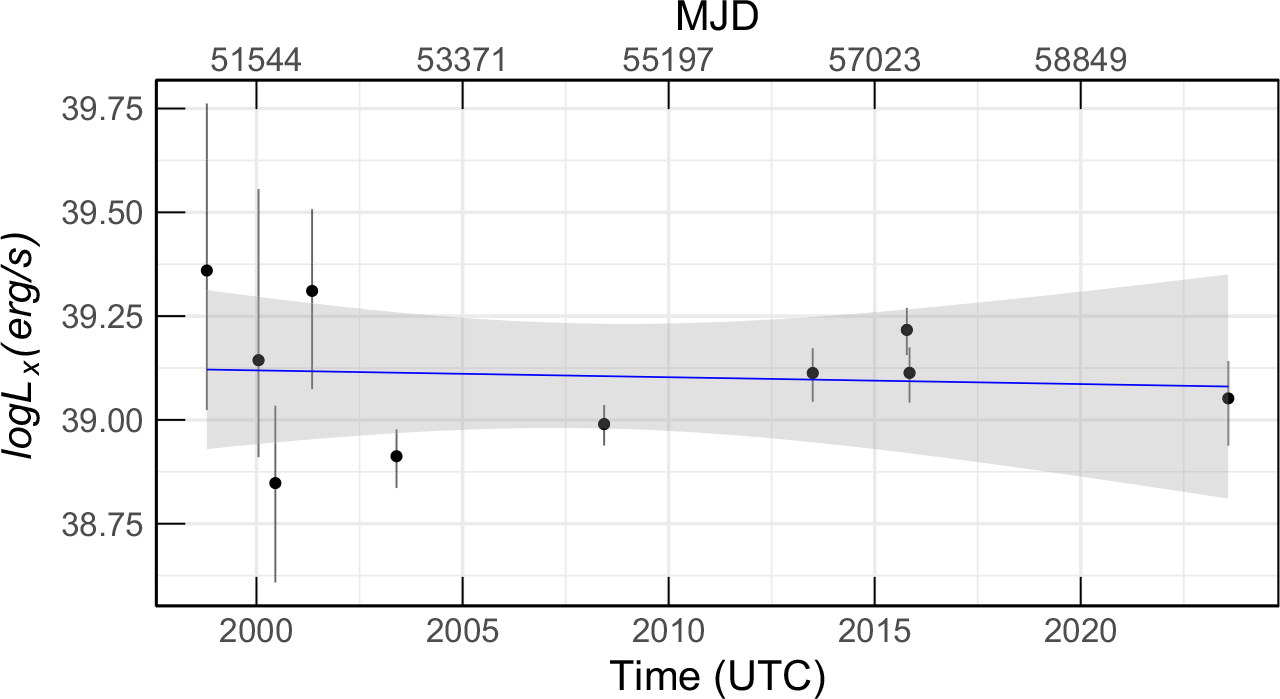
While the X-ray emission from UCXBs often exhibits significant variability, the most luminous examples found in extragalactic GCs offer a new perspective on their early evolution. A prime case study is GCU7, which has displayed a stable luminosity of
 $L_X \approx 10^{39}erg~s^{-1}$
for over two decades of Chandra observations (Fig. 1). This sustained, high-luminosity emission strongly disfavors transient models, such as a tidal disruption event, which would predict a significant decay over this timescale. Instead, this points towards a continuous and regulated mass transfer process. We interpret it as a key signature of a young UCXB in its initial, super-Eddington accretion phase, offering a rare glimpse into the earliest stages of its evolution before it transitions into the less luminous, more variable systems commonly observed in the local universe.
The long-term X-ray light curve of GCU7 from 1999 to 2023, combining data from 13 Chandra observations in the 0.5–8.0 keV range. The luminosity has remained remarkably stable for over two decades, which is a key characteristic which argues against a transient origin.

3. Unveiling Donor Nature through Optical Spectroscopy
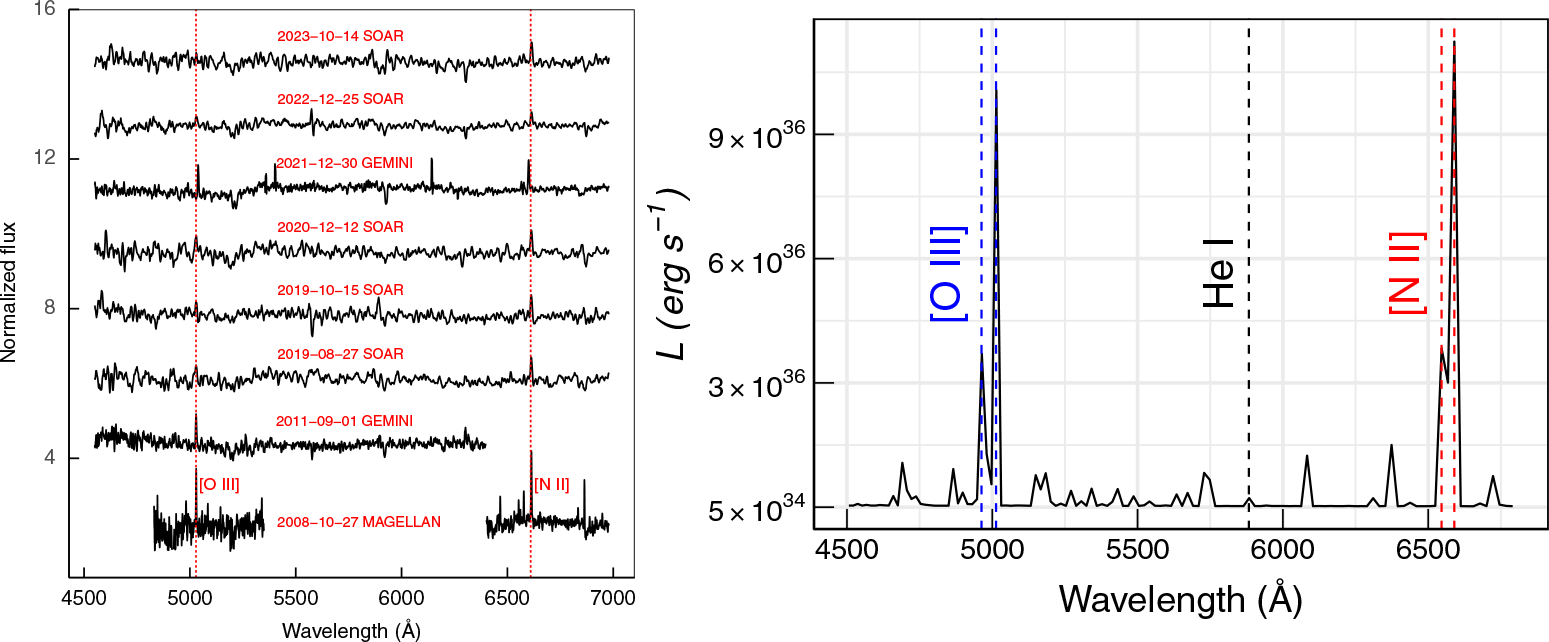
Optical spectroscopy is key to identifying the chemical composition of UCXB donors, confirming their hydrogen-deficient nature through the absence of hydrogen spectral features (van Haaften et al. Reference van Haaften, Nelemans, Voss, Wood and Kuijpers2012; Armas Padilla et al. Reference Armas Padilla, Corral-Santana, Borghese, Cúneo, Muñoz-Darias, Casares and Torres2023). Specific emission lines of helium, carbon, nitrogen, or oxygen distinguish donor types, such as helium stars, He WDs, or CO WDs. For instance, the GC ULX RZ 2109’s optical spectrum shows a strong, broad [O III] doublet without hydrogen, indicating a CO WD donor, likely associated with a fast outflow or jet (Dage et al. Reference Dage, Bahramian, Naoz, Bobrick, Athukoralalage, Brumback, Haggard, Kundu and Zepf2024). By contrast, GCU7 presents a different but equally informative spectral signature. Its optical spectrum consistently shows prominent [N II] and [O III] emission lines (left panel of Fig. 2), while both hydrogen and helium features are clearly absent, consistent with its UCXB nature. This specific combination of lines–strong nitrogen and oxygen without helium–offers a powerful diagnostic for its donor. As shown by photoionization modeling with CLOUDY, this spectral appearance is best reproduced by an outflow from a system with a He WD donor (see right panel in Fig. 2).
Left: The optical spectrum of GCU7, showing the prominent [N II] and [O III] emission lines. Right: A CLOUDY model spectrum of a photoionized outflow from a He WD donor system, supporting the hypothesis of a He WD donor.

4. Synthesis and Future Outlook
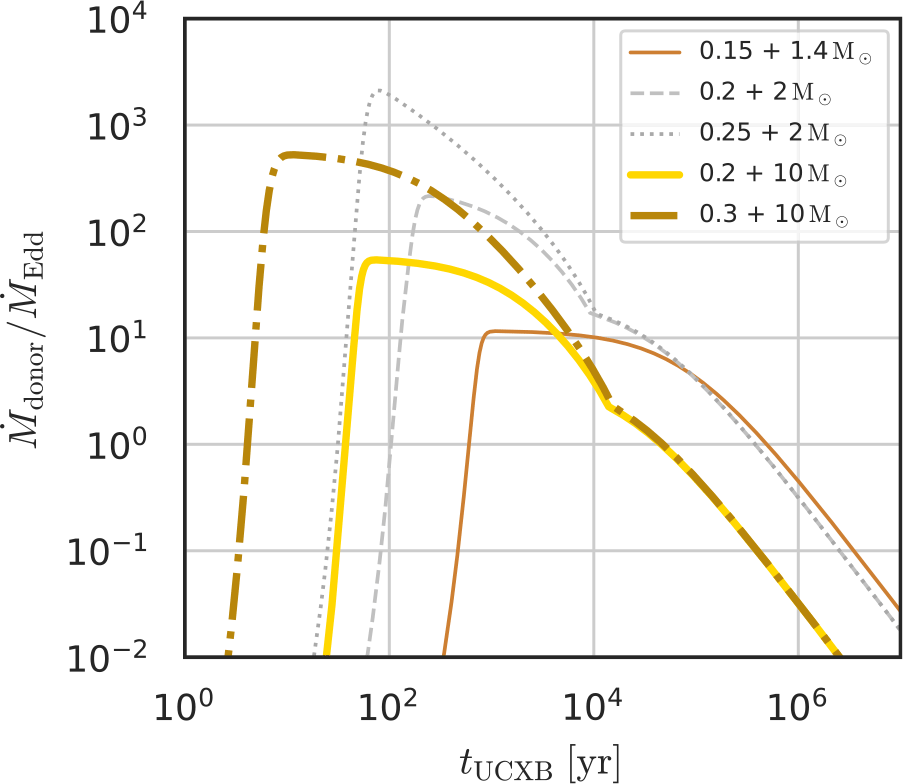
GCU7’s multiwavelength evidence, including stable X-ray luminosity and an optical spectrum with [N II] and [O III] lines but no hydrogen or helium, identifies it as a young UCXB with a He WD donor accreting at super-Eddington rates. Theoretical models suggest UCXBs evolve from high to low mass transfer over Gyr timescales due to gravitational wave radiation (Bildsten & Deloye Reference Bildsten and Deloye2004). As shown in evolutionary tracks (Fig. 3), a system like GCU7 represents this early stage, which may last for only
 $10^3$
to
 $10^4$
years (Oh et al. Reference Oh, Dage, Bobrick, Aydi, Bahramian, Goodwin, Haggard, Irwin, Kundu, Strader, Maccarone and Zepf2025). GCU7 thus provides a rare snapshot of this fleeting, high-luminosity phase that is statistically difficult to capture in the Milky Way.
Evolutionary tracks for UCXB systems with He WD donors. The tracks show an early phase of highly super-Eddington mass transfer, corresponding to the state of GCU7.

In conclusion, the study of extreme, extragalactic systems like GCU7 is essential for constructing a complete and observationally-grounded picture of UCXB formation and evolution. Studying such extragalactic systems is vital for understanding UCXB evolution and refining population synthesis models by identifying more young UCXBs in nearby galaxies.

 Open access

