INTRODUCTION
Premunition was defined in 1924 as a state in a disease wherein the host is protected from further infection with a pathogen by the existence of a persistent chronic infection with the same species of pathogen. This state of resistance contrasts with ‘solid immunity,’ where the host clears itself of the primary infection and is then totally refractory to challenge infection (Sergent et al. Reference Sergent, Parrot and Donatien1924). The term premunition has been used to describe relationships in infections of animals with bacteria [e.g. Aeromonas (Michel and Faivre, Reference Michel and Faivre1991)]; protozoa [e.g. malaria (Smith et al. Reference Smith, Felger, Tanner and Beck1999), coccidiosis (Solangi and Overstreet, Reference Solangi and Overstreet1980), Chagas disease (Meckert et al. Reference Meckert, Chambό and Laguens1988), leishmaniasis (Nadim, Reference Nadim1984) and toxoplasmosis (Araujo et al. Reference Araujo, Slifer and Kim1997)]; and helminths [e.g. schistosomiasis (Damian et al. Reference Damian, Greene and Fitzgerald1974) and trichostrongylosis (Kennedy and Todd, Reference Kennedy and Todd1975)]. In the case of pathogens of plants, premunition has been used to describe the protection of plants against viruses [e.g. apricot leaf roll (Castelain et al. Reference Castelain, Chastellière, Jullian, Morvan and Lemaire1997)] and fungi [e.g. Fusarium and Phytophthora (Taquet et al. Reference Taquet, Ravisé, Renard and Kunesch1985) and Verticillium (Regragui et al. Reference Regragui, Lahlou and Zaid1989)].
A form of premunition also occurs between the sibling Haemonchus species, H. contortus and H. placei. In this case, an infection of the sheep adapted H. contortus prevents the establishment of H. placei. However, mixed infections of the two species can occur.
There are various explanations for premunition, but none is sufficient or proven. One underlying principal of premunition that has been assumed is that the host maintains a steady-state immune response to the pathogen to protect itself from additional infection. It has been noted for some time that the removal of the underlying parasitic infection would allow the host to become infected with a new population (Cameron, Reference Cameron1934). Others have hinted that the result may not be due to a host-induced response, but rather to a response induced by the existing parasite population. It has been suggested that premunition is perhaps due to ‘crowding’ of the parasites (Read, Reference Read1951) or ‘due in part to competition between immature and mature members of the same species’ (Whitlock and Georgi, Reference Whitlock and Georgi1976). Another potential parasite-induced response would be in keeping with Hamilton's rule, wherein an existing infection would prevent the establishment of a non-related population because closely related individuals in an infection should show less aggression, and more altruism, towards closer kin (Hamilton, Reference Hamilton1963). This work was designed as an initial test of the hypothesis that kin selection, at least in the well-defined system of haemonchosis, plays a significant role in premunition.
MATERIALS AND METHODS
Model used
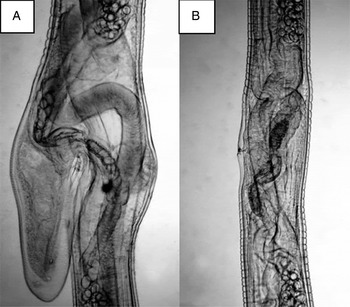
A Haemonchus contortus model was used in our work. This model was selected because premunition can be routinely induced with H. contortus (Kennedy and Todd, Reference Kennedy and Todd1975; Whitlock and Georgi, Reference Whitlock and Georgi1976). Haemonchus contortus also was selected as a model, because it is possible to distinguish vulva morphotypes comprising established and newly introduced competitors. Vulva morphotypes of H. contortus are defined by a cuticular process in the region of the vulva that can be selected by breeding worms of a defined type with the non-linguiform morphotype being recessive and consequently breeding more truly (Fig. 1); the biological function of the vulvar processes has not been determined and has not been related to differences in survival or reproduction (LeJambre, Reference LeJambre1977).
Photomicrographs of the vulval morphotypes of H. contortus used in the reported experiments for the identification of the different infections. The vulval morphotype of Fig. 1A is considered linguiform (the Linguiform A morphotype of LeJambre and Whitlock (Reference LeJambre and Whitlock1968). The vulva morphotype in Fig. 1B has been termed non-linguiform or smooth. It is possible to easily maintain these various morphotypes through passage in sheep and the characters are inherited in a simple Mendelian fashion.

We produced isolated morphotypes by collecting approximately 15 females (obtained from a sheep at a slaughterhouse) that had either a linguiform (rough; ‘Lf’) or non-linguiform (smooth; ‘Sm’) vulva (Roberts et al. Reference Roberts, Turner and McKevett1954). The eggs were isolated from the females and cultured to third stage larvae. The larvae from the Lf were given to one lamb and the larvae from the Sm to another lamb. Worms of each type were increased in relatedness by additional passages in isolated lambs. After the first passage, the sheep infected with Sm Haemonchus was euthanized and Sm morphotypes were again selected for egg collection and larval production. Any Lf Haemonchus from this sheep were discarded. The larvae were used to infect another lamb (second passage). Eggs collected from the feces of the second passage lamb were cultured and the larvae used to inoculate another lamb (third passage). Eggs collected from the third passage lamb were used to produce the larvae for the Sm infections used in this experiment. This procedure resulted in two selections based on morphotype and two larval passages for a total of 4 in-breedings of the Sm Haemonchus. The same procedure was followed to produce Lf Haemonchus.
Study design
In the Cornell University Institutional Animal Care and Use Committee (IACUC) approved study, 54 lambs (equal numbers of males and females, 3–4 months of age) were weighed on day −10 and ranked by weight within gender and randomly assigned into blocks of 9 using a random number generator. Six blocks were thus formed to produce 9 groups containing 3 female and 3 male lambs (6 lambs per group), the minimum required to produce statistically reproducible results. All lambs were given two ear tags to insure identification throughout the course of the study. The lambs were group housed in a raised outdoor pen (to prevent potential reinfection from larval stages that might develop from eggs passed in the feces) and given feed and water ad libitum. On the day of weighing and randomization, the lambs were also treated with fenbendazole (5 mg kg−1 body weight; Panacur® Paste 10%, Intervet, Millsboro, DE) to remove any existing intestinal helminths that might be present. One group of 6 lambs served solely to verify that the initial deworming was successful and that the maintenance conditions utilized prevented extraneous infection during the course of the study. These 6 control lambs remained free of helminths, were helminth-free at the end of the trial, and will not be discussed in any further detail.
On day 0, the 48 lambs, in 8 equal groups (Sm1–Sm4 and Lf1–Lf4), were orally inoculated with either 2000 non-linguiform (Sm) infective H. contortus larvae, 2000 linguiform (Lf) infective H. contortus larvae or a placebo (water with no larvae). Five weeks later, on day 35, the second inoculations, also with 2000 larvae, were administered. The group inoculations were: Sm1 Sm + Sm; Sm2 Sm + 0; Sm3 Sm + Lf; Sm4 0 + Sm; Lf1 Lf + Lf; Lf2 Lf + 0; Lf3 Lf + Sm; Lf4 0 + Lf.
The study was terminated with the euthanasia of the lambs on day 59 (4 weeks after the second infection), and all were necropsied for worm recovery. Using routine techniques, the abomasal contents were collected over screens and fixed in 10% formalin. Worms were later recovered from the contents, identified as to gender and morphotype, and counted. All counts were performed with personnel blinded to the inoculations received by the different sheep.
One way analysis of variance was used to compare the number of adult H. contortus and the number of female adult H. contortus recovered in each group. Additionally, within the Sm or Lf groups and across the Sm and Lf groups, the percentage of non-linguiform females (Sm groups) or linguiform females (Lf groups) were compared. The groups that only received one inoculation also were used to assess the infectivity of the inoculate.
RESULTS
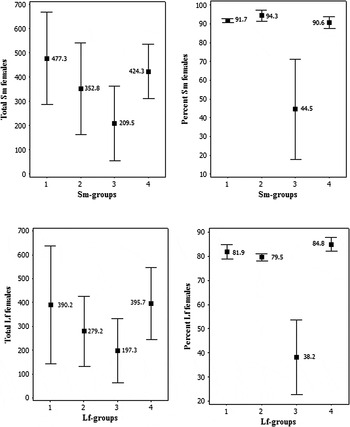
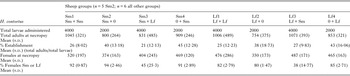
In Group Sm2, one sample was inadvertently destroyed before the counts were completed, thus, there were only 5 animals represented in this group. Given the primary role of this group, to confirm the infectivity of the inoculate, this did not impact the ability to compare groups. There were no significant differences in the numbers of total adult worms (P = 0·756) or total female adult worms (P = 0·802) recovered between any of the groups. This indicates a lower establishment rate in lambs given 4000 larvae compared with those that received 2000 larvae. The establishment rate was statistically significantly different between the Sm1–Sm4 groups (P = 0·005), but not between the Lf1–Lf4 groups (P = 0·144). The mean percentage of Sm females and the total number of Sm females in Groups Sm1, Sm2, Sm3 and Sm4 were significantly different (P < 0·001 and P = 0·032, respectively). In the case of Groups Lf1–Lf4, the mean percentage of Lf females also was significantly different, although the total number of Lf females was not (P < 0·001 and P = 0·154, respectively). There was a marked decrease in the number of non-linguiform females recovered from lambs that were secondarily infected with linguiform females (Fig. 2). This same effect was noted in the case of lambs with the reciprocal crosses, but was less pronounced due potentially to differences in the genetic inheritance of the linguiform trait. The effect was even more striking when the percentage of worms of the primary morphotype or first infection given to the sheep was examined (mean per cent non-linguiform in Groups Sm1, Sm2 and Sm4 = 92·1, s.d. = 0·63, in Sm3 = 44·5, s.d. = 10·30; mean per cent linguiform in Groups Lf1, Lf2 and Lf4 = 82·1, s.d. = 3·16, in Lf3 = 38·2, s.d. = 14·77). In both cases where sheep received reciprocal crosses, the number of female worms remaining from the original infections was about half the total number of worms recovered and the differences were significant (P < 0·0001) (Fig. 2 and Table 1).
Mean (■) and 95% confidence interval for the number and per cent of adult female worms of the assigned group Lf linguiform (rough; Lf) vulva; Sm non-linguiform (smooth; Sm) vulva. Lambs were inoculated with 2000 infective stage larvae on day 0 and/or day 35. Sm1 received Sm + Sm (2000 infective larvae on day 0 and 2000 on day 35); Sm2 Sm + 0; Sm3 Sm + Lf; and Sm4 0 + Sm. The Groups Lf1–Lf4 received the reciprocal infections: Lf1 = Lf + Lf, Lf2 = Lf + 0, Lf3 = Lf + Sm and Lf4 = 0 + Lf.

Descriptive statistics for the 8 groups of sheep infected with linguiform or non-linguiform vulva morphotypes of Haemonchus contortus

Sm, smooth; non-linguiform Lf, rough; linguiform.
Sheep were inoculated on days 0 and 35 with either no larvae (0) or with 2000 non-linguiform (Sm) or linguiform (Lf) morphotypes. Sm + Sm = 2000 non-linguiform on days 0 and 35; Sm + 0 = 2000 Sm on day 0 and no larvae on day 35, etc.
% Females non-linguiform for Sm1–Sm4; % Females linguiform for Lf1–Lf4.
The worms from the first and second infections could also be distinguished on the basis of size, with the worms from the first infection being larger. Almost all the worms recovered from Groups Sm1 and Lf1 were large, Groups Sm2 and Lf2 were large, and Groups Sm4 and Lf4 were small. In the case of the reciprocal crosses, as expected, the worms from the first infection were large and those from the second infection were small.
DISCUSSION
The significant finding is that only half the worms remained from the original infection in those animals receiving reciprocal crosses. This is in contrast with those animals that received two doses of the same morphotype, in which almost all of the adults from the original infection remained, while few from the second infection of the same morphotype developed. because the non-linguiform trait is recessive and consequently bred more truly than the linguiform trait (LeJambre, Reference LeJambre1977). The proposed explanation for this reduction in the numbers remaining from the original infection in the reciprocal crosses is competition between the incoming morphotype with the existing morphotype to the extent that one-half of the original worms perished preventing the establishment of a full complement of the incoming population. Additional work is required to determine the extent that kin selection or negative interference competition participate in the interaction.
It had originally been expected that there would be twice as many worms recovered in those animals receiving the Sm + Sm or Lf + Lf infections, but this did not occur. From the larger size of almost all the adult worms recovered from those animals that received two inoculations with the same morphotypes, it was apparent that there were almost no adults from the second infection present. One explanation for this outcome might be that all the incoming worms went into hypobiosis. Hypobiosis occurs in parasitic nematodes when infective forms undergo a state of histiotrophic developmental arrest within the mucosa and remain as small larval stages rather than maturing to adults (Adams, Reference Adams1986). Unfortunately, the examination of the abomasa of these sheep did not include methods required for the detection of hypobiotic larvae, and thus, until additional studies are performed, this can only be considered as conjecture.
Another possible explanation of the results is that the immune response of the host was more successfully mounted against worms of the same morphotype, hence decreasing the ability of the second inoculate in the Sm + Sm and Lf + Lf sheep. Sheep having an existing infection induce the formation of significantly greater numbers of hypobiotic larvae than do sheep that are prevented from inducing an immune response (using the related nematode Teladorsagia in sheep receiving varying doses of whole-body irradiation) (Dunsmore, Reference Dunsmore1961). However, a heightened immune response against an existing morphotype would not explain the reductions in the original population observed in the sheep that received the Sm + Lf or the Lf + Sm infections. If there was no competition between morphotypes, it would be suspected that the number of worms from the original infections would have been the same as in those infections wherein the sheep received only one morphotype. Thus, the significant reductions in the first morphotype present within the lambs can be interpreted as an indication of self-sacrifice for kin selection rather than as expulsion due to an immune response to a challenge infection.
The mechanisms of kin selection that may cause the observed phenomena are unknown. The worms in the primary infection may reduce the fitness of the incoming population through allelopathy, secretion of molecules that act directly on the incoming worms or that induce the host to respond in such a manner that interferes with the new population. Research on the excretory–secretory products of nematodes is a growing field, with a focus on how these products modulate the host immune system. The activity of many of these products is not yet understood but it is clear that they aid the parasites in maintaining their lifestyle (Hewitson et al. Reference Hewitson, Grainger and Maizels2009; Mulvenna et al. Reference Mulvenna, Hamilton, Nagaraj, Smyth, Loukas and Gorman2009; Maizels, Reference Maizels2013).
Another possibility is actual physical interplay between the worms composing the two infections. Such physical competition has not been described for nematodes. However, the homosexual rape that has been described for acanthocephala would be a perfect place to examine the potential physical interplay of parasites relative to kin selection (Abele and Gilchrist, Reference Abele and Gilchrist1977).
A competition between morphotypes has been previously reported in the literature for Ostertagia ostertagi and H. contortus (Michel, Reference Michel1967; LeJambre and Whitlock, Reference LeJambre and Whitlock1968). In these earlier studies, the proportion of worms with differing vulval morphologies changed over the course of a season. In the case of H. contortus, there was not a significant change in the relative percentage of non-linguiform and linguiform forms, but in a careful analysis of the linguiform worms, it was found that over the course of the season, there was a significant and marked change in the ratio of two subtypes that were described as Linguiform A and B. It could be suggested that such changes are due to the competition between morphotypes under natural conditions.
If kin selection is operable under conditions involving challenge infections, it can be used to explain many of the previously observed phenomena that have been ascribed to premunition. When the second infection can be reliably distinguished from the first, additional experiments with other systems can be designed to determine the role that kin selection plays in these systems. This explanation of the altruistic nature of the relationship of a parasite to niche protection against unrelated conspecifics would suggest that when an original infection is removed by drug treatment or natural host responses, that the host is again susceptible to infection because there is no existing population working to exclude unrelated competitors. Also, it is to be expected that the primary infection has a resident advantage in its ability to occupy the niche because of its priority in colonization and it may also be better able to persist as a latent infection as with Aeromonas salmonicida (Michel and Faivre, Reference Michel and Faivre1991). Additional studies in other systems are required to verify the role of kin selection amongst and between parasite populations and in the control of parasite populations within a host and within the general area of parasite ecology. Further study of kin selection could reveal that there is a greater social organization and structure to parasite communities than previously considered.
ACKNOWLEDGEMENTS
We would like to acknowledge the following people for reviewing this manuscript: Paul Sherman, Jay Georgi and Edward Pearce from Cornell University and Leo LeJambre from CISRO, Australia.
FINANCIAL SUPPORT
This research received no specific grant from any funding agency, commercial or not-for-profit sectors.