


Introduction
As global climate change, pollution, habitat conversion, and invasive species accumulate, it is unknown whether parasite abundance will decrease or increase (Wood and Vanhove Reference Wood and Vanhove2023). We need more tools to systematically evaluate long-term changes in parasite burden (Wood et al. Reference Wood, Leslie, Claar, Mastick, Preisser, Vanhove and Welicky2023a), as it is inherently difficult to track, as the soft bodies of nematodes, cestodes, and trematodes rapidly degrade, many are microscopic, and their remains contain insufficient amounts of DNA for analysis (Littlewood and Donovan Reference Littlewood and Donovan2003). However, museum collections of preserved specimens (and their associated parasites) have recently been proposed to monitor whether parasite abundance increases or decreases over time (Wood et al. Reference Wood, Leslie, Claar, Mastick, Preisser, Vanhove and Welicky2023a). Indeed, Wood et al. (Reference Wood, Welicky, Preisser, Leslie, Mastick, Greene, Maslenikov, Tornabene, Kinsella and Essington2023b), dissected parasites from eight fish species from 1880 to 2019 and found 10.9% decline in the abundance of parasites with three or more host species in their life cycle, which translates to a 38% decline with every 1°C increase in sea surface temperature in Pugent Sound, U.S. Undoubtedly, this is a novel discovery that has ramifications for conservation and fish management but how do parasites numbers fluctuate over time in terrestrial environments? One way to understand this is to examine parasites of terrestrial gastropods (slugs and snails), which are important intermediate hosts of a wide variety of nematodes of medical, veterinary, and ecological importance (Grewal et al. Reference Grewal, Grewal, Tan and Adams2003). For example, the zoonotic rat lungworm Angiostrongylus cantonensis, the causative agent of human eosinophilic meningitis (Barratt et al. Reference Barratt, Chan, Sandaradura, Malik, Spielman, Lee, Marriott, Harkness, Ellis and Stark2016), the feline lungworm Aelurostrongylus abstrusus (Elsheikha et al. Reference Elsheikha, Schnyder, Traversa, Di Ceasare, Wright and Lacher2016), and the canine and fox lungworm Crenosoma vulpis and Trogostrongylus brevior, all of which can cause respiratory diseases in domestic and wild carnivores (Crisi et al. Reference Crisi, Di Cesare and Boari2018). As well as the slug parasitic nematode Phasmarhabditis hermaphrodita – a biocontrol agent formulated and commercialised to control slugs and snails in the U.K. and northern Europe (Rae et al. Reference Rae, Sheehy and McDonald-Howard2023) and the genetic model nematode Caenorhabditis elegans (Schulenburg and Félix Reference Schulenburg and M-A2017). Gastropods use behavioural adaptations to avoid nematode infection (Rae Reference Rae2023; Wilson et al. Reference Wilson, Hughes, Jefferies and Glen1999), but they also mount an understudied innate immune response including antimicrobial molecules such as reactive oxygen species, C-type lectins, and lysozymes (Davison and Neiman Reference Davison and Neiman2021). Furthermore, research has shown that upon nematode infection, swarms of haemocyte-like cells fix to the cuticle of invading nematodes and fuse it to the inner shell (Rae Reference Rae2017). This encapsulation response has been observed in many species across the phylogeny of the Stylommatophora (slugs and snails), and is not just specific to nematodes (Falkingham and Rae Reference Falkingham and Rae2021; Rae Reference Rae2017; Reference Rae2018; Rae et al. Reference Rae, Robertson and Wilson2008; Williams and Rae Reference Williams and Rae2015, Reference Williams and Rae2016), as trematodes (Gérard et al. Reference Gérard, De Tombeur, Dahirel and Ansart2023), and maybe even mites (Dahirel et al. Reference Dahirel, Proux, Gérard and Ansart2022) have been observed fixed inside the shell and killed. Indeed, it has been shown that land snails in conchology collections harbour encapsulated nematodes that are decades, even hundreds and thousands of years old (Rae Reference Rae2017; Reference Rae2018). However, there is no information about how nematode dynamics infecting snails fluctuate over time collected from one specific location. Understanding temporal variation in nematode abundance within terrestrial gastropods is important because changes in parasite prevalence and intensity directly influence transmission risk to humans, domestic animals and wildlife. Long-term monitoring can reveal how environmental change, including shifts in climate, habitat quality and host community composition, affects parasite dynamics and may identify periods of elevated disease risk (Hudson et al. Reference Hudson, Cattadori, Boag and Dobson2006). Such information is essential for understanding parasite ecology, predicting future changes in transmission and informing surveillance of emerging gastropod-borne diseases (Poulin Reference Poulin2021). Hence, the main aim of this study was to utilise conchology collections and modern collections to understand how nematode dynamics change over time and how this differs with host and location.
Materials and methods
Museum and modern collections of C. nemoralis and C. hortensis shells
Three locations were chosen based on results of a previous study by Rae (Reference Rae2017), which highlighted areas of wild C. nemoralis or C. hortensis populations with high numbers of nematodes encased in their shells: Point of Ayr, Wales (SJ120853), Formby, England (SD280080) and Strathy beach, Scotland (NC835650). These two snail species were chosen as they are highly abundant in coastal sand dunes around the U.K., are regularly infected with nematodes (see Rae Reference Rae2017), and were collected extensively around the U.K. by Arthur Cain et al. in the 1960s (e.g. Cain Reference Cain1968), providing a substantial collection to monitor nematode abundance in the shells over time and at different locations. C. nemoralis and C. hortensis were collected at two time points (2016 and 2024) from Formby and Strathy beach, respectively. C. nemoralis from Formby and Point of Ayr were collected in 2016 by technicians and are stored at LJMU (outlined in Rae, Reference Rae2017) and were re-examined for nematode encapsulation. Three time points were chosen to examine C. nemoralis shells from Point of Ayr (1962, 2016, and 2024). In 1962, C. nemoralis shells were collected from Point of Ayr by A. Cain and P.M. Sheppard (see Cook and Pettitt, Reference Cool and Pettitt1998 for further info) and their analysis was published by Cain (Reference Cain1968). I accessed these C. nemoralis shells collected by Cain and Sheppard in 1962, which are housed at Manchester Museum as part of the Arthur Cain C. nemoralis collection, and quantified the number of nematodes in each shell (Figure 1A-C). It should be noted that, as well as nematodes found in the inner aperture of the shell, foreign objects, debris, and small roots can be easily recorded as nematodes but are not (see Supplementary Figure 1 for more guidance).
Museum conchology collections hold a plethora of molluscs from all over the world (A) that are hundreds, if not thousands, of years old, e.g. C. nemoralis from 1904 (B). Nematodes can be found encased and preserved in the inner part of the whorl of C. nemoralis (C). Scale bar represents 0.5 cm.

Figure 1. Long description
The figure is divided into three panels labeled A, B, and C.
Panel A occupies the top half of the frame. It is a wide-angle photo of a museum conchology drawer containing dozens of small, rectangular black boxes arranged in a grid. Each box contains multiple light-colored snail shells and small identification labels.
Panel B is located at the bottom-left. It is a close-up photo of a single specimen box containing six pale, yellowish-white C. nemoralis shells resting on a white cotton-like substrate. A handwritten label at the bottom of the box reads Helix nemoralis, Mull. Glencarbury, 1700 feet alt. Co. Sligo. A. W. S. July 15, 1904.
Panel C is located at the bottom-right. It is a high-magnification micrograph showing dark, thin, worm-like nematodes preserved against a textured, golden-yellow background representing the inner whorl of a shell. A solid black scale bar in the bottom-right corner represents 0.5 cm.
In 2024, C. nermoralis were collected from Point of Ayr and Formby sand dunes, and C. hortensis was collected from Strathy beach. In each case, sand dunes were explored for any dead C. nermoralis or C. hortensis shells for ~2 hours, then transported back the lab in clear, resealable bags, gently washed in warm water to remove sand and vegetation and left for dry for 48 hours before examination of the inner lip of each shell for nematodes using a dissecting microscope at magnification using ×40 and the numbers encapsulated was quantified. Only the shells of dead snails were collected. To understand whether the size of C. nermoralis shells affected nematode encapsulation (i.e. larger shells harbour more parasites), shells from Formby (2016 and 2024) and Point of Ayr (2016 and 2024) were individually weighed (g) (this was not possible for C. hortensis or for C. nemoralis from 1962). It should be noted that C. nermoralis is a polychromatic snail with several different colour and banding morphs, and this was not considered, as most shells collected were 3–5 banded yellow shells (>60%), and there were not enough morphs of the other varieties to allow comparisons.
Statistical analysis
The numbers of nematodes encapsulated in C. nemoralis or C. hortensis shells (as well as the weight of shells) collected in 2016 vs. 2024 were compared using a Student’s t-test. A One-Way Analysis of Variance with Tukey’s post hoc test was used to compare the numbers of nematodes encased in C. nemoralis shells collected in 1962 vs. 2016 vs. 2024. Chi-squared tests were used to analyse the proportion of snails with and without nematodes in their shells from each year of collection. A negative binomial generalized linear model (GLM), with shell weight, sampling time, and their interaction included as explanatory variables, was used to understand whether larger shells harboured more nematodes from C. nemoralis from Formby (2016 and 2024). Data analysis was carried out using Python3 (Version 3.14) using scipy.stats and statsmodels libraries.
Results and discussion
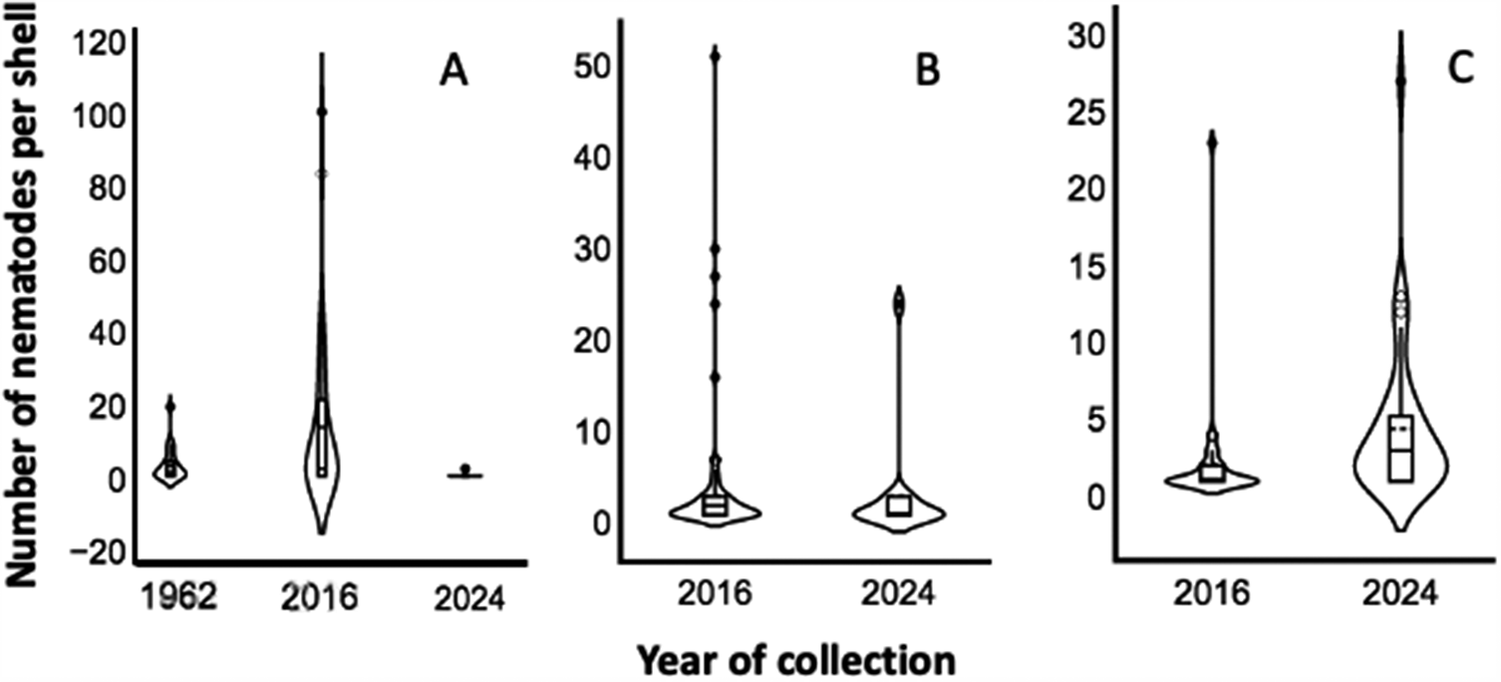
The proportion of C. nemoralis shells from Point of Ayr that had nematodes present increased significantly from 1962 (8.1%) to 2016 (59.7%) (X2 = 127.18; df = 1, p < 0.001), then significantly decreased to 10% in 2024 (X2 = 45.41; df = 1, p < 0.001). The numbers of nematodes in shells from 1962 (n = 41 shells, mean = 3.7 nematodes per shell ± 0.6; range 1 to 20), 2016 (n = 40 shells, mean = 14.1 nematodes per shell ± 3.5; range 1 to 101) and 2024 (n = 9 shells, mean = 1.2 nematodes per shell ± 0.2; range 1 to 3), differed significantly (F = 5.98; df = 2,86, p = 0.004), with the numbers of nematodes encased in shells from 1962 and 2016 increasing significantly (p < 0.05) (Figure 2A).
Violin plots illustrate the distribution of the number of nematodes encased in C. nemoralis shells from Point of Ayr collected in 1962, 2016, and 2024 (A), C. hortensis collected from Strathy beach in 2016 and 2024 (B) and Formby in 2016 and 2024 (C). The inner box represents the interquartile range (IQR), and the horizontal line denotes the median. Violin width indicates the density of observations.

Figure 2. Long description
A three-panel multiplot with a shared y-axis label ‘Number of nematodes per shell’ and a shared x-axis label ‘Year of collection’. Each panel contains violin plots with internal box plots showing the I Q R and median.
Panel A (Point of Ayr): Three plots for 1962, 2016, and 2024. The 1962 plot is small, centered near zero with a peak around 20. The 2016 plot shows a very wide distribution with a long vertical tail reaching above 100. The 2024 plot is nearly flat, indicating very low counts.
Panel B (Strathy beach): Two plots for 2016 and 2024. Both show high density near zero. The 2016 plot has a long vertical tail with outliers reaching 50, while the 2024 tail is shorter, reaching approximately 25.
Panel C (Formby): Two plots for 2016 and 2024. The 2016 plot is concentrated between 0 and 5. The 2024 plot shows a significant increase in both density and range, with the main body of the violin extending to 10 and a tail reaching 30.
The proportion of C. hortensis shells from Strathy beach with nematodes (compared to without nematodes) decreased significantly from 2016 (26.7%) to 2024 (3.1%) (X2 = 72.52; df = 1, p < 0.001). There was no significant difference between the numbers of nematodes found in C. hortensis shells collected from Strathy in 2016 (n = 128 shells, mean = 3.1 nematodes per shell ± 0.5; range 1 to 51) and 2024 (n = 14 shells, mean = 3.1 nematodes per shell ± 1.6; range 1 to 24) (t = 0.09; df=140; p > 0.05) (Figure 2B). There was no significant difference in shell weight of C. nemoralis collected in Point of Ayr in 2016 (0.67 ± 0.02 g; n = 55) and those collected in 2024 (0.58 ± 0.06 g; n = 18) (t(71) = 1.57, p = 0.121).
In Formby, the proportion of C. nemoralis shells with nematodes (compared to without nematodes) increased significantly in 2016 from 17.6% to 31.3% in 2024 (X2 = 8.35; df = 1, p = 0.039). The numbers of nematodes found in C. nemoralis shells collected from Formby in 2016 (n = 36 shells, mean = 2.1 nematodes per shell ± 0.6; range 1 to 23) and 2024 (n = 41 shells, mean = 4.4 nematodes per shell ± 0.8; range 1 to 27) increased significantly (t = −2.54; df = 76; p < 0.05) (Figure 2C). Shells collected in Formby 2024 were significantly heavier (1.05 ± 0.04 g; n = 82) than those collected in 2016 (0.6 ± 0.03 g; n = 68) (t(148) = −9.52, p < 0.001). A negative binomial regression was used to assess the effects of shell weight and sampling year on parasite abundance at this site. Sampling year significantly affected parasite numbers, with higher parasite burdens recorded in 2024 compared with 2016 (β = 0.76, z = 2.75, p = 0.006). Shell weight did not significantly predict parasite abundance (β = 0.41, z = 1.20, p = 0.232), suggesting that parasite load was not strongly related to host size at this location.
The value of historic collections to understand parasite abundance and diversity cannot be overstated (Wood et al. Reference Wood, Leslie, Claar, Mastick, Preisser, Vanhove and Welicky2023a) and has only recently been explored to track parasite infection abundance through time (albeit in marine environments). For example, Welicky et al. (Reference Welicky, Preisser, Leslie, Mastick, Fiorenza, Maslenikov, Tornabene, Kinsella and Wood2021) dissected parasites from museum specimens of English sole (Parophrys vetulus) collected over a 90-year period (1930–2019) and found that out of the 12 taxa, 9 did not change in abundance (e.g. nematodes, trematodes, and leeches), 2 increased (an acanthocephalan and a trematode), and another trematode species decreased. Also, by examining museum specimens, Howard et al. (Reference Howard, Davis, Lippert, Quinn and Wood2019) detailed an 8-fold increase in the nematode Clavinema mariae (a parasite of English Sole) in Puget Sound from 1930 to 2017. These studies have undoubtedly provided important insights into parasite dynamics in marine environments. By utilising conchology and field collections of snails, I have been able to detail parasite burden of terrestrial environments and show nematode infection of land snails is a dynamic process that differs substantially over time, between locations and host species. For example, 8% of C. nemoralis shells collected in Point of Ayr in 1962 had encased nematodes, and this increased substantially to 60% in 2016, and decreased to 10% in 2024. There was also a reduction in the number of nematodes encased in C. hortensis shells from Strathy beach from 27% infected in 2016 to 3% in 2024. This is not the trend for all locations. Indeed, the opposite was found in C. nemoralis shells from Formby, with the proportion of shells with encased nematodes increasing from 18% in 2016 to 31% in 2024. However, two important points about these data need to be considered. First, it should be noted that it is unclear whether encapsulated nematodes in the snails’ shells represent the actual burden of the nematodes in a snail host population, as I did not dissect live snails. Encapsulation could therefore reflect infection, snail immune response, or any other process influencing the number of worms that get encased. Second, it is unclear whether the data is capturing long-term variability or short-term ebbs and flows of parasite population abundances. Other studies have reported similar results in parasites of crabs (Hemigrapsus oregonensis and H. nudus) from historical and contemporary time points where the abundance of parasitic isopods (Portunion conformis) varied around a stable mean for 50 years; there was no change in larval acanthocephalans, and the prevalence of microphallid trematodes increased over 50 years (Quinn et al., Reference Quinn, Lee, Greeley, Gehman, Kuris and Wood2021). Only further validation studies examining the parasite burden of live snails, the mechanics of the encapsulation and immune response, and at regular intervals will be able to help answer these questions.
It is difficult to understand why nematode numbers decrease, even increase over time; perhaps urbanisation, climate change, and environmental pollution could have an effect, which has been shown in other studies. For example, Díaz-Morales et al. (Reference Díaz-Morales, Atkinson, Boyd, Commisso, Christner, Jones, Leslie, Thirtyacre, Whalen, Kuris, Mann, Bart and Wood2026) found the abundance of the myxozoan parasite Myxobolus infecting Carpiodes velifer gills decreased by 86% from 1963 to 2005, due to increasing temperature and higher metal concentrations. In contrast, Mastick et al. (Reference Mastick, Welicky, Katla, Odegaard, Ng and Wood2024) discovered an increase in the numbers of Anisakis nematodes in tinned chum and pink salmon over 42 years, potentially due to increases in numbers of marine mammal hosts.
In terms of identifying what nematode species are encapsulated in these shells, DNA and morphological analysis identified Phasmarhabditis californica, and a species of mermithid infecting C. nemoralis (Rae Reference Rae2017). This approach has been more successful in other snail species; for example, recently, Fuster-Calvo et al. (Reference Fuster-Calvo, Oiler, MacDonald, Parent, Massol, Burin, Phillips, Rae and Gravel2026) managed to identify 147 nematode operational taxonomic units (OTUs) representing 3 classes and 14 orders of nematodes infecting Naesiotus snails from the Galápagos Islands. Also, in Cornu aspersum, nematodes such as C. elegans were found encased in shells, but the efficacy of PCR can be hindered by different factors in the shell, such as calcium content, which is a known inhibitor of PCR (Cowlishaw et al. Reference Cowlishaw, Andrus and Rae2019), and requires further research to optimise conditions.
In summary, conchological collections could represent a valuable resource for understanding parasite abundance, as they comprise extensive assemblages of shells from diverse species, geographic regions and at different time periods. For example, Manchester Museum holds the fourth largest mollusc collection in the U.K., with approximately 166,000 lots and 400,000 specimens (McGhie Reference McGhie2008). Such collections may therefore be used to investigate temporal patterns in shell-associated parasites, including nematodes, trematodes, and mites, across extended timescales.
Supplementary material
The supplementary material for this article can be found at http://doi.org/10.1017/S0022149X26102041.
Acknowledgements
I am thankful to Caroline Tiernan for maintenance of the collection of C. nemoralis at JMU, as well as Henry McGhie and Rachel Petts for the use of the C. nemoralis collection at Manchester museum.
Competing interests
The author declares none.



 Open access

