Memory problems are commonly reported following stroke, with between 23% and 55% of stroke survivors experiencing memory difficulties 3 months’ post-stroke, and 11%–31% experiencing continued memory dysfunction after 1 year (Snaphaan & De Leeuw, Reference Snaphaan and De Leeuw2007). Post-stroke memory complaints are reported more frequently than impairments in other cognitive domains (Lamb et al., Reference Lamb, Anderson, Saling and Dewey2013). Additionally, memory impairment is a predictor of poorer quality of life in stroke survivors (Baumann et al., Reference Baumann, Couffignal, Le Bihan and Chau2012). In terms of memory rehabilitation, there is a paucity of stroke-specific recommendations. Previous studies have mostly been conducted in mixed acquired brain injury groups, and few have investigated memory interventions in stroke-only samples (das Nair et al., Reference das Nair, Cogger, Worthington and Lincoln2016). In a group of stroke survivors, Miller and Radford (Reference Miller and Radford2014) found objective memory improvements following group memory rehabilitation, including psychoeducation and compensatory strategy training. More recently, Withiel et al. (Reference Withiel, Wong, Ponsford, Cadilhac, New, Mihaljcic and Stolwyk2019) used a version of the same program and reported greater attainment of memory goals and internal strategy use at 6-week follow-up, compared with computerised training and wait list control conditions.
Combined, these preliminary studies suggest that stroke survivors may benefit from participating in compensatory memory interventions. However, there remains some uncertainty regarding their efficacy, due to differences in results and outcome measures used, as well as a lack of evidence for sustained benefit (das Nair et al., Reference das Nair, Cogger, Worthington and Lincoln2016). Discrepancies in previous findings could be due to the multifactorial nature of memory interventions and the complexity of mechanisms which may lead to intervention-related improvements. It is possible that certain components may be better than others, or that some beneficial strategies have been omitted (Radford et al., Reference Radford, Lah, Thayer, Say and Miller2012). Accordingly, investigation of the efficacy of novel specific memory strategies is warranted, in order to determine whether the effectiveness of existing multifactorial compensatory interventions can be improved.
One memory strategy which has received attention in the literature but has never been examined in stroke survivors is wakeful rest, a technique whereby, after learning, individuals refrain from engaging in a cognitively stimulating activity (Dewar et al., Reference Dewar, Alber, Cowan and Della Sala2014). Theoretically, wakeful rest acts to reduce interference, enabling better long-term memory consolidation. Consolidation is the process whereby new memory traces are stabilised (Dudai, Reference Dudai2004), and occurs most strongly during periods of sleep and minimal cognitive activity, when there is a reduction in other cognitive or sensory processing that may interfere with the consolidation process (Born, Reference Born2010; Wixted, Reference Wixted2004). Forgetting of recently learned information is, therefore, less likely to occur when finite consolidation resources are dedicated to this information, rather than being divided between two competing sources (Dudai, Reference Dudai2004; Wixted, Reference Wixted2004). Research in healthy undergraduate students has shown that memory retention may be unaffected when an interference task involves minimal semantic and episodic memory demands (i.e., working memory tasks), suggesting that the adverse effect of interference primarily occurs when episodic memory resources in particular are reallocated during consolidation (Varma et al., Reference Varma, Takashima, Krewinkel, van Kooten, Fu, Medendorp and Daselaar2017; Varma et al., Reference Varma, Daselaar, Kessels and Takashima2018).
Numerous studies have examined the efficacy of wakeful rest in clinical groups with memory impairment, including amnestic mild cognitive impairment (Alber et al., Reference Alber, Della Sala and Dewar2014; Dewar et al., Reference Dewar, Garcia, Cowan and Della Sala2009) and mild-to-moderate Alzheimer’s disease (Dewar, Pesallaccia, et al., Reference Dewar, Pesallaccia, Cowan, Provinciali and Della Sala2012). Alber et al. (Reference Alber, Della Sala and Dewar2014) found that wakeful rest enhanced amnesic participants’ recall of prose passages after delays of 30 minutes and 7 days. Further, Dewar, Pesallaccia, et al. (Reference Dewar, Pesallaccia, Cowan, Provinciali and Della Sala2012) found that wakeful rest enabled greater retention of word lists in participants with amnestic mild cognitive impairment, and also in participants with mild-to-moderate Alzheimer’s disease, after a delay of 10 minutes. Critically, these clinical groups experience primary memory encoding and consolidation deficits (Reed et al., Reference Reed, Eberling, Mungas, Weiner and Jagust2000), making them highly susceptible to consolidation interference, compared with a ‘normal’ susceptibility observed to a mild extent in neurologically intact individuals (for a review, see Dewar et al., Reference Dewar, Cowan and Della Sala2007). No study to date has investigated the efficacy of wakeful rest in stroke survivors, who may experience a different profile of memory difficulties compared with these amnestic groups (Reed et al., Reference Reed, Eberling, Mungas, Weiner and Jagust2000).
Post-stroke memory dysfunction can arise from damage to a range of different brain regions related to encoding, consolidation, or retrieval processes (Budson & Price, Reference Budson and Price2005). While some stroke survivors experience encoding difficulties due to medial temporal lobe damage (Aggleton & Brown, Reference Aggleton and Brown1999), many experience impairments in the executive control of memory processes, when there is damage to the frontal lobe or the wider network of brain regions implicated in executive functions (Stuss & Benson, Reference Stuss, Benson and Perecman1987). Although many stroke survivors’ memory difficulties are not necessarily consolidation-based, they may still benefit from using wakeful rest because they remain susceptible to typical effects of consolidation interference (although potentially to a lesser degree than those with primary encoding deficits, as proposed by Dewar et al., Reference Dewar, Cowan and Della Sala2007). It is also possible that the disruption of early consolidation processes may exacerbate retrieval-based deficits by weakening the memory trace to be retrieved, thus increasing retrieval competition between similar items (Dewar et al., Reference Dewar, Cowan and Della Sala2007).
Therefore, we aimed to investigate whether wakeful rest enhances verbal memory in a group of stroke survivors and matched healthy controls. The healthy control group was included as a basis for comparison, in order to determine whether there is a differential impact of stroke on the efficacy of wakeful rest. We hypothesised that stroke survivors and healthy control participants would retain more verbal information after a 30-minute delay when wakeful rest occurred after learning, compared to when a cognitively demanding task was undertaken after learning. Further, we predicted that the beneficial effects of wakeful rest would be sustained in both groups after a delay of 7 days. A supplementary exploratory aim was to investigate whether a relationship exists between demographic and stroke-related variables and the magnitude of stroke survivors’ benefit with the wakeful rest technique.
Method
Design
The current study was observational and used an analytical cross-sectional approach (Grimes & Schulz, Reference Grimes and Schulz2002).
Participants
This study was approved by the Monash University Human Research Ethics Committee (Project Number 9964). Twenty-seven stroke survivors and 24 healthy control participants were initially recruited for the study. Participants were approached if they had a history of stroke, confirmed by a neurologist via neurological examination and brain imaging, at least 3 months previously. Two stroke survivors were excluded due to cognitive impairment, which impacted on their ability to adequately understand and complete tasks required (determined by a registered psychologist during a preliminary screening interview via telephone, in consultation with carers or relatives). One stroke survivor was also excluded due to a diagnosis of epilepsy. As such, 24 stroke survivors (10 males, M age = 67.60, SD = 8.76; 14 females, M age = 65.64, SD = 11.43) and 24 healthy controls (10 males, M age = 69.60, SD = 11.57; 14 females, M age = 67.64, SD = 7.43) participated in the study. Participants were recruited between November 2018 and January 2020, through advertisements in local newspapers, stroke support groups, and a registry of stroke survivors collated by researchers. This research was conducted in accordance with the ethical principles outlined in the Declaration of Helsinki. Participation was on a voluntary basis.
Primary Measure of Verbal Memory
Two short stories were taken from the Logical Memory subtest of the Wechsler Memory Scale (Adult Battery) – Fourth Edition (Wechsler, Reference Wechsler2009c). Stories were matched based on linguistic features such as the number of semantic elements (25 per story), readability, and sentence complexity (Schnabel, Reference Schnabel2012). Participants were scored one point for each element correctly recalled, and zero for each element which was omitted in each story (total maximum score = 25).
Supplementary Measures of Cognition and Mood
The Test of Premorbid Functioning (Wechsler, Reference Wechsler2009b) was used to estimate participants’ level of premorbid functioning and the Montreal Cognitive Assessment (Nasreddine et al., Reference Nasreddine, Phillips, Bédirian, Charbonneau, Whitehead, Collin and Chertkow2005) was included as a screening measure of cognition. The Doors and People Test (Baddely et al., Reference Baddely, Emslie and Nimmo-Smith1994) measured participants’ verbal memory in recall (‘People’ subtest) and recognition (‘Names’ subtest) formats. Participants’ raw scores on both subtests were added to create one verbal memory score. The Everyday Memory Questionnaire – Revised (Royle & Lincoln, Reference Royle and Lincoln2008) was used as a subjective measure of memory difficulties. Participants’ time to complete the Trail Making Test (TMT) was used to measure psychomotor speed (TMT A), and divided attention (TMT B). Raw scores from the Boston Naming Test (Kaplan, Goodglass, & Weintraub, Reference Kaplan, Goodglass and Weintraub1983) were used to measure confrontational naming, and raw scores on the Controlled Oral Word Association Test (Patterson, Reference Patterson, Kreutzer, DeLuca and Caplan2011) measured verbal fluency. Additionally, the Hospital Anxiety and Depression Scale (Snaith, Reference Snaith2003) was used to assess anxiety and depression symptomatology, with scores of 8 and above (total possible score of 21) on each subscale indicating clinically elevated symptoms (Stern, Reference Stern2014).
Procedure
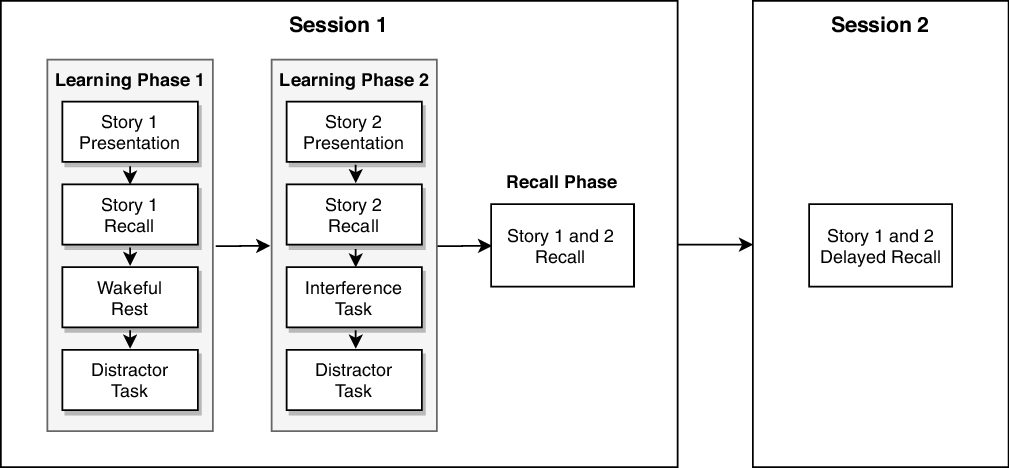
Data collection took place in participants’ homes. All data collection and scoring procedures were carried out by a single researcher. Written informed consent was obtained at the outset. This study utilised a protocol developed by Dewar, Alber, et al. (Reference Dewar, Alber, Butler, Cowan and Della Sala2012), comprising two testing sessions separated by 7 days. As shown in Figure 1, session one comprised of two learning phases. Each phase consisted of (1) an aural presentation of one of the two short stories; (2) immediate recall of that story; (3) a 10-minute delay, during which participants were instructed to engage in either (a) wakeful rest or (b) an interference task; and (4) a 5-minute distractor task. Importantly, condition (wakeful rest or interference) and story order were counterbalanced evenly across participants.
Experimental procedure.
Five minutes were allowed for recall of each story at each time point. Duration of wakeful rest and interference periods was 10 minutes. Duration of distractor tasks was 5 minutes. Sessions were separated by 7 days.

During the wakeful rest condition, participants were instructed to rest for 10 minutes, and were asked to avoid speaking for the duration. For the interference condition, participants were instructed to complete a 10-minute visual ‘spot the difference’ task, in which they were required to point to 2 subtle differences between 20 sets of nearly identical images, developed by the authors to emulate the task used by Dewar, Alber et al. (Reference Dewar, Alber, Butler, Cowan and Della Sala2012). This task was selected because it required participants to focus their attention, yet its components did not resemble those of the stories. Image sets were presented simultaneously to minimise reliance on working memory processes. Following the rest and interference conditions, participants completed a 5-minute ‘spot the difference’ distractor task, identical in nature to the main interference task. Distractor tasks were employed to ensure that Learning Phase 2 and the Recall Phase were preceded by an identical activity, regardless of the order of the wakeful rest and interference conditions. For example, if participants rested immediately prior to hearing the second story, they might retain more of this story than if they were completing another task beforehand.
A delayed recall test for both stories followed Learning Phase 2, in the order which they were presented, 30 minutes after the presentation of the first story and 15 minutes after the presentation of the second story. Participants were instructed to recall as many details as possible from each story, and were allowed up to 5 minutes for this. Consistent with the protocol used by Dewar, Alber et al. (Reference Dewar, Alber, Butler, Cowan and Della Sala2012), participants’ recall of both stories was tested at the same time rather than after each learning phase to ensure that the recall test would come as a surprise in both conditions, to minimise the chance of intentional story rehearsal by participants during the delay conditions. Recall was unlikely to differ between the stories solely based on the difference in delay duration (Montgomery, Harris, Stabler, & Lu, Reference Montgomery, Harris, Stabler and Lu2017). Participants were told that the purpose of the second testing session was for another component of a broader research study. In contrast with the protocol of Dewar, Alber et al. (Reference Dewar, Alber, Butler, Cowan and Della Sala2012), participants were not asked about whether they engaged in story rehearsal or mindwandering during either delay period.
Data Analysis
For each participant, the percentage of each story retained after the 15–30-minute and 7-day delay periods was calculated. Percentages were based on the number of story units correctly recalled immediately after the stories were presented, in order to mitigate the effects of any variability in participants’ initial registration of the two stories. Retention scores were capped at 100%, in line with Dewar, Alber et al. (Reference Dewar, Alber, Butler, Cowan and Della Sala2012). We analysed participants’ retention scores using a factorial mixed-model analysis of variance (ANOVA) with a significance level of α = .05, with two within-subject factors: condition (wakeful rest and interference) and time (15–30 min and 7 days). The between-subjects factor was group (stroke and control). Despite no significant interaction effects, after careful inspection of graphed data, we conducted pairwise comparisons with Bonferroni correction, as recommended by Wei et al. (Reference Wei, Carroll, Harden and Wu2012). We also conducted a mixed ANOVA on participants’ raw memory recall scores across three time points (immediate, 15–30 min, 7 days), and conducted two-tailed paired t tests to investigate whether immediate recall differed between the stories in both groups. Mixed ANOVAs were also conducted using condition order and story type (i.e., which story was used for each condition) as between-groups factors to determine whether participants’ percentage retention scores were influenced by these factors.
Additionally, the difference in the percentage of story retention between the wakeful rest and interference conditions was calculated for each participant at both time points. These ‘discrepancy’ scores were compared between stroke survivors and controls using two-tailed independent t tests to directly compare the magnitude of the wakeful rest effect between groups. Additionally, Pearson’s and Spearman’s correlations were conducted (depending on whether parametric assumptions were met) to determine whether there was a relationship between discrepancy scores and participant demographic, stroke, cognition, and mood variables to investigate whether there was a differential response to wakeful rest in the stroke survivor group. Further, Kruskal–Wallis tests were conducted to examine group differences in discrepancy scores according to lesion hemisphere (left, right, bilateral) and stroke mechanism (ischaemic, haemorrhagic, combined) variables. A significance level of α = .05 was used for all exploratory analyses.
Results
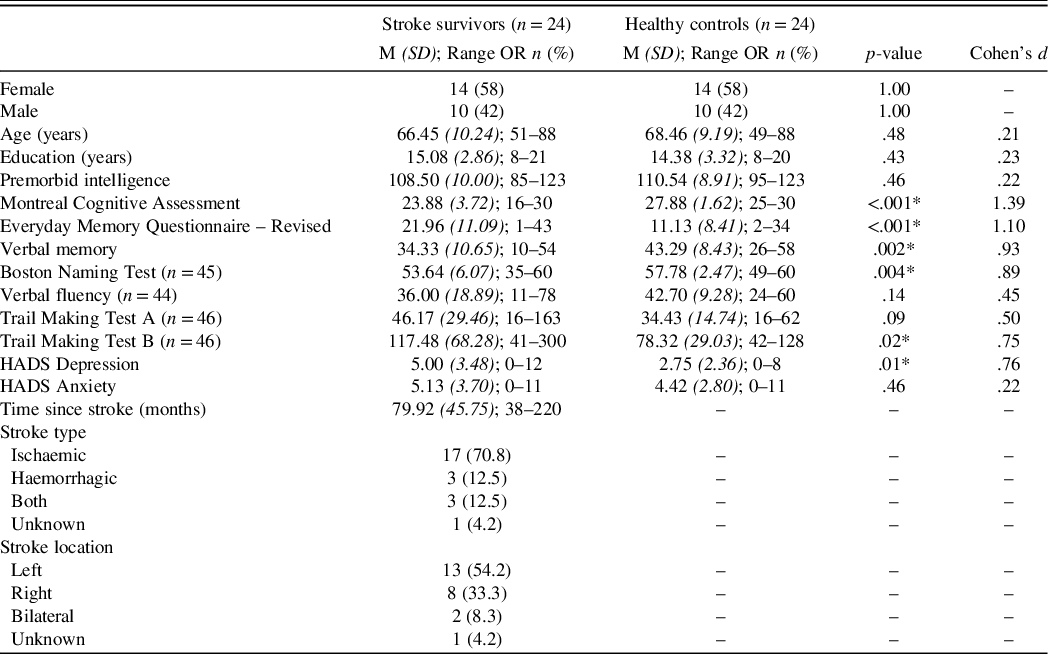
Demographic and clinical features of both participant groups are presented in Table 1. Data from 24 stroke survivors and 24 healthy controls were included in the final analyses. Imaging data was not available for one stroke survivor, although a diagnosis of stroke was confirmed by their neurologist. The stroke and control groups were matched based on age, gender, education, and premorbid intelligence. The control group performed significantly better than stroke survivors on measures of subjective everyday memory, verbal memory, confrontational naming, divided attention, and a cognitive screening tool. There was no difference between groups with regard to psychomotor speed or verbal fluency. Based on recommended clinical cut-offs (Stern, Reference Stern2014), seven stroke survivors endorsed symptoms of depression within at least the mild range, compared with one healthy control. Additionally, six stroke survivors reported elevated symptoms of anxiety, compared with three healthy controls.
Demographic and clinical profile of study participants

n = number of participants, % = percentage of total participants. M = mean; SD = standard deviation. *significant difference at an alpha level of .05. Gender differences are calculated using chi-square test. Verbal memory = combined verbal recall and recognition scores from the Doors and People Test. BNT data are missing from one stroke survivor and two healthy controls. Verbal fluency data are missing from one stroke survivor and three healthy controls. TMT data are missing from one stroke survivor and one healthy control.
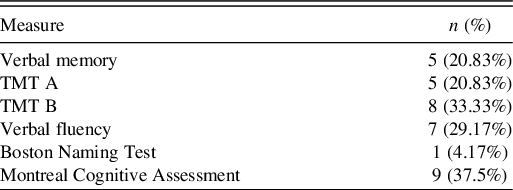
Critically, no healthy control participants scored more than one standard deviation below their estimated premorbid level across any cognitive measures. Overall, a small proportion of stroke survivors showed clinically significant impairment on cognitive measures, with the majority of the sample showing mild-to-moderate difficulties. Table 2 presents the number of stroke survivors with impaired performance on each measure.
Stroke survivors with clinical impairment on cognitive measures

n = 24. Clinical impairment = performance of at least 1.67 standard deviations below premorbid level (<5th percentile). Verbal memory = combined verbal recall and recognition scores from the Doors and People Test. Montreal Cognitive Assessment clinical cut-off (24/30) has been recommended for use in stroke survivors by Cumming et al., Reference Cumming, Churilov, Linden and Bernhardt2013.
Immediate Recall
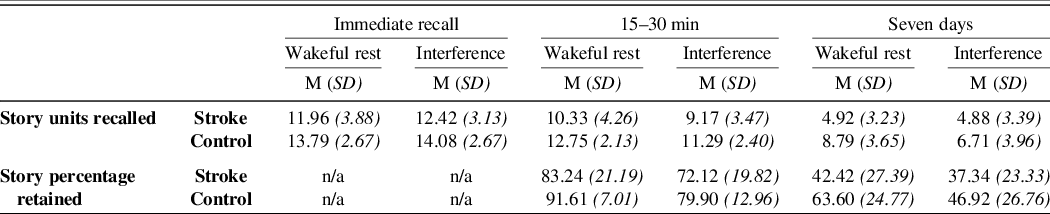
The mean story units recalled at each time point are presented in Table 3. Overall, healthy control participants performed significantly better than stroke survivors at immediate recall, F(1, 46) = 4.95, p = .03,
 ${\rm{\eta }}_p^2$
= .10. There was no significant difference between participants’ immediate recall in the wakeful rest and interference conditions, F(1, 46) = .71, p = .40,
 ${\rm{\eta }}_p^2$
= .02. Additionally, direct comparison of participants’ immediate recall of Story 1 (M = 13.76, SD = 3.06) and Story 2 (M = 12.75, SD = 3.35) revealed that there was no significant difference in participants’ immediate recall between the two stories, t(23) = 1.44, p = .16, d = .21, confirming that the stories were similar in terms of difficulty.
Story units recalled and story percentage retained in the wakeful rest and interference conditions

n(Stroke) = 24; n(Control) = 24. M = mean; SD = standard deviation. Percentage retention scores are based on immediate recall data.
Story Percentage Retained
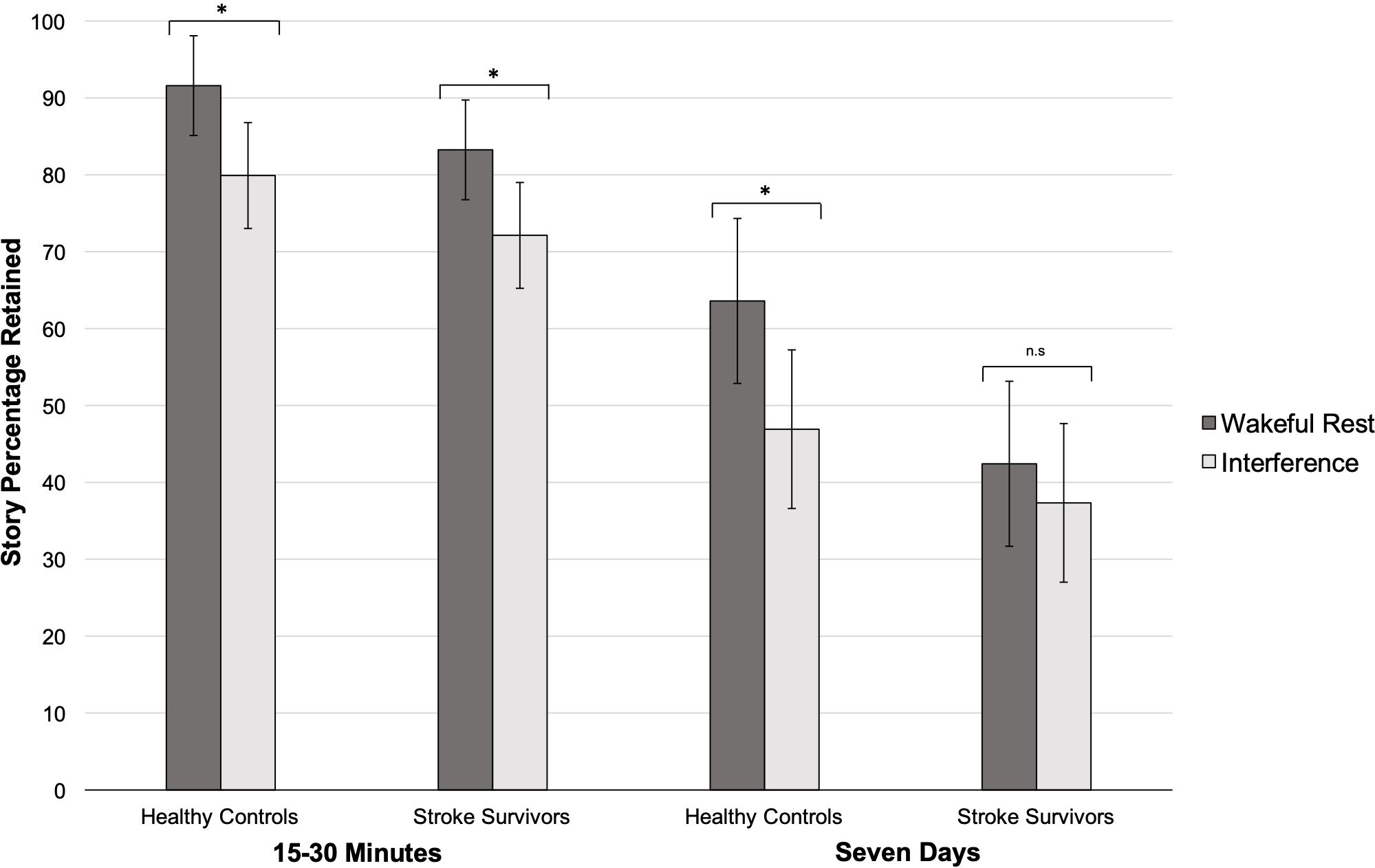
Mean percentage retention data for both participant groups are displayed in Figure 2, and exact scores are presented in Table 3. As expected, the factorial ANOVA revealed healthy control participants retained significantly more information than stroke survivors in both conditions, across both time points, F(1, 46) = 6.93, p = .012, with a medium-to-large effect,
 ${\rm{\eta }}_p^2$
= .13. Additionally, the main effect of time was significant, F(1, 46) = 143.18, p < .001, representing a large effect,
 ${\rm{\eta }}_p^2$
= .76, indicating that retention of both stories was significantly lower after the 7-day delay in both groups. There was a significant main effect of learning condition, F(1, 46) = 19.31, p < .001, with a large effect,
 ${\rm{\eta }}_p^2$
= .30, meaning that on average, participants retained significantly more information from the story followed by wakeful rest compared with the story followed by the interference task. Further, there was no significant main effect of condition order, F(1, 46) = .104, p = .75,
 ${\rm{\eta }}_p^2$
= .002, or story type, F(1, 46) = .47, p = .50,
 ${\rm{\eta }}_p^2$
= .01, confirming that retention scores at each time point were not influenced by the initial order of the wakeful rest and interference conditions, or which story was used for each condition. There were no significant interaction effects in either analysis.
Percentage of story elements retained at each time point.
Error bars represent 95% confidence intervals. *significant difference at p < .05. n.s = no significant difference at p = .05.

Pairwise comparisons revealed a significant difference between the wakeful rest and interference conditions in the healthy control group after 15–30 min, t(23) = 3.73, p = .001, d = .76, and after 7 days, t(23) = 2.83, p = .01, d = .58. While there was a significant difference between the wakeful rest and interference conditions in the stroke survivor group after 15–30 min, t(23) = 3.58, p = .002, d = .73, there was no significant difference between the conditions after 7 days, t(23) = .95, p = .35, d = .19. The same results were observed when analyses were conducted after excluding one stroke survivor who did not recall any details from either story after 7 days.
Magnitude of the Wakeful Rest Effect
Group Comparison
Discrepancy scores were comparable between stroke survivors (M = 11.12, SD = 15.20) and healthy controls (M = 11.70, SD = 15.36) after 15–30 min, t(46) = .13, p = .90, d = .04. While the difference between stroke survivors’ (M = 5.07, SD = 26.23) and healthy controls’ (M = 16.68, SD = 28.90) discrepancy scores after 7 days did not reach statistical significance, t(46) = 1.46, p = .15, d = .42, the differential effect of wakeful rest was in the expected direction (i.e., a greater magnitude of the effect of wakeful rest in the control group), consistent with the findings from the main analysis.
Correlational Analyses
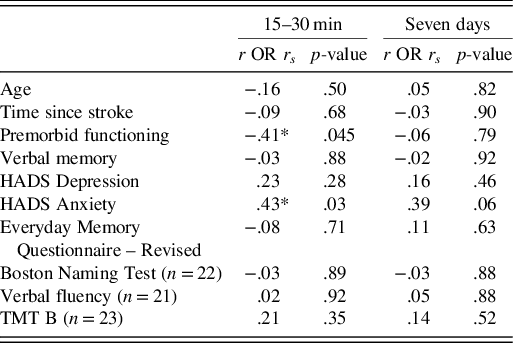
The results of our exploratory correlational analyses are presented in Table 4. Overall, no significant relationships were observed between discrepancy scores and most participant characteristics, with the exception of a negative association between premorbid functioning and discrepancy scores, and a positive relationship between anxiety and discrepancy scores in the short term.
Correlations between discrepancy scores and participant characteristics in the stroke survivor group at each time point

n = 24. *significant correlation at p < .05. r = Pearson’s correlation coefficient, r s = Spearman’s rho (calculated for HADS Depression, HADS Anxiety, and Everyday Memory Questionnaire – Revised). Discrepancy scores reflect the difference between memory retention scores associated with the rest and interference conditions.
Stroke Characteristics
Further, there was no significant difference in discrepancy scores between participants who experienced a right-hemisphere, left-hemisphere, or bilateral stroke after 15–30 min,
 ${\chi ^2}$
(2, n = 23) = 1.58, p = .45, η2 = .11, and after 7 days,
 ${\chi ^2}$
(2, n = 23) = 2.03, p = .36, η2 = .19. Moreover, there was no significant difference in discrepancy scores between ischaemic, haemorrhagic, and combined stroke survivors after 15–30 min,
 ${\chi ^2}$
(2, n = 23) = 3.68, p = .16, η2 = .62, or after 7 days,
 ${\chi ^2}$
(2, n = 23) = .87, p = .65, η2 = .03. Combined, these results indicated that participants did not benefit disproportionately from the use of wakeful rest based on stroke-related factors.
Discussion
This is the first study to investigate the efficacy of wakeful rest in a group of stroke survivors and matched healthy controls. As expected, our results revealed significantly better story retention in the wakeful rest condition, compared with the interference condition, after a delay of 15–30 minutes in both groups. The beneficial effect of wakeful rest was observed to be of a similar magnitude in both groups over the short term. The finding that wakeful rest enhanced story retention after 15–30 minutes is consistent with previous literature demonstrating that wakeful rest is an effective memory technique in clinical groups with memory difficulties, and also in healthy older adults (Alber et al., Reference Alber, Della Sala and Dewar2014; Dewar, Alber et al., Reference Dewar, Alber, Butler, Cowan and Della Sala2012; Dewar et al., Reference Dewar, Garcia, Cowan and Della Sala2009; Martini et al., Reference Martini, Zamarian, Sachse, Martini and Delazer2019). These findings support the hypothesis that wakeful rest enhances early memory consolidation by reducing the effects of post-learning interference (Dewar et al., Reference Dewar, Garcia, Cowan and Della Sala2009).
While healthy control participants benefited from the use of wakeful rest after a delay of 7 days, stroke survivors did not, as their recall in both conditions did not significantly differ. These results contrast with previous findings by Alber et al. (Reference Alber, Della Sala and Dewar2014) showing that wakeful rest enhances memory in individuals with amnestic memory profiles over a delay of 7 days, despite using the same methodology. Notably, amnestic participants in the study by Alber et al. (Reference Alber, Della Sala and Dewar2014) experienced a greater magnitude of the wakeful rest effect after 15–30 minutes, compared with both groups in our study. The stronger effect of post-encoding wakeful rest observed in their amnestic participants over the longer term might be explained by their higher susceptibility to consolidation interference (Dewar et al., Reference Dewar, Cowan and Della Sala2007), due to medial temporal lobe dysfunction (Walsh et al., Reference Walsh, Wilkins, Bettcher, Butler, Miller and Kramer2014). Conversely, the majority of stroke survivors in this study experienced damage to anterior cortical and subcortical regions (most commonly through infarction of the middle cerebral artery and anterior cerebral arteries); therefore, retrieval-based memory difficulties were more prevalent than primary encoding deficits in our sample. It, therefore, appears that strengthening the memory trace by reducing consolidation interference was not sufficient to counteract stroke survivors’ greater susceptibility to retrieval interference (i.e., competing memory items during retrieval) after a longer delay.
In these cases, combining the use of wakeful rest with other memory techniques targeting retrieval processes (e.g., retrieval practice; Evans et al., Reference Evans, Wong and Stolwyk2020) may enable the short-term benefits of wakeful rest to be maintained for a longer period of time in stroke survivors who have memory retrieval difficulties. Martini et al. (Reference Martini, Martini, Maran and Sachse2018) demonstrated that an additional delayed recall opportunity supported word list retention over 7 days in undergraduate students; however, further research in a stroke-only sample is required to confirm whether this finding could also apply to stroke survivors. Another future research direction would be to investigate whether the response to wakeful rest differs between those with primary consolidation deficits, compared with a retrieval-based memory profile.
Other analyses revealed that the magnitude of memory enhancement due to wakeful rest did not differ between participants based on factors such as age, time since stroke, stroke laterality, stroke type, verbal memory, verbal fluency, confrontational naming, divided attention, and depression scores. This suggests that many stroke survivors may benefit from the use of wakeful rest to a similar degree over the shorter term, regardless of individual characteristics. However, we observed a weak-to-moderate negative relationship between stroke survivors’ level of premorbid functioning and the magnitude of the effect of wakeful rest, such that as premorbid functioning increased, the effect of wakeful rest decreased. This finding might be explained by participants with higher cognitive ability being more likely to use other strategies to enhance their recall of both stories, in line with previous research investigating spontaneous use of cognitive strategies in older adults (Frankenmolen et al., Reference Frankenmolen, Fasotti, Kessels and Oosterman2018). Alternatively, those with lower levels of intelligence may have fewer resources to allocate to memory consolidation (Lee et al., Reference Lee, Ojha, Kang and Lee2015), and may benefit from strategies that act on consolidation processes. Further, we observed a weak-to-moderate positive relationship between anxiety and the effect of wakeful rest, suggesting that stroke survivors with higher anxiety benefited more from the use of wakeful rest in the short term, with a trend for this over the long term. Possibly, participants with higher levels of anxiety may have benefited from the anxiolytic effect of wakeful rest, given that they may have fewer cognitive resources to dedicate to memory consolidation (Robinson et al., Reference Robinson, Vytal, Cornwell and Grillon2013). However, this finding is limited by the low levels of anxiety reported in our sample and should be interpreted with caution.
A key strength of this study was the home-based nature of data collection, rather than in a controlled laboratory environment, such as in the study by Dewar, Alber, and colleagues (Reference Baumann, Couffignal, Le Bihan and Chau2012). Naturally, there are certain variables within home environments which cannot be controlled, such as the amount of light in the room, and unexpected distractions such as ringing phones, or outside noises. Importantly, our results suggest that wakeful rest can be used effectively by stroke survivors, despite these environmental distractors. Therefore, our findings extend on previous studies by providing preliminary evidence for the ecological validity of this memory strategy, at least over the shorter term. While it is possible that this methodological aspect contributed to the diluted effect of wakeful rest; it is promising that participants’ recall in the wakeful rest condition was still superior to the interference condition over the shorter term (as well as after 7 days in the control group). The nature of data collection in this study is also important when considering the efficacy of this technique within a rehabilitation setting. Given that many memory interventions take place in an environment in which there are distractions (e.g., in groups, or in hospital settings), our findings suggest that stroke survivors may still derive some benefit from using wakeful rest in this context.
Limitations
We must acknowledge some limitations of the current study. First, the young average age of our sample relative to the average age of stroke onset in Australia (75 years; National Stroke Foundation, 2015), and the higher estimated intelligence relative to standardised norms (Wechsler, Reference Weschler2009a) should be considered. It is also important to acknowledge that eligibility was not limited to stroke survivors with objective memory impairment; replication of our findings in samples with greater representation of educational level, as well as those with moderate to severe objective memory impairment is needed, given that Miller and Radford (Reference Miller and Radford2014) found greater rehabilitation-related gains in stroke survivors with lower baseline memory scores. Moreover, future studies incorporating severity ratings (e.g., the National Institutes of Health scale, stroke volume) may indicate whether the magnitude of the wakeful rest effect is influenced by stroke severity.
An additional consideration is the longer time post-stroke reported in our sample, with the average length of time since stroke between 6 and 7 years. Indeed, support for post-stroke memory difficulties has been identified as a significant long-term unmet need in stroke survivors (Andrew et al., Reference Andrew, Kilkenny, Naylor, Purvis, Lalor, Moloczij and Cadilhac2014). However, the longer time since stroke in our sample does limit our ability to apply these findings to those undergoing inpatient rehabilitation. This is important, given that rehabilitation programmes are typically offered to stroke survivors in the early phases of recovery (Rasquin et al., Reference Rasquin, Bouwens, Dijcks, Winkens, Bakx and van Heugten2010). Investigation of this memory technique in stroke survivors who are undergoing inpatient rehabilitation is therefore an important future research direction.
It is also possible that participants may have intentionally rehearsed stories during the wakeful rest delay period, despite not receiving any warning that their recall would be tested at either time point. Future studies would benefit from asking participants whether they rehearsed the stories, such as in the study by Alber et al. (Reference Alber, Della Sala and Dewar2014). Moreover, stroke survivors were recruited from a research registry, which meant that they may have previously participated in memory interventions (Lawson et al., Reference Lawson, Stolwyk, Ponsford, McKenzie, Downing and Wong2020; Withiel et al., Reference Withiel, Wong, Ponsford, Cadilhac, New, Mihaljcic and Stolwyk2019), although wakeful rest was not taught in these studies.
Finally, given that individuals with severe communication deficits were excluded from participating, it is possible that this may have attenuated the influence of factors such as stroke laterality and severity. Future studies may benefit from directly comparing the efficacy of wakeful rest in larger groups of right- and left-hemisphere stroke survivors to determine whether they might derive the same level of benefit. Moreover, future studies should investigate whether wakeful rest enhances memory for visuospatial material in stroke survivors with communication deficits to determine whether people with aphasia may also benefit from using this technique.
Conclusion and Future Directions
This study is the first to demonstrate the efficacy of wakeful rest in a group of stroke survivors over at least the shorter term, and our results have important implications for clinical rehabilitation practices. Wakeful rest is a relatively simple memory technique, which requires minimal cognitive demand. While memory rehabilitation programmes commonly teach participants about pacing and rest breaks to manage fatigue, wakeful rest is rarely taught as a technique to enhance memory. Therefore, clinicians might consider incorporating this technique into rehabilitation programmes in two ways. First, wakeful rest could be taught as a compensatory strategy to enhance memory in stroke survivors’ everyday lives. For example, stroke survivors may choose to undertake a brief period of wakeful rest after reading or being told information they need to remember (e.g., about their stroke or their rehabilitation activities), in order to consolidate the information that has been presented. Second, clinicians could build wakeful rest into the structure of rehabilitation sessions to enhance stroke survivors’ retention of newly learned skills. This technique has the potential to be incorporated across a range of therapeutic contexts outside of neuropsychology, including speech pathology, physiotherapy, and occupational therapy. Coupled with the established benefits of regular rest breaks to manage fatigue (Nguyen et al., Reference Nguyen, Wong, McKay, Rajaratnam, Spitz, Williams and Ponsford2019), periods of wakeful rest are likely to have multiple benefits when incorporated into rehabilitation programmes, including fatigue reduction and enhanced recall over at least the shorter term.
Further, our findings have implications with regard to formal cognitive assessment procedures. Our finding that wakeful rest led to significantly better recall after 15–30 min in both groups suggests that the type of activity completed after learning has a significant influence on delayed recall performance. If the delay period on formal memory tests is filled with cognitively demanding activities, it is possible that memory function could be underestimated or misinterpreted. Consequently, there is a need to standardise the type of tasks which are completed during the delay period of memory tests, in order to accurately and consistently measure memory functioning. This represents an important direction for future investigation.
Currently, there is a paucity of empirical research investigating specific memory strategies which may be beneficial for stroke survivors. Wakeful rest is a simple memory technique which enhanced stroke survivors’ verbal memory in the short term; however, the effect was lessened over the longer term in our study. This technique shows promise in this clinical population and could be implemented in clinical guidelines with further replication and extension of our results. Wakeful rest could be used to support stroke survivors’ everyday memory function and enhance learning during rehabilitation programmes, potentially leading to increased functional independence.
Acknowledgements
The authors would like to acknowledge all of the participants who generously gave their time for this project.
Financial Support
The authors received no specific funding for this research.
Conflict of Interest
The author(s) have no conflict of interest to report.