The literature has documented a range of predictors of child abuse and neglect, including factors such as poverty (Knutson, DeGarmo, Koeppl, & Reid, Reference Knutson, DeGarmo, Koeppl and Reid2005), family stress (Whipple & Webster-Stratton, Reference Whipple and Webster-Stratton1991), and parents' negative attributions regarding children's behaviors (Berlin, Dodge, & Reznick, Reference Berlin, Dodge and Reznick2013). Methodologically, these different factors are typically treated as predictors of child abuse and neglect in a regression or structural equation framework, which has been an effective way of demonstrating unique and multivariate associations between a range of predictors and child abuse and neglect. However, missing from this approach is an understanding of how multiple levels of influence including factors within families, within communities, and over time are related to child abuse and neglect. The present study was designed to provide multilevel understanding in the context of 13 cultural groups from nine countries.
Definitional issues are important in considering what constitutes child abuse and neglect; approaching these issues from an international perspective brings some of these definitions to the forefront. Definitions of child abuse vary widely across countries. The United Nations has taken the position that all corporal punishment is physical abuse. This position stems from the 1989 Convention on the Rights of the Child (CRC), which, among other provisions, holds that children have the right to protection from abuse and exploitation. A major tenet of the CRC is that children are agents with the same rights as everyone else, so even apart from the protective function of not using corporal punishment, children should not be hit because doing so is disrespectful of the child. Countries have used the CRC as a framework within which to evaluate their policies related to child protection, and 46 countries have now outlawed all forms of corporal punishment to comply with the CRC's mandate to protect children from abuse (http://www.endcorporalpunishment.org). This international standard of child protection is not yet endorsed universally, however. In the United States, for example, corporal punishment is legal and, in most states, is differentiated from physical abuse by criteria that generally involve factors such as abuse leaving bruises or marks that last more than 24 hr and corporal punishment involving pain but not injuries. Even if one argues that it is possible to distinguish between corporal punishment and physical abuse, mild corporal punishment is a risk factor for more severe corporal punishment (Lansford, Wager, Bates, Pettit, & Dodge, Reference Lansford, Wager, Bates, Pettit and Dodge2012), and the use and endorsement of corporal punishment are risk factors for physical abuse (Russa & Rodriguez, Reference Russa and Rodriguez2010).
Neglect can be even more difficult to define, especially in an international framework. For example, in some countries, leaving infants and toddlers in the care of young siblings would constitute neglect, whereas in other countries, this is the modal way of caring for children (Korbin & Spilsbury, Reference Korbin, Spilsbury and Dubowitz1999). In countries where co-sleeping is the norm, having a child sleep not only in a separate bed but also alone in a separate room is perceived as neglectful (LeVine et al., Reference LeVine, Dixon, LeVine, Richman, Leiderman and Keefer1994). In high-income countries, not providing children with food, clean water, medical care, and an education would be considered neglect. This may also be neglectful in low-income countries, but in many low-income countries, extreme poverty and lack of access mean that these provisions are not available to anyone in the community. Therefore, children's neglect in these places would be more a community-level effect than the effect of having neglectful parents in an otherwise provisioned community. In the present study, we adopt a more psychological than physical conceptualization of neglect, operationalizing neglect in terms of children's perceptions that their parents do not pay attention to them and things that are important to them. Rohner (Reference Rohner1986) has described this approach as being less value laden and as encompassing a more universal definition of neglect without limiting the conceptualization to specific harmful acts or omissions.
Individual-Level Predictors of Child Abuse and Neglect
Individual-level predictors of child abuse and neglect can be factors related to children, parents, or both. Characteristics of children that make them more difficult to parent are related to higher rates of abuse and neglect. For example, children with conduct problems (Lytton, Reference Lytton1990), attention problems (Alizadeh, Applequist, & Coolidge, Reference Alizadeh, Applequist and Coolidge2007), and noncompliance (Patterson, Reference Patterson, Reid, Patterson and Snyder2002) experience harsher parenting than do children without those characteristics. It can be difficult to determine the direction of effects in those relations. Children with more externalizing behavior problems, for instance, elicit more corporal punishment than do children who are well behaved, but corporal punishment also leads to more externalizing problems in a transactional process over time (Lansford et al., Reference Lansford, Criss, Laird, Shaw, Pettit and Bates2011). Thus, one goal of the present study was to examine individual child characteristics (viz., externalizing and internalizing problems) that are related to child abuse and neglect.
Some characteristics of parents also make them more likely to abuse or neglect their children. Parents who more positively evaluate aggressive responses to hypothetical provocations, for example, are more likely to use corporal punishment with their own children (Lansford et al., Reference Lansford, Woodlief, Malone, Oburu, Pastorelli and Skinner2014). Low family socioeconomic status as indicated by low levels of parents' completed education and low household income is a risk factor for child abuse and neglect; in the United States, children whose parents had less than a high school education were more than three times as likely to abuse and more than seven times as likely to neglect their children than were parents with more education (Sedlak et al., Reference Sedlak, Mettenburg, Basena, Petta, McPherson and Greene2010). Thus, another goal of the present study was to examine individual parent characteristics (viz., parental education and attitudes regarding progressive parenting and the appropriateness of aggressive behavior) that might alter the likelihood of abuse and neglect.
Community-Level Predictors of Child Abuse and Neglect
In a sample of 30,470 families with 2- to 4-year-old children from 24 low- and middle-income countries, 11%–18% of the variance in whether parents used severe forms of corporal punishment (hitting on the head or beating with an implement) and 27%–38% of the variance in whether parents reported believing it was necessary to use corporal punishment to rear a child properly were accounted for by the families' country of residence (Lansford & Deater-Deckard, Reference Lansford and Deater-Deckard2012). To illustrate, only 1% of parents in Belarus, Kazakhstan, and Ukraine reported that their child had experienced severe forms of corporal punishment during the last month, whereas 40% of parents in Mongolia and Yemen reported that their children had experienced such forms of corporal punishment. Similarly, only 4% of parents in Albania reported believing it was necessary to use corporal punishment to rear a child properly, whereas 93% of parents in Syria reported holding this belief.
In part, national differences in rates of corporal punishment and belief in its necessity can be attributed to differences in laws and policies related to childrearing. There is evidence from Sweden, the first country to outlaw corporal punishment, that attitudes about the appropriateness of corporal punishment changed both before the legal ban (allowing it to be passed) and after the legal ban (Durrant, Reference Durrant1999). Even in the absence of legal bans, some countries and cultural groups are more tolerant of aggression and violence than others. For example, Nisbett and Cohen (Reference Nisbett and Cohen1996) described a “culture of honor” in the southern United States in which individuals are more likely than those in the northern United States to attribute hostile intentions to ambiguous behaviors and to retaliate to perceived provocation with violence. In an analysis of anthropological data from 186 cultural groups, harsher and more frequent corporal punishment were related to higher prevalence of violence and more endorsement of violence at a societal level, as measured by indicators of interpersonal aggression among adults, warfare, and inculcation of aggression in children (Lansford & Dodge, Reference Lansford and Dodge2008).
The present study addresses community-level predictors of child abuse and neglect in two ways. First, we analyze mothers' and fathers' perceptions of the normativeness of corporal punishment in their cultural group (i.e., how frequently parents believe that other parents in their community use corporal punishment). Second, we use a multilevel analytic strategy that can parse variance attributable to between-culture differences from variance attributable to differences between families within a culture or to differences between parents within a family. Even individual characteristics such as parents' attitudes regarding progressive parenting and the appropriateness of aggressive behavior may vary not only between parents within a cultural group but also between cultural groups; our modeling strategy is able to account for these different levels of influence.
Predictors of Child Abuse and Neglect Over Time
Predictors of child abuse and neglect can vary over both developmental and historical time. Developmentally, neglect is most prevalent in the first year of life, followed by the toddler years (US Department of Health and Human Services, Administration for Children and Families, Administration on Children, Youth and Families, Children's Bureau, 2013), in large part because young children are so dependent on their caregivers to meet basic needs. Older children report being physically abused more than younger children (Finkelhor, Turner, Ormrod, & Hamby, Reference Finkelhor, Turner, Ormrod and Hamby2009), but younger children are more likely to be injured seriously enough to require hospitalization (Allareddy et al., Reference Allareddy, Asad, Lee, Nalliah, Rampa and Speicher2014). Historically, rates of child abuse and neglect are higher during times when unemployment is high and the economy is weak, speaking to the importance of societal-level economic factors in shaping how parents treat their children. For example, between 2000 and 2009 in the United States, rates of child abuse requiring hospital admission and of traumatic brain injury allegedly caused by child abuse increased in tandem with 90-day mortgage delinquency rates (Wood et al., Reference Wood, Medina, Feudtner, Luan, Localio and Fieldston2012), evidence that housing insecurity is linked to child maltreatment.
Aside from these developmental and macroeconomic factors, other time-varying factors also might account for changes in abuse and neglect over time. For example, if children's externalizing behaviors increase during a period of more pronounced noncompliance, parents may respond with harsher parenting or neglect. Likewise, if parents' attitudes change over time or they perceive that the normativeness of particular behaviors changes in their community over time (e.g., if corporal punishment becomes less accepted), then their parenting might change over time, too. Our use of three consecutive years of data allows us to examine time-varying predictors of abuse and neglect. Our sample included children who were 8 years old, on average, at the initial assessment. Focusing on this developmental period was strategic both methodologically (e.g., we were able to obtain children's self reports rather than relying exclusively on parents' reports and locally representative samples could be recruited through schools) and conceptually (e.g., corporal punishment is still a salient issue during middle childhood).
Mothers and Fathers
In statistics from cases reported to child protective agencies in the United States, 40% of children were maltreated only by their mother, 18% were maltreated only by their father, and 17% were maltreated by both parents (US Department of Health and Human Services, Administration on Children, Youth and Families, 2007). Higher rates of maltreatment by mothers than fathers might be accounted for by several factors, including the greater likelihood of children living with single mothers than single fathers and the fact that mothers, even in two-parent families, spend more time with children. Most cases of child abuse and neglect do not come to the attention of authorities, and it is unclear in these cases how mothers and fathers differ in their harsh or neglectful treatment of children.
Roles of mothers and fathers in parenting also might differ across countries. For example, traditional notions of fathers as disciplinarians are embodied in the Chinese adage “Strict father, kind mother” (Chang, Chen, & Ji, Reference Chang, Chen and Ji2011), whereas mothers in the Philippines have traditionally been expected to discipline their children along with taking on the majority of other childrearing responsibilities (Alampay & Jocson, Reference Alampay and Jocson2011). In a cross-cultural comparison with families from the present sample, in China, Colombia, Italy, Jordan, Kenya, the Philippines, and the United States, mothers reported using corporal punishment more frequently than did fathers; only in Sweden (where there was virtually no corporal punishment) and in Thailand were there no differences between mothers' and fathers' reports of corporal punishment (Lansford et al., Reference Lansford, Alampay, Al-Hassan, Bacchini, Bombi and Bornstein2010). Differences in rates of corporal punishment, abuse, and neglect do not, however, provide information about whether the same or different individual- and community-level factors predict mothers' and fathers' behavior. The present study analyzes mothers' and fathers' reports of corporal punishment separately to be able to examine within-family, between-family within culture, and between-culture differences in predictors of mothers' and fathers' behavior.
Present Study
The present study addressed the overarching research question of to what extent mothers' and fathers' use of corporal punishment and children's perceptions of their parents' neglect were predicted by parents' belief in the necessity of using corporal punishment, parents' perception of the normativeness of corporal punishment in their community, parents' progressive parenting attitudes, parents' endorsement of aggression, parents' education, children's externalizing problems, and children's internalizing problems. We hypothesized that between families within a cultural group, parents who believed in the necessity of using corporal punishment, perceived that corporal punishment was normative in their community, had less progressive parenting attitudes, endorsed the use of aggression, were less educated, and had children with more behavior problems would use more corporal punishment and be more neglecting than other parents within the cultural group. Likewise, we hypothesized that between cultural groups, groups that were higher than the average in parents' beliefs in the necessity of using corporal punishment, perceptions of the normativeness of corporal punishment, and endorsement of aggression, and were lower than the average in progressive parenting attitudes would use more corporal punishment and be more neglecting than parents in other cultural groups.
Method
Participants
Participants included 1,418 children (age range = 7 to 10 years, M = 8.29, SD = 0.66; 51% girls), their mothers (n = 1,398), and their fathers (n = 1,146). Families were drawn from Jinan, China (n = 120); Shanghai, China (n = 121); Medellín, Colombia (n = 108); Naples, Italy (n = 100); Rome, Italy (n = 103); Zarqa, Jordan (n = 114); Kisumu, Kenya (n = 100); Manila, Philippines (n = 120); Trollhättan/Vänersborg, Sweden (n = 101); Chiang Mai, Thailand (n = 120); and Durham, North Carolina, United States (n = 111 European Americans, n = 103 African Americans, and n = 97 Latin Americans). Participants were recruited through letters sent from schools. Response rates varied across countries (from 24% to nearly 100%), primarily because of differences in the schools' roles in recruiting. For example, in the United States, we were allowed to bring recruiting letters to the schools, and classroom teachers were asked to send the letters home with children. Children whose parents were willing for us to contact them to explain the study were asked to return a form to school with their contact information. We were then able to contact those families to try to obtain their consent to participate, scheduling interviews to take place in participants' homes. Much higher participation rates were obtained in countries in which the schools had more involvement in recruiting the sample. For example, in China, once the schools agreed to participate, they informed parents that the school would be participating in the study and allowed our researchers to use the school space to conduct the interviews. Virtually all of the parents in the Chinese sample agreed to participate once the school informed them of its participation.
Most parents (82%) were married, and nonresidential parents were able to provide data. Nearly all were biological parents, with 3% being grandparents, stepparents, or other adult caregivers. To maximize representativeness, sampling focused on including families from the majority ethnic group in each country; the exception was in Kenya, in which we sampled the Luo ethnic group (third largest, 13% of population), and in the United States, where we sampled European American, African American, and Latin American families. To ensure economic diversity, we included students from private and public schools and from high- to low-income families, sampled in proportions representative of each recruitment area. Child age and gender did not vary across countries. At the follow-up interviews 1 year after the initial interviews, 94% of the original sample continued to provide data; 91% of the original sample continued to provide data 2 years after the initial interviews (see Table 1 for the percentages of the original sample providing Time 3 data in each country). The mean age of the children was 9.37 years (SD = 0.73) at Time 2 and 10.40 (SD = 0.73) at Time 3. Participants who provided Time 2 and 3 data did not differ from the original sample with respect to child gender, parents' marital status, or mothers' education.
Multilevel model results with random intercepts for family and culture

Procedures and measures
Children completed the Parental Acceptance–Rejection/Control Questionnaire (Rohner, Reference Rohner, Rohner and Khaleque2005) for each parent in each year. Children were asked to describe, using a 4-point scale, how often their parents treated them in different ways (1 = almost never, 4 = every day). Six items describing the following parental behaviors were averaged to create the Child-Reported Neglect Scale: pays no attention to child, pays no attention when child asks for help, reverse coded-pays a lot of attention, forgets things that are important to child, and pays no attention as long as child is not bothering the parent. The Cronbach α coefficients for neglect by mothers were 0.58, 0.60, and 0.65 over the 3 years, respectively, and 0.64, 0.66, and 0.67 for neglect by fathers.
Parents completed two measures capturing attitudes toward and use of corporal punishment. Mothers and fathers answered the Multiple Indicator Cluster Survey (UNICEF, Division of Policy and Planning, 2006) in each of the 3 years of the study. Six dichotomous items captured whether the parent administered the following punishments in the last month: spanked/hit child with bare hand, hit child on the bottom, slapped/hit child on the hand, slapped/hit child on the face, shook the child, or beat the child. Corporal punishment in the last month was created by averaging across these six items (for mothers: α = 0.71, 0.70, and 0.76 in Years 1–3 and for fathers: α = 0.71, 0.58, and 0.72). The measure also asked “Do you believe that in order to bring up (raise, educate) (target child's name) properly, you need to physically punish him/her?” (0 = no, 1 = yes), which was used as the necessity of corporal punishment scale. The normativeness of corporal punishment was captured by the following item administered to parents in each of the 3 years as part of the discipline interview (Huang et al., Reference Huang, Malone, Lansford, Deater-Deckard, Di Giunta and Bombi2012; Lansford et al., Reference Lansford, Chang, Dodge, Malone, Oburu and Palmérus2005): “How frequently do other parents in your community spank, slap, or hit their children?” This scale ranged from 0 (never) to 5 (almost every day).
Parents also completed Achenbach's (Reference Achenbach1991) Child Behavior Checklist each year, capturing how often a child enacted a behavior or felt an emotion: never (coded as 0), sometimes (coded as 1), or often (coded as 2). The Externalizing Behavior Scale was created by summing the responses from 33 items, including behaviors such as lying, truancy, vandalism, bullying, drug and alcohol use, disobedience, tantrums, sudden mood change, and physical violence (for mothers: α = 0.86, 0.87, and 0.88 in Years 1–3 and for fathers: α = 0.85, 0.84, and 0.86). The Internalizing Behavior Scale was generated by summing the responses from 31 items, including behaviors and emotions such as loneliness, self-consciousness, nervousness, sadness, feeling worthless, anxiety, withdrawn behavior, and physical problems without medical causes (for mothers: α = 0.84, 0.85, and 0.85 in Years 1–3 and for fathers: α = 0.84, 0.87, and 0.86).
Parents also completed the Normative Beliefs about Aggression measure (Huesmann & Guerra, Reference Huesmann and Guerra1997) in Year 1. Twelve items captured whether parents believe yelling or hitting are acceptable responses for children when another child was verbally or physically aggressive. Three items captured whether parents believe aggressive behavior, such as verbal insults, hitting, and fighting, is acceptable when angry, and five items captured whether parents believe such behavior is acceptable in general. Items were coded on a 4-point scale (0 = really wrong, 1 = sort of wrong, 2 = sort of OK, and 3 = perfectly OK), and the mean score across all items formed the parent's Endorsement of Aggression Scale (for mothers α = 0.91, for fathers α = 0.89).
Finally, parents completed the Parental Modernity Inventory (Schaefer & Edgerton, Reference Schaefer, Edgerton and Sigel1985) in Year 1 to monitor where parents' childrearing attitudes fall on an authoritarian/progressive continuum. The measure asked parents if they agreed with different statements about childrearing and education using a 4-point scale (1 = strongly disagree, 4 = strongly agree). Progressive attitudes were captured by eight statements declaring that children have the right to their own opinions even when they disagree with adults, that children should be able to express those alternative opinions, and that children learn best at home and by doing things themselves rather than listening to adults. Twenty-two statements captured authoritarian attitudes such as declaring that all children should be treated and disciplined the same, teachers should not be questioned by parents, children's complete obedience is most important, and parents should teach children unquestionable loyalty. A Modernity of Attitudes Scale was constructed by subtracting the mean across the authoritarian items from the mean across the progressive items (for mothers α = 0.86, for fathers α = 0.85).
Analysis plan
The measures capturing neglect and corporal punishment were administered in each year for 3 consecutive years, providing an opportunity to examine the relation between beliefs about corporal punishment (normativeness in the community and its necessity for childrearing) and the prevalence of neglect and corporal punishment within a multilevel framework. Time points (n = 3, Level 1) are nested within families (n = 1,418, Level 2) who are nested within different cultures (n = 13, Level 3). Consequently, we can examine how neglect and corporal punishment are affected by within-family differences in attitudes over time, between-family differences in attitudes within cultures, and between-culture differences in attitudes.
Three-level, full information maximum likelihood multilevel models were estimated for all outcomes using SAS PROC MIXED. Along with random intercepts for family and culture, the model included Normativeness of corporal punishment (within parent, between parent within culture, and between culture), necessity of corporal punishment (within parent, between parent within culture, and between culture), externalizing behavior (within and between person), internalizing behavior (within and between person), endorsement of aggression, modernity of attitudes, and parent's education (years of education completed). To examine whether fixed effects across level were statistically different (i.e., the between-parent within-culture effect of normativeness and the between-culture effect of normativeness), estimate statements were included (Hoffman & Stawski, Reference Hoffman and Stawski2009).
Results
Descriptive and preliminary analyses
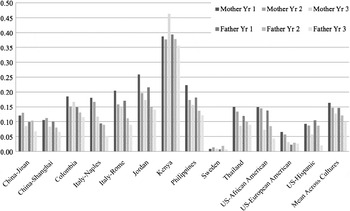
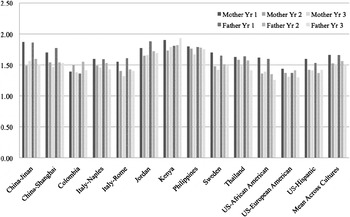
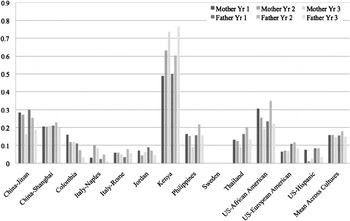
For each outcome, an empty model with random-intercepts for Levels 2 and 3 was estimated to assess the division of outcome variance across levels. For corporal punishment in the last month, between-person variance accounted for 54% and 50% of the total variance for mother and father reports, respectively. Culture variation accounted for 33% and 39% of the between-person variance, respectively. Log likelihood ratio tests of model fit between the Level 2 and Level 3 models indicated that these proportions were statistically different from zero; for mothers: χ2 (1) = 327.5, p < .001 and for fathers: χ2 (1) = 346.7, p < .001, and suggested that Level 3 models are preferable. The variations across cultures for both mother and father-reports of corporal punishment can be seen in Figure 1. For child-reported neglect, the proportion of variance attributed to culture differences was smaller but still statistically significant. Between-person variance accounted for 34% and 35% of the total variance for child-reported neglect by mothers and fathers, respectively. Culture variation accounted for 17% and 20% of the between-parent variance, respectively, and was significant; for mothers: χ2 (1) = 108.1, p < .001 and for fathers: χ2 (1) = 129.1, p < .001. The culture variation is displayed in Figure 2.
Average corporal punishment in the last month over time.

Average child-reported neglect over time.

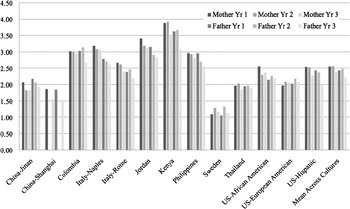
An empty, random intercept only model for normativeness of corporal punishment estimated that between-parent differences account for 53% and 49% of the variance in mother- and father-reported normativeness, respectively. Variation across cultures accounted for 55% and 47% of that between mother and father variation, respectively, providing evidence of between-culture differences in the normativeness of corporal punishment that is displayed in Figure 3. Similarly, between-parent differences accounted for 41% and 40% of the variance in mother- and father-reported necessity of corporal punishment. Variation across cultures accounted for 43% of both the between-mother and between-father variation, providing evidence of prominent between-culture differences in belief in the necessity of corporal punishment that is shown in Figure 4.
Mean normativeness of corporal punishment over time. Parents did not complete the normativeness item in Shanghai in Year 2.

Mean necessity of corporal punishment over time.

Given that the variance of both the normativeness and the necessity constructs is spread across all three levels of data (within family, between families, and between cultures), three predictors were constructed for each of the corporal punishment belief predictors: the deviation from the parent's mean at each time point (capturing within-parent effects), the parent's deviation from the parent mean within his or her culture (capturing the between-person effects within culture), and the culture deviation from the grand mean across all cultures (capturing the between-culture effect; Hoffman & Stawski, Reference Hoffman and Stawski2009). These three variables were created for normativeness of corporal punishment and necessity of corporal punishment.
Externalizing and internalizing behaviors were also measured in all 3 years; however, the possible between-culture impacts of these constructs are outside the focus of the current study. In addition, although the between-child variations in externalizing and internalizing problems were high (for mother reports: 68% and 64%, respectively, and for father reports: 60% and 59%), only a small proportion of that variance was attributable to cultural differences. For mother reports, only 10% and 19% of externalizing and internalizing between-person variance, respectively, was associated with culture variation. Similarly, for father reports, only 13% and 15% of between-person variance in externalizing and internalizing problems was attributable to between-culture effects. Consequently, the impact of problem behaviors was only separated into two levels: within parent (measured by deviations from the parent mean) and between parent across all cultures (measured by parent deviations from the grand mean). All other predictors were measured at a single time point, and therefore, within- and between-person effects were assumed to be equivalent.
Determinants of mother-reported corporal punishment in the last month
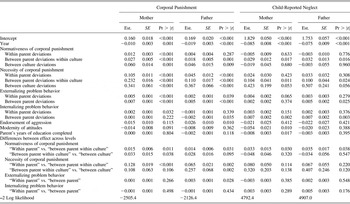
The effects of normativeness of corporal punishment are significant at each level (see Table 1). Within mothers, a stronger belief in the normativeness of corporal punishment this year than her average predicts greater corporal punishment (estimate = 0.012, SE = 0.003, p < .001). Between mothers within culture, stronger belief in the normativeness of corporal punishment than the average mother in the culture is associated with corporal punishment (estimate = 0.027, SE = 0.005, p < .001). In addition, this between-mother effect is statistically significantly different from the within-mother effect (p = .011). Between cultures, stronger cultural belief in normativeness of corporal punishment relative to other cultures is also linked with greater corporal punishment (estimate = 0.060, SE = 0.014, p = .001). This between-culture effect is statistically significantly different from the between-mother effect within culture (p = .038).
The effects of necessity of corporal punishment are also significant at each level. Within mothers, a stronger belief in the necessity of corporal punishment this year than the mother's average corresponds to greater corporal punishment (estimate = 0.105, SE = 0.011, p < .001). Between mothers within culture, stronger belief in the necessity of corporal punishment than the average mother in the culture is also associated with greater corporal punishment (estimate = 0.232, SE = 0.016, p < .001). This between-parent effect is statistically significantly different from the within-parent effect (p < .001). Between cultures, stronger cultural belief in necessity of corporal punishment relative to other cultures is linked to greater corporal punishment (estimate = 0.341, SE = 0.061, p < .001). However, this between-culture effect is not statistically significantly different from the between-parent effect within culture (p = .106). Given the relatively small number of cultures in the sample, however, we cannot draw strong conclusions that the between-culture effects of the necessity of corporal punishment are equivalent to between-parent effects within culture.
The effects of externalizing behaviors on corporal punishment are significant at each level, while only the within-family effects of internalizing behaviors are significant. Within mothers, more problematic externalizing behavior than usual in a family is associated with greater corporal punishment (estimate = 0.005, SE = 0.001, p < .001). Between mothers, more problematic externalizing behavior than the average is also linked to greater mother-reported corporal punishment (estimate = 0.007, SE = 0.001, p < .001). This between-parent effect is not statistically significantly different from the within-parent effect (p = .266). Within mothers, more problematic internalizing behavior than the average for the child across the 3 years is related to greater corporal punishment (estimate = 0.002, SE = 0.001, p = .032), but this effect is not significantly different from the between-mother effect. None of the time-invariant predictors are significantly related to corporal punishment.
Determinants of father-reported corporal punishment in the last month
Within-father deviations in belief in the normativeness of corporal punishment are not related to corporal punishment (estimate = 0.004, SE = 0.004, p = .287). Between fathers within culture, stronger belief in the normativeness of corporal punishment than the average father in the culture corresponds to greater corporal punishment (estimate = 0.018, SE = 0.005, p = .001). This between-father effect is statistically significantly different from the within-father effect (p = .031). Between cultures, stronger cultural belief in normativeness of corporal punishment relative to other cultures is related to greater corporal punishment (estimate = 0.046, SE = 0.015, p = .009). However, this between-culture effect is only marginally statistically different from the between-father effect within culture (p = .095), but the small number of cultures prevents strong conclusions from this result.
The effects of necessity of corporal punishment are significant at each level and follow the same pattern that emerges in the mother-reported data. Within fathers, a stronger belief in the necessity of corporal punishment in a given year than the father's average across the 3 years is related to greater corporal punishment (estimate = 0.045, SE = 0.012, p < .001). Between fathers within culture, stronger belief in the necessity of corporal punishment than the average father in the culture corresponds to greater corporal punishment (estimate = 0.110, SE = 0.017, p < .001). This between-parent effect is statistically significantly different from the within-parent effect (p = .002). Between cultures, stronger cultural belief in necessity of corporal punishment relative to other cultures is associated with greater corporal punishment (estimate = 0.367, SE = 0.066, p < .001), and this effect is statistically significantly different from the between-parent effect within culture (p = .002).
As among mothers, the effects of externalizing behaviors on corporal punishment are significant at each level. However, only the between-father effect of internalizing behavior is significant. Within families, more problematic externalizing behavior than usual in a family predicts greater father-reported corporal punishment (estimate = 0.002, SE = 0.001, p = .039). Between families, more problematic externalizing behavior than the average child is also related to greater father-reported corporal punishment (estimate = 0.005, SE = 0.001, p < .001) and is statistically significantly different from the within-parent effect (p = .028). Between families, more problematic internalizing behavior than the average child is associated with lower father-reported corporal punishment (estimate = –0.002, SE = 0.001, p = .035), but this effect is not statistically different from the within-father effect (p = .434). Finally, stronger endorsement of aggression by fathers is linked to more corporal punishment (estimate = 0.026, SE = 0.010, p = .010).
Determinants of child-reported neglect
For both mother and father neglect, there is a significant positive relation between child-reported neglect and between-parent within-culture deviations in normativeness of corporal punishment (for mothers: estimate = 0.029, SE = 0.012, p = .017, and for fathers: estimate = 0.032, SE = 0.013, p = .016), while the relations for within-parent and between-culture deviations are not significant. For both parents, these between-parent within-culture effects are significantly different from the within-family effects (p = .030 and .038, respectively).
Similarly, for both mother and father neglect, there is a significant positive relation between child-reported neglect and between-parent within-culture deviations in belief in the necessity of corporal punishment (for mothers: estimate = 0.104, SE = 0.041, p = .011, and for fathers: estimate = 0.100, SE = 0.044, p = .024). However, these between-parent within-culture effects are not significantly different from the within-family effects. For both mother and father neglect, there is a marginally significant positive relation between child-reported neglect and between-culture deviations in necessity of corporal punishment (for mothers: estimate = 0.423, SE = 0.199, p = .053, and for fathers: estimate = 0.507, SE = 0.241, p = .056). These effects are not statistically different from the between-family within-culture effects, but these tests are limited by the small number of cultures included.
The relations between child-reported neglect and externalizing behaviors are not significant except for between-family deviations and father neglect. Between families, more problematic father-reported externalizing behavior than the average child increases child-reported neglect by fathers (estimate = 0.005, SE = 0.002, p = .025); however, this relation is not statistically different from the within-family effect. For both child-reported neglect by mothers and fathers, there is a significant and positive relation between neglect and between-child deviations in internalizing behavior. Between families, more problematic parent-reported internalizing behavior than the average child increases child-reported neglect (for mothers: estimate = 0.007, SE = 0.002, p = .002, and for fathers: estimate = 0.007, SE = 0.002, p = .003). These effects are not statistically different from the within-child effects.
Finally, more progressive attitudes about childrearing by mothers are associated with less child-reported neglect (estimate = –0.054, SE = 0.021, p = .010). In addition, more completed years of education by mother are associated with less child-reported neglect (estimate = –0.008, SE = 0.003, p = .017). None of the father-reported time invariant predictors is significantly related to child-reported neglect.
Discussion
The main contribution of this study is in unpacking variance in corporal punishment and neglect at three levels: within families over time, between families within a particular cultural group, and between cultural groups. The study advances understanding of temporal, individual, and cultural factors that might increase the risk of child abuse and neglect. Predictors of each source of variance are discussed in turn.
First, time-varying factors predicted both mothers' and fathers' reports of their use of corporal punishment. Changes in mothers' and fathers' beliefs in the necessity of using corporal punishment and in children's externalizing behavior problems predicted changes over time in mother- and father-reported corporal punishment. In addition, changes in mothers' perceptions of the normativeness of corporal punishment and children's internalizing problems predicted changes over time in mother-reported corporal punishment. These findings suggest that changes over time in both individual-level (child internalizing and externalizing problems) and cultural-level (normativeness) factors are related to changes in parents' use of corporal punishment.
Second, between families within a particular cultural group, a larger number of factors were related to parents' use of corporal punishment and children's perceptions of their parents' neglect than was the case for either within-family variation over time or between-culture variation. Although we found differences over time and between-culture differences in predictors of corporal punishment, we found only between-family within-culture predictors of children's perceptions of their parents' neglect. Within a cultural group, children who had more internalizing problems, whose mothers had less progressive parenting attitudes and were less educated, and whose parents regarded corporal punishment as more normative and believed it was necessary to use corporal punishment were more likely than other children to perceive their parents as being neglecting.
Third, between cultural groups, mothers' and fathers' perceptions of the normativeness of corporal punishment in their community, mothers' and fathers' belief in the necessity of corporal punishment, and child externalizing behaviors each predicted mothers' and fathers' corporal punishment. The multilevel design is a notable strength in interpreting these findings because it enabled us to determine that differences between cultural groups in these factors contributed to variance in corporal punishment above and beyond differences between families within a cultural group. One implication of these findings is that national policies that alter the normativeness of corporal punishment and individuals' beliefs in its necessity (e.g., legal bans of corporal punishment) have the potential to alter behavior at the level of the cultural group.
It is not surprising that children's externalizing behaviors were more predictive of their parents' use of corporal punishment than were children's internalizing behaviors. Theoretical models and empirical studies of reciprocal and transactional processes explain how children's aggressive and noncompliant behaviors elicit harsh parenting (including corporal punishment), which in turn increases children's externalizing problems (e.g., Lansford et al., Reference Lansford, Criss, Laird, Shaw, Pettit and Bates2011; Patterson Reference Patterson, Reid, Patterson and Snyder2002). Although corporal punishment predicts increases in children's internalizing problems (Gershoff, Reference Gershoff2002), internalizing problems are less likely than externalizing problems to elicit corporal punishment. Our findings showed mothers' and fathers' reports of children's internalizing problems to predict children's perceptions of their parents' neglect. Children who are depressed, anxious, or withdrawn may lead their parents to withdraw in response, prompting their children to perceive them as being neglectful. Parental neglect also contributes to children's internalizing problems (Bolger & Patterson, Reference Bolger and Patterson2001).
The present study has many strengths, particularly the availability of three waves of longitudinal data from mothers, fathers, and children in 13 cultural groups in nine countries, making it possible to examine levels of effects within families over time, between families within a cultural group, and between cultural groups. The study also has limitations worth noting. First, although very few studies include as many cultural groups as were included in the present study, 13 groups is nevertheless a small number for examining between-culture effects. Future studies including a larger number of cultures would increase confidence in variance explained by between-culture effects. Second, our samples were not nationally representative, so cautions about not overgeneralizing the findings to entire populations are warranted. Nevertheless, including individuals from nine countries makes results from our international sample more generalizable to the world's population than has been the case in most previous research, which has focused primarily on North American and Western European samples (see Henrich, Heine, & Norenzayan, Reference Henrich, Heine and Norenzayan2010). Third, our analyses focused on corporal punishment (which the United Nations defines as physical abuse) rather than emotional or sexual abuse. Different types of abuse often co-occur (Higgins & McCabe, Reference Higgins and McCabe2001). For example, in a national probability sample of American adolescents, 17% were found to have experienced both physical and sexual abuse (Stevens, Ruggiero, Kilpatrick, Resnick, & Saunders, Reference Stevens, Ruggiero, Kilpatrick, Resnick and Saunders2005). Prevalence and co-occurrence of different types of maltreatment also vary across countries (UNICEF, 2012). Future research would benefit from focusing specifically on emotional and sexual abuse to determine individual, cultural, and developmental precursors to those types of abuse.
The findings have several implications for preventing and reducing child abuse and neglect in diverse cultural groups. At the between-culture level, differences in culture-wide beliefs about the normativeness of corporal punishment and the necessity of using corporal punishment to rear children properly were related to mothers' and fathers' likelihood of using corporal punishment. Likewise, at the between-family within-culture level, individual mothers and fathers who believed corporal punishment was more normative and who believed it was necessary to use corporal punishment to rear children properly were more likely to use corporal punishment. Therefore, a first step in intervening to reduce corporal punishment could be working to alter parents' beliefs about the normativeness and necessity of using corporal punishment. Several parenting interventions have tried with varying levels of success to alter such beliefs (e.g., Chavis et al., Reference Chavis, Hudnut-Beumler, Webb, Neely, Bickman and Dietrich2013; Lansford & Bornstein, Reference Lansford and Bornstein2007). Altering beliefs alone may not be sufficient to change behavior, because there is often a disconnect between parents' beliefs and their behaviors, with a larger proportion of parents reporting using corporal punishment than believing that it is necessary to use corporal punishment to rear children properly (Lansford & Deater-Deckard, Reference Lansford and Deater-Deckard2012).
Parenting interventions often try to alter parents' beliefs at an individual level, but laws and policies are designed to function at a societal level. All forms of corporal punishment have been legally banned in 46 countries, including 2 in the present study (Kenya and Sweden, although data were collected in Kenya before the legal ban). In some cases, societal-level beliefs in the appropriateness and necessity of corporal punishment changed prior to legal bans, enabling bans to be enacted (see Ziegert, Reference Ziegert1983, in the case of Sweden). In other cases, legal bans have been enacted in response to factors such as international pressure to protect children in the context of the Convention on the Rights of the Child or Millennium Development Goals, with the intention of using the legal ban to change parents' beliefs and behaviors after the ban (see Zolotor & Puzia, Reference Zolotor and Puzia2010).
What is most notable about our findings is that they advance understanding of predictors of child abuse and neglect at multiple levels of influence. Relations between child maltreatment and factors such as child externalizing problems (Patterson, Reference Patterson, Reid, Patterson and Snyder2002), low parental education (Sedlak et al., Reference Sedlak, Mettenburg, Basena, Petta, McPherson and Greene2010), and parental belief in the necessity of using corporal punishment (Russa & Rodriguez, Reference Russa and Rodriguez2010), all have been established in previous research. The novelty of our study stems from the ability to document which factors account for within-family variation over time, between-family within-culture variation, and between-culture variation in corporal punishment and neglect. Better understanding the sources and levels of variation offers the promising of being able to intervene more effectively to prevent child abuse and neglect.