Introduction
Cations with lone-pair (non-bonding) valence-shell electrons are well known to exhibit off-centre or ‘lopsided’ coordinations due to lone-pair – bond-pair interaction, often referred to as the lone-pair effect. In such coordinations, bonds on the side of the cation opposite its lone-pair electrons are significantly shorter than those on the same side as the lone pair. Shorter bonds are generally stronger bonds, so that some cations with lone pairs, such as As3+ (4s 2 lone pair) and I5+ (5s 2 lone pair), commonly form strongly bonded anionic groups with O2–, such as the AsO33– (arsenite) and IO3– (iodate) trigonal pyramidal anions in which three O2– ligands define the base of the pyramid with the cation at its apex. Pb2+, with its 6s 2 lone pair, exhibits more varied coordinations, commonly with three or four short bonds in the 2.2 to 2.4 Å range, but sometimes with essentially symmetrical coordination spheres in which the lone pair is not stereoactive. The new mineral pohlite, described herein, has a structure that includes two different kinds of cations with lone-pair electrons, Pb2+ and I5+. The single I5+ in the structure participates in an iodate group, whereas all seven discrete Pb2+ cations have stereoactive lone pairs and form short- to medium-length bonds to O atoms, resulting in two different cluster structural units, [Pb4(OH)3]5+ and [Pb3(OH)(IO3)]28+, both apparently new to science.
Pohlite is named for American economic geologist Demetrius Pohl (b. 1944). Dr. Pohl received his Ph.D. in geochemistry in 1984 from Stanford University, California, USA. In the mid 1980s, he was Assistant Curator of economic geology at the American Museum of Natural History. During that period, he collected at various mines in South America including La Compania mine at Sierra Gorda, Chile, where he discovered the new mineral described herein. After leaving the employ of the American Museum, Dr. Pohl joined a major mining company and then started a company exploring for gold and base-metal deposits principally in South America and Africa. Dr. Pohl has given his permission for the mineral to be named in his honour. The new mineral and name (symbol Poh) were approved by the Commission on New Minerals, Nomenclature and Classification of the International Mineralogical Association (IMA2022-043, Kampf et al., Reference Kampf, Harlow and Ma2022a). The description is based on three cotype specimens. One is deposited in the American Museum of Natural History, New York, New York, USA with catalogue number 115471. Two are deposited in the collections of the Natural History Museum of Los Angeles County, Los Angeles, California, USA with catalogue numbers 76251 and 76252.
Occurrence
Pohlite was found by Demetrius Pohl at La Compania mine, Sierra Gorda, Antofagasta Province, Antofagasta, Chile (22°56′27″S, 69°20′37″W). La Compania mine is located 6 km SW of the town of Sierra Gorda and ~1 km SE of the Pan-American Highway in a range of low hills. La Compania mine exploits a 2–3 m wide, polymetallic, quartz–baryte vein hosted by porphyritic andesites of the lower Cretaceous Quebrada Mala Formation (Williams, Reference Williams1992). The vein is characterised by banded, crustiform quartz and gangue minerals in a propylitically-altered andesite host rock. Several copper chlorides and supergene native gold comprise the economic mineralisation which extends into fractures several metres beyond the vein margins (Boric et al., Reference Boric, Diaz and Maksaev1990). It is surmised that much of the exploited gold mineralisation was precipitated in fractures by evaporation of saline groundwater with a high Br:Cl ratio (0.3), which increased the stability of aqueous Au–Br complexes and permitted solution transport of gold into the wall rocks (Pohl, Reference Pohl1986).
The new mineral occurred in an interior, oxidised portion of the vein in small cavities within massive granular aragonite and anhydrite close to fresh sulfides, ~40 m below the surface and ~50 cm above the water table. In addition to the new mineral, other associated minerals identified in the zone are anhydrite, aragonite, boleite, cotunnite, goethite, gold, hematite, paratacamite, pseudoboleite, saponite and seeligerite.
Physical and optical properties
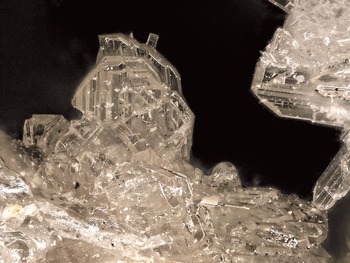
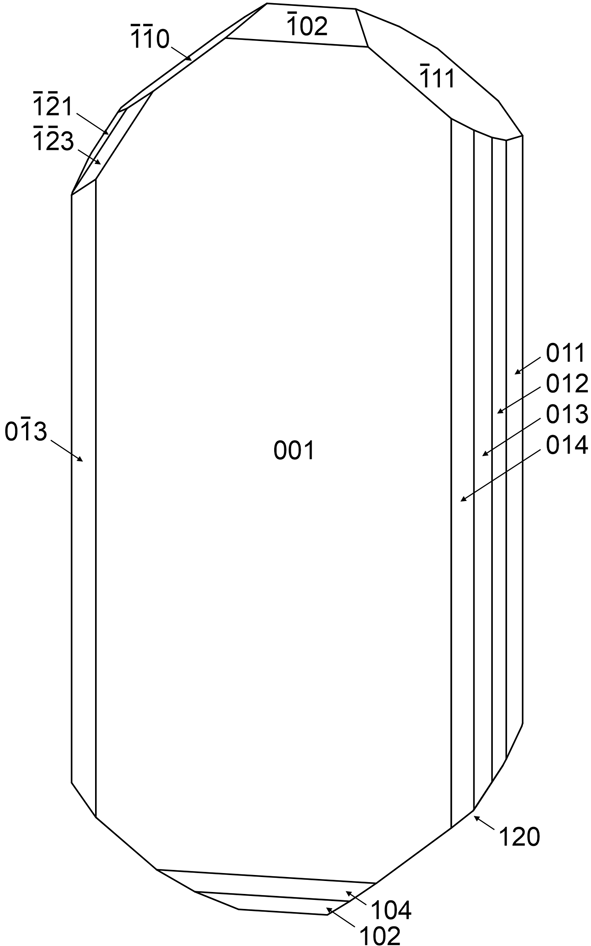
Pohlite crystals are striated blades, up to ~4 mm in length (Fig. 1). Blades are elongated and striated parallel to [010], flattened on {001} and exhibit the forms {001}, {011}, {012}, {013}, {014}, {0$\bar{1}$ 3}, {102}, {104}, {$\bar{1}$
 02}, {$\bar{1}$
 11}, {110}, {120}, {12$\bar{1}$
 } and {12$\bar{3}$
 } (Fig. 2). Crystals are colourless to pale grey and transparent with adamantine lustre and a white streak. The mineral is nonfluorescent. The Mohs hardness is ~2½, based on scratch tests. Crystals are brittle with conchoidal fracture and no cleavage. Pohlite becomes cloudy and very slowly dissolves in room-temperature, dilute HCl. The density could not be measured because crystals exceed the density of available density fluids. The calculated density is 5.838 g⋅cm–3 for the empirical formula and 5.975 g⋅cm–3 for the ideal formula.
Pohlite crystals on cotype specimen #76251. The field of view is 1.5 mm across.

Crystal drawing of pohlite; clinographic projection with a vertical (pointing down).

All indices of refraction for pohlite are >2.00, the highest liquid available to us. Observations of Becke lines in the 2.00 liquid suggest that α is only slightly >2.00. Estimating the value α to be 2.01 allows the calculation of β and γ from the α–β and γ–β birefringences measured with a Berek compensator as 0.010(5) and 0.030(5), respectively. The optical properties are thus: biaxial (+), α = 2.01(est.), β = 2.02 (calc.) and γ = 2.05 (calc.). 2V (meas.) = 60(5)° by direct measurement on a spindle stage and 2V (calc.) = 60.7°. Dispersion is r > v moderate. The partially determined optical orientation is Y ∧ a ≈ 20° and Z ∧ b ≈ 30°. No pleochroism was observed. The Gladstone–Dale compatibility index 1 – (K P/K C) is –0.025 (excellent) for the empirical formula and –0.013 (superior) for the ideal formula (Mandarino, Reference Mandarino2007).
Raman spectroscopy
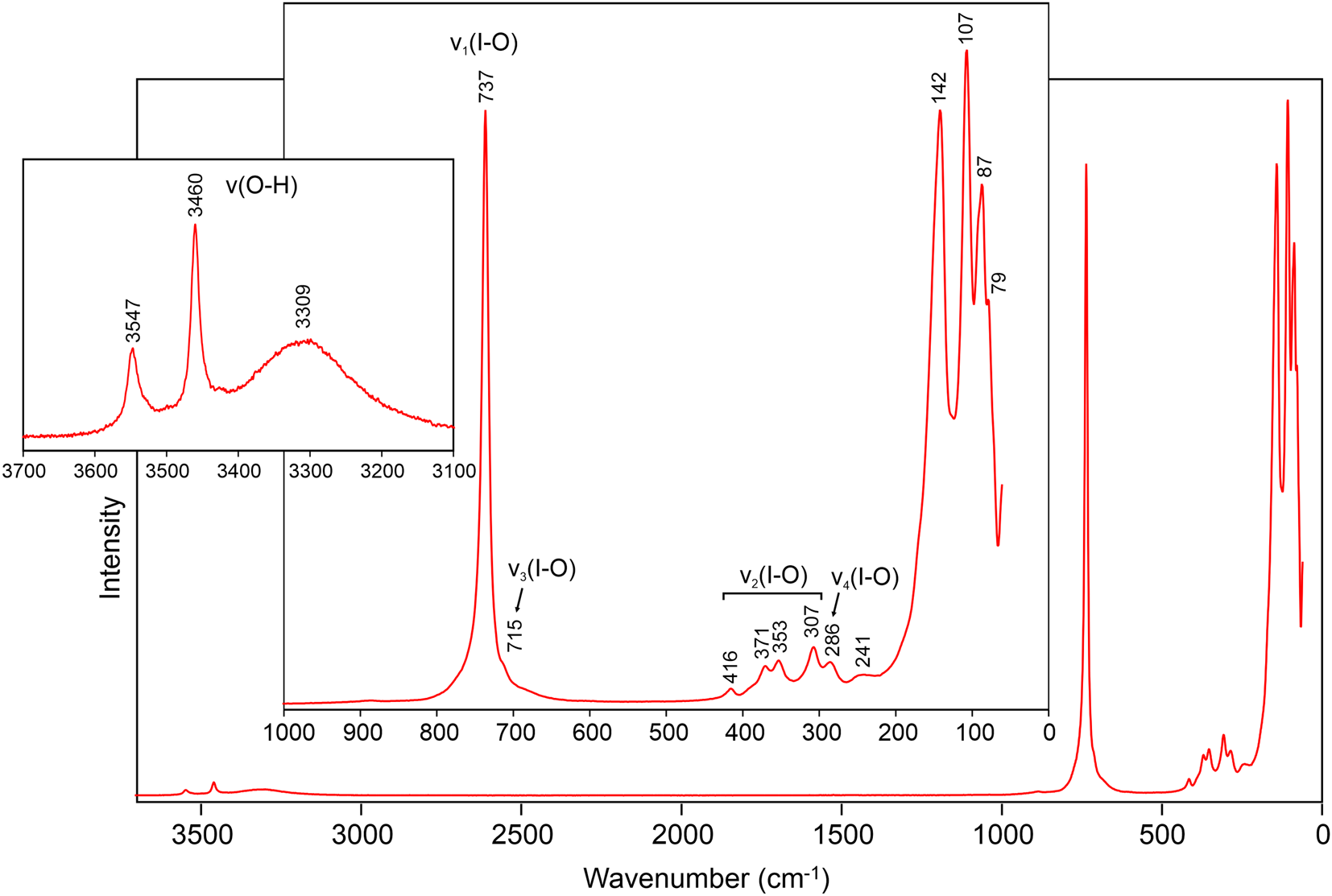
Raman spectroscopy was conducted on a Horiba XploRA PLUS using a 532 nm diode laser, 50 μm slit, 2400 gr/mm diffraction grating and a 100× (0.9 NA) objective. The spectrum for pohlite from 4000 to 60 cm–1 is shown in Fig. 3. The bands between 3700 and 3100 cm–1 are consistent with the O–H stretching vibrations [labelled ν(O–H) in Fig. 3]. Most other bands in the spectrum are probably attributable to the various stretching and bending modes of the iodate group (see Schellenschläger et al., Reference Schellenschläger, Pracht and Lutz2001; Girase et al., Reference Girase, Sawant, Patil and Bhavsar2013). In Fig. 3, these are tentatively labelled as follows: ν1(I–O) = I–O symmetric stretching, ν3(I–O) = I–O asymmetric stretching, ν2(I–O) = I–O symmetric bending and δ4(I-O) = I–O asymmetric bending. However, it should be noted that some of the bands between 400 and 60 cm–1 are probably related to Pb–O stretching and bending modes (see Jensen, Reference Jensen2002; Welch et al., Reference Welch, Rumsey and Kleppe2016).
Raman spectrum of pohlite recorded with a 532 nm laser.

Chemical composition
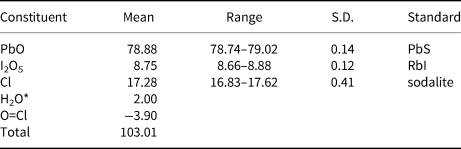
Analyses of pohlite (3 points) were performed at Caltech on a JEOL 8200 electron microprobe in wavelength dispersive spectroscopy mode. Analytical conditions were 15 kV accelerating voltage, 10 nA beam current and 5 μm beam diameter. We generally observed higher Cl analyses than were expected on the basis of the structure determination. Insufficient material is available for the determination of H2O, so it is calculated based on the structure. Analytical data are given in Table 1. The empirical formula (calculated on the basis of O + Cl =16 atoms per formula unit) is Pb6.74I1.00Cl9.29O6.71H4.23. The ideal formula is Pb7(IO3)(OH)4Cl9, which requires PbO 77.64, I2O5 8.29, Cl 15.86, H2O 1.79, O = Cl –3.58, total 100 wt.%.
Chemical composition (in wt.%) for pohlite.

* Based on the structure.
S.D. – standard deviation
X-ray crystallography and structure refinement
Powder X-ray diffraction was done using a Rigaku R-Axis Rapid II curved imaging plate microdiffractometer, with monochromatised MoKα radiation. A Gandolfi-like motion on the φ and ω axes was used to randomise the sample and observed d-values and intensities were derived by profile fitting using JADE Pro software (Materials Data, Inc.). The powder data are presented in Supplementary Table S1. Unit cell parameters refined from the powder data using JADE Pro with whole pattern fitting are: a = 7.336(5), b = 9.526(5), c = 16.245(5) Å, α = 81.582(19), β = 84.904(10), γ = 89.584(14)° and V = 1118.5(8) Å3.
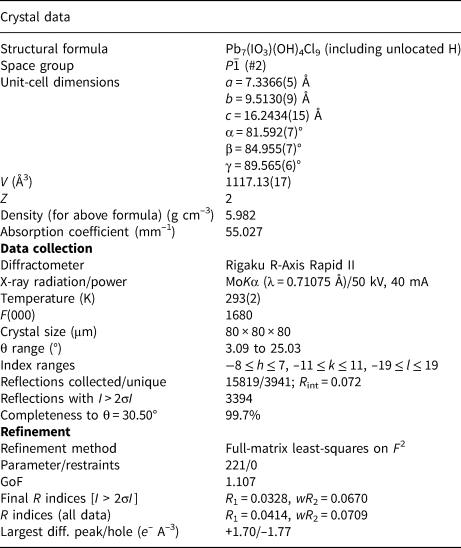
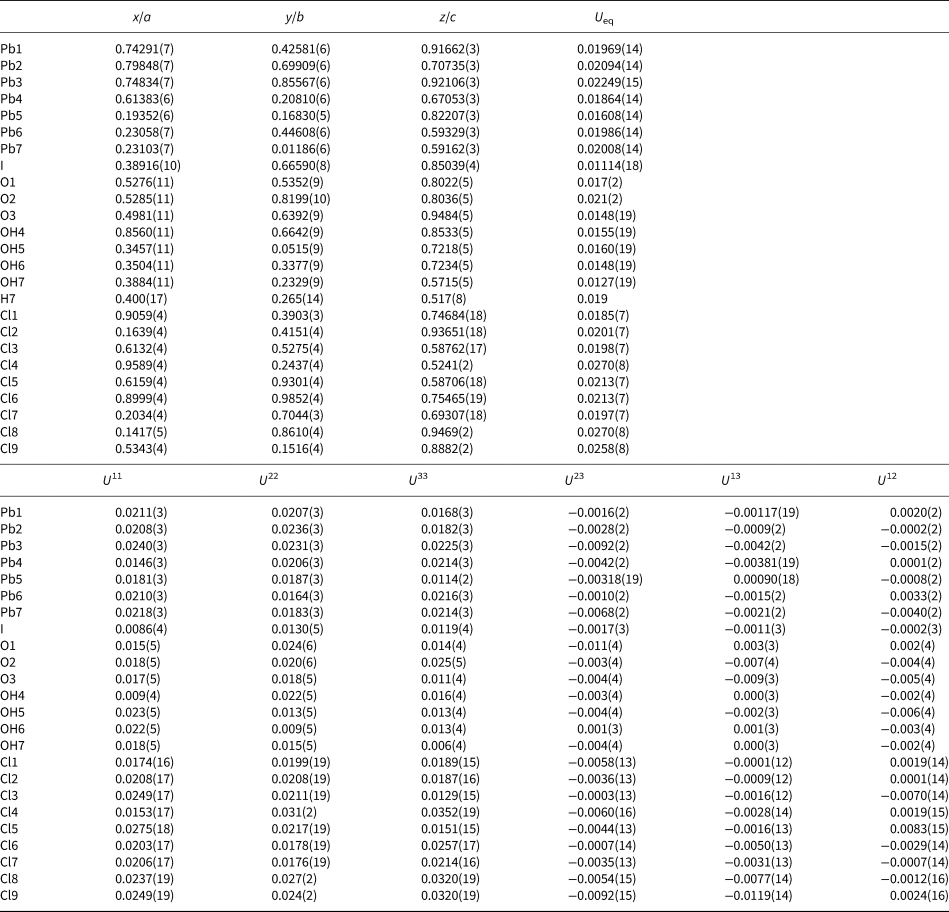
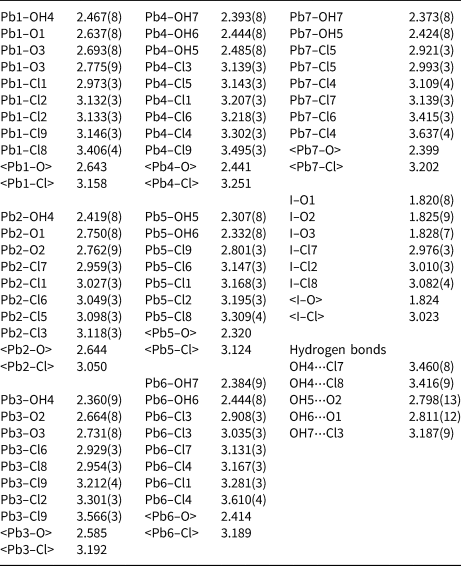
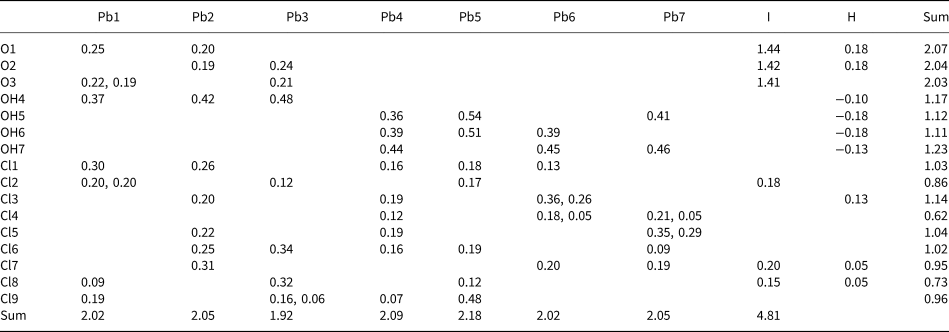
The single-crystal structure data were collected at room temperature using the same diffractometer and radiation noted above. The Rigaku CrystalClear software package was used for processing structure data, including the application of an empirical multi-scan absorption correction using ABSCOR (Higashi, Reference Higashi2001). The structure was solved using the intrinsic-phasing algorithm of the SHELXT program (Sheldrick, Reference Sheldrick2015a). SHELXL-2016 (Sheldrick, Reference Sheldrick2015b) was used for the refinement of the structure. Difference-Fourier mapping revealed only one likely H site (H7). Data collection and refinement details are given in Table 2, atom coordinates and displacement parameters in Table 3, selected bond lengths in Table 4 and a bond-valence analysis in Table 5. The crystallographic information file has been deposited with the Principal Editor of Mineralogical Magazine and is available as Supplementary material (see below).
Data collection and structure refinement details for pohlite.

R int = Σ|F o2–F o2(mean)|/Σ[F o2]. GoF = S = {Σ[w(F o2–F c2)2]/(n–p)}½. R 1 = Σ||F o|–|F c||/Σ|F o|. wR 2 = {Σ[w(F o2–F c2)2]/Σ[w(F o2)2]}½; w = 1/[σ2(F o2)+(aP)2+bP] where a is 0.0163, b is 8.7538 and P is [2F c2+Max(F o2,0)]/3.
Atom coordinates and displacement parameters (Å2) for pohlite.

Selected bond lengths (in Å) for pohlite.

Bond-valence sums (in valence units) for pohlite.

Bond-valence parameters for I5+–Cl– are from Brese and O'Keeffe (Reference Brese and O'Keeffe1991). All others are from Gagné and Hawthorne (Reference Gagné and Hawthorne2015). Hydrogen bond contributions are estimated from OD⋅⋅⋅OA distances using Ferraris and Ivaldi (Reference Ferraris and Ivaldi1988) and from H⋅⋅⋅Cl distance using Malcherek and Schlüter (Reference Malcherek and Schlüter2006). We are not aware of a relation for calculating hydrogen bond contributions based on the OD⋅⋅⋅ClA distance, so we have estimated them as 0.05 valence units for OH4⋅⋅⋅Cl7 and OH4⋅⋅⋅Cl8. Negative values indicate donated hydrogen-bond valence.
Description of the structure
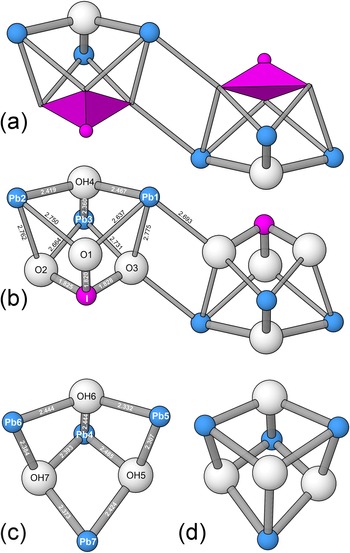
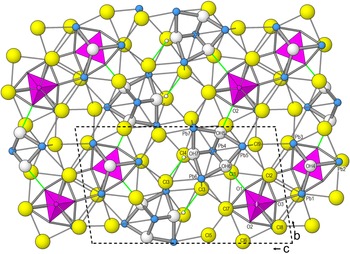
There are seven distinct Pb atoms (Pb1 through Pb7) each of which exhibits markedly off-centre coordination typical of Pb2+ with stereoactive 6s 2 lone-pair electrons. There is one I atom with a valence of 5+. Due to its 5s 2 lone-pair electrons, the I5+ also displays off-centre (one-sided) coordination, participating in three short bonds to O atoms (O1, O2 and O3) to yield a trigonal pyramidal IO3– iodate anion with I5+ at its apex. Short Pb–O bonds define two different clusters. The Pb1, Pb2 and Pb3 atoms each form a short bond (2.360 to 2.467 Å) to OH4 yielding a strongly bonded Pb3(OH) grouping. Each of these Pb atoms also makes two medium-length bonds (2.637 to 2.775 Å) to O atoms in the IO32– iodate anion resulting in a [Pb3(OH)(IO3)] cluster. The Pb1 atom also forms a medium-length bond (2.693 Å) to the O1 atom in an adjacent [Pb3(OH)(IO3)] cluster thereby creating a double Pb1–O1 link and yielding a [Pb3(OH)(IO3)]28+ ‘double cluster’ (Fig. 4a,b). The second cluster comprises Pb4, Pb5, Pb6, Pb7, OH5, OH6 and OH7. Pb4 forms short bonds (2.393 to 2.485 Å) to three OH groups and Pb5, Pb6 and Pb7 each form short bonds (2.307 to 2.444 Å) to two OH groups resulting in a [Pb4(OH)3]5+ cluster (Fig. 4c). There are nine distinct Cl atoms (Cl1 through Cl9). The Pb and I atoms form long bonds to the Cl atoms at Pb–Cl distances from 2.801 to 3.637 Å and I–Cl distances from 2.976 to 3.082 Å. The long bonds Pb–Cl and I–Cl serve to link the clusters together in three dimensions. Additional linkage is provided by hydrogen bonds. The located H7 site indicates a likely hydrogen bond between OH7 and Cl3. Hydrogen bonds from OH5 to O2 and from OH6 to O1 are also clearly indicated. From a geometrical perspective, the only hydrogen bonds likely to be from OH4 are to Cl7 and Cl8. The complete structure is shown in Fig. 5.
The [Pb3(OH)(IO3)]28+ ‘double cluster’ in the structure of pohlite (a) with the iodate group shown as a pyramid and (b) with the iodate group shown in ball-and-stick style. (c) The [Pb4(OH)3]5+ cluster in the structure of pohlite. (d) The cubane-like [Pb4(OH)4]4+ cluster in the structure of nitroplumbite. Short Pb–O bonds are shown as thick grey sticks and medium-length Pb–O bonds are shown as thinner grey sticks.

The structure of pohlite viewed along [100]. Short Pb–O bonds are shown as thick grey sticks, medium-length Pb–O bonds are shown as thinner grey sticks, long Pb–Cl and I–Cl bonds are shown as thin sticks and hydrogen bonds are shown as green lines (OH4⋅⋅⋅Cl hydrogen bonds are hidden). The unit-cell outline is shown by dashed black lines.

Kolitsch and Tillmanns (Reference Kolitsch and Tillmanns2003) surveyed Pb–(O,OH) clusters. They did not report clusters equivalent to the [Pb3(OH)(IO3)]28+ ‘double cluster’ (or to the Pb3(OH) grouping within that cluster) or to the [Pb4(OH)3]5+ cluster, which are the structural units in the structure of pohlite. However, it is worth noting that both of these clusters have similarities to the well-known cubane-like [Pb4(OH)4]4+ cluster (Fig. 4d) that occurs in the structures of several minerals: maricopaite (Rouse and Peacor, Reference Rouse and Peacor1994), bideauxite (Cooper et al., Reference Cooper, Hawthorne, Merlino, Pasero and Perchiazzi1999), siidraite (Rumsey et al., Reference Rumsey, Welch, Kleppe and Spratt2017), nitroplumbite (Kampf et al., Reference Kampf, Hughes, Nash and Marty2022b), cubothioplumbite (Kampf et al., Reference Kampf, Smith, Hughes, Ma and Emproto2022c), hexathioplumbite (Kampf et al., Reference Kampf, Smith, Hughes, Ma and Emproto2022d), hayelasdiite (Kampf et al., Reference Kampf, Smith, Hughes, Ma and Emproto2022e) and finescreekite (Kampf et al., Reference Kampf, Smith, Hughes, Ma and Emproto2022f). Each side of the [Pb3(OH)(IO3)]28+ ‘double cluster’ is topologically equivalent to the cubane-like [Pb4(OH)4]4+ cluster with the I5+ taking the place of one of the four Pb2+ and three O2– taking the place of OH– groups (Fig. 4b). The [Pb4(OH)3]5+ cluster is essentially the same as the [Pb4(OH)4]4+ cluster with one OH– group removed (Fig. 4c,d).
Seeligerite, Pb2+3(I5+O3)OCl3 (Bindi et al., Reference Bindi, Welch, Bonazzi, Pratesi and Menchetti2008), and schwartzembergite, Pb2+5H2I3+O6Cl3 (Welch et al., Reference Welch, Hawthorne, Cooper and Kyser2001) are the only other minerals with compositions similar to that of pohlite; however, these minerals have crystal structures that are very different from one another and from that of pohlite. In addition, schwartzembergite contains I3+, rather than I5+.
Acknowledgements
Reviewers John M. Hughes, Oleg Siidra and Structures Editor Peter Leverett are thanked for their comments on the manuscript. A portion of this study was funded by the John Jago Trelawney Endowment to the Mineral Sciences Department of the Natural History Museum of Los Angeles County.
Supplementary material
To view supplementary material for this article, please visit https://doi.org/10.1180/mgm.2022.123
Competing interests
The authors declare none.