Introduction
Impacts of human activities on the Antarctic environment date back to the 18th century, but the process has been continuous and accelerating since the International Geophysical Year 1957–58. The building and occupation of research stations have led to significant changes in the Antarctic environment in the last 50 years (Burgess et al. Reference Burgess, Spate and Norman1992, Kim et al. Reference Kim, Kennicutt II and Qian2006, Bargagli Reference Bargagli2008, Martins et al. Reference Martins, Bícego, Rose, Taniguchi, Lourenço, Figueira, Mahiques and Montone2010). In addition, the impact of global anthropogenic activities has also been observed over time, for example the introduction of anthropogenic radioactive materials (Tubertini et al. Reference Tubertini, Bettoli, Cantelli, Tositti, Valcher, Triulzi, Marzano, Mori, Vaghi, Sbrignadello, Degetto and Faggin1995, Pourchet et al. Reference Pourchet, Magand, Frezzotti, Ekaykin and Winther2003), or man-made chemicals such as chlorofluorocarbons (CFCs), halons and a number of other gases provoking stratospheric ozone depletion (WMO 1991). All such impacts undermine any concept of Antarctica as a pristine environment as is noted by Tin et al. (Reference Tin, Fleming, Hughes, Ainley, Convey, Moreno, Pfeiffer, Scott and Snape2009).
Human presence and survival in Antarctica requires the use of fossil fuels for transport and energy and it also produces waste which, unless properly managed, can have a negative impact on the environment. Thus, every coastal Antarctic station is a potential source of hydrocarbon impact on the marine environment (Cripps & Shears Reference Cripps and Shears1997, Martins et al. Reference Martins, Bícego, Taniguchi and Montone2004, Bícego et al. Reference Bícego, Zanardi-Lamardo, Taniguchi, Martins, Da Silva, Sasaki, Albergaria-Barbosa, Paolo, Weber and Montone2009, Tin et al. Reference Tin, Fleming, Hughes, Ainley, Convey, Moreno, Pfeiffer, Scott and Snape2009). Increasing tourism activities, including tourist ships and airplanes, also contribute to the human impact (Liggett et al. Reference Liggett, McIntosh, Thompson, Gilbert and Storey2010). According to statistics from the International Association of Antarctica Tour Operators (IAATO), the number of tourists to Antarctica has increased from 8210 people in the period 1994–95 to 37 858 people in the period 2008–09 (IAATO 2010; http://www.iaato.org/tourism_stats.html, accessed 12 April 2010). Additionally, accidental oil spills, leaks from the storage of fuels and the refilling of motor vehicle, helicopter and airplane fuel tanks, or the discharge of contaminated wastewaters have been identified at the following stations: Palmer (Kennicutt et al. Reference Kennicutt II, McDonald, Denoux and McDonald1992), Henryk Arctowski (Krzyszowska Reference Krzyszowska1990), McMurdo (Tumeo & Wolk Reference Tumeo and Wolk1994), Marambio (Pearce Reference Pearce1995), Casey (Deprez et al. Reference Deprez, Arens and Locher1999, Revill et al. Reference Revill, Snape and Guille2007).
Sediments are constituted by organic and inorganic compounds coming from internal or external sources to the water body; they play a significant role in maintaining water quality because of their ability to adsorb dissolved compounds, sometimes even immobilizing heavy metals, herbicides, pesticides, hydrocarbons and other chemical species (Raymundo & Preston Reference Raymundo and Preston1992). Sediments may hold, for example, a considerable deposit of polycyclic aromatic hydrocarbons (PAHs), which are significant organic pollutants prevalent in marine sediments around the world.
In Antarctica, researchers have studied sediments to assess anthropogenic contamination of both seawater and sediment (Kim et al. Reference Kim, Kennicutt II and Qian2006, Curtosi et al. Reference Curtosi, Pelletier, Vodopivez and Mac Cormack2007, Bícego et al. Reference Bícego, Zanardi-Lamardo, Taniguchi, Martins, Da Silva, Sasaki, Albergaria-Barbosa, Paolo, Weber and Montone2009). Martins et al. (Reference Martins, Bícego, Rose, Taniguchi, Lourenço, Figueira, Mahiques and Montone2010) used sediment cores to assess the historical local input of anthropogenic materials (particulate and organic compounds) in the area of Admiralty Bay, King George Island. These compounds resulted from the influence of human occupation of the region and possible long-range atmospheric transport of combustion products from sources in South America. Cripps & Priddle, as early as Reference Cripps and Priddle1991, considered that Antarctic marine regions and ice-free zones were particularly vulnerable to contamination from oil hydrocarbons.
Aliphatic hydrocarbon analysis is a tool which assesses hydrocarbon sources in sediments in order to characterize oil spills and obtain additional information about crude oil degradation (Volkman et al. Reference Volkman, Holdsworth, Neil and Bavor1992, Liu et al. Reference Liu, Chen, Jianfu, Qinghui, Zhiliang and Hongwen2008). Aliphatic hydrocarbons derive from a variety of allochthonous sources such as vascular plants, and autochthonous plants, plankton, and bacteria (Volkman et al. Reference Volkman, Holdsworth, Neil and Bavor1992, Wakeham Reference Wakeham1996).
Over 100 PAHs have been identified, 16 of which were classified by United States Environmental Protection Agency (USEPA) as priority contaminants. Some are identified by the International Agency for Research on Cancer (IARC) as carcinogenic or potentially carcinogenic to humans. In addition, PAHs are sensitive indicators of pyrogenic and petrogenic hydrocarbon sources (Wang et al. Reference Wang, Fingas and Page1999); differentiation may be carried out by utilizing molecular ratios or diagnostic ratios (DRs) which relate the compounds to a source, the higher stability of a certain compound in the environment, its molecular weight or a combination of these (Yunker et al. Reference Yunker, Macdonald, Vingarzan, Reginald, Goyette and Sylvestre2002, Sienra et al. Reference Sienra, Rosazza and Préndez2005, Dvorská et al. Reference Dvorská, Lammel and Klánová2011).
The purpose of this study is to describe the presence of organic compounds and quantify the concentrations of alkanes and PAHs in a zone containing several Antarctic stations on King George Island and, with the aid of the GIS system, obtain a better visualization of the eventual contamination at the sites, thus contributing to monitoring the last most natural area of the planet.
Materials and methods
Study area and sampling
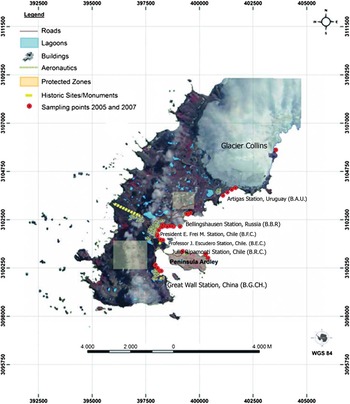
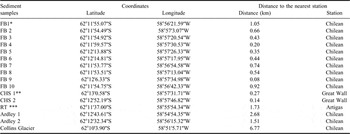
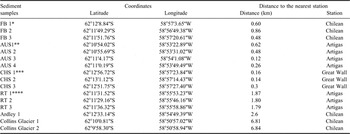
The study area is geographically limited to Fildes Peninsula, King George Island, Antarctica (Fig. 1), 62°11′S, 58°52′W. Surficial (0–5 cm) sediment samples, including duplicates, were collected by hand in the intertidal zone around the sandy-gravel beaches near the stations. Sampling method followed the recommendations of the Antarctic Environmental Monitoring Handbook (GERG 2000). The different sampled points for the years 2005 and 2007 are shown in Tables I & II including the distances to the nearest station.
Location of sampling sites of coastal sediments, Fildes Bay, King George Island, Antarctica.

Geographic coordinates for sediment samples along Fildes Peninsula and distances to the nearest stations, 2005.

*FB = Fildes Bay, indistinguishable influence between Chilean and Russian Stations.
**CHS = Great Wall Chinese Station.
***RT = Russian tanks for fuel storage.
Geographic coordinates for sediment samples along Fildes Peninsula and distances to the nearest stations, 2007.

FB* = Fildes Bay, indistinguishable influence between Chilean and Russian stations.
AUS** = Artigas Uruguayan station.
CHS*** = Great Wall Chinese station.
RT**** = Russian Tanks for fuel storage.
Analytical method
Hydrocarbons subjected to quantification were alkanes and PAHs. Of the latter, the following were quantified: naphthalene, acenaphtylene, acenaphthene, fluorene, phenanthrene, anthracene, fluoranthene, pyrene, benzo(a)anthracene, chrysene, benzo(b)fluoranthene, benzo(k)fluoranthene, benzo(a)pyrene, indeno(1,2,3-c,d)pyrene, dibenzo(ah)anthracene, and benzo(ghi) perylene.
Analytes were extracted from the sediment samples according to USEPA 3550B method (USEPA 1996) using HPLC grade reagents. Before extraction, all samples were sieved to 2 mm (US standard 10) in order to remove gravel, shell, and other material from the sample. The collected samples were dried at room temperature. Portions of 20 g of dry sample were weighed for extraction and subjected to an ultrasonic bath for 3 min in 30 ml of a 1:1 (v/v) acetone:dichloromethane mixture. This extraction was repeated to provide a volume of 120 ml per sample. The extract was filtered through a funnel with anhydrous sodium sulphate to eliminate impurities and remaining water, and concentrated to 2 ml in a Kuderna-Danish evaporator. The extract was then transferred to an amber vial, phenanthrene-d10 (2000 μg ml-1, Dr Ehrenstorfer) was added as an internal standard, and 1 μl extract was injected in a gas chromatograph (HP 5890 Series II) coupled to a mass spectrometric detector (Fisons Instruments MD 800) in SIR (Selected Ion Recording) mode for analyte determination. Standards of 1000 μg ml-1 and 2000 μg ml-1 were respectively used for alkanes and PAHs (Dr Ehrenstorfer).
The method was validated performing the evaluation of the following parameters:
• Linearity: The calibration curves were obtained by processing eight standard solutions in duplicate. The range of concentrations studied were 0.05–1.5 μg ml-1 for PAHs and 0.05–5 μg ml-1 for alkanes, which corresponded to 2.5–75 ng g-1 dry wt and 2.5–250 ng g-1 dry wt in sediment samples, respectively. Regression coefficients were between 0.99905–0.99930 for PAHs and 0.99980 for total alkanes.
• Accuracy: Accuracy was estimated by means of recovery experiments analysing sediments (n = 6) spiked at 50 ng g-1 dry wt. The recovery was between 88.3–99.5% for PAHs and 89.8% for total n-alkanes. Considering that these recoveries are quantitative, all concentrations were not corrected.
• Precision: Precision was determined in terms of repeatability of the method which was expressed as relative standard deviation (RSD, %) from the recovery experiments (n = 6). The values found were between 3.4–6.3% for PAHs and 2.2% for total alkanes.
• Selectivity: The selectivity of the GC–MS procedure was based on monitoring the appropriate ion (m/z) for each analyte.
• Detection limit (LOD) and Quantification limit (LOQ): The LOD and LOQ were estimated as the analyte concentration that produced a peak signal of three and ten, respectively, times the background noise from the chromatogram.
• Confirmation criteria: To confirm a finding as an actual positive, a maximum ratio tolerance of ± 20% was accepted between intensity of the target and qualifier ion. Obviously, the same retention time in sample and standard was also required to confirm a positive.
Quality control during sample analysis was based on the use of method blanks, matrix spikes and duplicates of the sediment samples. Method blanks revealed no contamination. Analysis of matrix spikes were between 80 and 110%, and difference in duplicates was lower than 15%.
Spatial relation analysis
The explicit spatial results for the chemical species under study were integrated with base administrative and geographic maps 1:10.000 (IGM 2007) and satellite imagery from Google Earth in a GIS environment using ArcGis 9.2 software (R). A geometric adjustment was applied to all data to ensure their spatial matching. A layer with the sampled points and attribute fields was made which included concentrations of the different chemical species for the different years. Complementary vector layers included ice cap and glacier areas, Antarctic stations and buildings, roads and runways, hydrology, specially protected or managed Antarctic zones, and historical sites and monuments. In order to interpolate experimental data, the area was limited to 1000 m from the coastline, both inland and offshore. The resulting area was used for controlling the extension of an IDW (Inverse Distance Weighted) interpolation of the concentrations (Fig. 1). Isoconcentration maps, inserted in Fildes Peninsula, King George Island, were generated in colour shades in order to appreciate the distribution of total n-alkanes and PAHs over the area.
Results and discussion
Alkanes
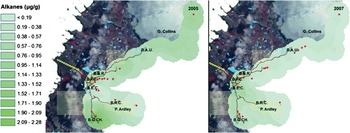
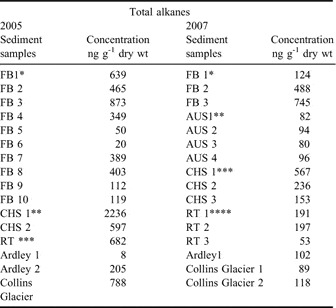
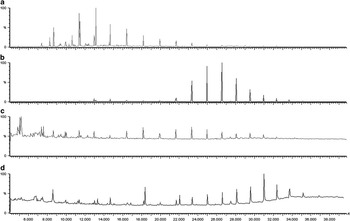
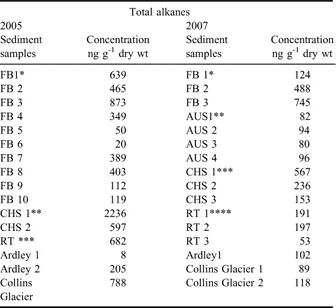
The concentrations of total alkanes in the sediments sampled along the Fildes Peninsula coast are represented in Fig. 2 and detailed values for each point are shown in Table III. Total n-alkanes concentrations were between 8 and 2236 ng g-1 dry wt in 2005 and between 53 and 745 ng g-1 dry wt in 2007. In both cases, higher concentrations were found in locations with a higher density of stations suggesting an anthropogenic source. The n-alkane distribution profile in most of the sampled points are centred in n-alkane C20, suggesting a similar source. Figure 3a shows the chromatogram of the sample collected at CHS 1 in 2007, as representative of this distribution, found also in other sediments collected near the stations President Frei, Bellingshausen, Artigas, and Great Wall suggesting a petrogenic source (Bícego et al. Reference Bícego, Zanardi-Lamardo, Taniguchi, Martins, Da Silva, Sasaki, Albergaria-Barbosa, Paolo, Weber and Montone2009), in these cases probably due to oil spills from ships servicing the stations along Fildes, from tourist ships or from airborne input from power generators in the area close to the stations. However, those concentration levels are considered low when compared to samples from polluted urbanized areas, and they are similar to those found in unpolluted sediments (Volkman et al. Reference Volkman, Holdsworth, Neil and Bavor1992).
Total concentrations of alkanes in coastal marine sediments from Fildes Bay 2005 and 2007.

Concentrations of total alkanes in marine sediment along Fildes Peninsula.
FB* = Fildes Bay, indistinguishable influence between Chilean and Russian stations.
AUS** = Artigas Uruguayan Station.
CHS*** = Great Wall Chinese Station.
RT**** = Russian Tanks for fuel storage.
Gas chromatograms (GC-MS) obtained in SIR mode (m/z = 85) for different sampling points. a. CH1 2007, b. FB3 2007, c. Ardley 1, 2005, d. Collins 2005.

Greater concentration ranges for total n-alkane, have been reported by Bícego et al. (Reference Bícego, Zanardi-Lamardo, Taniguchi, Martins, Da Silva, Sasaki, Albergaria-Barbosa, Paolo, Weber and Montone2009) around Admiralty Bay, King George Island for total n-alkanes, pristane/phytane and odd/even ratios, concentrations under 8170 ng g-1 depending on the site and year (1990–2004), and Kennicutt et al. (Reference Kennicutt II, McDonald, Denoux and McDonald1992) reported total n-alkanes concentrations of 1000 ng g-1 in sediments near Palmer Station, but ranging from 1000–1700 ng g-1 after the Bahia Paraíso accident.
A different behaviour was observed in the sampled points FB3 (2007), Ardley 1 (2005), and Collins Glacier (2005) in which the distribution profiles for total n-alkanes are centred in carbon numbers of C28, C26 and C31, respectively (Fig. 3b–d). The Collins Glacier is fairly distant from activities of the Chilean and Russian stations; the nearest station is the Uruguayan one (see Tables I & II). The profile 3d shows n-alkanes of short and long chain that are probably entirely the result of marine and terrestrial natural sources (Sánchez-García Reference Sánchez-García2007); the ratio between the homologues C31/C17 is greater than 1 (Lijmbach 1975 in Sánchez-García Reference Sánchez-García2007) suggesting the possibility that this comes from the contribution of bacterial mat and microalgae growing at the ice surface of the glacier. Summer runoff brings a part of this terrestrial organic matter to coastal waters where biodegradation leads to the observed profile 3d. The profile 3c corresponds to samples collected at Ardley Peninsula, ASPA No 150 (ATCP 1991), and probably can also be explained by marine and terrestrial natural sources. Ardley Peninsula has an important colony of penguins and has a geographic location that favours the washing of sediments by marine currents and the consequent dilution and west–east migration of n-alkanes along the King George Island coast (Rakusa-Suszczewski Reference Rakusa-Suszczewski1995, Marín & Delgado Reference Marín and Delgado1999). Ardley Peninsula shows the lowest n-alkane values for 2005 and a low value for 2007. The profile 3b is more difficult to explain; it was sometimes found, but always in the samples collected very near the Chilean and Russian stations; it has waxy pattern characteristic of vascular plants (Sánchez-García Reference Sánchez-García2007) even though there are only two vascular plants on the island. It could also be phthalates (easy to confuse with alkanes in SIR mode) from plastic degradation. In 2007, the highest concentration of n-alkanes occurred in such a location (Table III).
Total PAHs
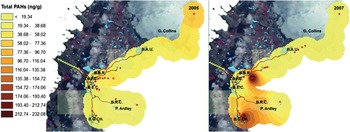
The PAHs quantified were naphthalene (Nap), acenaphtylene (Acy), acenaphthene (Ace), fluorene (Flu), phenanthrene (Phe), anthracene (Ant), fluoranthene (Fl), pyrene (Py), benzo(a)anthracene (BaA), chrysene (Chry), benzo(b)fluoranthene (BbF), benzo(k)fluoranthene (BkF), benzo(a)pyrene (BaP), indene(1,2,3-c,d)pyrene (IP), dibenzo(ah)anthracene (DBahA), and benzo(ghi)perylene (BghiP). A map representing the total PAHs, corresponding to the sum of concentrations of all the PAHs quantified in the coastal sediments at the different geo-referenced points, is shown in Fig. 4.
Total PAHs concentration in coastal marine sediments from Fildes Bay 2005 and 2007.

The concentrations of total PAHs at the different points under study were below 55.6 ng g-1 dry wt in 2005 and from 0.54–228 ng g-1 dry wt in 2007. In 2005, the highest value corresponded to the sediments taken at the Chilean and Russian stations, followed by the values found at Collins Glacier, as seen in Fig. 4. In 2007, higher concentrations than 2005 were quantified at the Chilean, Russian and Chinese stations unlike Collins Glacier where total PAHs decreased almost 97% compared with 2005. According to the three levels of PAHs contamination in sediments proposed by Notar et al. (Reference Notar, Leskovsek and Faganeli2001), the sediments studied from Fildes Bay can be classified as slightly contaminated (total PAHs, < 250 ng g-1).
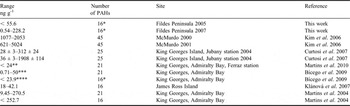
A comparison with total PAHs concentrations in sediment samples reported in Antarctica at other sites and in other periods is shown in Table IV. Considering the differences between numbers of PAHs quantified, periods and places, the principal observation is that the values reported in this work are in the range of other values reported for King George and James Ross Island but are lower than those reported for McMurdo Station.
Concentration of total PAHs in marine sediment in Antarctica at different places and times.

*The 16 PAHs classically considered by USEPA.
**Segment of Core A corresponding to 2000–06.
***Range considering concentrations for the period 1990–2003.
****Considering only the 16 PAHs USEPA, period 1990–2006.
Light PAHs (LW PAHs)
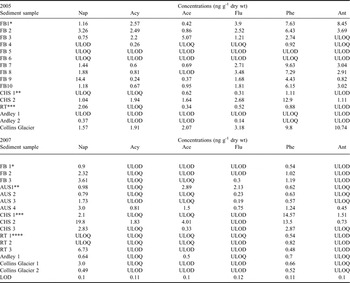
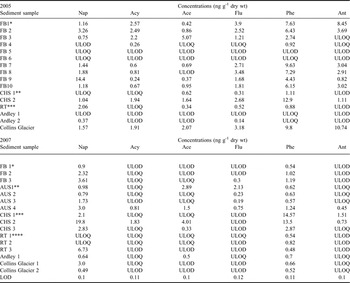
PAHs quantified for this study were classified into two groups - light (2–3 aromatic rings) and heavy (4–6 aromatic rings). Light PAHs correspond to six PAHs: naphthalene, acenaphtylene, acenaphthene, fluorene, phenanthrene, anthracene. Values obtained are shown in Table V for the years 2005 and 2007.
Concentrations of light weight PAHs in marine sediment along Fildes Peninsula, 2005 and 2007.
LOD = detection limits of individual compounds.
ULOD = below detection limits.
ULOQ = below quantification limits.
The sum of light PAHs concentrations for each site under analysis was below 29.27 ng g-1 dry wt for 2005 and in the range 0.54–39.87 ng g-1 dry wt in 2007. In 2005, the highest value was found at Collins Glacier followed by the values of samples collected at the coastal zone near the Presidente Eduardo Frei Chilean Station and Bellingshausen Russian Station, and the Great Wall Chinese Station. In 2007, the highest concentration was observed at the Great Wall Chinese Station.
In 2005, light PAHs concentrations at the sites under study may be distributed in two levels: 1) where naphthalene (below 14.4 ng g-1 dry wt), phenanthrene (below 12.9 ng g-1 dry wt), and anthracene (below 8.45 ng g-1 dry wt), are found, 2) presence of acenaphtylene, acenaphthene, and fluorene, all below a few ng g-1 dry wt. In 2007, the highest values for naphthalene (below 19.8 ng g-1 dry wt) and phenanthrene (below 14.57 ng g-1 dry wt) where found near the Great Wall Station.
The high value found in 2005 was in the Collins Glacier sample, resulting from the concentration of phenanthrene plus anthracene and fluorene. The sample collected at Ardley Peninsula shows low light PAHs values, individually and totally, both for 2005 and for 2007.
For the sum of light PAHs, (Buchmann Reference Buchman1999) has established TEL (Threshold Effects Level) and PEL (Probable Effects Level) as “threshold” values of probable effects on organisms. TEL is the chemical concentration below which the probability of finding adverse effects is low, and PEL is the chemical concentration above which adverse effects are frequently found. These values are, respectively, 312 and 1442 ng g-1. Concentrations obtained in this study were far below those values.
According to Yunker et al. (Reference Yunker, Macdonald, Vingarzan, Reginald, Goyette and Sylvestre2002), the values of the DRs of anthracene/anthracene + phenanthrene (Ant/Ant + Phe) allow distinguishing between combustion and petroleum sources. On the other hand, Martins et al. (Reference Martins, Bícego, Rose, Taniguchi, Lourenço, Figueira, Mahiques and Montone2010) suggests calculating this DR only if concentrations exceed 10 ng g-1 in order to avoid misleading conclusions. From our data, the sample of Collins Glacier in 2005 is the only one that could eventually give us some indication of the source of the PAHs detected; the value obtained of 0.523 (> 0.10) could indicate a dominance of combustion, where the concentration of pollutants from the Chilean, Russian and Uruguayan stations could be due to the movement of sediments by marine currents mentioned before.
Heavy PAHs (HW PAHs)
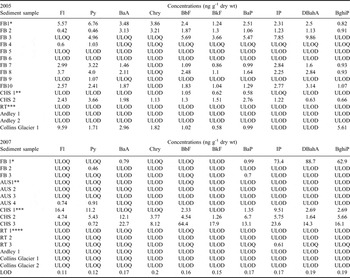
Heavy PAHs included in this study correspond to fluoranthene, pyrene, benzo(a)anthracene, chrysene, benzo(b)fluoranthene, benzo(k)fluoranthene, benzo(a)pyrene, indene(1,2,3-c,d)pyrene, dibenzo(ah)anthracene, and benzo(ghi)perylene. According to Yunker et al. (2002) and Dvorská et al. (Reference Dvorská, Lammel and Klánová2011) these PAHs are frequently related to combustion processes. The concentrations of the heavy PAHs at the different sampling sites are shown in Table VI.
Concentrations of heavy weight PAHs in marine sediment along Fildes Peninsula, 2005 and 2007.

LOD = detection limits of individual compounds.
ULOD = below detection limits.
ULOQ = below quantification limits.
Concentrations of individual heavy PAHs at the different sites varied from values below 9.86 ng g-1 dry wt in 2005 to below 88.7 ng g-1 dry wt in 2007. The highest value in both cases was found in the samples obtained at the sites in the coastal zone near Presidente Eduardo Frei and Bellingshausen stations.
In 2005, the sum of heavy PAHs in the sample taken at Collins Glacier was 24.28 ng g-1 dry wt. In 2007, this value sharply reduced as to be undetectable. In 2005 and 2007, no heavy PAHs were found in the samples collected at Ardley Peninsula.
In 2005, all the heavy PAHs were quantified in the coastal zone near Presidente Eduardo Frei and Bellingshausen stations; the most abundant PAHs at the sites were, in decreasing order, pyrene and fluoranthene; in 2007, not all the heavy PAHs were detected, and the most abundant, in decreasing order, were dibenzo(ah)anthracene, indeno(1,2,3-c,d)pyrene, and benzo(ghi)perylene. However, in 2007, the samples collected in the zone of the Great Wall Station showed values for all the heavy PAHs (0.72–64.4 ng g-1 dry wt) with benzo(b)fluoranthene as the most abundant.
In 2007, it was possible to calculate some DRs in the studied sites. Near the Chilean and Russian stations, the value of 0.54 for the ratio of IP/BghiP indicated combustion sources. In the area of the Chinese Station, it was possible to calculate the DRs BaA/BaA+Chry = 0.74, (Fl/Fl+Py = 0.59 and IP/BghiP = 0.60) all indicating combustion sources. According to Dvorská et al. (Reference Dvorská, Lammel and Klánová2011), the proximity of the station to the sampled points obtaining DRs could be more related to station heating than to any other source.
The NOAA (Buchmann Reference Buchman1999) reference tables for organics in marine sediments show the sum of heavy PAHs, concentrations to 655 and 6676 ng g-1 for TEL and PEL, respectively. In this study, such values were not reached in any of the years under study. However, for individual hydrocarbons in 2007, there is a site where dibenzo(ah)anthracene, with 88.7 ng g-1, is above the ERL, TEL, and T20 levels, corresponding to 63.4, 6.22, and 19, respectively. It is the site located in the vicinity of the Chilean and Russian stations.
Conclusion
The concentrations and distributions of aliphatic and aromatic hydrocarbons in the study area show contributions from different natural and anthropogenic sources to the surficial marine sediments in the Fildes Peninsula. In some of the sites, it is difficult to distinguish a low contamination from background.
The presence of diesel fuel in Fildes Bay and the low concentrations of n-alkanes could indicate that the source is not fuel spill and that the presence and concentrations of n-alkanes are more related to the management of stationary or mobile potential sources servicing the scientific stations on King George Island.
On the other hand, calculated diagnostic ratios indicate fuel combustion as a source in the area of the Chinese station. The calculated DR for BaA/BaA+Chry was 0.70, a high value according to Dvorská et al. (Reference Dvorská, Lammel and Klánová2011). However, as only oil should be used in Antarctica (King George Island) not wood or coal, and terrestrial vehicles are very scarce, we think that this DR indicates essentially “heating” of the station.
The low contamination detected is in the range of other sites reported from King George Island. The fact that aliphatic hydrocarbons are present in the lipid fraction of all marine flora and fauna make it a potential source for these in Antarctica. The natural input from land to the marine system is limited due to sparse terrestrial biota; however, it was observed in samples collected at Collins and Ardley. On the other hand, results obtained near the scientific stations seem to be related to anthropogenic activities.
If the results obtained really reflect a low but quantified degree of contamination of anthropogenic origin, a continuous input to the atmospheric and marine environment and a slow rate of biodegradation of hydrocarbons become a potential hazard for the future because of the high primary biological productivity of Antarctica and possible bioaccumulation of hydrocarbons within the marine food chain. This indicates that further study in this area is necessary.
During the season 2009–10, we observed the rupture of one of the pipelines distributing diesel to Bellingshausen station, provoking an important oil spill in Fildes Bay.
Acknowledgements
This research was supported by the Chilean Antarctic Institute, Projects 04/03 and T 02_07. The authors thank the anonymous reviewers for their valuable comments and suggestions as well as Dr B. Didyk's useful intellectual discussion, all which certainly improve this work.