



Introduction
Marine Isotope Stage 2 (MIS 2, c. 29 000–14 000 BP) is an interval of predominantly cold climatic conditions that also spanned the substantial climatic variability (Lisiecki & Raymo, Reference Lisiecki and Raymo2005; Seierstad et al. Reference Seierstad2014; Zhao et al. Reference Zhao2015; Mingram et al. Reference Mingram2018). In response to the climatic and environmental shifts of MIS 2, shifts in human population distributions, subsistence practices and technological strategies are witnessed worldwide. In East and north-east Asia, the appearance and wide diffusion of microblade technology constitutes one of the most prominent adaptive strategies of hunter-gatherer populations, along with the adoption of a high level of mobility, intensified large-game hunting and the long-distance transfer of high-quality raw materials (e.g. Elston & Brantingham Reference Elston and Brantingham2002; Goebel Reference Goebel2002; Kuzmin Reference Kuzmin, Kuzmin, Keates and Shen2007, Reference Kuzmin2019; Morisaki et al. Reference Morisaki, Izuho, Terry and Sato2015; Buvit et al. Reference Buvit, Izuho, Terry, Konstantinov and Konstantinov2016; Yi et al. Reference Yi, Gao, Li and Chen2016; Yue et al. Reference Yue, Yang, Li, Storozum, Hou, Chang and Petraglia2021; Deng et al. Reference Deng2023).
The Changbaishan Mountains of north-eastern China are situated at the crossroads of East and north-east Asia and are an important region for the examination of prehistoric population migration, cultural interaction and ecological adaptation. The region is sensitive to rapid changes in climate, given its location on the current northern boundary of the East Asian monsoonal system. Annually laminated sediment sequences from the Sihailongwan and Erlongwan maar lakes provide a fine-scale registry of climatic and vegetation history that corresponds with global conditions, including of the Last Glacial Maximum (LGM, 25 600–18 200 BP), Heinrich stadial 1 (17 650–16 850 BP) and the Bølling–Allerød interstadial (14 450–12 680 BP; Liu et al. Reference Liu, Zhang, Liu, You and Han2008; Stebich et al. Reference Stebich, Mingram, Han and Liu2009; Mingram et al. Reference Mingram2018). The Changbaishan Mountains also contain a variety of natural resources, including obsidian; the abundance of this high-quality raw material for tool-making is exemplified at the numerous archaeological sites dating to MIS 2 in the area.
The Xianrendong cave site in Huadian County provides the earliest known evidence for hominin occupation in the Changbaishan Mountains, with the lower cultural layer dated to 162.1±18ka by Uranium-series dating and the upper cultural layer to 34 290±510 BP by radiocarbon dating (Chen et al. Reference Chen, Zhao and Wang2007). A core-flake industry typifies the Xianrendong lithic assemblages, with the upper cultural layer demonstrating more advanced technical features, including chipped/polished bone tools and lithic toolkits typical of the Upper Palaeolithic (e.g. endscrapers, burins; Chen et al. Reference Chen, Zhao and Wang2007). A premolar tooth characteristic of Homo sapiens and radiocarbon dating to c. 44 000–30 000 BP was excavated from the Shimenshan cave in Antu County, though no cultural remains were recovered (Jiang Reference Jiang1982). Since the 1990s, many sites with lithic assemblages characterised by blade and microblade technologies and the extensive use of obsidian have been identified in the Changbaishan Mountains, including Shirengou, Fenglin and Helong Dadong. Analyses of lithic typologies, raw material and use-wear have been conducted at some of these sites, and the results are largely published in Chinese (e.g. Chen & Wang Reference Chen and Wang2008; Chen et al. Reference Chen, Zhao and Wang2009, Reference Chen, Jia, Doelman, Zhao and Wang2015; Jia et al. Reference Jia, Doelman, Chen, Zhao, Lin, Torrence and Glascock2010; Zhao Reference Zhao2012; Zhao et al. Reference Zhao, Xu and Ma2016; Tian et al. Reference Tian, Xu, Guan and Gao2017; Wan et al. Reference Wan, Chen, Fang, Wang, Zhao and Li2017; Fang Reference Fang2019; Liu Reference Liu2019; Xu et al. Reference Xu, Zhao and Gu2023a & Reference Xu, Chen and Lib).
The role of the Changbaishan Mountains in the emergence and spread of microblade technologies in East and north-east Asia has been highlighted in archaeological and petrological studies. Geoarchaeological analyses indicate that obsidian originating around the Changbaishan Tianchi Volcano prevails among the microblade assemblages in north-east China (Jia et al. Reference Jia, Doelman, Chen, Zhao, Lin, Torrence and Glascock2010) and the Korean Peninsula (Kim et al. Reference Kim2007; Lee & Kim Reference Lee and Kim2015; Kim & Chang Reference Kim and Chang2021). Extensive networks of late Upper Palaeolithic obsidian transport and exchange have been reconstructed, ranging across north-east China (including the Changbaishan Mountains), the Korean Peninsula, the Russian Far East and Hokkaido in the Japanese Archipelago (e.g. Jia et al. Reference Jia, Doelman, Chen, Zhao, Lin, Torrence and Glascock2010; Kuzmin Reference Kuzmin2011, Reference Kuzmin2019). Comparison of MIS 2 microblade assemblages from across north-east Asia suggests that the Changbaishan Mountains probably served as a core area for the emergence of the ‘Northern Microblade Industry’—a lithic technocomplex characterised by wedge-shaped microblade cores and the pressure flaking technique—that then spread extensively across East and north-east Asia (Yue et al. Reference Yue, Yang, Li, Storozum, Hou, Chang and Petraglia2021).
Yet, few sites in the Changbaishan Mountains are well dated, and many are either surface collections or the subject of limited excavation. Most of the microblade assemblages are ascribed to the late Upper Palaeolithic or the terminal Late Pleistocene based on stratigraphic correlations and lithic techno-typological comparisons. Therefore, to better understand the nature and diachronic changes of lithic industries and their relationship with palaeoclimatic and palaeoenvironmental perturbations, it is necessary to conduct systematic excavations with an aim to obtain chronostratigraphic information. Here, we report findings from the 2010 excavation of Helong Dadong, an open-air site in the hinterland of the Changbaishan Mountains, around 75km east of the Tianchi Volcano. More than 1000 lithic artefacts representative of blade and microblade technologies were uncovered. Radiocarbon dating indicates that occupation of the site ranged from c. 27 000–15 000 BP, with two main cultural phases dated to between 27 300–24 100 and 15 800–15 600 BP. The high stratigraphic integrity, reliable chronology and abundant lithic artefacts at Helong Dadong provide an opportunity to examine ecological adaptations and lithic technologies of hunter-gatherer populations in the Changbaishan Mountains during MIS 2, and offer new data to investigate the emergence and spread of microblade technology.
Helong Dadong
The Helong Dadong site (43°5′20.4″N, 128°57′20.9″E, 637masl) extends over an area of about 4km2. It is located at the confluence of the Tumen River and its tributary, the Hongqi River, along the border between China and North Korea (Figure 1a–b). The site was discovered and first excavated in 2007, yielding tens of thousands of lithic artefacts, the majority of which were from surface collections. The lithic assemblages contain blade and microblade technological products that are typically ascribed to the terminal Late Pleistocene based on stratigraphic and typological comparisons (Li Reference Li2008; Zhao Reference Zhao2012; Wan et al. Reference Wan, Chen, Fang, Wang, Zhao and Li2017).
The Helong Dadong site: a) topographic map of north-east Asia; b) overview of the landscape around Helong Dadong; c) stratigraphic profile of the site (figure by authors).

In 2010, systematic excavation at Helong Dedong exposed an area of 50m2 (Xu et al. Reference Xu, Zhao and Gu2023a). The deposits, extending to a depth of more than 2m, were excavated in 50mm artificial spits. Seven stratigraphic layers were identified based on sediment colour, texture and structure (Figure 1c). Layer 7, at the bottom of the stratigraphic profile, is a fluvial deposit of basaltic gravels mixed with coarse sands. Layer 6, around 1.2m thick, consists of loose, yellowish-grey silt and can be divided into two sub-layers (6A and 6B) based on grain size variations. Layers 3–5 constitute the primary cultural layers of Helong Dadong, the sediments of which are characterised by a dense silty clay, with soil colours ranging from yellow (layer 5, 0.3m thick), to black (layer 4, 0.4–0.5m) and greyish-brown (layer 3, 0.2–0.3m). Layer 2 (20–50mm thick) is greyish-white volcanic ash with numerous pumice particles, overlain by modern tillage soil (layer 1). Based on soil micromorphology and particle size analysis, alternating fluvial sandy layers and overbank fine-grained sediments were deposited in layers 4/5, and layer 3 is dominated by fine-grained alluvial overbank sediment with strong pedogenesis, implying an ideal depositional environment for human activities (Lian et al. Reference Lian, Xu, An, Zhu, Shi, Zhao and Chen2023).
Organic samples collected from the stratigraphic layers during the excavation in 2010 were taken for accelerator mass spectrometry (AMS) radiocarbon dating at Peking University. Two dates were obtained, 21 350±120 BP for layer 4 and 35 090±47 BP for layer 7 (Table 1). To further develop a reliable chronological framework, charcoal samples were taken from stratigraphic deposits during fieldwork in 2021 and three additional radiocarbon dates were obtained from Beta Analytic (Table 1). The combined radiocarbon dates bracket human occupation at Helong Dadong between c. 27 000 and 15 000 BP, with the lower cultural layers (layers 4–5) dating from 27 300–24 100 BP, and the upper cultural layer (layer 3) from 15 800–15 600 BP. A temporal gap between c. 24 000 and 16 000 BP is therefore present.
Radiocarbon dates calibrated with the OxCal v4.4.4 software (Bronk Ramsey Reference Bronk Ramsey2021) and the IntCal20 dataset (Reimer et al. Reference Reimer2020).

Techno-typological characteristics of the lithic assemblages
All 1040 lithic artefacts were excavated from the primary cultural layers of Helong Dadong in 2010, along with 213 pieces from the modern tillage soil, and were plotted in three-dimensional space (with a total station). Table 2 shows the techno-typological composition of the lithic assemblage from the lower and upper cultural layers.
Techno-typological compositions of lithic artefacts.

Lower cultural layers (27 300–24 100 BP)
In total, 834 lithic artefacts were recovered from the lower cultural layer. Most are small, with an average length of 24.16mm. The raw materials are dominated by obsidian, which accounts for 94.7 per cent of the assemblage. Other materials are represented in small quantities, including tuff, basalt, siliceous limestone and sandstone. Field survey of the site and surrounds indicates that obsidian is easily accessible in the gravel layers of the Tumen River terraces, which may constitute the main source of obsidian at Helong Dadong.
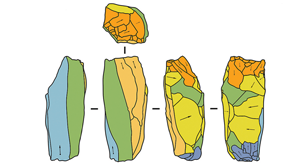
Production methods are represented by core-flake, blade and microblade debitage (defined here as an operation that consists of fracturing a raw material in order to produce blanks (Inizan et al. Reference Inizan, Reduron-Ballinger, Roche and Féblot-Augustins1999)). Five simple cores without special preparation indicate core-flake reduction, along with numerous flakes, some of which may also result from the shaping out and maintenance of blade cores. Blade reduction is particularly prominent, represented by two blade cores and a series of characteristic debitage products, including blades, crests and rejuvenation flakes. Both blade cores were made on thick obsidian flakes (Figure 2). The long edges of the flake blanks were modified into crests through successive unifacial removals and, in the same manner, the proximal and distal ends were then prepared into platforms from which blades were detached by soft-hammer percussion. In addition, blades were selected as tool blanks, and constitute the dominant blank type of the retouched tools.
Blade cores from the lower cultural layer (figure by authors).

Microblade debitage is represented by five microblade cores and 38 microblades (Figure 3 & 4). Microblade cores are blade/flake-based and burin-like, and usually involve preparing blanks with unifacial marginal removals, resembling the Tougeshita-type microblade cores of the early microblade industries in Hokkaido (Nakazawa et al. Reference Nakazawa, Izuho, Takakura and Yamada2005). Continuous abrupt or semi-abrupt direct removals are applied to the proximal/distal end of the blank, forming a relatively long and concave platform. The debitage surface (the facet that bears microblade scars) is usually parallel to the morphological axis and perpendicular to the lower face of the blank and shows repeated microblade removals running through the entire length of the blank (Figure 3). No sign of use has been detected based on microwear analysis, further indicating that these pieces function as cores rather than tools. Microblades are produced from obsidian and exhibit characteristics of pressure flaking—regular and parallel edges, thin and straight profiles, short and pronounced bulbs, small point-like platforms and a maximum width at the shoulder (Figure 4; Inizan et al. Reference Inizan, Reduron-Ballinger, Roche and Féblot-Augustins1999; Gómez Coutouly Reference Gómez Coutouly2018).
Microblade cores from the lower cultural layer (figure by authors).

Microblades from the lower cultural layer: a–b) view of proximal part of microblades showing small point-like platforms and pronounced short bulbs; c–e) mesial portions of microblades. Scale bars for enlarged images all show 500μm (figure by authors).

Burins are the most frequent tool type in the lower cultural layer (Table 3, Figure 5). These are made on obsidian blades/flake blanks that were typically retouched along the edge(s) with direct removals. A few pieces preserve the morphology of the original blank without modifications. Before burin blows (Inizan et al. Reference Inizan, Reduron-Ballinger, Roche and Féblot-Augustins1999), a short striking platform was created through limited retouching of the distal end, or sometimes the proximal end, of the blank. The burin facet, resulting from one or more burin blows, is usually oblique to the morphological axis and slightly angled in relation to the upper or lower face of the blank. Use-wear analysis indicates that the burin facets worked not only as employable units (e.g. scraping action), but in some cases for the holding, hafting and recycling of tools (Xu et al. Reference Xu, Chen and Li2023b).
Stone tool types.

Illustrations of burins from the lower cultural layer (figure by authors).

In addition to burins, formal retouched tools from the lower cultural layers of Helong Dadong include scrapers, endscrapers, bifacial points, one polished point and one notch (Figure 6). These pieces were typically made on obsidian blades or flakes and retouched by soft-hammer percussion and pressure techniques. A few relatively large tools, including two polished pieces and three cobble tools, have also been identified. Non-obsidian materials, such as basalt, andesite, granite and sandstone, were procured for the manufacture of these larger items, showing distinct raw material preferences and exploitation strategies. The polished point—original material olivine basalt (Figure 7)—underwent an elaborate grinding process and use-wear analysis suggests it was probably used heavily.
Examples of tools from the lower cultural layer: a & b) scraper; c–i) endscraper; j & k) bifacial point (figure by authors).

Partially polished point from the lower cultural layer: a) impact fracture (20× magnification); b & c) ground wear (100× magnification). Scale bar for a & b is 500μm and for c is 250μm (figure by authors).

Upper cultural layer (15 800–15 600 BP)
In the upper cultural layer, 206 lithic artefacts were recovered (Table 2; Figure 8). The artefacts are generally small, with an average length of 17.68mm. Obsidian is the most common raw material type, alongside a few tuff and siliceous limestone artefacts. Blades, microblades and core-flakes constitute the main reduction objectives. Twelve blades and several blade-based tools, as well as 12 microblades and one boat-shaped microblade core preform based on a thick obsidian flake (Figure 8a) were identified. Tools consist of burins, scrapers and notches (Table 3), and all are obsidian and made on blades (60%) and flakes (40%).
Lithic artefacts from the upper cultural layer: a) preform of microblade core; b) microblade; c) blade; d & e) burin (figure by authors).

Discussion
The Helong Dadong site records two phases of human occupation during MIS 2, with the lower and upper cultural layers dating to around the onset of the LGM and the transition into the Late Glacial period, respectively. Lithic assemblages from both phases show clear similarities regarding artefact size, raw material use and technological composition; most of the lithic artefacts are small, obsidian dominates the assemblages and blade and microblade reduction represent the primary flaking objectives. Tools are diverse and largely represented by burins made through elaborate retouching of blades. Diachronic variation is observable through time chiefly with respect to microblade technology. In the lower cultural layers, microblades were detached from relatively simply prepared burin-cores, while the microblade cores from the upper cultural layer were more elaborately prepared—several of the bifacially prepared wedge- and boat-shaped cores were also recovered during earlier excavations (Figure 9c, nos. 1–2; Li Reference Li2008).
Geographic and climatic contexts and microblade technologies in the Changbaishan Mountains during MIS 2: a) topographic map showing microblade assemblages mentioned in this article; b) the pollen records from the Sihailongwan maar lake (Mingram et al. Reference Mingram2018); c) microblade cores from the 2007 excavations of the upper cultural layer of Helong Dadong (nos. 1–2, Li Reference Li2008) and the Xiaolongtoushan site (nos. 3–4, Li Reference Li2021); d) microblade cores from the Fenglin site (Tian et al. Reference Tian, Xu, Guan and Gao2017); e) microblade cores from the lower cultural layer of Helong Dadong (reported here) (figure by authors).

This technical system—characterised by high proportions of obsidian, blade and microblade technologies, and a blade-based toolkit—is seen across sites in the Changbaishan Mountains during MIS 2 (Figure 9). The Fenglin site, located around 43km west of the Tianchi Volcano and approximately 120km south-west of Helong Dadong, has been subject to formal excavations and dated to c. 24 000–17 000 BP (Xu Reference Xu2020), falling between the lower and upper cultural layers of Helong Dadong. Obsidian is the dominant raw material at Fenglin and, in addition to blade reduction, microblade technology is well represented by typical wedge-shaped microblade cores, along with boat-shaped examples (Figure 9d; Tian et al. Reference Tian, Xu, Guan and Gao2017). Tools include scrapers, endscrapers, burins and points, with most made on blade blanks. The sites of Xinxing Loc. 1 and Xiaolongtoushan also provide a small number of lithic artefacts featuring blades and microblades (Figure 9c, nos. 3–4; Li Reference Li2021; Xu et al. Reference Xu, Fang, Zhao, Shi, Yang and Yan2021). Radiocarbon dating indicates ages of c. 16 000–15 500 BP for both sites, synchronous with the upper cultural layer of Helong Dadong. Numerous other lithic assemblages similar to that of Helong Dadong, though lacking precise dates, are identified in the Changbaishan Mountains, such as at Shirengou, Liudong and Xintunzi Xishan (Chen et al. Reference Chen, Wang, Fang, Hu and Zhao2006a & Reference Chen, Wang, Fang and Zhaob, Reference Chen, Zhao and Wang2009; Chen & Wang Reference Chen and Wang2008; Yue et al. Reference Yue, Yang, Li, Storozum, Hou, Chang and Petraglia2021).
Based on these findings, successive human occupation and lithic technological records covering MIS 2 can be established in the Changbaishan Mountains. Episodes of human occupation share geographic and environmental contexts; identified sites are typically situated in open-air contexts, along riverine floodplains, where the relatively stable deposition environment and dry and exposed landscape were apparently suitable for human activities (Lian et al. Reference Lian, Xu, An, Zhu, Shi, Zhao and Chen2023). In addition, the Changbaishan Mountains are under the direct influence of volcanic activities, which not only form a special landform (e.g. basalt platform), but also result in the accumulation of fertile soils and rich plant and animal resources. Pollen analysis indicates that steppe flora expanded rapidly during the LGM, and that there were cold-dry coniferous forests and mixed conifer-broadleaf forests in mountainous areas of north-east China (Li et al. Reference Li, Zhao and Zhou2019). Phylogeographic studies further suggest that cool-temperate deciduous tree species persisted within their modern northern range in East Asia during the LGM, with the Changbaishan Mountains acting as a continuous glacial refugium (Bai et al. Reference Bai, Liao and Zhang2010; Zeng et al. Reference Zeng, Liao, Petit and Zhang2011, Reference Zeng, Wang, Liao, Wang and Zhang2015; Liu et al. Reference Liu, Tsuda, Shen, Hu, Saito and Ide2014). Large quantities of high-quality obsidian resources are locally available and were extensively exploited by populations equipped with blade and microblade technologies during MIS 2 (Jia et al. Reference Jia, Doelman, Chen, Zhao, Lin, Torrence and Glascock2010; Yue et al. Reference Yue, Yang, Li, Storozum, Hou, Chang and Petraglia2021; Hou et al. Reference Hou, Zhao, Gao and Seong2022). Overall, the suitable geomorphic and sedimentary environments, fertile soils, rich faunal and floral resources, and abundant lithic raw materials made the Changbaishan Mountains ideal for human activities.
Gradual cooling of the climate c. 29 500 BP marks the beginning of MIS 2, with the coldest climatic conditions of the last 65 000 years reached during the LGM (Figure 9b; Mingram et al. Reference Mingram2018; Li et al. Reference Li, Zhao and Zhou2019). The prevailing core-flake industries of the relatively warm MIS 3 (c. 57–29ka; Chen et al. Reference Chen, Zhao and Wang2007) quickly gave way to blade and microblade industries in the Changbaishan Mountains, accompanied by the extensive exploitation of obsidian and the adoption of a high-level mobility strategy—with microblade technology indicating a greater residential mobility. With a date of 27 300–24 100 BP for the lower cultural layers, Helong Dadong has the earliest known blade and microblade industry in the Changbaishan Mountains; thereafter, these lithic technologies were continuously used, perhaps in reaction to the cold and highly variable climatic conditions throughout MIS 2. Despite strong uniformity in the blade and microblade industries, it is possible to recognise gradual changes in lithic technology through time. This is particularly apparent in the shift of microblade cores from simply prepared burin-like cores, through the wedge-shaped types using margin-retouched blanks, to wedge-shaped cores with bifacial blanks, with the latter two also accompanied by boat-shaped types (Figure 9c–e).
Blade and microblade industries were widespread in East and north-east Asia during MIS 2, mainly including north-east and north China, the Korean Peninsula, Hokkaido Island and the Russian Far East (e.g. Nakazawa et al. Reference Nakazawa, Izuho, Takakura and Yamada2005; Gómez Coutouly Reference Gómez Coutouly2007; Norton et al. Reference Norton, Bae, Lee, Harris, Kuzmin, Keates and Shen2007; Kato Reference Kato2014; Morisaki et al. Reference Morisaki, Izuho, Terry and Sato2015; Yue et al. Reference Yue, Yang, Li, Storozum, Hou, Chang and Petraglia2021). Extended networks of obsidian exchange have been reconstructed for these regions, implying frequent long-distance exchange and population interaction (Kuzmin Reference Kuzmin2019). Obsidian originating from the Changbaishan Tianchi Volcano, for example, was transported over distances of up to 800km, to the central and southern parts of the Korean Peninsula (Kim & Chang Reference Kim and Chang2021). The identification of microblade products in the lower cultural layers at Helong Dadong makes these artefacts the earliest current evidence for microblade technologies in north-east China, roughly contemporaneous with the earliest microblades from the Korean Peninsula and Hokkaido (Nakazawa et al. Reference Nakazawa, Izuho, Takakura and Yamada2005; Norton et al. Reference Norton, Bae, Lee, Harris, Kuzmin, Keates and Shen2007; Seong Reference Seong2011), and therefore among the earliest records of pressure knapping microblade technology in north-east Asia (e.g. Graf Reference Graf2009; Buvit et al. Reference Buvit, Izuho, Terry, Konstantinov and Konstantinov2016; Keates et al. Reference Keates, Postnov and Kuzmin2019; Kuzmin & Keates Reference Kuzmin and Keates2021; Yue et al. Reference Yue, Yang, Li, Storozum, Hou, Chang and Petraglia2021). The overall evidence indicates that the Changbaishan Mountains, occupying a critical geographic location and with rich obsidian resources, functioned as a transit station for population movements and resource and information exchanges in East and north-east Asia during MIS 2, and as a core area for the emergence and spread of microblade technology.
Conclusion
Here we have discussed excavated lithic assemblages from the Helong Dadong site in the Changbaishan Mountains of north-east China, which is well dated to 27 300–24 100 BP and 15 800–15 600 BP for the lower and upper cultural layers, respectively. The lithic assemblages are characterised by the extensive use of obsidian, systematic blade and microblade debitage and blade-based retouched tools (e.g. burins). This technical system was widely distributed in the Changbaishan Mountains during MIS 2, and shows a close relationship to the geographic, climatic and environmental contexts of human occupation in this area. Endowed with a pivotal geographic position, habitable environments and rich natural resources (especially obsidian), the Changbaishan Mountains offer an ideal setting to examine the ecological adaptations, population interactions and cultural exchanges of hunter-gatherers in East and north-east Asia during MIS 2.
Funding statement
This research is supported by the major project of Archaeological China, National Cultural Heritage Administration, and the National Social Science Foundation of China (No.23AKG001 & 20CKG003).



