Clostridium difficile infections (CDIs) pose an urgent threat to public health.Reference Gerding, Muto and Owens 1 Both the Society for Healthcare Epidemiology of America (SHEA) and the Infectious Diseases Society of America (IDSA) recommend 2 approaches to combat CDI: (1) infection prevention interventions to limit transmission of C. difficile from infected patients and (2) antimicrobial stewardship to limit unnecessary antimicrobial use. Antibiotic stewardship programs (ASPs) have been shown to effectively in reduce CDI, but ASPs cannot directly address nonantimicrobial factors that contribute to CDI, including chemotherapy, immunosuppressant medications, surgery, gastrostomy or jejunostomy tubes, gastric acid suppression, and consumption of processed meats.Reference Cohen, Gerding and Johnson 2 , Reference Vindigni and Surawicz 3
Thus, we designed a 2-phase study (1) to define the types of CDI that clinicians consider unlikely preventable by inpatient ASPs and (2) to estimate the relative proportion of inpatient CDI cases at a tertiary-care hospital that belongs to this category of “nonpreventable” CDI.
This study was conducted at Duke University Hospital (DUH), a 924-bed, quaternary-care, academic medical center. First, study investigators presented 11 hypothetical clinical scenarios with various CDI onset locations (ie, hospital onset [HO] vs community onset [CO]), preceding antibiotic exposure, and stewardship interventions (eg, change of antibiotic). We queried 29 infectious diseases physicians using a 2-step Delphi survey to determine the perceived preventability of CDI.Reference Tetzlaff, Moher and Chan 4 Each respondent was asked to use a 5-point Likert scale to indicate whether they agreed that the CDI scenario would be preventable by an inpatient ASP. In round 2, participants were provided the average responses from round 1 and were asked to repeat the survey. Consensus was defined a priori as >80% of respondents indicating “strongly agreed” and/or “agreed” or “strongly disagreed” and/or “disagreed.” In round 1, 22 individuals responded, and 10 responded in round 2. Answers from round 2 were used to determine consensus except when participants failed to respond in round 2, in which case the responses from round 1 were used.
Second, we performed a retrospective cohort study of CDI cases among inpatients at DUH from January to December 2014. CDI cases were extracted from the infection control database. CDI cases were defined using National Healthcare Safety Network (NHSN) surveillance definitions and were categorized as hospital onset (HO CDI), community onset (CO CDI), or community-onset healthcare-associated (CO-HCFA CDI).Reference McDonald, Coignard, Dubberke, Song, Horan and Kutty 5 Patient records were reviewed to determine whether antibiotics had been administered during the current hospitalization prior to CDI diagnosis. Additionally, records from 5% of the cohort patients were reviewed to validate CDI cases and probable location of acquisition. The DUH Institutional Review Board approved the study.
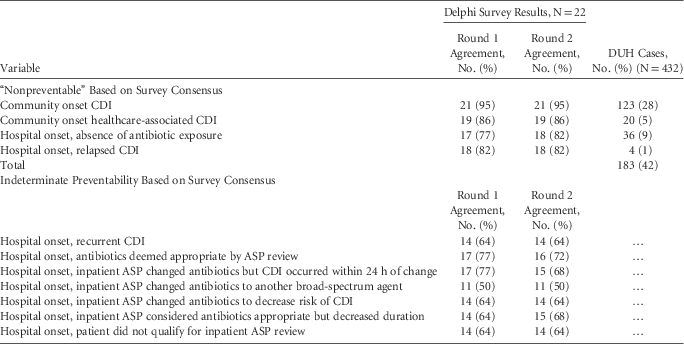
Survey respondents agreed that 4 CDI scenarios were unlikely to be prevented by inpatient ASP efforts: CO CDI, CO-HCFA CDI, HO CDI in the absence of preceding antibiotics, and relapse of HO CDI (Table 1).
Results of a Delphi Survey of Preventability of Clostridium difficile Infection by an Inpatient Antimicrobial Stewardship Program and the Proportion of “Nonpreventable” Cases at Duke University Hospital, 2014

NOTE. DUH, Duke University Hospital; ASP, antimicrobial stewardship program, CDI, Clostridium difficile infection.
A total of 432 CDI cases were detected during the study period; 183 cases (42%) belonged to 1 of the 4 previously mentioned scenarios deemed to be unlikely to be prevented by inpatient ASP according to the Delphi survey results (Table 1). Of these 183 cases, 123 cases (67%) were CO CDI, 36 cases (20%) occurred in HO-CDI patients without recorded antibiotic exposure within 90 days, 20 cases (11%) were CO HCFA, and 4 (2%) were relapsed HO CDI. In addition, in 19 HO-CDI cases, patients received a single dose of antibiotics, either for surgical prophylaxis or empirical therapy, prior to developing CDI.
We found that nearly half of all CDI cases at our hospital were unlikely to be prevented by activities of an inpatient ASP. While numerous studies show the benefits of ASPs, our study is the first to describe the proportion of CDI cases unlikely to be prevented by inpatient ASPs. In our cohort study, most “nonpreventable” cases were CO CDI cases (67%). CO CDI cases made up 28% of all CDIs detected during the study period. Because other studies found that approximately 50% of hospitalized CDI cases are CO,Reference Durkin, Baker and Dicks 6 an even greater proportion of CDI cases at other hospitals may not be prevented by activities of their local inpatient ASPs.
While inpatient ASPs may not be able to affect the development of CO CDI, interventions implemented by outpatient ASPs could have a big impact because most antibiotics are prescribed in the outpatient setting, where overuse is common. Moreover, 2 prior systematic reviews have concluded that outpatient ASPs can reduce inappropriate use and/or selection of antibiotics.Reference Ranji, Steinman, Shojania and Gonzales 7 , Reference Ranji, Steinman and Shojania 8 Indeed, the Centers for Medicare and Medicaid Services (CMS) has commenced discussions on policies relating to ASP interventions in ambulatory clinics and in long-term-care facilities outside acute-care hospitals.Reference Tartof, Rieg, Wei, Tseng, Jacobsen and Yu 9 Our data support the need for more comprehensive outpatient ASP interventions.
This study had several limitations. First, the study was performed at a single academic center and the results may not be applicable to all hospitals. Second, the 11 clinical scenarios used in the survey were not representative of all possible CDI cases. Finally, there was a low response rate in round 2 of the survey.
In conclusion, a subset of hospitalized CDI cases, including community-onset cases and cases arising in patients without preceding inpatient antimicrobial exposure, are unlikely to be prevented by an inpatient ASP. These findings suggest that key stakeholders must (1) expand outpatient antimicrobial stewardship programs to address unnecessary antimicrobial use outside of hospital settings and (2) devise new strategies to prevent CDIs that occur in the absence of antimicrobial exposure or following appropriate antimicrobial exposure. Such strategies include selective use of vaccines and new technologies to assess and manipulate the microbiome in high-risk patients.
ACKNOWLEDGMENTS
Financial support: No financial support was provided relevant to this article.
Potential conflicts of interest: All authors report no conflicts of interest relevant to this article.