In Rev 18.12–13, John lists the merchandise which is consumed by Babylon, concluding with the words, σωμάτων καὶ ψυχὰς ἀνθρώπων. Many commentators interpret this phrase as a critique of the slave trade.Footnote 1 As Richard Bauckham explains, ‘[John] is pointing out that slaves are not mere animal carcasses to be bought and sold as property but are human beings’.Footnote 2 Pierre Prigent adds: ‘Our author obviously sees in this [i.e. the slave trade] the height of the capital's sinfulness.’Footnote 3 Other scholars, however, do not find this interpretation so obvious.Footnote 4 George Ladd argues that John's meaning is obscure and warns against reading too much into his words.Footnote 5 Louis Brighton likewise cautions: ‘There might not be any purpose for adding another word or designation that has a similar meaning.’Footnote 6
Such scepticism is warranted, given the limited data and the sobering fact that biblical scholars are frequently accused of whitewashing the NT's acceptance of slavery.Footnote 7 Despite its popularity, the claim that σωμάτων καὶ ψυχὰς ἀνθρώπων constitutes a critique of the slave trade has not been sufficiently established. This article thus seeks to fill a lacuna in biblical scholarship by providing a robust defence of this disputed claim. The article is composed of three sections. In the first, I briefly address my own biases in this project. In the second, I examine the use of the terms σώματα and ψυχαὶ ἀνθρώπων in the extant Greek literature and conclude that the peculiar conjunction of these terms in Rev 18.13 is best understood as a critique of the slave trade. In the third, I argue that the literary context of Rev 18.13 supports such an interpretation. This article thus offers an important contribution to the ongoing debate over the early Christian view of slavery.Footnote 8
1. A Preliminary Note on Bias
Slavery is one of the most controversial topics in the study of the ancient world.Footnote 9 In this emotionally charged debate, scholars are often accused of allowing their biases to distort their interpretation of the data. For example, Keith Bradley claims: ‘The historiography of ancient slavery has been traditionally apologetic’, and among those scholars who still seek to describe ancient slavery as relatively benign, Bradley concludes: ‘Apologetic influences are still at work.’Footnote 10 Conversely, Niall McKeown asserts that Bradley's ‘moral beliefs, particularly his hatred of cruelty and oppression’, have led him to favour reconstructions that emphasise the severity of ancient slavery.Footnote 11 Such critiques are often even more pointed in the realm of NT studies. Hector Avalos, for example, comes quite close to dismissing all of biblical scholarship as an exercise in apologetics.Footnote 12 Conversely, in a scathing review, J. Albert Harrill observes that Avalos’ work ‘reads more like a manifesto of a political ideology than a serious study of historical interpretation’.Footnote 13
Given this context, a few words about my own biases are in order. I acknowledge that I am a confessing Christian and committed humanitarian who would thus be pleased to find a critique of slavery in the pages of the NT. Furthermore, I acknowledge that the brief phrase under consideration is rather vague and open to multiple interpretations. Nevertheless, in this article, I will attempt to demonstrate that the available evidence, limited though it may be, favours one interpretation. I recognise that every scholar's perspective inevitably impacts his or her interpretation of the evidence. In this essay, I simply seek to lay out the evidence as clearly as possible and explain the reasoning behind my assessment of that evidence.
2. The Language of Revelation 18.13
2.1 The Number of Items
The interpretation of the phrase σωμάτων καὶ ψυχὰς ἀνθρώπων involves two key questions. First, do σωμάτων and ψυχὰς ἀνθρώπων refer to the same item on the list, or do these terms refer to two separate items? As early as 1919, Isbon Beckwith declared: ‘Neither here nor elsewhere is there anything to indicate a difference between the two terms, as denoting different classes of slaves. Numerous suggestions of a distinction have been made, but they are arbitrary, without foundation in our passage or in the use of the terms elsewhere.’Footnote 14 Nevertheless, commentators still often suggest that, while σωμάτων refers to common slaves, ψυχὰς ἀνθρώπων may refer to a particular class of slaves, such as gladiators, captives of war or victims of piracy.Footnote 15 Immediately after noting that John's language has provoked ‘die wundersamsten Spekulationen’, Georg Glonner continues that trend by offering yet another suggestion: σωμάτων refers to slaves used as labourers while ψυχὰς ἀνθρώπων refers to slaves used as teachers.Footnote 16
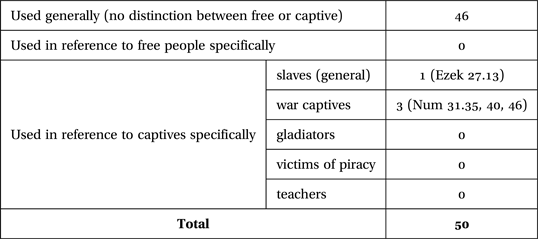
As demonstrated in Table 1, all of these suggestions are indeed ‘arbitrary’ and ‘without foundation’. The Greek phrase ‘souls of persons’ occurs a total of fifty times in the Loeb Classical Library (LCL), LXX and Greek pseudepigrapha.Footnote 17 In only four of these occurrences is the phrase used in reference to captives of any kind, and three of these four are from the same passage. Every other occurrence of the term is used in reference to people in general, with no distinction made in the context between captive and free. Thus the evidence of the extant Greek literature does not support the notion that ψυχὰς ἀνθρώπων functions as an idiom for a particular class of slave.
‘Souls of Persons’ in LCL, LXX and Greek Pseudepigrapha.

Furthermore, the phrase ψυχαὶ ἀνθρώπων in Rev 18.13 is likely taken from Ezek 27.13. As commentators often note, the lament over Babylon in Revelation 18 draws upon the lament over Tyre in Ezek 26.1–28.19.Footnote 18 Both passages concern the destruction of a wealthy city, both describe the city as a giant in maritime trade, both list the commodities which comprise that trade, and both emphasise the mourning of the city's trading partners. Furthermore, both passages share similar language at multiple points, and fifteen of the twenty-nine commodities listed in Revelation occur in Ezekiel.Footnote 19 Thus many commentators conclude that John took the phrase ψυχαὶ ἀνθρώπων from Ezek 27.13.Footnote 20 This is significant for our investigation because, as noted in Table 1, the phrase ψυχαὶ ἀνθρώπων (נפש אדם) is used in Ezek 27.13 as a reference to slaves in general, not as a reference to a particular class of slaves.
Finally, Bauckham's research concerning numbers indicates that the terms σωμάτων and ψυχὰς ἀνθρώπων do not refer to two different items of merchandise. Bauckham argues that John has meticulously incorporated certain numbers into the structure of his work, including seven and four. Furthermore, he argues that in Revelation, the number seven represents completeness, while the number four represents the world. Thus he concludes: ‘It is certainly no accident that the list of cargoes which Babylon (Rome) imports from “the merchants of the earth” (18.11–13) comprises twenty-eight (4 × 7) items. They are listed as representative of all the products of the whole world.’Footnote 21 However, if σωμάτων and ψυχὰς ἀνθρώπων are considered two separate items, then the number is twenty-nine, not twenty-eight. Thus, while Bauckham does not make the argument himself, his research on numbers indicates that σωμάτων καὶ ψυχὰς ἀνθρώπων is a reference to only one item.
2.2 The Purpose of the Redundancy
Having thus concluded that σωμάτων and ψυχὰς ἀνθρώπων do not refer to two different classes of slaves, we turn now to consider the second key question: why did John choose to refer to the same item with these two different terms? Concerning σώματα, Robert Gundry argues: ‘The term always points … toward thingness in one or another capacity (as slaves, prisoners, troops, corpses, entries on a census list, and so on) or toward other specifically physical emphases (bodily presence, sustenance, procreation, and the like).’Footnote 22 However, Jennifer Glancy reasons: ‘If the metaphor were no longer live, those who used the expression ta sōmata simply intended to say “slaves”’. Thus she concludes: ‘We cannot know whether such word choices distanced ancient speakers and writers from the humanity of their property.’Footnote 23 In his comments on Rev 18.13, David Aune likewise concludes: ‘The contention that the use of the term σώματα … for slaves indicates the contemptuous degradation of a human being to the level of a thing is doubtful.’Footnote 24
However, while Aune is probably correct here, his observation is largely irrelevant to the question at hand. We are not seeking to determine the meaning of σώματα in isolation; we are seeking to determine how the idiom would have been heard when coupled with ψυχαὶ ἀνθρώπων. As Craig Koester observes, ‘[w]hen taken alone, the use of the term “bodies” to mean slaves could be regarded as simply conventional’.Footnote 25 The term, however, does not appear alone.
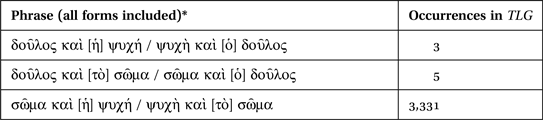
As shown in Table 2, a search of the Thesaurus Linguae Graecae (TLG) database reveals that the words σῶμα and ψυχή are frequently linked together in Greek literature. It is therefore difficult to believe that the conjunction of these two terms in Rev 18.13 is mere accident, as if John might just as well have said δούλων καὶ ψυχὰς ἀνθρώπων or σωμάτων καὶ δούλους. Furthermore, if John had said δούλων καὶ ψυχὰς ἀνθρώπων or σωμάτων καὶ δούλους, it would be quite difficult to explain the redundancy. However, the fact that John uses two terms which are paired so frequently in Greek literature provides a ready explanation for the redundancy: John intended the terms to be understood together. Finally, given the frequency with which these terms appear together, it is difficult to believe that a first-century auditor would have failed to notice the connection between them.
The Pairing of Body, Soul and Slave in Extant Greek Literature.

* The search identified all occurrences of the phrase, noun–καί–noun, regardless of case or number, and all occurrences of the phrase, noun–καί–article–noun, in which both nouns agree in case and number. For the latter phrase, the search did not identify constructions in which the case or number of the two nouns differed.
The English word ‘bow’ can refer to both a weapon and a decorative ribbon. However, no English speaker who hears the phrase ‘bow and arrow’ would understand ‘bow’ as a reference to a decorative ribbon. Likewise, while σώματα could mean either ‘bodies’ or ‘slaves’, a Greek speaker who heard the phrase σωμάτων καὶ ψυχάς would have naturally understood σῶμα as the material ‘body’ in contrast to the immaterial ψυχή.Footnote 26 Thus, even if, as Glancy suggests, the metaphor for slaves as σώματα ‘were no longer live’, John brings it back to life; by coupling the common idiom for slaves with ψυχὰς ἀνθρώπων, John forces his audience to hear σωμάτων as a reference to physical bodies. In so doing, John reminds his audience that slaves are more than mere ‘bodies’; they are also ‘souls of persons’.
Consider the only passage in the LCL where the notion of selling the ‘souls of persons’ is entertained. In the biography by Philostratus, Apollonius recounts his ‘noblest’ deed as the captain of a merchant vessel. While docked in port, Apollonius was approached by Phoenician pirates who offered him 10,000 drachmas if he would enable them to take the ship. They promised they would spare his life and the life of any of his friends. Apollonius agreed and even made the pirates swear in a temple to keep their end of the bargain. That night, however, he secretly set sail and escaped to sea. At this point, Apollonius’ interlocutor objects: ‘Why, Apollonius, do you consider those to be acts of justice?’ Apollonius replies: ‘Yes, and of humanity too, for I think it a combination of many virtues not to sell human souls [μὴ ἀποδόσθαι ψυχὰς ἀνθρώπων], not to barter away merchants’ property and to show yourself above money when you are a sailor’ (Philostratus, Vit. Apoll. 3.23.1–24.3; trans. Jones, LCL). These words, which have been overlooked in the discussion of Rev 18.13, demonstrate that even in ancient times an author could expect his audience to recognise the act of selling ψυχαὶ ἀνθρώπων as an obvious evil.
2.3 The Change in Case
Before concluding our examination of σωμάτων καὶ ψυχὰς ἀνθρώπων, we must consider the significance of the change from the genitive case (σωμάτων) to the accusative case (ψυχὰς).Footnote 27 Some have suggested that this switch signals that σώματα and ψυχαὶ ἀνθρώπων are to be considered as two separate items. Laurențiu Florentin Moț argues:
The accusative is the direct object, whereas the genitive stands for content here, and the interpreter must see the difference. Unlike bodies or slaves who are caught up in the business of slavery against their will, the souls of men were not bought and sold in bulk, but individually, probably inferring that they have previously given their own accord.Footnote 28
Thus Moț appears to believe that σώματα is a reference to ordinary slaves, and ψυχαὶ ἀνθρώπων is a reference to individuals who have chosen to sell themselves into slavery. Another suggestion is offered by Robert Mounce, who observes that the switch in case may serve to link σώματα with the two preceding nouns: horses and chariots. Thus the distinction would be as follows: ‘Bodies are slaves used for carrying goods and the souls of men are slaves considered as merchandise.’Footnote 29
Neither of these suggestions is convincing. Consider first that the same piece of evidence (i.e. the switch from the genitive to the accusative) which leads Moț to conclude that σώματα refers to ordinary slaves while ψυχαὶ ἀνθρώπων refers to a specific type of slave leads Mounce to precisely the opposite conclusion (i.e. ψυχαὶ ἀνθρώπων refers to ordinary slaves while σώματα refers to a specific type of slave). This discrepancy highlights the arbitrary nature of both proposals. Furthermore, concerning Moț’s proposal, the distinction he draws between ‘bodies’ as the content of the cargo and ‘souls’ as the object of purchase makes little sense when applied to the previous switch from the accusative πρόβατα to the genitive ἵππων. (If any such distinction can be maintained, surely sheep are more likely than horses to be ‘bought and sold in bulk’.) Concerning Mounce's proposal, the distinction he draws is unclear. Are not all of the items listed in 18.12–13 ‘considered as merchandise’? Furthermore, why would John wish to single out slaves who carry goods? The fact that Mounce himself ultimately does not adopt this reading underscores the weakness of the proposal.
Revelation is remarkable for the number of solecisms it contains. Scholars have identified scores of seemingly erroneous grammatical constructions in Revelation which resist any consistent explanation.Footnote 30 Thus one must be careful not to attribute too much significance to the change of case in 18.12–13. John may not have been intending to communicate anything in particular through this grammatical irregularity, which may be mere ‘stylistic variation’.Footnote 31 In conclusion, while one must of course remain open to the possibility that future research on the solecisms in Revelation will shed additional light on the meaning of the phrase σωμάτων καὶ ψυχὰς ἀνθρώπων, no suggestions have yet been offered which undermine the arguments advanced in this paper.
3. The Context of Revelation 18.13
3.1 The Contrast with New Jerusalem
Having thus concluded that the phrase σωμάτων καὶ ψυχὰς ἀνθρώπων is best explained as a critique of the dehumanisation inherent in the slave trade, we turn now to consider the wider context in which this phrase appears. As commentators often note, Babylon and the New Jerusalem ‘correspond to and counterbalance one another as twin poles of a carefully crafted antithesis’.Footnote 32 In addition to numerous structural parallels, Gordon Campbell identifies twenty-three ‘antithetical correlations whose cumulative force means that, in every respect, Jerusalem-the-bride is made to supplant Babylon-the-whore’.Footnote 33
Despite his thorough treatment, however, there is one contrast between Babylon and the New Jerusalem which Campbell does not mention: the treatment of slaves.Footnote 34 In Babylon, slaves are sold alongside sheep and horses (Rev 18.13); in the New Jerusalem, slaves reign as kings and friends of God: ‘His slaves shall worship him; they shall see his face, and his name shall be on their foreheads … And they shall reign for ever and ever’ (22.3–5).Footnote 35 Of course, the contrast may be mere coincidence. However, given the care that John has evidently taken in constructing the antithesis between Babylon and the New Jerusalem, this seems rather unlikely. Thus the context of Rev 18.13 supports our conclusion that the phrase σωμάτων καὶ ψυχὰς ἀνθρώπων is intended to highlight the dehumanisation inherent in Babylon's slave trade.
3.2 The Critique of Luxury
Throughout Revelation 17–18, John focuses relentlessly on the extravagant luxury and extensive commerce of the city.Footnote 36 This constitutes a striking parallel with what is perhaps the strongest critique of slavery in extant first-century literature. In the following passage, Philo describes the Essenes, a sect of Jews who lived apart from society and held their possessions communally:
They do not hoard gold and silver or acquire great slices of land because they desire the revenues therefrom, but provide what is needed for the necessary requirements of life … They judge frugality with contentment to be, as indeed it is, an abundance of wealth. As for darts, javelins, daggers, or the helmet, breastplate or shield, you could not find a single manufacturer of them, nor, in general, any person making weapons or engines or plying any industry concerned with war, nor, indeed, any of the peaceful kind, which easily lapse into vice, for they have not the vaguest idea of commerce either wholesale or retail or marine, but pack the inducements to covetousness off in disgrace. Not a single slave is to be found among them, but all are free, exchanging services with each other, and they denounce the owners of slaves, not merely for their injustice in outraging the law of equality, but also for their impiety in annulling the statute of Nature, who mother-like has born and reared all men alike, and created them genuine brothers, not in mere name, but in very reality, though this kinship has been put to confusion by the triumph of malignant covetousness, which has wrought estrangement instead of affinity and enmity instead of friendship. (Good Person 76–9; trans. Colson, LCL)Footnote 37
Thus Philo's critique of slavery, like the critique proposed in Rev 18.13, appears in the context of a negative account of luxury and commerce.
Furthermore, Philo is not unique in linking slavery with luxury; on the contrary, he is drawing upon common motifs in Greco-Roman utopianism.Footnote 38 Even if they did not believe the institution should be abolished, many ancients recognised that slavery violated a fundamental equality which existed among all human beings. Thus, the absence of slavery in remote cultures or distant times was considered ideal. In describing the Indians, Diodorus Siculus highlights the following custom as the one ‘most worthy of admiration’: ‘[Their] law has ordained that under no circumstances shall anyone among them be a slave, but that all shall be free and respect the principle of equality in all persons’ (Lib. Hist. 2.39.5; trans. Oldfather, LCL). Furthermore, the mythic ‘Golden Age’ which was celebrated every year during the popular Saturnalia festival was understood as a time without slavery. As Plutarch explains, ‘there was neither slave nor master, but all were regarded as kinsmen and equals’ (Comp. Lyc. Num. 1.5; trans. Perrin, LCL). Thus slaves were granted certain liberties such as dining with their masters in ‘a position of equality’ (Justinus, Epitome 43.1.3–4 (Yardley)), for during the Saturnalia, ‘everyone, slave and free man, is held as good as his neighbour’ (Lucian, Sat. 7; trans. Kilburn, LCL).Footnote 39
In addition to recognising the fundamental equality of master and slave, many ancients identified covetousness as the root cause of inequality and injustice. Seneca, for example, describes a distant past when people lived in simplicity and held all possessions in common. Everything ‘was divided among unquarrelling friends. Not yet had the stronger begun to lay hands upon the weaker; … each cared as much for his neighbour as for himself’ (Ep. 90.40; trans. Gummere, LCL). The situation changed drastically, however, when ‘avarice and luxury’ entered the world (90.36; see also 90.38). People quickly ‘turned to plunder’ (90.36), and their hands were soon stained ‘by human blood’ (90.41).Footnote 40
In conclusion, the connection attested in Philo between luxury and slavery does not of course prove that Revelation 18 must contain a critique of the slave trade. Nevertheless, this connection, which accords with common motifs in Greco-Roman utopianism, does demonstrate that a critique of slavery would fit nicely in Rev 18.13, where the luxury and extravagance of Rome stand in contrast to God's utopia.Footnote 41
4. Conclusion
In this article, I examined the popular assertion that Rev 18.13 entails a critique of the slave trade. I first analysed the phrase σωμάτων καὶ ψυχὰς ἀνθρώπων. Based on the use of ψυχαὶ ἀνθρώπων in the extant Greek literature, the echo of Ezek 27.13 and Bauckham's research on numbers in Revelation, I concluded that ψυχὰς ἀνθρώπων in 18.13 is not a reference to a particular class of slaves. Furthermore, based on the extremely common pairing of σῶμα and ψυχή in extant Greek literature, I concluded that the act of coupling ψυχὰς ἀνθρώπων with σωμάτων constrains the latter in such a way that this common idiom for slaves must be understood as a reference to mere physical objects. Furthermore, I noted that the only text in the LCL which references selling the ‘souls of persons’ presents the act as an obvious moral evil (Philostratus, Vit. Apoll. 3.23.1–24.3). I thus concluded that the redundant statement σωμάτων καὶ ψυχὰς ἀνθρώπων is best explained as a critique of the dehumanisation inherent in the slave trade.
I next considered the literary context of Rev 18.13. I first argued that the stark contrast between the treatment of slaves in Babylon (18.13) and the treatment of slaves in the New Jerusalem (22.3–5) is best understood as part of the ‘carefully crafted antithesis’ which John draws between these two cities. Secondly, I noted that what is perhaps the strongest critique of slavery in extant first-century literature occurs in the context of a critique of luxury and commerce (Philo, Good Person 76–9). Furthermore, I demonstrated that this connection between slavery and luxury is not an anomaly, but instead reflects common motifs in Greco-Roman utopianism. I thus concluded that the literary context of Rev 18.13 supports the interpretation of σωμάτων καὶ ψυχὰς ἀνθρώπων as a critique of the slave trade.
While slave traders were often accused of greed, dishonesty and illegal kidnapping, ‘the buying and selling of human merchandise’ was in and of itself ‘an ordinary, prosaic aspect of Roman life that among the free caused little consternation’.Footnote 42 My analysis, however, indicates that at least some early Christians were troubled by this traffic in souls. While slave ownership was evidently permitted in the church (Col 3.22–4.1; Eph 6.5–9; 1 Tim 6.1–2; Ign. Pol. 4.3; Barn. 19.7; Did. 4.10–11), Rev 18.13 calls into question the notion that the NT evidences no ‘moral unease’ with chattel slavery.Footnote 43