It has been a few decades since researchers in the field of psychology have become aware of the entwined nature of motivation and cognition (Braver et al., Reference Braver, Krug, Chiew, Kool, Westbrook, Clément and Somerville2014). In the scholarly research literature in the field of second language acquisition (SLA), however, these two dimensions are often treated as independent phenomena (Crookes & Schmidt, Reference Crookes and Schmidt1991; Laufer & Hulstijn, Reference Laufer and Hulstijn2001). This has been mainly due to the lack of sufficient attention paid by both cognitive and motivation researchers to the interconnectedness of these two domains (Dörnyei & Ryan, Reference Dörnyei and Ryan2015). The gap between the cognitive and motivational aspects of second language (L2) learning appears to exist due to the way motivation has generally been viewed in the field. SLA researchers have predominantly approached motivation as a quantity of energy that is produced to initiate, continue, and complete the learning pursuit. This energy has been shown to be produced by certain L2-specific motives such as the instrumental and integrative orientations (Gardner, Reference Gardner1985), intrinsic and extrinsic motivations (Noels, Reference Noels, Dörnyei and Schmidt2001), and the ideal and ought-to L2 selves (Papi, Reference Papi2010; Papi & Teimouri, Reference Papi and Teimouri2012, Reference Papi and Teimouri2014; Taguchi, Magid, & Papi, Reference Taguchi, Magid, Papi, Dörnyei and Ushioda2009), and result in different behavioral and achievement measures (e.g., Dörnyei & Ushioda, Reference Dörnyei and Ushioda2009; Gardner, Reference Gardner1985). Thus, such motives are generally assumed to produce different levels of energy or what Gardner (Reference Gardner1985) called the “pulling power” required for the language learning pursuit.
The quantity perspective toward motivation is best apparent in the studies on task motivation. These studies have limited the scope of motivational influences on task performance to the quantity of motivation and have ignored any qualitative differences in what motivates learners to engage in and complete a task, and how the learners accomplish that. In the first study on L2 task motivation, conducted in the English as a foreign language (EFL) context of Finland, Julkunen (1989) used motivation as an outcome variable. She compared high-achieving students and low-achieving students in terms of the effects of different types of tasks on their level of motivation. The results showed that in individualistic and competitive tasks, high achievers’ motivation increased, whereas in cooperative situations both high and low achievers showed increases in their motivation. It was also found that an open task was more motivating than a closed task.
In another study, Dörnyei and Kormos (Reference Dörnyei and Kormos2000) investigated the relationship between learners’ motivational variables and their task performance in Hungary. They asked 46 English learners from eight classes to do an oral argumentative task and measured their immediate and general motivational characteristics. The results of their study showed that for high-task-attitude students, willingness to communicate (WTC), linguistic self-confidence, and need for achievement were significantly correlated with the number of words they produced during the task, whereas for low-task-attitude participants, attitudes toward the English course were correlated with the number of produced words. In a follow-up analysis of the same dataset, Dörnyei (Reference Dörnyei and Robinson2002) found that the performance of students with low task-attitudes improved when each of them was paired with a motivated peer; however, students with high task-attitudes did not benefit as much from such pairing. In a third analysis of the same dataset, Kormos and Dörnyei (Reference Kormos and Dörnyei2004) found that motivation was related to the quantity of language performance but not much to the quality of linguistic production (complexity, accuracy, and fluency).
The small number of studies that have been conducted on the relationship between motivation and task performance have either focused on the effects of tasks on the amount of motivation or the effects of the amount of motivation on task performance. This quantity approach is most apparent in Kormos and Dörnyei’s (2004) conclusion that the lack of association between the motivational and qualitative measures of task performance “is in fact consistent with theories of motivation, which see motivation as the force that determines the magnitude of behavior rather than the quality of the behavioral outcome” (ibid., p. 10).
This motivation-as-energy view has been of great value and has formed applied linguists’ current understanding of L2 motivation. At the same time, however, it has obscured the true nature of motivation as a phenomenon that is driven by fundamentally different human needs and can result in qualitative differences in individuals’ choices and behavior (Higgins, Reference Higgins2012). The central idea behind the motivation-as-quality perspective, which has been proposed by some prominent motivation researchers in the field of social and educational psychology (e.g., Dweck, Mangels, & Good, Reference Dweck, Mangels, Good, Dai and Sternberg2004; Elliot, Reference Elliot1999; Higgins, Reference Higgins1997, Reference Higgins2012), is that human beings’ chronic concerns with different survival needs, such as the need for security and nurturance, render them motivationally different from each other. These motivational differences not only direct individuals’ goal preferences but also influence the processes and strategic means that they employ in their goal pursuits. Considering language learners’ chronic or traitlike motivational preferences and how those preferences influence the ways learners approach the language learning process have been discussed to paint a better picture of the role of motivation in L2 learning (e.g., Dörnyei & Ryan, Reference Dörnyei and Ryan2015; Papi & Teimouri, Reference Papi and Teimouri2014; Teimouri, Reference Teimouri2016).
In the present study, Higgins’s regulatory focus theory (1997) and regulatory fit theory (2000), which represent a motivation-as-quality perspective in the field of social psychology, are employed to examine how the interaction between learners’ chronic regulatory focus and the manner in which a language learning task is presented to them influences their task-based vocabulary learning during an integrated reading/writing task.
REGULATORY FOCUS THEORY
According to regulatory focus theory (Higgins, Reference Higgins1997), there are two distinct but coexisting motivational systems that serve different survival needs and regulate human goal-directed behavior: the promotion system and the prevention system. The promotion system is concerned with the basic survival need for nurturance as well as the higher-level needs for joy and happiness. Individuals with a promotion focus are concerned with accomplishments, advancement, and growth, and are sensitive to the presence and absence of positive outcomes. However, the prevention system involves the survival need for security as well as the higher-level needs for safety and calmness. Individuals with a prevention focus are concerned with fulfilling their duties, responsibilities, and obligations, and are sensitive to the presence and absence of negative outcomes. According to Higgins (Reference Higgins1997), this is not an either/or dichotomy, and individuals can be strong or weak on either or both orientations.
REGULATORY FIT THEORY
“Regulatory fit theory predicts that individuals will be more strongly engaged in an activity and value it more when they have a promotion orientation toward the activity and engage it in an eager manner, or have a prevention orientation toward the activity and engage it in a vigilant manner” (italics added for emphasis; Higgins, Cesario, Hagiwara, Spiegel, & Pittman, Reference Higgins, Cesario, Hagiwara, Spiegel and Pittman2010, p. 560). An eager strategic tendency insures approaching matches to their desired end states by taking advantage of every potential opportunity and, in signal-detection terms, avoiding errors of omission (missing an opportunity); whereas a vigilant strategy insures avoiding mismatches to their desired end states by making correct rejections and avoiding errors of commission (making a wrong choice). Individuals experiencing regulatory fit “feel right” about what they are doing, which contributes to their motivation to pursue their goals (Higgins, Reference Higgins2005). Regulatory fit enhances motivation by increasing the value of the goal, which is promoted through an individual’s engagement in goal-directed activity (e.g., Higgins, Reference Higgins2000, Reference Higgins2005).
Numerous studies have provided strong empirical evidence for the prediction that when individuals pursue a goal in a manner that fits their chronic or temporarily induced regulatory focus, the fit enhances (a) their perceived value of the goal (e.g., Higgins, Idson, Freitas, Spiegel, & Molden, Reference Higgins, Idson, Freitas, Spiegel and Molden2003); (b) their engagement, motivational strength, and persistence in the goal pursuit (Avnet, Laufer, & Higgins, Reference Avnet, Laufer and Higgins2013; Cesario, Higgins, & Scholer, Reference Cesario, Higgins and Scholer2008; Crowe & Higgins, Reference Crowe and Higgins1997; Higgins & Scholer, Reference Higgins and Scholer2009; Spiegel, Grant-Pillow, & Higgins, Reference Spiegel, Grant-Pillow and Higgins2004); (c) their enjoyment of and interest in the goal pursuit (e.g., Freitas & Higgins, Reference Freitas and Higgins2002; Higgins et al., Reference Higgins, Cesario, Hagiwara, Spiegel and Pittman2010); and finally (d) their learning and performance (e.g., Markman, Baldwin, & Maddox, Reference Markman, Baldwin and Maddox2005; Worthy, Maddox, & Markman, Reference Worthy, Maddox and Markman2007).
Despite the widespread application of the regulatory focus and fit theories in social psychology, only a handful of research studies have examined regulatory fit impacts on learning processes and outcomes. Following the research tradition in regulatory fit studies, researchers typically create fit between the chronic or induced regulatory focus of the participants and the regulatory focus of the task to see how the match or mismatch between the two influences learning experiences and outcomes. Regulatory fit promotes learning through creating positive affect, which, in turn, results in dopamine release in the frontal areas of the brain (e.g., Isen & Labroo, 2003, as cited in Markman, Maddox, & Baldwin, Reference Markman, Maddox and Baldwin2007), thereby promoting learners’ cognitive flexibility, which could be required to reach optimal task performance (Markman et al., Reference Markman, Maddox and Baldwin2007). Cognitive flexibility, which Maddox and Markman (Reference Maddox and Markman2010) defined as “active, effortful exploration of a set of response strategies” (p. 106), has been shown to improve learning in the areas that require conscious employment of working memory and executive control, including classification learning, skill acquisition, and problem-solving tasks.
Regulatory fit predictions have been tested in a series of studies focusing on classification learning. In the first of these studies, Markman, Baldwin, and Maddox (Reference Markman, Baldwin and Maddox2005) asked their participants to write how their sense of hopes and aspirations has changed over time, to induce a temporary promotion focus, or to write how their sense of duties and obligations has changed over time, to induce a temporary prevention focus. Participants then completed a classification task in which they had to categorize 150 dots based on their location of appearance on a computer screen. In the gain condition, they were told that they had to gain 80% of the points to win a ticket to a $50 raffle. In the loss condition, they were told that if their performance fell below the criterion (80%), they would lose the ticket they were shown earlier. The results of the study confirmed the regulatory fit predictions. In the gain matrix, participants in the promotion focus significantly outperformed those in the prevention focus. In the loss matrix, by contrast, prevention-focused participants showed significantly better performance than those in a promotion focus. The results of that study were corroborated in similar studies by Maddox, Baldwin, and Markman (Reference Maddox, Baldwin and Markman2006), Grimm, Markman, Maddox, and Baldwin (Reference Grimm, Markman, Maddox and Baldwin2008), and Worthy, Maddox, and Markman (Reference Worthy, Maddox and Markman2007).
Chen, Kee, Hung, and Lin (Reference Chen, Kee, Hung and Lin2016) examined regulatory fit effects in relation to motor skill acquisition. The researchers asked their participants to throw 50 tennis balls into a bucket. In the gain condition, the participants gained NT$2 by throwing each ball in the bucket; in the loss condition, every time they missed the target they would lose NT$2 off an initial promised NT$100. The results of their study showed that the participants who were chronically promotion-focused performed better in the gain condition. Those who were prevention-focused, however, performed better in the loss condition.
Van Dijk and Kluger (Reference Van Dijk and Kluger2011) investigated the interaction between positive and negative feedback on tasks with a promotion focus versus tasks with a prevention focus. Promotion tasks require creativity, risk taking, and eagerness (e.g., generating ideas, creative problem solving, and challenging decision making); whereas prevention tasks require attention to details, vigilance, and adherence to rules (e.g., detecting errors, work scheduling, and maintaining safety and quality control). In Study 1, they found that giving positive feedback to individuals who worked on promotion tasks increased their motivation and performance significantly more than did giving negative feedback. Conversely, negative feedback on prevention tasks resulted in significantly higher increases in participants’ motivation and performance than positive feedback did.
In sum, the studies that have applied regulatory focus and fit theories to the area of learning and performance have resoundingly confirmed the predictions of regulatory fit theory. These studies provide strong evidence highlighting the role of the motivational systems that direct learners’ preferences for different learning goals, and how the learners pursue those goals. In the present study, the regulatory focus and fit theories are employed in relation to L2 vocabulary learning, an area that has been shown to be highly influenced by, but rarely studied in relation to, learner motivation (Laufer & Hulstijn, Reference Laufer and Hulstijn2001). Regulatory fit is expected to influence vocabulary learning because learning the meanings of new vocabulary items falls under the explicit type of learning (Ellis, Reference Ellis1994, Reference Ellis, McCarthy and Schmidt1997), and is thus expected to be influenced by the increased levels of cognitive flexibility, which is induced by regulatory fit.
MOTIVATION AND INCIDENTAL L2 VOCABULARY LEARNING
Students’ motivation is believed to be a key factor in their success in vocabulary learning simply because “even the best materials are little good if students do not engage with them” (Schmitt, Reference Schmitt2008, p. 338). The significance of motivation in vocabulary learning can also be seen in two important models of L2 vocabulary learning. The first one is the motivational-cognitive construct of task-induced involvement. Proposed by Laufer and Hulstijn (Reference Laufer and Hulstijn2001), this construct suggests that for a task to be effective in facilitating vocabulary learning, it must induce learner’s involvement through the elements of need, search, and evaluation, with the first one being a motivational construct. Tseng and Schmitt’s (2008) model of motivated vocabulary learning is the second framework that highlights the role of motivation in vocabulary learning. The model involves motivation in different stages of vocabulary learning and views it as “an integral part of the whole system that drives the vocabulary learning cycle along” (p. 383).
Vocabulary learning is considered intentional when it involves the explicit memorization of vocabulary items for an upcoming test, and it is incidental when the learning of the new vocabulary items happens during meaning-focused activities without learners being told in advance that they will be tested afterward (Hulstijn, Reference Hulstijn, Doughty and Long2003). Given the more self-driven nature of incidental vocabulary learning, this type of learning is arguably subject to notable individual differences (Pulido, Reference Pulido2007; Pulido & Hambrick, Reference Pulido and Hambrick2008), which could be attributed to different learner factors including motivation (see Fraser, Reference Fraser1999; Nassaji, Reference Nassaji2003; Paribakht & Wesche, Reference Paribakht and Wesche1999). Despite the importance of motivation in incidental vocabulary learning, the number of studies that have examined the relationship between the two does not even reach a handful. These studies can be classified into two groups. One group uses the construct of task-induced involvement to investigate how task-induced engagement could result in better learning outcomes (e.g., Kim, Reference Kim2011; Zou, Reference Zou2017); and the other group examines how learners’ motivation could result in vocabulary learning and better task performance. Given the focus of the current study, the second group, including only four major publications, are reviewed here.
In the first experimental study on the effects of motivation on intentional L2 vocabulary learning, Gardner and MacIntyre (Reference Gardner and MacIntyre1991) had a group of 92 college students study a series of 28 English/French word pairs. They divided the participants into an experimental and a control group. The participants in the experimental group were told that they would gain $10 if they got 26 of the 28 word pairs right in a posttest. The participants in the control group were told to simply do their best. The results showed that the participants in the experimental condition significantly outperformed the control group on the vocabulary test. In addition, the students who reported having high integrative motivation (showing high interest in the L2 culture and community) also achieved significantly higher scores than those who were low on the integrative motivation. Gardner and MacIntyre (Reference Gardner and MacIntyre1991) concluded that their results support the generalization that “any factors that motivate an individual to learn will result in successful acquisition” (p. 68).
In two similar studies, Gardner and Tremblay (Reference Gardner and Tremblay1998) and Tremblay, Goldberg, and Gardner (Reference Tremblay, Goldberg and Gardner1995) investigated the effects of trait and state motivation on the learning of many word pairs. They considered more general motives such as attitudes, persistence, and interest in foreign languages to be trait motivation, a stable and enduring motivational disposition. By contrast, variables such as the viewing time (before translation appeared) and the study time (after translation appeared) of the word pairs were considered to represent state motivation, which they defined as “an individual’s motivational condition at a particular point in time” (Tremblay & Gardner, Reference Tremblay and Gardner1995, p. 358). Both studies showed that trait motivation influenced state motivation, which, in turn, influenced vocabulary learning. Tremblay and Gardner (Reference Tremblay and Gardner1995) opined that “individuals with high levels of trait motivation tend to also have high levels of motivation in the actual learning situation, and these promote achievement” (p. 368), suggesting their quantity understanding of motivation.
In a survey study, Tseng and Schmitt (Reference Tseng and Schmitt2008) tested a structural equation model (SEM) that included different motivational elements present at different stages of the process of vocabulary learning. A total of 259 EFL students completed a measure of vocabulary knowledge and a motivation questionnaire, including items measuring initial appraisal of vocabulary learning experience, self-regulatory capacity in vocabulary learning, strategic vocabulary learning involvement (frequency of strategy use for vocabulary learning), mastery of vocabulary learning tactics, and finally, postappraisal of vocabulary learning tactics. The results of the SEM analysis showed strong links between these motivational constructs and target vocabulary measures, which led the authors to conclude that “motivation appears to be involved in all stages of learning (instigating, sustaining, and evaluating), thus permeating the whole process” (Tseng & Schmitt, Reference Tseng and Schmitt2008, p. 383).
The studies reviewed in the preceding text all assume that it is only the quantity of motivation, be it at the trait or state level, that matters when it comes to vocabulary learning. Given the prominence of learner motivation in vocabulary learning, the present study is another attempt to examine the role of motivational factors in incidental vocabulary learning. What distinguishes the present study from the previous studies is the application of regulatory fit and regulatory focus theories, which moves beyond a motivation-as-quantity perspective and examines how qualitative differences in the motivational orientations of learners could interact with situated task-related factors to improve vocabulary learning outcomes.
RESEARCH OBJECTIVES AND QUESTIONS
The main purpose of the present study is to see how regulatory fit influences English as a second language (ESL) learners’ vocabulary learning outcomes during an integrated reading/writing task. Based on the previous discussion, the following research question is sought to be answered:
How does regulatory fit between the framing of task instructions (gain vs. loss) and ESL learners’ chronic regulatory focus (promotion vs. prevention) influence ESL learners’ rate of vocabulary learning?
Based on the previous research findings regarding regulatory fit effects on learning and performance, which were reviewed previously, regulatory focus (promotion and prevention) and framing condition (gain and loss) are not expected to independently result in significant improvements in vocabulary learning for the whole sample. Nonetheless, promotion is expected to significantly predict vocabulary learning in the gain condition, and prevention is expected to predict vocabulary learning in the loss condition. More importantly, the interactions between the promotion and prevention scales, on one side, and the gain and loss framing conditions, on the other side, are predicted to be statistically significant. In other words, it is expected that the promotion scale will predict a significantly higher rate of vocabulary learning in the gain-framed condition than in the loss-framed condition; whereas the prevention scale is anticipated to result in significantly higher vocabulary learning in the loss-framed condition than in the gain-framed condition.
METHOD
The study followed an experimental design that included two motivational orientations (promotion vs. prevention) and two framing conditions (gain framed vs. loss framed). The focus of the study was to examine how the interaction between these variables will influence vocabulary learning.
PARTICIPANTS
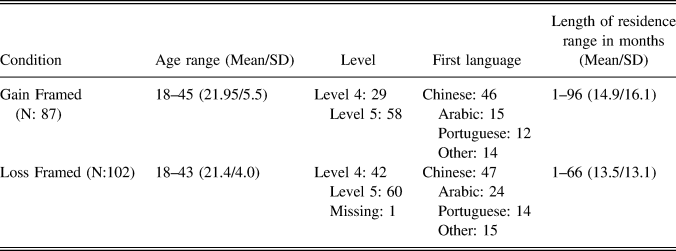
A sample of 189 English language learners from a large university in the United States participated in the study. Students who study at this institution are conditionally admitted by the university; that is, they must meet the English requirements before they officially start taking courses for credit. The university classifies language learners into five levels, based on their TOEFL scores and performance on a placement test that the university administers annually. Participants in the current study were recruited from Level 4 and Level 5 classes, which were reading and writing classes. Descriptive statistics for the sample for each condition are presented in Table 1. As shown in the table, the students were from different linguistic backgrounds, and the two conditions were fairly balanced in terms of their proficiency level, first language, and length of residence in the United States.
Descriptive statistics for participants in each condition

MATERIALS AND INSTRUMENTS
Questionnaires
Although the regulatory focus questionnaire (RFQ) developed by Higgins et al. (Reference Higgins, Friedman, Harlow, Idson, Ayduk and Taylor2001) has been the classic instrument in regulatory focus studies, the present study employs Haws, Dholakia, and Bearden’s (Reference Haws, Dholakia and Bearden2010) composite regulatory focus scale (CRFQ), which includes items from Higgins’s RFQ, Carver and White’s (1994) behavioral inhibition system/behavioral activation system (BIS/BAS) scale, and the Lockwood scale (Lockwood, Jordan, & Kunda, Reference Lockwood, Jordan and Kunda2002). While RFQ is exclusively oriented toward the past, the composite scale includes items related to the past, present, and future, as well as emotion-related items. More importantly, the CRFQ has shown better predictive power than the RFQ (see Haws et al., Reference Haws, Dholakia and Bearden2010). The scale contains 10 items, five measuring the prevention orientation and five measuring the promotion orientation.Footnote 1
Reading Comprehension Materials
An authentic online article (Murnaghan, Reference Murnaghan2016) which was 675 words long and discussed the pros and cons of animal testing was used in the present study. Even though the procedures took place in a computer laboratory environment, measures were taken to make the reading process as natural as possible. Participants were not given time limits for reading, and could use an English-to-English dictionary and take notes on a blank sheet of paper during the reading process. Participants were asked to answer 10 true/false comprehension questions after reading the text. The true/false statements were not meant to test the participants’ actual understanding of the text; they were only used to reinforce their gain or loss induction through predetermined feedback on their performance on those statements.
L2 Vocabulary Test
The Range program with the British National Corpus/Corpus of Contemporary American English lists (25,000 words) was used to analyze the text in terms of its frequency measures. The analysis showed that 530 word tokens (182/273 types) were in the first base list (each base list includes 1,000 words), making 80.30% of the text, and 73 tokens (57 types) were in the second base list, making 11.06% of the text. Because the target population included upper-intermediate to advanced learners of English (based on their institutional placement), 9.64% of the words that were on the range between 3,000 and 7,000 words were included in the final list of 40 vocabulary items for the test.
Based on the guidelines proposed by Carr (Reference Carr2011), the 40 vocabulary words on the final list were used to develop a multiple-choice test of vocabulary. The test instructions asked participants to choose one out of four options that are the closest match in meaning for each target word. The option “I don’t know” was also included to minimize the effects of guessing. Furthermore, one extra blank box was added to allow the test takers to write an L1 translation or a meaning that was not included in the options presented to them. In grading the participants’ performance on the test, which was used as both pretest and posttest, the right answer was given a 1, and the wrong answer was given a 0. Likewise, if participants chose the option “I don’t know,” the item was given a 0. However, if participants provided a related meaning or correct translation, the item was given a 1.
PROCEDURES
After getting permission from the authorities in charge of the language learning institute where the data were collected, the teachers who taught Level 4 and Level 5 classes were contacted because of the similarity of the focus of their classes (which is reading and writing) to the activities that this research study involved. Having been informed of the procedures and objectives of the study, the teachers who decided to cooperate agreed to perform the experiment as in-class activities. The researcher visited the classes once for recruiting participants and administering the vocabulary pretest, and once for the main experimental session.
In the first visit, the students were informed that the purpose of the study was writing an essay on animal testing. They were instructed that they were expected to do some activities in addition to writing the essay, including taking a vocabulary test, reading an article, and completing some other questionnaires and forms, all as part of their regular class activities. It was established from the beginning that if they chose to give permission to the researcher to use the data, their essays would be entered in an essay contest; and if they concluded the contest with 75 out of 100 possible points, their names would be entered in a drawing to win one of three $100 gift cards. This was the perception even though at the end of the study, all the participants’ names were entered in the drawing regardless of their performance. In addition, everyone permitted the use of their data. During the same class visit, the students took the multiple-choice vocabulary pretest, which took approximately 15 minutes to complete. The students were told that the test was only meant to examine whether the article they were supposed to read in the next class was at the appropriate level. The participants were also assured that their performance on the test would not have any effects on their scores in the essay contest, and that they would be even provided with a dictionary including the definitions of all those words at the time of essay writing.
The main data collection session happened over the following week. Groups of participants were invited to a computer laboratory to perform the related activities using Qualtrics, an online survey platform. The session included five steps. First, each group of participants was randomly assigned to either a gain-framed or a loss-framed condition. Second, the participants completed a background questionnaire and the CRFQ. Third, the participants read the article about animal testing and answered a set of 10 true/false reading comprehension questions (worth 30/100 points), on which they received predetermined feedback either in gain (i.e., You have gained 21 points) or in loss terms (i.e., You have lost 9 points) (20 minutes). During this stage, the participants had access to an English-to-English dictionary (which included all the target words) and could take notes. Fourth, the participants wrote their essays, explaining their positions toward the topic to a group of scholars who are going to make a decision about this issue and are interested in the international students’ opinions on this matter (40 minutes). During the writing process, the participants had access to the article, their notes, and the dictionary. Fifth, the participants took the unannounced vocabulary posttestFootnote 2 after their notes and dictionaries were taken away from them (10 minutes). On average, each data collection session lasted approximately 80 minutes.
Following the data collection stage, the participants were debriefed through e-mail about the hidden aspects of the study including the motivational framing, feedback on their performance on the true/false statements, and the fact that everyone’s name was entered in the drawing regardless of his or her performance. At that point, the participants were given another chance to refuse to let the researcher use their data for research purposes, which no one utilized.
Regulatory Fit Induction
Regulatory fit can be created incidentally or integrally (Cesario, Higgins, & Scholer, Reference Cesario, Higgins and Scholer2008). To create incidental regulatory fit, the induction happens in an irrelevant task right before the main task. The effects of fit are then expected to carry over to the next activity, which would be the target task. For example, participants might be asked to write an essay about their hopes and aspirations (promotion induction) or their obligations and responsibilities (prevention induction) to create temporary induction, which can be a fit or nonfit for the following task (e.g., Freitas & Higgins, Reference Freitas and Higgins2002).
In integral regulatory fit induction, however, participants experience regulatory fit as an integral part of the task in which they are involved. Given that there is evidence for the effectiveness of integral fit induction on learning and task performance (e.g., Markman et al., Reference Markman, Baldwin and Maddox2005; Worthy et al., Reference Worthy, Maddox and Markman2007), this type of induction was employed through the incentive structure of the task to create regulatory fit and nonfit conditions in the present study. To accomplish that, the researcher randomly assigned half of the participants to a gain-framed task condition and the other half to a loss-framed task condition. In the gain-framed condition, the participants were instructed that they started the contest with zero points but their names would be entered into a drawing to win one of three $100 gift cards if they obtained 75 points out of the total score of 100 points. Lastly, they were instructed that they could gain 30 points on reading comprehension questions and 70 points on the quality of their writing. In the loss-framed condition, participants were instructed that they started the contest with 100 points but they would have to avoid losing more than 25 points for their names to stay on the list for the drawing. To maintain the influence of regulatory fit and nonfit on the participants during the task, predetermined performance feedback on the true/false reading comprehension questions was given to the participants immediately after they responded to the questions.
DATA ANALYSIS
After data screening and checking the assumption, multiple regression analyses were conducted to see how the promotion and prevention orientations would predict vocabulary learning in gain versus loss conditions. The steps are explained in the following text.
Outliers
Following the guidelines presented in Field (Reference Field2009), two measures were employed to check for the outliers: (a) Cook’s distance, which measures the overall influence of each case on the regression model, and (b) Mahalanobis distance, which measures the distance of individual cases from the mean of the predictor variable. Six outliers were, consequently, removed from the following analyses.
Reliability Analysis
A Cronbach reliability analysis was run on the data collected using the CRFQ. The initial alpha coefficient was .51 for the prevention scale (mean = 3.39, SD = .57) and .58 for the promotion scale (mean = 3.52, SD = .52). To increase the reliability of the scales, one item from the promotion scale (“When it comes to achieving things that are important to me, I find that I don’t perform as well as I would ideally like to do”) and one item from the prevention scale (“Not being careful enough has gotten me into trouble at times”), which happened to be the only negatively worded statements, were deleted and reliability analysis was run for the new scales again. The final alpha coefficients were .58 for the prevention scale (mean = 3.39, SD = .66) and .66 for the promotion scale (mean = 3.59, SD = .61). Although the figure for the promotion scale was acceptable, the one for the prevention scale was on the border line.
Multiple Regression Analysis
Multiple regression analysis using the enter method was conducted first for the entire sample with framing condition (gain =1 vs. loss =2), promotion and prevention as the predictor variables, vocabulary pretest scores as covariate, and vocabulary posttest scores as the outcome variable. Next, to test for the effects of promotion and prevention in each condition and their interactions with framing conditions (gain vs. loss), the following model was tested with the participants in the loss condition being the reference group:
Y (Posttest Vocabulary Scores) = Framing (gain = 1 vs. loss = 0) + Promotion + Prevention + (Promotion × Framing) + (Prevention × Framing) + Pretest Vocabulary Scores
Following the procedures proposed by Aiken and West (Reference Aiken and West1991), the equation tested for the effects of (a) framing, (b) promotion and prevention in the loss condition, (c) the interaction between promotion and framing, and (d) the interaction between prevention and framing, while using pretest vocabulary scores as the covariate to control for differences in the pretest scores. The same analysis was run this time with the participants in the gain condition being the reference group. That is, the codes for framing were reversed (gain = 0 vs. loss = 1) to test for the effects of promotion and prevention in the gain condition, and interactions between the two scales, on one side, and the new dummy variable for framing, on the other side (the results of which were assumed to be the same as those of the previous analysis). Standardized scores were used in both analyses to lessen the correlations (i.e., collinearity) between the interaction terms and their components.
Simple slopes were also created using the same equation presented in the preceding text with the labels replaced with their respective regression coefficients (obtained in the previous analyses) and multiplied by the promotion or prevention scores at one standard deviation below the mean (-1 SD), to represent the lower end of each regression line, and one standard deviation above the mean (+1 SD), to represent the higher end of each line. Framing was also replaced with 1 (the gain condition) or 0 (the loss condition), depending on the condition being examined. Finally, two data points for each of the four regression lines were computed, which were then visualized using Excel 2016 (Microsoft Office).
RESULTS
The means and standard deviations of the predictor and outcome variables by framing condition are presented in Table 2. As shown, the participants’ mean scores for their promotion and prevention scales are approximately equal in both conditions. However, the difference between the vocabulary posttest and pretest scores seems to be higher in the gain condition (3.8) than it is in the loss condition (1.92).
Means and standard deviations for predictor and outcome variables

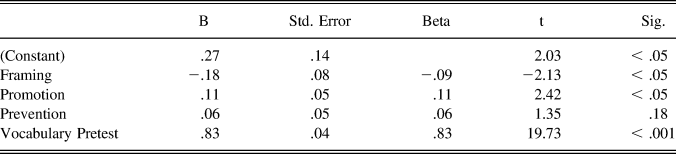
Correlations between the measured variables are also presented in Table 3. As shown, the pretest and posttest vocabulary scores correlate more strongly with the promotion than the prevention scores. There is also a moderate correlation between promotion and prevention scales, which is common in regulatory focus studies. The results of the multiple regression analysis for the entire dataset, that is regardless of framing condition, with vocabulary pretest scores as the covariate (presented in Table 4) showed that framing condition made a significant difference in the vocabulary posttest scores. This result was unexpected because the participants were randomly assigned to each condition and neither of the conditions was supposed to result in better outcomes. In addition, whereas the prevention scale did not emerge as a significant predictor of the vocabulary posttest scores, the promotion scale predicted a statistically significant amount of variance in the posttest scores. The latter result was not expected because the participants were randomly assigned to either a fit or a nonfit condition, a technique that was supposed to cancel out the main effects of the scales for the entire sample.
Pearson correlations between predictor and outcome variables

Note: * = p < .05, ** = p < .01, *** = p < .001
Regression results for the whole sample with vocabulary posttest performance as the outcome variable

Note: R 2 = .73
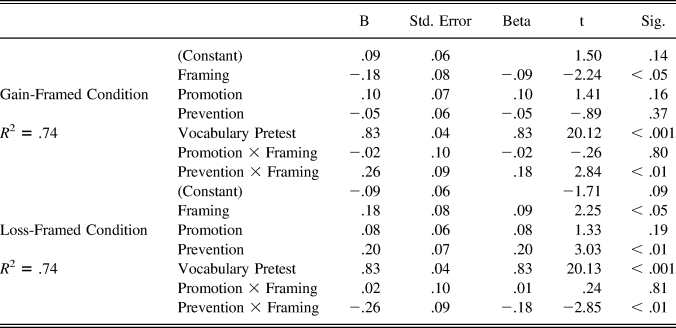
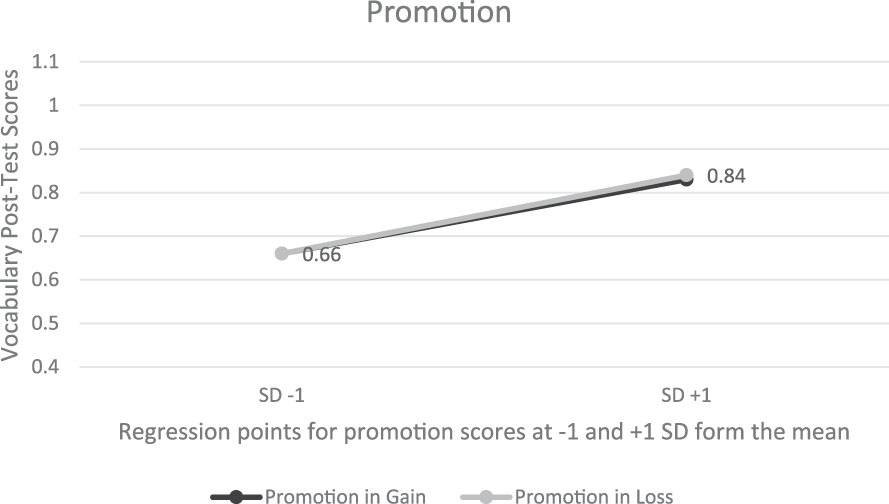
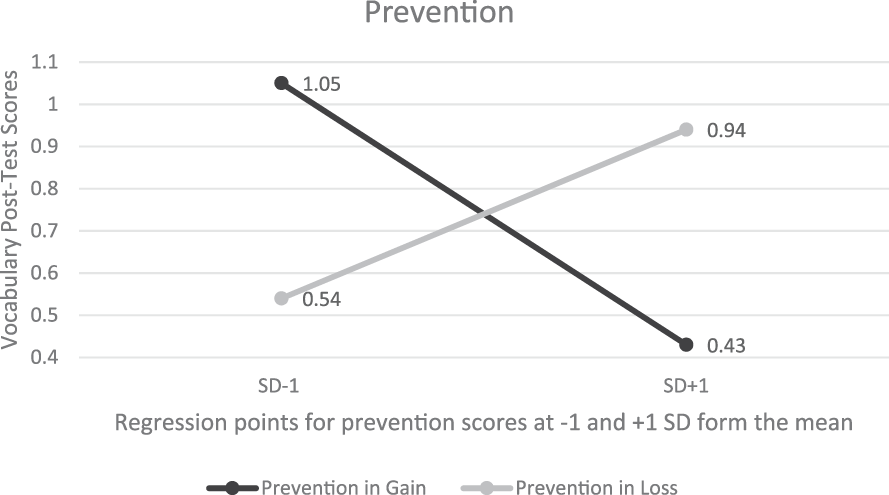
The results of further regression analyses with the interaction terms included (presented in Table 5) confirmed the predictions of regulatory fit theory for the prevention but not the promotion scale. In the loss condition, the prevention scale was a significant predictor of the vocabulary posttest scores. More importantly, there was a statistically significant interaction between the prevention scale and framing condition; the prevention scale predicted the vocabulary posttest scores significantly better in the loss condition than it did in the gain condition (for a visual comparison of simple slopes see Figure 1). By contrast, the promotion scale did not emerge as a significant predictor of vocabulary posttest scores in the gain condition. In addition, the interaction between the promotion scale and framing condition was not significant, suggesting that the amount of variance that the promotion scale predicted in the vocabulary posttest scores did not vary across framing conditions (for a visual comparison of the simple slopes see Figure 2).
Regression results with vocabulary posttest performance as the outcome variable

Schematic comparison of simple slopes for the prevention scale across framing conditions.

Schematic comparison of simple slopes for the promotion scale across framing conditions.

DISCUSSION
In agreement with the regulatory fit predictions, the prevention scale did not predict vocabulary learning for the entire sample, but emerged as a significant predictor of vocabulary learning in the loss condition; more importantly, it did so significantly better in the loss condition than in the gain condition. This pattern did not emerge for the promotion scale, which was a significant predictor of vocabulary learning for the entire sample but not in the gain condition; nor did it predict more vocabulary learning in the gain condition than it did in the loss condition. Furthermore, the gain condition resulted in the learning of a significantly higher number of vocabulary items than the loss condition did, another unexpected result.
These results partly support the predictions of regulatory fit theory, which proposes that when individuals pursue a goal that matches their regulatory focus, they feel right about what they do, are more engaged in the goal pursuit, and show better performance (e.g., Cesario et al., Reference Cesario, Higgins and Scholer2008; Higgins, Reference Higgins2000). Previous studies have found regulatory fit effects on different types of learning including general category learning (Maddox et al., Reference Maddox, Baldwin and Markman2006; Markman et al., Reference Markman, Baldwin and Maddox2005; Worthy et al., Reference Worthy, Maddox and Markman2007), explicit rule-based learning versus implicit procedural learning (Grimm et al., Reference Grimm, Markman, Maddox and Baldwin2008), motor skill acquisition (Chen et al., Reference Chen, Kee, Hung and Lin2016), and performance on promotion versus prevention tasks (Van Dijk & Kluger, Reference Van-Dijk and Kluger2004, Reference Van Dijk and Kluger2011). The results of this study provide preliminary evidence that regulatory fit effects could be extended to the context of incidental vocabulary learning, corroborating the findings of the previous research studies linking motivation and vocabulary learning.
More importantly, the study introduced a new theoretical lens through which the past studies on motivation and vocabulary learning, which were conducted from a quantity perspective, could be revisited. In the study by Gardner and MacIntyre (Reference Gardner and MacIntyre1991), for example, the participants who were offered the monetary reward significantly outperformed those who were not offered any reward. In addition, those with higher integrative motivation, which is an eager strategy matching a promotion focus, scored higher than others. From a regulatory fit perspective, it is very likely that the gain-framed reward structure employed by the researchers has significantly benefitted their promotion-focused (integratively oriented) participants over their prevention-focused participants. In two other studies, Gardner and Tremblay (Gardner & Tremblay, Reference Gardner and Tremblay1998; Tremblay & Gardner, Reference Tremblay and Gardner1995), categorized motivational constructs under trait versus state motivation, which were both examined as measures that varied across individuals only in terms of quantity. From a regulatory focus perspective, trait motivation is not considered to only comprise more enduring goals such as the integrative motive. Rather, it is about fundamental motivational preferences that direct learners’ choice of such goals and how they pursue those goals. Learners with different regulatory orientations are thus more motivated by situation-specific factors that match their orientations, creating regulatory fit experiences through which more desirable learning outcomes emerge.
Tseng and Schmitt (Reference Tseng and Schmitt2008) also found strong links between different motivational constructs and vocabulary measures. They examined motivational variables related to learners’ self-regulatory capacity in vocabulary learning, strategic vocabulary learning involvement, and mastery of vocabulary learning tactics. This study also followed the mainstream quantity tradition, assuming all learners employ similar strategies and tactics. The key premise of regulatory fit theory (Higgins et al., Reference Higgins, Friedman, Harlow, Idson, Ayduk and Taylor2001), however, is that individuals are more motivated when they employ means that match their regulatory focus. Promotion individuals are more motivated when they use eager strategic means to attain their goals; whereas prevention individuals’ motivation increases when they employ vigilant strategic means. Examining the self-regulation in relation to vocabulary learning could thus be more eye-opening if conducted through the lens of regulatory fit theory.
Regulatory fit theory could especially make valuable contributions to the area of vocabulary learning through its direct effects on task engagement, a notion that has been the focus of Laufer and Hulstijn’s (2001) construct of task-induced involvement. Laufer and Hulstijn proposed that a task with a higher involvement load in terms of need (which is a motivational construct), search (a cognitive/behavioral construct), and evaluation (a cognitive/behavioral construct) results in more task engagement, deeper levels of processing, and eventually more effective vocabulary learning. The studies conducted on this construct have provided compelling support for the importance of these three dimensions in more successful vocabulary learning. In task-induced involvement terms, it is reasonable to speculate that the regulatory fit induced in Laufer and Hulstijn’s study might have increased the involvement load of the task through increasing the value of task completion and its potential incentive (Higgins, Reference Higgins2000); the increased value, in turn, might have strengthened the learners’ sense of need for the vocabulary items that could be used to successfully complete the task. The results of the present study, therefore, show that there is more to task engagement than the sense of need aroused by the task-specific features outlined in the construct of task-induced involvement (Schmitt, Reference Schmitt2008); more specifically, a match between learner’s chronic regulatory focus and the framing of the incentive structure of the task can also result in higher levels of engagement, as evidenced by the higher rate of vocabulary learning in the current study. Therefore, the construct of task-induced involvement can be broadened to include other motivational influences such as the ones outlined by the regulatory focus and fit theories, which go beyond task-specific requirements.
The connection between regulatory fit and vocabulary learning in this study seems to have been made possible through the involvement of explicit learning mechanisms,Footnote 3 which drive vocabulary learning at the conceptual level (Ellis, Reference Ellis1994, Reference Ellis, McCarthy and Schmidt1997) and are optimized through regulatory fit experiences (as evidenced by the studies reviewed in the introduction to this article). Contrary to an implicit procedural-based system, which works through an incremental and gradual learning process without the use of conscious awareness, an explicit system uses working memory and executive attention to consciously select and test hypotheses (Markman et al., Reference Markman, Maddox and Baldwin2007). Regulatory fit influences the explicit hypothesis-testing system by increasing cognitive flexibility through the release of dopamine in the frontal areas of the brain; but it does not have the same effects on the implicit procedural-based system.
Vocabulary learning, however, is a process that involves both explicit and implicit processes. According to Ellis (Reference Ellis1994), learning the perceptual aspects of word forms and the new motor habits to produce new words requires implicit learning mechanisms; whereas the acquisition of meanings, which was the focus of the present study, involves explicit learning mechanisms. Regulatory fit in the present study contributed to the prevention-focused individuals’ learning of the conceptual aspects of new words in the loss condition presumably through making the learners “feel right” about their involvement in completing the task, which, in turn, led to increases in dopamine release in their frontal brain areas, and, subsequently, to cognitive flexibility in their use of explicit learning mechanisms; that is, their “active, effortful exploration of a set of response strategies” (Maddox & Markman, Reference Maddox and Markman2010, p. 106) such as “informing word meaning from context, semantic or imagery mediation between the FL word (or a keyword approximation) and the L1 translation, and deep processing for elaboration of the new word with existing knowledge” (Ellis, Reference Ellis, McCarthy and Schmidt1997, p. 18). The optimized use of such strategies has likely resulted in the prevention-focused students’ relative success in learning the meanings of the new vocabulary items in the loss condition compared to the prevention-focused students in the gain condition, who did not experience regulatory fit.
The results of this study, however, were not completely in line with the predictions of regulatory fit theory. Unexpectedly, the promotion scale predicted vocabulary posttest scores for the entire sample; more importantly, it did not predict more vocabulary learning in the gain condition than it did in the loss condition. Also, participants generally performed better in the gain condition than in the loss condition. One possible explanation for these unexpected results might concern the low reliability coefficients for the promotion (.66) and prevention (.58) scales. The most commonly used instrument for measuring regulatory focus is Higgins et al.'s (Reference Higgins, Friedman, Harlow, Idson, Ayduk and Taylor2001) regulatory focus questionnaire. However, in the present study, the regulatory focus scale developed by Haws et al. (Reference Haws, Dholakia and Bearden2010) was used, which is a composite measure that combines elements from other questionnaires (Carver & White, Reference Carver and White1994; Higgins et al., Reference Higgins, Friedman, Harlow, Idson, Ayduk and Taylor2001; Lockwood et al., 2002). Haws and her colleagues (2010) found the composite questionnaire to show stronger predictive power than the two other questionnaires did; nonetheless, they also had some concerns about the reliability of the scales in their Study 1. In addition, the questionnaire was not translated into the participants’ first languages in the current study, which might have contributed to this lack of reliability. This reasoning, however, does not answer why regulatory fit worked as anticipated for the prevention scale.
A second possible explanation concerns the regulatory nature of the task. This explanation is supported by the findings of Van Dijk and Kluger’s studies (2004, 2011), which showed that tasks could also have an integral promotion or prevention focus. Examples of promotion tasks could be generating ideas, creative problem solving, and challenging decision making, which require creativity, risk taking, flexibility, and openness. Detecting errors, maintaining safety, and bookkeeping are examples of prevention tasks, which require attention to details, adherence to rules, and accuracy. The writing part of the task in this study involved producing convincing arguments as a response to a challenging question: Should we use animals for testing? In writing an argumentative essay on animal testing, the participants needed to take a challenging position, generate ideas to support their position, write them in a persuasive way, and possibly propose initiating some changes. Writing such an essay may also require some level of creativity because one cannot predict how the writing process would unfold and what the final product would look like given no specific structure was imposed on the participants to follow. Therefore, it could be speculated that the task might have had a promotion bias that resulted in a complex pattern of relations across three regulatory layers: one layer related to the regulatory focus of the participants (promotion vs. prevention), a second layer related to the framing instructions (gain vs. loss), and a third layer related to the regulatory nature of the task (as a promotion task). Considering the existence of different regulatory levels is in line with the current thinking in research on regulatory fit theory. For example, Maddox and Markman (Reference Maddox and Markman2010) proposed a three-way interaction among global incentives, which include promotion and prevention priming, local incentives, which are more integral to the nature of the task such as maximizing performance indices and minimizing errors, and task demands, which are the types of strategies that are necessary for optimal performance. The possibility of the writing task having a promotion bias at the level of task demands provides a reasonable speculation, the validity of which can only be established through further empirical research. The better performance of the participants in the gain condition (Table 4), the emergence of the promotion scale as a predictor of the vocabulary posttest scores for the entire sample (Table 4), and the moderate correlation between the promotion scale and the posttest scores (Table 3) support this speculation.
Although the results of the present study do not perfectly confirm the stated hypotheses, the quality approach taken in this study can further our understanding of the role of motivational variables in task-based language learning in ways that go beyond what is possible through the mainstream quantity approach followed in the previous task motivation studies. Julkunen (Reference Julkunen1989), for example, found that open tasks were more motivating than closed tasks, without offering a theoretical explanation as to why that was the case. From a regulatory fit perspective, open tasks, which require creativity and flexibility, match a promotion focus, whereas closed tasks, which require vigilance and adherence to the rules, match a prevention focus (Van Dijk & Kluger, Reference Van Dijk and Kluger2011). The open task might have, thus, resulted in more eager behaviors such as active participation; whereas the prevention task might have led students to employ vigilant strategies to avoid possible negative outcomes (e.g., making mistakes). Dörnyei and Kormos (Reference Dörnyei and Kormos2000) found that out of 14 motivational variables, only WTC and three situated motivational factors significantly correlated with one or both target communicative measures such as number of produced words and number of turns taken. Additionally, Kormos and Dörnyei (2004) found partial evidence for associations between the motivational variables and qualitative measures of the learners’ linguistic production such as accuracy, complexity, and the number of arguments. From a regulatory focus perspective, measures such as the number of produced words, and the number of turns and arguments are considered eager strategies, which fit a promotion focus; whereas vigilant strategies to decrease errors and increase accuracy are characteristics of prevention-focused individuals (Bass, De Dreu, & Nijstad, Reference Bass, De Dreu and Nijstad2008; Förster, Higgins, & Bianco, Reference Förster, Higgins and Bianco2003; Van Dijk & Kluger, Reference Van Dijk and Kluger2011). Support for this claim in L2 motivation research comes from two studies by Teimouri (Reference Teimouri2016) and Papi, Bondarenko, Mansouri, Feng, and Jiang (Reference Papi, Bondarenko, Mansouri, Feng and Jiang2017) that have found that while the ideal-L2-self measures, which have a promotion focus (Dörnyei, Reference Dörnyei, Dörnyei and Ushioda2009), strongly predicted eager behavioral tendencies such as WTC, the ought-to-L2-self measures, which have a prevention focus (Dörnyei, 2009), did not predict WTC but predicted vigilant motivated behaviors. Papi and Abdollahzadeh (2012) also found that the ought-to-L2-self was negatively correlated with EFL students’ voluntary participation in classroom activities, which is an eager behavior.
CONCLUSIONS
The present study was the first experimental application of regulatory fit theory (Higgins, Reference Higgins2000) in the field of SLA. The effects of regulatory fit between ESL learners’ chronic regulatory focus (promotion vs. prevention) and the incentive structure of the task (gain framed vs. loss framed) on incidental vocabulary learning were examined and supported. Even though the results of the study did not precisely match the regulatory fit predictions, they confirmed the key principle motivating this study: There is a qualitative link between the motivational and cognitive aspects of L2 learning. In other words, these results challenge the widespread misconception among SLA researchers that language learning is an almost exclusively cognitive pursuit; a pursuit in which even though affective variables such as motivation “can sometimes be important in getting learners to the starting line … cognitive variables take over when learners confront the learning task itself” (Long, Reference Long2014, p. 59). The present study contests this assumption by highlighting motivational effects that regulate the task-based learning process at three different regulatory levels: (a) the regulatory focus of the participants, (b) the reward and feedback structure of the task, and (c) the regulatory focus of the task. These findings suggest that motivational variables are more than random “temporarily limiting factors” (Robinson, Reference Robinson2001, p. 32), and their effects are not limited to the stakes of task performance (cf. Skehan, Reference Skehan1996).
The mainstream quantity approach has resulted in a limited view of L2 motivation, a lack of connection between the motivational and cognitive aspects of language learning, and, consequently, a predominantly cognitive understanding of L2 learning. Researching motivation as quality, that is, as preferences that direct the individual’s choice of different goals and strategic means for achieving those goals, is not only more scientifically valid but can also uncover unique potentials for developing a more comprehensive understanding of L2 learning processes and outcomes. It can help us understand not only how but also why these processes unfold the way they do and result in one versus other outcomes.
LIMITATIONS
The study contains several limitations. The composite regulatory focus questionnaire used in the present study did not show adequate reliability, which might have affected the predictive power of the scales. Higgins’s (2001) classic instrument for measuring the regulatory focus could be a better choice for future studies. Alternatively, an L2-specific questionnaire might provide a more accurate tool to measure learners’ regulatory orientations with regard to the language they are in the process of learning. Translating the questionnaire through a rigorous translation and back-translation procedure (Dörnyei, Reference Dörnyei2010) could also result in more optimal comprehensibility and, thereby, better psychometric properties for the instrument. The writing task that was chosen for the present study might have been biased in favor of the promotion orientation. This might have created some complications responsible for the asymmetric results in this study. In future studies, it is recommended that researchers use tasks that do not favor either of the regulatory orientations. Alternatively, promotion and prevention tasks could be employed in the same study to examine how they affect task engagement for learners in different regulatory foci. The vocabulary pretest results might have been influenced by the way the test was framed. The students were told that the purpose of administering the test was only to establish that the text they would be asked to read would not be too difficult for them to understand. They were also instructed that a dictionary including the definitions of all the vocabulary items in the test would be provided for each of them. More importantly, it was established that the students’ performance on the vocabulary pretest would not affect their chances of winning the entry ticket to the drawing. Thus, the students might have not taken the test as seriously as desired. Because this study was completed in a computer laboratory setting, the results may not be generalized to more naturalistic learning environments. The gender of the participants was not documented in the present study. Therefore, it could not be established whether the results could vary as a function of gender affiliation.
DIRECTIONS FOR FUTURE RESEARCH
Adopting the quality perspective toward L2 motivation can complement the existing quantity perspective and further our understanding of different facets of motivation to learn a second language. More importantly, it would form a qualitative link between motivation research and other research areas in the field, thereby painting a more comprehensive picture of language learning processes and outcomes (Crookes & Schmidt, Reference Crookes and Schmidt1991; Laufer & Hulstijn, Reference Laufer and Hulstijn2001). Chronic motivational factors might be a contributing factor in L2 learners’ linguistic, communicative, learning, and behavioral differences. Promotion-focused individuals have a tendency for fluency and big-picture thinking, while prevention-focused individuals have an eye for details and tend to prioritize accuracy over speed in task completion (see Förster et al., Reference Förster, Higgins and Bianco2003). The observation that many learners speak their second languages fluently (with higher speed) but with many errors while others speak their second languages very accurately but not as fluently might be better explained by deeper regulatory differences than surface personality descriptors (e.g., Dewaele & Furnham, Reference Dewaele and Furnham2000). Regulatory focus might also help explain differences in learners’ willingness and frequency of communication in the second language (Teimouri, Reference Teimouri2016).
Furthermore, situational regulatory focus could provide numerous contributions to language instruction. Learning may be more successful for the learners whose dominant regulatory focus matches the regulatory focus of their teachers, syllabus, curriculum, and classroom context (Leung & Lam, Reference Leung and Lam2003; Rodriguez, Romero-Canyas, Downey, Mangels, & Higgins, Reference Rodriguez, Romero-Canyas, Downey, Mangels and Higgins2013). Other productive areas of research could involve investigating the regulatory fit effects on L2 learners’ task engagement, enjoyment, anxiety, and performance as well as on learning other aspects of a second language such as grammar, pronunciation, pragmatics, and so forth (see Freitas & Higgins, Reference Freitas and Higgins2002; Van Dijk & Kluger, Reference Van-Dijk and Kluger2004, Reference Van Dijk and Kluger2011). Regulatory focus could provide a theoretical framework for understanding differences in the types of strategies that learners employ in their learning pursuits (Higgins et al., Reference Higgins, Friedman, Harlow, Idson, Ayduk and Taylor2001; Papi et al., under review).