




No CrossRef data available.
Article contents
Observations of early triadic family interactions: Boundary disturbances in the family predict symptoms of depression, anxiety, and attention-deficit/hyperactivity disorder in middle childhood
Published online by Cambridge University Press: 01 September 2004
Abstract
This article argues for the importance of focusing explicitly on the construct of boundary disturbances in families to understand the development of depressive, anxious, and attention-deficit/hyperactivity disorder (ADHD) symptoms in middle childhood. Grounded in family systems theory, this study examined traditional parent–child antecedents of childhood depression and anxiety (hostile, controlling, and disengaged interactions) in the context of the entire family as well as enmeshed patterns, whereby one parent drew in the child by turning to the child for caregiving or intimacy and excluded the spouse, and balanced patterns, whereby all family members expressed vulnerabilities and asserted their needs or desires. Mostly White, middle-class mothers, fathers, and children were observed at home interacting on a series of everyday tasks when the children were 24 months old, and mothers and teachers rated children's symptoms of anxiety, depression, somatic problems, and ADHD at age 7. Regression analyses revealed that, after controlling for maternal depression and the effects of other family patterns, enmeshed family patterns forecast children's depressive symptoms; controlling and disengaged interactions predicted anxious and depressive symptoms; and hostility forecast ADHD and somatic complaints. Intriguing gender differences emerged. As predicted, whereas boys who experienced enmeshed family patterns more often developed symptoms of ADHD, girls who experienced enmeshed family interactions later showed symptoms of depression.This research was supported by Grant SBR-9212990 from the National Science Foundation and Grant 3332 from the Hogg Foundation for Mental Health. The authors thank the families who participated in this study, as well as Lisa Steffeck who assisted with coding the data.
Information
- Type
- Research Article
- Information
- Copyright
- © 2004 Cambridge University Press
Learning to regulate affect is central to children's emotional development. Children who have difficulty expressing emotion and regulating impulses effectively are at risk for becoming depressed and anxious and suffering from symptoms of attention-deficit/hyperactivity disorder (ADHD; Carlson, Jacobvitz, & Sroufe, 1995; Duggal, Carlson, Sroufe, & Egeland, 2001). Moreover, clinically depressed and anxious children report high rates of stomachaches and other somatic symptoms (Garber, Zeman, & Walker, 1990; Offord et al., 1987). Childhood anxiety, depression, and ADHD, in turn, have been associated with poor problem-solving abilities and difficulty forming lasting friendships. Moreover, depressed children are more likely to experience recurring depressive episodes throughout adulthood (Garland & Weiss, 1995; Harrington, Rutter, & Fombonne 1996; Kovacs, 1996) and anxious children are more likely to become anxious adults (Mattison & Spitznagel, 1999). Given the wealth of data documenting the negative trajectories for these children, the goal of the present study was to understand further the family origins of symptoms of depression, anxiety, somatic complaints, and ADHD in middle childhood. This study identified family interaction patterns likely to interfere with emotion and impulse regulation when children were toddlers, because this is a critical age for learning self-control and affect regulation.
Most studies of family antecedents of childhood depression have examined interactions between a depressed mother and her child (Birmaher, Ryan, Williamson, Brent, Kaufman, Dahl, Perel, & Nelson, 1996; Downey & Coyne, 1990). The relationship between maternal depression and childhood psychopathology is thus well documented (Beardslee, Versage, & Gladstone, 1998; Cummings & Davies, 1994; Hammen, 1991; Weissman, Warner, Wickramaratne, Moreau, & Olfson, 1997). In addition, several studies have shown that attachment insecurity during infancy is related to children's difficulty with emotional expression and emotion regulation, increasing the likelihood of developing an affective disorder (Cicchetti, Cummings, Greenberg, & Marvin, 1990; Cummings & Cicchetti, 1990). Less is known, however, about the ways in which families respond to each other in the early years contributes to children's ability to regulate their own emotions and impulses. From a family systems perspective, it is important to look at patterns of interaction within the entire family to understand the mental health of each member individually. Although family theorists and therapists have long recognized the importance of moving beyond the dyad (Byng–Hall, 1999; Cowan, 1997; Cox & Paley, 1997; Marvin & Stewart, 1990), few studies have examined interactions in the entire family.
The role of boundary disturbances in childhood depression, anxiety, and ADHD
The idea of interpersonal boundaries was conceptualized originally by family systems theorists as implicit rules that govern interaction and regulate the amount of contact with others. Family system theorist Salvador Minuchin (1974) suggests that establishing clear but flexible boundaries within a relationship and between family relationships promotes autonomy and allows family members to express their ideas, feelings, and vulnerabilities. Thus, the balance of intimacy and autonomy in families is regulated, in part, by boundaries that provide implicit emotional and psychological limits communicating to individuals how to function in relationships (Bowen, 1978; Kretchmar & Jacobvitz, 2002; Jacobvitz, Riggs, & Johnson, 1999; Minuchin, 1974). Boundaries can also operate at the level of the family, separating the marital and parent–child subsystem. Couples support each other as parents, giving one another the emotional and instrumental support needed to provide their children with love and guidance.
Boundaries in a family may break down, becoming overly diffuse. Overly diffuse boundaries may involve enmeshing or controlling interaction patterns. The enmeshing pattern involves a parent's attempt to “pull in” the child to meet his or her needs, without respecting the child's personal or psychological space. Parents may use one or more of the following tactics to draw in their child: (a) spousification—turning to the child for companionship and intimacy, often involving inappropriate or unusual touching of the child, for example, repeatedly kissing and caressing the child when he or she does not invite, and may even resist, such overtures, or manipulating the child using coy, fake sweetness (Sroufe, Jacobvitz, Mangelsdorf, DeAngelo, & Ward, 1985); (b) parentification—a child is pulled into a parent's role and asked to bear parenting responsibilities in an inappropriate fashion (e.g., caregiving of parent; Byng–Hall, 1999; Jurkovic, Morrell, & Thirkield, 2002) or one parent may act childlike or helpless and constantly defer to the child for parental guidance or use guilt-inducing comments (“Now poor Mommy has to clean this up!”); and (c) family alliances—one parent aligns with the child and undermines the other parent's authority by criticizing or ignoring that parent or by leaving out the other parent during much of the interaction. In all of these cases, the spouse may become emotionally disengaged from the family (Kerig, 1995; Minuchin, 1974).
Interpersonal boundaries may also break down via a controlling pattern whereby one member of the triad dominates the interaction, dismisses or excludes other members, or makes decisions for the other spouse and/or children without letting them express themselves. Like enmeshing triads, the interaction patterns of controlling triads can involve structural boundary dissolution. The parenting subsystem is undermined when one parent reduces the other to a childlike status, or when both parents allow the child to dominate the interaction. The controlling pattern is distinct from the enmeshing pattern in that rather than using tactics that are guilt-inducing or helpless, one member attempts to dominate the others using tactics that are more direct and power assertive. A child's repeated experiences of loss of control may result in disengagement from the environment as a type of coping strategy, and may present as a state of withdrawal indicative of a depressive state (Trad, 1994). In fact, parental overcontrol and the absence of autonomy promotion observed in mother–adolescent and father–adolescent interactions have been associated with internalizing difficulties in adolescents (Kobak, Sudler, & Gamble, 1991).
An increasing number of studies have shown that a reversal of parent and child roles and parent–child alliances interferes with children's ability to regulate affect and arousal. Results from a large longitudinal study revealed that mothers who turned to their children at 24 and 42 months for intimacy or parenting were more likely to have children who had difficulty regulating their arousal. Some of these children, primarily boys, developed inattentive, overactive, and impulsive symptoms of ADHD in kindergarten (Jacobvitz & Sroufe, 1987) and in second and sixth grade (Carlson et al., 1995), while others developed difficulties relating to their peers in middle childhood (Sroufe & Jacobvitz, 1989). At ages 10 and 11, these children displayed inappropriate gender boundaries when interacting with peers of the opposite sex (Sroufe, Bennett, Englund, Urban, & Shulman, 1993). The present study builds on these studies of mother–child interactions by examining whether boys who experience an enmeshing triadic (mother, father, child) interaction pattern during toddlerhood develop symptoms of ADHD at age 7.
Less is known about the possible effects of boundary problems on the development of depression in children. However, findings from retrospective studies with young adult females indicate that memories of parent–child alliances have been associated with symptoms of depression, anxiety, and low self-esteem (Jacobvitz & Bush, 1996) and with problems in identity exploration (Fullinwider–Bush & Jacobvitz, 1993; see Jacobvitz et al., 1999, for a more comprehensive review). Prospective studies of the effects of enmeshing interactions in the whole family on children's ability to regulate emotion and impulses, however, are sparse. Thus, the present study examined whether children, and specifically, girls who experienced enmeshed family interactions at 24 months will display depressive symptoms in middle childhood.
Growing up in a family where one parent behaves in a controlling way is expected to relate specifically to symptoms of anxiety. Several studies have shown that adolescents' reports of high levels of parental psychological control are related to anxiety, as well as depression, loneliness, and confusion (Barber, 1996; Pettit, Laird, Dodge, Bates, & Criss, 2001). Parenting antecedents of psychological control were examined in a longitudinal study following over 400 kindergarten children over 5 years. Ratings of interviews conducted with mothers and responses from questionnaires completed by mothers revealed that hostile and coercive maternal behavior with kindergarten children predicted children's reports of psychological control during early adolescence (Pettit et al., 2001). Therefore, the present study included observational assessments of hostility as well as controlling triadic family interactions to determine whether hostile family interactions also would forecast anxiety in children.
Whereas some children experience poor boundaries, others may grow up in families that are overly rigid, thereby blocking intimacy. Rigid families may be emotionally disengaged, rarely making eye contact and unresponsive to each other's feelings or queries. It is expected that children who grow up in such families are likely to withdraw and become depressed. Moreover, a disengaged family pattern disrupts the protective and supportive functions of the parent–child relationship. Consistent with Bowlby's (1969) theory of attachment, infants and toddlers depend on their parents for protection and safety and the lack of such protection is expected to make young children anxious and depressed. In fact, emotional unavailability and unresponsiveness over the first year of life has been linked with the development of an insecure infant–caregiver attachment relationship (Ainsworth, Blehar, Waters, & Wall, 1978) and attachment insecurity has been related to internalizing and externalizing disorders in children (Cicchetti, Rogosch, & Toth, 1998).
Thus, the present study will examine whether triadic family interaction patterns indicative of boundary disturbances, including enmeshing and controlling patterns, forecast symptoms of depression, anxiety, ADHD, and psychosomatic problems. We expect that maternal depression will predict child depression and anxiety, but that boundary disturbances will contribute to childhood depression and anxiety independent of maternal depression. In addition, the present study will examine the extent to which hostile and emotionally disengaged interactions predict symptoms of depression, anxiety, somatic complaints, and ADHD in children. Balanced interactions, on the other hand, in which there is a balanced concern for all family members' emotional needs being met, are expected to be negatively related to these symptoms.
Finally, with respect to gender, several studies have demonstrated gender differences in the incidence of ADHD and childhood depression. ADHD is nearly 10 times more prevalent in boys versus girls in a clinic sample and 3 times more prevalent in boys in a community sample (Biederman, Mick, Faraone, Braaten, Doyle, Spencer, Wilens, Frazier, & Johnson, 2002). Moreover, as described earlier, boys who experience enmeshing boundary disturbances more often develop symptoms of ADHD. Therefore, the extent to which gender differences influence the magnitude of the relationship between enmeshing family patterns and blurred boundaries will be examined. Further, girls are at a higher risk than boys for becoming depressed during early adolescence and adulthood (Nolen–Hoeksema, 2001) and, as discussed, experiencing boundary disturbances or emotional distance in the family has been linked to childhood depression. Thus, we anticipate that girls, more than boys, who experience enmeshed, or emotionally disengaged interactions during toddlerhood will develop symptoms of depression during middle childhood.
Method
Sample
Participants were part of a longitudinal study investigating the transition to parenthood and family relationships (Curran, Hazen, Jacobvitz, & Feldman, in press; Jacobvitz, Leon, & Hazen, 2004; Riggs & Jacobvitz, 2002). When the women were in their third trimester of pregnancy, 125 couples were recruited through birthing classes, public service radio announcements, and flyers distributed at maternity stores in the Austin area. Only couples expecting their first child and living together (94.4% were married) were included in the study. The couples had a median family income of $30,000–$45,000, and the mean age of participants was 30.5 years. The majority reported education beyond the high school level, with 60% earning a bachelor's or graduate degree and another 30% reporting some college or trade/business school coursework. Ethnic distribution was predominantly Caucasian (85%) but also included Hispanic (8%), African American (3%), and biracial and/or “other” (4%) identifications. In return for their participation in the study, couples were offered a $50 savings bond for their child at each of the three phases (for a total of $150 in savings bonds) as well as bimonthly project newsletters, a T-shirt for their infant, and an audiotape of lullabies.
At 24 months, 108 families remained in the sample. Of the 17 families who left the study, 12 families moved away, three were too busy to participate, and two could not be located. Ninety-six triadic interactions were available because 12 couples had divorced. Between the 24-month and 7-year visits, nine families moved away, two families declined participation, and 12 families could not be located. Therefore, 85 mothers participated in the study at 7 years. Home and teacher visits took place within 3 months of each other. Only the 75 teachers who knew the child for at least 3 months were contacted to complete the Teacher Report Form (TRF; Achenbach, 1991); the 12 children who had been in the class with a new teacher for less than 3 months were not contacted. Four of the 75 teachers did not complete the TRF and thus, 71 children were included in analyses using the teacher data. Exact numbers of subjects will be reported for each analysis.
Couples at the prenatal phase who reported family incomes between $0 and $30,000 were less likely to have data at 7 years than individuals at the prenatal level who reported incomes between $45,000 and $60,000, χ2 (4) = 12.22, p < .05. There were no differences on any of the other demographic variables between individuals who stayed in the sample at 7 years and those who did not.
Procedures
Data reported for the present study were collected over two time points: when the children were 24 months and 7 years old. Families were visited twice when their child was 24 months old. The first visit took place at a University laboratory and mothers and fathers independently completed a series of measures, including an assessment of depression. At the second 24-month visit held in the couples' homes, mothers, fathers and their 2-year-old child participated together on a series of triadic interaction tasks lasting about 30 min. When the children were 7 years old, each child's mother and teacher completed the Child Behavior Checklist (CBCL; Achenbach, 1991).
Measures
Maternal depression
At the 24-month and 7-year visits, mothers completed the Center for Epidemiological Studies Depression Scale (CES-D; Radloff, 1977). The CES-D is a widely used instrument for assessing general depressive symptoms in nonclinical samples, and is among the most frequently used and well-validated self-report measures of depressive symptoms (Santor, Zuroff, Ramsay, Cervantes, & Palacios, 1995). The scale consists of 20 statements such as “I felt depressed” and “I thought my life had become a failure.” Participants are asked to indicate how often they've experienced the feeling described in each statement in the past week on a 4-point scale from “Rarely or none of the time” to “Most or all of the time.” The combined score for all the items represents the general depression experienced by the participant during the last week. The scale has high internal consistency, substantial evidence of construct validity, excellent concurrent validity (Radloff, 1977), and has superior scale discriminability (Santor et al., 1995). Depression has been defined as both a continuum of psychological disturbance and as a discrete diagnosis (Downey & Coyne, 1990). Questionnaire methods of depressive mood have a slightly different meaning from the diagnosis of depression (Harrington et al., 1996). Because the CES-D measures depressive mood, the term symptomatology will be used in this study, rather than the diagnosis of depression. Cronbach's alphas, which were used to the internal reliability for the CES-D at 24 months and 7 years, were .82 and .90, respectively.
24-Month triadic interaction scales for coding family interactions
Families were videotaped in their homes for about 30 min while completing a series of tasks. The purpose of the tasks was to provide an interaction context for families that would involve typical family functions in which parents would have to complete necessary adult tasks (in this case, completing a Q-set task) while providing caregiving for their child (fixing a snack, changing clothes, and playing if there is extra time). This interaction context was designed to elicit the parental planning and negotiation involved in juggling the work and child care tasks under time constraints, thus revealing interaction patterns typical to the family. Mothers and fathers were asked to complete a Q-Sort together, regarding attitudes about parenting; half of the families completed the Q-Sort about the mothers' attitudes and half of the families completed it about the fathers' attitudes. Couples were asked to come to an agreement about how Q-sort items should be classified. The content of the Q-Sorts was not coded. In addition to the Q-Sort task, families were asked to provide their child with a snack and change the toddler's clothing. If the families finished within only 20 min then the child was given a peg-sorting task to complete. The peg-sorting task involved putting rings of the same color that increased in size onto the same peg. The parents and child were shown the completed task with rings on pegs in the right order. The experimenter then took the rings off the pegs and noted that the task was for the child to put the rings back on the pegs. No other instructions were given.
Five 7-point scales were developed to code three-way family interactions for different types of boundary disturbances as well as for balanced family interactions: enmeshed, controlling, hostility, emotional disengagement, and balanced interactions. The enmeshed scale measured the extent to which one parent draws in the child using one or more of the following tactics: (a) spousification—turning to the child rather than the spouse for company or intimacy, flirting with the child, whispering secrets to the child, or touching the child inappropriately; (b) parentification of child—acting helpless and turning to the child for caregiving at the expense of providing the child with parental guidance; (c) parentification of spouse—turning to the spouse for parenting throughout much of the task rather than interacting with the spouse as a peer or companion; and (d) enmeshed interactions or coalitions—aligning with the child for most of the session while the other parent either observes his/her spouse and child together or completes the tasks alone. Parent–child alliances sometimes occurred during the card sort task. In some triads one parent read the cards aloud, and then decided on the placement of the card while the other parent and child were playing together despite the fact that the experimenter explicitly asked the parents to decide on the card placements together. Enmeshed family patterns could also involve one parent undermining the other parent's authority. For example, in one triad, the child was hitting the mother on her back. The father asked the child to stop hitting his wife. His wife responded, “It's okay. I don't mind.” Finally, enmeshing family behaviors included one parent appearing helpless, or making guilt-inducing comments and the other parent taking on most of the responsibility for the child and trying to please his or her spouse. Low scores indicated a lack of enmeshing family behaviors, whereby the parents acted as a cohesive and supportive unit to make decisions and care for the child during the task.
The controlling scale assessed the extent to which one member of the triad dominated the interaction, dismissed or excluded the other members; or made decisions for the other spouse and/or child. Triads scoring high on controlling usually had at least one member of the triad who was unable to express him or herself. Controlling behaviors are similar to family alliances conceptually in that one member of the couple does not show respect for the other person. However, rather than using tactics that are guilt inducing or helpless, one member attempts to dominate the others.
The emotional disengagement scale measured the degree to which triads are emotional distant or do not make room for feelings, differing viewpoints, or the different needs of family members during the tasks. High scores reflect emotional distance between at least two members of the triad. There is a sense that the family members neither experience pleasure nor a positive regard for each other. There may be excessive concern for the task parameters such that they are unable to sustain interaction for the duration of the tasks; or their concern for the tasks exceeds that for one another. Low scores will reflect a sense of emotional connectedness as noted in verbal and nonverbal cues of emotional responsiveness and availability. Members of the family allow for a wide range of affect without escalation or disengagement.
The hostility scale measured the degree to which one or more family member is critical or hurtful of another family member. High scorers on this scale expressed leaking anger toward another family member by making hostile or sarcastic comments; demonstrating an impatient, derisive, or mocking tone of voice; or exhibiting body language such as sighing or rolled eyes. Low scorers demonstrated none of these behaviors.
The balanced scale taps the extent to which the triadic interaction promotes autonomy of all of the members. Members in a flexible family system with clear boundaries support one another as well as provide an environment tolerant of change and autonomy seeking. All of the members are comfortable expressing vulnerability, openness, spontaneity, confidence, assertiveness, security, and equality. The overall tone of this family is a “tangible closeness” while supporting and enhancing the autonomy of each person. Low scores on balanced family patterns indicate that the energy in this family was focused on only one member's needs, one member may be left out, or that family members did not express vulnerability and spontaneity to each other.
Two raters, who were blind to all other assessments, independently coded the 96 triadic interactions on the enmeshed, controlling behavior, emotional disengagement, hostility, and balanced scales. The scores used in the study are the average score of the two coders. If ratings differed by more than two points, then a third trained coder scored the videotapes. Using Pearson Correlation Coefficients, interrater reliability on the five scales was r = .82 for family alliances, r = .83 for controlling behavior, r = .85 for disengaged and balanced, and r = .90 for hostility.
Children's emotional and behavioral problems at 7 years
Childhood emotional and behavior problems (7 years)
Mothers and teachers completed a child behavior checklist to assess symptoms of depression, anxiety, somatic complaints, and ADHD in the children. The mothers completed the CBCL (Achenbach, 1991) and the teachers completed the TRF (Achenbach, 1991). Both questionnaires, assessing children's behaviors from ages 4 to 18, contain 113 statements about the child's behavior and offer 3 responses (0 = not true, 1 = somewhat or sometimes true, and 2 = very true or often true). The parent and teacher forms vary slightly with more questions about behaviors most likely to be observed in the home occurring on the parent form (e.g., toileting and sleeping behaviors), and more questions about behaviors most likely to be observed at school occurring on the teacher form (e.g., performance in schoolwork, disruptive behaviors in class). The domains for assessment used in the present study include the DSM-IV oriented syndrome scales Affective Problems, and Anxiety Problems, and ADHD. The syndrome scales were used to minimize the conceptual overlap between anxiety and affective disorders. For example, whereas anxious/depressed includes items assessing both anxiety and depression, the anxiety disorder scale has items assessing fears and the affective disorder scale includes items related only to depression (e.g., sadness, preferring to be alone, harming oneself, suicidal behavior). In addition the DSM-IV oriented Somatic Complaints scale was used because children who complain about physical problems (e.g., headaches, stomachs) suffer more often from depression and anxiety (Garber et al., 1990). Cronbach's alpha (used to test internal reliability) for the TRF completed by teachers in the present study was .98 for Affective Disorders, .90 for Anxiety Disorders, .99 for Somatic Complaints, and .95 for ADHD. For the CBCL completed by mothers in the present study, Cronbach's alpha was .55 for Affective Disorders, .69 for Anxiety Disorders, .96 for Somatic Complaints, and .70 for ADHD.
Test–retest reliability for the CBCL scale scores was r = .89 for the mean of the problem scales. For the TRF measure, test–retest reliability for the mean score of the problem scales was r = .92. Interinterviewer and test–retest reliabilities for item scores were in the .90s, as demonstrated by intraclass correlations. Good interparent agreement was indicated by mean rs for the problem scales ranging from .65 to .75. Construct validity has been supported by several correlates of CBCL scales, including significant associations with comparable scales on the Conners Parent Questionnaire and the Quay–Peterson Revised Behavior Problem Checklist. Criterion-related validity has been demonstrated by the CBCL's ability to discriminate between referred and nonreferred children.
Results
Descriptive statistics
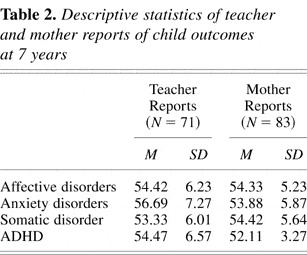
Table 1 shows the means and standard deviations for the triadic interaction scales and maternal depression symptoms, and Table 2 shows these descriptive statistics for the teacher and mother ratings of the DSM-IV oriented Affective Problems, Anxiety Problems, Somatic Complaints, and ADHD at 7 years.
Descriptive statistics of teacher and mother reports of child outcomes at 7 years

Descriptive statistics of triadic family interactions at 24 months and maternal depressive symptoms at 24 months and 7 years

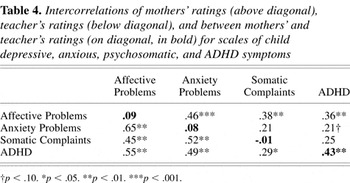
Intercorrelations for the triadic interaction scales are presented above the diagonal in Table 3, and intercorrelations for the teacher and mothers' ratings are presented below the diagonal in Table 4. The correlations between teacher and mother ratings are shown on the diagonal of Table 4. Teachers' and mothers' ratings were unrelated for Affective Problems, Anxiety Problems, and Somatic Complaints. Mother and teacher ratings of ADHD were significantly correlated (r = .43, p < .001). Because most of mother and teacher ratings were unrelated, the regressions using mother and teacher ratings were analyzed separately.
Intercorrelations of mothers' ratings (above diagonal), teacher's ratings (below diagonal), and between mothers' and teacher's ratings (on diagonal, in bold) for scales of child depressive, anxious, psychosomatic, and ADHD symptoms

Intercorrelations among triadic family interactions at 24 months (N = 96)

Relations between maternal depression and children's anxious and depressive symptoms
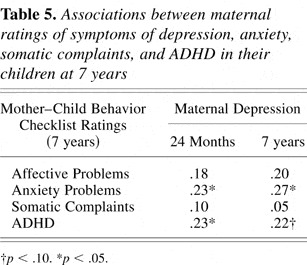
As shown in Table 5, mothers' self-report ratings of depressive symptoms at 2 and 7 years significantly forecast mothers' ratings of anxiety and depression in children at 7 years. Specifically, maternal depression at 2 and 7 years was correlated significantly with mother-reports of Anxiety Problems (r = .23, p < .05) and (r = .27, p < . 05), respectively, in children at 2 and 7 years. Maternal depression at 2 and 7 years was not related to any of the teacher-reported symptoms.
Associations between maternal ratings of symptoms of depression, anxiety, somatic complaints, and ADHD in their children at 7 years

Family relationship antecedents of emotional and behavior problems in children at 7 years
Teacher ratings
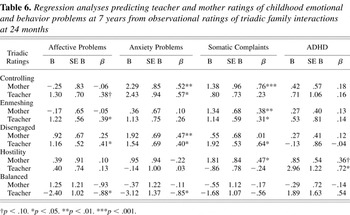
A series of simultaneous multiple regression analyses were conducted with the five observational ratings of triadic interactions, controlling, enmeshing patterns, emotional disengagement, hostility, and balanced relationships, entered as the predictor variables and the teacher ratings of child outcome as the dependent variable. Four separate regressions were conducted, one for each of the teacher ratings of symptoms of Affective Problems, Anxiety Problems, Somatic Complaints, and ADHD. As shown in Table 6, controlling for the other 24-month triadic ratings, high levels of controlling interactions at 24 months predicted teachers' ratings of Anxiety Problems (t = 2.60, p < .01) and showed a nonsignificant trend with Affective Problems (t = 1.72, p < .09). Moreover, observational ratings of enmeshed family patterns at 24 months forecast symptoms of Affective Problems (t = 2.19, p < .03) and Somatic Complaints (t = 1.95, p < .05). Emotional disengagement among family member predicted symptoms of Affective Problems (t = 2.24, p < .03), Anxiety Problems (t = 2.21, p < .03), and Somatic Complaints (t = 3.63, p < .001). Hostility in the family at 24 months predicted symptoms of ADHD (t = 2.66, p < 01) in children at 7 years. Finally, balanced interactions forecast lower ratings on Affective Problems (t = 2.35, p < .02) and Anxiety Problems (t = 2.30, p < .03).
Regression analyses predicting teacher and mother ratings of childhood emotional and behavior problems at 7 years from observational ratings of triadic family interactions at 24 months

Mother ratings
A series of hierarchical multiple regression analyses were conducted with the five triadic ratings scales, controlling, enmeshing patterns, emotional disengagement, hostility and balanced interactions, and maternal depressive symptoms at 7 years were entered as the predictor variables and mother ratings of child outcomes at 7 years as the dependent variable. Four separate regressions were conducted for mothers' ratings of the child outcome, one for each variable: Affective Problems, Anxiety Problems, Somatic Complaints, and ADHD. Maternal depression was correlated significantly with their ratings of anxiety and depression in their children. To control for biases due to mothers' negative mood in reporting their children's symptoms of depression, anxiety and somatic problems, maternal depressive symptoms at 7 years were entered in Step 1 of each regression. As shown in Table 6, higher levels of controlling interactions in the family at 24 months were significantly related to Anxiety Problems (t = 2.69, p < .01) and Somatic Complaints (t = 1.95, p < .05). In addition, emotional disengagement in the triad forecast Anxiety Problems (t = 2.84, p < .01). Hostility predicted somatic complaints (t = 2.36, p < .03), and showed a nonsignificant trend with ADHD symptoms (t = 1.79, p < .09).
Interactions between gender and family interaction patterns
Gender differences were significant for teacher ratings of Affective Problems (t = 2.75, p < .05), and ADHD (t = −2.82, p < .05) and mothers' ratings of Somatic Complaints (t = 3.50, p < .05). Moderator analyses, however, were conducted to examine only those gender differences hypothesized to contribute to the magnitude of the association between the family triadic patterns and child outcomes. Specifically, it was expected that boys who experience enmeshing boundary disturbances would be more likely to develop symptoms of ADHD. It was anticipated also that girls, more than boys, who experience enmeshing or emotionally disengaged family interactions during toddlerhood would display symptoms of depression during middle childhood. Separate moderator analyses were conducted for teacher and mother ratings of ADHD and Affective Problems.
Teacher ratings
A series of hierarchical regressions were performed. In all analyses, gender and one family interaction were entered in Step 1, and the interaction between gender and the family pattern was entered in Step 2. In the first regression, ADHD was the dependent variable and gender and the enmeshed family pattern were the predictor variables. As predicted, the overall model was significant (F = 5.40, p < .002). Gender contributed uniquely to the model (t = 2.91, p < .01), but enmeshed triadic interactions did not. However, controlling for both gender and enmeshed interactions, the interaction between gender and the enmeshing family pattern significantly forecast teacher ratings of ADHD symptoms (t = 2.45, p < .02).
In the next set of hierarchical regressions, teachers' ratings of depressive symptoms were the dependent variable. In the analyses with gender and enmeshed family pattern entered in Step 1, and Gender × Enmeshed Pattern entered in Step 2. Both gender and the enmeshed family pattern contributed uniquely to the model (t = 2.99, p < .005, and t = 2.59, p < .02, respectively). Moreover, gender differences were found to moderate the relationship between enmeshing family interactions and teachers' ratings of depression in girls (t = 1.96, p < .05). In the next analysis, gender and emotional disengagement were entered in Step 1 and Gender × Emotional Disengagement was entered in Step 2. Gender, emotional disengagement, and Gender × Emotional Disengagement contributed uniquely to the model (t = 2.56, p < .01; t = 2.47, p < .02; and t = 1.98, p < .05, respectively) indicating that gender differences significantly influenced the relationship between emotional disengagement and depression in girls.
Mother ratings
A series of hierarchical regressions were performed. In all analyses, mothers' depressive symptoms at the 7-year visit were entered in Step 1, gender and one-family interaction were entered in Step 2, and the interaction between gender and the family pattern was entered in Step 3. In the first regression, ADHD was the dependent variable, and gender and the enmeshed family pattern were the predictor variables. This analysis was not significant, indicating that for mother reports, gender differences did not moderate the association between enmeshed family patterns and ADHD symptoms.
Next, two separate hierarchical regressions were conducted to analyze whether gender differences moderated the relation between enmeshing family interactions and depressive symptoms and between emotional disengagement and depressive symptoms. None of these analyses yielded significant results. Gender differences did not significantly amplify the association between enmeshed family interactions and depressive symptoms or between controlling patterns and symptoms of depression or anxiety.
Discussion
With two notable exceptions (Duggal et al., 2001; Pettit et al., 2001), most investigations of the contribution of family interactions to depression and anxiety in children are cross-sectional studies of adolescents or preadolescents. Prospective longitudinal studies of the early family antecedents of anxiety, depression, and somatic complaints in middle childhood are scant so that the direction of effects cannot be determined. Moreover, the vast majority of studies of ADHD in children have examined the biological underpinnings of this disorder (Jacobvitz, Sroufe, Stewart, & Leffert, 1990); relatively few studies have examined family relationship antecedents. Drawing on principles of family systems theory, this prospective, longitudinal study demonstrated associations between blurred and rigid boundary disturbances in triadic interactions during toddlerhood and symptoms of anxiety, depression, somatic complaints, and ADHD in children 5 years later.
Depressive symptoms in school-aged children were predicted by emotionally disengaged and unbalanced family dynamics. Disengaged triadic interactions are characterized by a lack of warmth or affection, little or no eye contact between family members, and little emotional responsiveness. Members of families scoring low on balanced interactions are notably uncomfortable showing their vulnerabilities and expressing their needs and desires. Such family dynamics are likely to interfere with toddlers' developing sense of self. Cummings and Cicchetti (1990) have suggested that children's early relationship experiences contribute to a child's early internal representation of self, which is critical to the development of healthy self-esteem. Poor self-esteem, in turn, has been considered a core symptom of depressive disorders. Another explanation for the links between depressive symptoms and emotionally disengaged and unbalanced interactions is that girls in these families are discouraged from expressing feelings, leading them to withdraw and become depressed.
Experiencing enmeshed family patterns, whereby one parent draws in the child by turning to the child for parental guidance or intimacy or by undermining the authority of the spouse, also forecast affective problems in children. Moreover, findings in this study suggest that girls, more than boys, who experienced enmeshed family patterns more often developed depressive symptoms, according to teacher ratings. Although there was no evidence in this study that mothers who were depressed at the 24-month assessment engaged more frequently in enmeshed interactions, it is possible that over time they involved their daughters more often than sons in their difficulties. Klimes–Dougan and Bolger (1998) found that female adolescents feel more responsible for their mothers' depression; they express more sadness and worry than do male adolescents. Similarly, Radke–Yarrow, Richters, and Wilson (1988) describe a group of depressed mothers who used their daughters as comfort objects, mixing physical affection and sadness in their interactions. Our data suggest that daughters whose parents make them feel responsible for the parents' well-being, which is generally the case in enmeshed families, may develop symptoms of affective disorders as early as age 7.
Finding an association between controlling early family interactions and anxiety in middle childhood is consistent with a growing body of research demonstrating associations between parental control and symptoms of anxiety (fears, worrying) or anxiety disorders in adolescents (Barber, 1996; Dumas, LaFreniere, & Serketich, 1995; Gruner, Muris, & Merkelbach, 1999; Hudson & Rapee, 2001; Mattanah, 2001; Muris & Merckelbach, 1998; Papini & Roggman, 1992; Siqueland, Kendall, & Steinberg, 1996; Whaley, Pinto, & Sigman, 1999; see Wood, McLeod, Sigman, Hwang, & Chu, 2003, for a comprehensive review). It is interesting to note, however, that these studies have not consistently found associations between childhood anxiety and controlling behavior on the part of mother and father. For example, in some studies paternal control, but not maternal control, has been associated with anxiety (Barber, 1996; Mattanah, 2001). Yet, in other studies, maternal control has been associated with anxiety in adolescents (Whaley et al., 1999; Siqueland et al., 1996). Drawing on a systems approach, it is understandable that associations between parental control and anxious symptoms might only occur with one parent. In the present study, high levels of control in the triad almost always involved only one parent behaving in a controlling manner and the other parent acting submissively, allowing their spouse to dominate both themselves and their child.
It is important to note that controlling family interactions forecast anxious symptoms even after controlling for enmeshed patterns. Most of the studies of parental psychological control have used a 10-item self-report instrument (the Psychological Autonomy versus Psychological Control; Schaefer, 1965) to assess parental control. The items on this measure combine dominating behaviors (e.g., “is always telling me how I should behave,” “would like to be able to tell me what to do all the time,” “is always trying to change me”) with items related to enmeshment (e.g., “stops talking to me until I please her [him] again,” “says, if I really cared for her [him] I would not do things that cause her [him] to worry,” “will avoid looking at me when I have disappointed her [him]”). The observational scales in this study were designed to discriminate between interactions that appeared dominating and controlling and those on the enmeshing scale in which parental behaviors were designed to draw in the child through guilt-inducing comments or by acting helpless.
Hostile parental behavior often accompanies controlling and enmeshing parental behavior. As observed in Sroufe and Ward's (1980) study of mothers' seductive behavior with toddlers, the mothers in these interactions acted sweet and coy in an attempt to manipulate their children to behave in a particular way. However, these same mothers also were rated higher on punitive and harsh behavior. In the present study, observational ratings of hostility were moderately correlated with ratings of controlling and enmeshed family interactions. Yet, even after controlling for hostility, controlling family interactions still predicted depressive and anxious symptoms in children.
Hostility in the triadic interactions forecast mothers' ratings of somatic complaints in their children. The hostility scale in this study assessed parents who were demeaning, overly critical and sarcastic with each other or with their child, but did not openly express anger, upset, or hurt, rendering it unlikely that the sources of their discontent would be discussed openly. Such indirect expressions of anger may be related to children's difficulty openly expressing their own sadness; instead these children report headaches, stomachaches or have difficulty with bowel movements. Children in hostile families systems may also find that expressing physical illness is a safe way to receive care, because open expression of sadness or distress is likely to provoke parental hostility. It is also possible that, over time, hostile early family interactions will transform into psychologically controlling interactions. Pettit and colleagues (2001) found that mothers who were harsh when their children were 5 years old more often were psychologically controlling when their children reached adolescence. Adolescent females' reports of parental control were, in turn, associated with mother-reported and child-reported anxiety. Following the children in this study into adolescence would further clarify the distinct role of different patterns of early family interactions in the emergence of emotional and behavior problems in children.
Somatic complaints, as reported by both mothers and teachers, also predicted enmeshed family patterns at 24 months. As with hostility, perhaps children in families that violate role boundaries by placing the child in a caregiving role have learned that they can receive some tenderness and care from their mothers by complaining that they do not feel well physically. Family therapists have noted that children who display patterns of compulsive caregiving toward their parent may frequently present symptoms of illness because it is a safe way to elicit parental caregiving while maintaining the appearance of compliance (Koslowska, 2001; Koslowska & Hanney, 2002). Such children appear to be very competent, overly bright and cheerful, and unusually attentive to the parent with whom they have an alliance. According to Koslowska (2001), the parents of these children generally place high demands on their child, and the children are thus “fearful of falling short of parental expectations and risking parental anger, rejection, displeasure …” (p. 582). It is likely that these children actually do experience more headaches, stomachaches, and so forth as a result of maintaining the burden of meeting their parents' needs while constantly denying their own.
Finally, teacher reports of symptoms of ADHD were predicted by hostile family interactions at 24 months. This finding is consistent with studies demonstrating a relationship between ADHD behaviors and mother–child conflict in the family (Burt, Krueger, McGue, & Iacono, 2003; Campbell & Ewing, 1990). Burt and colleagues examined family conflict after the children had developed symptoms of ADHD; therefore, it is unclear whether conflictual interactions were a consequence or a cause of impulsive, overactive, and inattentive symptoms in the children. Campbell and Ewing (1990), on the other hand, followed children from age 3 to 9. However, the 3-year-olds in their study were parent-referred problem preschoolers. In the present study, hostile family interactions in a nonclinic sample of toddlers forecast the development of ADHD in middle childhood. Future studies, however, are needed to determine whether symptoms of ADHD such as impulsivity were already present in toddlers contributing to hostility in the family. Finding that boys who experienced enmeshed family interactions were at risk for developing symptoms of ADHD is consistent with previous longitudinal studies demonstrating a link between 42-month-olds whose mothers turned to them for intimacy or caregiving or engaged in inappropriate physical contact and the development of ADHD symptoms in kindergarten (Jacobvitz & Sroufe, 1987) and in third and sixth grades (Carlson et al., 1995).
The findings in this study were based on reports gathered from mothers and teachers. Most studies of childhood depression and anxiety, however, have relied more heavily on mother-reported symptoms than on teacher-reported symptoms because mothers are thought to be more aware of internalizing symptoms in their children. The results of this study highlight the importance of obtaining reports from both mothers and teachers. Consistent with other studies, mothers and teachers showed modest correlations on ratings of Affective Problems, Anxiety Problems, Somatic Complaints, and ADHD, however, mother and teacher reports also differed in interesting ways. It was striking that enmeshing family interactions forecast teachers' but not mothers' ratings of depressed symptoms in the children. One explanation for this finding is that children who experience parent–child role reversal may seem overly eager to please, self-deprecating, and generally exhibit low self-esteem at school; or they may show extreme sadness at times, such as crying. At home, on the other hand, mothers who turn to their children to meet their emotional needs may not notice that their children are sad and withdrawn, particularly if the children feel responsible for their enmeshed parent and are thus more likely to try to be pleasing to the parent rather than troublesome (Koslowska, 2001). As a consequence, these mothers may actually believe that their children are emotionally strong (neither sad nor fearful), and thus able to meet their needs. Future research should explore these interesting possibilities.
A number of limitations of the present study should be considered. In the present study, the assessment of enmeshed triadic patterns did not distinguish interactions characterized by parentification, spousification, and parent–child alliances. Rather, this study conceptualized these forms of enmeshment as functionally equivalent. It is possible, however, that the overly stimulating qualities of spousification is related to ADHD in boys and the caregiving required of children in the parentification and parent–child alliance pattern is what predicted the depressive symptoms in girls. Seductive maternal behaviors at 24 months have been shown to forecast poor boundaries between mothers and sons at 42 months (Sroufe et al., 1985), which in turn, predicted ADHD in kindergarten. Furthermore, girls, more often than boys, take responsibility for their parents' fights and side with their mothers (Buchanan, Maccoby, & Dornbusch, 1991). These girls may be at risk for becoming depressed and anxious.
Moreover, not all types of poor boundaries were assessed in this study. Specifically, parents may deflect attention onto their children's problems or special needs as a way of avoiding confronting conflict in their marriage (termed scapegoating). Children, in turn, may take on the role of identified patient to maintain stability, or homeostasis in the family (Minuchin, Rosman, & Baker, 1978). Scapegoating is similar to “detouring” in which the couple “detours” around their marital problems by deflecting attention on the problems or special needs of their child (Kerig, 1995). Kerig (1995) found that parents' reports of internalizing symptoms were related to families members' concurrent reports of the detouring pattern, but not to cohesive (family members all close to one another), separate (target child and parents all distant from one another) or triangulated (mother–child coalitions, father–child coalitions, or child in the middle, with each parent seeking a coalition with the child) family interactions. It would be interesting to determine whether detouring patterns developed early in the children's lives, before they develop internalizing symptoms, forecasts depression, anxiety, and somatic problems in middle childhood.
In summary, findings from this study have important implications for intervention. The children in this study were not clinically diagnosed with depression or anxiety. However, enmeshing, controlling, and emotionally disengaged family interactions did forecast elevated levels of anxiety and depression in middle childhood, which may significantly increase the likelihood that these children will suffer from anxiety and affective disorders during adolescence. Effective programs aimed at working with the entire family may be needed to prevent the development of these disorders. The importance of early family intervention programs is accentuated by research that suggests children who suffer from high anxiety are more likely to become anxious adults (Mattison & Spitznagel, 1999) and children who suffer from depressive symptoms are likely to battle depression throughout their lives (Kovacs, 1996). In short, effective early intervention programs may be a significant opportunity to prevent a great deal of suffering for children and their families.
References
REFERENCES
Achenbach, T. M.
(1991).
Manual for the Child Behavior
Checklist/4–18 and 1991 Profile.
Burlington, VT:
University of Vermont, Department of Psychiatry.
Ainsworth, M. D. S.,
Blehar, M. C.,
Waters, E., &
Wall, S.
(1978).
Patterns of attachment.
Hillsdale, NJ:
Erlbaum.
Barber, B. K.
(1996).
Parental psychological control: Revisiting a neglected construct.
Child Development
67,
3296–3319.Google Scholar
Beardslee, W. R.,
Versage, E. M., &
Gladstone, T. R. G.
(1998).
Children of affectively ill parents: A review of the past 10 years.
Journal of the American Academy of Child and Adolescent Psychiatry
37,
1134–1138.Google Scholar
Biederman, J.,
Mick, E.,
Faraone, S. V.,
Braaten, E.,
Doyle, A.,
Spencer, T.,
Wilens, T. E.,
Frazier, E., &
Johnson, M. A.
(2002).
Influence of gender on attention deficit hyperactivity disorder in
children referred to a psychiatric clinic.
American Journal of Psychiatry
159,
36–42.Google Scholar
Birmaher, B.,
Ryan, N. D.,
Williamson, D. E.,
Brent, D. A.,
Kaufman, J.,
Dahl, R. E.,
Perel, J., &
Nelson, B.
(1996).
Childhood and adolescent depression: A review of the past 10 years.
Part 1.
Journal of the American Academy of Child and Adolescent Psychiatry
35,
1427–1439.Google Scholar
Bowen, M.
(1978).
Family therapy in clinical practice.
New York:
Aronson.
Bowlby, J.
(1969).
Attachment and loss: Vol. 1. Attachment.
New York:
Basic Books.
Buchanan, C. M.,
Maccoby, E. E., &
Dornbusch, S. M.
(1991).
Caught between parents: Adolescents' experience in divorced
homes.
Child Development
62,
1008–1029.Google Scholar
Burt, S. A.,
Krueger, R. F.,
McGue, M., &
Iacono, W.
(2003).
Parent–child conflict and the comorbidity among childhood
externalizing disorders.
Archive of General Psychiatry
60,
505–513.Google Scholar
Byng–Hall, J.
(1999).
Family and couple therapy: Toward greater security. In
J. Cassidy &
P. R. Shaver (Eds.),
Handbook of attachment: Theory, research, and clinical applications
(pp.
625–645).
New York:
Guilford Press.
Campbell, S. B., &
Ewing, L. J.
(1990).
Follow-up of hard-to-manage preschoolers: Adjustment at age 9 and
predictors of continuing symptoms.
Journal of Child Psychology and Psychiatry
31,
871–899.Google Scholar
Carlson, E. A.,
Jacobvitz, D., &
Sroufe, L.A.
(1995).
A developmental investigation of inattentiveness and hyperactivity.
Child Development
66,
37–54.Google Scholar
Cicchetti, D.,
Cummings, E. M.,
Greenberg, M., &
Marvin, R.
(1990).
An organizational perspective on attachment beyond infancy. In
M. T. Greenberg,
D. Cicchetti, &
E. M. Cummings (Eds.),
Attachment in the preschool years (pp.
3–49).
Chicago:
University of Chicago Press.
Cicchetti, D.,
Rogosch, F. A., &
Toth, S. L.
(1998).
Maternal depressive disorder and contextual risk: Contributions to
the development of attachment insecurity and behavior problems in
toddlerhood.
Development and Psychopathology
10,
283–300.Google Scholar
Cowan, P. A.
(1997).
Beyond meta-analysis: A plea for a family systems view of
attachment.
Child Development
68,
601–603.Google Scholar
Cox, M., &
Paley, B.
(1997).
Families as systems.
Annual Review of Psychology
48,
243–267.Google Scholar
Cummings, E. M., &
Cicchetti, D.
(1990).
Toward a transactional model of relations between attachment and
depression. In
M. T. Greenberg,
D. Cicchetti, &
E. M. Cummings (Eds.),
Attachment in the preschool years (pp.
339–372).
Chicago:
University of Chicago Press.
Cummings, E. M., &
Davies, P. T.
(1994).
Maternal depression and child development.
Journal of Child Psychology and Psychiatry
35,
73–112.Google Scholar
Curran, M. A.,
Hazen, N.,
Jacobvitz, D., &
Feldman, A.
(in press).
Representations of early family relationships predict marital
maintenance during the transition to parenthood.
Journal of Family Psychology.
Downey, G., &
Coyne, J. C.
(1990).
Children of depressed parents: An integrative review.
Psychological Bulletin
108,
50–76.Google Scholar
Duggal, S.,
Carlson, E. A.,
Sroufe, L. A., &
Egeland, B.
(2001).
Depressive symptomatology in childhood and adolescence.
Development and Psychopathology
13,
143–164.Google Scholar
Dumas, J. E.,
LaFreniere, P. J.,
Serketich, W. J.
(1995).
“Balance of power”: A transactional analysis of control
in mother–child dyads involving socially competent, aggressive,
and anxious children.
Journal of Abnormal Psychology
104,
104–113.Google Scholar
Fullinwider–Bush, N., &
Jacobvitz, D. B.
(1993).
The transition to young adulthood: Generational boundary
dissolution and female identity development.
Family Process
32,
87–103.Google Scholar
Garber, J.,
Zeman, J., &
Walker, L. S.
(1990).
Recurrent abdominal pain in children: Psychiatric diagnoses and
parental psychopathology.
Journal of American Academy of Child and Adolescent Psychiatry
29,
648–656.Google Scholar
Garland, E. J., &
Weiss, M.
(1995).
Subgroups of adolescent depression.
Journal of the American Academy of Child and Adolescent Psychiatry
34,
831–832.Google Scholar
Gruner, K.,
Muris, P., &
Merkelbach, H.
(1999).
The relationship between anxious raring behaviors and anxiety
disorders symptomatology in normal children.
Journal of Behavior Therapy and Experimental Psychiatry
30,
27–35.Google Scholar
Hammen, C.
(1991).
Depression runs in families: The social context of risk and
resilience in children of depressed mothers.
New York:
Springer–Verlag.
Harrington, R.,
Rutter, M., &
Fombonne, E.
(1996).
Developmental pathways in depression: Multiple meanings,
antecedents, and endpoints.
Development and Psychopathology
8,
601–616.Google Scholar
Hudson, J. L., &
Rapee, R. M.
(2001).
Parent–child interactions and anxiety disorders: An
observational study.
Behaviour Research and Therapy
39,
1411–1427.Google Scholar
Jacobvitz, D., &
Bush, N.
(1996).
Reconstructions of family relationships: Parent–child
alliances, personal distress and self-esteem.
Developmental Psychology
32,
732–743.Google Scholar
Jacobvitz, D.,
Leon, K., &
Hazen, N.
(2004).
Does expectant mothers' unresolved trauma predict frightening
maternal behavior? Risk and protective factors.
Manuscript submitted for publication.
Jacobvitz, D.,
Riggs, S., &
Johnson, E. M.
(1999).
Cross-sex and same-sex family alliances: Immediate and long-term
effects on daughters and sons. In
N. D. Chase (Ed.),
Burdened children: Theory, research and treatment of
parentification (pp.
34–55).
Thousand Oaks, CA:
Sage.
Jacobvitz, D., &
Sroufe, L. A.
(1987).
The early caregiver–child relationship and Attention Deficit
Disorder with Hyperactivity in kindergarten: A prospective study.
Child Development
58,
1488–1495.Google Scholar
Jacobvitz, D.,
Sroufe, L. A.,
Stewart, M., &
Leffert, N.
(1990).
Treatment of attentional and hyperactive problems in children with
sympathomimetic drugs: A follow-up review.
Journal of the American Academy of Child and Adolescent Psychiatry
29,
677–688.Google Scholar
Jurkovic, G. J.,
Morrell, R., &
Thirkield, A.
(2002).
Assessing childhood parentification: Guidelines for researchers
and clinicians. In
N. D. Chase (Ed.),
Burdened children: Theory, research and treatment of
parentification (pp.
92–113).
Thousand Oaks, CA:
Sage.
Kerig, P. K.
(1995).
Assessing the links between interparental conflict and child
adjustment: The Conflict and Problem-Solving Scales.
Journal of Family Psychology
10,
454–473.Google Scholar
Klimes–Dougan, B., &
Bolger, A. K.
(1998).
Coping with maternal depressed affect and depression: Adolescent
children of depressed and well mothers.
Journal of Youth and Adolescence
27,
1–15.Google Scholar
Kobak, E. R.,
Sudler, N., &
Gamble, W.
(1991).
Attachment and depressive symptoms during adolescence: A
developmental pathways analysis.
Development and Psychopathology
3,
461–474.Google Scholar
Koslowska, K.
(2001).
Good children presenting with conversion disorder.
Clinical Child Psychology and Psychiatry
4,
575–591.Google Scholar
Koslowska, K., &
Hanney, L.
(2002).
The network perspective: An integration of attachment and family
systems theories.
Family Process
41,
285–310.Google Scholar
Kovacs, M.
(1996).
The course of childhood-onset depressive disorders.
Psychiatric Annals
26,
326–330.Google Scholar
Kretchmar, M. D., &
Jacobvitz, D.
(2002).
Mother–child observations across three generations:
Attachment, boundary patterns, and the intergenerational transmission
of caregiving.
Family Process
41,
351–374.Google Scholar
Marvin, R. S., &
Stewart, R. B.
(1990).
A family systems framework for the study of attachment. In
M. T. Greenberg,
D. Cicchetti, &
E. M. Cummings (Eds.),
Attachment in the preschool years: Theory, research and
intervention (pp.
51–86).
Chicago:
University of Chicago Press.
Mattanah, J. F.
(2001).
Parental psychological autonomy and children's academic
competence and behavioral adjustment in late childhood: More than just
limit-setting and warmth.
Merrill–Palmer Quarterly
47,
355–376.Google Scholar
Mattison, R. E., &
Spitznagel, E. L.
(1999).
Long-term stability of child behavior checklist profile types in
child psychiatric clinic population.
Journal of the American Academy of Child and Adolescent Psychiatry
38,
700–707.Google Scholar
Minuchin, S.
(1974).
Families and family therapy.
Cambridge, MA:
Harvard University Press.
Minuchin, S.,
Rosman, B. L., &
Baker, L.
(1978).
Psychosomatic families.
Cambridge, MA:
Harvard University Press.
Muris, P., &
Merckelbach, H.
(1998).
Perceived parental rearing behaviour and anxiety disorders symptoms
in normal children.
Personality and Individual Differences
25,
1199–1206.Google Scholar
Nolen–Hoeksema, S.
(2001).
Gender differences in depression.
Current Directions in Psychological Science
10,
173–176.Google Scholar
Offord, D. R.,
Boyle, M. H.,
Szatmari, P.,
Raegrant, N. I.,
Links, P. S.,
Cadman, D. T.,
Blyles, J. A.,
Crawford, J. W.,
Blum, H. M.,
Byrne, C.,
Thomas, H., &
Woodward, C. A.
(1987).
Ontario Child Health Study 2: 6-Month prevalence of disorder and
rates of service utilization.
Archives of General Psychiatry
44,
832–836.Google Scholar
Papini, D. R., &
Roggman, L. A.
(1992).
Adolescent perceived attachment to parents in relation to
competence, depression and anxiety: A longitudinal study.
Journal of Early Adolescence
11,
258–275.Google Scholar
Pettit, G. S.,
Laird, R. D.,
Dodge, K. A.,
Bates, J. E., &
Criss, M. M.
(2001).
Antecedents and behavioral-problem outcomes of parental monitoring
and psychological control in early adolescence.
Child Development
72,
583–598.Google Scholar
Radke–Yarrow, M.,
Richters, J., &
Wilson, W. E.
(1988).
Child development in the network of relationships. In
R. A. Hinde &
J. Stevenson–Hinde (Eds.),
Relationships within families: Mutual Influences (pp.
48–67).
Oxford:
Clarendon Press.
Radloff, L. S.
(1977).
The CES-D scale: A self-report depression scale for research in the
general population.
Applied Psychological Measurement
1,
3855–401.Google Scholar
Riggs, S. A., &
Jacobvitz, D.
(2002).
Expectant parents' representations of early attachment
relationships: Associations with mental health and family history.
Journal of Consulting and Clinical Psychology
70,
195–204.Google Scholar
Santor, D. A.,
Zuroff, D. C.,
Ramsay, J. O.,
Cervantes, P., &
Palacios, J.
(1995).
Examining scale discriminability in the BDI and CES-D as a function
of depressive severity.
Psychological Assessment
7,
131–139.Google Scholar
Schaefer, E. S.
(1965).
Children's reports of parental behavior: An inventory.
Child Development
36,
413–424.Google Scholar
Siqueland, L.,
Kendall, P. C., &
Steinberg, L.
(1996).
Anxiety in children: Perceived family environments and observed
family interaction.
Journal of Clinical Child Psychology
25,
225–237.Google Scholar
Sroufe, L. A.,
Bennett, C.,
Englund, M.,
Urban, J., &
Shulman, S.
(1993).
The significance of gender boundaries in preadolescence:
Contemporary correlates and antecedents of boundary violation and
maintenance.
Child Development
64,
455–466.Google Scholar
Sroufe, L. A., &
Jacobvitz, D.
(1989).
Diverging pathways, developmental transformations, multiple
etiologies and the problem of continuity in development.
Human Development
32,
196–204.Google Scholar
Sroufe, L. A.,
Jacobvitz, D.,
Mangelsdorf, S.,
DeAngelo, E., &
Ward, M. J.
(1985).
Generational boundary dissolution between mothers and their
preschool children: A relationship systems approach.
Child Development
56,
316–325.Google Scholar
Sroufe, L. A., &
Ward, M. J.
(1980).
Seductive behavior of mothers of toddlers: Occurrence, correlates
and family origins.
Child Development
51,
1222–1229.Google Scholar
Trad, P. V.
(1994).
Depression in infants. In
W. M. Reynolds &
H. F. Johnston (Eds.),
Handbook of depression in children and adolescents (pp.
401–426).
New York:
Plenum Press.
Weissman, M. M.,
Warner, V.,
Wickramaratne, P.,
Moreau, D., &
Olfson, M.
(1997).
Offspring of depressed parents.
Archives of General Psychiatry
54,
932–940.Google Scholar
Whaley, S. E.,
Pinto, A., &
Sigman, M.
(1999).
Characterizing interactions between anxious mothers and their
children.
Journal of Consulting and Clinical Psychology
67,
826–836.Google Scholar
Wood, J. J.,
McLeod, B. D.,
Sigman, M.,
Hwang, W., &
Chu, B. C.
(2003).
Parenting and childhood anxiety: Theory, empirical findings, and
future directions.
Journal of Child Psychology and Psychiatry
44,
134–151.Google Scholar
Descriptive statistics of teacher and mother reports of child outcomes at 7 years

Descriptive statistics of triadic family interactions at 24 months and maternal depressive symptoms at 24 months and 7 years
Intercorrelations of mothers' ratings (above diagonal), teacher's ratings (below diagonal), and between mothers' and teacher's ratings (on diagonal, in bold) for scales of child depressive, anxious, psychosomatic, and ADHD symptoms

Intercorrelations among triadic family interactions at 24 months (N = 96)
Associations between maternal ratings of symptoms of depression, anxiety, somatic complaints, and ADHD in their children at 7 years
Regression analyses predicting teacher and mother ratings of childhood emotional and behavior problems at 7 years from observational ratings of triadic family interactions at 24 months
 You have
Access
- 127
- Cited by