Systematic monitoring of pediatric exanthema is largely absent from established public health surveillance, yet should be considered an essential component of any effective surveillance system in pediatric populations. Monitoring for pediatric exanthema is increasingly pertinent given the recent United States (US) measles epidemic in under-vaccinated populations.1 Rash also has a more extreme characteristic as the often earliest clinical symptom of bioterrorism agents like smallpox, anthrax, plague, and trichothecene toxin.2-Reference Wagner, Moore and Aryel6 As frequently mild disease, however, pediatric exanthema are rarely captured by traditional, clinic-based surveillance systems.
Child care centers in the US, however, offer a particularly ideal population for exanthema surveillance based on a number of reasons: (i) nationally, a large proportion of children aged 0-5 years attend out-of-home child care,Reference Shope and Hashikawa7 (ii) child care-related absenteeism serves as a more specific measure for illness than school settings,Reference Wagner, Moore and Aryel6,Reference Schellpfeffer, Collins, Brousseau, Martin and Hashikawa8 (iii) and active surveillance in centers is performed year-round due to licensing regulations and child care policies associated with illness-based exclusion.Reference Schellpfeffer, Collins, Brousseau, Martin and Hashikawa8-Reference Robinson11 Moreover, pediatric exanthema illnesses are prevalent in child care center environments and are responsible for some of the highest numbers of child absentee days compared to other symptomatic diseases.Reference Cordell, Waterman and Chang12,Reference Cordell, MacDonald, Solomon, Jackson and Boase13 A national survey of parents with sick children unable to attend child care found that subsequent emergency department and urgent care use was most associated with rash symptoms.
In 2013, we created a novel, online, free-to-use, child care center-based illness reporting network known as Michigan Child Care Related Infection Surveillance Program (MCRISP). MCRISP, designed with input from local public health agencies, collates electronic illness reports entered online by child care centers from within a single county in southeast Michigan.Reference Schellpfeffer, Collins, Brousseau, Martin and Hashikawa8,Reference DeJonge, Martin and Hayashi9 Unlike Michigan’s established regional surveillance systems that focus largely on respiratory and gastrointestinal illness or specific diseases only, MCRISP was designed to capture common childhood illness symptoms that may not be routinely reported to local primary care clinics, hospitals, or emergency departments. MCRISP has already been demonstrated to be reliable, user-friendly, and representative of real-time outbreaks for gastrointestinal and respiratory illness.Reference Schellpfeffer, Collins, Brousseau, Martin and Hashikawa8,Reference DeJonge, Martin and Hayashi9 As part of our ongoing analysis of MCRISP surveillance data, we assessed MCRISP reports from 4.5 years of surveillance in order to describe temporal and diagnostic patterns in pediatric exanthema-associated diseases.
METHODS
MCRISP is a biosurveillance network established in December 2013 that collates online illness reports from a cohort of child care centers in Washtenaw County, Michigan. Briefly, MCRISP sentinel reporters are instructed to enter both child illnesses data occurring at child care centers and child illness-related absenteeism reported to the child care center by parents.Reference Lozon and Bradin4 All MCRISP centers are licensed child care centers, and no special training was needed for reporters to use the MCRISP system. Reporters can mark illness categories for suspected illnesses, including “norovirus-like illness,” “pink eye,” and exanthema. Illness symptoms and demographics are also requested on each report, including child age range, daily facility enrollment, and action taken by child care centers. Generally, MCRISP reports entered by reporters are symptom-based reporting rather than diagnosis-based reporting. However, if an experienced reporter is highly suspicious that certain symptoms represent a concerning diagnoses (eg, chicken pox) or parents report that the child was diagnosed by a medical provider, they have the option of entering the specific diagnosis.
Reports are routinely updated if follow-up physician diagnoses become available but are contingent on parents reporting this information. Child care center reporters are also instructed to contact the local health department immediately if certain reportable conditions are suspected (eg, measles, chicken pox).14 MCRISP reports are sent to Washtenaw County Health Department at least weekly or more often if there are unusual or unexpected spikes or clusters of illnesses being reported from one or more centers. All child care centers enroll in MCRISP voluntarily and do not receive remuneration; further details of this network have been described previously, including a published study demonstrating that respiratory and gastrointestinal illness outbreaks detected by MCRISP broadly mirrored traditional surveillance reports from within the surrounding region.Reference DeJonge, Martin and Hayashi9,Reference Hashikawa, Juhn and Nimmer17
For this analysis, we identified all cases of pediatric exanthema occurring between January 1, 2015 and June 15, 2019, which included all reports categorized with “rash” symptom or illness descriptions associated with exanthema. These reports were analyzed using basic descriptive statistics. R (version 3.5.0) was used to construct an epidemic curve for each season, stratified by type of rash illness. The University of Michigan Medical School Institutional Review Board (IRB) reviewed, approved, and deemed this study exempt.
RESULTS
As of 2019, 28 child care centers participate in MCRISP (a threefold increase from the 9 centers enrolled in MCRISP’s initial season), which represent nearly 14.5% of the 192 established child care programs in Washtenaw County.15 Immunization data from 2017 were available for 26 of these centers and indicated that an average of 83.9% of attendees were completely up-to-date on vaccinations.Reference Mack16
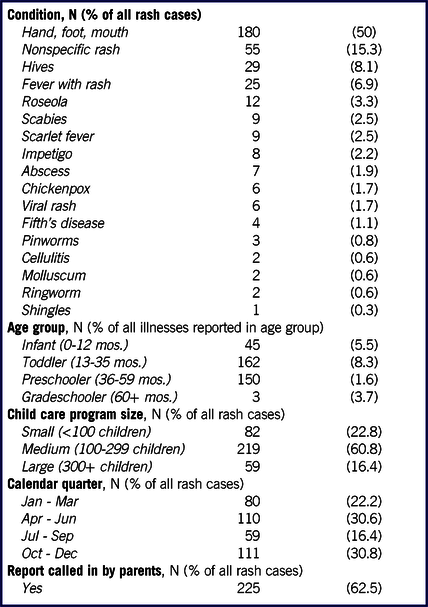
Across all 4.5 years of surveillance, a median of 115 children attended each center and MCRISP surveillance captured a total of nearly 3,000 children over that time period. Out of 12,233 individual illness cases reported to MCRISP over the surveillance period, 360 (3%) were categorized as exanthema illnesses (Table 1). The majority of these exanthema cases reported to MCRISP were reported by parents (n = 225, 62%) while the rest were identified by child care center providers. As a proportion of all reported illnesses across the study seasons, rash illnesses were most frequently reported in toddlers aged 13-35 months, followed by infants aged <12 months, kindergarteners aged ≥60 months, and preschoolers aged 36-59 months (8.3%, 5.5%, 3.7%, and 1.6% of all reported illness cases, respectively).
Characteristics of all rash episodes reported to the MCRISP network (n=360): January 1, 2015 to June 15, 2019

MCRISP = Michigan Child Care Related Infections Surveillance Program, Percentages are rounded and may not add to 100%
The 5 most frequently reported exanthema illnesses were consistent with hand-foot-mouth disease (50% of all cases, n = 180), nonspecific rash without fever (15.3%, n = 55), hives (8%, n = 29), fever with nonspecific rash (6.9%, n = 25), and roseola (3.3%, n = 12). Other bacterial- (scarlet fever and impetigo), parasitic- (scabies, pinworm, ringworm), and viral-associated infection (molluscum, varicella, shingles, Fifth’s disease) were observed less frequently (Table 1).
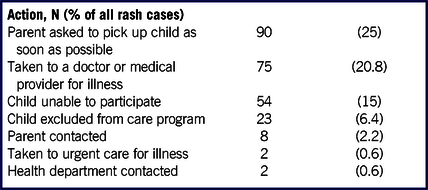
One-quarter of children with rash were sent home with parents or guardians (n = 90; Table 2). Among all rash cases, 20.8% (n = 75) were then evaluated by a primary health care provider and reported to parents; only 2 cases were reported to be seen in urgent care departments. Two exanthema cases, which presented as varicella, were reported to local health departments over 4.5 seasons (representing < 1% of total MCRISP exanthema cases reported).
Actions associated with rash episodes reported to the MCRISP network (n=360): January 1, 2015 to June 15, 2019
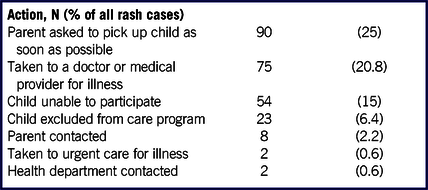
MCRISP = Michigan Child Care Related Infections Surveillance Program, Percentages are rounded and may not add to 100%
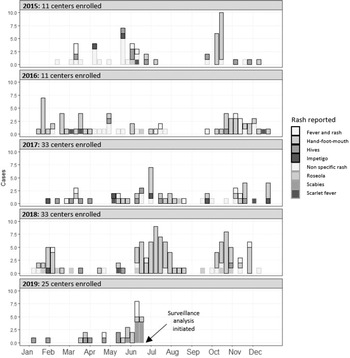
Among the top 8 most reported illnesses, no distinct seasonality was associated with particular reportable conditions across any of the surveillance seasons (Figure 1). A noticeable hand-foot-mouth outbreak occurred from mid-June to August 2018. In June 2019, MCRISP reports indicated a cluster of multiple children within a single child care center as having “hives” (Figure 1). The Washtenaw County Health Department was immediately notified and was able to intervene and prevent further cases in what was then recognized to be an emerging scabies outbreak.
Epidemic curves of the top eight most frequently reported rash illnesses reported to the MCRISP network: January 1, 2015 to June 15, 2019.

DISCUSSION
MCRISP, to our knowledge, is the first US-based online program to implement syndromic surveillance in child care environments. Leveraging MCRISP data, we were able to detect a wide range of pediatric exanthema illnesses throughout the entire calendar year—including hand-foot-mouth disease, hives, and roseola—and found notable differences in the distribution of rashes across child age groups.
Unsurprisingly, given the characteristics of a child care environment, the most prevalent type of rash reported was consistent with hand-foot-mouth disease—a viral illness transmitted by direct contact with respiratory droplets and the fecal-oral route. Nonspecific rash was also commonly reported, though we suspect that many of these cases were also viral in nature.Reference Koenig and Boatright3 Illness reports from toddlers and infants showed the highest proportion of rash illness. According to the reports, most were mild illnesses. Only 2% of all rash-associated cases were seen by a medical provider and < 1% were concerning enough to be directly reported to local health departments. This reaffirms the idea that for child care center providers, as well as for parents of attendees, blanket exclusion policies for all rashes are impractical; similarly, a requirement that all rashes be evaluated by a medical provider is not evidenced-based, practical, or financially feasible.Reference Shope and Hashikawa7
Notably, 62% of cases reported to MCRISP were collected from child care centers after parents had notified the center that their child was absent due to illness. This was encouraging, as it suggests that directors were actively engaged in contacting parents and determining the reason for any child’s absence. In part, this is what makes child care-based illness surveillance so sensitive (compared to other school-based surveillance systems)Reference Wagner, Moore and Aryel6—child care center directors and staff have a vested business interest in ensuring their community of children remains healthy. Additionally, the missed-work or lost-wage implications for parents of sick children unable to attend child care means frequent same-day communication between child care center staff and parents, which means there typically is very little lag time in reporting.
Indeed, this combination of parent- and provider-based reports has remained a key component of MCRISP since its inception. Together, these reports improve the sensitivity of the system and detect cases frequently overlooked in traditional school absenteeism counts. Director reports also improve the specificity of cases reported. MCRISP rash reports do not require child care center reporters to have substantial medical expertise. MCRISP does not require diagnosis of illness, but only reporting of illness symptoms that can be reviewed and followed by local public health. Generally, rash symptoms are highly likely to be reported by child care staff with the concern given to chickenpox, meningitis, or even dangerous allergic reactions, given their implications in child care centers.Reference Shope and Hashikawa7,Reference Hashikawa, Juhn and Nimmer17 Child care directors are particularly wary of rashes; previous studies have found that child care directors would require the immediate exclusion and/or immediate medical evaluation of a child for a suspected rash such as ringworm (tinea corporis)—a rash that would not require immediate exclusion or emergency medical evaluation based on national child care guidelines.Reference Hashikawa, Stevens and Juhn18,Reference Enserink, Noel and Friesema19
We had several limitations in this study. While MCRISP is free-to-use, we experienced some expected turnover in some of the child care center ownership and staffing that is not unique to the child care industry, with the total number of participating programs fluctuating 10-15% since MCRISP was created. From 2017 to 2019, 8 programs left MCRISP (3 temporarily due to staffing issues), a large number of which were smaller programs (< 30 children), and therefore the collection of cases reported to MCRISP may be biased toward larger child care centers. However, as a passive surveillance system, MCRISP’s significance remains as a signaling network rather than an analytical one. We also note that our child care center directors averaged 13.6 years of director experience, and therefore the network may not be generalizable to other regions with more inexperienced child care directors.Reference DeJonge, Martin and Hayashi20 However, the MCRISP network does draw from a broad range of private, university, and government-sponsored child care programs in the area and was designed specifically for all levels of child care providers without any medical expertise or substantial working experience.
FUTURE DIRECTIONS
While MCRISP provides reports to researchers and public health stakeholders, the network currently does not have a robust data dashboard or user interface to allow for bidirectional communication between public health and child care providers. Future MCRISP projects will focus on improving this 2-way communication using direct input from child care center stakeholders. We also envision targeted rollout of systems like MCRISP near emergency departments or other strategic locations, whereby individual child care centers serve as year-round sentinel reporters to monitor for illness symptoms, similar to select primary care clinics. For instance, year-round child care center surveillance information could provide pertinent data on impending outbreaks to begin appropriate quarantine of symptomatic individuals away from general waiting or triage rooms to protect medical staff and other vulnerable patients. Early evidence suggests that outbreaks captured in MCRISP are temporally accurate and at least broadly reflective of wider community epidemics.Reference DeJonge, Martin and Hayashi9 Moreover, while the network is contained to a single county in southeast Michigan, MCRISP sentinel child care centers represent a mix of private, university-based, and government-sponsored programs similar to those found in other parts of the state and country. However, outside of Scandinavia, the child care center population remains mostly untapped for rash surveillance.Reference Enserink, Noel and Friesema19,Reference Pijnacker, Mughini-Gras and Vennema21,Reference Mughini-Gras, Pijnacker and Enserink22
Local surveillance during public health emergencies has been called the “foundation of [the] national biosurveillance enterprise.”(page 17)Reference Nuzzo23 The US Centers for Disease Control and Prevention (CDC) has called for improving public syndromic surveillanceReference Shope and Hashikawa7 and numerous disease surveillance systems have been designed, including networks centered around over-the-counter health care products, chief complaints, International Classification of Diseases (ICD) codes,Reference Shope and Hashikawa7,Reference Schellpfeffer, Collins, Brousseau, Martin and Hashikawa8,Reference Olson, Heffernan and Paladini24 school/work absenteeism,Reference Wagner, Moore and Aryel6,Reference Mann, O’Connell and Zhang25-Reference Lenaway and Ambler28 and app-based social media-based networks.Reference Stockwell, Reed and Vargas29 Given the importance of early detection of both vaccine-preventable disease and potential acts of bioterrorism, and the CDC’s call for “newer, faster, and smarter” surveillance,30 a priori, we recognized that child care center populations had the potential to serve as reliable group for surveillance of rash-associated illness in the community. Our results suggest that the MCRISP reporting system is well-equipped to monitor seasonal and demographic variation in patterns of pediatric exanthema. During critical situations (eg, measles outbreak or bioterrorism concerns), networks need to have the capability for surveillance to monitor for atypical exanthema cases or cases that surge above baseline.
Future efforts should recognize that a community-based surveillance model like MCRISP can connect significant public health stakeholders in a community and has the potential to augment existing public health surveillance networks by providing valuable real-time information about concerning infectious symptoms in an at-risk population.
Author contributions
AM assisted with data analysis and drafted and revised the manuscript. PD assisted in surveillance data analysis, created epidemic curves, and reviewed and revised the final manuscript. SM aided with initial MCRISP work and reviewed the final manuscript. KC reviewed and revised the manuscript. MH reviewed and revised the manuscript. ETM conceptualized the analysis, and reviewed and revised the manuscript. ANH established the MCRISP network, conceptualized the analysis, and reviewed and revised the manuscript. All authors approved the final manuscript as submitted and agree to be accountable for all aspects of the work.
List of Abbreviations
CDC Centers for Disease Control and PreventionIRB Institutional Review BoardMCRISP Michigan Child Care Related Infections Surveillance ProgramUS United States
Supplementary material
To view supplementary material for this article, please visit https://doi.org/10.1017/dmp.2020.137
Conflict of Interest Statement
The authors have no conflicts of interest to declare.