The aim of this paper is to extend our understanding of the mechanisms underpinning children's knowledge of and access to morphology by considering a group of children who have word finding difficulties (WFDs; German & Simon, Reference German and Simon1991). These children have frequent failures to retrieve words and specific problems with inaccurate and slow naming (German & Simon, Reference German and Simon1991). The impairments have been attributed to impaired or less elaborate semantic representations which make access to lexical information difficult (Messer, Dockrell & Murphy, Reference Messer, Dockrell and Murphy2004; McGregor & Waxman, Reference McGregor and Waxman1998), or to difficulties with establishing and accessing phonological features of lexical representations (Constable, Stackhouse & Wells, Reference Constable, Stackhouse and Wells1997; McGregor & Appel, Reference McGregor and Appel2002). A systematic examination of the performance of children with word finding difficulties (CwWFDs) on tasks addressing morphological competence has not yet been conducted. To remedy this situation our aim is to map relationships between lexical and morphological skills, evaluate current understandings of WFDs and contribute to current debates about models attempting to explain the nature of underlying linguistic representation.
A framework for this investigation is provided by the dual-mechanism model (Pinker, Reference Pinker1999). This posits two separate systems underpinning a dissociation in linguistic performance; a system where rule-based linguistic items are computed on-line (e.g. regular morphological phenomena such as past tense formation), and a system where irregular items are retrieved from an associative memory-based lexicon. According to the model, word frequency is not expected to affect the production of regular items, since these are computed by a rule-based process. In contrast, irregular items are subject to frequency effects related to ease of retrieval from memory (i.e. high frequency items are retrieved more accurately and faster).
Findings from several studies have supported these predictions (e.g. Prasada, Pinker & Snyder, Reference Prasada, Pinker and Snyder1990; Ullman, Maloof, Hartshorne, Estabrooke, Brovetto & Walsenski, under revision; Miozzo, Reference Miozzo2003). In addition, there have been suggestions that language difficulties can involve impairments to either the rule-governed or associative system.
Van der Lely & Ullman (Reference van der Lely and Ullman2001) propose that individuals with G-SLI (grammatical Specific Language Impairment) have difficulty in using computational rules. These children are less accurate than typical children in producing regular, rule-based inflectional features (i.e. past tense production), but do not differ in their production of irregular items. G-SLI children also showed frequency effects with regular verbs, consistent with the notion that G-SLI children are retrieving items from memory, rather than computing them on-line. In contrast, Clahsen & Almazan (Reference Clahsen and Almazan1998) have suggested that children with Williams syndrome experience difficulties retrieving lexical items from the associative system, but are not impaired on rule-governed inflections.
Other researchers have taken issue with the claims made in the dual-route model. Ullman (Reference Ullman2004) has proposed a declarative/procedural model, where word-specific lexical knowledge depends on the declarative system, while rule-governed grammatical systems depend on the procedural system. From a different perspective, Joanisse & Seidenberg (Reference Joanisse and Seidenberg1998) have argued that dissociations do not necessarily reflect fundamental differences in how these two linguistic features are represented and processed. Instead, they propose that the regular system is more affected by problems involving phonological features of words, while the irregular system is more affected by impairments to semantic features.
Despite concerns about the dual-mechanism model, it continues to provide an important perspective about language difficulties in clinical populations. CwWFDS allow a further test of the model. The problems experienced by these children, as evidenced by their lower accuracy and higher latency to name monomorphemic words (Dockrell et al., Reference Dockrell, Messer and George2001), suggests a difficulty with lexical access. If lexical access is impaired, but morphosyntactic processes left intact, one would expect impairments with irregulars, but not on rule-based items (relative to controls). Alternatively CwWFDs might experience difficulties, like children with G-SLI, with the computational aspects of language involving regular (rule-based) items. These two different lines of argument provide alternative hypotheses about which forms of morphosyntax are impaired in CwWFDs.
To address these issues comparisons were made between CwWFDs and a group of typical children matched for vocabulary comprehension, which is an area of relative strength in children with WFDs (compared to word production), and so will highlight difficulties with inflectional morphology. Three separate experimental tasks that are known to differentially tap into knowledge of regular (rule-based) and irregular (associative) lexical items were administered. These tasks were past tense verb generation, past tense verb generalization and a denominal task; each is considered in a separate section.
EXPERIMENT 1 – PAST TENSE GENERATION
Prasada et al. (Reference Prasada, Pinker and Snyder1990) examined adults' latency of generating the past tense of regular and irregular English verbs in relation to word frequency. The latency to produce the past tenses of irregular verbs was related to word frequency (faster production of high- rather than low-frequency irregulars). Typical children also show this pattern (van der Lely & Ullman, Reference van der Lely and Ullman2001).
Following this methodology, children in our samples were asked to generate the past tenses of low- and high-frequency irregular and regular verbs. If CwWFDs have impairments to the rule-based system, they should be less accurate and slower in producing the past tense of regular verbs than a language age control group. Alternatively, if WFDs only affect the retrieval system, children should only be impaired in the latency and accuracy of the production of irregular forms. Experiment 1 tested whether either or both of these predictions were applicable to CwWFDS.
METHOD
Participants
Twenty-six CwWFDs (17 males, 9 females) participated in all three experiments and were selected according to the following criteria:
(1) WFDs as identified by scores at least 1·5 SD below the mean on the Test of Word Finding Difficulties (TWF, German, Reference German1989; M=71, SD=6·6). To match samples on comprehension (see below) all comprehension items of the TWFs were given. Thus, the matching was based on standardized items and on the items used to identify the sample with WFDs.
(2) Age appropriate (at or above the 25th percentile) non-verbal abilities as assessed by Raven's matrices (1982).
(3) No marked difficulties in articulation as assessed by the Goldman Fristoe Test (2000).
To obtain a measure of language competence, children were tested on expressive and receptive subscales of the The Clinical Evaluation of Language Fundamentals – Revised, (CELF-RUK; Semel, Wiig & Secord, Reference Semel, Wiig and Secord1986). Children under the age of eight completed Linguistic concepts, Sentence structure and Oral directions for their receptive measure and Word structure, Formulated sentences and Recalling sentences for the expressive measure. Children aged eight and above completed Oral directions, Word classes and Semantic relations for their receptive measure and Formulated sentences, Recalling sentences and Sentence assembly for their expressive measure. Additionally, the older children completed the Word structure measure for comparative purposes.
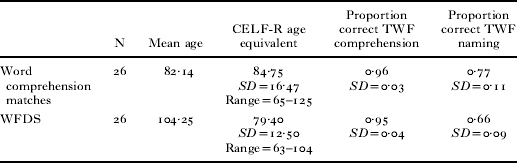
Twenty-six typical children (13 boys, 13 girls) were individually matched to be within 2% of the performance of a CwWFDs on lexical comprehension of objects and actions on the TWF and are described as a word comprehension match (WC match). These children performed age appropriately on language measures (CELF-R) and had average non-verbal abilities. The pattern of differences between the CwWFDs and matches supports the categorisation of children with WFDs (see Table 1).
Comparison of children with WFDs and their comprehension matched peers
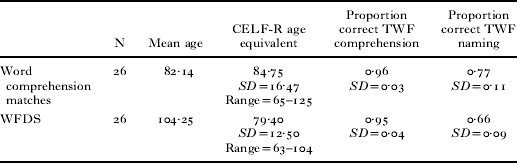
The two groups did not differ on the proportion of correctly comprehended object and action words from the TWF (t(50)=1·148, p=0·256), nor on CELF age equivalent scores (t(49)=1·308, p=0·197). The groups did differ on the proportion of correctly named nouns and verbs on the TWF (t(50)=4·172, p<0·001, eta squared=0·26), supporting the view that CwWFDS have lexical retrieval difficulties. As expected, CwWFDs had significantly lower expressive than receptive scores on the CELF (receptive M=85; expressive M=78, t(25)=2·32, p=0·03). Nine CwWFDs had receptive language scores 1·5 SD or more below the mean, indicating language difficulties beyond those assessed in the TWF. However, there was no significant difference in TWF scores between those with only WFDs (M=72) and those with additional language impairments (M=70).
Materials
Low-frequency verbs were identified (Francis & Kucera, Reference Francis and Kucera1982) with a stem and past tense word frequency of less than 20; high-frequency verbs with a stem and past tense frequency greater than 50 (see Table 2). All stimuli were audio-recorded on to a laptop and presented using Psyscope (Cohen, MacWhinney, Flatt & Povost, Reference Cohen, MacWhinney, Flatt and Povost1993).
Items used in the past tense generation task

Procedure
Testing was carried out individually. Children heard a verb through the computer's speakers simultaneously with the word being spelt out on the screen. The children produced the past tense form of the verb stem as quickly and as accurately as possible. Responses were timed using a voice-activated key. The internal clock started with the termination of the word and ran until the child's oral response began. The visual presentation was terminated by activation of the voice key. The inter-trial interval was 2,000 ms. There were four practice trials (laugh, teach, rock, build) and children could ask questions before the experimental trials began. All experimental trials were randomized. The child's response was recorded on a response sheet.
RESULTS
Accuracy analysis
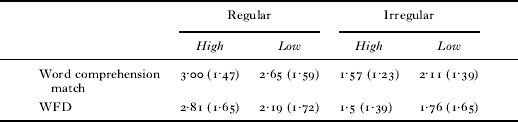
The mean number of correct responses involving high- and low-frequency verbs is presented in Table 3.
Mean number (standard deviation) of correct past tense forms produced
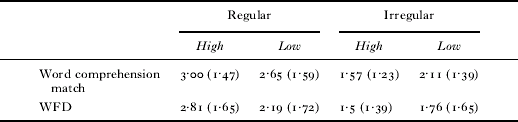
A multivariate analysis of variance was conducted. There was one between group factor (GROUP) with two levels (WC Match, CwWFDs), and two within-subjects factors: (VERB TYPE) with two levels (regular, irregular) and (VERB FREQUENCY) with two levels (low, high). ANOVAs were carried out by Subject (F1) and by Item (F2). This revealed a main effect of Verb Type (F 1(1, 50)=108·02, p<0·001, eta squared=0·69; F 2(1, 12)=28·04, p<0·001, eta squared=0·70) and a main effect of Verb Frequency in the subjects analysis (F 1(1, 50)=17·36, p<0·001, eta squared=0·26; F 2F<1). There was no Verb x Frequency interaction, no effect of Group and no Group interactions. Both groups of children performed similarly on this task and were more accurate with higher frequency and regular verbs.
Error analysis
Incorrect responses were coded into one of the following categories: regularization (adding [-ed] to an irregular verb), progressive form (-ing), stem repeat, no response and other. Stem repeats were the most frequent errors (M=3·9; SD=5·6), followed by regularization errors (M=3·6; SD=2·6) then ‘other’ (M=0·8; SD=1·7). No significant differences were identified between groups in these data.
Latency to respond
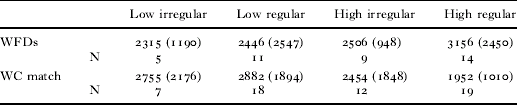
The reaction time (RT) data resulted in 672 correct responses, 91 (14%) were false positives due to the sensitivity of the microphone, false starts or environmental noise. Box and whiskers plots identified outliers and mean latencies were computed for high- and low-frequency items, and regular and irregular items (see Table 4).
Mean latency of response in milliseconds (standard deviation) for past tense generation for children with WFDs and their word comprehension (WC) age matches
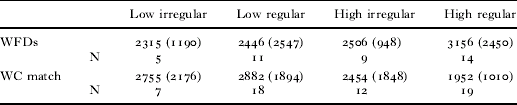
Only regular items provided sufficient data for statistical comparisons. No statistically significant difference between groups was found for low-frequency regular items (F<1). However, there was a trend for the CwWFDs to be slower in generating high-frequency regular items (F(1, 32)=3·754, p=0·06 eta squared=0·26). The low power in this analysis (0·47) may account for the lack of statistical significance.
DISCUSSION OF EXPERIMENT 1
CwWFDs, compared to typical children, did not have difficulties with producing the past tenses of regular or irregular verbs. There was no evidence from the accuracy data of problems involving either computational (regular verbs) or retrieval processes (irregular verbs). Thus, the prediction from the dual-mechanism model that verb frequency affects irregular but not regular verbs was not supported by the accuracy data. Another feature of the findings was that there was a trend for CwWFDs to be slower at producing high-frequency regular verbs than the typical children, suggesting that they might have difficulties processing regular items, a finding compatible with past research.
EXPERIMENT 2 – PAST TENSE GENERALIZATION
Experiment 1 suggests that CwWFDs perform similarly to peers matched on word comprehension. Another test of children's morphosyntactic abilities involves unknown items so that performance depends on established grammatical processes. Prasada & Pinker (Reference Prasada and Pinker1993) used Berko's (Reference Berko1958) classic paradigm to investigate generalizations about the past tense of English. Prasada & Pinker constructed two sets of nonsense verbs, one based on English regulars, the other on English irregular verbs. The degree of similarity between the nonsense and real verbs varied within each set by manipulating the degree to which the nonsense verbs rhymed with existing verbs. For example, plip was used as a prototypical, regular, nonsense verb because it rhymes with many real English regular verbs (chip, drip, etc.). intermediate regular and irregular nonsense verbs possessed initial CC (consonant clusters) and V (vowels) or final CC and V that do not appear in any English regular verb (e.g. brilth). distant regular and irregular nonsense verbs had final CCs that never appear in English and/or initial CCs and vowels that never appear along with sequences of vowels and final CCs that actually violate phonological constraints in English (e.g. ploamph).
Prasada & Pinker (Reference Prasada and Pinker1993) assumed that the same computational process of adding the suffix [-ed] would occur with regular nonsense verbs irrespective of their similarity to real verbs. In contrast, similarity was expected to influence responses to the irregular nonsense verbs, since these are retrieved from associative memory, more [-ed] forms should be produced as the distance from the prototypical irregular verb increases. Their findings supported these predictions from the dual mechanism model (Prasada & Pinker, Reference Prasada and Pinker1993).
Our aim was to use this paradigm to investigate whether typical children and CwWFDs would generalize their grammatical knowledge onto nonsense ‘regular’ and ‘irregular’ verbs, at the prototypical and intermediate levels of similarity. If the linguistic deficit experienced by CwWFDs is associated with computational limitations they should show impaired production of regular nonsense words relative to typical children. In contrast if their deficit involves accessing irregular verbs in associative memory then they should perform less well in the production of irregular nonsense words.
METHOD
Materials
Twenty nonsense verbs from Prasada & Pinker's (1993) study were used; five from each of their four categories. The past tense was elicited using a picture of an ambiguous figure performing an ambiguous action and the following template: This is George. George knows how to spling. He is splinging. Yesterday he ______________. (see Appendix I for the items and an example picture).
Procedure
The task was introduced in the context of an ‘alien’ who could not speak properly and the task was to help this alien use the right kind of words. Each trial (i.e. each word) involved showing an A4 laminated picture card and giving the elicitation prompt (see above); the order was randomized for each child. The experimenter recorded the response.
RESULTS
Affixation analysis
The mean number of [-ed]s added to the verb stems was calculated for each of the four types of verb and are presented in Table 5.
Mean number (and standard deviation) of [-ed]s added to the nonsense verb stem for word comprehension (WC) match and word finding difficulties (WFD) children

The data were submitted to a multivariate repeated measures ANOVA with one between-subjects factor, GROUP, tested at two levels (CwWFDs, WCmatch) and two within-subjects factors; VERB REGULARITY tested at two levels (regular, irregular) and SIMILARITY, tested at two levels (prototypical, intermediate). This analysis revealed a main effect of Verb Regularity in the Subjects analysis (F 1(1, 50)=7·5, p<0·01, eta squared=0·13; F 2<1), indicating that overall the children added more [-ed] morphemes to the regular than the irregular nonsense verbs (Regular M=4·03, Irregular M=3·80). There was also a main effect of Similarity (F 1(1, 50)=4·2, p<0·05, eta squared=0·08; F 2(1, 16)=9·96, p<0·01, eta squared=0·39), indicating that the children added more [-ed] morphemes to the intermediate than the prototypical nonsense verbs (Prototypical M=3·84; Intermediate M=3·96). There was no main effect of Group on this task and Verb Regularity did not interact with either the Similarity or Group effects.
There was a reliable Similarity×Group Interaction in the Subjects analysis (F 1(1, 50)=4·2, p<0·05, eta squared=0·08; F 2, n.s.). Collapsed across regular and irregular forms, the mean number of [-ed] affixes for the matched children on prototypical and intermediate verbs was 3·96 in both cases. The mean number of affixes for CwWFD on the prototypical verbs was 3·71 and for the intermediate verbs was 3·96. Post-hoc comparisons failed to detect any significant difference between these figures.
Other responses
The children's non-[-ed] responses were coded into one of four categories: progressive, no response, irregular form, stem repeat. The children made a mean of 4·4 errors, the most common type being progressive responses (M=1·9; SD=5·2), followed by irregular forms (M=1·1; SD=3·0), no responses (M=0·8; SD=3·9) and stem repeat responses, which were infrequent (M=0·7; SD=3·0). The majority of errors were generated by a few children who mostly made one type of error. There was no difference between groups, or between types of errors.
DISCUSSION OF EXPERIMENT 2
The children, like the adults in Prasada & Pinker (Reference Prasada and Pinker1993), produced significantly more [-ed] responses for regular than irregular nonsense verbs, although the size of the difference was not large. Significantly more [-ed]s were added to intermediate than prototypical verbs, though the differences between the cell means were not large and the effect sizes were small. Furthermore, there was no significant interaction of the type that would be expected from the dual-mechanism model (i.e. frequency affecting irregulars but not regulars), despite the stimuli being the same as those used by Prasada & Pinker (Reference Prasada and Pinker1993). The children may have made atypical responses to individual nonsense verbs or item-specific effects might differ across adult and child populations. Both explanations are consistent with associative accounts where individual items exert an influence on the lexicon, regardless of whether they are ‘regular’ or ‘irregular’.
EXPERIMENT 3 – DENOMINAL TASK
Denominal verbs are based on nouns (e.g. He braked the car suddenly) and generally have a regular past tense, since irregular past tense forms are unlikely to be associated with the root representation of the relevant noun. It is possible to identify verbs that are homophones of denominals that have irregular past tense forms. Kim, Marcus, Pinker, Hollander & Coppola (Reference Kim, Marcus, Pinker, Hollander and Coppola1994) used these stimuli to examine underlying grammatical representations. They presented children with homophonous verbs as both denominals and with their usual verb root meaning. For example, in the denominal context, the word leave is used to denote the noun leaves (found on trees): These are leaves. Can you say ‘These are leaves’. I like to leave the table [Experimenter covers the table with leaves.] I just _____. In this context, the children consistently produced leaved the table. However, the same form can be used in the context of its usual root meaning: Kermit wants to leave. Can you say ‘Kermit wants to leave?’ Kermit is going to leave the table. [Have Kermit leave the table.] Kermit just _____. In this context, the children produced the irregular form left. Kim et al. (Reference Kim, Marcus, Pinker, Hollander and Coppola1994) argued that the [-ed] morpheme is a ‘default’ form which is accessed when retrieval fails, or when there is no item to retrieve because the item is being processed as a denominal.
The children in our sample were given the task and stimuli used by Kim et al. (Reference Kim, Marcus, Pinker, Hollander and Coppola1994). If CwWFDs have difficulty with direct lexical retrieval this should result in more errors when producing irregular verb forms. If the CwWFDs have difficulty with the computation of inflections, they should be less likely to use the ‘default’ rule of ‘add [-ed]’ when verbs are used in the denominal context relative to language matched peers.
METHOD
Materials
Nine words were each used once as a denominal and a verb root (see Appendix II). Each item was presented as either a real object (i.e. some real leaves for leaves) or as a toy that represented the object.
Procedure
Each child was tested individually. The instructions were based on Kim et al. (Reference Kim, Marcus, Pinker, Hollander and Coppola1994), using a denominal context (e.g. This is an A. I'm going to A you. [Give the letter A to the child.] Now this is a C. Now I'm going to C you. [Give the letter C to the child.] I just _____.) or using a verb root (e.g. I like to see with this telescope. I'm going to see you through the telescope. [Look through the telescope at the child.] I just _____.). The eighteen items were randomly presented to each child.
RESULTS
Affixation analysis
The mean number of [-ed] responses for both groups of children on the two types of verb form are presented in Table 6. Analyses of variance revealed a main effect of verb derivation (F 1(1, 50)=30·46, p<0·001, eta squared=0·38; F 2(2, 16)=7·25, p<0·01, eta squared=0·31). The children added more [-ed] affixes when the verbs were used as denominals (M=3·06, SD=2·64) than when used as verb roots (M=1·67, SD=2·20). There were no other statistically reliable effects in this analysis.
Mean number (and standard deviations) of [-ed]s added to denominal and verb roots

Non [-ed] responses
The non [-ed] responses were coded into one of six categories: irregular form, no response, same verb/different form (e.g. the progressive form of the verb was produced), different verb (e.g. ‘draw’ instead of ‘write’), stem repeat, other. Only three types of errors had means above 1·00 (Total Irregular Errors=6·8; SD=4·7; denominals=1·7; SD=2·1; verb forms=5·0; SD=3·0. Producing Other Verbs=3·7; SD=2·7; for denominals=2·7; SD=1·9; for verb forms 0·9; SD=1·4; and Stem repeats, 1·7; SD=2·9; for denominals 0·9; SD=1·6; for verb forms 0·8; SD=1·5). Analyses failed to identify differences between groups in these types of errors, both in terms of frequency and percentage of errors.
DISCUSSION OF EXPERIMENT 3
The results replicate the findings of Kim et al. (Reference Kim, Marcus, Pinker, Hollander and Coppola1994), and are in line with the predictions of the dual-mechanism model. Moreover the CwWFDs were similar to the matched children on this task in terms of the number of [-ed] morphemes added to the stems in each of the two conditions.
GENERAL DISCUSSION
By using established experimental paradigms that tap into children's knowledge of both the rule-based (regular) and associative (irregular) lexical features, we were able to investigate the extent to which CwWFDs have lexical and/or morphosyntactic difficulties. Our findings indicate that CwWFDs primarily experience lexical problems. There was no evidence to suggest that these CwWFDs had a problem in accurately generating the past tense of real English verbs (Experiment 1), in generalizing their knowledge of the English past tense system onto novel verbs (Experiment 2) or displaying sensitivity to verb type (Experiment 3). The CwWFDs did not experience grammatical difficulties (as measured by these tasks) and as such, present a different profile of language problems than previously identified in some subsets of children with SLI (e.g. van der Lely & Ullman, Reference van der Lely and Ullman2001). The only area of difference that was detected, which was a trend, involved CwWFDs taking longer than typical children to produce high-frequency verbs. This can be explained either by ill-defined lexical representations or slower processing of lexical information (Dockrell et al., Reference Dockrell, Messer and George2001). These findings regarding morphology and those of other investigators about latency, together suggest that CwWFDs do not have problems with the specific processes involved in producing appropriate morphological forms, but rather, have more general problems with processes involved in the speed of word retrieval and production.
Despite being identified as having WFDs on the basis of a standardized test, the children did not differ significantly from typical children in their access to words even those with irregular forms that need to be retrieved from memory. While initially surprising, this can be explained at a number of levels. Firstly, the CwWFDs were matched against, and performing similarly to, children who were nearly two years younger. Thus, their ability to access and use verbs was markedly impaired. Secondly, previous research suggests that latency rather than accuracy may be a more sensitive marker of WFDs (Dockrell et al., Reference Dockrell, Messer and George2001). Our on-line assessments supported this hypothesis as there was a trend towards longer latencies to produce high-frequency items in Experiment 1. Thirdly, unlike previous research with this population, the CwWFDs were provided with the stem of the verb and therefore had a lexical prime to support access to the regular, irregular or denominal forms. Given this prime, their reduced speed of performance with regular items in Experiment 1 is an important finding.
Our three experiments were based on experiments that have provided support for the dual-mechanism model, consequently, our data also speak to the issue of dissociations between regular and irregular inflections. In all three experiments, both groups responded differently to regular and the irregular lexical items. However, other findings were unexpected, given the model's predictions. In Experiment 1, it was not expected that word frequency would have an effect on the production of regular verbs. However, the children were more accurate with high- rather than low-frequency regular verbs, and there was no interaction. In contrast, studies by van der Lely & Ullman (Reference van der Lely and Ullman2001) of older children (nine to twelve years) and by Pinker and colleagues of adults, have failed to identify frequency effects on regulars. One explanation for the discrepancy is that the system might only become ‘dual’ later on in linguistic and cognitive developmentFootnote 1. There is evidence to support this possibility since Ellis & Schmidt (Reference Ellis and Schmidt1998) have shown that frequency effects early on in learning are observable on both regular and irregular items, and it is only later on in the learning curve that the effects on regulars seem to attenuate while the effect of frequency on irregulars remains observable.
In Experiment 2, the findings did not support a different aspect of the dual-mechanism model. There was a main effect where children added more [-ed] affixes to intermediate than prototypical nonsense verbs (though the effect size was small), which was expected for irregulars but not for regulars. It is relevant that other work has had a problem replicating this aspect of Prasada & Pinker (Reference Prasada and Pinker1993; see Murphy, Reference Murphy2004). In the third experiment, both groups of children produced some irregular forms in the denominal context. This is not predicted by the model since denominals verbs are not represented as verbs in the lexicon and consequently, all denominals should have been suffixed. In all three experiments, the categorical nature of the predictions of the dual-mechanism model does not fit well with the more graded nature of our findings.
In summary, the experiments provide mixed support for the dual-mechanism model. In contrast, there is a clearer message about CwWFDs. Some groups of children with atypical language development are argued to have a specific and selective deficit on either the rule-based features of language (e.g. G-SLI; van der Lely & Ullman, 2001) or the associative features (e.g. Williams syndrome; Clahsen & Almazan, Reference Clahsen and Almazan1998). The CwWFDs did not show either of these patterns and were not significantly different to the typical children in the use of [-ed] responses or in the use of errors. Thus, these data do not suggest that CwWFDs are impaired in their use of morphosyntax. Given that other investigators have identified children with impairments in morphosyntactic abilities, our findings add to the growing body of evidence that children with language difficulties are a heterogeneous group and have a range of impairments.
Appendix I
ITEMS USED IN THE PAST TENSE GENERALIZATION TASK (EXPERIMENT 2)

EXAMPLE OF STIMULI PRESENTED TO CHILD
 This is Michael.
Michael knows how to spling.
He is splinging.
Yesterday he ____________.
PRASADA & PINKER (Reference Prasada and Pinker1993) NONCE VERB CATEGORIES
There were six different types of verbs based on phonological characteristics of real English verbs:
• Regular prototypical (e.g. ‘plip’ (c.f., ‘drip’, ‘sip’, ‘flip’, etc.))
• Regular intermediate (e.g. ‘smeeb’ (c.f., ‘beam’, ‘cream’, ‘gleam’, etc.))
• Regular distant (e.g. ‘ploamph’ (c.f., ‘croak’, ‘choke’, ‘joke’, etc.))
• Irregular prototypical (e.g. ‘spling’ (c.f., ‘cling’, ‘fling’, ‘sling’, etc.))
• Irregular intermediate (e.g. ‘cleef’ (c.f., ‘bleed’, ‘breed’, ‘feed’, etc.))
• Irregular distant (e.g. ‘goav’ (c.f., ‘blow’, ‘know’, ‘grow’, etc.))
Appendix II
ITEMS AND INSTRUCTIONS USED IN THE DENOMINAL TASK (EXPERIMENT 3)
“I have lots of toys here and I am going to do something with them and then I am going to ask you what I have just done.”
Instructions for each Item
Denominal Items
C: “This is an A. I'm going to A you. [Give the letter A to the child.] Now this is a C. Now I'm going to C you. [Give the letter C to the child.] I just ……….”
Bye: “Winnie-the-Pooh likes to say hi and he likes to say bye. Winnie-the-Pooh is saying hi to you. [Have him say hi to the child.] Winnie-the-Pooh likes to say bye even more. [Have him say bye to the child.] Winnie-the-Pooh is going to bye you. Winnie-the-Pooh just ……….”
Meat: “This is a bun. This is meat and this is cheese. First I'm going to cheese the buns. [Put the cheese on the bun.] Now I'm going to meat the buns. [Put the meat on the bun.] I just …….”
Drink: “This is a drink. First I'm going to French fry you. [Give the French fries to the child.] Now I'm going to drink you. [Give the drink to the child.] I just ……..”
Fly: “This is a fly. I'm going to fly this board. [Put flies all over the board.] I just ……….”
Stick: “This is a stick. I'm going to stick the cup. [Hit the cup with the stick.] I just ……….”
Right: “Mickey likes to drive in his car. Mickey likes to go this way. [Have Mickey go left.] See, Mickey likes to go left in his car. Mickey also likes to go this way. [Have Mickey go right.] See Mickey likes to go right in his car. Mickey just ……….”
Leave: “These are leaves. I like to leave the table. [Cover the table with leaves.] I just ……….”
Ring: “This is a ring. I am going to ring your finger. [Put the ring on the child's finger.] I just ……….”
Verb Root Items
See: “I like to see with this telescope. I'm going to see you through the telescope. [Look through the telescope at the child.] I just ……….”
Buy: [Give the child a bell and a ring.] “Winnie-the-Pooh likes to buy things with money. First he is going to buy a bell from you. [Have Winnie-the-Pooh give the child the money in exchange for the bell.] Now he is going to buy the ring from you. [Have Winnie-the-Pooh exchange the money for the ring.] Winnie-the-Pooh just ……….”
Meet: “Mickey likes to meet people. He is going to meet Cat Woman. [Have Mickey meet Cat Woman.] Now Mickey will meet Batman. [Have Mickey meet Batman.] Mickey just ……….”
Drink: “Winnie-the-Pooh likes to drink. He is going to fill up his cup with water. [Have Winnie-the -Pooh fill the cup with water.] Now he is going to drink it. [Have him pretend to drink it.] Winnie-the-Pooh just ……….”
Fly: “This airplane is going to fly. The airplane is about to fly through the air. [Fly the airplane in the air.] The airplane just ……….”
Stick: “This putty sticks to things. I'm going to stick the putty to the ball. [Stick the putty on the ball.] I just ……….”
Write: “Winnie-the-Pooh likes to write on the board. First he is going to write YES. [Make him write yes.] Now, he is going to write NO. [Make him write no.] Winnie-the-Pooh just ……….”
Leave: “Winnie-the-Pooh wants to leave. Winnie-the-Pooh is going to leave the table. [Make Winnie-the-Pooh leave the table.] Winnie-the-Pooh just ……….”
Ring “I like to ring this bell. I am going to ring this bell. [Ring the bell.] I just ……….”