





Introduction
Leafy vegetable production systems are highly vulnerable to weed establishment, because frequent irrigation, shallow cultivation, repeated soil disturbance, open crop canopies during early growth, and short crop cycles create repeated opportunities for weed recruitment. High production costs and strict quality standards then magnify the consequences of weed infestation, because weeds can reduce marketability or increase the risk of crop rejection (Kristiansen Reference Kristiansen2014). In leafy green salad crops, even low levels of weed infestation can increase contamination risk, making produce unsafe for consumption (Singh Reference Singh2022). Contamination can occur when weed fragments, soil attached to weeds, or toxic plant material are harvested with the crop; this is particularly important where crops are mechanically harvested and minimally processed. Therefore, effective weed management is essential for maintaining both productivity and economic viability in these production systems, yet reliance on herbicides is often constrained by crop sensitivity, residue concerns, regulatory limits, and the emergence of herbicide-resistant weeds (Coleman et al. Reference Coleman, Kristiansen, Sindel and Fyfe2024). These challenges underscore the need for alternative, integrated strategies informed by weed biology and ecology, providing a foundation for studies on seed germination as a key step in understanding and controlling weed populations.
Burning nettle (Urtica urens L.) and common groundsel (Senecio vulgaris L.) are among the most prevalent and problematic weeds in temperate horticultural regions worldwide (Marshall et al. Reference Marshall, Fyfe, Coleman, Sindel and Kristiansen2019). Frequent irrigation, shallow tillage, and short crop cycles typical of horticulture favor rapid weed establishment, allowing these species to persist and spread (Bhullar et al. Reference Bhullar, Kaur, Kaur and Yadav2015; Nichols et al. Reference Nichols, Verhulst, Cox and Govaerts2015). Urtica urens is an annual weed that reproduces only by seeds, enabling long-term persistence once established (Coleman et al. Reference Coleman, Kristiansen, Sindel and Fyfe2018; Taylor Reference Taylor2009). Although traditionally associated with field margins and unmanaged habitats, U. urens has increasingly invaded vegetable fields as a cool-season annual weed (Fennimore et al. Reference Fennimore, Smith, Tourte, LeStrange and Rachuy2014), where it competes strongly for water and nutrients and interferes with field operations (Kumar et al. Reference Kumar, Kumari, Rana, Rana, Anwar, Qureshi, Saleh, Alamer, Attia, Ercisli and Aghayeva2024). Its stinging hairs or trichomes can cause painful skin irritation, interfering with hand harvesting and making its presence undesirable in labor-intensive horticultural crops (Coleman et al. Reference Coleman, Kristiansen, Sindel and Fyfe2018; Schellman and Shrestha Reference Schellman and Shrestha2008).
Senecio vulgaris is a fast-growing annual weed capable of completing multiple life cycles within a single growing season (Leiss and Müller-Schärer Reference Leiss and Müller-Schärer2001). It produces large quantities of small seeds equipped with a pappus, facilitating effective wind dispersal over long distances (Leiss and Müller-Schärer Reference Leiss and Müller-Schärer2001). This trait, combined with its rapid life cycle and continuous germination, enables the species to quickly colonize disturbed and open soil surfaces typical of vegetable production systems (Leiss and Müller-Schärer Reference Leiss and Müller-Schärer2001; McGiffen et al. Reference McGiffen, Spokas, Forcella, Archer, Poppe and Figueroa2008). This invasive plant is especially problematic in leafy vegetable crops and protected cultivation where herbicide options are limited (Boyd et al. Reference Boyd, Moretti, Sosnoskie, Singh, Kanissery, Sharpe, Besançon, Culpepper, Nurse, Hatterman-Valenti, Mosqueda, Robinson, Cutulle and Sandhu2022; Söchting and von Redwitz Reference Söchting and Von-Redwitz2025). In addition, the species contains pyrrolizidine alkaloids that are toxic to livestock and potentially hazardous if present as contaminants in food products (Wiedenfeld and Edgar Reference Wiedenfeld and Edgar2011).
In Australia, both these species are widespread and highly problematic in so-called baby leaf (small leafy salad) crops such as spinach (Spinacia oleracea L.), wild rocket (Diplotaxis tenuifolia (L.) DC), leafy Brassica spp., and other vegetable crops, especially in temperate regions (Hort Innovation Australia 2021; Kristiansen Reference Kristiansen2014). Growers produce multiple crops throughout the year, and these two species are consistently problematic; however, seasonal variations have been observed in terms of infestation levels. Environmental and edaphic factors such as temperature, light, soil moisture, pH, salt stress, soil type, and burial depth strongly influence germination and emergence of weed seeds, with temperature and moisture often acting as primary determinants in agricultural systems (Benvenuti et al. Reference Benvenuti, Macchia and Miele2001; Hooda and Chauhan Reference Hooda and Chauhan2024).
In field soils, emergence is also influenced by seedbank processes, including primary and secondary dormancy, afterripening, burial, seasonal temperature and moisture cycles, and light or nitrate exposure following disturbance. For S. vulgaris, seedbank persistence and maternal environmental effects on dormancy have been reported previously, whereas U. urens has been described as a small-seeded annual with seedbank behavior influenced by burial and light conditions (Coleman et al. Reference Coleman, Kristiansen, Sindel and Fyfe2018; Lati et al. Reference Lati, Shem-Tov and Fennimore2016). Senecio vulgaris produces seeds that germinate readily under suitable temperature regimes and emerge primarily near the soil surface, with germination responses affected by temperature and seasonal conditions (McGiffen et al. Reference McGiffen, Spokas, Forcella, Archer, Poppe and Figueroa2008). Seeds buried within the soil seedbank remain viable but typically persist for only a few months in regularly disturbed soils, indicating a limited yet dynamic seedbank (Figueroa et al. Reference Figueroa, Doohan, Cardina and Harrison2007, Reference Figueroa, Herms, Cardina and Doohan2010). Because dormancy cycling and seedbank persistence regulate field emergence, controlled germination studies should be interpreted together with seedbank ecology.
Understanding these species–specific germination responses enables better prediction of emergence timing and supports targeted management interventions, including stale seedbeds, strategic irrigation, and tillage–mediated seed burial to reduce weed pressure (Benvenuti et al. Reference Benvenuti, Selvi, Mercati, Cardinali, Mercati and Mazzoncini2021). Such knowledge is particularly important as horticultural systems seek to reduce herbicide reliance and adopt more sustainable, integrated weed management strategies (Coleman et al. Reference Coleman, Kristiansen, Sindel and Fyfe2024). Despite their importance in horticultural systems, detailed information on germination response of U. urens and S. vulgaris to environmental factors remains limited. Therefore, this study aimed to investigate the effects of temperature, photoperiod, pH, salinity, osmotic stress, and burial depth on the germination and emergence of U. urens and S. vulgaris. The specific objectives were to:
-
1. Evaluate the germination responses of U. urens and S. vulgaris to various environmental factors, including alternating day/night temperature, photoperiod, pH, salinity, and osmotic stress.
-
2. Evaluate the influence of soil type and burial depth on the seedling emergence of U. urens and S. vulgaris.
Our study is novel in that it directly compares two economically important leafy salad weeds from the same Australian production system across a suite of abiotic germination and emergence factors. It provides response thresholds and management-relevant contrasts for species that remain understudied in Australian horticulture.
Materials and Methods
Seed Collection
Seeds of U. urens and S. vulgaris were collected from a baby leaf production field at Tripod Farmers, Bacchus Marsh, VIC, Australia (37.6879°S, 144.4337°E). Several thousand mature seeds were collected from a single healthy cropping population of each species during the summer season of 2024 to 2025. It was determined that the seed pods had dried, and seeds were naturally released with gentle handling. Then seeds were placed in paper bags and immediately transported to the Centre for AgriBioscience La Trobe University, Melbourne, VIC, Australia (37.7236°S, 145.0537°E).
Only one population per species was collected. This design was chosen to compare two problematic species from the same leafy salad production context under standardized conditions; therefore, results should be interpreted primarily for the sampled populations and as indicative, rather than definitive, for similar temperate horticultural systems. Upon arrival, seeds were air-dried in a laboratory at ambient temperature (20 to 25 C) for 5 d before they were stored in sealed containers with silica gel in under cold room conditions (4 ± 1 C, <15% humidity) (Bonner Reference Bonner, Bonner and Karrfalt2008). Dry cold storage was used to preserve seed viability and standardize experimental timing, not to simulate field or soil seedbank conditions. Seeds were retrieved from cold storage to be used for various experiments in this study.
Experimental Design
All the experiments described in the following sections were laid out in a completely randomized design with simple or factorial arrangement and three replicates for each experimental unit unless stated otherwise. Each experiment was repeated once over time to confirm that treatment responses were reproducible across independent experimental runs.
Seed Morphological Traits
The 100-seed weight was determined by randomly selecting five samples of 200 seeds from each species and weighing them using a precision balance with readability of 0.0001 g (Ohaus Corporation, USA). The values were then converted to 100-seed weight for data analysis.
Seed length and width were evaluated through microscopic analysis to quantify seed size. Ten seeds were randomly selected from each species, with one seed representing each replicate, and examined using a light microscope equipped with a 10 × objective lens and a digital camera. Seed images were captured using Leica Application Suite (LAS) software (v. 5.12, Leica Microsystems, Wetzlar, Germany). The length and width of 10 randomly selected seeds per species were then measured from the captured images using ImageJ software v. 1.54g (Schneider et al. Reference Schneider, Rasband and Eliceiri2012).
General Seed Germination Protocol
The effects of environmental factors, including alternating day/night temperature, photoperiod, salinity, osmotic potential, and pH, on the germination of U. urens and S. vulgaris were investigated in laboratory. The experiments were conducted under controlled laboratory conditions using petri dishes (90 mm by 14 mm; Gamma Sterile, NSW, Australia). Germination tests were performed in incubators (LABEC, NSW, Australia) under specified temperature regimes. Controlled germination assays are widely used to isolate abiotic response thresholds in weed seed biology, including responses to temperature, light, salinity, osmotic stress, pH, and burial depth (Chauhan et al. Reference Chauhan, Ali and Florentine2019; Hooda and Chauhan Reference Hooda and Chauhan2024; Tang et al. Reference Tang, Guo, Yin, Ding, Xu, Wang, Yang, Xiong, Zhong, Tao and Sun2022). Nevertheless, such assays do not reproduce the full complexity of the field seedbank and should be validated under commercial production conditions
Seeds were surface-sterilized in 2% sodium hypochlorite (NaClO; Chem-Supply, Australia) for 5 min and rinsed five times with reverse-osmosis (RO) water before being air-dried on two layers of sterile paper towels (Adnan et al. Reference Adnan, Shahzad, Collins and Bajwa2025). Surface sterilization was used to reduce fungal contamination during controlled germination assays and to standardize the abiotic treatment comparisons. We acknowledge that this procedure may reduce epiphytic seed-associated microorganisms, and therefore the results represent germination responses under sanitized laboratory conditions rather than intact seed–microbiome conditions (Nelson Reference Nelson2018). For each treatment, 30 healthy, filled seeds were placed on a double layer of Whatman No. 4 filter paper in petri dishes using sterile forceps. Filter papers were moistened with 5 ml of RO water or treatment solutions (polyethylene glycol, sodium chloride, or pH-adjusted solutions) using a micropipette (Eppendorf, Hamburg, Germany), with additional solution added as required to maintain moisture.
Petri dishes were sealed with Parafilm® (Bemis, USA) to minimize evaporation. For petri dishes placed under complete darkness (24-h) conditions that were not monitored for germination, 7 ml of RO water was applied to ensure sufficient moisture. Germination was recorded every 3 d for 21 d, with seeds considered germinated when the radicle reached ≥2 mm in length. Germinated seeds were removed after being counted, and final germination percentages were calculated for analysis. This protocol was used for all seed germination experiments described unless stated otherwise.
Effect of Temperature and Photoperiod
Urtica urens and S. vulgaris seeds were incubated in petri dishes under three alternating day/night temperatures (15/5, 25/15, and 35/25 C), all matched with two photoperiod regimes, 14/10-h day/night and 24-h dark. The 14/10-h day/night cycle was set up using the incubator settings, while completely dark conditions were imposed by wrapping petri dishes with two layers of aluminum foil (Universal Choice, NSW, Australia). In the completely dark treatment, petri dishes were only opened at the final germination count after 21 d, unlike the 14/10-h day/night treatment, which was observed at 3-d intervals. The temperature regimes were selected to represent cool, moderate, and warm seasonal conditions relevant to temperate horticulture, whereas the photoperiod treatments were used to isolate light responses. The optimum conditions identified in this experiment were then used in subsequent assays to compare stress thresholds under conditions permissive for germination. Maximum germination of U. urens seeds was observed at 25/15 C and 24-h dark conditions, whereas S. vulgaris seeds germinated best at 25/15 C under the 14/10-h day/night photoperiod. Therefore, all subsequent experiments for each species were conducted under these respective temperature and photoperiod conditions.
Effect of Salt Stress
The effect of salinity on seed germination of U. urens and S. vulgaris was evaluated using sodium chloride (NaCl) solutions at various concentrations, including 25, 50, 100, 150, 200, 250, and 350 mM. The solutions were prepared by dissolving NaCl (Mallinckrodt Baker, Phillipsburg, NJ, USA) in sterile distilled water. A treatment with sterile RO water was included as a control (0 mM). Field soil NaCl concentration was not quantified; therefore, NaCl treatments should be interpreted as controlled salinity gradients rather than exact simulations of the production field.
Effect of Osmotic Stress
The effect of osmotic stress on seed germination was evaluated by exposing seeds to seven levels of osmotic potential (−0.1, −0.2, −0.4, −0.6, −0.8, −1.0, and −1.2 MPa). These moisture stress levels were selected based on previous studies investigating weed seed germination responses under water-limited conditions (Chauhan et al. Reference Chauhan, Ali and Florentine2019; Tang et al. Reference Tang, Guo, Yin, Ding, Xu, Wang, Yang, Xiong, Zhong, Tao and Sun2022) and reflect osmotic conditions commonly occurring in regions where these species may establish. A treatment with RO water served as the control (0 MPa).
Aqueous solutions with the required osmotic potential were prepared using polyethylene glycol (PEG), following the method described by Michel and Kaufmann (Reference Michel and Kaufmann1973). No direct osmometer measurement was made. PEG 6000 (Merck, Germany) was dissolved in RO water in calculated amounts to achieve the target osmotic potentials at the optimal temperature regime for both species (25/15 C day/night), as determined in the temperature and photoperiod experiment.
Effect of pH
The effect of pH on seed germination was assessed using seven pH levels (4, 5, 6, 7, 8, 9, and 10) for both species. These pH levels are representative of most soil types in horticultural production systems where these weeds are problematic. Buffer solutions covering this pH range were prepared according to the method described by Chachalis and Reddy (Reference Chachalis and Reddy2000). Solutions with pH values of 4, 5, and 6 were prepared using a 2 mM solution of 2-(N-morpholino) ethanesulfonic acid (MES). Buffer solutions with pH values of 7 and 8 were prepared using a 2 mM solution of N-(2-hydroxymethyl) piperazine-N′-(2-ethanesulfonic acid) (HEPES), while solutions with pH values of 9 and 10 were prepared using a 2 mM solution of N-tris(hydroxymethyl)methyl glycine (tricine). All buffer solutions were adjusted to the desired pH by the gradual addition of sodium hydroxide (NaOH) or 0.1 N hydrochloric acid (HCl), and pH was confirmed using a calibrated pH meter (HI 4221, Hanna Instruments®, USA). The RO water (pH 6) was included as the control treatment and also represented one level of the pH gradient.
Effect of Seed Burial Depth on Seedling Emergence
An independent experiment was conducted to assess the effect of seed burial depth on seedling emergence for both species. Seeds were sown at six burial depths: surface placement (0 cm), 0.5, 2, 4, 6, and 10 cm, in two growth media, soil and sand. The soil used for the burial-depth experiment was collected from the same Tripod Farmers production site where seeds were collected; it had pH 6.9 and EC 1.03 mS cm−1. The physicochemical properties of the growing medium (sand vs. soil) are presented in Supplementary Table S1. To accommodate the different burial depths, two pot sizes were used. Smaller square black pots (width by length by height: 85 mm by 85 mm by 60 mm) were used for the 0-, 0.5-, and 2-cm depths, whereas taller square pots (85 mm by 85 mm by 140 mm) were used for the 4-, 6-, and 10-cm depths. Soil was oven–dried at 100 C for 3 consecutive days and thoroughly stirred on the second day. After sterilization, three trays of the dried soil were maintained at adequate moisture for 4 wk to ensure that no resident seeds germinated. Following this period, the soil was ready for use in the experiment.
The experiment was conducted under glasshouse conditions maintained at day and night temperatures of 22/16 C, a 16/8-h day/night photoperiod, and approximately 40% relative humidity. Twenty healthy, viable seeds of uniform size were placed at each designated depth and covered with the corresponding growth medium (sand and soil). Pots were irrigated manually as required using a handheld mist sprayer to maintain adequate moisture while minimizing seed disturbance. Seedling emergence was recorded at 3-d intervals for 28 d after sowing. Each experimental unit (pot) had three replicates, and the experiment was repeated once in time.
Statistical Analysis and Data Visualization
A two-sample t-test was carried out using Statistix 8.1 to compare the differences in seed traits of two species. For each trait, the mean values between species were compared using an independent two-sample t-test assuming unequal variances (Welch’s t-test). Statistical significance was assessed at α = 0.01. The ANOVA was also conducted using Statistix 8.1 to assess the significance of experimental factors. As no significant differences (P > 0.01) were detected between the two runs, the datasets were pooled for subsequent analyses. Where ANOVA F-tests were significant at P < 0.01, treatment means were separated using Fisher’s protected LSD at P < 0.01. The results are illustrated using bar graphs, with variability expressed as standard error (± SE) of the mean.
For osmotic potential and salinity experiments, data were analyzed using nonlinear regression model in SigmaPlot software (v. 16; 4am Software, Grafiti, Palo Alto, CA, USA) due to the quantitative nature of the treatments. The coefficient of determination (R2) was used to evaluate the goodness of fit. A four-parameter sigmoidal (logistic) model was fit to the data (Equation 1).
 $G\;\left( \% \right) = {y_0} + {a \over {1 + {\rm{exp}}\;\left[ {- {{x - {x_0}} \over b}\;} \right]}}$
In this equation, G represents germination percentage, y 0 represents the lower asymptote, a represents the difference between maximum and minimum germination, b represents the slope, and x₀ is the level of the treatment variable at which 50% of the maximum germination is achieved.
Results and Discussion
Seed Morphological Traits
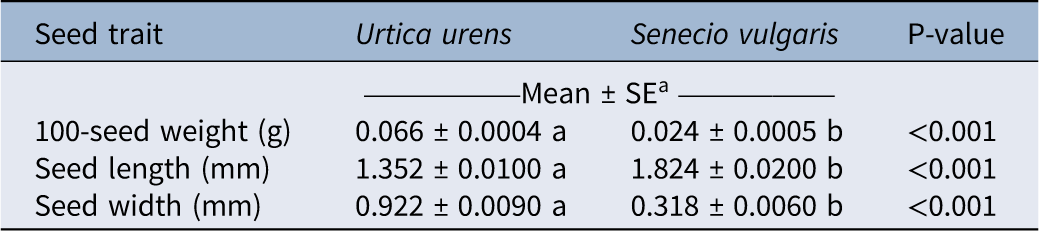
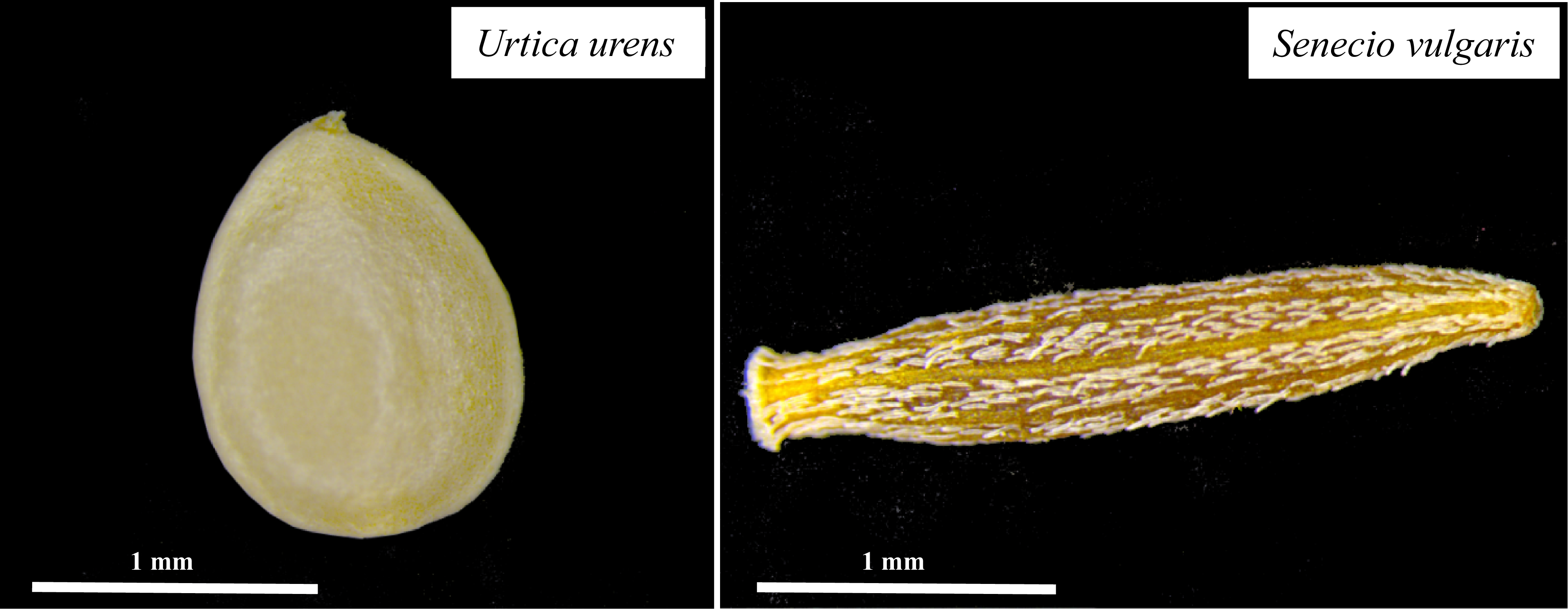
The average weight of 100 seeds was 0.07 g for U. urens and 0.02 g for S. vulgaris (Table 1). Although both species are considered small seeded, U. urens seeds were significantly heavier than those of S. vulgaris (P < 0.01). Urtica urens seeds were oval-shaped (Figure 1), with an average length of 1.35 mm and a width of 0.92 mm (Table 1). In contrast, S. vulgaris seeds were significantly longer (P < 0.01; Figure 1), with an average length of 1.82 mm but much narrower (P < 0.01), with a width of only 0.32 mm (Table 1). Both U. urens and S. vulgaris can produce many seeds, but the smaller seeds of S. vulgaris likely enhance dispersal efficiency at the cost of reduced nutrient reserves for early growth (Sonkoly et al. Reference Sonkoly, Deák, Valkó, Molnár, Tóthmérész and Török2017). In contrast, the slightly larger seeds of U. urens provide more stored resources, which may support better seedling establishment despite both species following a high seed output strategy.
Differences in selected seed traits of Urtica urens and Senecio vulgaris.

Table 1. Long description
The table compares seed traits between Urtica urens and Senecio vulgaris, focusing on 100-seed weight, seed length, and seed width. It has four rows and four columns, including the headers. The columns are labeled Seed trait, Urtica urens, Senecio vulgaris, and P-value. The row labels are 100-seed weight (g), Seed length (mm), and Seed width (mm). Row 1: 100-seed weight (g), 0.066 ± 0.0004 a, 0.024 ± 0.0005 b, <0.001. Row 2: Seed length (mm), 1.352 ± 0.0100 a, 1.824 ± 0.0200 b, <0.001. Row 3: Seed width (mm), 0.922 ± 0.0090 a, 0.318 ± 0.0060 b, <0.001. The table shows that Urtica urens seeds are heavier, shorter, and wider compared to Senecio vulgaris seeds, with significant differences in all measured traits.
a Means followed by the different letter within a row are significantly different at α = 0.01 based on a two-sample t-test.
Images of seeds of Urtica urens and Senecio vulgaris captured using a digital camera mounted on a light microscope.

This comparison of seed morphology traits is presented as a descriptive context because seed mass and dimensions may influence dispersal, light sensitivity, and emergence from burial. These differences provide context for interpreting the burial-depth and surface-emergence responses but should not be interpreted as a direct test of germination mechanism.
Effects of Temperature and Photoperiod
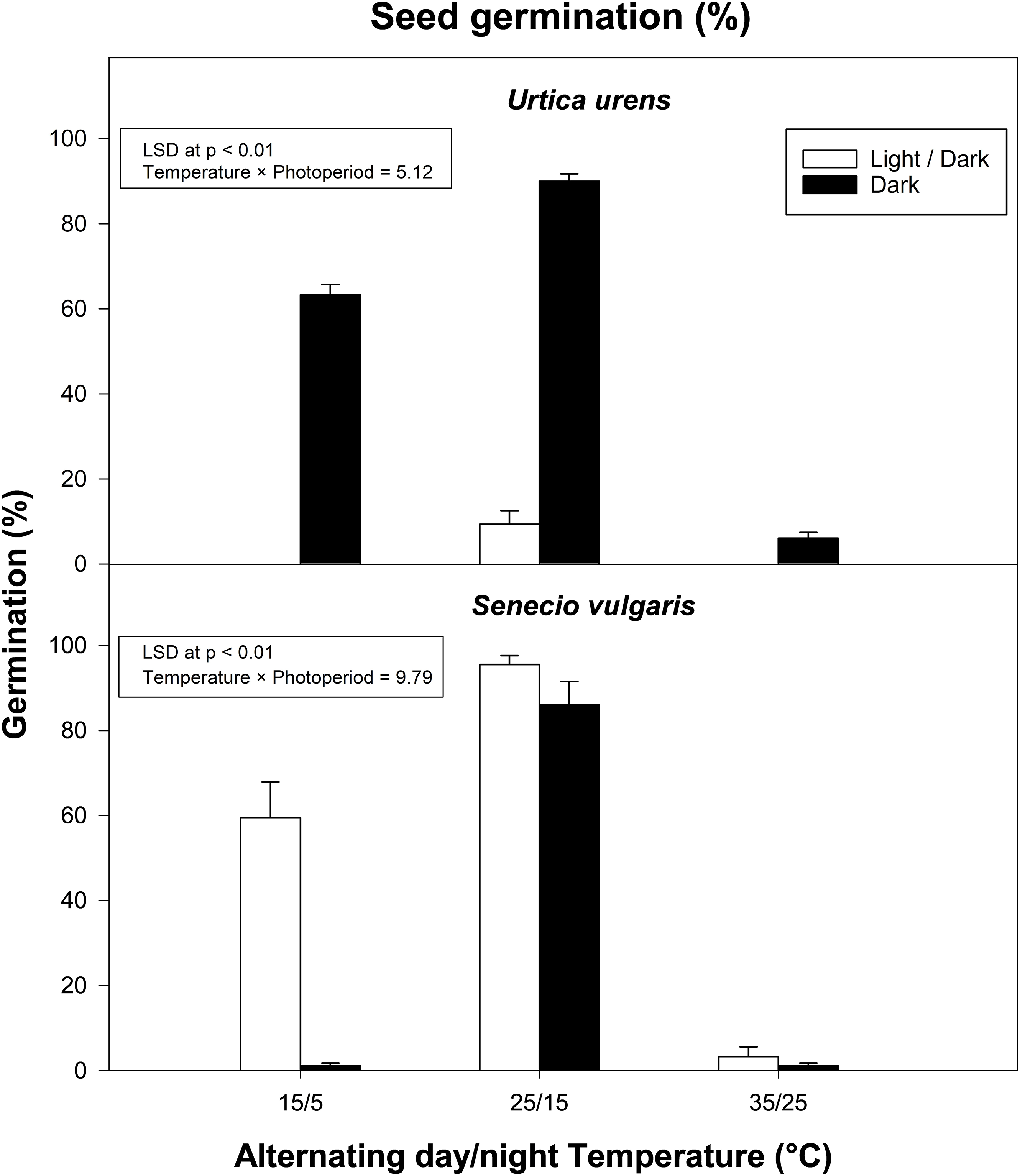
Seed germination of both species was significantly affected by photoperiod, temperature, and their interaction (P < 0.01; Figure 2). In U. urens, higher germination was recorded under complete darkness (53%) compared with day/night (14/10-h) conditions (3%) across all temperature regimes studied. The highest germination (90%) was observed under complete darkness at 25/15 C, whereas germination was completely inhibited at 15/5 C and 35/25 C under day/night conditions. In contrast, S. vulgaris showed higher germination under day/night (14/10-h) conditions (53%) than under complete darkness (29%) across all temperature regimes studied (Figure 2). The highest germination (96%) occurred at 25/15 C under day/night conditions, with no significant difference under complete darkness at the same temperature (86%). Germination of S. vulgaris decreased at 15/5 C (30%) and was almost completely suppressed at 35/25 C (2%), regardless of photoperiod.
Effect of alternating day/night temperatures (15/5, 25/15, and 35/25 C) on the seed germination percentage of Urtica urens and Senecio vulgaris under day/night (14/10-h photoperiod) and completely dark (24-h photoperiod) regimes. Seeds were incubated for 21 d. Data represent mean ± SE (n = 6), pooled from three replicates over two runs, and LSD represents the least significant difference value for mean comparison at P < 0.01.

Environmental cues such as temperature and photoperiod play a crucial role in regulating seed germination, because they synchronize germination with seasonal conditions that favor seedling establishment (Yan and Chen Reference Yan and Chen2020). The strong preference of U. urens for darkness suggests a negative photoblastic response, which may function as an adaptive strategy to promote germination when seeds are buried or located within the soil matrix, where moisture conditions are generally more stable (Carta et al. Reference Carta, Skourti, Mattana, Vandelook and Thanos2017). Similar dark-enhanced germination responses have been reported in U. urens previously (Lati et al. Reference Lati, Shem-Tov and Fennimore2016), indicating that this species may be adapted to germinate in microsites where light penetration is limited.
The influence of alternating temperatures further suggests that germination is promoted under conditions that mimic natural diurnal fluctuations, which often signal seasonal suitability for establishment (Benech-Arnold et al. Reference Benech-Arnold, Sánchez, Forcella, Kruk and Ghersa2000; Liu et al. Reference Liu, Baskin, Baskin, Bu, Du and Ma2013). Such responses have also been reported in certain weed species where germination is not strictly dependent on light. For example, common teasel (Dipsacus fullonum L.) has been shown to germinate under both alternating temperature regimes and dark conditions, indicating that temperature cues can partially compensate for light requirements (Frazzetto et al. Reference Frazzetto, Huarte, Puglia, Prjibelski, Saini, Giglio, Dattilo and Cristaudo2025). Similarly, grass species such as wild oat (Avena fatua L.) and rescuegrass (Bromus catharticus Vahl) exhibit enhanced germination under fluctuating temperatures, with some germination occurring even in darkness (Alshallash Reference Alshallash2018).
In contrast, S. vulgaris exhibited higher germination under day/night conditions than in continuous darkness, indicating a positive response to light. However, high germination was also observed in darkness at 25/15 C, suggesting that the species is not strictly light dependent but rather shows a facultative photoblastic response (Milberg et al. Reference Milberg, Andersson and Thompson2000; Ren and Abbott Reference Ren and Abbott1991). The combined response indicates that temperature provides the permissive range for germination, while light enhances germination within that thermal window, with optimal performance occurring under moderate temperatures and diurnal light cycles. Similar responses have been reported in fierce thornapple (Datura quercifolia Kunth; syn. Datura ferox L.) and common lambsquarters (Chenopodium album L.), with germination promoted by light but not completely inhibited under dark conditions (Botto et al. Reference Botto, Scopel and Sánchez2000; Tang et al. Reference Tang, Guo, Yin, Ding, Xu, Wang, Yang, Xiong, Zhong, Tao and Sun2022). Comparable germination responses under alternating temperature regimes have been observed in several weed species, including black nightshade (Solanum nigrum L.), field pennycress (Thlaspi arvense L.) (Wagenvoort and Van Opstal Reference Wagenvoort and Van Opstal1979), hairy beggarticks (Bidens pilosa L.) (Chauhan et al. Reference Chauhan, Ali and Florentine2019), and Amaranthus spp. (Steckel et al. Reference Steckel, Sprague, Stoller and Wax2004). These species, like S. vulgaris, show increased germination under fluctuating temperatures that mimic natural diurnal conditions, which promotes seedling establishment in disturbed environments.
Overall, both species exhibited maximum germination at 25/15 C, indicating that moderate alternating temperatures are optimal. These conditions typically occur during spring and autumn in temperate regions and are associated with peak germination periods of many annual horticultural weeds such as shepherd’s purse [Capsella bursa-pastoris (L.) Medik.], common chickweed [Stellaria media (L.) Vill.], and wild mustard (Sinapis arvensis L.) (Benech-Arnold et al. Reference Benech-Arnold, Sánchez, Forcella, Kruk and Ghersa2000). As S. vulgaris showed germination under both light and dark conditions at 25/15 C, light management alone is unlikely to prevent emergence of this species. However, practices that reduce exposed soil or minimize repeated light stimulation of the seedbank may still contribute to integrated management. Examples include rapid crop canopy closure, stale seedbed preparation followed by shallow control, and avoiding unnecessary soil disturbance immediately before periods with favorable temperatures and moisture. Such approaches are consistent with previous work showing that seed burial, soil disturbance, and stale seedbed practices can effectively manipulate light and temperature regimes and therefore influence weed emergence and seedbank depletion (Benvenuti Reference Benvenuti2003; Benvenuti et al. Reference Benvenuti, Macchia and Miele2001, Reference Benvenuti, Selvi, Mercati, Cardinali, Mercati and Mazzoncini2021). In contrast, U. urens exhibited stronger light-mediated suppression, indicating a potentially greater response to management strategies that modify soil-surface light conditions. Understanding the interaction between temperature and photoperiod therefore provides useful insight for refining the timing and design of integrated weed management strategies.
Effect of Salt Stress
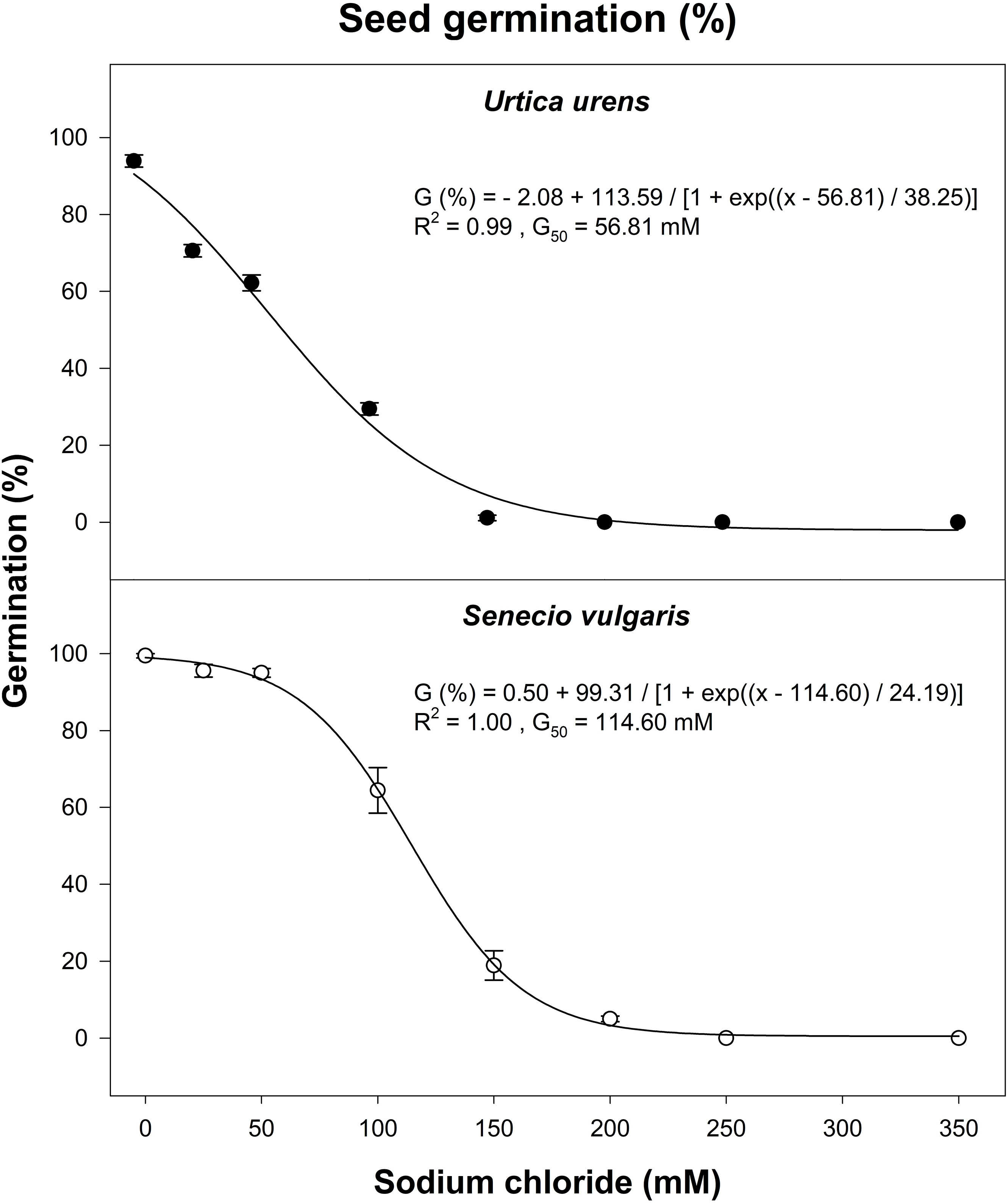
Seed germination of both species was significantly affected by salt stress (P < 0.01; Figure 3). Germination of both species decreased in a nonlinear, sigmoidal fashion as the salinity levels increased from 0 mM (control) to 350 mM. In U. urens, the highest germination (94%) was observed at 0 mM (control), with a sharp decrease in germination at higher salinity levels and complete inhibition in germination at 200 mM NaCl concentrations and above. On the other hand, S. vulgaris exhibited high seed germination (>95%) at 0 to 50 mM and complete inhibition occurred at 250 mM. Fifty percent inhibition of germination was predicted to occur at 57 mM and 115 mM of NaCl in U. urens and S. vulgaris, respectively.
Effect of different sodium chloride (NaCl) concentrations (mM) on the seed germination percentage of Urtica urens and Senecio vulgaris. The trendlines represent four-parameter sigmoidal, nonlinear model fit on data. Each data point represents SE (n = 6), pooled from three replicates over two runs.

The early phases of seed germination and seedling establishment are particularly susceptible to the adverse effects of salinity (Zörb et al. Reference Zörb, Geilfus and Dietz2019). Variations in salinity tolerance among weed species are common and may influence species distribution in saline environments. Similar reductions in germination with increasing salinity have been reported for several weed species, including common purslane (Portulaca oleracea L.), Indian lovegrass [Eragrostis pilosa (L.) P. Beauv.], Chenopodium spp., and feather fingergrass (Chloris virgata Sw.) (Han et al. Reference Han, Qian, Zhu, Ye, Zhao and Song2025; Li et al. Reference Li, Jiang, Li, Zhou and Xin2011; Nikolić et al. Reference Nikolić, Ghirardelli, Schiavon and Masin2023).
The higher tolerance of salinity shown by S. vulgaris suggests that it is more likely to establish and compete with crops in moderately saline soils, particularly in irrigated systems where salt accumulation may occur. In contrast, the lower tolerance of U. urens indicates that its emergence and establishment may be naturally limited under similar conditions. Rather than implying that growers should change crop choice, these results may help identify which weed species are more likely to persist in salt-affected areas and support more timely control following irrigation or rainfall events that reduce surface salinity and favor germination (Han et al. Reference Han, Qian, Zhu, Ye, Zhao and Song2025).
Effect of Moisture Stress
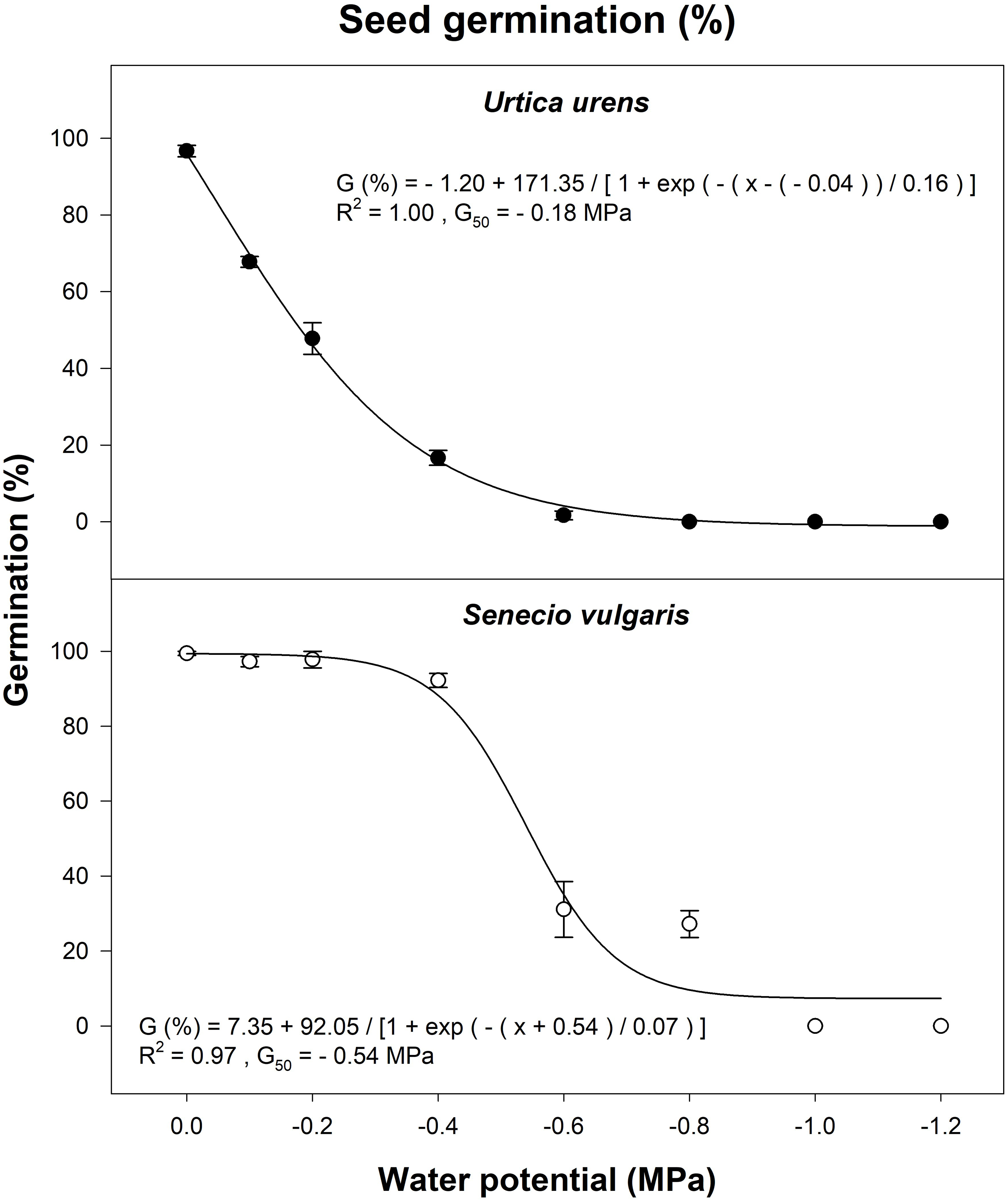
Seed germination of both species was significantly affected by different osmotic potential levels (P < 0.01; Figure 4). Germination of both species decreased in a nonlinear, sigmoidal fashion as the osmotic potential levels decreased from 0 MPa (control) to −1.2 MPa. In U. urens, the highest germination (97%) was recorded in the control at 0 MPa, and complete inhibition of germination occurred at −0.6 MPa and above. In S. vulgaris, the highest germination (99%) was recorded in the control (0 MPa), with complete inhibition of germination occurring at −1.0 MPa and above. Fifty percent inhibition in germination was predicted to occur at osmotic potential levels of −0.18 MPa and −0.54 MPa in U. urens and S. vulgaris, respectively.
Effect of different water potential levels (MPa) on the seed germination percentage of Urtica urens and Senecio vulgaris. The trendlines represent four-parameter sigmoidal, nonlinear model fit on data. Each data point represents SE (n = 6), pooled from three replicates over two runs.

Water absorption is a critical step in seed germination, because it activates metabolic pathways necessary for embryo growth and radicle emergence (Bewley et al. Reference Bewley, Bradford and Hilhorst2012). According to a recent global meta-analysis, seed germination of broadleaf weeds decreased by 53% under moderate water stress (−0.2 to −0.4 MPa) and by up to 97% at severe water stress (−0.6 to −0.8 MPa) (Singh et al. Reference Singh, Thapa, Kukal, Irmak, Mirsky and Jhala2022). The ability of S. vulgaris to germinate under lower osmotic potential indicates that it can establish even when soil moisture is limited, whereas less tolerant species like U. urens require higher soil moisture for successful germination. Moisture stress reduces germination in many weed species by limiting water uptake and slowing metabolic activity, with germination declining progressively as osmotic potential becomes more negative, as reported in species such as B. pilosa (Chauhan et al. Reference Chauhan, Ali and Florentine2019), C. album (Tang et al. Reference Tang, Guo, Yin, Ding, Xu, Wang, Yang, Xiong, Zhong, Tao and Sun2022), and Echinochloa spp. (Yuan et al. Reference Yuan, Gao, Fang, Shen and Tian2025).
These differences have important implications for weed management, because S. vulgaris may emerge and compete with crops even during dry periods or under deficit irrigation, making it more difficult to control if soil moisture conditions are favorable for its germination. Growers can use this knowledge to optimize management practices: pre-irrigation or rainfall events that increase soil moisture may trigger S. vulgaris emergence, providing an opportunity for timely mechanical control or preemergence herbicide application. Conversely, maintaining drier soil conditions may suppress germination of less tolerant species like U. urens. Understanding species-specific moisture thresholds allows growers to anticipate weed emergence patterns and implement targeted, efficient control strategies, reducing competition with crops and improving overall productivity (Gardarin et al. Reference Gardarin, Guillemin, Munier-Jolain and Colbach2010). Although water stress can reduce weed germination ability and growth, many species still germinate and produce seeds, allowing the soil seedbank to persist for years and creating ongoing management challenges for growers (Singh et al. Reference Singh, Thapa, Kukal, Irmak, Mirsky and Jhala2022).
Because the salinity and moisture stress experiments used controlled gradients of NaCl and PEG rather than measured field episodes, they should be interpreted as relative tolerance thresholds that can inform risk prediction rather than direct simulations of Tripod Farmers soil conditions.
Effect of pH
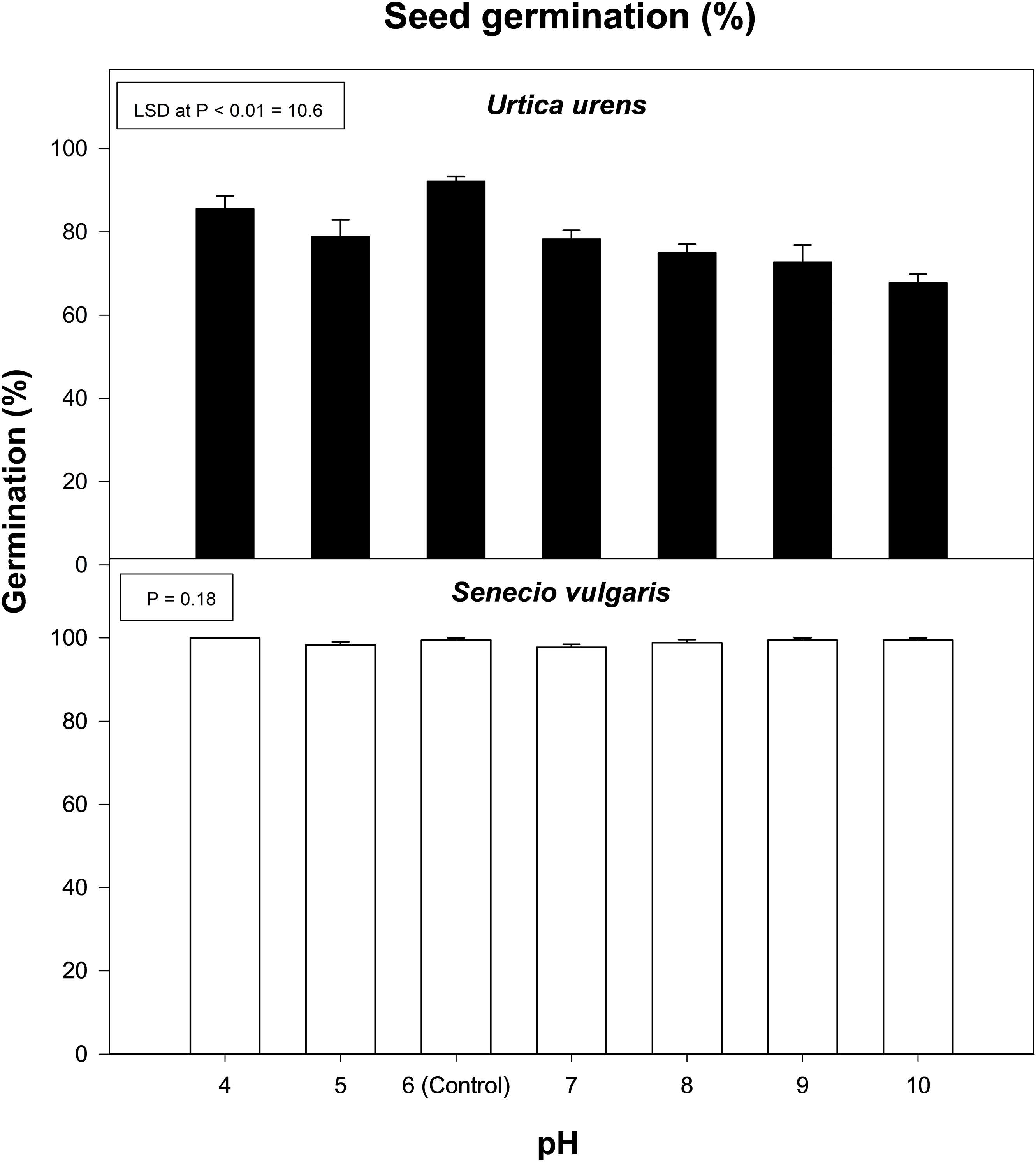
Seed germination of U. urens was significantly affected by pH levels (P < 0.01), whereas S. vulgaris germination was not significantly affected by pH levels (P = 0.18) (Figure 5). In U. urens, the highest germination (92%) was observed at pH 6 (control) and germination decreased under both acidic (86% at pH 4) and alkaline conditions (68% at pH 10), indicating that this species may prefer slightly acidic to neutral soils for successful germination. In contrast, S. vulgaris seeds germinated uniformly (>97%) across all pH levels tested (4 to 10) (Figure 5), indicating that germination of this species is relatively insensitive to soil pH. Broad tolerance to pH conditions has been commonly observed in several successful weed species such as annual bluegrass (Poa annua L.), buckhorn plantain (Plantago lanceolata L.), and Carolina geranium (Geranium carolinianum L.) (Buchanan et al. Reference Buchanan, Hoveland and Harris1975).
Effect of different pH levels on the seed germination percentage of Urtica urens and Senecio vulgaris. Data represent mean ± SE (n = 6), pooled from three replicates over two runs, and LSD represents the least significant difference value for mean comparison at P < 0.01. The effect of pH on U. urens was significant (P < 0.01), whereas it was not significant for S. vulgaris (P = 0.18).

In the sampled production context and comparable temperate leafy vegetable systems, soil pH may vary depending on soil type and management practices (Machado Reference Machado2022). The wide pH tolerance observed in S. vulgaris suggests that this sampled population may establish across a relatively broad pH range. In contrast, the slightly narrower pH tolerance of U. urens may influence its distribution in soils with more extreme pH conditions.
Effects of Seed Burial Depth on Seedling Emergence
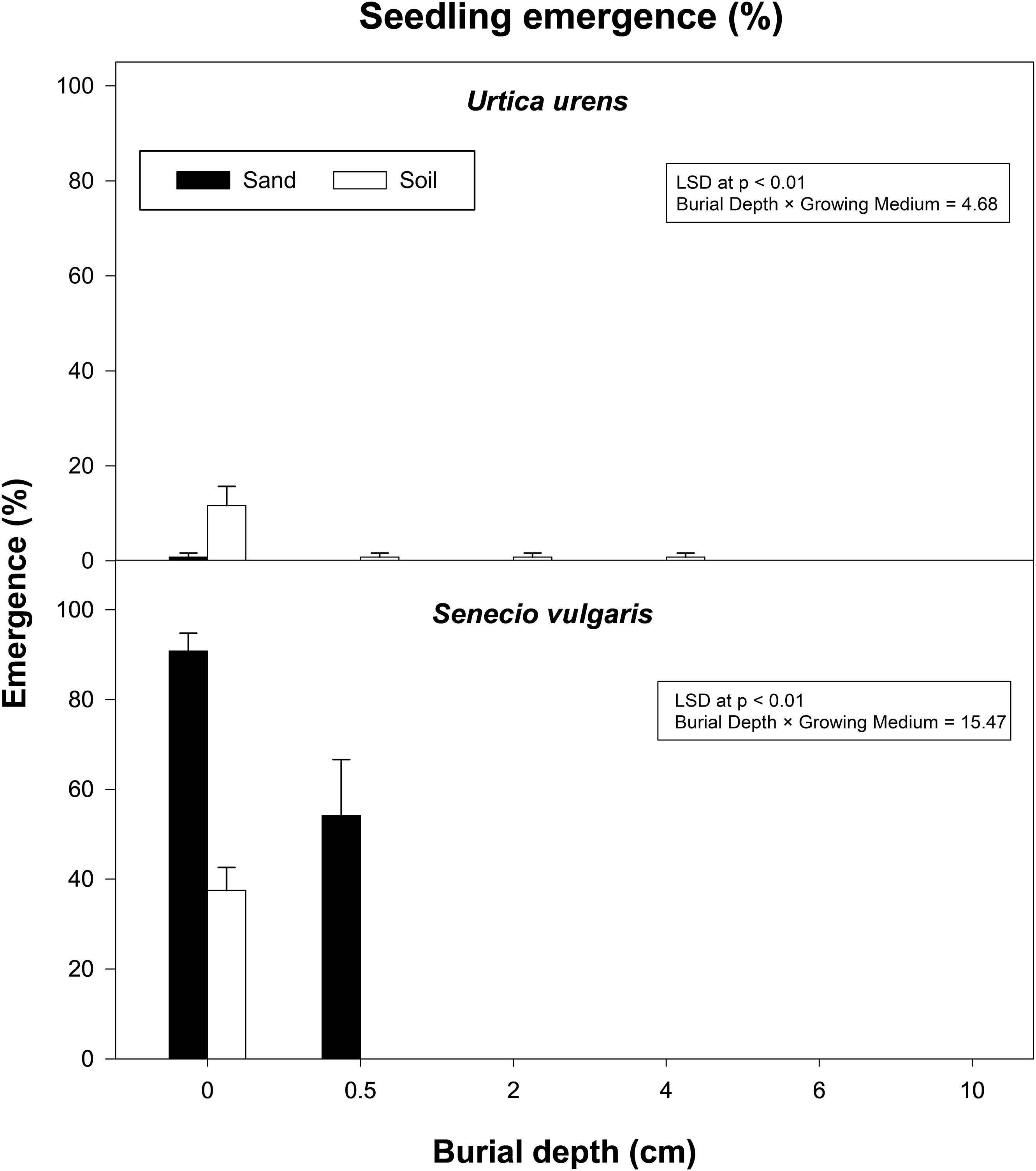
Seedling emergence was significantly influenced by burial depth and growing medium for both U. urens and S. vulgaris, with a significant interaction between these factors (P < 0.01; Figure 6). In U. urens, emergence was generally low, with the highest value on the soil surface (11%), while all other treatments showed minimal (<1%) or no emergence. In contrast, the emergence of S. vulgaris was highest on the soil surface (0 cm), especially in sand (90%), followed by soil (37%), and declined sharply with burial, with no emergence beyond 0.5 cm.
Effect of seed burial depth on the emergence of Urtica urens and Senecio vulgaris in sand and soil recorded 28 d after sowing. Data represent mean ± SE (n = 6), pooled from three replicates over two runs, and LSD represents the least significant difference value for mean comparison at P < 0.01.

The contrasting emergence patterns between U. urens and S. vulgaris reflect differences in their germination ecology and environmental requirements. The very low emergence of U. urens across all treatments suggests that its germination may be constrained by specific cues not fully satisfied in this study. In particular, U. urens has been reported to germinate more successfully under dark conditions (Coleman et al. Reference Coleman, Kristiansen, Sindel and Fyfe2018). However, in the present study, slightly higher emergence was observed at the soil surface compared with buried treatments. This suggests that factors other than light, such as improved oxygen availability, reduced mechanical resistance, or favorable moisture conditions at the surface, may have played a more important role in promoting emergence (Benvenuti Reference Benvenuti2003). It is also possible that burial depth imposed physical constraints that outweighed any potential benefits of reduced light exposure (Finch-Savage and Leubner-Metzger Reference Finch-Savage and Leubner-Metzger2006).
In contrast, S. vulgaris exhibits a typical light-dependent germination response, with emergence declining sharply as burial depth increases. This is consistent with previous studies showing that germination in S. vulgaris is strongly stimulated by light and inhibited by even shallow burial (Roberts and Neilson Reference Roberts and Neilson1981). Greater seedling emergence observed in sand compared with soil likely can be attributed to its coarser texture, which results in larger pore spaces, improved gas diffusion, and higher porosity. These conditions enhance oxygen availability and reduce penetration resistance, thereby facilitating seedling emergence (Hoyle et al. Reference Hoyle, McElroy and Guertal2013). These findings highlight distinct establishment strategies, where S. vulgaris is well adapted to colonize disturbed environments with surface-exposed seeds, while U. urens may require more specific microsite conditions, including reduced light exposure, for successful establishment.
Our results suggest that S. vulgaris has a broader germination niche than U. urens under the tested conditions. The tested population of S. vulgaris germinated strongly under moderate temperatures, tolerated a wider range of pH, salinity, and osmotic stress, and emerged readily from the soil surface, indicating high risk when seeds remain near the surface after disturbance. In contrast, the tested population of U. urens showed a narrower response, with high germination under dark, moderate-temperature conditions but low emergence from both soil and sand, suggesting stronger dependence on specific microsite conditions. These patterns are best interpreted as interactive ecological tendencies rather than independent field predictors.
Limitations of the Current Study
Although this study used one population of each species, the controlled experiments evaluated broad gradients of key environmental factors and provided useful comparative response thresholds for the sampled populations. Because only one population of each species was studied, direct inference is strongest for the sampled populations and production context. Nevertheless, when considered alongside previous studies, the results contribute to understanding the germination ecology of these species in temperate horticultural environments. Multi-population experiments are required to quantify intraspecific variation and test whether these response thresholds are stable across regions. Future studies should also focus on interactive effects of key climatic and edaphic factors on seed germination and emergence dynamics as practically feasible.
Although petri dish assays do not reproduce the physical, chemical, and biological complexity of field soils, they are useful for isolating abiotic germination thresholds and comparing relative responses among species or populations. These thresholds can inform hypotheses about emergence risk and management timing, but they require field validation before being used as predictive rules; this should be a focus of future studies.
In conclusion, the two species exhibited distinct and contrasting germination and emergence responses to key environmental factors. For the sampled populations of each species, Urtica urens showed high germination under darkness and moderate temperatures but lower tolerance to salinity, osmotic stress, and burial, indicating a narrower germination niche under the tested conditions. In contrast, S. vulgaris showed broader tolerance across pH, moisture, and salinity gradients and stronger emergence from the soil surface. These contrasting responses may help explain differences in emergence timing and persistence risk in production fields, but field studies are required to determine how these species coexist, dominate, or fluctuate under commercial management. These differences may help inform integrated weed management in the sampled production context and similar temperate leafy vegetable systems. However, multi-population, multi-season, and field-based studies are needed to determine how stable these response patterns are across regions and management systems.
Supplementary material
To view supplementary material for this article, please visit https://doi.org/10.1017/wsc.2026.10142
Acknowledgments
The authors are grateful to Sajitha Biju for her help with seed and soil collection. The support of cooperator industry partner Tripod Farmers is also appreciated.
Funding statement
This research has been funded by Hort Innovation Australia as part of the national project “Addressing Key Challenges in Australian Baby Leaf Production (VG23014)” using the vegetable research and development levy and funds from the Australian Government. The project also received financial co-contributions from Applied Horticultural Research and La Trobe University.
Competing interests
The authors declare no conflicts of interest.


 Open access

