The Parmeliaceae is a highly diverse family among the lichenized Ascomycota, both in terms of species number, with more than 2500 species distributed worldwide (Thell et al. Reference Trifinopoulos, Nguyen, von Haeseler and Minh2012; Jaklitsch et al. Reference Kalyaanamoorthy, Minh, Wong, von Haeseler and Jermiin2016), and morphological and anatomical variation (Blanco et al. Reference Blanco, Crespo, Richard and Lumbsch2006; Crespo et al. Reference Crespo, Lumbsch, Mattson, Blanco, Divakar, Articus, Wiklund, Bawingan and Wedin2007). It also has a complex taxonomy which dates back to the time of Acharius and has been studied by some of the most well-known lichenologists of the 20th century (Thell et al. Reference Trifinopoulos, Nguyen, von Haeseler and Minh2012). Generic concepts and delimitation have often undergone dramatic changes (Crespo et al. Reference Crespo, Lumbsch, Mattson, Blanco, Divakar, Articus, Wiklund, Bawingan and Wedin2007; Nelsen et al. Reference Orange, James and White2011) but in recent years molecular phylogenetics have helped to establish a more natural classification (Thell et al. Reference Thell, Crespo, Divakar, Kärnefelt, Leavitt, Lumbsch and Seaward2009; Crespo et al. Reference Crespo, Divakar and Hawksworth2011; Miadlikowska et al. Reference Minh, Nguyen and von Haeseler2014; Divakar et al. Reference Divakar, Singh, Crespo, Schmitt, Kraichak, Lumbsch and Leavitt2017). Within the informal group of “cetrarioid” species, the most recent classification includes only two genera, Cetraria and Nephromopsis (Divakar et al. Reference Divakar, Singh, Crespo, Schmitt, Kraichak, Lumbsch and Leavitt2017).
However, as pointed out by Randlane et al. (Reference Thell, Feuerer, Kärnefelt, Myllys and Stenroos2013), there are still some poorly known species in this group with an unresolved taxonomy. One such case is the Antarctic species Cetraria subscutata D. C. Linds., described from collections made during the 1964 British Antarctic Surveys in the Argentine Islands Archipielago, west Antarctic Peninsula (Lindsay Reference Messuti, Passo, Scervino and Vidal-Russell1973). It was included in Cetraria Ach., the most important genus within the “cetrarioid group” at that time, mainly due to the similarity in external morphology and its chemistry, despite the lack of apothecia. Lindsay compared it with two other Cetraria species, namely C. chlorophylla (Wild.) Vain. (now in Nephromopsis Müll. Arg.), from which it was distinguished by the lack of soredia, and with C. antarctica Zalhbr. [=Pseudocyphellaria glabra (Hook f. & Taylor) C. W. Dodge] (Lindsay Reference Messuti, Passo, Scervino and Vidal-Russell1973). Later, Øvstedal & Lewis-Smith (Reference Passo, Calvelo and Stocker-Wörgötter2001) re-examined Lindsay’s species as part of their Antarctic Flora and kept it in Cetraria, although with some hesitation, stating that it would probably be better placed under Tuckermannopsis (a genus resurrected by Lai (Reference Lindsay1980), now included in Nephromopsis) but the observation of sexual structures was needed for confirmation. So far, the species has been collected in Antarctica only four times; all these sterile specimens were studied by Lindsay (Reference Messuti, Passo, Scervino and Vidal-Russell1973) and by Øvstedal & Lewis-Smith (Reference Passo, Calvelo and Stocker-Wörgötter2001). As a result, it has never been included in any of the recent molecular studies and is currently considered as an enigmatic species of unknown taxonomic position (Randlane et al. Reference Thell, Feuerer, Kärnefelt, Myllys and Stenroos2013).
During the 2014 Argentine Antarctic Survey, we identified some sterile specimens as “C. subscutata” and these were used for molecular phylogenetic studies. The results confirmed that the species belongs to Nephromopsis and is conspecific with N. chlorophylla (Willd.) Divakar et al. However, the specimens from Antarctica show some differences with collections from other regions, which are discussed below.
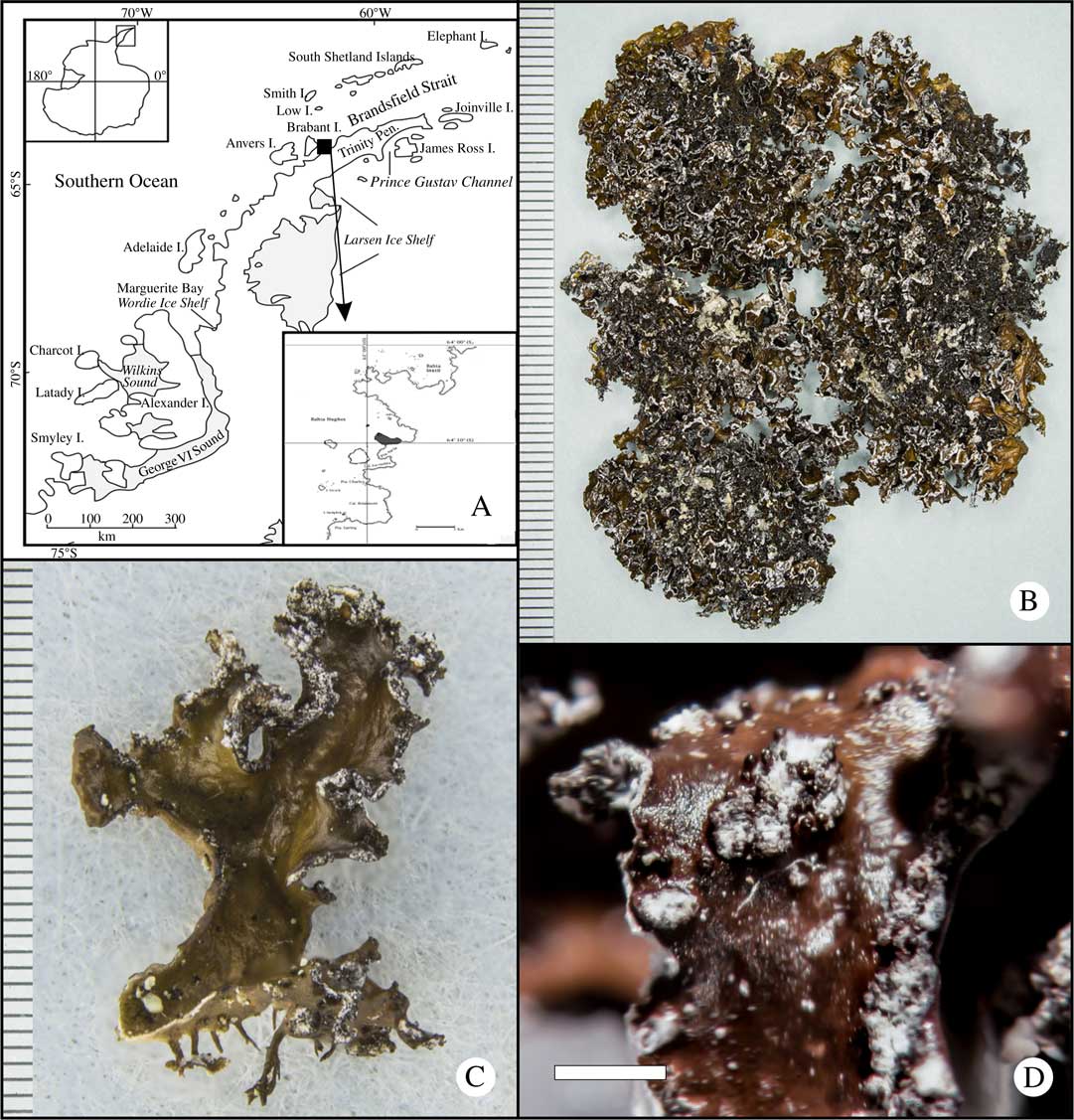
The specimens of “Cetraria subscutata” were collected by the authors (AP and JMR) on the Danco Coast, west of the Antarctic Peninsula near Argentine Primavera Station, c. 1000 km from its original collection site (Fig. 2A). The specimens were deposited in BCRU and CORD herbaria. Morphological and anatomical observations were performed following standardized methods as described in Passo et al. (Reference Randlane, Saag, Thell and Ahti2004). Secondary metabolites of the material were studied with thin-layer chromatography (Orange et al. Reference Øvstedal and Lewis-Smith2001). Digital images of the type specimens of “C. subscutata” provided by AAS and O herbaria were compared with the material collected from Antarctica.
Total genomic DNA was extracted using the commercially available Ultraclean Microbial DNA Isolation Kit (Mo Bio Laboratories, Carlsbad, USA). The internal transcribed spacer regions (ITS, including 5.8S) of nuclear ribosomal DNA were amplified with the following primers: the fungal specifics ITS1-F (Gardes & Bruns Reference Gardes and Bruns1993) and ITS4 (White et al. Reference White, Bruns, Lee and Taylor1990). Amplicons generated by PCR were sequenced by the INTA Castelar (Argentina) sequencing service. For a more detailed description of the methodology, see Messuti et al. (Reference Miadlikowska, Kauff, Högnabba, Oliver, Molnár, Fraker, Gaya, Hafellner, Hofstetter and Gueidan2016).
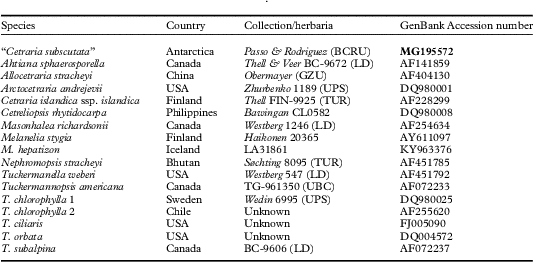
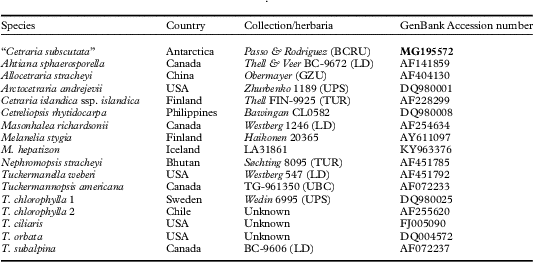
A matrix was constructed with 16 sequences representing the type species of main genera of the Nephromopsis clade and a small number of sequences from the Cetraria clade, sensu Thell et al. (Reference Trifinopoulos, Nguyen, von Haeseler and Minh2012). Although the most recent delimitation of the Parmeliaceae accepts only two genera in the “cetrarioid core”, names of species were left as they are found in GenBank, on the figure and in the text, whenever making a specific reference to the older name. After preliminary analysis a few additional sequences of the formal genus Tuckermannopsis were also incorporated. The species Melanelia hepatizon (Ach.) A. Thell and Melanelia stygia (L.) Essl. were used as outgroup. All sequences were downloaded from GenBank. The final matrix consisted of 17 sequences, including that from “Cetraria subscutata” (Table 1).
Collection data and sequences with GenBank Accession numbers used in the phylogenetic analysis. New sequences are in bold
Sequences were aligned and trimmed using MAFFT multiple sequence alignment software v.7 (Katoh & Standley Reference Kumar, Nei, Dudley and Tamura2013). The phylogenetic reconstruction was carried out using the IQ-Tree web server for maximum likelihood reconstruction criterion (Trifinopoulos et al. Reference White, Bruns, Lee and Taylor2016) with the ModelFinder software for search of the best model of character evolution (Kalyaanamoorthy et al. Reference Karnefelt2017). Branch support was attained through ultrafast bootstrap with 1000 replicates (Minh et al. Reference Nelsen, Chávez, Sackett-Hermann, Thell, Randlane, Divakar, Rico and Lumbsch2013). Genetic distances were calculated using MEGA software (Kumar et al. Reference Lai2008).
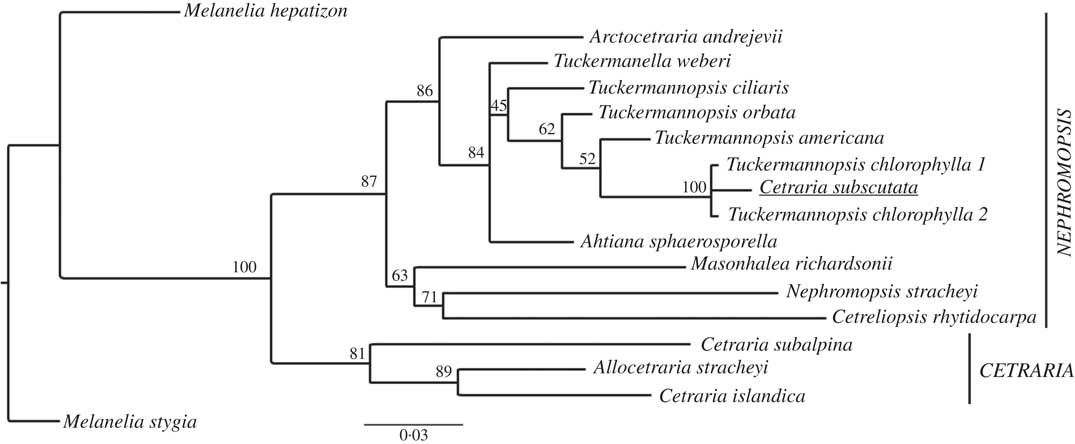
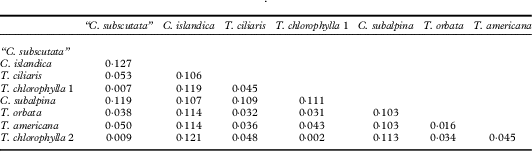
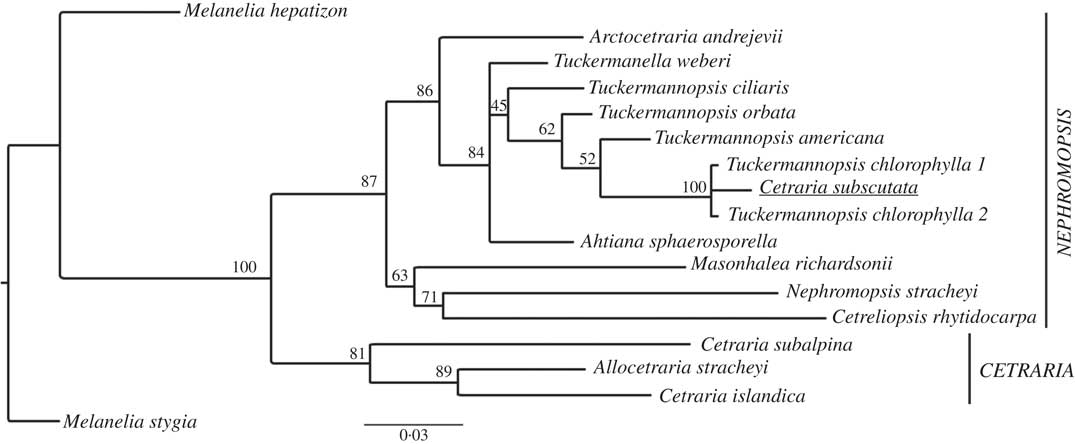
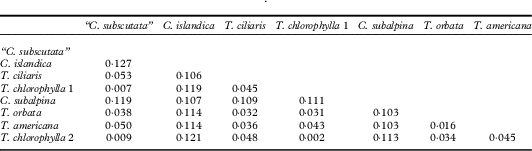
The resulting alignment contained 17 sequences and 805 bps, with 571 constant sites (70·9% of all sites). The resulting consensus tree from the ML inference (Fig. 1) is in general agreement with those found using multigene datasets (Nelsen et al. Reference Orange, James and White2011; Miadlikowska et al. Reference Minh, Nguyen and von Haeseler2014; Divakar et al. Reference Divakar, Singh, Crespo, Schmitt, Kraichak, Lumbsch and Leavitt2017). Minor differences may be explained by the low resolution of the ITS at generic level, as well as the low support of some branches. However, two main clades are observed, namely the Cetraria clade and the Nephromopsis clade. The position of C. subalpina Imshaug, included in the analysis because it was cited as similar to C. subscutata (Lindsay Reference Messuti, Passo, Scervino and Vidal-Russell1973), agrees with its uncertain affinity reported by Thell et al. (Reference Thell, Crespo, Divakar, Kärnefelt, Leavitt, Lumbsch and Seaward2009). The ITS sequence of “C. subscutata” falls within Nephromopsis with strong support. It is almost identical with the two sequences from Nephromopsis chlorophylla (shown as Tuckermannopsis chlorophylla in Fig. 1, one from Europe and the other from South America), as shown in the distance matrix (Table 2).
Phylogenetic position of “C. subscutata”. Maximum likelihood consensus tree based on ITS data with ultrafast bootstrap support on branch nodes. Names of species are shown as they are found in GenBank, their current classification is indicated on the bars.
Genetic distances of ITS sequences of selected species of Cetraria and Tuckermannopsis closely related to C. subscutata
These results suggest that the species is not related to Cetraria but rather belongs to Nephromopsis, and that it is conspecific with N. chlorophylla. The morphological, anatomical and chemical examinations also suggest the conspecificity with N. chlorophylla, despite some particular variations. Therefore, we conclude that C. subscutata should be regarded as a synonym of N. chlorophylla. A brief description and notes on the taxonomy and distribution are included here.
Nephromopsis chlorophylla (Willd.) Divakar, Crespo & Lumbsch
Fungal Biology 84: 112 (2017).—Lichen chlorophyllus Willd., in Humboldt, Flor. Friburg. Spec.: 20 (1793); type: “In cortice Pyni sylvestris beym Vorwerk Hals copiose” (B-Willd, non vidi).
Cetraria subscutata D. C. Linds., Bull. Brit. Antarc. Surv. 36: 107 (1973); type: Antarctica, Antarctic Peninsula, Argentine Islands, Galíndez Island, on rock surfaces in Usnea community, 30 m, 21 April 1964, R. W. M. Corner 514 (AAS—holotype, non vidi; O!—isotype).
“Cetraria subscutata” (Nephromopsis chlorophylla) (BCRU 04596). A, location of Primavera Station on the Antarctic Peninsula; B, habitus; C, thallus margin with abundant soredia; D, detail of corticate soredia. Scales: B & C=1 mm; D=0·5 mm. In colour online.
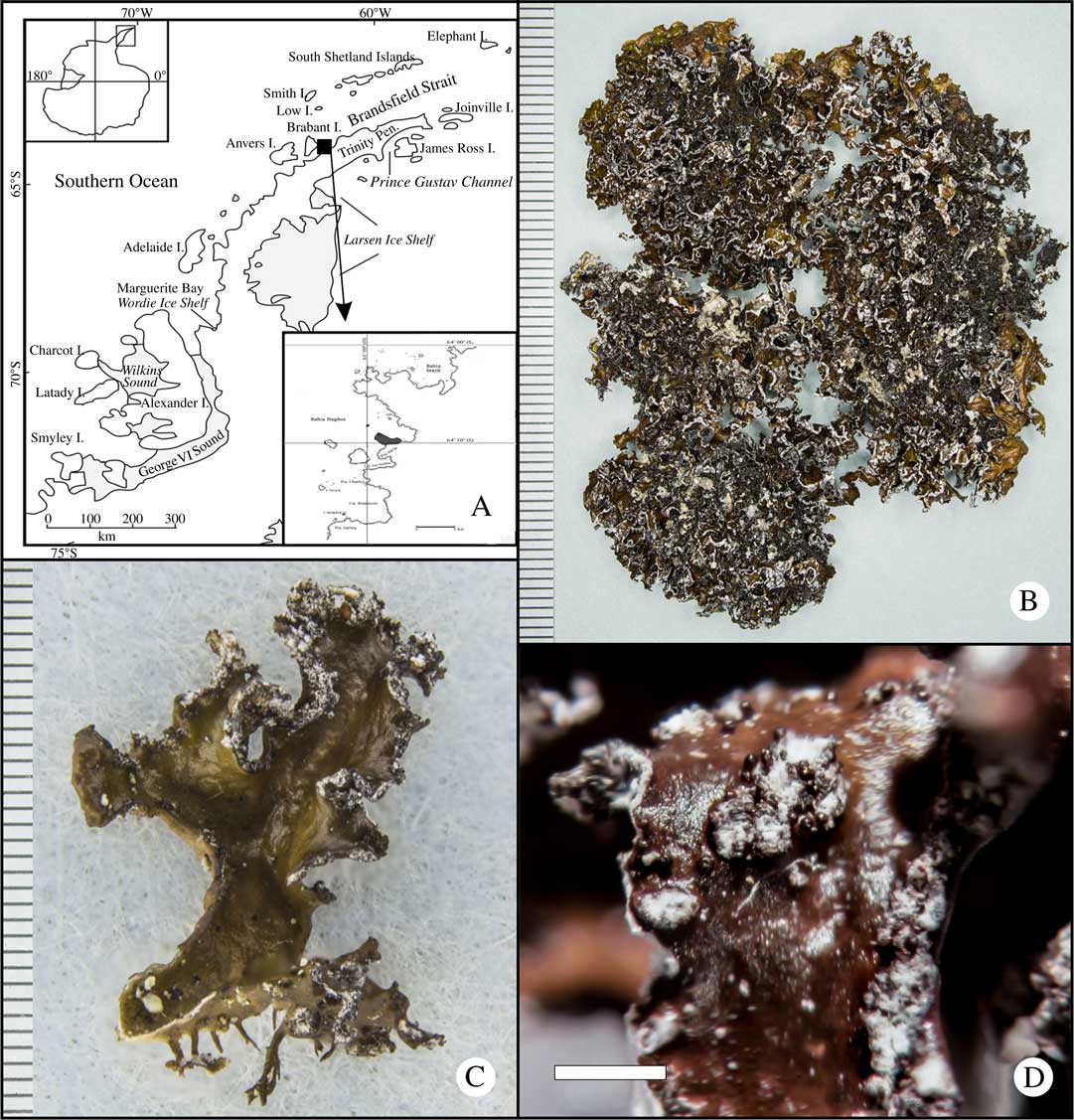
Thallus foliose to subfruticose, suberect, lobes divided and irregularly branched, broadly to weakly canaliculated; upper surface pale brown to olive-brown (brown to dark brown in Antarctic specimens), glossy and wrinkled; margins with small scattered white to greyish soredia (moderate to profusely sorediate in Antarctic specimens), soredia also laminal in older parts of the thallus and becoming corticated (Fig. 2D); lower surface pale brown to almost whitish, wrinkled with a few dispersed and short rhizines.
Apothecia rare (absent in Antarctic specimens).
Pycnidia uncommon, marginal or laminal, globose with a short stalk, black to black-brown, scattered; conidia bifusiform.
Chemistry. Protolichesterinic acid.
For a more detailed description (as T. chlorophylla) see Brodo et al. (Reference Brodo, Duran-Sharnoff and Sharnoff2001), Kärnefelt & Thell (Reference Kärnefelt and Thell2001) and Gilbert (Reference Gilbert2009), and in the original description under C. subscutata (Lindsay Reference Lindsay1973).
When Lindsay (Reference Messuti, Passo, Scervino and Vidal-Russell1973) described C. subscutata, Cetraria was the only cetrarioid genus in the Parmeliaceae. The lack of sexual structures on the Antarctic specimens, as well as the limited information about the species, prevented a better placement in the subsequent treatments of the group. However, recent studies on the family suggest that the shape of conidia is a more important character than apothecial structures (Thell et al. Reference Thell, Feuerer, Kärnefelt, Myllys and Stenroos2004, Reference Trifinopoulos, Nguyen, von Haeseler and Minh2012). Bifusiform conidia are characteristic of the Nephromopsis clade, while the Cetraria clade includes species with single swelling conidia. This supports the new proposed delimitation of the cetrarioid core (Divakar et al. Reference Divakar, Singh, Crespo, Schmitt, Kraichak, Lumbsch and Leavitt2017). The observation of conidia in our Antarctic collections strengthens the molecular results reported here, and shows that Lindsay’s species belongs to Nephromopsis.
Both Lindsay (Reference Messuti, Passo, Scervino and Vidal-Russell1973) and Øvstedal & Lewis-Smith (Reference Passo, Calvelo and Stocker-Wörgötter2001) discussed the similarity between C. subscutata and the widespread N. chlorophylla but considered them as separate species. Lindsay (Reference Messuti, Passo, Scervino and Vidal-Russell1973) commented on the absence of soredia in his species as the main difference and, later, Øvstedal & Lewis-Smith (Reference Passo, Calvelo and Stocker-Wörgötter2001) mentioned the presence of marginal pseudocyphellae in the Antarctic collections as the key difference but, contrary to Lindsay, stated that soredia were present. However, Øvstedal & Lewis-Smith (Reference Passo, Calvelo and Stocker-Wörgötter2001) focused more on its generic position than on the difference from T. chlorophylla. Our examination of the high-resolution images of the isotype (RWMC 514, O!), as well as some of the collections revised by Lindsay (RWMC 559, RILS 951, AAS!), confirmed the presence of marginal soredia, although poorly developed. Furthermore, our Antarctic material is copiously sorediate, not only at the margins but also occasionally on the lamina, becoming pseudoisidiate in older parts of the thallus (Fig. 2D). Adler & Calvelo (Reference Adler and Calvelo1993) and Calvelo (Reference Calvelo1994) also found laminal and corticate soredia on specimens of N. chlorophylla (as C. chlorophylla) from subantarctic Nothofagus forest and regarded this as a variation from the typical form. In the isotype (O, E. Timdal, pers. comm.) and in our fresh material, it was not possible to observe any pseudocyphellae. One explanation of why Øvstedal & Lewis-Smith (Reference Passo, Calvelo and Stocker-Wörgötter2001) mentioned these structures in C. subscutata is that they interpreted immature soralia as pseudocyphellae.
Nephromopsis chlorophylla is a common and widespread species in both the Southern and Northern Hemispheres, mainly in cool-temperate forests (Adler & Calvelo Reference Adler and Calvelo1993; Kärnefelt & Thell Reference Katoh and Standley2001). In the Maritime Antarctic region, the species has a very restricted distribution, confined to the mid-west Antarctic Peninsula. Although this region is frequently visited by many international lichenological expeditions, this peculiar distribution may be the reason that the species is poorly collected or overlooked. There are only four published records of N. chlorophylla as “C. subscutata” (e.g. with traceable collections deposited in official herbaria) so far: RWMC 514 (AAS and O!–types), RWMC 559 (AAS!), RILS 951 (AAS!) and RILS 2579 (?hb.) (Øvstedal & Lewis-Smith Reference Passo, Calvelo and Stocker-Wörgötter2001).
Nephromopsis chlorophylla usually grows on bark, even in extreme conditions as in Tierra del Fuego, southernmost South America (Adler & Calvelo Reference Adler and Calvelo1993). In Antarctic territories, where woody vegetation is absent, it is found over rock and between mosses. Severe and extreme conditions seem to trigger the morphological variation and substratum preferences discussed here. Wide morphological plasticity has been described previously from related groups under similar conditions, for example in Cetraria s. str. in the Arctic region (Kärnefelt Reference Karnefelt1979).
Specimens examined. As C. chlorophylla. Argentina: Río Negro: Cerro Chalhuaco, 1350 m, on Nothofagus pumilio, 13 v 1992, S. Calvelo (BCRU 00292). Tierra del Fuego e Islas del Atlántico Sur: Tolhuin, near Lago Fagnano, on N. antarctica, xi 1993, S. Calvelo & M. T. Adler (BCRU 00409).
As C. subscutata. Antarctica: Antarctic Peninsula: Danco Coast, Punta Cierva, 64°09'18·5'' S, 60°57'09·1'' W, on rock near sea shore, 11 ii 2014, A. Passo & J. M. Rodríguez (BCRU 05496), J. M. Rodríguez & A. Passo (CORD); Graham Coast, Argentine Islands, Uruguay Island, on Andreaea sp. and rock, 1967, R. Smith 951 (AAS); Skua Island, crags overlooking Skua Creek, on exposed rock surface, no snow or ice, alt. 20 ft., 1964, R. W. M. Corner 559 (AAS).
We thank the staff of the Primavera Station, the DNA (Dirección Nacional del Antártico) and IAA (Instituto Antártico Argentino) for providing logistics during fieldwork. This contribution was supported by CONICET (PIP 11220120100564), UNComahue (B 207) and ANPCyT-DNA (PICTO 2010–0095). We are grateful to H. Peat and E. Timdal for kindly providing the photographs of material in AAS and O, respectively. We thank two anonymous reviewers for comments and suggestions, and A. W. Archer for a critical review of the English style.