

The sibling relationship can be one of the closest and longest throughout a person's life, and therefore plays a pivotal role in shaping one's childhood, adolescence and adulthood (Noller, Reference Noller2005). Recent statistics suggest that 90% of the world's population have at least one sibling (Milevsky, Reference Milevsky2011). Siblings exist in many forms — biological, adoptive, step, half and/or foster siblings. This means that the majority of people have sibling relationships. Siblings have the potential to influence a person's likes and dislikes, their goals and aspirations, and even their relationships with others. According to family systems theory (Minuchin, Reference Minuchin1974) the relationship between two siblings has the ability to impact all other relationships within the family unit (Seltzer, Begun, Seltzer, & Krauss, Reference Seltzer, Begun, Seltzer and Krauss1991). Whether for better or worse, the quality of the relationship that one has with their brother or sister impacts all areas of social, emotional and occupational functioning (Milevsky & Heerwagen, Reference Milevsky and Heerwagen2013). It is not surprising then, that these relationships become particularly significant when one sibling has a disability.
The idea of sibling relationship quality has not been consistently defined throughout the literature, and instead exists as a vague, abstract concept. Nevertheless, measurement of this construct (most notably through the Sibling Relationship Questionnaire) has taken into account four dimensions: warmth/closeness, conflict, rivalry and relative status/power (Furman & Buhrmester, Reference Furman and Buhrmester1985). These dimensions capture both the positive and negative aspects of the day-to-day interactions between siblings. Consequently, the current study defines sibling relationship quality as the evaluation of the positive and negative attributes of the relationship itself (rather than of the individual siblings), based on how siblings interact and engage with one another.
Early sibling relationships have been described as a context for learning, and have a great impact on children's social, emotional, language and cognitive development (Howe & Recchia, Reference Howe and Recchia2014). The quality of these relationships has been empirically researched for typically developing siblings. As early as 2001, Lockwod, Kitzmann, and Cohen suggested that high quality sibling relationships may engender positive expectations about relationships, and/or allow children to practise pro-social behavior. Through a critical analysis of decades of research, Kramer (Reference Kramer2014) highlighted that through sibling conflict, children learn the necessary skills for conflict resolution, and therefore to regulate their emotional states. Thus it seems that an optimal amount of sibling conflict provides children with opportunities to develop their emotion regulation skills.
Multiple studies have shown that children in warm sibling relationships, low in conflict, develop fewer internalising symptoms such as anxiety and depression in childhood and adolescence (for a meta-analysis, see Buist, Deković, & Prinzie, Reference Buist, Deković and Prinzie2013). Alternatively, poor quality sibling relationships that are low in warmth and high in conflict have been found to result in negative psychosocial outcomes (Buist et al., Reference Buist, Paalman, Branje, Deković, Reitz, Verhoeven and Hale2014) associated with increased incidence of externalising symptoms such as aggression (Garcia, Shaw, Winslow, & Yaggi, Reference Garcia, Shaw, Winslow and Yaggi2000), delinquency (Slomkowski, Rende, Conger, Simons, & Conger, Reference Slomkowski, Rende, Conger, Simons and Conger2001), and antisocial behaviour (Bank, Burraston, & Snyder, Reference Bank, Burraston and Snyder2004). The literature therefore suggests that the quality of sibling relationships in childhood is associated with either positive or negative outcomes later in life. Although a large body of research now exists examining typically developing sibling relationships, a more recent development within the literature investigates whether (and how) the sibling relationship is affected when a sibling has a disability.
Disability and Sibling Relationships
The United Nations' (2006) definition of disability refers to all people who have ‘long-term physical, mental, intellectual or sensory impairments' (p. 3). According to the Australian Bureau of Statistics (ABS, 2011), 18.5% of Australians report having a disability. Approximately 290,000 of these are children under 14 years of age (ABS, 2012b). In Australia, 144,000 children have a physical disability, 143,000 an intellectual/learning disability, 120,000 a sensory/speech disability (including hearing or vision impairment), 44,000 a psychiatric disability (including developmental disabilities), and 13,000 an acquired brain injury (Australian Institute of Health and Welfare, 2004). The incidence of disability in Australia is high; consequently, a large proportion of childhood sibling relationships are impacted by disability.
Research in the area of sibling relationships and disability has traditionally focused on the negative psychosocial outcomes experienced by the typically developing sibling (e.g., Giallo, Gavidia-Payne, Minett, & Kapoor, Reference Giallo, Gavidia-Payne, Minett and Kapoor2012). Many typically developing siblings report heightened difficulties with social isolation, self-esteem, adjustment, communication and spending time with their families (Dew, Balandin, & Llewellyn, Reference Dew, Balandin and Llewellyn2008). Children who have a sibling with intellectual impairment have also been found to have a significantly (but small) increased likelihood of depression, anxiety, and overall internalising and externalising behaviours (Rossister & Sharpe, Reference Rossister and Sharpe2001). Fewer studies have focused on positive psychosocial outcomes, but some research suggests that typically developing children with a sibling with disability may have strengthened family relationships, be more independent (Derouin & Jessee, Reference Derouin and Jessee1996), have higher cooperation and self-control (Mandleco, Marshall, Olsen, & Dyches, Reference Mandleco, Marshall, Olsen and Dyches2003), demonstrate increased empathy for others (Cuskelly & Gunn, Reference Cuskelly and Gunn2003), and develop greater adaptive coping abilities (Cox, Marshall, Mandleco, & Olsen, Reference Cox, Marshall, Mandleco and Olsen2003). Although perspectives in this area are inconsistent, there is evidence within the literature that childhood psychosocial development does differ (both positively and negatively) when one sibling in the dyad has a disability. Nevertheless, the research is less clear about how the quality of the relationship itself is impacted by disability.
Family systems theory suggests that disability impacts the roles and quality of all relationships within the family system (Burbidge & Minnes, Reference Burbidge and Minnes2014). Consequently, the pressure on family relationships, including sibling relationships, may be heightened when one child has a disability. Although this theory predicts how relationship quality may differ for these families, this has not yet been empirically investigated. Furthermore, the impact of variables such as age, gender, birth order and family size on these relationships is relatively unknown. Considering what we already know about sibling relationships, particularly regarding the association between relationship quality and psychosocial development, this is an important area for investigation. If researchers can better understand how the quality of childhood sibling relationships is affected by disability, then they may also begin to better understand how relationship quality may protect against negative psychosocial adjustment. This will be important in designing interventions for siblings in the future.
Few recent studies have empirically investigated childhood sibling relationship quality and disability. Despite the necessity of research in this area, a plethora of current research has instead focused on the impact of disability on adult sibling relationships (e.g., Burbidge & Minnes, Reference Burbidge and Minnes2014; Doody, Hastings, O'Neill, & Grey, Reference Doody, Hastings, O'Neill and Grey2010; Heller & Arnold, Reference Heller and Arnold2010; Tozer, Atkin, & Wenham, Reference Tozer, Atkin and Wenham2013), while research specific to children has yielded discrepant findings.
Some studies have found that when one sibling has a disability, the sibling relationship is more positive than relationships between two typically developing children. For example, Roper, Alfred, Mandleco, Freeborn, and Dyches (2014) quantitatively found that mothers of children with Down syndrome and multiple disabilities (physical and intellectual), but not mothers of children with autism spectrum disorder (ASD), reported more positive sibling relationships than the typically developing sample. In a similar study by Fisman, Wolf, Ellison, and Freeman (2000), siblings of children with pervasive developmental disorder and Down syndrome reported significantly more warmth and less conflict in their sibling relationships than the control group with typically developing siblings. A study by Cuskelly and Gunn (Reference Cuskelly and Gunn2003) again found minimal but positive differences in relationship quality between the reports of siblings and parents of children who had Down syndrome versus siblings who were typically developing.
On the other hand, other studies have found no differences between the two groups. An older study by Bågenholm and Gillberg (Reference Bågenholm and Gillberg1991) found that there were relatively few qualitative differences between sibling relationships in typically developing, ASD and intellectual impairment groups, with siblings in each group generally reporting positive relationship qualities. Bischoff and Tingstrom (Reference Bischoff and Tingstrom1991) found a similar result using a quantitative measure, concluding that both siblings and mothers of children with various disabilities reported no differences compared to a comparison sample on warmth/closeness, conflict or rivalry in the sibling relationship. Mothers within the disability group reported greater status/power differences between their children than mothers from the comparison sample. Nonetheless, the small sample size of 12 participants per group and mere age of this research questions the validity of these results.
A further set of studies have found both positive and negative qualities of sibling relationship within the same study. Of particular significance, Kaminskey and Dewey (2001) evaluated children's self-reported relationship quality with either a typically developing sibling, sibling with ASD, or a sibling with Down syndrome. They found that siblings of children with Down syndrome had significantly more closeness in their sibling relationship (compared to the other two groups), including greater affection, and more nurturance towards and admiration by their sibling. Both disability groups reported less conflict in their sibling relationship, including less competitiveness and quarrelling, and greater admiration of their sibling. Conversely, children in the ASD group also reported less intimacy and nurturance by their siblings (compared to both other groups) and less pro-social behaviour (compared to the Down syndrome group). These contradictory finding suggest that the association between disability and siblings is not clear, with both positive and negative relationship qualities being observed within the one study, and even within the same disability type.
Few researchers have considered the importance that constellation variables might have in affecting sibling relationship quality when one sibling has a disability. Begum and Blacher (Reference Begum and Blacher2011) found that sibling relationships with disability had more warmth in same-sex dyads (as opposed to mixed-sex dyads) and when a boy had the disability. They found no significant differences based on the birth order or sibling gender variables. Bat-Chava and Martin (Reference Bat-Chava and Martin2002) found that children with hearing impairment who were older than their siblings tended to have positive or very positive relationships, while children who were younger than their typically developing siblings tended to have mixed or negative relationships. Larger families (with more children) reported fewer negative sibling relationships compared to smaller families (with fewer children). Alternatively, Floyd, Purcell, Richardson, and Kupersmidt (2009) found that relationship quality was not impacted by variables such as gender, birth order, or target age.
There are a number of methodological discrepancies that may account for these inconsistent findings within the literature. First, there is considerable variability in how the construct of relationship quality has been measured in these studies: quantitatively or qualitatively. The choice of informant also varies, with existing studies using a variety of researcher observation, and parent and child reports (Stoneman, Reference Stoneman2005). Expected informant and measurement variability makes research in this area therefore difficult to compare (Guite et al., Reference Guite, Lobato, Kao and Plante2004). Nonetheless, because mothers are typically the primary caregivers within the family (ABS, 2012a), they are likely to spend the most time as indirect observers of sibling relationships. Consequently, a number of studies have chosen to use mothers as reliable informants to report on the quality of these relationships.
Second, a number of studies have only focused on a single disability type in their research. Many studies focus on developmental disabilities such as ASD (see Beyer, Reference Beyer2009) and/or on intellectual impairment (e.g., Fisman et al., Reference Fisman, Wolf, Ellison and Freeman2000; Floyd et al., Reference Floyd, Purcell, Richardson and Kupersmidt2009; Kaminskey & Dewey, Reference Kaminsky and Dewey2001). Relatively few studies have focused on physical or sensory impairments in this area, and even fewer (if any) have evaluated each of the disability subtypes simultaneously. This again restricts the generalisability of these results, and thus the general impact of ‘disability' as a category remains unknown.
Finally, a number of studies are also limited by the absence of a typically developing comparison sample. For example, Pollard, Barry, Freedman, and Kotchick (2013) found that sibling relationships in which one child has ASD had fewer social support qualities, more negative interchanges, and lower levels of overall perceived relationship quality compared to relationships where one child had Down syndrome. However, because no comparison was used in this study, it is unknown whether relationship quality is different from, or merely akin to, what would be expected in a typically developing sample.
The Current Study
Overall, we do not know a great deal about how disability impacts the quality of the childhood sibling relationship. There is much research on the psychosocial effects on the typically developing sibling — the outcomes of the relationship — but not on the quality of relationships (which we know is an important predictor of child maladjustment). Different studies report that when one sibling has a disability, sibling relationship quality may be more positive, more negative, or even no different compared to a typically developing group. Methodologically, each study varies in its type of measurement, choice of informer, type of disability and use of comparison samples. This, and the age of many studies, limits the generalisability of research findings and prevents comparisons between studies. There is thus a need to address the existing research limitations, by establishing a more comprehensive understanding about mothers' perceptions of the effect of disability on the quality of sibling relationships. We ask two questions here: (1) how does disability affect the quality of the childhood sibling relationship, and (2) what variables may be additionally related to the quality of the relationship, such as age order, number of children, gender grouping, target gender and target age. The current study aimed to empirically investigate these questions through an online questionnaire completed by mothers of children who are typically developing or who have a disability. Using an Australian sample of parents with children under the age of 18 years, we are the first to investigate these questions with this sample, and investigate all subtypes of disability simultaneously.
Method
Participants
Of the 108 parents recruited, six were excluded from analysis as they did not fit the criteria that both the target and sibling were under 18 years old. Families whose fathers answered the survey were also excluded from the analysis due to insufficient respondents (n = 12). One participant with 100% missing data on the dependent variables (DVs) was also excluded, resulting in the final sample of 89 participants. The final sample consisted of 41 mothers with a child with disability, and 48 with no children with disability. Fifty-three per cent of all of the families had two children and 42.1% had three or more children.
The ‘target’ child was defined either as the child with the disability, or else a child preselected by the parent for the no disability families. The ‘sibling’ was identified as the child closest in age to the target child. Forty-five per cent of the target children were female, and 46% of these children's siblings (who were closest in age to them) were female. The age of the target child ranged from 2–17 years (M = 7.88, SD = 3.20) while the age of the sibling ranged from 1–17 years (M = 7.82, SD = 4.18). Of those children with disability, 10 were diagnosed with physical impairment, 26 with intellectual impairment, 3 with vision impairment, 3 with hearing impairment, 9 were diagnosed with ASD and 5 were diagnosed with a general neurological disability.
Measures
Sibling relationship questionnaire — brief version
(SRQ; Furman & Buhrmester, Reference Furman and Buhrmester1985). The SRQ consists of 39 items for 16 scales, loading onto four factors. Previous research suggests that two factors, the warmth/closeness and conflict factors, have the greatest validity and provide the most information about the sibling relationship (e.g., Fisman et al., Reference Fisman, Wolf, Ellison and Freeman2000; Lockwood et al., Reference Lockwood, Kitzmann and Cohen2001). Consequently, only the scales underpinning these two factors were used. This resulted in a 21-item questionnaire measuring the DVs' warmth/closeness and conflict.
Items used a 5-point Likert scale with responses from 1 = hardly at all to 5 = extremely much. An example from the warmth/closeness factor is: ‘How much does this sibling look up to and feel proud of [name of target]?'An example of a conflict factor item is: ‘How much do [name of target] and this sibling insult and call each other names?’ High scores on the warmth/closeness factor indicate strong amounts of warmth/closeness within the sibling relationship, while high scores on the conflict factor are indicative of high amounts of conflict in the sibling relationship. Previous research suggests high reliability coefficients of .94 and .93 for the warmth/closeness and conflict factors respectively, and good construct validity (Derkman, Scholte, Van der Veld, & Engels, Reference Derkman, Scholte, Van der Veld and Engels2010). Cronbach alphas for this sample were .94 (warmth/closeness) and .79 (conflict).
Demographic information
Mothers also recorded the number of people in their family, the gender and age of each of their children, and the nature of their child's disability (if applicable). Three variables were calculated based on this data — number of children (two vs. more than two), birth order (sibling older vs. sibling younger), and gender grouping (both male vs. both female vs. male target/female sibling vs. female target/male sibling).
Procedure
Participants were recruited through eight Education Queensland school newsletters and organisation websites/Facebook pages such as Carers Queensland and Autism Queensland. A URL directly linked participants to the online survey. Participants were first presented with an information sheet, before answering demographics and the questionnaire. Submission of the completed survey was interpreted as consent to participate. The survey took approximately 10 minutes to complete.
Results
Data Preparation and Preliminary Analyses
A missing values analysis revealed that all variables had less than 5% of missing data, and Little's MCAR test was not significant (p = .188), indicating that no patterns of missing data were detected. In creating the warmth/closeness and conflict scores, Fruman and Buhrmester (1985) suggest that participants must complete at least two thirds of items for each factor for that score to be generated. Of the 14 participants identified as missing one or more DV items, none met the criteria for exclusion. The DV scores were then calculated by averaging the scores of corresponding items for each factor. The demographic variables (number of children, birth order and gender grouping) were also generated at this time.
A one-way analysis of variance (ANOVA) was conducted to determine whether the demographic variables of target age and sibling age varied significantly based on the variable disability (disability vs. no disability). No significant difference was found for target age between the no disability (M = 7.63; SD = 2.27, 95% CI [6.97, 8.28]) and disability condition (M = 8.17; SD = 4.05, 95% CI [6.89, 9.45]) groups, F(1, 87) = .64, p = .426, ηP 2 = .007.1 However, sibling age for the disability condition (M = 9.00; SD = 4.62, 95% CI [7.54, 10.46]) was found to be significantly higher than for the no disability condition (M = 6.81; SD = 3.50, 95% CI [5.80, 7.83]), F(1, 87) = 6.44, p = .013, ηP 2 = .069.
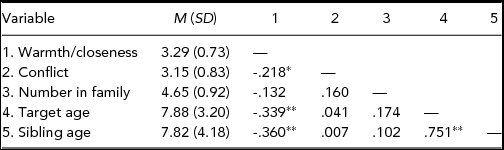
Bivariate correlations were then conducted to determine whether target age, sibling age, number in family, and the two DVs were significantly correlated. As seen in Table 1, the warmth/closeness factor was significantly related to target age (r = -.339, p = .001), and sibling age (r = -.360, p = .001). These results suggest that warmth/closeness within the sibling relationship decreases with increasing target and/or sibling age. As would be expected, target age and sibling age were also significantly correlated (r = .751, p < .001), suggesting that as the target age increases, so too does the sibling age. The conflict factor was significantly correlated with the warmth/closeness factor (r = -.218, p = .041), but with none of the demographic variables. This suggests that as conflict within the sibling relationship increases, warmth/closeness decreases.
Intercorrelations Between the Dependent Variables, Number in Family, and Target and Sibling Age

Note: ** p < .01, * p < .05
Covariates
Based on results from the preliminary one-way ANOVA and bivariate correlations, all analyses were initially run using analysis of covariance (ANCOVA) with sibling age and target age as the covariates. However, neither covariate had a significant univariate effect in any of the analyses conducted, and did not differ significantly to the comparative ANOVAs. Consequently, the ANOVA results were reported for analyses. The exception to this was for an analysis involving the demographic variable age order and the conflict factor, whereby the ANCOVA and ANOVA results differed considerably. The ANCOVA results were therefore reported here.
Main Analyses
A one-way ANOVA was performed to determine whether the two DVs differed significantly based on the independent variable (IV), disability. For the warmth/closeness factor, mothers with a child with disability (M = 2.92, SD = .69, 95% CI [2.70, 3.14]) reported significantly lower warmth/closeness in the sibling relationship than mothers without a child with disability (M = 3.60, SD = .61, 95% CI [3.42, 3.77]), F(1, 87) = 23.60, p < .001, ηP 2 = .213. For the conflict factor, there was no significant difference between the no disability (M = 3.28, SD = .71, 95% CI [3.07, 3.48]) and disability groups (M = 3.00, SD = .93, 95% CI [2.71, 3.29]), F(1, 87) = 2.55, p = .114, ηP 2 = .028.2
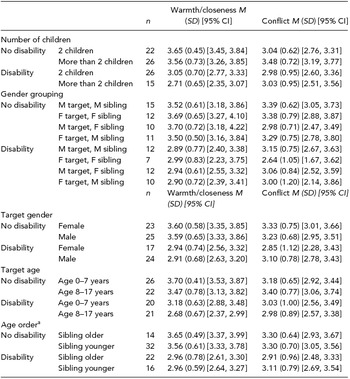
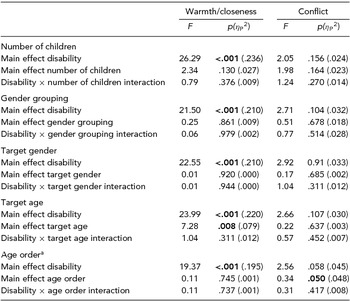
A series of two-way ANOVAs were then conducted to assess the potential impact of the demographic variables number of children, gender grouping, target gender, target age and age order as moderators for the IV-DV relationships. A two-way ANCOVA (with covariates sibling age and target age) was conducted with age order for the conflict factor. Descriptive statistics for these analyses are reported in Table 2. As reported in Table 3, the main effect of disability remained significant for the warmth/closeness factor and non-significant for the conflict factor in each of the ANOVA analyses. The only significant demographic variable main effect was target age. It was found that irrespective of disability, there was significantly more warmth/closeness in sibling relationship for younger target children (M = 3.47, SD = .58, 95% CI [3.30, 3.64]) compared to older target children (M = 3.09, SD = .83, 95% CI [2.83, 3.34]), F(1, 85) = 7.28, p = .008, ηP 2 = .079. No significant disability–demographic variable interactions were found. For the age order ANCOVA, a marginally significant main effect of age order was found. Irrespective of disability, and over and above the effects of sibling and target age, mothers reported significantly more conflict when the sibling was younger than the target child (M = 3.24, SD = .73, 95% CI [3.03, 3.45]) compared to when the sibling was older than the target child (M = 3.06, SD = .86, 95% CI [2.77–3.35]), F(1, 78) = 3.96, p = 0.05, ηP 2 = .048. No main effect of disability or interaction was found for this variable.
Descriptive Information for the Two-Way ANOVA Analyses Between the Demographic Variables and Disability on the Dependent Variables

Note: aFive participants who reported that the target and sibling child were the same age were excluded from this analysis. Figures for the conflict factor are based on the ANCOVA results.
Two-Way ANOVA Results Between the Demographic Variables and Disability on the Dependent Variables

Note: Significant p values in bold. aFive participants who reported that the target and sibling child were the same age were excluded from this analysis. Figures for the conflict factor are based on the ANCOVA results.
Discussion
This study sought to establish a broader understanding about mothers' perceptions of the effect of disability on the quality of childhood sibling relationships. We first asked whether there were differences in the quality of sibling relationships when one sibling did or did not have a disability. It was found that while there were no differences in reported conflict between the two groups, mothers with a child with disability reported significantly lower warmth/closeness in their children's sibling relationship than mothers without a child with disability. We also asked whether demographic variables such as number of children, gender grouping, target gender, target age and age order moderated the impact of disability on sibling relationship quality. None of these variables were found to significantly alter the differences originally found between the disability and no disability groups. However, it was found that as a whole, mothers reported significantly more warmth/closeness for younger rather than older children, and more conflict when the sibling was younger than the target child as opposed to older than them.
The observed differences between the disability and no disability groups are similar to other studies that have found both positive and negative relationship qualities within the same study (e.g., Floyd et al., Reference Floyd, Purcell, Richardson and Kupersmidt2009). The finding that the groups did not differ in reported conflict is consistent with a number of studies that suggest that sibling relationship quality remains constant irrespective of disability (Bågenholm & Gillberg, Reference Bågenholm and Gillberg1991; Bischoff & Tingstrom, Reference Bischoff and Tingstrom1991). In line with existing research into sibling conflict (Brody, Reference Brody1998), both groups recorded moderate and potentially optimal levels of conflict in their relationships. However, for conflict to be beneficial, it needs to be balanced with an optimal level of warmth/closeness (Lockwood et al., Reference Lockwood, Kitzmann and Cohen2001).
The finding that the disability group had significantly less warmth/closeness in their sibling relationships than the typically developing sample is important considering the empirical link between sibling relationship quality and psychosocial outcomes (e.g., Buist et al., Reference Buist, Deković and Prinzie2013; Garcia et al., Reference Garcia, Shaw, Winslow and Yaggi2000). The overall quality of the relationship for the disability group, with moderate conflict but comparatively low warmth/closeness, may therefore begin to explain the empirical association between disability and sibling negative psychosocial adjustment (Dew et al., Reference Dew, Balandin and Llewellyn2008; Giallo et al., Reference Giallo, Gavidia-Payne, Minett and Kapoor2012). Furthermore, decreased warmth/closeness may be related to the typically developing siblings' adjustment to having a sibling with disability. The grief and loss experienced by parents with a child with disability is well documented (Costantino, Reference Costantino2010; Foley, Reference Foley, Gilbert and Hochman2006) and is likely to also impact sibling relationship quality. This contradicts the view that sibling relationships in disability are akin to, if not better than, those for typically developing children (e.g., Stoneman, Reference Stoneman2005).
The other major finding from this study was that no demographic variables moderated the association between disability and sibling relationship quality. These findings are similar to a study by Floyd et al. (Reference Floyd, Purcell, Richardson and Kupersmidt2009), which found the same result for adolescents with intellectual impairment. While this finding contradicts the existing research that suggests gender grouping and target age do impact the relationship (Begum & Blacher, Reference Begum and Blacher2011), previous research findings were again specific to intellectual impairment, and therefore do not appear to hold true for ‘disability’ as a general category in this study.
The finding that warmth/closeness was higher for younger children (irrespective of disability) makes intuitive sense — as children become older, they begin to spend more time with the peer group than within their family relationships (Stauffacher & DeHart, Reference Stauffacher and DeHart2006). The marginally significant finding that conflict is higher when the sibling is younger than the target child may merely be an uninterpretable artifact of the study's methodology — mothers in the no disability group arbitrarily selected which of their children would be the ‘sibling’ and the ‘target’.
Methodological Limitations
Some methodological limitations of the present study should be noted. First, and similar to other studies in this area, this study only used mothers as informants. Although we originally aimed to compare the perspectives of both mothers and fathers, this was not possible due to insufficient father responses (n = 12). Furthermore, an a priori decision was made not to collect siblings' perspectives at this time. Siblings were as young as 1 year old, therefore data collection from this group was not feasible. Existing research suggests that while mother, father and sibling reports may be moderately correlated (e.g., Cuskelly & Gunn, Reference Cuskelly and Gunn2003), children typically overestimate the positive qualities within their relationships compared to adults (Floyd et al., Reference Floyd, Purcell, Richardson and Kupersmidt2009; Guite et al., Reference Guite, Lobato, Kao and Plante2004). Consequently, the generalisability of these findings across informants may be restricted. This study is therefore explicit in stating that findings are a comprehensive representation only of mothers' perceptions about the quality of their children's sibling relationships. Future research comparing these three informants' perspectives would be a valuable addition to the literature.
The results of this study may also be limited by the sample size. Although the cell size was sufficiently large for the disability (n = 41) versus no disability (n = 48) analyses, they were considerably reduced for analyses involving multiple variables. For example, in the analyses comparing both the disability and gender grouping variables, there were eight different cells with sample sizes ranging from n = 7 to n = 15. Consequently, the true impact of some demographic variables may be underestimated. To accommodate for this, all effect sizes were reported so that the relative effect of each of the variables can be understood. Nevertheless, this research provides important preliminary data about childhood sibling relationship quality and disability, which may be enhanced with larger studies in the future.
Implications for Intervention
The results of this research may have important implications for practitioners working with children who have siblings with disability. There are currently a number of organisations within Australia that focus on helping typically developing children manage having a sibling with disability, such as Siblings Australia and the Association for Children with a Disability. Sibling programs typically focus on the development of coping and emotion regulation skills for the typically developing child (Association for Children with a Disability, 2003), and provide them with a space to form an identity away from their sibling's disability (Nesa & Strohm, Reference Nesa and Strohm2010). While important, these strategies do not address issues within the sibling relationship directly. This research preliminarily suggests, however, that these programs should place a strong emphasis on enhancing the quality of the child's relationship with their sibling with disability. Importantly, siblings require a space to explore and adjust to changing family dynamics related to disability, and to process the grief and loss associated with their expectations of what life is like in a family when one sibling has a disability.
Future Research
To address the informant limitations of the current study, future research should endeavour to compare the perceptions of mothers, fathers and siblings simultaneously. Although we acknowledge that gathering data from young children is logistically difficult and that there is often a low response rate for fathers in research, it is important to supplement the results of the current study with their perspectives to evaluate whether there are inherent differences between mothers', fathers' and siblings' points of view. This may have further implications for intervention. The investigation of family level variables such as socioeconomic status and parental demographics (e.g., age, level of education, psychopathology) with a larger sample size, would also be useful in further exploring what factors may moderate the association between disability and sibling relationship quality.
Acknowledgements
None
Financial Support
None
Conflict of Interest
None
Ethical Standards
The research was approved by the university ethics committee and the schools.