Introduction
Smoking kills around 5,000 New Zealanders annually and its harmful effects are well documented (Gerritsen, Stefanogiannis, & Galloway, Reference Gerritsen, Stefanogiannis and Galloway2008). Worldwide, it remains a leading cause of many preventable illnesses, disabilities and premature morbidity (Fried, Reid, & DeVore, Reference Fried, Reid and DeVore2004; Richards et al., Reference Richards, Toop, Brockway, Graham, McSweeney and MacLean2003; Suchanek Hudmon et al., Reference Suchanek Hudmon, Corelli, Chung, Gundersen, Kroon and Sakamoto2003; Weaver, Whittaker, Valachovic, & Broom, Reference Weaver, Whittaker, Valachovic and Broom2002; WHO, 2013). Smoking is a serious risk factor for respiratory, cardiovascular and neoplastic diseases (Hallmon, Reference Hallmon2001; Johnson & Bain, Reference Johnson and Bain2000; Kottke, Battists, Defriese, & Brekke, Reference Kottke, Battista, DeFriese and Brekke1988), as well as cancers of the head and neck regions, mucosal conditions, periodontal disease, failures of dental implants and halitosis (Downes, Reference Downes2002; Kottke et al., Reference Kottke, Battista, DeFriese and Brekke1988; Warnakulasuriya et al., Reference Warnakulasuriya, Dietrich, Bornstein, Peidró, Preshaw and Walter2010; Warren et al., Reference Warren, Sinha, Lee, Lea, Jones and Asma2011). Past research has identified that practising New Zealand (NZ) dentists engage little in promotion of smoking cessation amongst their patients (Brady, Ayers, Thomson, & Holborrow, Reference Brady, Ayers, Thomson and Holborow2004). NZ has a 5-year training programme for dentistry, but it is unknown how dental students develop in their understanding and implementation of smoking cessation interventions (SCIs) through the training programme.
Around one in five (21.0%) New Zealanders aged 15–64 years were current tobacco smokers in 2009, down slightly from 23.5% in 2006. However, smoking remains considerably more prevalent amongst Māori (45.1%) and Pacific Islanders (30.3%) (Gerritsen et al., Reference Gerritsen, Stefanogiannis and Galloway2008; Ministry of Health, 2010). In 2011, the NZ Government set a goal for the country to become smoke-free by 2025. It is a responsibility of all health care professionals to work together to decrease the prevalence of smoking in this country.
SCIs are as effective in the dental setting as in any other health care setting (Macgregor, Reference Macgregor1996). The Consensus Report from the second European workshop on tobacco use prevention and cessation for oral health professionals reported that the provision of SCIs by oral health professionals can improve the odds a patient will quit smoking (Ramseier et al., Reference Ramseier, Warnakulasuriya, Needleman, Gallagher and Lahtinen2010). Warnakulasuriya (Reference Warnakulasuriya2002) described the results of seven smoking/smokeless tobacco trials by dental care providers, and observed annual quit rates of up to 15%. Pooled data from all 14 studies included in the most recent Cochrane review (10 involved dentists and hygienists and four hygienists only) suggested that the provision of SCIs by oral health professionals can significantly increase tobacco abstinance rates at 6 to 24 months (OR1.71, 95% CI 1.44 to 2.03) (Carr and Ebbert, Reference Carr and Ebbert2012). An outcomes analysis found a quit rate of 10% to 15% can be expected in dental surgeries when an effective cessation programme is put in place, with dentists more likely to provide SCC (smoking cessation counselling) and take an interest in patients quitting if they know of, and can refer, the patient to a smoking cessation organisation (Helgason et al., Reference Helgason, Lund, Adolfsson and Axelsson2003).
Considering that one in two adults had visited a dentist in a 12-month period over 2011 and 2012, it is important that dentists provide effective SCIs to their patients (Ministry of Health, 2013). Dental treatments often extend over a prolonged period of time giving the dentist a chance to revisit SCIs with the patient, thereby increasing the chance of success (Carr & Ebbert, Reference Carr and Ebbert2006; Macgregor, Reference Macgregor1996).
Dental students at the University of Otago, NZ begin treating patients in their third year of study (BDS3) with patients seen for a total of 6 hours per week. The time spent treating patients doubles in the fourth year of study (BDS4). The final year of the degree (BDS5) consists almost exclusively of clinical practice. This takes place in a ‘general dentist’ setting within the Faculty as well as on their 6-week clinical outplacements in communities around the country. Although the effects of smoking on oral and general are covered in the dental curriculum in the second and third years of study in the BDS programme, no specific SCI training is currently provided to these students.
The knowledge of, and attitudes towards, SCI of NZ dental students has not previously been reported. The aim of this study was to investigate student attitudes, knowledge and current SCI practices and to explore perceived barriers that may prevent them from delivering SCIs to their patients.
Methods
Ethical approval was obtained from the University of Otago Human Ethics Committee (D14/124) and Māori consultation was sought from Ngāi Tahu Consultation Committee according to the University of Otago's Policy for Research Consultation with Māori. The study population included all dental students enrolled in their third (BDS3), fourth (BDS4) or final (BDS5) year of study at the Faculty of Dentistry in 2014 (N = 343). These students are involved in patient care. Participants were recruited halfway through the first semester of the university year. The questionnaire was distributed to the third- and fourth-year BDS students during simulation teaching clinics. As final year students no longer attend simulation clinics, they were contacted via the Faculty's internal mail service and by email. Participation was voluntary. Completed questionnaires were returned to a designated area to maintain anonymity.
Questionnaire (Appendix 1)
A self-administered questionnaire was constructed and pretested which led to improvements in clarity and wording. Face validity was established by dental specialist colleagues (two periodontal specialists and one dental public health specialist), as well two general dentists who had advanced training in SCI. The questionnaire consisted of questions with Likert scale or categorical responses, as well as a final question inviting participants to add any comments or suggestions.
Questionnaire items included the following:
-
• Recall of any SCI education or training, and information regarding smoking related oral and general health implications.
-
• Use of a routine protocol to identify smokers amongst their patients (such as inclusion of standard questions in the patient's medical history) and how these patients are managed.
-
• Students’ personal views on SCI.
-
• Current knowledge of students about available SCI organisations.
-
• Confidence levels in delivering SCIs.
-
• Barriers that may prevent the provision of SCIs to patients.
-
• Students’ views regarding the current curriculum with regards to SCI training.
Statistical Analysis
Data were managed and analysed in IBM Statistical Package for the Social Sciences (SPSS Version 22.0, Chicago, IL, USA). The chi-square test was used to test for significance of observed associations between categorical variables, with an alpha level of 0.05. Qualitative content analysis of the final question, which invited additional comments, was carried out with responses summarised into groups with similar concepts and a coding frame then used to carry out the analysis.
Results
Participant Details
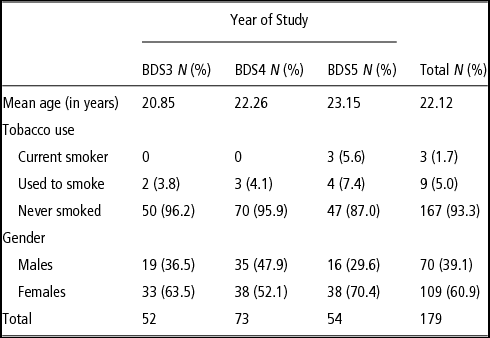
The response rate was 73.7% (179/243). The demographic characteristics of the participants are shown in Table 1. Approximately three in five participants were female, consistent with the characteristics of the overall dental student population (59.0% female). The mean age of all participants was 22.1 years (SD = 2.0). Only three participants were current smokers (1.7%, two males and one female), but a further one in 20 were past smokers (5.0%, eight males and one female). The remainder of participants had never smoked (93.3%).
Participant demographics by year of study

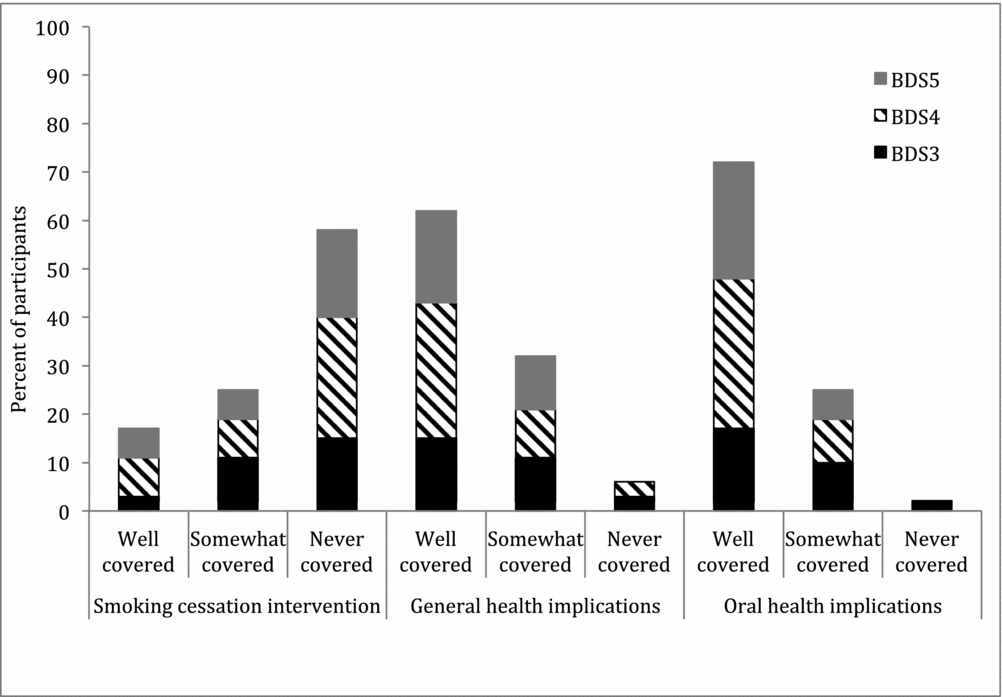
Recall of SCI Education and the Health Implications of Tobacco Use (Figure 1)
Only 17.3% of participants felt that SCI education had been covered in sufficient detail during their studies and more than half had no recall of the inclusion of SCI into the curriculum. However, almost two-thirds (62.0%) reported that the curriculum had included a great deal of education regarding the general health implications of tobacco smoking. None of those who felt that this topic was not well covered were in their final year of study. Only 5.6% of students had no recall of any teaching about SCIs. Although almost all of the participants (97.2%) felt that the oral health implications of tobacco smoking had been covered in the curriculum, almost three quarters (73.6%) wanted more education and training in discussing the oral health implications of smoking with patients.
Students’ recall of smoking related topics in the current dental school curriculum.

Perceptions Regarding SCI
Although the majority of participants (64.8%) felt that providing SCI is important in clinical practice, fewer than half (39.1%) felt that it is their duty as health professionals to do so. Twenty students (11.2%) thought that SCI is an ineffective service to provide to patients. Whilst there was no statistically significant gender difference in the belief whether health professionals have a duty to provide SCIs to their patients (p = 0.148), females were significantly more likely than males to believe that providing SCIs to patients was important (p = 0.018).
Irrespective of their beliefs about ineffectiveness, almost all participants (96.6%) agreed that the provision of SCI was important for patients with periodontal disease. All BDS5 students (100%) thought that SCI was important in patients with dental implants, whilst only 57.7% of BDS3 students and 83.6% of BDS4 agreed, a finding similar to other implant-related results in this study. Almost all participants, regardless of year group, believed that providing SCIs to Māori (97.8%) and Pacific Island (97.2%) patients was important.
SCI Practices
Over two-thirds (70.9%) used a routine protocol to identify patients who smoke. The routine protocol consists of four questions which students are encouraged to use as part of interviewing patients on their health history: the patient's current smoking status, substance used, frequency of smoking and time since quitting for former smokers. Use of these questions is not, however, compulsory. Although the more junior students were less likely to use a routine protocol, there was no statistically significant difference between the three groups (p = 0.323). Three-fifths of all participants, irrespective of their stage of training, had carried out some form of SCI amongst tobacco smokers. The patient groups specified by participants as being of particular importance for SCIs were ‘all adults’ (44.7%) and ‘patients with periodontal disease’ (37.4%). BDS5 students were close to seven times more likely to report carrying out SCI with implant patients than BDS3 students, and over 1.5 times more likely than BDS4 students. No statistically significant differences were observed by students’ gender (p > 0.05).
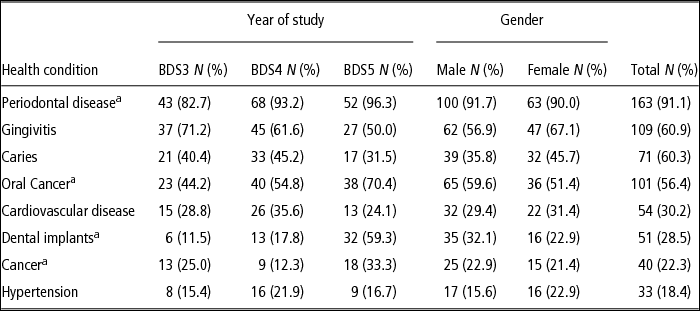
Health conditions, both oral and general, which prompted a discussion of the health impacts of smoking are shown in Table 2. Periodontal disease (91.1%), gingivitis (60.9%), caries (60.3%) and oral cancer (56.4%) were the most frequently listed conditions, whilst other types of cancer were considered the least important. Although not statistically significant, BDS5 students were three times more likely than BDS4 and five times more likely than BDS3 students to discuss the effects of smoking on oral health with dental implant patients (p = 0.066).
Number and percent of students who discuss the health effects of tobacco smoking by health condition

a p < 0.05 between year of study groups.
Over two-fifths of BDS3 students (42.3%) reported never having spent any time on SCI with their patients. This situation improved as the students progressed through their degree with only 20.5% of BDS4 and 13% of BDS5 students having spent no time on SCIs. The majority of the participants (BDS3 46.2%, BDS4 65.8% and BDS5 70.4%) spent less than 5 minutes on smoking cessation activities with their patients, whilst a small minority spent more than 5 minutes. There were no students who spent more than 20 minutes SCIs.
Types of SCIs Used
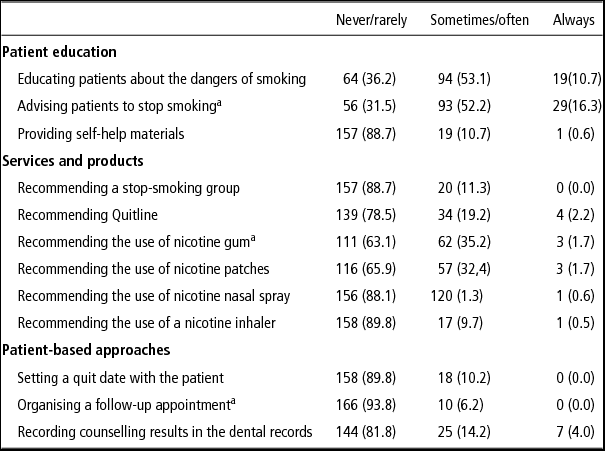
Of all the SCI options listed in the questionnaire, providing verbal advice to stop smoking was the most commonly used intervention (see Table 3). Insofar as smoking cessation products are concerned, nicotine gum and nicotine patches were the most popular products recommended. The questionnaire did not explore the specific dosages recommended by participants for any of the listed nicotine replacement products, only whether or not their recommendation was part of the respondent's SCI armamentarium. The majority of participants reported they rarely or never provided self-help materials, recommended products or services, undertook patient-based SCI approaches or recorded SCC in the patient's dental records. The Quit Group (Quitline) was the smoking cessation organisation that most participants knew of (59.2%) and had used (20.7%). A third (33%) of all participating students were aware of the National Heart Foundation's smoking cessation programme. Other SCI organisations listed were NRT Exchange Card Providers, District Health Bard Smokefree teams, Aukati KaiPaipa, Te Hotu Manawa Māori, Pacific Quit Smoking Services, Education for Change and Smokefree Murses Aotearoa/NZ.
Frequency of smoking cessation activities carried out by New Zealand dental students

a p < 0.05 between year of study groups.
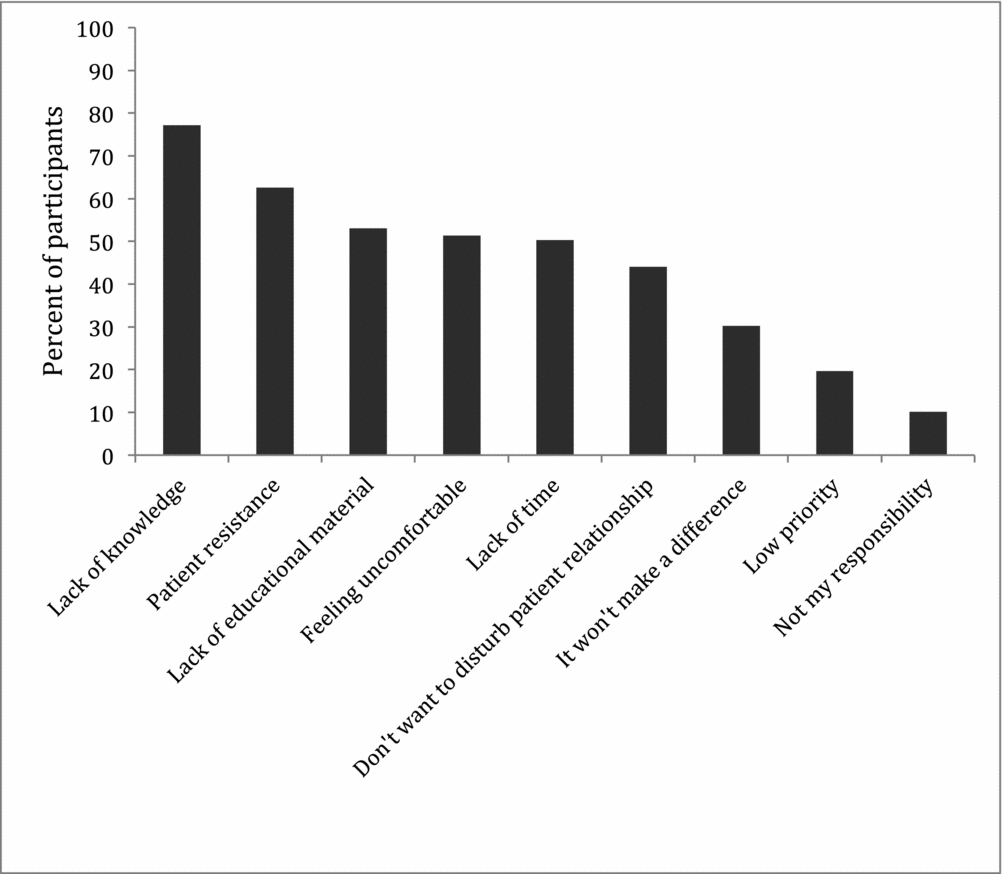
Lack of knowledge (77.1%) and patient resistance (62.6), were the most commonly perceived barriers to providing SCI noted (see Figure 2). The view that SCI is not the responsibility of dental health professionals was mentioned by just over 10% of participants. Levels of confidence in the provision of SCI varied between students. More than 90% of students reported low confidence in their ability to provide SCIs. It is unfortunate that, even for students who reported feeling confident, this did not appear to be reflected in an increased likelihood of them providing SCIs. BDS4 and BDS5 year students felt more confident than BDS3 students. Just over three-quarters (76%) of all students agreed that more information, training and education are needed, as this will enable them to better manage patients and action referrals to SCI organisations.
Barriers to offering cessation intervention, as perceived by NZ dental students.

Discussion
This study investigated the knowledge, attitudes and SCI practices of NZ dental students in their final 3 years of clinical training. The study identified several barriers that prevent the provision of SCIs to patients. Although most identified patients who smoke, the majority did not provide any SCI services to them. This appears to be due to a lack of knowledge about available organisations and referral procedures.
One of the weaknesses identified in this study is that its findings may not be applicable to dental students in other parts of the world. Recall bias, the potential for confusion in the questionnaire, and inaccurate self-reporting of health conditions by patients could also have affected this questionnaire study. Although a response rate of 73.7% was achieved, it is unknown whether the sociodemographic characteristics of the respondents differed from those of the non-respondents. As it is likely that non-respondents were more likely to be non-providers and be disinterested in the topic, the findings reported here are likely to overestimate the likelihood of students providing SCIs.
Very few of the participants reported that they were smokers. It is possible that an awareness of the detrimental effects of smoking on both general and oral health, peer pressure and social desirability bias may have contributed to this. Dental students in Saudi Arabia reported smoking prevalence rates of 13% for males and 2% for females (Almas, Al-Hawish, & Al-Khamis, Reference Almas, Al-Hawish and Al-Khamis2003), in Iran 9.6% reported current smoking (Ebn Ahmady, Golmohammadi, Ayremlou, Khoshnevisan, & Lando, Reference Ebn Ahmady, Golmohammadi, Ayremlou, Khoshnevisan and Lando2011), whilst in the UK 11% of second year dental students and 4% of final year students were smokers (Newbury-Birch, Lowry, & Kamali, Reference Newbury-Birch, Lowry and Kamali2002). It has been reported that tobacco smoking is becoming less common amongst dental students in Australia, Canada, Great Britain and the United States, but that many dental students in other countries continue to smoke tobacco (Smith & Leggat, Reference Smith and Leggat2007). More recently, the Global Health Professions Student Survey found that over 20% of third-year dental students were smokers in more than half of the 44 countries investigated (Warren et al., Reference Warren, Sinha, Lee, Lea, Jones and Asma2011). Although NZ and Australia were not included in this study, a 2003 survey at the University of Sydney Faculty of Dentistry found that 13% of undergraduate dental students were self-reported current smokers (Rikard-Bell, Groenlund, & Ward, Reference Rikard‐Bell, Groenlund and Ward2003). The aforementioned literature may not be entirely comparable due to changing attitudes to smoking over time and worldwide cultural differences. This generational effect, with the NZ dental students having been brought up in an era when the dangers of smoking are well known, may also have resulted in the lower percentage of reported smokers.
The majority of the NZ dental students did not recall having received specific SCI training or education. Tamí-Maury et al. (Reference Tamí-Maury, Aigner, Hong, Strom, Chambers and Gritz2014) identified several pratical barriers to implementing tobacco use prevention and cessation training in Latin American and Caribbean dental schools, such as lack of resources to make referrals, lack of skills to provide motivational interventions, insufficient class and clinic time, limited educational resources and faculty skills. Lack of a supportive organisation was identified by senior dental students in Iran as an important barrrier (Ebn Ahmady et al., Reference Ebn Ahmady, Golmohammadi, Ayremlou, Khoshnevisan and Lando2011). Although several of these may be applicable to the NZ dental school, the NZ Ministry of Health (MOH) does provide a free LearnOnline e-learning training course in smoking cessation for all health care professionals. In combination with increased Brief Motivational Interviewing (BMI) training, which has been shown to significantly improve students’ smoking-cessation counselling techniques (Koerber, Crawford, & O'Connell, Reference Koerber, Crawford and O'Connell2003), compulsory completion of this training course could increase students’ confidence and proficiency in offering SCIs.
As found with this NZ group, it is not uncommon for dental students to feel that providing SCI is not part of their duty, even though they recognise its importance. Only 40% of Belgium dental students felt that it is the responsibility and duty of dentists to participate in anti-smoking programmes (Vanobbergen, Nuytens, van Herk, & De Visschere, Reference Vanobbergen, Nuytens, Van Herk and De Visschere2007), whilst in Nigeria, SCI was not perceived to be within a dentist's scope of practice (Uti & Sofola, Reference Uti and Sofola2011).
It is only possible to effectively provide SCIs if those patients who smoke are clearly identified. Information regarding both current and past smoking habits is necessary, and both new and existing patients need their clinical records to be regularly updated.
Use of a standardised history and examination template, which includes the aforementioned four smoking-related questions, is strongly encouraged in the NZ School of Dentistry clinics which may explain why almost three-quarters of all participants indicated that they use a routine protocol to identifying smokers. This is similar to Australian dental students where 77% have indicated that they take tobacco histories from all patients (Rikard-Bell et al., Reference Rikard‐Bell, Groenlund and Ward2003). Documentation of both the patient's smoking history and cessation history needs to be updated at every visit.
Although it would appear that very little time is spent on SCIs – less than 5 minutes for most – studies have shown that even a brief intervention of between 2 and 5 minutes is associated with a 2%–3% higher rate of smoking cessation (Fiore, Reference Fiore2000). The average time reported for effective SCI and counselling is 10 minutes (Shibly, Reference Shibly2010). A Cochrane review concluded that SCIs in the dental setting are more effective than usual care for promoting tobacco cessation with pooled tobacco abstinence at 12 months of 1.44 (Carr & Ebbert, Reference Carr and Ebbert2006). All studies included in this review involved only brief advice from the dental professional. Dental patients have been shown to be receptive to dentists providing SCC and intervention (Warren et al., Reference Warren, Sinha, Lee, Lea, Jones and Asma2011).
With regards to an awareness of smoking-related health risks, NZ dental students (91.1%) were found to be comparable to Greek dental students (96.3%) in recognising the relationship between smoking and periodontal disease (Polychonopoulou, Gatou, & Athanassouli, Reference Polychonopoulou, Gatou and Athanassouli2004). Unfortunately though, in both groups, it would appear that having knowledge about associated risks does not necessarily translate to an increased provision of SCI.
Lack of confidence in providing SCIs is not unusual with more than half of the dental students in a South Carolina survey not confident about treating nicotine dependence (Cannick, Horowitz, Reed, Drury, & Day, Reference Cannick, Horowitz, Reed, Drury and Day2002) and only 22% of Australian of dental students reporting confidence in providing information about the oral health effects of smoking to their patients (Rikard-Bell et al., Reference Rikard‐Bell, Groenlund and Ward2003). NZ dental students appear less confident than their American and Australian peers with less than a 10th of participants (9.1%) reporting that they are confident in providing SCIs. Worldwide, students in other health professions, such as medicine, have also reported being underprepared with regards to providing effective tobacco SCI and counselling (Warren, Jones, Chauvin, & Peruga, Reference Warren, Jones, Chauvin and Peruga2008).
The perceived barriers to providing SCI were similar in this study to those previously identified for both dentists and dental students. A lack of training in SCC and techniques was found to be the main barrier in perceived by NZ dentists (Brady et al., Reference Brady, Ayers, Thomson and Holborow2004) as well as dental students in Cardiff (Clareboets, Sivarajasingam, & Chestnutt, Reference Clareboets, Sivarajasingam and Chestnutt2010), Greece (Polychronopouloe et al. Reference Polychonopoulou, Gatou and Athanassouli2004), New York (Yip, Hay, Ostroff, Stewart, & Cruz, Reference Yip, Hay, Ostroff, Stewart and Cruz2000) and Nigeria (Uti & Sofola, Reference Uti and Sofola2011). NZ students felt that improvements in the curriculum would increase their confidence and result in an increase in the provision of SCIs. Another possible explanation as to why some students provide SCIs, whilst others do not, could be explained by the empathy-altruism hypothesis (Batson et al., Reference Batson, Batson, Slingsby, Harrell, Peekna and Todd1991). Those students who feel greater empathy for others and are motivated to increase the well-being of the patient will be more likely to intervene to help, in this case by, by providing SCIs for those patients who smoke.
In NZ, Māori and Pacific Islanders have the largest proportion of smokers over the age of 15 years with 39.2% of smokers Māori and 24.7% Pacific Islanders. These groups represent those with the highest risk of developing smoking-related oral and general health condition (Ministry of Health, 2013). The NZ dental curriculum places considerable emphasis on the differences in health outcomes for Māori and Pacific Island population groups. These are mainly due to socio-economic inequality, limited access to health care and health and lifestyle factors such as tobacco smoking and diet (Blakey, Tobias, Atkinson, Yeh, & Huang, Reference Blakely, Tobias, Atkinson, Yeh and Huang2007). It was pleasing to note that almost all students perceived SCI to be of importance in Māori (97.8%) and Pacific Island populations (97.2%).
A range of options is available in NZ to assist people to quit smoking with the two main services available nationally free of charge for those wanting to quit – the Quit Group and Aukati Kai Paipa. The Quit Group services provide support for smokers through the Quitline, the Internet and mobile phones (Txt2Quit). Aukati Kai Paipa is a NZ-wide service with 39 offices located throughout the country, providing intensive face-to-face support for Māori smokers who wish to quit. Both services provide Quit Cards which smokers can use to obtain government-subsidised NRT from pharmacies for a small payment. Although NZ dental students receive no formal SCI training, three out of every five were aware of Quitline (59.2%). The lack of training may explain why only one in three students who were aware of Quitline had actually recommended this organisation to a patient. In their study of qualified NZ dentists, Brady et al. (Reference Brady, Ayers, Thomson and Holborow2004) found that only one in three dentists referred patients to cessations clinics or other smoking cessation programmes.
Conclusions
Future health professionals have a vital role to play in the NZ Government's goal to make the country smoke-free by 2025. SCIs provided in a dental setting are effective, but are not consistently implemented. NZ dental students would benefit from more formalised training in SCI and counselling, including the effectiveness and importance of brief interventions. As a successful SCI training programme has already been established in the Bachelor of Oral Health Degree at the University of Otago, sharing of resources or inclusion of dental students in this training could be considered. Completion of the NZ MOH LearnOnline e-learning training course in smoking cessation could also be a mandatory prerequisite either prior to students commencing patient care or as part of their requirements for professional registration. The importance of updated documentation of patients’ smoking and cessation histories needs to be strongly encouraged.
Future research may re-evaluate the knowledge and confidence levels of students once SCI training has been introduced into the curriculum.
Acknowledgements
None.
Financial Support
This research received no specific grant from any funding agency, commercial or not-for-profit sectors.
Conflict of Interest
None.
Ethical Standards
Not applicable as this research did not involve any human and/or animal experimentation.