Introduction
Many studies discuss the relationship between social support and health in general, and a large proportion of these concentrate on elderly people (Horman, Reference Horman1989; Gliksman et al., Reference Gliksman, Lazarus, Wilson and Leeder1995; Johnson, Reference Johnson1996; Al-Kandari, Reference Al-Kandari2001b, Reference Al-Kandari2008, 2011; McCawley, Reference McCawley2007; Thanakwang & Soonthorndhada, Reference Thanakwang and Soonthorndhada2011). Across ethnic groups and nations, whether observed or self-reported, better quality social support predicts greater life expectancy and lower mortality rates among older adults (Hanson et al., Reference Hanson, Isacsson, Janzon and Lindell1989; Lyyra & Heikkinen, Reference Lyyra and Heikkinen2006; White et al., Reference White, Philogene, Fine and Sinha2009). Some studies have shown that the effect of social support on longevity and health differs between men and women (Shye et al., Reference Shye, Mullooly, Freeborn and Pope1995; Okamoto & Tanaka, Reference Okamoto and Tanaka2004). Men generally report lower rates of morbidity than do women, while women report worse health but survive longer than men in most samples regardless of social setting or culture (Waldron, Reference Waldron1967; Case & Paxson, Reference Case and Paxson2004; Mendoza-Sassi & Beria, Reference Mendoza-Sassi and Beria2007). Differentials in health and symptomology between elderly men and women have been well documented (Deeg & Bath, Reference Deeg and Bath2002; Molarius & Janson, Reference Molarius and Janson2002; Murtagh & Hubert, Reference Murtagh and Hubert2004; Oman et al., Reference Oman, Reed and Ferrara1999; Zunzunegui et al., Reference Zunzunegui, Alvarado, Béland and Vissandjee2009; Schollgen et al., Reference Schollgen, Huxhold and Tesch-Romer2010). Sarason et al. (Reference Sarason, Sarason, Pierce, Barbara, Sarason, Sarason and Pierce1990) distinguished between ‘quality of support perceived and provided social support’. Several studies have examined effects of spousal support on elder's health (Minkler, Reference Minkler, Cohen and Syme1985; Wyke & Ford, Reference Wyke and Ford1992; Barron, et al., Reference Barron, Foxall, Von Dollen, Jones and Shull1994; Gliksman et al., Reference Gliksman, Lazarus, Wilson and Leeder1995). Others concentrated on the effect of having children (Spitze & Logon, Reference Spitze and Logon1990; Akiyama et al., Reference Akiyama, Elliott and Antonucci1996; Al-Kandari, 2011). In most cases, the importance of kin to elders' health and survival is clear.
Social support is an important psychological concept in Kuwait traditional and modern society. Solidarity is an important element of such social support. Internal cohesion among family groups and living in familial social solidarity were adaptive in the harsh environments of traditional Kuwait. One of the most important values of Kuwaiti familial solidarity is providing support and aid to one's elders in the form of respect and obedience (Barakat, Reference Barakat2008). Al-Thakeb (Reference Al-Thakeb1985) and Al-Kandari & Poirier (Reference Al-Kandari and Poirier2001) reported that modernity has changed the traditional Kuwaiti family pattern from extended families towards preferring living in nuclear families. Change also has occurred in the way men and women interact and their different roles in modern society. Women in traditional Kuwait society were mostly segregated from men. Today, women are taking an increasingly active role in education, politics and the work force (Al-Falah, Reference Al-Falah1989; Jaleeli, Reference Jaleeli2008; Al-Kandari, Reference Al-Kandari2010).
Social support for the elderly and its relationship to health have been examined in several studies in Kuwaitis (Al-Kandari, 2001, Reference Al-Kandari2008, 2011). Social support is an important psychological element for older adults. Participating in a non-formal organization with relatives and friends in what is called Diwaniyyah is related significantly to positive overall health in elderly Kuwaitis (Al-Kandari, Reference Al-Kandari2008). Religiosity, an element of social support, has also been found to be associated with positive overall health among older adults in Kuwait society (Al-Kandari, 2011).
This study examines the differences between Kuwaiti men and women aged 60 years and over across three age categories (60–69, 70–79, 80+ years) for several aspects of health: glycaemia, reported somatic symptoms, systolic and diastolic blood pressures and self-reported general health and over the last year. The relationships between several social support variables, somatic symptoms and systolic and diastolic blood pressure are also examined. Although a few studies have discussed the relationship between health and social support in Kuwait (Al-Kandari, 2001, Reference Al-Kandari2008, 2011), this is the first to explore associations of health and social factors across multiple categories of the elderly Kuwaiti population: the young-old, old-old and oldest-old. To the authors' knowledge, neither discussions nor comparisons among different cohorts of elders have appeared in any studies of Kuwaiti elders. In Kuwait different age cohorts have experienced rapid cultural change, radically different life styles, and new patterns of survival and longevity. In this report health across these three age groups of elders is compared.
Methods
A total of 1427 adult men (472) and women (955) aged 60 years and over representing all six governorates in Kuwait were enrolled into a health survey. The respondents' age averaged 77.1 years (SD=9.41) (range: 60–105 years). Respondents were sampled from all socio-cultural and economic backgrounds. Most had a low level of education – elementary or below (69.3%). Medical and socio-cultural data were collected in the field by research assistants who worked as nurses or were working in mobile care units affiliated to the Ministry of Social Affairs in Kuwait. Data collection consisted of obtaining informed consent, and then introducing the questionnaire and interview to the participant and completing it with the aid of the closest-related person to the participant currently at home. Other than self-reports, this person who was knowledgeable about the elderly participant's health, social status, cultural background and current behaviour helped with data collection. All procedures were completed during the evening at the participant's home. This study was part of a larger project supported by Kuwait University and approved by the university's institutional review body. The data were collected during 2008–2009.
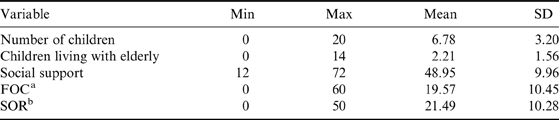
The questionnaire included items eliciting data on socio-cultural and demographic factors, medical history and self-ratings of health. Questions on age, gender, total number of children and number of children currently living in the same household were included, along with the total number of residents in the household. The Social Support Scale (SSS) developed by Zimet et al. (Reference Zimet, Dahlem, Zimet and Farley1988) has been used previously in Kuwaiti studies (Al-Mutiri, Reference Al-Mutairi2000; Al-Kandari, Reference Al-Kandari2001a, Reference Al-Kandari2002). Several modifications allow this scale to better fit the elderly adults constituting this sample. This SSS has high internal consistency overall (α-coefficient of 0.87). A Frequency of Contact (FOC) scale, including questions concerning kin and friends' frequency of contact with the responding elderly family member and the participant's daily contact with spouse, children, cousins, close friends, and others, was also completed. In addition, a Strength of Relations (SOR) scale was included to determine strength of contacts with these people. Both scales are based on five points: always (5) to never (1). These scales also show high internal consistency (α-coefficient of 0.84 and 0.85, respectively). Table 1 describes social support characteristics of the sample.
Descriptive social support characteristics, Kuwait men and women aged over 60

a FOC=Frequency of Contact;
b SOR=Strength of Contact.
Self-rated scales of general health (What is your estimation of your health in general?) and health in the past year (What is your estimation of your health in the last year?) were used. These are ten-point scales scored as 0=poor and 10=excellent. A Somatic Symptoms Inventory (SSI), developed by Abdel-Kalek (Reference Abdel-Kalek2003b), was useful for examining physical health status. In the SSI, ‘the vast majority of items [are] related to physical and organic aspects, e.g., tooth aches, dyspnea, gastric upset, joint pains, and otitis media, notwithstanding that it is difficult to differentiate the psychic from the somatic,’ (p. 117). The SSI includes sixty somatic symptoms rated on a Likert scale: 0=none, 1=some, 2=much, and 3=always. The SSI has been reported for other Kuwait elderly samples (Al-Kandari, Reference Al-Kandari2001a; Abdel-Kalek, Reference Abdel-Kalek2003a, Reference Abdel-Kalek2004), and shows high internal consistency in this sample (α-coefficient 0.92). The study research assistants completed systolic and diastolic blood pressure (SBP and DBP) measurements using an aneroid sphygmomanometer (desk model). Systolic pressure was read as the first Korotkoff phase, i.e. onset of sound. Three blood pressure measurements were taken at different times during the visit. The average of these three readings was used for all analyses. The research assistants also completed glucose measurements using a Glucose Elite III, Glucose One Touch®. All visits were at night before the common dinner hour (19:00 hours) and about 4–5 hours after standard lunch time (12:00–13:00 hours).
Analysis was performed with SPSS (Version 17), and t-tests, ANOVA and multivariate regression were used to assess differences between men and women in self-reported health and the effects of selected socio-cultural (age, education and socioeconomic status) and social support variables on somatic symptoms, SBP and DBP. These included a forward stepwise regression of each of these health measures of the full set of socio-cultural and social support measures.
Results
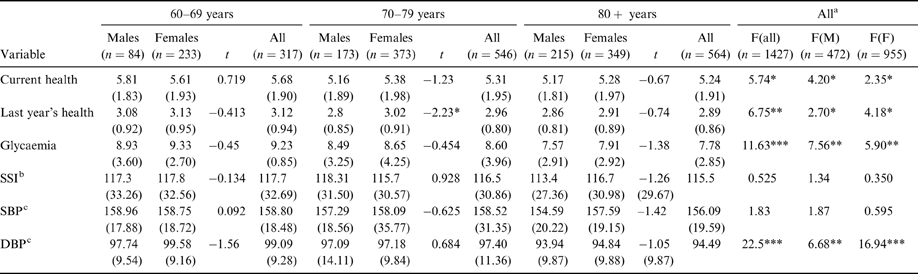
Self-reported health and health over the last year, glycaemia, somatic symptoms, and systolic and diastolic blood pressure were examined. To estimate the strength of differences in health between elderly men and women within and across age groups, means, standard deviations (SD) and t-values were determined to compare men and women. Between-age-group differences were examined using one-way ANOVA and F-statistics, and the results are shown in Table 2.
Differences between elderly Kuwaiti men and women of different age groups in self-reported health and somatic symptoms and assessed glucose and systolic and diastolic blood pressure, mean (SD)
*p<0.05; **p<0.01; ***p<0.001.
a All means compared differences in scores within age groups.
b SSI, Somatic Symptoms Inventory;
c SBP and DBP, systolic and diastolic blood pressures.
Self-rated health and health in the last year differed significantly across age groups. As expected, the young elderly report greater satisfaction with their current health and their health over the last year compared with older age groups. No significant difference in health was found between men and women in the older age group, or in self-rated health and self-rated health in the last year. No significant differences were found in average glycaemia between men and women in any age group. However, glycaemia differed significantly across the three age groups for the total sample and for both men and women. The highest average glycaemia was observed at the youngest ages compared with both older groups. Among men aged 60–69 glycaemia averaged 8.93 IU (SD=3.60) – slightly higher than in the older age groups, and a pattern repeated among women. Systolic and diastolic blood pressures showed a similar pattern of variation, being lower in older respondents than in younger. For SBP these differences were non-significant. Significant differences in DBP across age groups are observed among both men and women. The highest SBP average was found in the youngest sample of men, as was the highest DBP; the same was observed for women. No significant differences between men and women in SBP or DBP were observed within age groups. Finally, no significant differences across the three age groups in somatic symptoms were observed. However, the youngest group reported more symptoms than other age groups. Also, no significant differences in somatic symptoms between men and women were observed for any age group.
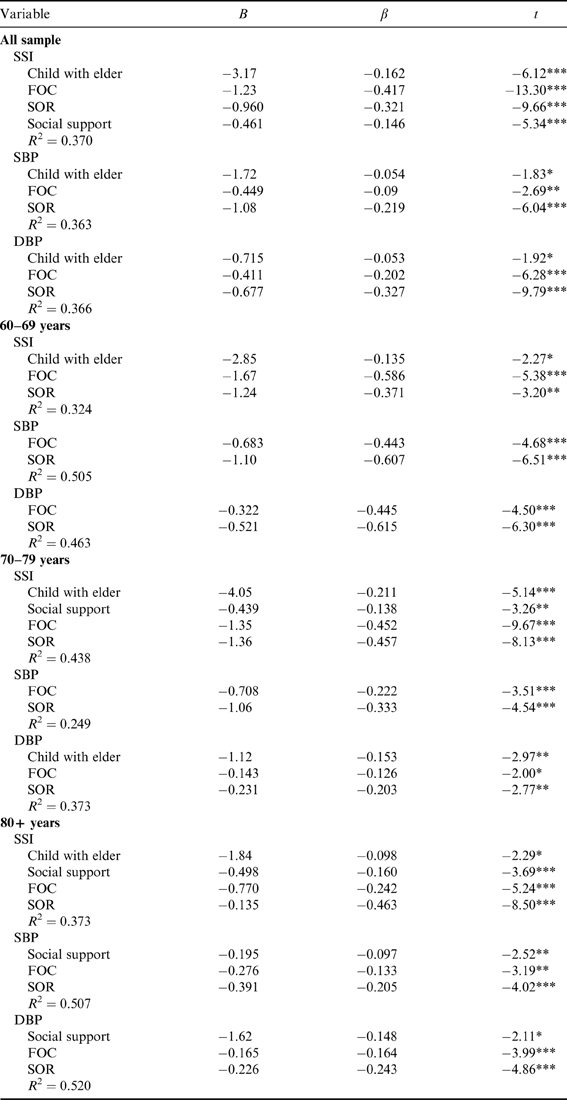
Next, a forward step-wise multivariate regression model was used to examine independent associations of social support with the dependent variables, somatic symptoms and systolic and diastolic blood pressure (see Table 3). Strength of relationship, frequency of contact, social support and children living with an elderly adult were all associated with fewer somatic symptoms, and all, except social support, were associated with lower systolic and diastolic blood pressures. The young-old elders showed higher SSI scores when fewer of their children were living in the household, they had lower frequency of contact or lower strength of relations. Systolic blood pressure was most related to a combination of frequency of contact (FOC) and strength of relations (SOC) scales. Diastolic blood pressure was best modelled using FOC and SOR. Somatic Systems Inventory (SSI) responses among elders aged 70–79 were related to all social factors examined: fewer children living in the same household, SSS (Social Support Scale), FOC and SOR. Higher systolic blood pressure was related to lower FOC and SOR. Diastolic blood pressure was related significantly to all social measures except SSS. In the oldest-old group SSS, FOC and SOR were closely related to SSI, SBP and DBP. Variation in SSI was related to number of children living in the elder's household, SSS, FOC and SOR. Both SBP and DBP were best explained by lower SSS, FOC and SOR. Social support appeared to strongly affect elder's health. This was true across all age groups of elders examined; however, SSS showed a stronger effect at later life stages.
Regression coefficients of somatic symptoms inventory (SSI) and systolic and diastolic blood pressures on social support variables by age category of elderly Kuwaitis
FOC=Frequency of Contact; SOR=Strength of Contact.
*p<0.05; **p<0.01; ***p<0.001.
Discussion
Social support has generally been found to be associated with well-being during the later days of the human life span in most socio-cultural settings. Having children, the perception of social support, and frequency of contact with and strength of relationships with kin have all been found to be important modulators of somatic symptoms and blood pressure among elderly Kuwaitis. Modernity has changed the socio-cultural characteristics and social relationships of elderly Kuwaitis (Bustan, Reference Bustan1986; Al-Kandari, Reference Al-Kandari2008, Reference Al-Kandari2011a, Reference Al-Kandarib). Socio-cultural surveys have shown major changes in the social lives of elders secondary to rapid modernization and socio-cultural changes throughout the Middle East over recent decades (Bustan, Reference Bustan1986; Hegland et al., Reference Hegland, Sarraf and Shahbazi2007; Jaleeli, Reference Jaleeli2008; Sokolovsky, Reference Sokolovskyno date). Among these many changes are smaller family sizes, fewer spouses for men, more education for girls and women and increased number of single-family households (Al-Thakeb, Reference Al-Thakeb1985; Al-Kandari & Poirier, Reference Al-Kandari and Poirier2001; Barakat, Reference Barakat2008; Al-Kandari, Reference Al-Kandari2010).
Changing family size has been observed in Kuwait and other Gulf countries. In Kuwait, average family size declined from 6.5 in 1970 to 5.9 in 2005 and is expected to fall to 4.25 by 2015 (El-Haddad, Reference El-Haddad2003). Fertility declined at the same time, from a rate of 7.0 per 1000 in 1970 to only 6 per 1000 in 2005 (Al-Kandari, Reference Al-Kandari2007). Living in nuclear families, as opposed to the traditionally preferred extended family, is characteristic of modern Kuwait (Al-Thakeb, Reference Al-Thakeb1985). In the past, it was important to have many children as the people lived in harsh environments in the desert, on farms and at sea. In such settings, a large labour force was needed to counter the harsh living circumstances of subsistence agriculture, herding and fishing. Thus, large numbers of children have long been important for Kuwaiti families living traditional lives. Such needs enhanced the solidarity and cohesion among family members and kin who strived to survive together. Everyone needs the support of others to counter life's stressors. Traditionally, children were called ezwa or sanad, meaning supporter and well-helpers (e.g. Barakat, Reference Barakat2008). In modern Kuwait clearly the number of children living with their parents in extended family households has declined. Children who live with an elderly relative provide social support and aid with activities of daily living.
Based upon previous research, it was expected that the youngest elders would receive more social support and more frequent contact from relatives and friends than the oldest. This is partly because older participants will have lost more friends and relatives to death and that many will have retired and not worked for long periods of time leaving them without co-workers to visit them. It has been confirmed by other studies (Heylen, Reference Heylen2010; Melchiorre, et al., Reference Melchiorre, Chiatti, Lamura, Torres-Gonzales, Stankunas and Lindert2013) that the oldest people are the more isolated. They receive less social support. It seems that social isolation may be more frequent among some Kuwait elders due to their improved survival.
In this study, several differences between elderly age groups identified as young-old, old-old and the oldest-old were observed. Young elders reported more satisfaction with their health, self-rating themselves higher than older groups. The oldest-old were the least satisfied with their current health. However, no significant differences in somatic symptoms were reported across the three age groups. Satisfaction with one's health may flow more from the amount of social support received. The younger elderly have larger social networks and support than the oldest. Social networks will become more critical as deaths of friends and spouses reduce the networks of the oldest elderly, as has already been seen in longitudinal studies (Haessler & Willis, Reference Haessler and Willis1990). Indeed, social support may relate to overall life satisfaction and thereby further affect health satisfaction. Feeling more integrated socially and psychologically comfortable seems to be related to better self-perceived health. As reported by Chang (Reference Chang1997) ‘social support … [has] profound and pervasive protective effects on adjustment and satisfaction of the elderly,’ (p. 471). Reviewing related studies, Ballesteros (Reference Ballesteros2001) modelled the inter-relationships between environmental factors, health and life satisfaction among elders. Social support was the most important factor for health satisfaction. In this study, health satisfaction was higher among the youngest elderly, probably because they are receiving more social support and have more contact with relatives and friends. Social factors probably affect the health satisfaction of the elderly through both direct and indirect pathways.
The youngest sample of Kuwaiti elders showed more chronic diseases, higher glycaemia and higher systolic and diastolic blood pressures than did the older age groups. The oldest-old were the least healthy on most assessments. Blood glucose and blood pressure generally rise with age. However, Bots et al. (Reference Bots, Grobbee and Hofman1991) suggested that neither SBP nor DBP rise significantly after age 65 years. It is a possibility that those with higher systolic and diastolic blood pressures and blood glucose die at earlier ages, leaving those with lower blood pressure and glycaemia surviving into old age. Genetic factors may lead to lower systolic and diastolic blood pressure and glycaemia among elders. According to the World Health Organization (2006) the leading cause of death in Kuwait is ischaemic heart disease (around one-third of total deaths), the second is hypertensive heart disease (11% of total deaths) and diabetes mellitus is the seventh (5% of total deaths). It is likely that these conditions more affect those with higher blood pressure and glycaemia, so selective mortality could lead to those predisposed to lower blood pressure alive at older ages.
Among the multiple types of social support the elderly receive over their lives, the major source is their spouse. Elders with a spouse report fewer somatic symptoms, lower blood glucose, SBP and DBP, and higher self-rated current health and health over the past year. Elwert & Christakis (Reference Elwert and Christakis2008) stated that ‘what is called the “widowhood effect” – is one of the best documented examples of the effect of social relations on health,’ (p. 2092). Spouse death ‘causes loneliness which has been identified as one of the most stressful life events elderly people can ever face,’ (Nalungwe, Reference Nalungwe2009; p. 12).
These trends are clear even at young-old ages. Among elders with a spouse aged 80+ years both blood glucose and self-rated health in the last year are significantly below those without a spouse, while among elderly aged 70–79 years, glycaemia, somatic symptoms and self-rated current health and health in the last year were all lower. Such differences suggest that the positive effect of having a spouse on elders may wane as adults succumb to the progressive influences of senescence, ageing and loss of allostasis. It is well documented that there is an association between death of a spouse and worsening health among the elderly (e.g. Zisook & Shuchter, Reference Zisook and Shuchter1991; Kaunonen et al., Reference Kaunonen, Tarkka, Paunonen and Laippala1999). It has been found that ‘conjugal bereavement is one of the highest-ranking stressful life events,’ (Holmes & Rahe, cited in Keijser & Schut, Reference Keijser, Schut, Knipscheer and Antonucci1990, p. 67). It has also been reported that the oldest elders report more feelings of anxiety and depression, which affect general health, than younger older ones (Sable, Reference Sable1991).
Social support is important for health at all ages and may be assessed as self-reported social support, frequency of contact, strength of relation and number of children living with elderly. Social support may aid in slowing the onset of somatic symptoms and chronic diseases. Physical illness and loss of ability to complete activities of daily living may require children to be near elders to provide services. The more that somatic illness affects one's elderly relatives, the more physical help they need from spouses, kin and children. Significantly in this study, number of children is not directly related to elder's health. How social support affects health is not clear. However, the nature of the relationships may be more important than the number of relatives and friends in the social system (Sarason et al., Reference Sarason, Sarason, Pierce, Barbara, Sarason, Sarason and Pierce1990).
There are differences between men and women in receiving social support in Kuwaiti society. Social support, frequency and strength of contact were found to be associated with lower somatic symptoms and diastolic and systolic blood pressure. Differences in interpersonal relationships by gender are not small in Kuwait society, especially in traditional society. In traditional society, women have fewer social support contacts with relatives and friends compared with men. Women were mostly segregated from the outside world. They have become more active in education and the work force in the modern Kuwaiti society, but men in all generations still have more social relationships with the outside world. Although differences between men and women in interpersonal relationships are large in Kuwait society, the study results do not show any differences between men and women in the three old-age categories. These are only found between men and women in the old-old category for one item: self-rating of health in the last year. This lack of difference may be because men and women receive support from different sources. As mentioned in another study (Al-Kandari, Reference Al-Kandari2011a), men have greater social networking and more contacts with relatives and friends. On the other hand, women have more strength of contact within their social networks than do men. Women also receive a higher quality of support than men by having a higher frequency of contact. It is found that women receive more help from kin and friends than do men (Gallagher, Reference Gallagher1994). Women are more likely than men to exchange emotional support (Liebler & Sandefur, Reference Liebler and Sandefur2001). Emotional support is given by those who provide with ‘empathy, caring, love, and trust’ (House, Reference House1981, p. 24). This is related to strength and frequency of relations, which determine strength and frequency of contacts with relatives and friends. As stated by Sarason et al. (Reference Sarason, Sarason, Pierce, Barbara, Sarason, Sarason and Pierce1990), the nature of relationships is the more important element of social support.
However, there are certain limitations to this study. Although respondents came from different socio-cultural backgrounds and well represent Kuwait society, more research in this field is needed. Another possible limitation is that the sample was selected from six available home care units. Also, we need to be cautious when interpreting data concern health and social support among elderly in these data as, although the respondents well represent Kuwaiti society and show acceptable relationships between social support and health variables, a causal relationship is still unclear.